Tag Archives: visa

Stripe, Transparency, and User Rights

Online payment processor Stripe announced on Friday, that the company is committing to transparency and user rights for its customers, following the lead of Google, Twitter, and Host Merchant Services.  For today’s edition of the Official Merchant Services Blog, we will introduce Stripe, as well as discuss what these recent steps mean for the company, and the industry.

Stripe’s recent move is part of an effort to increase awareness of the effects of the legal process on their users. The company is an online payment processor geared toward developers.  They offer to handle everything, including storing cards, subscriptions, and direct payouts to your bank account.  Although some merchants may find that helpful, it may make refunds, voids, retrievals and chargebacks more difficult, since you do not have direct access to your customers’ payment information. The company also charges unusually high fees for acceptance, in an effort to simplify the process with rates starting at 2.9% and 30 cents for any card type.

Stripe charges such a high rate, in an effort to simplify things for merchants. I would like to point out, however that a standard Debit card, using Durbin Debit rates would qualify for a rate of 0.05% and 22 cents under Interchange Plus pricing, the type of pricing offered here at Host Merchant Services.  Since this rate of 5 basis points is so much lower, Stripe’s customers are overpaying by as much as 2.85%. For a transaction of $500, Stripe would charge a merchant $14.5 (2.9%) and an additional 30 cents on a transaction that actually costs them 25 cents (0.05%) and an additional 22 cents, or $0.47 total.  In this case, the flat rate of 2.9% charged, is much greater than the Durbin Debit rate that could be applied, if the merchant was using Interchange Plus.

Stripe is moving towards more transparency, because they sometimes receive legal requests from third parties to stop doing business with certain users.  Stripe is enlisting help from Chilling Effects, a joint project run by the Electronic Frontier Foundation, Harvard, Stanford, Berkeley, and other law schools that publish copyright takedown notices sent to web companies, and its most prominent contributors are Google, Twitter and GitHub.

It’s not clear how often the payment processor is asked to stop working with a site or on what grounds, however the best example of the lack of transparency by the net’s dominant payment intermediaries was demonstrated in the fall of 2010.  Visa, MasterCard and PayPal all cut off WikiLeaks on the grounds it was engaged in illegal activities, after publishing a trove of U.S. diplomatic cables.

Stripe intends to provide transparency reports regularly about how many requests it gets, a practice that was pioneered by Google. Stripe, in regards to a subpoena notification policy also says it’s instituting the same policy as Twitter, committing to informing a user, when not barred from doing so, that someone is subpoenaing their record. This allows the targeted user to try to quash the subpoena in court. Twitter has spent significant resources fighting to allow its users to resist government subpoenas — including winning the right for WikiLeaks associates to try to quash a grand jury subpoena for their Twitter records.

In conclusion, it is a step in the right direction for large Internet companies to be on the side of transparency as well as advocate for the rights of their users.  I hope more web companies step forward in the name of full disclosure in the future.  Host Merchant Services has been committed to transparency from the start, and we maintain the promise of personal service and clarity for all customers.

Industry Terms: Visa International Service Assessment (ISA)

This is the latest installment in The Official Merchant Services Blog’s Knowledge Base effort. We want to make the payment processing industry’s terms and buzzwords clear. We want to remove any and all confusion merchants might have about how the industry works. Host Merchant Services promises: we deliver personal service and clarity. So we’re going to take some time to explain how everything works. This ongoing series is where we define industry related terms and slowly build up a knowledge base and as we get more and more of these completed, we’ll collect them in our resource archive for quick and easy access.

Today we will take another look at international processing, and the fees associated with accepting an international card.  Yesterday we defined the MasterCard Cross Border Fee, and today we will explain the Visa International Service Assessment.

Visa implemented an international service assessment (ISA) fee of 40 basis points (0.40%) in April of 2008. This fee applies to all transactions involving a U.S. based business and a credit or debit card issued outside of the U.S. The ISA is also separate from interchange rates and from Visa’s standard assessment fee, which is currently 11 basis points (0.11%).

For example, the ISA fee of 0.40% will be added to a transaction where a customer uses a Visa-branded card issued out of the United States to buy something here in Delaware.

The ISA is one of two fees Visa currently charges for international card usage, the other is the International Acquirer Fee, a separate 45 basis point fee (0.45%), which applies under the exact same circumstances as the ISA. Visa began charging the IAF in October 2009.

The total fees Visa charges for a transaction involving an international card processed in the U.S. is the sum of the ISA fee (0.40%), the Visa standard assessment (0.11%), and the International Acquirer Fee (0.45%), which comes to almost a full percent above interchange, 96 basis points (0.96%).

NRF Opposes Interchange Settlement

It’s been a little while since the Official Merchant Services Blog touched on the increasingly sensitive topic of the Credit Card Interchange Settlement. We first talked about the possibility of ‘The Big Cash Comeback’ when the settlement was first announced, and later we discussed the opposition to the settlement.

Seven years after the first lawsuits were actually filed against the bank card networks and some leading banks, a tentative settlement was reached on July 13 of this year.  The agreement has had many mixed reviews, and some big name retailers have come out against it, including most recently the National Retailers Foundation, the nations largest retail trade association.  The NRF’s members operate 3.6 million stores nationwide, however the organization itself is not involved in the lawsuit, which includes individual and class merchants as well as trade-group plaintiffs.

Under the proposal, the main defendants, Visa and MasterCard will pay $6.6 billion in damages and temporarily reduce interchange rates to save merchants another $1.2 billion. Merchants also will get greater freedom to surcharge card transactions and could form bargaining groups to negotiate interchange with the networks. In return, the networks will be freed from future legal challenges from merchants regarding interchange rates and merchant rules, even from merchants that didn’t participate in the current lawsuit.

I think the key points here are the temporary reduction of interchange rates as well as the fact that all merchants give up their rights to sue Visa and MasterCard upon accepting the settlement.  Merchants will most certainly be satisfied by the reduction of interchange rates, but the drop will only be temporary.  After a few months Visa and MasterCard will raise them again, and continue to collect outlandish fees for credit card transactions.  Also, not every merchant is involved in this suit. I don’t think it’s a good deal for merchants to give up any of their rights, particularly the rights to any future litigation.

The National Association of Truck Stop Operators (NATSO) released a statement on Monday, announcing their dismissal of the settlement, “We joined this lawsuit in search of real reform to a broken system, one that is shielded from normal competitive forces. This proposed settlement does not achieve this goal. It lacks meaningful fixes to a system that allowed Visa and MasterCard to set artificially high swipe fees and provided retailers and consumers with no choice except to pay.”

This statement echo’s the cries of dissenters, who say the settlement protects the status quo more than anything, and will not change the way the networks set interchange.

In conclusion, the settlement still faces harsh criticism, and Visa and MasterCard have not had much to say to those who oppose it.  Only time will tell if the plaintiffs decide to accept the deal, or push back for a settlement more in their favor.  Host Merchant Services will keep you informed of all the latest news involving this legal battle between the merchants and the card-issuing giants.

How Does Credit Card Processing Work?

Today The Official Merchant Services Blog gets extra visual with a step by step breakdown of how Credit Card Processing works.

This is the latest installment in The Official Merchant Services Blog’s Knowledge Base effort. We want to make the payment processing industry’s terms and buzzwords clear. We want to remove any and all confusion merchants might have about how the industry works. Host Merchant Services promises: the company delivers personal service and clarity. So we’re going to take some time to explain how everything works. This ongoing series is where we define industry related terms and slowly build up a knowledge base and as we get more and more of these completed, we’ll collect them in our resource archive for quick and easy access. Today we build off of our previous knowledge base entry on just credit cards. We noticed that we’ve been adding to this database for months now and kind of skipped over some of the most basic elements of the industry. So now that we’ve defined credit cards, we want to take you on a journey through credit card processing, detailing exactly how it happens.

CREDIT CARD PROCESSING

Host Merchant Services is able to guarantee its customers savings and the lowest rates possible. By understanding how credit card processing works, where the money gets made off of the transactions themselves and where those hidden fees actually are, you can gain some valuable insight into how Host Merchant Services is able to make its guarantee. Here’s a step-by-step breakdown that sheds light on where the fees from each transaction come from:

How Does Credit Card Processing Work?

The way credit card processing companies make money for themselves can sometimes be a confusing labyrinth where fees are hidden, percentages are tied to things not listed on statements and the deal you think you are getting isn’t the best deal you can actually get. Host Merchant Services is dedicated to giving its merchants the lowest price guaranteed, and the company strives to maintain transparency with no hidden fees. So take a walk with us and see behind the curtain as you learn exactly where the money is being made when you swipe a customer’s credit card.

Step One: A customer visits a store.

Step Two: Customer purchases $10 worth of merchandise.

Step Three: The customer swipes his credit card through a payment processing terminal such as a Hypercom T4205 from Equinox Payments to pay for the merchandise.

Step Four: The card reader recognizes who the customer is and contacts the bank that issued the credit card.

Step Five: The customer’s bank sends $10 to the merchant’s bank.

Step Six: Then the merchant’s bank deposits $9.80 to the merchant’s bank account.

Step Seven: That remaining 20 cents, a 2% fee, is taken from the $10 and given to the customer’s bank.

Step Eight: The customer’s bank then splits the 20 cents with the credit card company.*

* Depending on the specific company, country and merchant, the percentage can range from 1% to 6%. The amount the bank gets and the amount Visa gets is a negotiated deal. Also, Visa and MasterCard charge the banks an annual fee to be a part of their network in the first place.

Where The Money Gets Made

Credit card companies make money in a variety of ways. This graphic lists four of them.

Credit Card Companies make money in a variety of ways. Here are the four most common:

One: The most common way credit card companies make money is through fees, such as the annual fee, overlimit fee and past due fees.

Two: Another way credit card companies make money is through interest on revolving loans if the card balance is not paid in full each month.

Three: As explained above, the card issuer (the bank that issued the card and/or the issuer network, be it Visa, MasterCard, Discover) makes a percentage of each item you purchase from a merchant who accepts your credit card. The rates range from 1% to 6% for each purchase.

Four: The card issuer can also make money through ancillary avenues, such as selling your name to a mailing list or selling advertisements along with your monthly billing statement.

SOURCE: Information for this article was gathered from www.creditscore.net, the movie Superman III, Wikipedia and Authorize.net.

Continue Next – How Payment Gateways Work >

Industry Terms: AVS

This is the latest installment in The Official Merchant Services Blog’s Knowledge Base effort. We want to make the payment processing industry’s terms and buzzwords clear. We want to remove any and all confusion merchants might have about how the industry works. Host Merchant Services promises: the company delivers personal service and clarity. So we’re going to take some time to explain how everything works. This ongoing series is where we define industry related terms and slowly build up a knowledge base and as we get more and more of these completed, we’ll collect them in our resource archive for quick and easy access. Today’s term is the Address Verification System, or AVS.

The system was designed by card issuers to aid in the detection of suspicious credit card transaction activity, and verify that the cardholder’s address info matches what the banks have on file. The service is provided as part of a credit card authorization for mail order/telephone order transactions (MOTO) or Internet e-commerce transactions.  A code is received with an authorization result that determines the level of accuracy of the address match. This verification helps secure the most favorable interchange rates for the merchant.

Visa, MasterCard, Discover, and American Express support this service, and when paired with a CVV confirmation the result is a secure, verified transaction. To verify a customer’s address, a merchant will need the cardholder’s billing ZIP code and the house or apartment number of the billing address.  The merchant does not need to enter in the street, city or state of the cardholder.  While AVS is not intended for use as absolute protection against suspicious transaction activity, it is an important step in securing non-face-to-face transactions. Host Merchant Services recommends to all merchants that they secure these types of orders with both AVS and CVV.

Visa’s V.me, a new breed of mobile wallet

The Official Merchant Services Blog again looks into the mobile wallet world today, by introducing the new product from Visa, Inc. called V.me.  Last week we discussed in detail the BarclayCard mobile wallet system, which has come here to Delaware at participating locations in Newark and Wilmington.

Visa plans to roll out its own version of a mobile wallet solution by the end of this year.  Although the Card Issuer is the largest in the world, the entrance seems late in a game filled with tough competitors.  Visa has been testing a beta of the program with five large online retailers.  Buy.com, Bidz.com, Cooking.com, Modnique and PacSun are the retailers currently offering the e-commerce side of the service on their web sites.  Customers have the option when checking out to sign up for the program, set up the account and add a card, all without leaving that merchant’s site. Buy.com went live with V.me first in May; the others followed suit a few months after.

The program will eventually allow mobile device users to pay for goods from participating merchants at physical locations, most likely by the end of 2012.  V.me uses a ‘hybrid’ security system of the device’s secure element, as well as cloud servers to store customers’ card credentials.  This technique is reportedly more secure than the Isis system of storing card information directly on a device’s SIM card.  In August, Google decided to upgrade to a cloud based system of storing card data, however they kept reliance on the phone-based element to house a prepaid virtual card that initiates transactions and identifies users.

Visa will also include a location-based offers service with V.me, that will likely use geo-tagging to identify customers most visited locations, and market offers accordingly.  Competitor Google Wallet, while nearly a year old, has struggled due to the reliance on NFC-based technology that is not wide spread enough yet.  Other companies such as Apple Inc., and MasterCard have also announced their entrance into the mobile payment game.  Apple, with its Passbook wallet feature expected in the new iOS 6 will feature QR code reading technology.  MasterCard announced a mobile wallet program in May, called PayPass wallet service that claims to be open to third parties for development and flexible to a wide variety of payment brands.

In summary, Visa’s V.me is one of the mobile wallets that I’ll be eagerly waiting for, however it seems a long way off from implementation now. For Delawareans, Barclays’ Barclay Card Mobile Wallet app seems to be the only one to hit the ground running here in the First State. A watchful eye will be kept on this close race of Banks, Card Issuers and Credit Card Processors to see who will be the one to win Mobile Wallet Dominance.

Changes to Interchange Fees

Breaking News from The Official Merchant Services Blog: MasterCard and Discover have announced interchange increases and modifications to take effect October 2012. Specific association modifications such as these are beyond the control of payment processors like Host Merchant Services. They come directly from the big card associations themselves. These changes affect all merchant card processors and their customers, meaning these changes in fees and rates travel in a straight line from Visa, MasterCard and Discover to the merchants.

The Meat and Potatoes

MasterCard will be reducing the Consumer Debit rate from 1.64% + $0.16 to 1.60% + $0.15. MasterCard will increase the Small Ticket Debit rate from 1.30 + $0.02 to 1.30 + $0.03.

Discover Card will be enacting several changes to their PSL Public Services interchange fee programs. Rates will increase from 1.50% +$0.10 to 1.55% + $0.10. Discover PSL Card-Not-Present/E-Commerce Premium Plus will increase from 2.30% + $0.10 to 2.35% + $0.10. Discover will also increase Key Enter Premium Plus from 2.10% + $0.10 to 2.15% + $0.10.

Add These Fees to the Pile

These changes come on the heels of a series of changes we reported back in February. Visa’s new Fixed Acquirer Network Fee and Transaction Integrity Fee made all of the headlines back then, but MasterCard also implemented its new annual Acquirer License Fee. This fee took effect in July 2012. MasterCard also implemented a new annual Type III Third Party Processor (TPP) Registration Fee in July 2012.

MasterCard based these fees on a full year of 2011 volume for each merchant, and for 2012 only the fees are 50% of the total fee calculated — since they cover only half of the year. MasterCard passed these fees through on a pro-rata basis and all acquired MasterCard credit and signature debit volume was utilized to determine the annual volume for both programs. PIN debit volume was excluded.

The changes to Discover Card’s PSL Public Services interchange fee programs are also in addition to a series of changes Discover announced back in February. Discover introduced a US Commercial Large Ticket Interchange program, increasing its assessment fee by .005%. Discover also changed existing card present Interchange rates for transactions less than $15 for Express Service merchants (Local Commuter, Bus Lines, Toll & Bridge Fees, Restaurants, Fast Food Restaurants, News/Dealer Stands, Laundries, Dry Cleaners, Quick Copy & Reproductions, Parking Lots/Garages, Car Washes, Motion Picture Theaters and Video Entertainment Rentals) and less than $25 for Taxi/Limo merchants.

Pay Attention to Your Statement

As stated above, these changes are made directly to Interchange rates from the Card Associations.  Unlike Visa’s much ballyhooed FANF, which is a completely new fee and not subject to regulation from the Durbin Amendment, these fees fall under the scope and purview of Interchange, and thus Durbin.

Merchants will begin to see the following text on their August Statements to explain the changing fees:

Visa, MasterCard, Discover Card Services have announced category introductions and modifications to their current interchange structures. These changes may affect your current pricing effective October 2012. Further detail specific to these changes and impacts to your merchant account will be detailed on your September merchant statement. As previously disclosed on your February and March merchant statements, MasterCard introduced the new MC licensing fee. Beginning in August 2012, the new licensing fee of $.005 will be included with the MasterCard NABU billing and appear as “MC assoc NABU/license fee”. Thank you for your continued business.

Discover Teams Up with PayPal

Discover Teams Up with PayPal [2023 Update]

The Official Merchant Services Blog continues to shine its spotlight of educational information directly on the Mobile Payments Industry. This bristling business sector keeps creating buzz among payment processing persons as well as overall economic assortments. One minute people are predicting hundreds of billions of dollars in revenue will get generated by consumers embracing the cashless society model and conveniently swiping their phones to pay for every little thing that catches their eye. The next minute people are predicting U.S. consumers are too wary and cautious and not ready to expose their information to the cloud and the criminals trying to crack their way into that cloud.

This titanic tug-of-war between “the next big thing” that economic analysts desperately desire M-Payments to become and the “hold your horses hombre” caution that those same analysts caveat the slow acceptance in U.S. markets has been defining the media coverage of the Mobile Wallet Madness for more than a year. But the potential for prodigious profits has pushed the possibilities of mobile payment processing through the morass of misgivings.

Merchants United!

As we purposely pointed out to our peerless readers just mere days ago, the Merchant Customer Exchange was formed. This epic assemblage of retail industry giants teams Wal-Mart Stores Inc., Best Buy Co. and Target Corp, 7-Eleven  Inc., Alon Brands Inc., CVS Caremark Corp., Darden Restaurants Inc., Lowes Co., Sunoco Inc., Sears Holding Corp. and the Publix Supermarket chains into a mega-group of retail merchant might on a mobile wallet mission.

Coming on the heels of Visa’s saturation of the 2012 London Olympics with all things Mobile and all things Visa, the mighty mingling of the MCX merchants applied unforeseen amounts of pressure on the mobile payment marketplace.

Mobile Payment Paring: Discover and PayPal

On August 22 PayPal, owned by eBay, announced a deal with Discover Financial Services to bring PayPal access to the 7 million merchants in Discover’s network. This deal will begin in the second quarter of 2013 and the announcement was made a mere two weeks after Square partnered up with Starbucks to let customers pay with Square’s app at the 7,000 U.S. Starbucks locations.

Excelsior! Retail titans are teaming up with mobile gadgeteers in one mass scramble to make it to market before the U.S. consumer becomes firmly affixed on the easiest and most widespread brand — as is wont to happen with U.S. shopper market behavior.

The PayPal deal is a particular point of note because PayPal itself is pushing from the online marketplace back into the physical realm of brick and mortar. This may indeed help bridge the gap from e-commerce to old fashioned commerce, and that bifrost of payment processing could very well buttress mobile payment processing in a brave new world of cashles-sness and contactless transactions.

The super-powered pairing of Discover and PayPal drove stock prices for each company, with Discover gaining 3.9% and eBay gaining 2.5% on the market the day the announcement was made. This arrangement will greatly accelerate PayPal’s in-store payment efforts. By riding on Discover’s network, PayPal can get into more locations  and get there quickly. Best of all this movement doesn’t requiring any significant integration work by merchants. That potentially puts PayPal at a big advantage against rival mobile payment systems such as Google Wallet, Isis, and Square.
Discover is integrating PayPal’s payment system into its software, which will be uploaded to millions of point-of-sale terminals that support Discover Card payments. PayPal’s branding and rules will be presented to consumers who choose to pay in store with PayPal. PayPal currently has more than 50 million U.S. customers who will be able to take advantage of in-store payments.

Olympic Payments: Cash Takes Gold

Today the Official Merchant Services Blog will take a look at the role Mobile Payments played in the 2012 London Olympic Games.

Visa, the official Payment Payment provider of the Olympics pushed for Mobile Payment Technology as a safe and convenient payment option for consumers throughout the London games. Jim McCarthy, Head of Products at Visa Inc., said “This summer we will be demonstrating the future of payments in London – a future where most consumers will rely on mobile devices, tablets and PCs to manage their daily financial lives.”

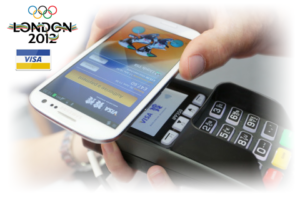
As a part of Visa’s Olympics marketing push for the future of Mobile, a limited edition Samsung Galaxy S III was provided to some Visa sponsored athletes and trialists. The device featured an Olympic-branded version of Visa’s mobile payment application, Visa payWave which uses Near Field Communication technology, or NFC. To make purchases, consumers simply needed to select the Visa icon on the Samsung device and hold the phone to a contactless payment terminal to pay.

It seemed as though Visa had all the pieces in place to make this Olympics a Mobile Payments success; a dominant payment network, including Visa only ATMs positioned throughout the games, NFC-enabled vendors able to take the mobile payments, and spectators with smart phones who could pay via mobile. The only problem was competing against an Olympic veteran of every games, cash.

During Great Britain’s Men’s Soccer match versus the United Arab Emirates, spectators were unable to pay for food and drinks at Wembley Stadium by credit card or mobile payment after terminals went down.  Many ticket holders described the lines that subsequently built up as ridiculous and said a lack of cash machines at the west London ground added to the problem.

A spokesman for Visa was quick to point the finger at Wembley officials, placing the blame firmly on the stadium’s network infrastructure saying, “We understand that Wembley’s systems failed and therefore they were only accepting cash at the food and beverage kiosks.”

Twitter was bombarded with thousands of angry posts from people who found it completely unacceptable that they couldn’t feed themselves. This was due to the fact that the only available way to pay was with old-fashioned cash and coins, a means of payments Visa wanted to push away from with its mobile payment implementation.

In these games, mobile payments did not expand as much as Visa had anticipated.  Add that to the complete network failure at Wembley Stadium and it would seem that mobile payments were a flop at this year’s Olympic Games.  The silver lining however, is that mobile payments did have a huge presence at the games.  And the uproar caused by the network failure seems to prove that we are moving away from cash as a society.  Just a few years ago, credit card terminals going down at the Olympics might not have been such a big story, let alone a trending topic on Twitter.  It seems for the London Olympic Games, cash took the gold medal yet again in payments, but with the doubling of Mobile users here in the U.S. and the increase globally; cash may soon be unseated by mobile payments.

Industry Terms: CVV

This is the latest installment in The Official Merchant Services Blog’s Knowledge Base effort.  We want to make the payment processing industry’s terms and buzzwords clear.  We will eliminate any and all confusion merchants might have about how the industry works.  At Host Merchant Services, we promise to deliver personal service and clarity.  So we’re going to take some time to explain how everything works.  This ongoing series is where we define industry related terms and slowly build up a knowledge base and as we get more and more of these completed, we’ll collect them in the resource archive for quick and easy access.

Card Verification Value (CVV)

In continuing with our E-Commerce focused blogs this week, I thought it would be appropriate to introduce the term Card Verification Value, or CVV. There are two types of CVV codes, called CVV1 and 2, respectively. The CVV1 is embedded in the magnetic stripe of track 2 of a card. The purpose of the first CVV is to verify data stored on a card is valid and was issued by a bank when used in person.

The second and more prominent CVV2 is a three-digit code (Visa, MasterCard) printed on the back of credit and debit cards.  American Express cards have a ‘Unique card code’ that is four-digits long and printed on the front. Discover has a 3-digit code on the back of its cards, but refers to this as a CID (Card Identification Number). These codes are used in card not present transactions occurring over the Internet, or MOTO as an added security feature to prevent fraudulent purchases. The code is meant to verify that the customer has the card in their possession.

Security Benefits

For Merchants:

Merchants requiring CVV2 codes for their card not present transactions can dramatically reduce fraud in their businesses. Using this extra layer of protection can stop breached or fraudulent cards from going through. Avoiding potential retrievals and chargeback fees.

For Consumers:

Entering your CVV2 code when purchasing online products verifies that you are who you say you are. Under Visa regulations, merchants cannot store CVV2 codes in their databases.  This means any card numbers lost in a breach would be less useful. In this sense, a consumer is protected on both sides of a transaction, once when verifying the purchase, and then again in terms of breach or fraud security.