
Tag Archives: The Official Merchant Services Blog

Industry Terms: Payment Gateway

This is the latest installment in The Official Merchant Services Blog’s Knowledge Base effort. We want to make the payment processing industry’s terms and buzzwords clear. We will eliminate any and all confusion merchants might have about how the industry works. At Host Merchant Services, we promise to deliver personal service and clarity. So we’re going to take some time to explain how everything works. This ongoing series is where we define industry related terms and slowly build up a knowledge base and as we get more and more of these completed, we’ll collect them in the resource archive for quick and easy access.

Payment Gateway

Today we will focus on Payment Gateways and how they work, in order to wrap up our week of E-commerce driven content. A payment gateway allows E-commerce merchants to accept credit cards on their websites. Sensitive payment information is encrypted by the gateway to ensure that it passes securely between the customer and the merchant. We have defined a POS, or point of sale system already for the Knowledge Base. A payment gateway can be considered a virtual point of sale system. The gateway acts as a “middle man,” allowing communication between online shopping carts or virtual terminals and the banks processing the transaction.

The process can be broken down like this, it starts when a customer places an order on a website by pressing the “Submit Order” button in an online shopping cart. The payment gateway then forwards the transaction information to the payment processor used by the merchant’s acquiring bank. From there the payment processor forwards that information to the appropriate card association (ex Visa, MasterCard). The credit card issuing bank receives the request, or the Authorization and does the necessary credit or debit check and then sends a response back to the processor in the form of an approval code (ex approved, denied). Next the processor forwards the authorization response back to the payment gateway. After receiving the response, the gateway forwards it on to the website, which then evaluates it as a relevant response and relays the outcome to the merchant and cardholder. Finally, the merchant then fulfills the customers order, then after a batch the acquiring bank receives the funds, and deposits them into the merchants bank account.

Payment gateways can be stand-alone systems designed for integration with other 3rd party systems, or they can be bundled with their own shopping carts and virtual terminals. It’s worth noting that most merchants will not need to install additional software on their own servers to run a basic payment gateway. Some payment gateway providers are simple to implement, but do not offer much customization. Others are more complex but can be customized to your needs.

Host Merchant Services offers a variety of E-commerce solutions to fit your business, including Transaction Central, our own cutting edge in house payment gateway. HMS is able to interface with most of the major Payment Gateways out there, including Authorize.net. We also offer unparalleled protection for all of our merchants in the form of our PCI Compliance Initiative.
 

Durbin Amendment About To Be In Effect

On the last day of September, Durbin Amendment Eve if you will, The Official Merchant Services Blog is about ready to end its Countdown to Durbin Series. Today we take a look at the big news that has the media buzzing.

Bank of America Reacts to Durbin

Bank of America, the largest bank in the country going by deposits, announced it is going to begin charging its customers a $5 monthly fee to use debit cards. The bank will begin charging the fee next year for the bank’s basic checking accounts. It will apply only to debit card purchases and not to ATM withdrawals, online bill payments or mobile phone transfers, the company said.

Consumer Backlash and Cut Up Cards

Bank of America announced this change, which will take effect for its customers in 2012, and were soundly slammed with negative feedback. Our first link comes from Fox Business Network, where Gerri Willis cut up her debit card on the air in reaction to the news from Bank of America. “Right here, right now, I’m going to show Bank of America what I think of their fees,” she said before using a pair of scissors on her card.

Durbin Slams Bank of America

Our next link comes from The Washington Post. It picks up the topic, mentioning what Willis did on the air. It then offers Bank of America’s defense of this new fee, stating that the bank is doing this to recoup losses that will come from the cap on debit card swipe fees that the Durbin Amendment will put into place tomorrow on October 1. Then the article quotes Senator Dick Durbin: “Bank of America is trying to find new ways to pad their profits by sticking it to its customers,” Durbin said in a statement Thursday. “It’s overt, unfair, and I hope their customers have the final say.”

Bank of America Already in Crisis

While this move was quite predictable, and falls into line with Host Merchant Services’ previously published analysis of how banks will react to the Durbin Amendment, the news is quite incendiary because of Bank of America’s current situation. Which is mentioned in the third article we highlight on Bank of America, by Fox News: “the Bank of America decision drew outrage for several reasons. The company is the largest U.S. bank by deposits. And it reaped $45 billion in federal bailout money — receiving the first chunk in 2008 and the rest in 2009 to cope with losses at Merrill Lynch. “

The article also mentions that Bank of America did pay back the government all of the bailout money.

Bank of America a Microcosm of Durbin’s Impact

A fourth article, from the Christian Science Monitor, sums up quite succinctly how this news is quite standard Durbin Amendment fallout: “So in other words, Bank of America is shifting a part of the fee obligation from merchants to customers.”

As we’ve seen in the ongoing Countdown to Durbin series, this is one of the most expected moves that banks are making. Shifting the burden of the fees away from merchants and putting it squarely on the shoulders of the consumers. This avoids the scope of the Durbin Amendment’s regulations and lets the banks continue to reap profits from the billion dollar payment processing industry.

Rounding out the coverage of Bank of America and its announced monthly debit fees we find:

The Chicago Tribune offers a quick glance at Bank of America’s plan here.

The Baltimore Sun blogs to its readers to avoid these types of fees by switching to ATM only.

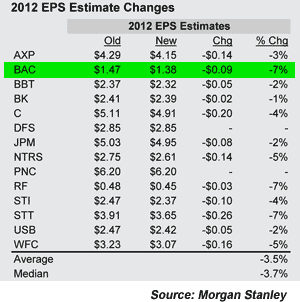
And the final little tidbit we offer you today on the eve of Durbin enactment comes from The Street, reporting that Morgan Stanley cut 2012 earnings estimates for Bank of America and 11 other banks.

This chart, while the story states is not entirely tied to Bank of America’s recent announcement or to the Durbin Amendment, does show that banks will be affected by the Durbin Amendment. They will have to make changes to deal with the losses they expect to take from a hard cap on fees that they were profiting from, and if Bank of America is any indicator, the burden of those changes will go from the merchants who used to get hit with the swipe fees to the consumer who will now have to pay more to support the use of debit cards.