
Tag Archives: payment processing

Rebuttal of RIAA Opinion

SOPA: Rebuttal of RIAA Opinion Pt. 1

The RIAA just won’t quit. They’re taken up the crusade to push for anti-piracy legislation once again, as seen in this New York Times Op-Ed piece titled “What Wikipedia Won’t Tell You” written by Cary H. Sherman,chief executive of the Recording Industry Association of America, which represents music labels. The content of the piece is incendiary, and that’s being kind. The RIAA is adamant about their stance on piracy and are pressing the issue in every outlet they can. To quote Digital Underground from their Sons of the P album — which currently is not available for legal purchase online due to holes in the DU library in various legit digital music resources — “Like Ice Cube says, Once Again it’s On.”

Everyday They’re Shufflin’

The Stop Online Piracy Act and the Protect Intellectual Property Act were both killed in Congress — shelved because they were too wide open to abuse. The protest against these bills reached a collective crescendo when internet giants Wikipedia and Google and WordPress teamed up with a host of others for an internet blackout. When the largest source of internet information — and grade school kids’ favorite spot for help with their homework — goes dark and the search engine juggernaut that fuels the internet shines its spotlight on your bill, things have finally gotten serious. The U.S. citizens took notice of this blackout, and joined the internet in protest. And Congress heard the people and backed off this poorly written legislation.

But that hasn’t stopped the entertainment lobby. They went back to the drawing board and then returned mere weeks later with a new idea on how to combat online piracy. Unfortunately that new idea was the exact same idea as before. This was seen in the wishlist the International Federation of the Phonographic Industry (IFPI) released. The highlights of this list are essentially that the music industry wants pretty much the exact same things that were in SOPA, the same things that prompted the protest in the first place. A list of seven demands, which include the exact same far reaching calls for search engines and payment processors to police websites individually and be responsible to law enforcement for content they are indirectly connected to.

We’ll get back to this, but for now the point is the music industry felt the need to push for the same stuff that killed SOPA and PIPA. And that came right back to the forefront with Mr. Sherman’s opinion article in the New York Times. Essentially the RIAA wants a do-over and Mr. Sherman is here to tell us why that needs to happen.

Come At Me Bro

So today The Official Merchant Services Blog is going to try to put this issue in its place much like Blake Griffin did to Kendrick Perkins recently. Yes, we are going to Posterize the RIAA. Because the op-ed article indicates the RIAA has soft interior defense and can’t play man to man very well at all. First up we’ll start with the relative hypocrisy of Sherman’s ill-timed article found in this contextual relationship: Suggesting Wikipedia isn’t telling people everything, and then making this comment, “They knew that music sales in the United States are less than half of what they were in 1999, when the file-sharing site Napster emerged, and that direct employment in the industry had fallen by more than half since then, to less than 10,000.”

This is hypocritical because Mr. Sherman is leaving out some very pertinent information — which his employees were just recently bragging about on twitter. As we reported on January 31, the RIAA was excited about the IFPI wishlist because it had a series of statistics that showed the music industry is doing well with digital sales. The music industry claims Wikipedia is being deceptive and then suggests that they are still reeling from Napster, which was effectively scuttled back in 2002. They’re making a play for sympathy from an issue that happened almost a full decade ago, and yet they just got finished gloating about how successful they were this year!

Jonathan Lamy, senior VP of Communications for the RIAA, tweeted that paid subscription services rose 65 percent to 13.4 million in 2011. This tweet was in response to figures released by the IFPI which Lamy was excited to read. Lamy also tweeted that paid digital music services are active in 58 countries, generating $5.2 billion in revenues.

And then Cara Duckworth. The VP of Communications for the RIAA also cited the IFPI figures and then said: “W/more than half of all music sales coming from digital services, we know how Internet works. “Music=Innovation. Declare THAT. #CES #SOPA.”

What the RIAA isn’t telling you is far worse than what Wikipedia isn’t telling you. But Mr. Sherman isn’t about to concede facts when the agenda needs to continue to be pushed. The music industry is finally getting the hang of the digital market. Their own people brag that they know how the internet works. Declare that! But Sherman’s still waving the Napster suit in your face trying to claim that Wikipedia is obfuscating the issue.

It gets worse.

Born This Way

Sherman writes, “While no legislation is perfect, the Protect Intellectual Property Act (or PIPA) was carefully devised, with nearly unanimous bipartisan support in the Senate, and its House counterpart, the Stop Online Piracy Act (or SOPA), was based on existing statutes and Supreme Court precedents.”

The only thing in that statement that is rooted in the reality of what happened with SOPA and PIPA is that there was a lot of bipartisan work. Unfortunately, the work was bipartisan unity on finding problems with the so-called carefully devised legislation. Tech industry experts on both sides of party lines found the problems and holes in the legislation. As we reported on December 27, 2011, SOPA sparked unity in the federal government. And as we’ve written in our in-depth analysis, the bill was not very carefully devised at all. In that analysis we lean heavily on discussion from Congresswoman Zoe Lofgren [D-CA], an expert in the tech industry. We’ll highlight just a bit of Lofgren’s criticism of this bill, with questions raised: “Section 103 also allows a “portion of” a website to be deemed “dedicated to the theft of U.S. property,” regardless of the culpability of the website as a whole. Like many important terms throughout H.R. 3261, the precise meaning of these words is ambiguous, and will require years of expensive litigation to clarify. However, the plain meaning of the words seems to indicate that any large website could face a risk of termination by payment and advertising providers based solely upon infringing material contained in a single web page. 

This is not carefully devised legislation. And as we eventually reported, the bill’s own sponsor admitted he did not fully understand the technical aspect of the bill and he backed off of it. Bill sponsor Lamar Smith is quoted in various media sources as saying:  “I have heard from the critics and I take seriously their concerns regarding proposed legislation to address the problem of online piracy. It is clear that we need to revisit the approach on how best to address the problem of foreign thieves that steal and sell American inventions and products.

To Be Continued

payment processing

Payment Processing News Roundup [2023 Update]

Today The Official Merchant Services Blog is going to give you a roundup of the latest news that is affecting merchants and payment processing. Our goal is to keep you informed and up to date on all the important news developments in the industry. Armed with that information you can make the decisions and the moves to keep your business ahead of the curve. The news roundup today focuses mainly on The Durbin Amendment and its continued impact on consumers, merchants and processors. The Durbin Amendment will continue to have a major impact on processing throughout 2012, and we’ll continue to keep you abreast of the topic.

Durbin Reactions

The first story we bring you is from the Los Angeles Times and it’s about the fallout from the Durbin Amendment. The article, found here, states that by the end of last year 610,000 U.S. bank customers switched to a switched to a smaller institution to protest plans by major banks to impose monthly charges for using debit cards. The article says the data was reported by Javelin Strategy & Research in a report and that the 610,000 figure represented 11% of the overall 5.6 million people who switched banks in that time period. The article also noted that: “In addition to the 11% who joined the Bank Transfer Day movement in October, November and December, an additional 26% told Javelin that they switched not as part of the protest movement per se but because the banks charged too many fees.”

Host Merchant Services Predictions Confirmed

The next news item we’re reporting is from The Denver Post. In this article the Post reports pretty much exactly what Host Merchant Services predicted would happen in its Durbin Amendment Analysis article.

The Denver Post writes: “Instead of one new fee, prepare to be sold more products, offered new services, lose rewards and face more fees in general.”

In the HMS Article from 2011, we wrote: “Merchants will end up having to shoulder the burden of the extreme cuts in revenue that this cap brings. Those who predict that merchants will end up worse off by the amendment suggest that the banks, not wanting to take a $9 to $10 billion dollar loss in revenues for the year, will simply add fees to other payment options or get rid of premiums and extras that they had been offering merchants prior to the cap being put in place.”

So essentially the Denver Post reports that the banking industry is reacting as expected to the Durbin Amendment. We even did an entire blog making the statement that the banking industry was going to go in stealth mode like a ninja.

The Denver Post article also gives a recounting of the tale of the Durbin Amendment as it took center stage in the media spotlight. This entire tale was chronicled as it happened by The Official Merchant Services Blog both in its Countdown to Durbin Series, as well as its ongoing Durbin Coverage after the October 1, 2011 date that saw the bill’s provisions begin. The Denver Post recap is succinct and states: “Several other banks already had either imposed debit card fees or were testing them, and analysts had predicted the trend would spread to the entire industry. But BofA’s plan, which leaked out at the end of September, produced an enormous surge of criticism. Protesters from the Occupy movement, consumer advocates and even President Obama questioned the move, and an online movement called Bank Transfer Day emerged to encourage people to switch to small  banks and credit unions. Bank of America ultimately called off its plans without imposing the $5 charge, and the rest of the industry followed suit in allowing fee-free use of debit cards.

Durbin Going Bye Bye?

The final piece of Durbin-related news comes to us from payment processing review site cardpaymentoptions.com. In this article, they give an extensive roundup of their predictions for 2012 — and one piece is sub-titled “Durbin May Get the Boot.” The article states the Durbin Amendment was originally designed to help merchants deal with high swipe debit card transaction fees, but now that it’s been in effect merchants are feeling the legislation has harmed them. The article specifically cites merchants getting hit with much higher for small ticket transactions — a noted loophole in the law that many media sources criticized while the amendment was still being discussed by Congress.

The article then makes this bold prediction: “Several retail organizations have brought suit against the Federal Reserve in order to repeal/modify the amendment and even the main author, Dick Durbin, has admitted the new law is flawed. With such disastrous results, merchants should expect to see the Durbin Amendment either repealed or greatly modified this year.”

The Official Merchant Services Blog has reported on a few of these suits as they’ve come up. And the backlash against Durbin has been significant. But with the election about to be in full swing it seems, to us at least, that the Durbin Amendment may continue to kick around for 2012. In fact, we’ve also reported that there is growing interest in a similar cap on credit card processing fees, swinging things even further in a direction that will burden consumers and incur ire with the banking industry. It just seems like it will be a lot more difficult to get rid of Durbin after it’s started and that the path of least resistance for Congress on this issue will be to continue to add to the law with more tweaks and changes, making it even murkier and over-legislated. That’s more the federal government’s style.

What do you think? Will 2012 see the end of the Durbin Amendment and the great experiment that was finance reform for payment processing fees? Or will the federal government just try to keep working with the law they have in place trying to smooth it out?

Durbin Amendment Back In the News [2023 Update]

The Official Merchant Services Blog returns to a topic that it covered thoroughly throughout 2011: The Durbin Amendment. With the Stop Online Piracy Act getting most of the headlines lately, Durbin Amendment’s continued impact on the payment processing industry has gone into stealth mode. Until today that is. Stick with us as we offer a whirlwind roundup of all things Durbin related.

Bank of America Took a Beating

We’ll start off our tour Durbin tidbits with this article by ABC News. Apparently Bank of America took a substantial hit from their plan to charge $5 per month to use debit cards. According to the article: “Bank of America’s failed plan to impose a $5 monthly debit card fee led to a 20 percent increase in closed accounts in the last three months of 2011 and a public relations headache.”

The article quotes Bank of America CEO Brian Moynihan as saying, “yes, we had some impact from the $5 debit fee. That’s why we made a decision to reverse it.”

It wasn’t all bad news for Bank of America though, as the bank reported earnings of $2 billion in the last three months of 2011, up from a net loss of $1.2 billion in the same period a year ago, boosted in part from a one-time gain on the sale of China Construction Bank.

Small Lenders Strike it Big

The next little bit of Durbin aftermath comes from this article by NACS online. As was seen in the Host Merchant Services in-depth analysis of the legislation, The Durbin Amendment only applies to lending institutions with assets over $10 billion. Smaller banks and credit unions are exempt from the Durbin Amendment. As a result of being exempt, a Wall Street Journal report cited by the NACS article states that these institutions have been “collecting fees that are often three times those imposed on cards by large banks.” 

For comparison, the article says: “The WSJ notes that a $100 sweater purchased with a debit card would incur a fee of 95 cents on a card issued by a smaller bank and only 26 cents for those issued by big banks. “

The article also suggests that banks face further uncertainty by April 1, 2012, when “all U.S. banks and credit unions must offer retailers more choices of companies used to process debit card transactions, a move that is expected to lower interchange fees further.”

New Target: Credit Card Swipe Fees

Time Magazine Online Feature Moneyland reports something that Host Merchant Services has already touched on before in The Official Merchant Services Blog — that Credit Card Swipe Fees may be the next target of legislators and financial reform. From the Time article: “There’s another interchange fee fight in the offing — this time over credit cards. According to CNBC, equity analysts who cover the financial sector have expressed worry that ongoing litigation involving several major banks could lead to a cap of 0.5% on credit interchange fees — one-fourth of what’s currently charged — potentially dragging down bank earnings. If that happens, consumers who are used to generous credit card rewards programs complete with double miles, accelerated earnings, and big sign-up bonuses might get a rude awakening.”

The Official Merchant Services Blog on December 13, 2011 covered the topic of a Credit Card Swipe Fee. In that blog we wrote: “the plan would end up working much like the Durbin Amendment has worked. Where the idea of reform would get overshadowed by how banks and credit card companies reacted to the law. There would be some shifting, so in that sense the reform would cause change. But that eventually the burden for paying for any losses that banks and credit card companies get forced into through reform would end up squarely on the shoulders of the consumers.”

The Time article notes something that Host Merchant Services already pointed out regarding a Credit Card version of the Durbin Amendment — Banks would take another huge hit because Durbin has language that freed up banks and merchants to market and promote options to the consumer directly. In short, Durbin’s language freed merchants up to promote credit over debit. And because of that, a lot of merchants did just that as Banks offered new programs to make credit the more attractive choice. Subsequent changes that would now penalize Banks for doing that would create a lot of negative momentum for Banks and added onus for consumers who get stuck with no good choices overall.

New Hampshire Law

This article from credit.com reveals that one state legislature is already making moves to see a Credit Card Swipe Fee Cap become reality. As the article states: “A piece of legislation introduced in the New Hampshire House of Representatives, House Bill 1319, has drawn some attention for the way in which it would drastically alter the credit card landscape between businesses and payment processors. The law will limit the amount banks chartered within the state are able to charge businesses for processing credit card transactions to just 1 percent of the total purchase value.”

The article goes on to state that many businesses pay costs that range from 0.67 percent of the transaction’s value to 4.76 percent and that a MasterCard spokesperson told the Nashua Telegraph that the average 1.75 percent.

Cash Still Rules Everything Around Me

Our last news brief on the topic of the Durbin Amendment and swipe fee caps is a little different. This article from the Huffington Post shows a study that reveals cash is still king. The gist of the article: “More than three-quarters, or 79 percent, of consumers said they made a cash purchase in the last seven days, according to a report released on Tuesday from Javelin Strategy & Research, a market research group for financial services. Compare that to about 65 percent of credit and debit cardholders who say they swiped their plastic in the last week.”

The article suggests that this is a consumer reaction to card swipe fees. The article states that consumers are choosing to pay for items with cash to avoid fees on small, everyday purchases. The convenience of plastic gets overrun by the savings consumers perceive they get from going back to cold, hard cash. The study indicates that cash is replacing debit for small purchases, and credit is replacing debit for big purchases and the Durbin Amendment’s lasting legacy may simply be that it pushes Debit out of the consumer’s arsenal of payment options.

Finding Quality Merchant Services [2023 Update]

Today The Official Merchant Services Blog is playing a bit of catch up. The story we’re going to highlight and discuss is almost three weeks old. It was intended to run earlier, but technical difficulties with the blog’s production kept it from appearing until now. However, we feel the story is still worth some attention due to the issue it highlights about the payment processing industry.

The story comes to us from a Chicago, IL section of the Better Business Bureau (BBB). This article from the BBB says that the organization has seen a 42% rise in complaints against credit card processing services. The article, which originally was posted by the BBB on December 15 found that complaints were up for the 12 month period in 2011 compared to the previous 12 months. The breakdown was specifically 110 complaints in the recent 12 month period versus  77 complaints in the period prior.

Not Just In Chicago

The complaints aren’t just lodged in Chicago. This article from Fox40.com details similar complaints in Sacramento, CA. The article states: “The Better Business Bureau is warning businesses to beware of sales pitches by credit card processors that don’t reveal key details that could end up costing business owners more than they bargained for.”

And it quotes Caitlin Peterson of the Better Business Bureau of Northern California as saying “We’ve had over 1,700 complaints this year against the merchant processing business.”

What the Problem Is ?

From reading through the two articles — as well as an older BBB article about issues in the St. Louis, MO area — the problems that merchants are encountering are really straightforward. Business owners are being approached by salespeople offering big savings on their payment processing. And then once the merchant signs a contract with that person, they are saddled with hidden fees for services they were not told about. In short, the business owner is led to believe they are getting a great deal but end up having to pay out more because of all the things not mentioned in the deal. So complaints against payment processors rise in select areas.

Pricing and Transparency

This type of behavior is the exact reason Host Merchant Services utilizes its philosophy of Interchange Plus pricing and no hidden fees. These types of issues are why CEO Lou Honick says “Host Merchant Services is about bringing trust to the payment industry.”

“Payment processing is confusing,” says Honick, noting the ease in which merchants can get saddled with the types of issues that have cropped up with the BBB complaints. “The big guys make it difficult to understand exactly what your rate is and what fees are associated with accepting credit cards. We deliver personal service and clarity. Our people care about customer service and will take the time to explain how everything works.”

Honick also cites the process that Host Merchant Services uses to directly counter the problems that business owners encounter with other processors: “We believe that when you get your statement every month, you should understand every item, and it should match what you were promised in the sales process. If you have a question, there is a live person at Host Merchant Services ready to assist you.”

The Details

One of the primary ways Host Merchant Services combats the practices that lead to these complaints is with their pricing structure. Host Merchant Services uses Interchange Plus pricing instead of the more standard tiered pricing format. Interchange Plus makes statements easier to read, customer service easier to provide to merchants, and savings much easier to guarantee. Here’s a small graphic explaining the basics of how Interchange Plus works:

You can review a comparison between Host Merchant Services Interchange Plus pricing — which is simple and transparent — and the tiered pricing plans that other processors use in a two-part blog series that The Official Merchant Services Blog ran in October, 2023.

  • Part One
  • Part Two
  • Follow Up

What the BBB Advises ?

The BBB advises merchants take these steps to avoid getting stuck with the issues that their complainants have encountered:

Ask around.

The BBB suggests getting at least three estimates from different Payment Network Providers and to checkout he BBB Business Review of the merchant processing service. They also suggest asking fellow business leaders for referrals.

Know where to turn.

The BBB advises you check up on the support team that a potential Merchant Services Provider offers you. Can you contact them 24 hours a day? What is their response like outside of typical business hours? And the BBB advises you make sure their technical support can handle your needs as that kind of support is vital to your business’ success.

Try them out.

The BBB says that you should not settle without a trial period. You should make sure that the payment processor you choose has a 100 percent money-back guarantee before selecting them. Make sure their service works for you, and make sure they keep their promises to you.

Don’t get locked in to a long term contract.

The BBB is very clear on this. Never commit to a long term agreement that locks you in. Make the merchant services provider earn your business each and every month.

Get references.

The BBB advises that you get the payment processor to provide you with references. And then suggests you spend some time checking up on those references.

Make sure you know what you’re being charged for.

The BBB says that if you have a question regarding a fee that you were charged, ask the merchant services provider. Don’t let them hide fees on you. Make sure you understand your statement.

How Host Merchant Services Stacks Up 

Host Merchant Services falls in line with what the BBB advises merchants to do. The company places a big emphasis on transparency. Their salespeople will explain a merchant’s statement in detail. One of strengths of the offering from Host Merchant Service is their guarantee to save a merchant money. They achieve this by a statement analysis. Not only will Host Merchant Services explain the details of what your statement and fees are, completely transparent, while you process with them, they’ll also explain where the hidden fees are with your current statement.

Host Merchant Services will provide references. They do not lock you in to a contract. They do not charge you a termination fee. They provide free equipment and free paper for your terminals. And they offer 24-7-365 customer service where they guarantee you will talk to a real person that will help you out with your issues. You can even initiate a live chat with HMS Support right from any page on their web site.

As Host Merchant Services COO Dan Honick says, “You stay with us because you’re happy.”

A Look at VeriFone’s Vx Evolution

The Official Merchant Services Blog has been covering the basics of payment processing, offering insight and tips on the general topics of the credit card and debit card transaction industry for merchants. Today we’re going to go a little deeper, and delve into a nuts and bolts topic: payment terminals. This kicks off the first two-part series where we shine a spotlight on specific terminals that are available to merchants. After the first two-parter, we’ll occasionally revisit the topic of terminals and look at offerings from other terminal manufacturers.

Keep in mind that Host Merchant Services offers free terminals to its merchants, so reviewing what’s available and finding the terminal that fits you best can create a lot of savings on your processing bottom line in the long run. Our first spotlight shines on terminal manufacturer VeriFone, specifically the Vx series.

The Vx Evolution

VeriFone offers a series of terminals on its Vx Platform that have been slightly rebranded as the Vx Evolution. The terminals are being marketed under this evolution tag as being proven, advanced and evolved. What that boils down to is a new look with some upgrades to a line of terminals that have a history of working and working well.

VeriFone lauds the Nine Advantages of the Proven Vx Platform:

  • The Verix system that the terminals use has a decade of proven use.
  • The terminals maximize communication, speed and flexibility, support value-added transactions and deliver multi-app capability that essentially enables applications to securely co-exist on the same device.
  • A seamless transition for the next generation of the line, letting you continue to run the hundreds of existing applications that work on Verix.
  • The worldwide use and support for the popular Vx platform.
  • The lack of obstacles for platform switching, making it quick and easy to get started on a Vx platform terminal if you switch from another brand.
  • The Vx series of devices is idea for virtually any vertical market or end-use scenario.
  • The enhanced toolkit, clear guidelines and helpful documentation let users quickly build solutions based on Vx Evolution’s core technologies and capabilities.
  • The intuitive user interface helps the Vx platform get deployed quickly.
  • The ARM RealView Developer Suite (RVDS) 4.0 Complier helps you compile your applications with the Verix eVo Toolkit.


You can review those advantages in a downloadable PDF found here.

The Other Two Benefits of Vx

VeriFone also is lauding two other advantages for its Vx Evolution of terminals: speed and security.

The Need for Speed

According to VeriFone, the Vx Evolution delivers secure payment processing eight times faster than its competition. It claims it can do this with a superior single processor that outperforms dual processors that competitors use. Using the metric of MIPS –– Million Instructions Per Second –– this graphic shows how VeriFone’s 500 MIPS ARM 11 processor works:

Essentially what VeriFone is saying is that competitors use a 450 MIPS processor to run applications and a second 50 MIPS processor to handle critical security tasks. They claim this slows down secure transactions to 50 MIPS. But VeriFone, with its Vx Evolution brand, utilizes a built-in, integrated security processor. It’s running at 500 MIPS for everything –– applications and security.

You can fully review VeriFone’s documentation on speed by downloading a PDF about it here.

Staying up to Date on Security

The next advantage VeriFone is lauding its Vx Evolution brand with is security. This is of particular interest to The Official Merchant Services Blog because we’ve written in the past about PCI Security Standards. In fact, we took a close look at a study by Verizon that showed 79% of merchants surveyed were not fully compliant with PCI DSS standards.

Host Merchant Services offers a free PCI analysis for merchants and makes PCI Compliance a priority for its merchants. Which is why the Vx Evolution brand is noteworthy.

According to VeriFone their Full Spectrum Security package –– which is standard with all of its Vx terminals in the platform –– gets their terminals up to PCI PED 2.0 standards. So Host Merchant Services, in its push to keep all of its merchants compliant year in and year out, embraces the Vx platform of terminals that are stamped with the PCI PED 2.0 Approved seal.

At a time when many merchants are having issues maintaining the old PCI security standards, the VeriFone terminals are stepping up their game and making it easier for merchants to maintain the new PCI compliance standards. This lets Host Merchant Services merchants stay compliant moving forward and gives HMS a leg up in its initiative for quick, easy, and worry-free PCI Compliance.

You can read more about the security benefits of Vx Evolution by downloading a PDF here.

To Be Continued …

In the next part of this series, we’re going to look at the terminals themselves and see how they apply those Nine Advantages VeriFone has lauded.

In the meantime, what do you think of this branding? Have you used any Vx terminals? In the past? In the present? Let us know.

Merchant Services: Statement Sleuth

The Official Merchant Services Blog is here to share information with merchants to get them better prepared to understand how the payment processing industry works. This premise stems from Host Merchant Services and its philosophy to bring trust to the industry.

Payment processing can be confusing. And nowhere is that more evident than in a merchant’s processing statement. One of the ways some processors make their money is by hiding fees within the arcane labyrinth of a monthly statement, making the fees and the numbers difficult to understand.

Host Merchant Services believes that when one of its merchants receives their statement every month, that merchant should understand the items on the statement and that the fees should match what was promised in the sales process.

So in an attempt to help everyone understand that process better, The Official Merchant Services Blog is going to shine a spotlight on statements and see what there is to see.

What Is a Merchant Statement?

Every month, you receive a Merchant Statement from the company that processes your transactions. These transactions include Debit and Credit Card Transactions. This statement summarizes your net sales for all the cards that you process. It also provides your monthly transaction volume as well as provides you with an itemized list of your daily transactions. You can also see the majority of your debit and credit card processing fees. This is where we’re going to shine the spotlight, as this is where fees get hidden. Your fees on your statement include:

  • your transaction fee
  • your monthly discount rate for your Credit Cards
  • your monthly terminal fee (if you do not own your credit/debit card machine).
  • your Interchange charges
  • any chargebacks
  • third-party transactions
  • credit adjustments

The tricky part about these fees is that each company assembles their statement in a different way. Each payment processing provider has a unique statement layout structure, so most of the characteristics of the statement are the same but are put there in a different order. It forces merchants –– especially those who have used more than one processor in their time in business –– to do all of the eagle-eyed investigating themselves.

We’ll stick to the basics and then when that’s done, we’ll take a moment to explain why Host Merchant Services might be a little less confusing than other Payment Network Providers.

Card Deposit Summary

It’s pretty common for the Card Deposit Summary to be prominently displayed in a merchant statement. A lot of times it’s the first item a merchant will see on their statement. The phrasing may be a tad different –– perhaps it’s called a fund summary –– but for the most part it’s the opening line on each merchant services provider’s statement. The summary tends to include a laundry list of statement data, such as:

  • Amount of transactions incurred in that month
  • The dollar amount of those transactions
  • What credit cards were used
  • Any discount or coupon usage charges

Often this information is presented as individual daily line items, but some payment processors may combine all the data into one section.

Credit Card Fee Summaries

After the deposit summary information, most statements provide some sort of variation of how much the credit card issuer charged per transaction. This is usually called the Summary of Card Fees. As we explained in a previous blog series, a lot of payment processors offer a tiered pricing plan. And this is the section of the statement where you will see fees being charged for “qualified transactions.” That term specifically relates to your qualified tier in the pricing plan you signed up for. This section should include any fees, discounts and rates applied to transactions made through your merchant count. Most payment processors provide a complete list of card fee categories in this section, since qualified and non-qualified pricing tiers differ. Also included should be a listing for gross sales amounts per credit card and any fees and discounts applied to specific card transactions.

Transaction Fees

This section is an extension of the Summary of Card Fees section. This section lists each fee related to card transactions in dollar amounts. This can be a daunting section to sift through as the terminology used in this section is extensive. There is no shortage of card fee categories, and you’ll see chargebacks and batch header fees and ACH return fees mentioned here. This is why Host Merchant Services says payment processing can be confusing. The statements sometimes overwhelm merchants with tiny fees and cryptic buzzwords. Within that morass, the black hat companies will hide fees that some merchants aren’t aware they are paying or –– even worse –– aren’t aware they don’t even need to pay.

No Hidden Fees Guarantee

Now that some light has been shed upon the statement, and we can see where the fees get hidden and where the confusion takes place, it’s time to take a look at a much simpler way of doing this: Host Merchant Services offers a processing plan with no hidden fees. The company offers its merchants an Interchange Plus pricing plan. So right off the bat, there are no tiered pricing plan issues, so its merchants are not hit with “non-qualified” tier penalties and fees. Host Merchant Services also eschews a long-term contract. So there is no application or set up fee. No annual fee. No Non AVS Adjustment fee. Host Merchant Services does not penalize you with termination fees. Host Merchant Services also does not lock its merchants into contracts for equipment. The company provides free equipment, including free terminal paper. The prices that the company quotes during the application process are grandfathered, and will not increase at all during the lifetime of the business relationship.

It’s a simple and straightforward plan, really. Host Merchant Services shows you exactly what you will be charged on your monthly statement. The company has swept away many of the added charges that other companies hide on statement fees. And then the company sticks to the plan they quoted its merchant. The company will be happy to review your statement and help you find areas where you can save money each month.

Host Merchant Services Click Here Button

For more information contact the company here.

So monthly statements may be extremely confusing –– to the point where one thinks it is being done on purpose. But using some of the guidelines put forth here, or using Host Merchant Services itself, you can find your way through the puzzle that is payment processing.

The Allure of Credit Cards for Holiday Shopping

With the Holiday Shopping Season fast approaching –– Black Friday is 11 days away, Cyber Monday is 14 days away –– the payment processing industry is still getting the last pieces in place for a brisk rush in the use of credit and debit cards. The Official Merchant Services Blog continues its series focusing on the impact the holiday shopping season is going to have on both the e-commerce industry and merchant services in general.

The battlefield is set between Debit cards and Credit cards. Debit cards received a huge boon from the federal government in the form of a cap on interchange fees that went live on October 1, 2011 in the form of the Durbin Amendment. This cap restricts the interchange fees that can be applied to Signature debit card transactions. The cap restricts the charge to between 21 and 24 cents per transaction. This is a huge cut from the previous average of 44 cents per transaction, and presents debit card transactions as an attractive option for merchants to start accepting right as we slip into the big holiday shopping rush.

That has left Credit card issuers scrambling for a response, trying to stay competitive and keep consumers answering “Credit” at the checkout line.

This Reuters article suggests one of the big campaigns that credit card issuers are going to push this year is a significant raise in rewards programs for their customers, tempting them to choose credit as their swipe of choice to get access to those sweet sweet rewards. A focus on cash back and travel rewards push the right buttons for consumers while holiday shopping.

A Look At The Numbers

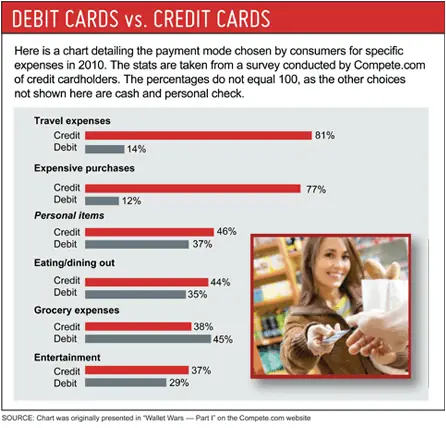
Here’s a small chart detailing the dichotomy between debit card usage and credit card usage from consumers in 2010:

The chart breaks down the chosen method of payment among a survey of credit card owners from 2010. Key numbers to note are the Travel category –– which is dominated by credit card use. It is unlikely that the Durbin Amendment and its changes are going to really affect that sector. But looking at the category listed as “Personal Items” –– which would tend to be the category for holiday gift purchases –– you’ll see a much tougher competition between the two transaction choices. This is where the Durbin Amendment changes to debit card swipe fees are going to have a large impact. And this is where the juicier cash back rewards have credit card issuers hoping they can keep things competitives.

According to the Reuters article: “For example, both Chase (CCF.A) and Citibank C.UL have cards that are offering new applicants $200 in cash back after they spend $500 on their cards.”

You Have to Dig to Find the Best Deals

Some of the best deals are not always displayed in easy to find places. The Reuters article cites a Citibank deal. On the Citi website it advertises the deal as $150 cash back on your first $500 of purchases. But then if you dig deeper by google searching “Citi Dividend $200” you find the better deal directly.

Making it Work For You

The really effective strategy to maximize these deals is to combine them with other deals you will be hit with during the holiday shopping season. The Reuters article notes: “Some cards (such as the Upromise card) have their own shopping portals that combine their rebates with rebates from merchants. In other cases, you can use your rewards points directly for holiday shopping; American Express (AXP.N) awards can be paid directly to Amazon for purchases, for example.”

This type of deal stacking gives consumers a lot of shopping incentive to choose credit as their swipe choice.

A Different Kind of +1

The Official Merchant Services Blog takes a moment to look at a transition in marketing strategies that is extremely relevant to small business : Postage. The United States Postal Service announced this week that it is going to raise its postal rates. Most notable is the cost of the first class stamp is going up one cent from $0.44 to $0.45.

Some other drastic changes are being investigated as well, as cited in that article from Reuters: “The Postal Service has asked Congress for permission to drastically overhaul its business, including cutting Saturday mail delivery and eliminating a massive annual payment to prefund retiree health benefits. The agency also is studying thousands of post offices and processing facilities for possible closure.”

Digital Over Direct Mail

This change is indicative of a shift in how the country does business. And it’s not really all that surprising. The USPS has to react to more than just competition from Federal Express and UPS. Businesses are thriving on the internet. And that makes using more traditional means of marketing –– i.e. print-based marketing –– too little bang for a business owner’s buck.

Which brings us to this interesting article from Multichannel Merchant that suggests that suggests that the postal rate increase is going to cut into the amount of printed materials that businesses mail –– specifically catalogs. Printed direct mail marketing materials, in my experience, have always had a really low impact with customers. Catalogs were usually stronger than other direct mail marketing pieces, for sure. But overall junk mail is called junk mail for the very reason that people ignore it. You send out thousands of direct mail items and are hoping to get dozens of responses, if you’re lucky. So things were already looking bleak for the future of direct mail marketing strategies.

The 2012 postal rate increase only furthers things a long right at the time when internet based marketing strategies are becoming very user friendly for just about everyone.

Social Media Plus One

Social Media can have a much stronger impact with your customers when utilized properly. And there are a lot of easy-to-find resources to help small business owners take advantage of Social Media. Getting tips on how to best use Facebook Ads and Google Ads and Twitter feeds to reach customers organically and generate strong responses to your business and its activities. Host Merchant Services provides some of those resources itself. This very blog is designed with the intent of reaching out to our merchants to help keep them on top of trends and news that help their business thrive. The company also provides an article archive on topics related to the industry so merchants can understand processing better. The company actively keeps its Facebook presence updated. It’s all part of the goal of reaching out to our merchants to help their business run better. The company also provides e-commerce solutions and social media and marketing advice and analysis for its customers. Beyond just the marketing aspects, Host Merchant Services is here to provide its merchants the assistance they need for their e-commerce opportunities.

So take this 2012 postal rate increase as a sign of how marketing for your small business now exists in a very different environment, and you have an opportunity to reach out to customers with the money you don’t give the USPS. You can reconsider reaching out via direct mail and focus on reaching out to your customers through facebook, twitter, your own site and blog, or any combination thereof. At the very least you’ll avoid those higher postal rates, and should be able to drum up just as many points of contact as your mailers were generating.

Print Still Has Its Place

Keep in mind, this isn’t a suggestion to go completely digital. You don’t have to abandon print-based marketing strategies. But you can certainly give serious consideration to adjusting how much you budget for them. If the price increase isn’t worth your money, you can scale back and focus your efforts and resources on something web-based. Use the postal rate increase as a catalyst for boosting your businesses’ e-commerce. Sticking to the most basic plan:

  • You can have your business online, with a website.
  • You can offer your products online, with a catalog.
  • You can process transactions online, through your website and its catalog.
  • You can use a merchant services provider like Host Merchant Services, to handle those transactions.
  • You can then connect to customers and potential customers through social media services like Facebook or Google Ads or Twitter.

From the Multichannel Merchant Article: “Deb Dyer, vice president of marketing for bedding merchant Cuddledown, says the rate increase “won’t keep us from sending catalogs to our house file or prospects, but it will make us look at other digital prospect opportunities and programs.” “

Information Flows Digitally Now

And that’s really what the postal rate increase is most likely going to do for a lot of other merchants. Give them the perfect opportunity to explore the powerful tools they have at their disposal with social media and e-commerce solutions. To put it in perspective, as I was reading the article I link here from Multichannel Merchant, my eyes were drawn to the Facebook “Share” button, Google “Plus One” button and Twitter “Tweet” button that were all conveniently placed on the left-hand side of the article. It’s all right there. One click and you can get yourself involved in a whole new marketing plan for your business.

In short, a lot of people have stopped getting their news from print media. They ignore direct mail sending it to the trash as junk mail. But they’re still consumers and you can reach them with well executed social media marketing strategies. The United States Postal Service is just reminding you that you have this option, albeit indirectly.

Tiered vs. Interchange Plus Part 2

The Official Merchant Services Blog continues it’s two-part series on Tiered Pricing vs. Interchange Plus. After yesterday’s blog defined what Three-Tier pricing looks like, we now take a closer look at how it falls apart and does not save merchants money. Then we’ll outline Interchange Plus pricing and highlight why Host Merchant Services uses this plan to save its merchants money.

Where the Problems Occur

The three tiers of a typical Tiered Pricing plan are commonly referred to as rate buckets or buckets. And Merchant Service Providers who use tiered pricing structures for their customers utilize a “qualification matrix” that dictates which rate bucket the various interchange categories will qualify to. That means that the fees can shift from month to month as a merchant consistently fails to meet the “standard” transaction of the Qualified bucket. Thus each month they consistently have to pay surcharges from the other two buckets which aren’t adequately displayed or described on their statement.

And because these fees and surcharges from the other two bucket rate tiers are often hidden, that makes it difficult to accurately compare rates and fees from competing providers unless a merchant knows how each provider will be qualifying those categories. Because the categories aren’t directly comparable and because the qualification matrix can shift fees on a merchant from month to month, a common occurrence is a merchant can look at two separate tiered pricing offers from different Merchant Services Providers that look nearly identical because they use the same language for each tier, and yet could be different by hundreds of dollars each month.

Merchants Have to do the Hard Part

This puts the responsibility squarely on the shoulders of the merchant. They need to read the fine print of their statement and understand the subtle differences between the tiers to note when they get shifted to a different tier. This is the most common way Merchant Services Providers make money. The sales pitch when signing the merchant focuses on the low end bucket that saves the customer the most money. But then once the processing starts, buckets shift and the merchant gets a lot more charges than they initially signed up for.

So if your statement shows that you have a lot of mid-qualified or non-qualified surcharges each month, it’s time to consider switching to Interchange Plus, the pricing structure that Merchant Service Providers like Host Merchant Services offers.

The Advantage of Interchange Plus

Interchange Plus pricing is based on the “interchange” tables published by both Visa and MasterCard. At first that may seem like a daunting pricing plan. But it ends up being a lot easier to understand, completely transparent to the merchant, and less expensive than tiered pricing plans. Interchange plus pricing has the merchant pay the exact interchange fee from the tables in addition to a flat markup fee from their Merchant Services Provider. That’s where the name comes from: It’s the Interchange fee Plus the markup fee. This eliminates all of the hidden fees you would find in a tiered pricing plan. And gets rid of surcharges that merchants would incur for transactions that don’t fit the standardized portion of the rate bucket matrix. You pay what you are told you will be paying.

This makes it less popular than tiered pricing plans where Merchant Services Providers can make quite a bit of money off of those surcharges due to the latitude they have in defining their tiered bucket rates. But Interchange Plus makes statements easier to read, customer service easier to provide to merchants, and savings much easier to guarantee. All of those elements are cornerstones of Host Merchant Services. So Interchange Plus is the best fit for the company and for their customers.