Tag Archives: payment gateways

FitPay: A Truly Wearable Payment Option

In the fragmented world of mobile payments, one company is taking advantage of unifying existing technologies for the benefit of shoppers.

FitPay is a California company that was envisioned by veterans of the mobile payments industry. This innovative tech firm has paid close attention to shoppers who have been largely underwhelmed by “contactless” mobile payments powered by the near-field connectivity (NFC) chips found in select smartphones.

Tech giants from Apple to Google to PayPal have attempted to disrupt the mobile payments scene through various methods. Digital wallets, NFC smartphones, and even key chain fobs have not become ubiquitous, and one of the reasons for the lack of widespread adoption is that major tech firms are trying to establish a new standard of payment instead of leveraging existing technology.

FitPay sees a problem with coming up with a new payment standard. When it comes to transactions at the cash register, the United States has proven to be averse to change. One clear example of this aversion is the implementation of the Europay MasterCard and Visa (EMV), which is not moving along as swiftly as industry analysts expected.

FitPay: Taking Advantage Of The Emerging Technology

FitPay: Taking Advantage Of The Emerging Technology

Instead of coming up with yet another new payment system, FitPay is taking advantage of two technologies on the rise: wearable smart devices and EMV terminals. The company has developed an API with a corresponding SDK that can marry credit and debit cards to wearable devices such as smartwatches. Part of the strategy is to give shoppers a functional enticement to wear their smartwatches by allowing them to make payments at EMV terminals.

The idea behind being able to pay with smartwatches and other wearable devices is that many shoppers do not feel comfortable taking out their smartphones at the checkout lines. With smartwatches, however, they are already wearing the device loaded with a credit or debit card that they can use anywhere an EMV system has been implemented. This new and exciting contactless payment platform is scheduled to launch in November, just in time for the busy holiday shopping season.

What Are Wearable Payment Options
What Are The Wearable Payment Options

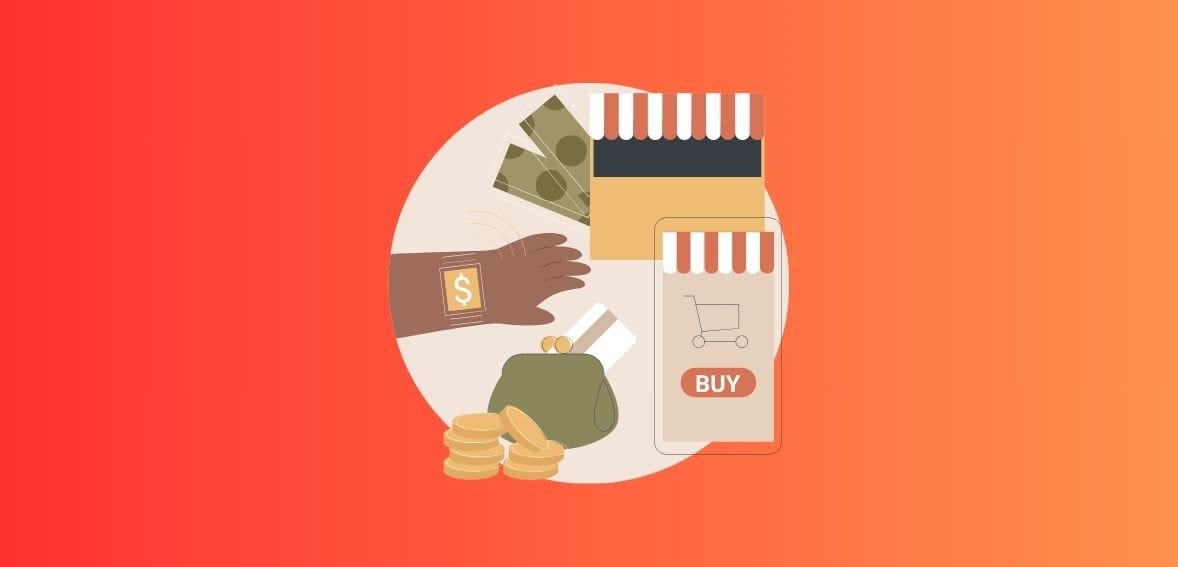
Well, it’s pretty straightforward. A wearable payment option refers to using devices that you wear on your body to make payments without needing cash or cards. These devices can come in forms like smartwatches, fitness trackers, bracelets, or embedded chips in clothes or accessories.

The way these wearable payment options function is through a technology called near-field communication (NFC). By connecting your device to your bank account or credit card information you can securely transfer money with a tap or wave of your wrist. This removes the hassle of rummaging through wallets and purses to find the card while waiting in line at a store.

One of the key benefits of using wearable payments is their convenience and ease of use. With this technology strapped to your wrist or attached to your clothing, making a purchase becomes as effortless as lifting an arm or touching a button. There’s no need to carry around bulky wallets filled with cards that could potentially be lost or stolen.

When it comes to security concerns about adopting this payment method, rest assured that wearable payments come with security features that safeguard against fraud and unauthorized transactions. Many devices nowadays require authentication, such, as fingerprint scans or facial recognition before processing any payments.

Like any technology wearables also have limitations and drawbacks. Some retailers haven’t upgraded their point-of-sale systems to accept NFC payments which limits the places where wearable payment options can be used for purchases.

However, we shouldn’t forget that these technologies offer exciting possibilities for developments in transaction methods. There might be some limitations as compared to cards and wallets that are common today, but the future is promising.

How Does It Work?

Wearable payment devices such as smartwatches or fitness bands allow individuals to link their bank accounts or credit cards through an app. This integration enables transactions with a tap or a swipe, on these devices. This feature enables individuals to make payments by tapping their device on a compatible point-of-sale terminal.

When you make a purchase the device uses Near Field Communication (NFC) technology to send encrypted payment data to the merchant’s terminal. The transaction is then processed instantly deducting the specified amount from your linked account.

This seamless integration eliminates the need to carry wallets or search for cards at checkout counters. With a tap of your wrist, you can effortlessly breeze through payments without dealing with cash or swiping cards.

In addition, many wearable devices offer features like transaction history tracking and budget management tools that help users stay organized and effortlessly keep track of their spending habits.

In terms of functionality wearable payment options are designed with user-friendliness and intuitiveness in mind. They utilize existing technologies such as NFC and biometrics to ensure transactions while providing convenience at every step.

Benefits Of Using Wearable Payment Options

Benefits Of Using Wearable Payment Options

The advantages of using payments are all about convenience and ease. Of fumbling through your wallet or bag to find your credit card you simply need to tap your wrist or wave your hand over a payment terminal. It’s quick and seamless. It removes the hassle of carrying cards.

Another great thing about wearable payments is how they simplify transactions in places. Especially during festivals when the shops are crowded, this payment option comes as a blessing.

Wearable payments also offer a layer of security compared to traditional methods. With features like authentication and tokenization, it becomes much harder for unauthorized individuals to access your information. This gives you peace of mind knowing that even if you misplace your device it would be challenging for someone to carry out fraudulent transactions.

Moreover, wearing smart devices that integrate payment capabilities means fewer items to carry around or potentially lose. By consolidating functions into one compact accessory – such as a smartwatch or fitness tracker – you have everything conveniently accessible on your wrist without the need for bulky wallets.

The advantages of utilizing wearable payments are centered around convenience, speed, enhanced security features, reduced clutter, from cards, and increased opportunities for integrating loyalty rewards programs.

Limitations Of Using Wearable Payments

However, it is important to acknowledge that wearable payment options also have their limitations and drawbacks. It is crucial to consider these factors before embracing this technology.

A key limitation is the issue of compatibility. Not all devices or merchants support wearable payment options, which means there may be situations where you cannot use your device for transactions. Additionally, different wearables may have varying levels of compatibility with payment platforms making it challenging to switch between devices without facing obstacles.

Another drawback is the reliance on technology and battery life. Wearable devices require a power source to function hence it becomes necessary to ensure that your device remains charged at all times. If your device runs out of battery while you’re, on the go you will be unable to make any payments until it is recharged.

There are concerns, about the security of payments. Even though encryption and authentication methods have improved there is always a risk of data breaches or hacking attempts. Storing information on a device that could potentially be lost or stolen raises understandable security concerns.

The cost can also be a barrier for some people considering payments. These devices often come with a high price tag compared to traditional payment methods like credit cards or cash. Additionally, there might be fees associated with using wearable payment platforms or services tied to wearables.

The Future Of Wearable Payment Options

Undoubtedly the future of payments looks promising. With technology advancing and a growing demand for convenience wearable devices are becoming a part of our daily lives. They seamlessly integrate into our routines. Enhance how we carry out transactions.
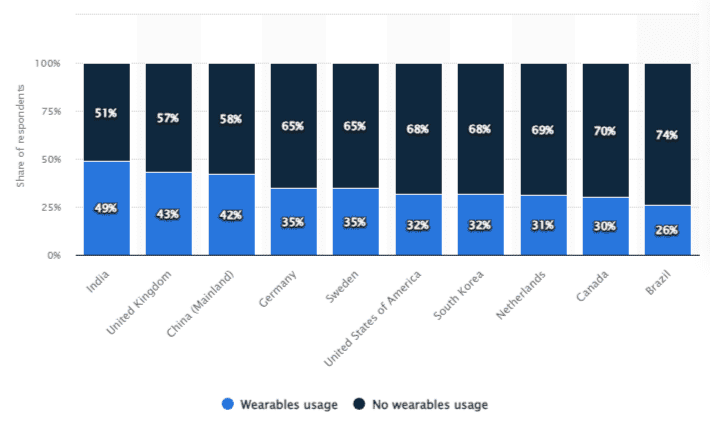
Source: Statista – Wearable devices usage in selected countries as of September 2023

One captivating aspect of the future of payments is the potential for convenience. Just imagine a world where you can effortlessly pay for your morning coffee or groceries by tapping your smartwatch or bracelet eliminating the need to rummage through your wallet or purse. Wearables can make transactions faster and more efficient than before.

Furthermore, as technology continues to evolve, so do security measures surrounding wearable payments. Biometric authentication such as fingerprint scanning or facial recognition can provide an extra layer of protection against fraud and unauthorized access to personal information.

We can anticipate innovations, in payment options as we move forward. There will likely be a range of wearables that cater to individual preferences and styles. The range of possibilities is vast, from fitness trackers that also function as payment devices to clothing that has payment capabilities built in.

Pay By Check

More Businesses Than You Think Still Pay By Check

Modern payment methods in the United States range from EMV chip cards to digital wallets to bitcoin; however, there’s one traditional form of payment that has managed to survive the shift towards digital.

Use of Paper Checks by American Business Entities

The use of paper checks by American business entities and individuals remains uncomfortably high in the 21st century. A 2013 survey by the Association of Financial Professionals indicated that half of all U.S. companies were happy using old-fashioned checks for their payment transactions.

In 2016, a survey conducted among 120 American retailers revealed that only half of respondents were interested in going digital for their payment methods; among those that were still using checks, 10% stated that they had no intention of switching to electronic payments ever.

The most surprising data of the aforementioned 2016 survey is that they half of the respondents explained that 3/4 of their payments were still made by writing out checks. Some of these retailers do not accept checks from shoppers, but they will still write and mail a check when they need to make a payment to a vendor. The only electronic payments they make are to international vendors.

When it comes to the adoption of electronic payment methods and advanced credit card processing, the U.S. is notorious for being a slow adopter. Many Latin American nations have virtually eliminated checking accounts in lieu of express deposit accounts with debit cards for consumers and electronic ledgers for business entities; this is a financial trend that dates back to 2005. Even the switch to EMV credit card processing is taking much longer than expected in the U.S.

Retailers and other businesses still using company checkbooks in the U.S. need to realize that a significant amount of fraud is perpetrated through gaining access to checking account information, which can be easily collected from each and every check printed.

Electronic payment platforms and credit card processing offer far more security measures to prevent theft and fraud, and they tend to be less costly than checking accounts. Automating the accounts payable process with digital platforms is clearly the most sensible way of doing business in the 21st century, and this is something that the American enterprise world should realize. Host Merchant Services takes pride in helping businesses switch over to using electronic payments, which are far more secure and up-to-date in the 2016 business world.

Walmart Pay

Walmart Pay to Deepen Information about Shopper Habits

Businesses are striving to stay on top of trends in consumer behavior, and mobile payments have been a hotbed of activity. Walmart Pay just rolled out nationwide, and the company is hoping that the app will help them collect more information about how customers use their products and make purchasing decisions. Credit card processing has seen huge changes recently, and new mobile payment apps like Walmart Pay and Apple Pay are certainly capitalizing on this trend.

Mobile Applications are seeing a ton of investment from the tech sphere, and Walmart is only one of the many companies trying to launch their propriety applications for their customers. The applications are supposed to make purchases easier for consumers. The app can track purchase history, which will allow customers to reorder frequently purchased items.

The application also speeds up the checkout process in-store, which is intended to increase the frequency that customers will visit Walmart and open their wallets. Walmart Pay is also intended to provide more information to the company. Businesses of all sizes are interested in the big data trend, and this application will help them further analyze the purchases and products that customers are viewing.

Walmart Pay also incorporates mobile payments, another major industry trend. Other apps like Apple Pay have been allowing consumers to create e-wallets that allow them to pay using their smartphones. This has been a major shakeup for credit card processing firms, and there have been many startups looking to help companies take mobile payments. While mobile payments have yet to catch on in a major way in the United States, Walmart is hoping that they can help move the needle on this.

The company is rolling out the application nation-wide, after testing the product in smaller markets across the United States. The application does not yet support third-party e-wallets, but customers can currently connect the application with debit, credit and prepaid cards. The company might decide to pair with Apple Pay in the future, but for now the options are slightly more limited. Time will tell if this application sees mainstream adoption. One thing is for sure, the evolution of e-wallets and retailer applications is going to be a transformative force for firms that do credit card processing.

Customized E-Commerce

The Official Merchant Services Blog switches its focus today back to e-commerce. After the boom in mobile phone usage this past weekend from Black Friday on through Cyber Monday, it’s becoming increasingly clear that smartphones and mobile internet users are becoming very important parts of the  e-commerce industry. As such, businesses that utilize e-commerce need to consider including the mobile phone element in their online shopping capability.

This increase in the importance of mobile usage –– most notably mobile payments –– is leading many e-commerce businesses to develop mobile apps. These mobile apps let those businesses customize their service and stay in touch with their consumers who prefer to connect via mobile networks. The trend is moving e-commerce mobile solutions away from the traditional Wireless Application Protocol (WAP) sites. That’s a paradigm shift in the industry. E-commerce businesses are developing and designing their own applications –– or at the very least branding their own versions of mobile apps.

Applications Over Surfing

E-commerce leaders are finding out that users prefer using a mobile application instead of going to a business through their mobile phone’s web interface. This article from The Hindu Business Line quotes Amarjit Batra of OLX.in as saying: “We found users more comfortable in having a mobile application than opting for mobile web search or using WAP sites.”

This change in e-commerce puts an emphasis on having payment gateways accessible across different mobile platforms. To put it simply, a business with a mobile payment aspect to its e-commerce presence needs to have a mobile payment system compatible with Android, iPhone and Blackberry.

Host Merchant Services is staying ahead of this curve, offering a series of customizable e-commerce solutions to its merchants. Included in that package are mobile payment services apps that work on both iPhone and Android. HMS keeps its options flexible so that its merchants can tap into the rapid growth in mobile payments.

Mobile is Key to E-Commerce

This growth is looking like a trend for businesses in the burgeoning mobile payments market. Juniper Research is often cited as predicting the Mobile Payment Industry is going to blossom from a $240 billion industry to a $670 billion industry by 2015. This makes it very helpful for businesses to recognize consumer behavior in terms of their mobile device usage. Google Analytics provides a great free source of tracking for e-commerce merchants to monitor traffic from mobile devices. That’s a great first step for a business to determine what kind of mobile payment option or customization might be needed for the e-commerce a merchant is already doing. At least get an indication if there is a need for mobile payments or a customized and branded mobile app for your business.

The move towards individual businesses dabbling in their own branded app development also extends from the fluid nature of the industry as it grows and evolves. With so many different companies –– Google, PayPal, Visa to name some of the giants –– all coming up with their own variation on mobile payments, the flexibility to customize and brand their own version of mobile payment services is extremely important for all players involved in the process. This includes merchants themselves as well as merchant services providers.

Stitching it all Together

Besides just crossing platforms between the major mobile carriers, the applications being developed need to integrate web services and payment options into the solution. Essentially the goal is to make e-commerce seamless for mobile users as well as internet users. The whole range of potential business needs to be taken into account with a business’ e-commerce package. And that’s why the focus is on customization.

Sachin Singhal, e-commerce expert for Naaptol, underscores this in the Business Line article when he told them: “A mobile app is more user-friendly than having a WAP site. However, integrating the payment window with it makes the application complete.”

Host Merchant Services has been aware of this trend from its beginning. And that’s why the company offers powerful tools to its merchants that help them complete this integration –– giving them an across the board e-commerce solution that caters to mobile users and internet surfers alike. HMSPay and HMSExpress are both important elements that allow the company to capitalize on this trend and give online businesses the flexibility they need to cater to the huge growth happening in mobile payment sector.

Merchant Services: Why You Need a Processor

The Official Merchant Services Blog functions on the logical premise that our readers are interested in the topics we cover, most notably merchant services. We strive to bring you useful news, tips, and insight that can help you as both a merchant and a consumer. That means that sometimes we delve into complex topics, like our multipart series on Payment Gateways. And other times we tackle newsworthy topics, like Google+ being opened up for business pages.

But today we’re going to get down to the basics and discuss the very heart of merchant services: Credit Card Processing. Credit cards, the plastic payment solution has become the most convenient form of payment for countless consumers. Why is it important for merchants to give their customers the option to pay with a credit card –– specifically on that merchant’s web site? Here are 10 of the top reasons we think credit card processing is an important option for merchants:

  • Competitive Advantage: If your business has the most options and the most flexible payment systems, you have an edge over your competition.
  • More Sales: Data collected on consumers shows that credit card owners buy 25 times more merchandise than customers who pay cash.
  • Cashless Society: We’re not there yet, but the trend in online shopping and electronic payment systems indicates that credit card and debit card processing are quickly becoming the preferred methods of payment. This will take center stage in business news next week when Black Friday goes right up against Cyber Monday.
  • Convenience: One of the primary reasons credit and debit card transactions are becoming so popular is because buying goods online with just a few mouse clicks is extremely convenient to consumers.
  • Impulse Sales: Credit Cards give customers the freedom to buy on impulse, spending money on previously unplanned merchandise. Cash is finite and in the pocket. But plastic lets customers reach beyond what they have in hand.
  • Enhanced Advertising: Customers are more likely to shop at businesses that accept their credit card. As such, they tend to look for and read ads from businesses that accept their credit cards first over other ads.
  • Steadier Sales: Credit Card business has less peaks. Cash using consumers buy heavily on payday and just before holidays, but credit card using consumers make purchases whenever they need to.
  • Larger Volume: Accepting credit cards helps merchants attain higher unit sales and extra orders.
  • More Expensive Merchandise: Credit card customers are sometimes less conscious of slight price differences. They are more likely to spend a bit extra at a merchant simply because they accept their form of payment instead of seeking out wholesalers or discounters who do not accept their credit card.

We’re interested in your feedback. What other reasons would you add to this list?

Tips and Terms

Revenues generated by credit card use are fast approaching the $200 billion mark. Your business can benefit  by offering credit card payment processing. To understand the process better, we’re going to define some of the important terms involved in credit card processing and give some insight into how it all works:

Acquirer – a bank, which is often a 3rd party provider, who processes and settles merchant credit card payments.  This can be a bank providing your merchant account or a service that provides it to your processing company.  The acquirer works with the credit card issuer.
Authorization – is the first step that happens after the credit card is swiped.  The purchase and card information are sent to the acquirer who, in turn, sends the same information to the credit card issuer.  The credit card issuer then accepts or declines the transaction.  If accepted, an authorization code is generated and the purchase transaction is continues to the next step, namely: batching.

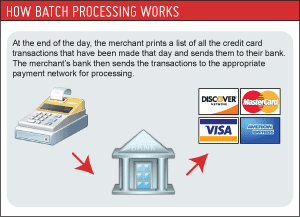
Batching – is the review process done by a merchant on all credit card transactions for the business day.  The review process involves ensuring all credit card transactions are authorized and signed by the cardholder.  After the review process, the merchant sends the information as a batch to the acquirer to receive clearing for payment.

Cardholder – he is the customer as specified on the credit card, the customer so to speak.

Card network – these are networks that act as an intermediary between the acquirer and the issuer.  Card networks transfer the information originating from the acquirer to the issuer about the purchase.  This happens in the authorization process.

Clearing – the third step in the payment process which happens after the acquirer sends the batch information through the card network to the issuing bank.  The card network acts as a router depending on the credit card issuer found on the purchase detail.  This process permits revenues for both the issuing bank and the card network called the interchange fee.  After deduction of interchange fees, the issuing bank sends the information back to the acquirer through the same card network used.
Discount fee – this fee is paid for by merchants to the acquirer to cover processing costs.

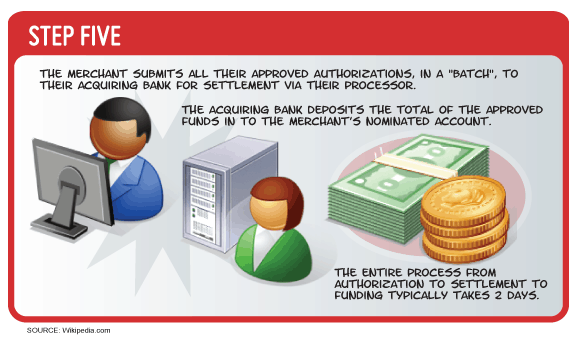
Funding – the fourth step in the credit card payment process.  This involves the acquirer sending back the transaction information to the merchant less the discount fee.  The merchant receives the remainder of the payment and is now considered paid.  This generates the cardholder’s billing statement and accounts are funded appropriately.
Interchange fee – the fee charged by card networks and card issuers to the merchants.  This fee is regulated to about 1 to 3 percent of the total purchase amount and covers the costs associated with credit card acceptance.

Issuer – the financial institution who issues credit card products to its customers.  Examples of major issuers include Discover, Amex, Visa and Mastercard.

A Step By Step Guide

And finally, to get an easy to read visual guide on how Credit Card Processing works, please visit the Host Merchant Services article archive here:

How Credit Card Processing Works