Tag Archives: online shopping

Top Free Online Shopping Carts

Today The Official Merchant Services Blog shifts its focus to the E-Commerce industry — specifically some tips we’ve found online to help small businesses with their e-commerce solution.

An article written by Nova Scotian Vangie Beal details the ins and outs of ten open source online shopping carts that are available to merchants or really anyone who wants to sell things on the internet. Beal’s been covering small business, e-commerce and internet technology for more than a decade with her writing. You can find the original article here.

E-Commerce has become an integral part of the economy throughout the world. Shoppers have embraced online shopping as part of their normal shopping routine. So businesses have responded by jumping into e-commerce and providing those consumers with competitive options that focus on the convenience that can be had with the click of a few buttons — the classic clicks vs. bricks debate is showing that clicks beat bricks.

So what do Merchants need to know about E-Commerce to get started?

Step One: Get A Payment Processor

The first step is something Host Merchant Services can handle — payment processing. Merchants need to accept payment in the form of credit cards and debit cards to stay healthy and viable as a business. So merchants need to incorporate payment processing solutions both in their brick and mortar stores as well as on their website with their online shopping solution. Host Merchant Services provides merchants with these options — along with free equipment and a guaranteed low rate that will save them money.

So step one in setting up your e-commerce business is to get a merchant account, with the services Host Merchant Services provides.

Step Two: Your Online Shopping Cart

Now that you’ve got a merchant account set up and are reedy to process payments online, step two is to get an online shopping cart for your website. As Vangie Beal says in her article, “When shopping for your own e-commerce shopping cart software the most important aspect toconsider is how well the cart software meets your business objectives.”

The shopping cart has to be customizable so that you can alter it to fit your business needs. It also needs to be able to fit your branding so that the shopping cart melds seamlessly with the rest of your website. It needs to be flexible so that as your business grows, your online shopping card and ability to process payments online can also grow. It needs to be secure and it needs to support industry security standards such as PCI compliance.

You can read about PCI Compliance Standards in the Host Merchant Services Article Archive.

We provide a PCI FAQ here. 

We provide a step by step guide on PCI Compliance here.

Open Source Shopping Cart

Vangie Beal’s article discusses the top 10 free or Open Source shopping carts. Beal says “Open source shopping carts are an attractive option. Storeowners might look to open source e-commerce software because it will typically deliver the features and tools to manage a product catalog on a website without the hefty licensing fees that come with proprietary or off-the-shelf packages.”

Continue Reading – Top Free Online Shopping Carts, Part 2

E-Commerce: Review and Preview

The Official Merchant Services Blog begins our second year of blogging with a look at one of our favorite topics: E-Commerce.

2011 saw huge gains for online shopping. As reported in The Official Merchant Services Blog on Cyber Monday, online shopping was strong on Black Friday. IBM research unit Coremetrics stated that 20% more consumers shopped online Black Friday 2011 than did in 2010. The data collected also states that 39% more online shopping happened on Thanksgiving Day 2011. The ease of online shopping is infiltrating the traditional brick-and-mortar retail event and Host Merchant Services‘ analysis of it held true –– sales numbers across the board rose from 2010, so overall Black Friday had a boost for retail, but clicks from e-commerce continue to grow and cut into the sales from bricks.

Also, mobile payments saw a huge increase during the holiday shopping season. According to this article from Seeking Alpha, mobile payments business increased 500% from 2010 on Black Friday. According to the article, PayPal mobile reported the huge increase, coming in at 511% to be exact. PayPal Mobile also noted that there was a 350% increase in mobile shopping on Thanksgiving 2011 when compared to 2010.

The Numbers Keep Coming In

This article by Internet Retailer demonstrates that Black Friday was just the beginning. There were more than 3,000 transactions totaling $141.6 billion in 2011 in the marketing, media, technology and service industries according to data collected by investment banking firm Petsky Prunier LLC. Of those transactions the E-Commerce and digital media segment was the most active, with 1,159 deals valued at more than $44 billion.

All of this activity demonstrates strength in the E-Commerce industry, and suggests that 2012 is a year primed for continued growth and success — which combines with the already rampant predictions of success for Mobile Payments within the E-Commerce industry.

Is There A Bubble?

This article from moneycontrol.com asks the question, “Will the E-Commerce Bubble Burst?”

Comparing the recent success to the success of internet companies in 2000 and 2001, the article tries to figure out if the bubble will burst like it did back then for tech companies. The author’s opinion is that the similarities are only on the surface, and that the two situations are vastly different — suggesting that in the end, it’s not a bubble that is going to burst but rather an industry that is going to grow and evolve. The article looks specifically at the E-Commerce sector in India, but does spend time detailing the big picture globally.

Online Shopping is Now Commonplace

To really underscore the potential growth that E-Commerce has in 2012, this article from Daily Deal Media talks about how popular online shopping is becoming with moms. The article cites a BabyCenter survey which suggests that: “71% of moms regularly turn to websites such as shopping engines and review sites to compare prices. Another 56% admit to searching for coupons or digital discount opportunities on a regular basis.”

This is a compelling point in regards to the overall picture of E-Commerce. It has become more and more commonplace in everyday life for shoppers around the world. Mothers are turning to it for the convenience of being able to get shopping done quickly and efficiently, according to the article. And it is just become an ingrained part of our economy, fueling the potential for further growth.

Host Merchant Services E-Commerce Mobile Payments image

Mobile Payments Big Problem

The potential growth for Mobile Payments is huge. But the one thing holding it back in the U.S. is security. Just as online shopping has become more and more commonplace, people have gotten comfortable with making payments online. That brings risk, as phishing scams and credit card fraud has increased. But security standards like the PCI DSS have helped to make the mainstream comfortable with clicking the pay button and giving out their payment information.

Mobile Payments, however, are not quite there yet in terms of acceptance. This article from the Chicago Tribune discusses the looming security issues that the mobile payments market faces. As the article states: “While the first mobile virus dates back to June 2004, risks from hackers remained limited because of the relatively small size of the market. But this has changed with the surge in the smartphone segment, which this year outgrew the PC market, and the new dominance of Google’s Android software. The emergence of mobile payments, which allows shoppers to swipe their phones at a cash register, is whetting the interest of hackers and data thieves.”

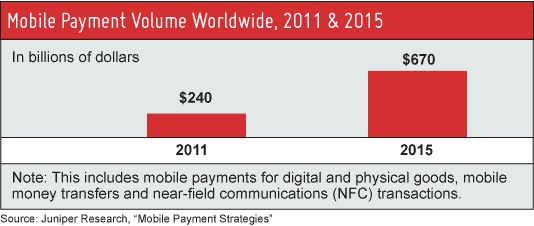
The article states that fewer than 5% of smartphone users have security software installed on their device, according to Juniper Research — the same Juniper Research that predicts Mobile Payments will increase to a $670 billion industry by 2015. And a study by Deloitte cited in the article suggests that for companies in the technology, media and telecom sector expect data stored on staff mobile devices to be their biggest security headache in 2012.

Essentially that’s the biggest obstacle holding back the Mobile Payments industry. The sheer convenience the technology brings to the payment industry is extremely powerful and so despite security concerns it continues to be developed and pushed. 2012 will see growth in the industry, despite the security issues. And as consumers get more and more familiar and comfortable with the phone swipe style of payment, the industry will boom.

A List for 2011

And just for fun, here’s a list from Mashable.com detailing who they think were the biggest winners and losers from 2011 in E-Commerce.

  • Their winners include: Amazon, Apple, Wal-Mart and Gilt Groupe.
  • Their losers include: Barnes and Noble, HP, Netflix and Sony.

Click the link to read why each company made the list.

E-Commerce: News Briefs [2023 Update]

The Official Merchant Services Blog continues to follow some of the top trending stories in the e-commerce industry. E-commerce is an essential growth element in most retail businesses. This has been building for years, as online shopping becomes more and more a convenient and commonplace fact of life for the everyday consumer.

E-Commerce Sets Record Highs

It became clear that e-commerce is a titanic force in the marketplace when Cyber Monday sales results came trickling in. But the robust clicks business continued. Now reports are indicating that e-commerce had a record setting week. This internet retailer article said that consumer spending reached at least $1 billion on three separate days last week according to the web measurement firm comScore Inc. This means that three of the four recorded billion dollar spending days for e-commerce occurred last week –– the fourth was Cyber Monday 2010.

The statistical breakdown shows that shoppers spent $1.25 billion on Cyber Monday 2011, the single highest spending day recorded for e-commerce by comScore. This was followed up by $1.12 billion on Tuesday and $1.03 billion on Wednesday. In the time period between Nov. 1 and Dec. 1, 2011, consumers so far this holiday shopping season have spent more than $18.69 billion with online retailers ––up 15% from approximately $16.25 billion at the same point last year.

Will The Trend Continue?

The article quotes comScore chairman Gian Fulgoni as saying “As the deals from this week expire, it will be important to see the degree to which consumers return to the same retailers to continue their holiday shopping, thereby helping improve retailers’ profit margins, or if we experience a pullback in consumer spending—which has occurred in previous years—before promotional offers and spending intensity pick back up in earnest around mid-December.”

Free Shipping appears to entice online shoppers in a major way. According to the article 63.2% of all online transactions last week included free shipping. This makes a lot of sense, since free shipping evens the playing field in the bricks vs. clicks battle. With shipping costs taken out of the equation, it comes down to convenience and price. It’s much easier for shoppers to visit a website instead of fight crowds and stand in line. And the Cyber Monday deals –– many of which got extended past Monday prompting the nickname Cyber Week to emerge –– keep the pricing war ultra competitive.

SOPA Update

With e-commerce business booming so much in the holiday shopping season, the Stop Online Piracy Act (SOPA) and its latest developments become more and more important. According to this PC World article, a bipartisan group of lawmakers have come out in support of a new law that has been proposed as an alternative to SOPA.

Under this proposed legislation, the U.S. International Trade Commission (ITC) would be given the power to investigate claims of copyright infringement on foreign websites. The proposal would also allow the ITC to issue cease-and-desist orders to foreign websites that willfully engage in copyright infringement. The lawmakers demonstrate some clever ingenuity here with this proposal by tapping the ITC for the job of piracy oversight. The ITC already investigates patent infringement complaints and can bar infringing products from being imported into the U.S.

Host Merchant Services offered up an extensive analysis of SOPA, including the history and development of previous laws that affect online piracy and intellectual property rights.

What is notable about this new law being proposed?

new law being proposed

Two of the legislators supporting the use of the ITC as copyright infringement oversight are Ron Wyden [D-OR] and Zoe Lofgren [D-CA]. Wyden is notable because he was the one that effectively killed the Combat Online Infringement and Counterfeits Act of 2010 in the Senate. Lofgren is notable because she is one of Congress’ leading experts on the internet and has spoken out against SOPA on her own website. Having these two support a proposed law that seeks to combat online piracy is a pronounced development.

The new proposal seeks to clean up the problem of SOPA by giving it a more streamlined and functional process for copyright infringement claims. Under the new proposal the ITC could also investigate complaints of copyright infringement by foreign websites. Owners of the websites would be invited to present their side to the ITC, and the public would be notified of investigations, as the ITC does in patent investigations. ITC rulings against websites could be appealed to a U.S. appeals court. All of these aspects are different from the broad powers that SOPA grants to the Department of Justice.

As the article explains: “SOPA would allow the DOJ to seek court orders to stop online ad networks and payment processors from doing business with foreign websites accused of enabling or facilitating copyright infringement. The DOJ-requested court orders could also bar search engines from linking to the allegedly infringing sites and order domain name registrars to take down the websites and Internet service providers to block subscriber access to the sites accused of infringing.

SOPA would also allow copyright holders to seek court orders requiring online advertising networks and payment processors to stop supporting the alleged infringers if those businesses do not comply with requests from copyright holders. The court orders requested by copyright holders could target U.S. websites and services that enable or facilitate copyright, in addition to foreign websites.”

The proposal states its case as being a better alternative to SOPA here: “We found that using trade laws to address the flow of infringing digital goods into the United States makes it possible to avoid many of the pitfalls that would arise from other legislative proposals currently being advanced to combat online infringement. Namely by putting the regulatory power in the hands of the International Trade Commission – versus a diversity of magistrate judges not versed in Internet and trade policy – will ensure a transparent process in which import policy is fairly and consistently applied and all interests are taken into account. When infringement is addressed only from a narrow judicial perspective, important issues pertaining to cybersecurity and the promotion of online innovation, commerce and speech get neglected. By approaching digital good infringement as a matter of regulating international commerce, we are able to take all of these factors into account.”

In short, this proposal focuses on the copyright infringement that is at the root of the online piracy, instead of on the payment processors and e-commerce sites that could get caught up in the broad crackdown that SOPA could initiate.

What’s Your Major? E-Commerce

We noted this on our Facebook Page yesterday, but feel the need the mention it in our blog as well. E-commerce is now becoming a path of study in college. This Practical E-Commerce article links to 15 different e-commerce focused course programs being offered by various institutions, including Carnegie Mellon, University of Maryland, and Temple.

E-Commerce SEO Tips for Merchants [2023 Update]

The Official Merchant Services Blog once again picks up its thread about the impact 2011’s holiday shopping season is going to have on e-commerce. Previously we gave merchants tips on improving their e-commerce experience for customers. These tips were primarily focused on things merchants can do with their website and their online shopping cart. Today we’re going to offer some tips on improving your site’s Search Engine Optimization (SEO). This is basically the other side of the coin. With the first set of tips the goal was to make it easy for your potential customers to use your site, and buy things from you effectively. With these SEO tips the goal is to make it easy for potential customers to find your web site in the first place.

What is SEO?

SEO

Search engine optimization (SEO) is the process of improving the visibility of a website or a web page in search engines via the “natural” search results that come up from using the search engine. SEO is absolutely vital to your online business. SEO is what helps the search engines such as Google find your website or your products in whichever marketplace you are using. In general, the earlier (or higher ranked on the search results page), and more frequently a site appears in the search results list, the more visitors it will receive from the search engine’s users. So the basic goal of SEO is to get a web site ranked on the first page.

How to Improve your SEO

Here are a few effective tips from Google itself and its SEO Report Card to help you use best SEO practices and boost traffic to your website or listings:

  • Offer Quality Content and Services

    –– According to Google, interesting websites will increase search engine recognition on their own. The internet is content driven. So the first step in improving your SEO is to make sure you have compelling, consistent content. In fact, here is what the Google SEO gurus have to say about your site’s content: “Creating compelling and useful content will likely influence your website more than any of the other factors discussed here.” Great content is more apt to be shared and linked to, which will help boost your rankings with the search engine results pages, or SERPs.

  • Create more descriptive title tags

    –– Optimized keywords and an effective URL naming structure can help the search engine understand the content of the page better. It is suggested to use a maximum of 60 characters on title tags as an opportunity to tell both users and search engines what the focus of the page is. There’s no need to go past this many characters, as most search engines will display ellipses ( … ) after this limit. Also, search engines may give less weight to words after a certain point.

  • Write Better Anchor Text

    –– What is anchor text? It’s the clickable text that users see as the result of a link and is placed within the anchor tag. This text tells Google and the other search engines, as well as internet users, a little something about the page you are linking to. You should use descriptive, concise text and format links so that they’re easily spotted. Don’t neglect your internal anchor text, either.

  • Create effective URLs

    –– Choose the form of the URL that is easiest to remember as the canonical and be consistent with this canonical form across all products. Think of the most common URL forms visitors are likely to try and then 301 redirect these to the preferred/canonical URL or be sure to use the rel=”canonical” link element if you cannot redirect.

  • Optimize Your Use of Images

    –– In the last blog post, we discussed the importance of using high quality images of your products in your shopping cart and how that helps you make sales. Those same images can help your SEO, if you utilize the text that comes with them properly. You can use a filename along with alt text for images and should take full advantage of both. The content of the alt attribute contains information about your image. Don’t scatter your image files in a bunch of directories and subdirectories, but store them all in a single directory. This will greatly simplify the path to your images. Use commonly supported file types such as PNG, JPEG, GIF and BMP.

The real work here for a successful e-commerce merchant is combining the strategies from the previous blog with the tips presented here. You need to make your site come up on the first page of a google search so customers can find you. Then once they click you need to have an strong, easy to use site so those same customers can make their purchase quickly and hassle-free. All of this leads up to the final submission of the sale, which is where Host Merchant Services steps in and makes the payment processing easy for you and completely worry-free. Let our tips and information help you with the first two steps, and then we’ll handle the processing.

Mobile Gift Cards

The Official Merchant Services Blog continues its ongoing coverage of the upcoming holiday shopping season and how it will impact the thriving E-Commerce industry. Yesterday’s blog took a look at some of the statistics revolving around 2010’s holiday shopping profits as well as detailing a trend among online shoppers to begin their holiday shopping in the summer months. We also promised that today’s blog would show how gift cards and gift certificates were being taken a step forward.

Mobile Gift Cards

Gift Cards are going digital this year, with the onslaught of a variety of providers who will give people purchasing power of gift cards sent directly to their mobile phones. This Fox News story touts mobile gift cards as the “cool” and “sophisticated” new gift giving idea. The article cites the success of coffee giant Starbucks this year with Mobile Gift Cards, and suggests that others are following that blueprint. Starbucks had some compelling numbers to underscore the success of their mobile gift card program according to the article:

“”Within nine weeks of the national launch of mobile payment, customers paid more than 3 million times using our mobile payment application in stores and this number continues to grow at a steady rate,” says Adam Brotman, senior vice president of digital ventures for Starbucks Coffee Co.”

A mobilesyrup article features the Mobile Gift Card for apps from Toronto-based Mobiroo. And a San Francisco Chronicle article looks at Giftly and its Mobile Gift Card product. It’s a new trend that looks to make a big splash in the 2011 holiday season.

How Do They Work?

2011 Holiday Season logoThe standard way Mobile Gift Cards are designed to work is: The card is sent via email, Facebook or text. The recipient is notified that he or she has a Gift Card, and can take their smartphone into the store and use it immediately. The store clerk simply scans a bar code from the recipient’s phone, and the card is applied to the balance.

Unfortunately, as has been pointed out by Host Merchant Services in previous posts about Mobile Payments not quite taking hold in the U.S., this standard process doesn’t always work out. Many retailers are not physically equipped to handle such a process. So if the bar code can’t be scanned, Mobile Gift Cards can still be used by consumers if they print out the coupon prior to going shopping, or if they input the gift card number at a website or point-of-sale terminal.

The obvious convenience of Mobile Gift Cards is that they work seamlessly with e-commerce and online shopping. You get a coupon code on your mobile device, and then can input that number at the website where you are shopping.

Follow the Leader

The Fox News article noted that Applebee’s, California Pizza Kitchen and Target all offered Mobile Gift Card options this year. The mobilesyrup article about Mobiroo cited the old school hook of the idea, stating that “Gift cards are a symbol of a bygone time when analog ruled and retailers yielded more to foot traffic than mouse clicks. But according to Mobiroo CEO Vinay Chopra, old is new again.”

Mobiroo, according to Chopra, sees Mobile Gift Cards having quite a lot of potential in the marketplace because of smartphones themselves, specifically the apps people use and purchase for their phones. But Mobiroo is still using a physical Gift Card, with a scratch-off area that gives a code to redeem for use in an App store, and Chopra sees this as a stocking stuffer item for the holiday shopping season.

Giftly, on the other hand, is following the example set by Starbucks and others, and makes a completely digital process available. According to the San Francisco Chronicle article: “When a Giftly card is purchased, the buyer’s credit card is charged. When the recipient opens the card on their mobile phone in the store, Giftly check their location. Once Giftly confirms that the recipient is at the right venue, the gift money is unlocked.  Giftly then send the money as a credit card reimbursement to the recipient. The recipient then purchases the product at the cash register per usual. The merchant doesn’t have to be told about the Giftly — the service is completely a location-based redemption. Unlike most gift cards, Giftly allows the buyer to select up to three venues where the recipient can spend the money.”

All Giftly cards are delivered via e-mail and redeemed on a mobile phone. They allow you to send gifts unbound by location. It adds convenience to the shopping process, which is a core element that is going to make it popular with consumers. By allowing consumers to digitally forward purchasing power to friends and family wherever they happen to be, the shopping process gets that much faster and easier, making mobile gift cards an attractive option for holiday shoppers.

Tomorrow we’ll touch on a topic brought up by this blog, taking a closer look at apps as gifts in the upcoming holiday season.

Getting Ready for Holiday Shopping

The Official Merchant Services Blog would like to wish everyone a very happy Halloween. As we speed our way into the last stretch of 2011, the holidays are going to zoom into view. Holiday shopping season officially tends to start on Black Friday. But in recent years, the boom in online shopping has holiday shoppers no longer traditionally adhering to the official shopping season trends. A 2010 survey conducted by Google and OTX found that 35% of internet users start their holiday shopping prior to the end of summer, months ahead of Black Friday.This trend is only continuing to grow as consumers find online shopping convenient to their shopping habits, easy to do, and the wide selection lets them find great deals on price.

This boom in e-commerce continues on past Black Friday. Cyber Monday, a marketing term coined in 2005 to describe a big push with incentives to shop online days after Black Friday, set records in 2010. According to a Star Tribune article from January 16, 2011, Cyber Monday sales rose 16 percent from 2009, and topped $1 billion overall –– marking the first time Cyber Monday hit the billion dollar mark. The record setting didn’t stop on Monday, according to comScore, a company that tracked the sales figures between November and December for the e-commerce industry. Sales on Thanksgiving Day were up 28 percent from the previous year, and overall e-commerce sales topped $32 billion in the holiday shopping period, a 12 percent rise from 2009. Even Black Friday, brick and mortar stores’ biggest holiday shopping day of the year, saw a 9 percent rise in e-commerce to $648 million.

“This trend isn’t going away in 2011. Some preliminary predictions are suggesting that this year’s holiday shopping season is going to be robust, and online shopping will continue its rise in the eyes and wallets of consumers. You can see that e-commerce is heavily predicted to boom in the next four years through previous articles posted by Host Merchant Services. And while The Official Merchant Services Blog prepares to give you ongoing coverage of the holiday shopping season’s impact on the E-Commerce industry, we’re going to take some time to give merchants some helpful tips to get prepared for 2011:
  • Start early. With your promotions and your sales, start getting the marketing as well as the products or services out there to your customers as early as you can. As seen with the statistics above, online shopping is not beholden to the Black Friday start date. Online shoppers make their lists, check them twice as soon as brick and mortar shoppers and start looking for deals from spring on through the rest of the year.
  • Check and re-check your process. Make sure your online shopping cart is running smooth. The biggest draw of e-commerce for many consumers is convenience. So it’s very important for your online shopping experience to be hassle free to the users of your website.
  • Consider your product line. With online business as booming as it is, it can be easy for your site to get lost in the crowd as shoppers surf around. Consider offering something your competition can not offer. A unique item. An eye-catching deal. Basic marketing plan, but even in the e-commerce industry, the basics still work.
  • Gift certificates are a big holiday item, and that does not stop online. In fact tomorrow’s blog post is going to look at something specific to this year’s shopping season that takes gift certificates and gift cards a step forward in terms of convenience for holiday shoppers. One thing to remember about gift certificates is the post-holiday business they drum up for you. They are purchased during the holiday season, but get used after the holidays, giving your online store the potential to attract other purchases beyond the capacity of the gift certificate in the slower sales month of January.
  • SEO and Keyword choices should be focused on with your advertising. Consumers gift shop online using search engines. You want to do everything you can to get your site in front of them when they search for these gifts. The focus of your e-commerce solution for your business should be an online store that your customers can find easily and then use conveniently. This will get them coming back to your site.
  • Free shipping. This is something that if you can offer, you should strongly consider offering to your customers. It is a big boost for the e-commerce industry leaders each year that they can offer free shipping to holiday shoppers.

Those tips are just scratching the surface of things you can do to prepare for the holiday shopping season. It’s certainly not too late to get ready for the business rush that holiday gift-giving provides each year. Host Merchant Services provides e-commerce solutions to our merchants that will let them take payments smoothly and efficiently. And The Official Merchant Services Blog will continue to provide insight on how merchants can maximize this opportunity.