Tag Archives: Near Field Communication

Isis Mobile Wallet is Here

Isis Mobile Wallet Debuts Using NFC Technology

A joint venture between AT&T, Verizon Wireless and T-Mobile known as Isis Mobile Wallet has released a revolutionary mobile payments app that promises to change the way people pay for goods and services. The trio of mobile service providers are ecstatic to finally debut this mobile payment platform right before Black Friday and the rush of the holiday shopping season, as this technology lets consumers conveniently utilize their mobile phone to pay for goods and services. Use of the platform makes it easier for merchants to accept a wider variety of payments and the Isis system itself encourages repeat purchases through loyalty programs tied into the app and its software.

The debut of Isis also heralds a huge step forward for Near Field Communication technology (NFC), a topic we’ve been consistently covering since our Official Merchant Services Blog began.

What Is the Mobile Wallet Platform?

The Isis Mobile Wallet platform is a completely free mobile application that utilizes NFC technology to allow consumers to pay for purchases by waving their mobile device in the air at a terminal that captures the pertinent information out of thin air.  The mobile payment industry has been dealing with one large obstacle from NFC recently, as Apple hasn’t made its iPhones compatible with NFC. And so an Isis representative said that iPhone support would come at a later time. Until then, the app is available on all other compatible phones, but users should be aware that downloading the app could cost money if they are not subscribed to a monthly plan with unlimited data.


How the Platform Works

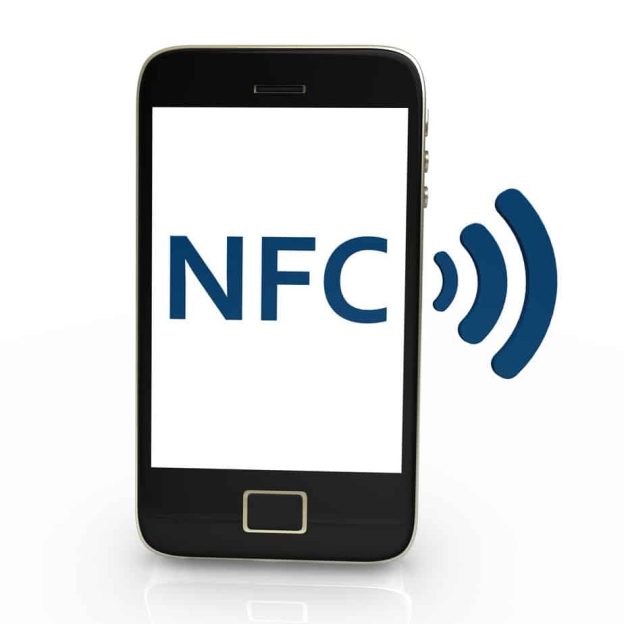
The NFC technology used in the mobile payments app allows mobile devices to transfer information when they are tapped together.  Merchants who use devices with this technology can accept payments quickly and securely from customers who have compatible devices. But wait, there’s more.

Mobile payments represent just one of the benefits of the Isis app.  Merchants can offer loyalty rewards to customers through the app.  These rewards can be earned and stored directly on a mobile device. We’ve delved into some of these types of incentives in our coverage of the Barclays bPay app, as well as social gifting articles. The basic idea of what’s happening is the app is giving customers yet another avenue for savings through their mobile device, in hopes to spur more purchases. Discounts are automatically deducted from a sale when Isis is used to pay for a product or service.  There’s no need for merchants to have cards or keychains printed, and customers do not have to worry about keeping track of dozens of loyalty cards.

Some specific incentives that are tied with the Isis debut: Isis Mobile Wallet customers can use My Coke Rewards and Isis to get three free drinks at select vending machines, while Jamba Juice is giving away 1 million free smoothies to Isis users. Purchases made from an American Express Serve account through the Isis wallet are eligible for a 20 percent discount (up to $200).

A PIN is used to protect personal information if a phone is lost or stolen.  The wallet can be locked when a phone is lost to prevent information from being breached.

Phone Compatibility With NFC Technology

NFC technology requires a cellphone user to have personal payment information stored on their phone.  The sensitive nature of this information means that extra precautions must be taken.  An enhanced SIM card that specifically details that it has been made for secure data storage must be used in conjunction with the application. Interested customers will have to get an enhanced SIM card to run Isis. They will also have to download the app on Google Play or get signed up at retail stores run by the three carriers.
NFC loyalty down by contact for Google [2023 Update]

Google Wallet dropped NFC Loyalty Points and Gift Cards

Google recently announced fundamental changes to its Google Wallet service. On August 21, Google Wallet stopped supporting NFC redemption for gift cards and merchant loyalty points. In these competitive times, more and more businesses have come to rely on loyalty programs to spur consumer activity. By simplifying the point-of-sale experience, NFC payments are supposed to optimize loyalty programs for mobile shoppers. The new changes to Google Wallet may make some companies rethink joining Google’s bold experiment in merchant services.

Though Google says it is looking for new ways to process loyalty and gift cards, no details are available as of yet. Nor has Google revealed a specific reason for scaling back its mobile wallet service. Furthermore, this newest change caps a string of high-profile personnel shuffles and policy changes for Google Wallet. In the wake of embarrassing security issues, Google discontinued its virtual prepaid debit cards last year. Since prepaid cards are gaining popularity very quickly, Google’s move inspired curiosity and controversy alike. In May, many observers were startled by the sudden departure of Osama Bedier, the vice president and public face of Google Wallet.

The story of Google Wallet demonstrates the complex pitfalls of pushing technological innovation in merchant services. For years, Google has boosted NFC technology as a game-changer for the mobile wallet industry. Though the company remains officially committed to NFC-enabled point-of-sale transactions, the changing dynamics of Google Wallet could herald future troubles for the payment system. In 2013, the public is increasingly worried about privacy and security issues. As details emerge about corporate involvement in NSA snooping and surveillance, many are wondering if Google is fully committed to safeguarding customer data. For many, these concerns may overshadow and obscure the security advantages of Google’s NFC-powered transactions.

Deeply invested in NFC technology, Google’s course is innovative yet arguably too experimental for many companies. Even forward-thinking carriers and vendors have limits to their adaptability. If Google Wallet’s limited market share is any indication, many smaller merchants are still unsure about the practicality of adopting NFC payments.

NFC Taking Too Long?

When I first started writing for this website, and The Official Merchant Services Blog, a topic I was both fascinated with and completely astounded by was Near Field Communication (NFC). It seems fitting that on the eve of the National Football League’s 2012-2013 season debut — a rare Wedensday Night Football game — which features a gridiron battle between the Dallas Cowboys and New York Giants, two mainstays of the National Football Conference (NFC), that I would once again be tackling the topic of NFC. The first time I saw the acronym I thought it was talking about football.

It wasn’t.

It was talking about technology that was poised to revolutionize payment processing and make everyone’s phone their wallet. We were going to be radically transformed from a cashless society relying on plastic cards with magnetic stripes into a cashless society relying on waving around your smartphone at registers and terminals who pick up your signal and magically charge your account. One swipe of the phone, and no hassle whatsoever, as Near Field Communication did all of the talking back and forth between devices while you figured out what you were going to buy next.

But over the past couple of years, the dominance of NFC has pretty much mirrored the Dallas Cowboys own dominance of the NFC in which they play. A lot of hype, but not a lot of tangible financial results. The biggest proponent of NFC has been Google Wallet, but another giant of the NFC industry-in-waiting has been Isis. Just like the NFL season, Isis — the mobile-payment joint venture backed by AT&T Inc., Verizon Wireless and T-Mobile USA Inc. — is poised to get underway in September too.

VeriFone Systems Inc., a maker of payment terminals that Host Merchant Services offers for free to qualifying merchants that sign up with them, is working on the Isis project. Chief Executive Officer Doug Bergeron said in an interview with Bloomberg that VeriFone is preparing to introduce Isis in Salt Lake City and Austin, Texas.

Isis had initially planned to roll out its NFC-based mobile payment service in the first half of 2012. The joint venture tweaked its strategy last year, opting to use credit-card companies to handle transactions rather than the carriers themselves. This shift has taken time to implement because its been focused on ensuring payments can be made securely — the single biggest fear that consumers have voiced about mobile payments.

Are You Ready for some Mobile?

So now that Isis is on the cusp of kicking off NFC-fueled mobile payments in select areas, is this validation for the technology? It doesn’t seem that way. Google Wallet’s NFC-integration still hasn’t come to my local shopping areas. But many other mobile payment options have. I can and have bought movie tickets on my phone. This was done using the QR-Code technology which seems to have had a quicker integration into the U.S. Economy at large. It was something that many companies were already using for their marketing so utilizing the technology to work for payments was faster as it relied on infrastructure already in place, and consumer fears of security were lower since consumers had already opted in with the codes.

Toss Square’s partnership with Starbucks and PayPal’s partnership with Discover into the mix and it seems like the Mobile Payments industry has decided it wants to score an industry-wide touchdown with or without the help of NFC. In fact, Devindra Hardaware suggests in a column for VentureBeat that the industry could still make use of the ideas in NFC, but completely bypass the ground game entirely by going with an aerial assault guaranteed to score big with consumers: “There’s still plenty of room for mobile wallets to disrupt the way we pay — just look at the Pay with Square with app, which lets merchants charge you just based on your name and face. In many cases, you won’t even need to pull your phone out of your pocket.”

What Brand is Your Wallet? [2023 Update]

Today The Official Merchant Services Blog keeps examining the rapidly growing payment processing sector of Mobile Payments. With an never ending stream of deals being made by startups and established companies developing the latest gimmicks and technology to bring mobile payments and mobile wallets to the average everyday U.S. consumer driving the marketplace, it’s easy to get lost in a sea of mobile payment processing media hype.

In our blog yesterday we were able to see how some of that disconnect works. Visa pushed mobile payment technology aggressively at the London games. Their plans were almost scuttled by a malfunction with the processing terminals during a men’s soccer match between Great Britain and United Arab Emirates. The crowd was cranky as they were unable to pay for concessions using a mobile phone or a credit card. They had to resort to cash, and many patrons were unprepared for the anachronism.

This wrinkle in Visa’s mobile plans underscores how fragile mobile payment technology still is; and it also highlights how close we’ve come to a cashless society — the kind of society where mobile payments promise to be a thriving and convenient way to pay for goods and services.

The Knock on Mobile Wallets

The continued skepticism U.S. consumers have with mobile payments can be found summarized well in this L.A. Times article by David Lazarus. The main theme is something we’ve covered extensively in the past year: Mobile Payments are the future, but people are worried that the payment processing is not secure. It seems that for almost every story published about how mobile wallets are going to revolutionize e-commerce and make billions and billions of dollars in profit, there’s a story like this one that says consumers are worried about security, fraud and identity theft.

These are valid concerns. Much like regular old online shopping — which has become ingratiated into the average U.S. consumer’s shopping habits — the threat of tech savvy criminals stealing pertinent payment information is an ongoing issue. Everything from phising scams to data breaches affect e-commerce. But none of it has stopped the juggernaut from steam rolling consumer buying habits. Everyone shops online because of the ease and convenience. This is powered by how easy it is for people to be online, click some buttons and buy something. The power of convenience trumps security concerns.

This will happen for mobile wallets as well. Once the technology gets out in front of people they will flock to it because it is easy to use and available where they shop.

Convenience is the Key

So what I believe is the current obstacle holding Mobile Payments back from making a huge splash with U.S. consumers is the fractured marketplace. They’re not readily available at the store when you go there. There’s too many variations on the theme. And too many different companies trying to inject a new technological advance into the sector before it gets traction with consumers. We covered the top types of Mobile Payment technologies recently, and even keeping our analysis to just a few contenders we’re stuck noticing a competition between Near Field Communication driven “Swipe Phone” technology and QR-Code driven “Scan” technology.

iPhone 4S Drives Mobile Commerce

Recent reports by Monetate show it gets even simpler than that — Smartphones themselves. Gone will be the advertising slogan of Captial One, “What’s in your wallet?” that questions what plastic card you use. Instead it will be “What brand is your wallet?” Or rather, which smartphone are you using to pay for things with — iPhone or Android?

According to the data from Monetate, the answer used to be in doubt as late as Q4 2011; and is now a resounding iPhone by Q2 2012. Monetate released its E-Commerce Quarterly Report for the second quarter of 2012, and the figures showed some dramatic changes in smartphone usage driving e-commerce traffic.

According to the report, “Leading e-commerce websites receive 3.31% of their total visits from smartphones running Android, up from 1.76% last year and an increase of 85% in total shopping sessions. These same websites receive 5.41% of their traffic from iPhones compared to 2.45% a year earlier, an increase of 117% in total shopping sessions over the same time period.”

The data showed that in Q4 of 2011 websites received 1.99% of their total visits from Androids and just 2.25% of their visits from iPhones, suggesting the two competing smartphone systems were about dead even. The iPhone 4S was released that quarter however, and iPhones spiked way ahead of the Android.

Despite that spike in iPhone usage, the report indicated that shoppers on Android-powered smartphones converted better than iPhone users — Android converting at a 1.26% clip and iPhone at a 1.00% clip.

What Does This All Mean?

Well even with iPhone getting a bigger spike than Android, both phones grew their e-commerce usage in 2012. That means the goal of realizing those heady revenue predictions from companies like Juniper and Gartner Research are on course. The security concerns may make good copy for the media, but the real obstacle remains saturation in the actual physical marketplace. Give people more opportunities to pay with their phones and they will readily begin to pay with their phone. It will start off as some new gimmick people want to try. And then it will become second nature.

Keepin’ it Mobile

Today The Official Merchant Services Blog brings an update on Mobile Payment Technology.

The Mobile Payments Technology sector has been the topic of overt optimism for quite some time now. We’ve reported multiple times that industry analysts have predicted large gains in Mobile Payments profits over the short- and long-term future. Our article from 2011 showcased three different research groups and their take on the successful future they felt was in store for Mobile Payments.

More pieces of that predictive puzzle have been falling into place. According to a mobile payments survey conducted by IDC Financial Insights, mobile payments use in the United States has doubled. The May 2012 study looked closely at emerging pay method technologies and discovered that 33 percent of respondents had used their devices for mobile payments at least once.

IDC’s practice director, Aaron McPherson, told QRCode Press that “Based on our results, we expect to see continued growth in open-loop prepaid cards and mobile payments next year, and believe that the improvements being offered in electronic-bill delivery will break electronic-bill presentment and payment out of its doldrums as well.”

The Next Big Affirmation for Mobile Payments

Visa is convinced new payment tech, including mobile payments, are definitely the trend of the future — so much so that the card association giant is poised to showcase the power of the future in the spotlight of the 2012 Olympic Games in London. One of the new technologies Visa is thrusting into the public eye at the Olympics is EMV Chip Cards — something we highlighted back in February. Visa is heavily invested in Smart Card technology so it’s no surprise the company is using its Olympic Games partnership to point some attention at its EMV efforts. But right alongside that EMV push, Visa is also Mobile Payment Technology as a safe and convenient payment option for consumers throughout the London games.

Jim McCarthy, Head of Products at Visa Inc., said “This summer we will be demonstrating the future of payments in London – a future where most consumers will rely on mobile devices, tablets and PCs to manage their daily financial lives.” Visa’s Olympics marketing push for the future of Mobile includes:

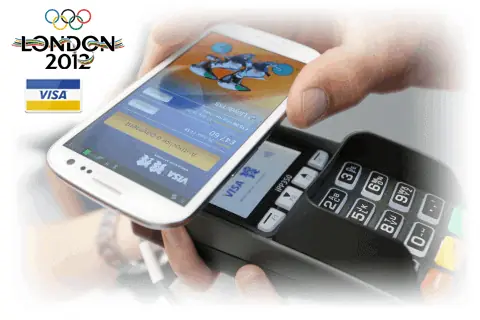
  • Visa Mobile Payments and Services: A limited edition of the Samsung GALAXY S III, Samsung’s Olympic Games Phone during the London 2012 Games, will be provided to Visa sponsored athletes and trialists. The device will feature an Olympic-branded version of Visa’s mobile payment application, Visa payWave. To make purchases, consumers simply select the Visa icon on the Samsung device and hold the phone to a contactless payment terminal to pay.
  • Visa Mobile Prepaid: During the London 2012 Games, Visa Inc. will also showcase its newest product – Visa Mobile Prepaid – the first mobile-based Visa product providing consumers in developing countries a payment account that offers Visa’s high standards of security, reliability and global interoperability. By accessing their Visa Mobile Prepaid account on their mobile phone, consumers can send and receive international remittances, pay bills, top-up wireless minutes, and access Visa ATMs.

Setting New Standards

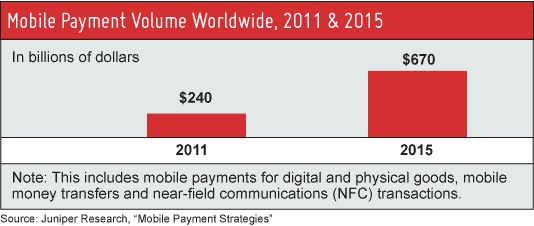
Looking at last year and then at this year’s statistics, Mobile Payments are doing their best to meet the bold predictions analysts have lined up for the future. The sector is growing rapidly and consumers in both the U.S. and around the world are embracing the convenience that the technology brings to their shopping habits. Juniper Research, a company that specializes in the identification and appraisal of high growth opportunities in various mobile telecommunications and applications sectors, put out a publication on July 5, 2011, titled “Mobile Payment Strategies.” Juniper predicted worldwide mobile spending would jump from $240 billion in 2011 to $670 billion in 2015.

Well Juniper is back with a new forecast that focuses on Near Field Communication (NFC) and this study predicts that in just five years the NFC Mobile Payments market will will exponentially increase and eventually exceed $180 billion — a whopping seven times what it is today. The study forecasts that one in four people from Western Europe and the United States will use NFC as a payment mechanism by 2017.

Juniper cites last year as a turning point for NFC payments and suggests that major consolidation of the technology is the impetus for the predicted growth in the market as consistent standards and protocols will help fuel rapid growth and assuage the security concerns of consumers. Juniper says that in 2011 major technology infrastructure standards were finalized within the NFC Mobile Payments market so that many mobile network operators committed to the market and NFC payment pilots from both mobile operators and financial institutions transitioned to commercial service. And the research firm pointed to NFC-enabled smartphone models being announced by almost all handset manufacturers and Google as a key factor for igniting interest in the mobile payment usage in the U.S.

“This is a critical time for the NFC retail payments market,” said report co-author Dr. Windsor Holden. “Despite the significant progress being made today, the full potential of the market can only be fulfilled if all ecosystem players are equally committed and mobile wallet consortia remain in place.”

E-Commerce uses Mobile Payments and Near Field Communications as new Merchant Services Solutions

Payment Processing Changes and How They Effect Small Businesses

It used to be one of the big decisions a small business had to make was whether or not to accept credit cards. But with E-commerce booming and consumers continually reaching for plastic instead of paper for their transactions, that decision has pretty much been made for small businesses. They have to accept some form of card payment as fewer people carry cash. However, the technology for payment processing is advancing at a high rate right now. And many studies predict mobile payments are on the verge of transforming the way people pay for things even more than before. The future of payment processing is ripe for change.

The Current Payment Processing Landscape At A Glance

Merchant Services, by its very nature, is an industry that for the most part seeks to work unnoticed by the consumer. The companies performing this service, which can be explained here in this Host Merchant Services infographic, tend to make their money off of percentages of a penny. Transaction by transaction those percentages grow into pennies, and as volume increases even further those pennies increase into dollars.

A lot of small business owners have horror stories about their payment processors because a really common practice that companies in the industry started to do to each other to compete better, was to boost the expenses from those transactions, and those percentages of pennies, with hidden fees and contractual obligations.

It got so bad that federal legislation, in the form of the Durbin Amendment, was passed as a way to combat debit card swipe fees. Host Merchant Services is already tracking the effects of those changes in a series right here on the Official Merchant Services Blog.

Changing the Game

But that’s not the only way the game is changing. Some companies, like Host Merchant Services, see the opportunity being created by the old standard. So HMS shines light on hidden fees, cuts away the fat from these agreements and HMS even goes so far as to not hold its merchants to contracts or termination fees.  Many of the features you find at Host Merchant Services are designed specifically to appeal to small business owners. A service oriented Merchant Services solution that lets the merchant know exactly what they are paying on their statement.

Technology Adds its Own Wrinkle

Beyond just what Host Merchant Services is doing to change the model for Merchant Services Providers, the industry is being shaped by advances in technology, specifically the potential for profits from mobile payments. Small Business Owners are starting to find the convenience of being able to process a payment anywhere can give them more flexibility to reach their customers. And so the companies developing the technology for these mobile payments are racing to reach the market with their ideas and advances.

Square Up  –  In 2009 the Co-Founder of Twitter, Jack Dorsey, introduced a breakthrough device that allows both individuals and businesses to swipe and process credit cards directly on their iPhone or Android phone. While Square was not the first company to do this, what set them apart was their fee structure and their lack of a contract. Square has no contract, does not have any monthly fees and only charges when a card is swiped or keyed in. They currently charge 2.75% of the transaction for each swiped card. This is their big selling point because Square lets small businesses that did not have the resources prior to begin accepting credit cards. This is appealing to small businesses with low or inconsistent volume that would normally be burdened by the heavy costs associated with setting up a merchant account.

Google Wallet  – On the other side of the payment world there is Google, who partnered with Citibank to create a new product called Google Wallet. This new mobile payment technology allows consumers to attach a credit card number to an embedded near-field communications (NFC) chip in their Android phone. This in turn gives that person the ability to make payments by swiping their mobile phone next to a chip reader.

NFC technology has been around for about a decade, and is still being tested in target market areas. Google Wallet will be tested first in New York City and Google hopes to roll it out for the rest of the country in 2012. Host Merchant Services noted this previously in an article.

HMSPay  – Host Merchant Services offers its own mobile payment solution, HMSPay. This is similar to Square in that it’s a device that attaches to an iPhone. And its big selling point is that it adheres to HMS’ standards of service and savings. Merchants who use it are able to get ultra-competitive rates that let small businesses take credit cards without being overwhelmed by hidden fees and other excesses found in the Merchant Services industry.