Tag Archives: mobile payments

Mobile Payments Made Live![2023 Update]

I’m back to once again speak about Mobile Payments and their presence in Delaware. In case you missed my last blog, it’s here. It’s really finally here. Barclaycard Mobile Wallet is an active program that participating merchants at the waterfront in Wilmington, DE, and along Main Street in Newark, are using. Right now you can use your phone to buy stuff!

So that’s exactly what I did. I set out to visit some shops and buy some stuff. To give this test run some authenticity, I decided to try and buy things I actually needed. Let’s see how the process works and how useful it is for real-time shopping!

But first, I needed to update my settings. After downloading the application, and adding a credit card to my account, I had noticed I wasn’t seeing any offers. Kara from Barclaycard saw my blog and reached out to help me.

So I needed to add another step in our process for getting the technology up and running. It may seem like a bit much at first, but trust me, it’s fast and easy to initialize.

Kara noted that I needed to add locations to my account to get the offers to show up. ZIP codes are the easiest way to do that. Wilmington’s ZIP is 19801, and Newark’s is 19711.

The Revised Set of Steps

So now, our updated steps to bring the power of mobile purchases right to your hot hands look like this:

  • Step 1: Visit this site and register for an account. This is key. You can’t just download the app and go. You need to register online first. Since you’re here online reading this blog, you can take a moment to click that link and get that out of the way.
  • Step 2: You go through the process of setting up an account. Choose a username, password, give your information.
  • Step 3: You add the card you want the wallet to charge.
  • Step 4: You can then download the app from the app store or google play store.
  • Step 5: Activate the app on your phone, and go through the log in process. You’ll be asked for your passcode, and to log in with your username and password, and even one of the additional security questions.
  • Step 6: Go to settings — the gear icon — and go to offer locations. Add locations. Use the ZIP code that works best for you (I used both). Then you go to …
  • Step 7: BOOM! Start buying stuff!

The Buying Stuff Part

Thanks to Kara’s timely advice, I had offers streaming through my phone immediately. Armed with mobile purchasing power and enthusiastic curiosity, I leapt from my centralized blogging and news update headquarters — taking this story live and direct to the macadam of Main Street Newark.

My first target was National 5 and 10, located on 66 E. Main Street. Boasting the world’s largest selection and lowest prices for University of Delaware merchandise, I decided to zero in on … art supplies. I needed a sketch book and a new pencil and eraser set to continue to design and draw projects like this more than I needed a new Blue Hens ball cap.

So I went to work racking up an impressive spree of supplies:

  1. Mechanical Pencil with lead refills, 0.5 mm fine point lead size. For the nitty gritty line work.
  2. Hi-Polymer Pentel white plastic art eraser. Because they take the pencil marks away but leave the ink behind.
  3. 5.5 x 8.5″ sketchbook, to help me rough out all my creative ideas.
  4. And to get my purchase up over $10, four 5 x 9″ bubble mailer envelopes, so I can send slick prints of my best portfolio pieces to people interested.

Total: $11.24
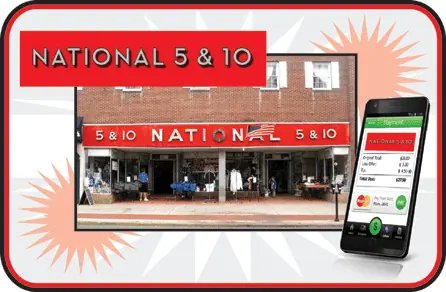
I took this stash of artistic loot to the one counter that was open. When it was my turn I happily stepped up and asked if I could purchase these with the Barclaycard app, and flashed my phone at the cashier. This caused quite a stir, as it seems I was the very first customer to utilize this technology. Excitement buzzed in the air. We moved this transaction over to the other side of the area where the Barclaycard Mobile Wallet Terminal was kept. Another cashier took over the transaction, but a crowd began to form. The owner came over to see this landmark purchase of a pencil, eraser, sketchbook and some envelopes take place. Customers took notice. And then it happened.

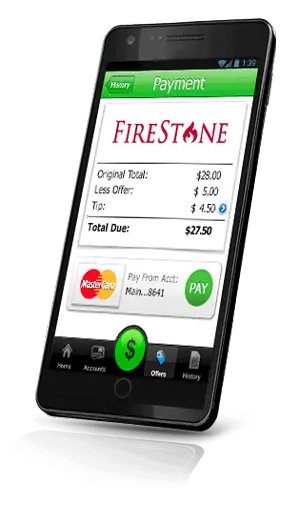
The cashier rang up the items. I had my phone out and the app open. I was prompted to scan the QR Code on the terminal. The app took over and in a flash my payment was recorded. I approved it with the click of a button. The cashier printed out my receipt and just like that it was over. Payment made. Stuff bought. Once the wow factor wears off, the process will turn out to be very easy. As fast as swiping a credit card, with none of the hassle of keeping a card on you in your wallet. Mobile wallet finally lives up to the hype. I take my phone everywhere, as do most people. I need it for emergencies — but also to keep up with work and friends while on the go. So tucking this payment power into it just consolidates everything, making shopping a seamless part of the package.

But Wait, There’s More

I made the effort to obtain a purchase of $10 or more to take advantage of the offer I saw on my screen. But it didn’t seem to take. Later in the day I found out the offer might not be live yet. So I moved on to my next stop: Switch Skateboarding, located on 54 E. Main Street. No worries here about finding an item over $10 in price, but there were no visible offers for Switch anyways, so I put that out of my mind and focused on finding something I actually needed — wrist guards.
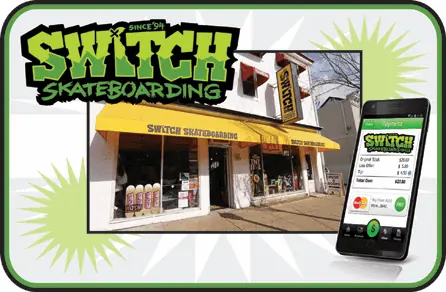
I haven’t been on a skateboard since I was 15 years old. But I’ve needed items that Switch sells almost regularly for the past four years because I’m a roller derby referee.  I picked up a pair of Destroyer wrist guards. I chose them primarily because I already have a pair of 187 wrist guards and an old pair of pro-tec, so wanted to see if these fit any more comfortably. They cost $17.

Once again I stepped up to the counter and announced my intention to purchase this item with the Barclaycard app. There was decidedly less of a fuss about it as the staff at Switch seemed to be both more chilled out in general and ready to handle the unusual request. However, just like at National 5 and 10, there was a swapping of cashiers in terms of who handled the transaction. Switch uses a different setup than 5 and 10. The skateboard shop is working a completely virtual system, running transactions through a computer. The payment seemed even more seamless than at 5 and 10. All that was involved was opening up their gateway in their browser, inputting the details of the transaction, scanning the item’s barcode and then it was up to me. Switch has a static, standing QR Code on a card atop its counter. I had my app open and ready. When prompted I clicked the button and my phone scanned the barcode. Once again it was lightning fast. And after clicking my approval of the sale, the transaction ended.

Success. I was now armed with a fully operational mobile payment telephone, a pair of brand new wrist guards and some art supplies that I needed. This took the idea of buying things with a wave of my phone from concept to cold, hard reality. I found myself wanting to do this everywhere.

The Only Downside

As far as I was concerned I came away from this excursion with only one negative — there just wasn’t enough visible presence to let consumers know this existed. At 5 and 10, I created a crowd, but I knew going into the store I could buy things this way. The terminal itself stands out as it is different from other terminals. But I wonder if it’s all that visible since it’s not exactly a place where consumers actually look. I’m reminded of the time I spend standing in line at places like Wawa or 7-11, where I’d really like to just swipe my phone and go. I don’t even look at the terminal until I have to. How do you let people know they can do this now? Do you start to ask them, “Credit, Debit or Mobile?”

Or do you just get the word out there with more and more buzz, like this blog or a demonstration in the store at key high traffic times? Do I just keep telling my friends, “Hey, check out what I can do?”

It’s probably a mixture of all of those ideas. The technology is now here. It works. And it’s very easy to use. The ball is rolling. It just needs to pick up speed and add more snowy mass as it rolls along.

Apple’s Passbook to replace Gift cards

Today the Official Merchant Services Blog, along with the rest of the world, will take a look at the new iPhone 5 being debuted in California today.  Specifically, we will look at one of the new iOS 6 features called Passbook.

Passbook is a new app, exclusive to iOS 6, the feature lets users store and quickly retrieve electronic versions of tickets, boarding passes and merchant cards all in one place according to executives at the WWDC 2012 today.

The app aims to replace almost all paper tickets, coupons and plastic gift cards that might be taking up space in a user’s wallet.  Apple already has partnerships with a number of airlines, retailers and venues including Virgin Air, Delta, and Starwood Hotels.

In a demo, senior Vice President of iPhone software Scott Forstall showed how to use the app with a San Francisco Giants baseball ticket.  The feature will also work with Starbucks and Apple Store gift cards.  Adding to its already intriguing features, the app is dynamic, so users will be notified of any flight delays or gate changes. Users can also be alerted when near a movie theater that they have tickets to or rewards points that can be redeemed.

The app uses a special QR code that can be scanned by the participating retailer to redeem that ticket or coupon. Done with a particular card in Passbook? A virtual shredder “shreds” it on screen.

Is it a mobile wallet?

Well no, Apple hasn’t announced any kind of payment feature yet for the Passbook app, but don’t rule that out just yet.  With the migration towards digitizing all of this info, as well as the time and location based triggers that give you what you need, when you need it this app is the one to watch in the festival of new software coming out of Cupertino, CA.

Passbook will roll out along side iOS 6 on September 19th, and the iPhone 5 will be begin shipping September 21st. As usual, we here at Host Merchant Services will keep you updated with all of the breaking news in the mobile payments world.

Mobile Payments Descend on Delaware [2023 Update]

It’s here. It’s really finally here.

Mobile Payments are available in Delaware.

Barclaycard Mobile Wallet is an active program that participating merchants at the waterfront in Wilmington, DE, and along Main Street in Newark, are using. Right now you can use your phone to buy stuff!

For Me, This is Big

Normally I try to maintain some composure and tact when scribing The Official Merchant Services Blog but I’m a little too excited to keep calm. Mobile Payment Processing– as I noted in my last blog entry about how long it was taking Near Field Communication to get here — is a topic I’ve been fascinated with my entire time working in this industry. And I’ve reported how each new take on the technology has been inching forward, how the pieces are in place for X, Y or Z to finally break through and for U.S. consumers to be able to start waving their phones around like lightsabers, cha-chinging their way through purchases.

Got the Ball Rollin’

For the most part it’s been tiny test markets using the things that are active — test markets nowhere near me or my shopping stomping grounds. And then there’s been other technology riddled with delays. And then there’s been discussions about security issues. It just seemed like this crazy new purchasing power was not going to come to a store near me anytime soon. The Magic 8-Ball Blog I wrote back on October 18, 2011 seemed to have encapsulated the entire issue.

Me: When will Mobile Payments get here?

Magic 8-Ball: Ask Again Later.

And even just the other day I was stuck in the same morass of Mobile Payments taking too long to get going, as I reviewed the status of NFC and looked at Isis getting ready to finally hit test markets — in Utah and Texas.

Then I found out about Barclaycard and their Mobile Wallet. It’s here. It’s live. It’s working in the areas where I shop.

barclaycard mobile wallet logo on Host Merchant Services

So Let’s Get Started

All I had to do was sign up and start trying this technology out. This blog is as close as I will probably get to real-time reporting on the Credit Card Processing Industry. I’m going through the steps to acquire this purchasing power right now. Here’s what I’m doing:

  • Step 1: Visit this site and register for an account. This is key. You can’t just download the app and go. You need to register online first. Since you’re here online reading this blog, you can take a moment to click that link and get that out of the way.
  • Step 2: You go through the process of setting up an account. Choose a username, password, give  your information.
  • Step 3: You add the card you want the wallet to charge.
  • Step 4: You can then download the app from the app store or google play store.
  • Step 5: Activate the app on your phone, and go through the log in process. You’ll be asked for your passcode, and to log in with your username and password, and even one of the additional security questions. But then you go to …
  • Step 6: BOOM! Start buying stuff!

Now Where do I go to Buy Stuff?

I now wanted to witness the firepower of this fully armed and operational battle station … I mean Mobile Wallet. Here’s a list of participating merchants:

Newark
  • SAS Cupcakes
  • MainStream Nutrition
  • Switch Skateboarding
  • National 5 and 10
  • Caffe Gelato


Coming Soon to Newark:

  • Gecko Fashions*
  • Over Easy*
  • Moxie Boutique*
  • Cosi*


Wilmington:

  • Al’s Sporting Goods
  • Harry’s Fish Market & Grill
  • Dryrock Café
  • Veritas
  • FireStone
  • eeffoc’s
  • Water Street Deli
  • Olde World Cheese Steak Factory
  • Cosi
  • Bella Vista Pizzeria
  • Zaikka Indian Grill
  • Riverfront Produce
  • Harry’s Seafood
  • Extreme Pizza

But Wait, There’s More!

This is more than just a way to buy things with your phone instead of your wallet. This program is a combination of sales promotion and mobile payment power. Now that I’m signed up and active, I will be able to pay with mobile and receive special offers from local merchants. That’s the added value — merchants who participate in this mobile wallet community will be able to offer me deals and specials. Think of it like this: It’s a mobile wallet with a built in groupon. It’s merging the best aspects of QR-Code technology and consumer convenience.

The app functions off of the QR-Code technology that we’ve discussed multiple times in the past. This technology was already ahead of other options as it had been harnessed for marketing purposes in the previous few years. In fact, it’s the one mobile payment option I’ve already had the good fortune of experiencing back in May through Fandango. These mobile payment solutions are generally pretty straightforward. They usually consist of an application on a merchant’s device that allows them to scan a barcode, or a QR Code. The QR Code scanning is becoming extremely popular, giving companies the ability to run marketing promotions as well as purchases through the use of the QR Code and its ability to capture information. Fandango’s Mobile Ticket program allows you to purchase your movie ticket through their application and then just scan the QR Code they send to your device when you arrive at the theater. This program has been gaining increased success and popularity this summer, and as we reported, set record highs for the company with the release of the blockbuster Avengers Movie.

What Barclaycard is doing is in-line with this description. You will use QR Codes to make purchases with your phone. But the app also seamlessly fuses the marketing power into the experience. As a Barclaycard Mobile Wallet user, I have access to exclusive offers available and redeemable only through the wallet. Offers will update at least once a week. I currently have no offers, but I just signed up 10 minutes ago so I will have to check back.

Twitter Targeted Ads

Twitter Tune Up: Targeted Ads [2023 Update]

Today the Official Merchant Services Blog would like to focus on social media advertising, and the recent steps Twitter has taken in order to expand their marketing prowess and outreach.

The social media giant with its 140 million monthly active users is second only to Facebook.  As we have previously reported here, Facebook had taken steps to create a realm of e-commerce unseen before in the social media world.  By transitioning from the ‘Like’ button for certain pages and products, to the ‘Want’ button, in an attempt to allow users to create personalized wish lists, the move will eventually lead to more purchases through Facebook itself.

The move spurred social media innovation, and Twitter has since come up with its own targeted marketing approach.  The new capabilities will allow marketers to identify, advertise and even send direct messages to consumers based on interests and likes.  For example, a consumer who has indicated an interest in digital photography would see ads for cameras and other photography related products.

There are two main ways Twitter will attempt to narrow down its user base.

First, Twitter has divided its users into 350 different interest categories.  They range from “education” to “investing” to “sports,” and are further divided into subcategories.

The second way involves targeting a more specific set of users, by creating a custom list of usernames that are relevant to what they want to promote.  The custom segments would allow marketers to reach users who share similar interests with that username’s followers, however they cannot target that users’ entire following.

Twitter has given the example of an indie band promoter that creates a custom audience by adding the ‘@usernames’ of similar bands, ensuring an audience with a similar taste in music.

Questions still remain about the overall effectiveness of the targeted ads.  For example, the click through and conversion rates are still unknown.  Twitter has been testing the system using beta advertisers, who can attest that there has been “significantly increased audience reach” as well as high engagement rates.

To bring this all back home, I believe there is outstanding value in Twitters’ targeted advertising system.  It will allow marketers to go beyond ‘Promoting’ their tweets, a system that would raise your post to the top of users Twitter feeds for a short time, however there was no targeting involved whatsoever.  With this new system, end users see more products that appeal to them or are related to their interests in some way.  Thus driving sales for that particular product, if the right target market is reached. This could be especially useful to the average small business owner, who may only rely on social media to promote the company, instead of a dedicated web page.

This could lead to a large boost in mobile commerce, through Twitter users who simply find an advertised product to their specific liking.  The push is meant to increase ad dollars to Twitter from eager marketers, as well as more effectively reach its user base with relevant ads and content.  It seems logical that the next step would be for Twitter to implement a direct buying feature for their 140 million users, this would further spur innovation and the competitive mobile payments market, as well as open up new E-Commerce solutions for businesses and advertisers.

NFC Taking Too Long?

When I first started writing for this website, and The Official Merchant Services Blog, a topic I was both fascinated with and completely astounded by was Near Field Communication (NFC). It seems fitting that on the eve of the National Football League’s 2012-2013 season debut — a rare Wedensday Night Football game — which features a gridiron battle between the Dallas Cowboys and New York Giants, two mainstays of the National Football Conference (NFC), that I would once again be tackling the topic of NFC. The first time I saw the acronym I thought it was talking about football.

It wasn’t.

It was talking about technology that was poised to revolutionize payment processing and make everyone’s phone their wallet. We were going to be radically transformed from a cashless society relying on plastic cards with magnetic stripes into a cashless society relying on waving around your smartphone at registers and terminals who pick up your signal and magically charge your account. One swipe of the phone, and no hassle whatsoever, as Near Field Communication did all of the talking back and forth between devices while you figured out what you were going to buy next.

But over the past couple of years, the dominance of NFC has pretty much mirrored the Dallas Cowboys own dominance of the NFC in which they play. A lot of hype, but not a lot of tangible financial results. The biggest proponent of NFC has been Google Wallet, but another giant of the NFC industry-in-waiting has been Isis. Just like the NFL season, Isis — the mobile-payment joint venture backed by AT&T Inc., Verizon Wireless and T-Mobile USA Inc. — is poised to get underway in September too.

VeriFone Systems Inc., a maker of payment terminals that Host Merchant Services offers for free to qualifying merchants that sign up with them, is working on the Isis project. Chief Executive Officer Doug Bergeron said in an interview with Bloomberg that VeriFone is preparing to introduce Isis in Salt Lake City and Austin, Texas.

Isis had initially planned to roll out its NFC-based mobile payment service in the first half of 2012. The joint venture tweaked its strategy last year, opting to use credit-card companies to handle transactions rather than the carriers themselves. This shift has taken time to implement because its been focused on ensuring payments can be made securely — the single biggest fear that consumers have voiced about mobile payments.

Are You Ready for some Mobile?

So now that Isis is on the cusp of kicking off NFC-fueled mobile payments in select areas, is this validation for the technology? It doesn’t seem that way. Google Wallet’s NFC-integration still hasn’t come to my local shopping areas. But many other mobile payment options have. I can and have bought movie tickets on my phone. This was done using the QR-Code technology which seems to have had a quicker integration into the U.S. Economy at large. It was something that many companies were already using for their marketing so utilizing the technology to work for payments was faster as it relied on infrastructure already in place, and consumer fears of security were lower since consumers had already opted in with the codes.

Toss Square’s partnership with Starbucks and PayPal’s partnership with Discover into the mix and it seems like the Mobile Payments industry has decided it wants to score an industry-wide touchdown with or without the help of NFC. In fact, Devindra Hardaware suggests in a column for VentureBeat that the industry could still make use of the ideas in NFC, but completely bypass the ground game entirely by going with an aerial assault guaranteed to score big with consumers: “There’s still plenty of room for mobile wallets to disrupt the way we pay — just look at the Pay with Square with app, which lets merchants charge you just based on your name and face. In many cases, you won’t even need to pull your phone out of your pocket.”

Wal-Mart Tests “Scan & Go” iPhone app

Keeping the Official Merchant Services blogs’ focus in the technology and mobile realm, today we take a look at the newest tech to be utilized by the retail giant Wal-Mart, which could potentially make the process of checking out more personal and faster.

Last week, Wal-Mart initiated testing of its new “Scan & Go” iPhone app in a Rogers, Arkansas supercenter near the company’s corporate headquarters.  Employees who had Apple Inc. iPhones were among the first to be able to test out the new app and it’s features in store.  The app allows customers to scan products as they shop and put them in bags in their carts. When it comes time to check out, the app transfers the scanned items to the self-checkout kiosk and the customer pays with conventional means (cash, check, or credit card).

The app does not allow users to pay on their phones yet.  However, we recently reported here that Wal-Mart had joined forces with other large retailers to begin creating a retailer-focused mobile wallet app called Merchant Customer Exchange, or MCX.  I expect to see some sort of integration between the “Scan & Go” app and the finished MCX product after it is unveiled.

The new system intends to skirt long lines at the retailers’ checkout counters, a widely held complaint of Wal-Mart shoppers.  Customers have even taken to Twitter to vent frustrations at times. The push to eliminate the need for cashiers and baggers could save Wal-Mart millions of dollars, said Chief Financial Officer Charles Holley.  The company spends about $12 million dollars in cashier wages every second at its U.S. Wal-Mart stores.

Wal-Mart’s iPhone app already includes functions such as letting shoppers create lists and seeing which items are in stock. Spokesman David Tovar said of the program, “We’re continually testing new and innovative ways to serve customers and enhance the shopping experience in our stores.”

This test comes as many retailers attempt new ways to speed up the checkout process and become innovators.  Wal-Mart declined to give details on where the test might lead, but it doesn’t seem a far leap to other mobile phone platforms (Android and Blackberry) as well as mobile payment options in the future.

Discover Teams Up with PayPal

Discover Teams Up with PayPal [2023 Update]

The Official Merchant Services Blog continues to shine its spotlight of educational information directly on the Mobile Payments Industry. This bristling business sector keeps creating buzz among payment processing persons as well as overall economic assortments. One minute people are predicting hundreds of billions of dollars in revenue will get generated by consumers embracing the cashless society model and conveniently swiping their phones to pay for every little thing that catches their eye. The next minute people are predicting U.S. consumers are too wary and cautious and not ready to expose their information to the cloud and the criminals trying to crack their way into that cloud.

This titanic tug-of-war between “the next big thing” that economic analysts desperately desire M-Payments to become and the “hold your horses hombre” caution that those same analysts caveat the slow acceptance in U.S. markets has been defining the media coverage of the Mobile Wallet Madness for more than a year. But the potential for prodigious profits has pushed the possibilities of mobile payment processing through the morass of misgivings.

Merchants United!

As we purposely pointed out to our peerless readers just mere days ago, the Merchant Customer Exchange was formed. This epic assemblage of retail industry giants teams Wal-Mart Stores Inc., Best Buy Co. and Target Corp, 7-Eleven  Inc., Alon Brands Inc., CVS Caremark Corp., Darden Restaurants Inc., Lowes Co., Sunoco Inc., Sears Holding Corp. and the Publix Supermarket chains into a mega-group of retail merchant might on a mobile wallet mission.

Coming on the heels of Visa’s saturation of the 2012 London Olympics with all things Mobile and all things Visa, the mighty mingling of the MCX merchants applied unforeseen amounts of pressure on the mobile payment marketplace.

Mobile Payment Paring: Discover and PayPal

On August 22 PayPal, owned by eBay, announced a deal with Discover Financial Services to bring PayPal access to the 7 million merchants in Discover’s network. This deal will begin in the second quarter of 2013 and the announcement was made a mere two weeks after Square partnered up with Starbucks to let customers pay with Square’s app at the 7,000 U.S. Starbucks locations.

Excelsior! Retail titans are teaming up with mobile gadgeteers in one mass scramble to make it to market before the U.S. consumer becomes firmly affixed on the easiest and most widespread brand — as is wont to happen with U.S. shopper market behavior.

The PayPal deal is a particular point of note because PayPal itself is pushing from the online marketplace back into the physical realm of brick and mortar. This may indeed help bridge the gap from e-commerce to old fashioned commerce, and that bifrost of payment processing could very well buttress mobile payment processing in a brave new world of cashles-sness and contactless transactions.

The super-powered pairing of Discover and PayPal drove stock prices for each company, with Discover gaining 3.9% and eBay gaining 2.5% on the market the day the announcement was made. This arrangement will greatly accelerate PayPal’s in-store payment efforts. By riding on Discover’s network, PayPal can get into more locations  and get there quickly. Best of all this movement doesn’t requiring any significant integration work by merchants. That potentially puts PayPal at a big advantage against rival mobile payment systems such as Google Wallet, Isis, and Square.
Discover is integrating PayPal’s payment system into its software, which will be uploaded to millions of point-of-sale terminals that support Discover Card payments. PayPal’s branding and rules will be presented to consumers who choose to pay in store with PayPal. PayPal currently has more than 50 million U.S. customers who will be able to take advantage of in-store payments.

mobile wallet

Mega Retailers Jump into Mobile Wallets [2023 Update]

Today the Official Merchant Services Blog will continue with our Mobile Commerce theme. A group of 14 Major U.S. Retailers recently announced that they have decided to join forces and create their own mobile wallet application. The group, which includes Wal-Mart Stores Inc., Best Buy Co. and Target Corp., will call itself Merchant Customer Exchange, or MCX.

MCX has no official launch date as of today, but the merchants are determined to jump head first into the expanding mobile payments market. The network of merchants also includes 7-Eleven  Inc., Alon Brands Inc., CVS Caremark Corp., Darden Restaurants Inc., Lowes Co., Sunoco Inc., Sears Holding Corp. and the Publix Supermarket chains.

Merchant Customer Exchange

MCX seeks to corner a piece of the mobile payments market, expected to balloon from $172 billion this year to $600 billion by 2016. The new merchant super group plans on offering a mobile-commerce solution capable of seamlessly integrating a wide range of consumer offers, promotions and retail programs. The application will be available through virtually any smart phone.

This move comes about a week after Starbucks announced partnering with Square, a mobile processing start-up that uses smart phone attachments to accept credit cards. Now MCX will not only compete with Square, it has taken away 14 potential partners from the processor. MCX is also bad news for Google, which has been expanding its own mobile wallet platform, called Google Wallet over the past year. Google Wallet uses NFC, or near field communication to transmit payment data from a customers smart phone to an NFC-enabled payment terminal.

Mega-Merchants

With these mega retailers coming together, a new perspective can be used to develop mobile wallet apps. The retailers want to focus on ease of use and security for the consumer.

“As merchants, no one understands our customers’ shopping and payment experience better than we do, and we’re confident that together we can develop a technology solution that makes that experience more engaging, convenient and efficient,” said Mark Williams, president of financial services at Best Buy.

Mike Cook, corporate vice president and assistant treasurer of Wal-Mart said, “the MCX platform will employ secure technology to deliver an efficiency-enhancing mobile solution available to all merchant categories, including retail stores, casual dining, petroleum and e-commerce.”

Now with many more contenders in the mobile commerce arena, the only thing consumers can do is wait for the dust to settle. The great race to mobile wallet supremacy has begun!Host Merchant Services will keep you up to date on all new technology developments and potential partnerships relating to the mobile payments world.

What Brand is Your Wallet? [2023 Update]

Today The Official Merchant Services Blog keeps examining the rapidly growing payment processing sector of Mobile Payments. With an never ending stream of deals being made by startups and established companies developing the latest gimmicks and technology to bring mobile payments and mobile wallets to the average everyday U.S. consumer driving the marketplace, it’s easy to get lost in a sea of mobile payment processing media hype.

In our blog yesterday we were able to see how some of that disconnect works. Visa pushed mobile payment technology aggressively at the London games. Their plans were almost scuttled by a malfunction with the processing terminals during a men’s soccer match between Great Britain and United Arab Emirates. The crowd was cranky as they were unable to pay for concessions using a mobile phone or a credit card. They had to resort to cash, and many patrons were unprepared for the anachronism.

This wrinkle in Visa’s mobile plans underscores how fragile mobile payment technology still is; and it also highlights how close we’ve come to a cashless society — the kind of society where mobile payments promise to be a thriving and convenient way to pay for goods and services.

The Knock on Mobile Wallets

The continued skepticism U.S. consumers have with mobile payments can be found summarized well in this L.A. Times article by David Lazarus. The main theme is something we’ve covered extensively in the past year: Mobile Payments are the future, but people are worried that the payment processing is not secure. It seems that for almost every story published about how mobile wallets are going to revolutionize e-commerce and make billions and billions of dollars in profit, there’s a story like this one that says consumers are worried about security, fraud and identity theft.

These are valid concerns. Much like regular old online shopping — which has become ingratiated into the average U.S. consumer’s shopping habits — the threat of tech savvy criminals stealing pertinent payment information is an ongoing issue. Everything from phising scams to data breaches affect e-commerce. But none of it has stopped the juggernaut from steam rolling consumer buying habits. Everyone shops online because of the ease and convenience. This is powered by how easy it is for people to be online, click some buttons and buy something. The power of convenience trumps security concerns.

This will happen for mobile wallets as well. Once the technology gets out in front of people they will flock to it because it is easy to use and available where they shop.

Convenience is the Key

So what I believe is the current obstacle holding Mobile Payments back from making a huge splash with U.S. consumers is the fractured marketplace. They’re not readily available at the store when you go there. There’s too many variations on the theme. And too many different companies trying to inject a new technological advance into the sector before it gets traction with consumers. We covered the top types of Mobile Payment technologies recently, and even keeping our analysis to just a few contenders we’re stuck noticing a competition between Near Field Communication driven “Swipe Phone” technology and QR-Code driven “Scan” technology.

iPhone 4S Drives Mobile Commerce

Recent reports by Monetate show it gets even simpler than that — Smartphones themselves. Gone will be the advertising slogan of Captial One, “What’s in your wallet?” that questions what plastic card you use. Instead it will be “What brand is your wallet?” Or rather, which smartphone are you using to pay for things with — iPhone or Android?

According to the data from Monetate, the answer used to be in doubt as late as Q4 2011; and is now a resounding iPhone by Q2 2012. Monetate released its E-Commerce Quarterly Report for the second quarter of 2012, and the figures showed some dramatic changes in smartphone usage driving e-commerce traffic.

According to the report, “Leading e-commerce websites receive 3.31% of their total visits from smartphones running Android, up from 1.76% last year and an increase of 85% in total shopping sessions. These same websites receive 5.41% of their traffic from iPhones compared to 2.45% a year earlier, an increase of 117% in total shopping sessions over the same time period.”

The data showed that in Q4 of 2011 websites received 1.99% of their total visits from Androids and just 2.25% of their visits from iPhones, suggesting the two competing smartphone systems were about dead even. The iPhone 4S was released that quarter however, and iPhones spiked way ahead of the Android.

Despite that spike in iPhone usage, the report indicated that shoppers on Android-powered smartphones converted better than iPhone users — Android converting at a 1.26% clip and iPhone at a 1.00% clip.

What Does This All Mean?

Well even with iPhone getting a bigger spike than Android, both phones grew their e-commerce usage in 2012. That means the goal of realizing those heady revenue predictions from companies like Juniper and Gartner Research are on course. The security concerns may make good copy for the media, but the real obstacle remains saturation in the actual physical marketplace. Give people more opportunities to pay with their phones and they will readily begin to pay with their phone. It will start off as some new gimmick people want to try. And then it will become second nature.

Olympic Payments: Cash Takes Gold

Today the Official Merchant Services Blog will take a look at the role Mobile Payments played in the 2012 London Olympic Games.

Visa, the official Payment Payment provider of the Olympics pushed for Mobile Payment Technology as a safe and convenient payment option for consumers throughout the London games. Jim McCarthy, Head of Products at Visa Inc., said “This summer we will be demonstrating the future of payments in London – a future where most consumers will rely on mobile devices, tablets and PCs to manage their daily financial lives.”

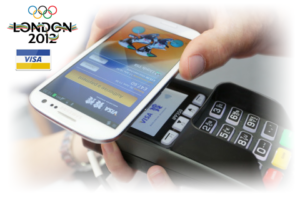
As a part of Visa’s Olympics marketing push for the future of Mobile, a limited edition Samsung Galaxy S III was provided to some Visa sponsored athletes and trialists. The device featured an Olympic-branded version of Visa’s mobile payment application, Visa payWave which uses Near Field Communication technology, or NFC. To make purchases, consumers simply needed to select the Visa icon on the Samsung device and hold the phone to a contactless payment terminal to pay.

It seemed as though Visa had all the pieces in place to make this Olympics a Mobile Payments success; a dominant payment network, including Visa only ATMs positioned throughout the games, NFC-enabled vendors able to take the mobile payments, and spectators with smart phones who could pay via mobile. The only problem was competing against an Olympic veteran of every games, cash.

During Great Britain’s Men’s Soccer match versus the United Arab Emirates, spectators were unable to pay for food and drinks at Wembley Stadium by credit card or mobile payment after terminals went down.  Many ticket holders described the lines that subsequently built up as ridiculous and said a lack of cash machines at the west London ground added to the problem.

A spokesman for Visa was quick to point the finger at Wembley officials, placing the blame firmly on the stadium’s network infrastructure saying, “We understand that Wembley’s systems failed and therefore they were only accepting cash at the food and beverage kiosks.”

Twitter was bombarded with thousands of angry posts from people who found it completely unacceptable that they couldn’t feed themselves. This was due to the fact that the only available way to pay was with old-fashioned cash and coins, a means of payments Visa wanted to push away from with its mobile payment implementation.

In these games, mobile payments did not expand as much as Visa had anticipated.  Add that to the complete network failure at Wembley Stadium and it would seem that mobile payments were a flop at this year’s Olympic Games.  The silver lining however, is that mobile payments did have a huge presence at the games.  And the uproar caused by the network failure seems to prove that we are moving away from cash as a society.  Just a few years ago, credit card terminals going down at the Olympics might not have been such a big story, let alone a trending topic on Twitter.  It seems for the London Olympic Games, cash took the gold medal yet again in payments, but with the doubling of Mobile users here in the U.S. and the increase globally; cash may soon be unseated by mobile payments.