Tag Archives: merchant services

Finding Quality Merchant Services [2023 Update]

Today The Official Merchant Services Blog is playing a bit of catch up. The story we’re going to highlight and discuss is almost three weeks old. It was intended to run earlier, but technical difficulties with the blog’s production kept it from appearing until now. However, we feel the story is still worth some attention due to the issue it highlights about the payment processing industry.

The story comes to us from a Chicago, IL section of the Better Business Bureau (BBB). This article from the BBB says that the organization has seen a 42% rise in complaints against credit card processing services. The article, which originally was posted by the BBB on December 15 found that complaints were up for the 12 month period in 2011 compared to the previous 12 months. The breakdown was specifically 110 complaints in the recent 12 month period versus  77 complaints in the period prior.

Not Just In Chicago

The complaints aren’t just lodged in Chicago. This article from Fox40.com details similar complaints in Sacramento, CA. The article states: “The Better Business Bureau is warning businesses to beware of sales pitches by credit card processors that don’t reveal key details that could end up costing business owners more than they bargained for.”

And it quotes Caitlin Peterson of the Better Business Bureau of Northern California as saying “We’ve had over 1,700 complaints this year against the merchant processing business.”

A graphic from Host Merchant Services detailing the rise in complaints against credit card processors for the BBB

What the Problem Is ?

From reading through the two articles — as well as an older BBB article about issues in the St. Louis, MO area — the problems that merchants are encountering are really straightforward. Business owners are being approached by salespeople offering big savings on their payment processing. And then once the merchant signs a contract with that person, they are saddled with hidden fees for services they were not told about. In short, the business owner is led to believe they are getting a great deal but end up having to pay out more because of all the things not mentioned in the deal. So complaints against payment processors rise in select areas.

Pricing and Transparency

This type of behavior is the exact reason Host Merchant Services utilizes its philosophy of Interchange Plus pricing and no hidden fees. These types of issues are why CEO Lou Honick says “Host Merchant Services is about bringing trust to the payment industry.”

“Payment processing is confusing,” says Honick, noting the ease in which merchants can get saddled with the types of issues that have cropped up with the BBB complaints. “The big guys make it difficult to understand exactly what your rate is and what fees are associated with accepting credit cards. We deliver personal service and clarity. Our people care about customer service and will take the time to explain how everything works.”

Honick also cites the process that Host Merchant Services uses to directly counter the problems that business owners encounter with other processors: “We believe that when you get your statement every month, you should understand every item, and it should match what you were promised in the sales process. If you have a question, there is a live person at Host Merchant Services ready to assist you.”

The Details

One of the primary ways Host Merchant Services combats the practices that lead to these complaints is with their pricing structure. Host Merchant Services uses Interchange Plus pricing instead of the more standard tiered pricing format. Interchange Plus makes statements easier to read, customer service easier to provide to merchants, and savings much easier to guarantee. Here’s a small graphic explaining the basics of how Interchange Plus works:

Interchange Plus by Host Merchant Services

You can review a comparison between Host Merchant Services Interchange Plus pricing — which is simple and transparent — and the tiered pricing plans that other processors use in a two-part blog series that The Official Merchant Services Blog ran in October, 2023.

  • Part One
  • Part Two
  • Follow Up

What the BBB Advises ?

The BBB advises merchants take these steps to avoid getting stuck with the issues that their complainants have encountered:

Ask around.

The BBB suggests getting at least three estimates from different Payment Network Providers and to checkout he BBB Business Review of the merchant processing service. They also suggest asking fellow business leaders for referrals.

Know where to turn.

The BBB advises you check up on the support team that a potential Merchant Services Provider offers you. Can you contact them 24 hours a day? What is their response like outside of typical business hours? And the BBB advises you make sure their technical support can handle your needs as that kind of support is vital to your business’ success.

Try them out.

The BBB says that you should not settle without a trial period. You should make sure that the payment processor you choose has a 100 percent money-back guarantee before selecting them. Make sure their service works for you, and make sure they keep their promises to you.

Don’t get locked in to a long term contract.

The BBB is very clear on this. Never commit to a long term agreement that locks you in. Make the merchant services provider earn your business each and every month.

Get references.

The BBB advises that you get the payment processor to provide you with references. And then suggests you spend some time checking up on those references.

Make sure you know what you’re being charged for.

The BBB says that if you have a question regarding a fee that you were charged, ask the merchant services provider. Don’t let them hide fees on you. Make sure you understand your statement.

How Host Merchant Services Stacks Up 

Host Merchant Services falls in line with what the BBB advises merchants to do. The company places a big emphasis on transparency. Their salespeople will explain a merchant’s statement in detail. One of strengths of the offering from Host Merchant Service is their guarantee to save a merchant money. They achieve this by a statement analysis. Not only will Host Merchant Services explain the details of what your statement and fees are, completely transparent, while you process with them, they’ll also explain where the hidden fees are with your current statement.

Host Merchant Services will provide references. They do not lock you in to a contract. They do not charge you a termination fee. They provide free equipment and free paper for your terminals. And they offer 24-7-365 customer service where they guarantee you will talk to a real person that will help you out with your issues. You can even initiate a live chat with HMS Support right from any page on their web site.

As Host Merchant Services COO Dan Honick says, “You stay with us because you’re happy.”

E-Commerce: Review and Preview

The Official Merchant Services Blog begins our second year of blogging with a look at one of our favorite topics: E-Commerce.

2011 saw huge gains for online shopping. As reported in The Official Merchant Services Blog on Cyber Monday, online shopping was strong on Black Friday. IBM research unit Coremetrics stated that 20% more consumers shopped online Black Friday 2011 than did in 2010. The data collected also states that 39% more online shopping happened on Thanksgiving Day 2011. The ease of online shopping is infiltrating the traditional brick-and-mortar retail event and Host Merchant Services‘ analysis of it held true –– sales numbers across the board rose from 2010, so overall Black Friday had a boost for retail, but clicks from e-commerce continue to grow and cut into the sales from bricks.

Also, mobile payments saw a huge increase during the holiday shopping season. According to this article from Seeking Alpha, mobile payments business increased 500% from 2010 on Black Friday. According to the article, PayPal mobile reported the huge increase, coming in at 511% to be exact. PayPal Mobile also noted that there was a 350% increase in mobile shopping on Thanksgiving 2011 when compared to 2010.

The Numbers Keep Coming In

This article by Internet Retailer demonstrates that Black Friday was just the beginning. There were more than 3,000 transactions totaling $141.6 billion in 2011 in the marketing, media, technology and service industries according to data collected by investment banking firm Petsky Prunier LLC. Of those transactions the E-Commerce and digital media segment was the most active, with 1,159 deals valued at more than $44 billion.

All of this activity demonstrates strength in the E-Commerce industry, and suggests that 2012 is a year primed for continued growth and success — which combines with the already rampant predictions of success for Mobile Payments within the E-Commerce industry.

Host Merchant Services Online Shopping E-Commerce Credit Card Payment Processing Image.

Is There A Bubble?

This article from moneycontrol.com asks the question, “Will the E-Commerce Bubble Burst?”

Comparing the recent success to the success of internet companies in 2000 and 2001, the article tries to figure out if the bubble will burst like it did back then for tech companies. The author’s opinion is that the similarities are only on the surface, and that the two situations are vastly different — suggesting that in the end, it’s not a bubble that is going to burst but rather an industry that is going to grow and evolve. The article looks specifically at the E-Commerce sector in India, but does spend time detailing the big picture globally.

Online Shopping is Now Commonplace

To really underscore the potential growth that E-Commerce has in 2012, this article from Daily Deal Media talks about how popular online shopping is becoming with moms. The article cites a BabyCenter survey which suggests that: “71% of moms regularly turn to websites such as shopping engines and review sites to compare prices. Another 56% admit to searching for coupons or digital discount opportunities on a regular basis.”

This is a compelling point in regards to the overall picture of E-Commerce. It has become more and more commonplace in everyday life for shoppers around the world. Mothers are turning to it for the convenience of being able to get shopping done quickly and efficiently, according to the article. And it is just become an ingrained part of our economy, fueling the potential for further growth.

Host Merchant Services E-Commerce Mobile Payments image

Mobile Payments Big Problem

The potential growth for Mobile Payments is huge. But the one thing holding it back in the U.S. is security. Just as online shopping has become more and more commonplace, people have gotten comfortable with making payments online. That brings risk, as phishing scams and credit card fraud has increased. But security standards like the PCI DSS have helped to make the mainstream comfortable with clicking the pay button and giving out their payment information.

Mobile Payments, however, are not quite there yet in terms of acceptance. This article from the Chicago Tribune discusses the looming security issues that the mobile payments market faces. As the article states: “While the first mobile virus dates back to June 2004, risks from hackers remained limited because of the relatively small size of the market. But this has changed with the surge in the smartphone segment, which this year outgrew the PC market, and the new dominance of Google’s Android software. The emergence of mobile payments, which allows shoppers to swipe their phones at a cash register, is whetting the interest of hackers and data thieves.”

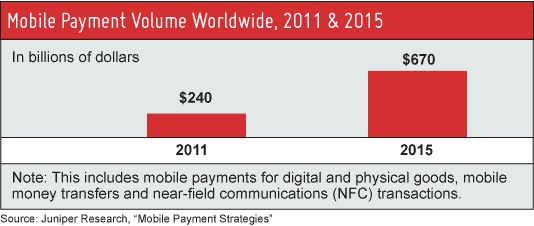
The article states that fewer than 5% of smartphone users have security software installed on their device, according to Juniper Research — the same Juniper Research that predicts Mobile Payments will increase to a $670 billion industry by 2015. And a study by Deloitte cited in the article suggests that for companies in the technology, media and telecom sector expect data stored on staff mobile devices to be their biggest security headache in 2012.

Essentially that’s the biggest obstacle holding back the Mobile Payments industry. The sheer convenience the technology brings to the payment industry is extremely powerful and so despite security concerns it continues to be developed and pushed. 2012 will see growth in the industry, despite the security issues. And as consumers get more and more familiar and comfortable with the phone swipe style of payment, the industry will boom.

A List for 2011

And just for fun, here’s a list from Mashable.com detailing who they think were the biggest winners and losers from 2011 in E-Commerce.

  • Their winners include: Amazon, Apple, Wal-Mart and Gilt Groupe.
  • Their losers include: Barnes and Noble, HP, Netflix and Sony.

Click the link to read why each company made the list.

customer service

Customer Service: A Cautionary Tale [2023 Update]

In what will likely be the last blog of 2011, The Official Merchant Services Blog is going right back to the basics. We’re going to give our readers a recap of a story that’s been the buzz of the internet for the past couple of days and which illustrates why customer service is so very very important for a business — good old fashioned and extremely basic customer service.

The Story, So Far

Penny Arcade, an extremely popular webcomic focused on video games and video game culture, written by Jerry Holkins and illustrated by Mike Krahulik, also has a regular blog. On that blog artist Krahulik posted the entire transcript of a dialog between a customer– named only as “Dave” in the coverage of the event — and the marketing/customer service person representing the Avenger Controller. This device was originally designed by David Kotkin, an art teacher, to help one of his pupils, who suffered from epidermolysis bullosa, to play games for prolonged periods without irritation.

You can read the entire transcript of the dialog at Penny Arcade here.

The recap is pretty simple. Dave went through the contact information given on the web for the product, and asked their customer service department when the product would arrive because it was late. The controller was advertised as being available in early December, and by December 16, Dave had not received the item that he had paid for in advance.

As seen in the transcript, the initial responses from Paul Christoforo of Ocean Marketing, the PR contact for iControl (the manufacturers and distributors of Kotkin’s design), were short and still vague. But then tempers flared, and Christoforo stepped over the line, attacking his own customer: “put on your big boy hat and wait it out like everyone else. The benefit is a token of our appreaciation for everyone no one is special including you or any first time buyer . Feel free to cancel we need the units were back ordered 11,000 units so your 2 will be gone fast. Maybe I’ll put them on eBay for 150.00 myself. Have a good day Dan.”

That sparked the entire fiasco. Christoforo continued to be rude and flippant in correspondence with Dave, as well as others, including Krahulik.

The Avenger Controller, object that started the customer service fiasco for Ocean Marketing.

The Internet Intervenes

Christoforo was nonplussed by Dave’s contacts in the e-mails. Even when Krahulik himself got involved, Christoforo did not believe Krahulik was who he said he was, and laughed at the idea that this negative publicity was going to impact his marketing. The conversation sort of soars from that point as Christoforo has it out with Krahulik. Christoforo threatens to initiate a smear campaign against the comic strip and Krahulik just posts the entirety of the e-mails, along with Christoforo’s information. With battle lines drawn, and sides chosen, the internet steps in — since Penny Arcade is indeed a very widely read web comic, it gets a lot of attention, especially from gamers who would all be potential customers for the product Christoforo is marketing.

First Round Knockout

The results of the smear campaign vs. Krahulik’s blog post and eventual comic strip?

  • This investigation, originally posted on Reddit, and later preserved as a .jpg
  • Christoforo shuts down his twitter account
  • Christoforo apologizes and asks for the spam to stop
  • Controller-N drops Ocean Marketing

So in essence, the internet retorted against the terrible customer service offered by Ocean Marketing and Paul Christoforo. The smear campaign he threatened against Penny Arcade never got off the ground. Ocean Marketing got slammed by a legion of video game players and Penny Arcade fans. Bad PR ruined Christoforo’s marketing business in mere days.

Captain Obvious to the Rescue

Without going too deep into the details of this internet battle between the forces of good gamers and misguided or misanthropic marketers — you can follow the fascinating set of links as this story is still picking up steam — Host Merchant Services is just going to cut to the chase.

Customer Service is a vital component of a business. Any business. That includes those doing marketing for video game controllers.

Host Merchant Services has provided some tips in the past on how to get into good customer service habits. You can read the blog post here. Customer Service is part of the core philosophy of Host Merchant Services. You can read CEO Lou Honick’s blog about customer service at the Web Host Industry Review here. It’s just The Official Merchant Services Blog didn’t think it would ever have to post a series of tips that included: “Do not curse at your customers, and do not call them stupid — especially in writing.”

Every customer is important. And as the person handling customer service, it’s definitely in your best interest to treat those customers with respect. Lashing out or trying to bully a customer is going to, at the very least, lose you that business. In this case, it lost the person more than just one customer. The whole entire exchange blew up in their face.

All of this could have been avoided with some very basic customer service strategies:

  • Do not argue with your customers.
  • Do not talk down to or insult your customers.
  • Listen to them and give their feedback or complaints your time and understanding.
  • Be honest with your customers. No one likes to hear that their product is late, but they’ll be much more willing to deal with you and your company if you’re honest with them and do not try to lie your way around the issue.

Honey, not Vinegar

After seeing the entirety of the mess Christoforo made, don’t you think the entire thing could have been avoided if Christoforo had been honest and polite? And if he had offered some form of compensation for the obvious mistake in shipping the company he represented had made? A discount? A rebate? A gift card? If Christoforo had spent just half the time performing actual customer service instead of writing insults and snark back to his customer, none of this would have happened.

That’s the lesson here. Customer Service needs to embrace the goal of long-term customer relationship building. As cathartic as the initial insults may have been for Christoforo, giving in to his frustration ultimately backfired for him and his business. Taking a hit on one customer due to having to be polite, and maybe even offer compensation for the mistake in shipping, would have saved Christoforo a lot of trouble.

This is a cautionary tale. Customer Service is important. Especially in the world of e-commerce where if things line up just right — you tick off a customer who has an open channel to one of the most widely read web comics — you could face the full force wrath of the internet.

Stop Online Piracy Act Sparks Unity?

The Official Merchant Services Blog is back from its brief holiday. Thank you for keeping up with us. We have a couple of treats to share with our readers today, though the posting is going to be brief. Host Merchant Services is gearing up its site and its services for the coming of 2012, including The Official Merchant Services Blog. Expect a return to the fast break pace and full industry coverage next week.

Stop Online Piracy Act

Up first for us is coverage of the Stop Online Piracy Act. You’ll hopefully recall that Host Merchant Services gave an in-depth analysis of the Stop Online Piracy Act a few weeks ago, getting out in front of the coverage of this controversial piece of legislation. What prompted this coverage was that the bill included payment processors in its extremely broad scope of oversight, letting the Department of Justice take action against merchant service providers — or Payment Network Providers as they are described in the bill’s wording — for the reported piracy of that processor’s merchants. This struck a chord with Host Merchant Services and other providers and brought the whole topic of online piracy into the arena of merchant services news.

GoDaddy Reverses Position

Outside of the entertainment industry support for the bill has been minimal. The bill has been soundly thrashed by most tech industry companies, ranging from Adobe to Google — you can read Google Executive Chairman Eric Schmidt’s comments on the bill here. Apple and Microsoft initially were part of a group that supported the bill, then changed their position quickly when the details of the bill were hashed out in a congressional hearing.

The latest company to do a full 180 on SOPA support is GoDaddy. Unfortunately, it may have been a bit too late. GoDaddy initially came out in favor of the bill, stating that the company opposed Online Piracy and supported the effort to stop this crime through the legislation. That prompted a harsh critical reaction from its customers, many gathering online to organize a boycott of GoDaddy.

GoDaddy relented and changed its position. As this politico.com article reports: “Go Daddy CEO Warren Adelman said in a statement that lawmakers can ‘clearly do better,’ even though the company stands by its original position that ‘fighting online piracy is of the utmost importance. It’s very important that all Internet stakeholders work together on this. Getting it right is worth the wait. Go Daddy will support it when and if the Internet community supports it,’ he continued.”

But the damage has already been done. Much like Bank of America taking a huge PR hit for its reaction to the Durbin Amendment, GoDaddy is now in the spotlight over the Stop Online Piracy Act. The article explains that GoDaddy was in a precarious position on this issue, as they had a vested interest in fighting piracy being a domain registrar: “The fight over Internet piracy has recently put Go Daddy in a precarious position: As a domain registrar with a vested interest in fighting illegal content, it sat opposite of other Internet companies that felt SOPA and the Protect IP Act threatened the Internet’s backbone.”

‘Unlikely Allies’

In one of the stranger developments linked to SOPA, it appears that the bill is acting as a unifying force for liberals and conservatives. According to this ology.com article Republicans and Democrats are banding together in their criticism of SOPA and becoming “unlikely allies.”

The bill, which was authored by Republican Lamar Smith does have some strong proponents besides just the Hollywood and the Recording Industry. The Better Business Bureau and various Chambers of Commerce back the bill on the very simple premise that online piracy is a serious issue and the crime is hurting businesses in the U.S. But as the article points out, the issue is deeper than that and has created allies among Republicans and Democrats: “The ‘netroots’ conservatives opposed to SOPA have some unlikely allies in liberal and libertarian bloggers. In the end, the battle over SOPA is as clear a case of big industry versus the little guy as there has been in recent years. As politics makes a turn toward the populist ahead of the “great recession” it is highly unlikely that the big studios will achieve a legislative victory here.”

Stay Up To Date on SOPA

The bill itself is currently tabled by Congress and likely won’t be dealt with until 2012. But you can keep up with the latest developments by continuing to follow the coverage Host Merchant Services. Also this google+ feed can be quite informative too: #SOPA

Beyond PCI: Digital Downloads and Security

‘Tis the season to be wary. There’s a lot of reports going around about how to be more secure and safe in your holiday shopping. Credit card scams and debit card scams are being looked out for. And shoppers are being careful. But the criminals are adapting and the danger goes beyond just phishing e-mails and retail shopping. So today, The Official Merchant Services Blog is here to talk about a particularly interesting development in security issues: video games.

We are in the midst of a very brisk holiday shopping season. Credit cards and debit cards are being swiped at record rates. Black Friday turned into Cyber Monday which then turned into Cyber Week. E-commerce, particularly mobile payments, were breaking sales records. Among this purchasing frenzy, blockbuster new video games are getting snapped up quickly. Games like Skyrim and Star Wars: The Old Republic are being rabidly purchased as gifts for gamers.

But these new video games come with some big picture concerns that consumers need to pay attention to –– namely, security breaches that compromise their credit card information.

And that danger is related less to the video game itself and far more to the way the game is purchased, activated and enhanced. Digital downloads, virtual in-game items purchased with real money, micro-payments, are all rapidly rising trends in the video game landscape. Hackers are taking advantage of this trend by trying to find weaknesses in the security around where that information is stored.

A Brief History of Crime

Security Breaches for video game companies have been happening frequently this year. The biggest breach happened to Sony, affecting their Playstation customers as well as their PC gaming customers not once, but many times this year.

In April of 2011, the Playstation Network was hacked, compromising the vital information of 77 million accounts, and 24.5 million Sony Online Entertainment accounts. This has been touted as the largest personal data heist recorded in history, and prompted Sony to shut down its services for a month.

After that initial bomb, hackers continued to attack Sony throughout the year. Once again Sony was being breached as recent as October, according to this Forbes article.

Not Just Sony Gets Breached

This problem is spreading, however, beyond just Sony. Other companies are getting breached. Notably Turbine, maker of Dungeons and Dragons Online and Lord of the Rings Online. Allegedly the company’s community forums were hacked in early October –– around the same time Sony was being breached –– and vital customer data was breached through the hack. Turbine took their forums and community down for a week in an attempt to fix the problem.

Then in November, digital game distribution leader Valve announced there has been a security breach within its Steam database. This breach was similar to the Turbine breach in that the hack targeted the Steam community forums, which in turn opened up access to the customer database. The timing of this breach was right around the time that Steam was offering the newly launched, extremely popular Skyrim for digital download.

The Trend Targets Forums

With the recent flurry in security breaches, a trend appears to be taking shape. Hackers break into ancillary areas of a video game’s structure, notably the community forums. Because of how those areas store customer information but are still very vulnerable to security breach, which customers have critiqued and notified the company about in Turbine’s case, hackers keep targeting this weak spot. By getting in through a forum, they can find a backdoor into the database that stores the credit card information.

The big picture concern here is that more and more games are being distributed digitally, and more and more games are requiring some form of storage of credit card information for either ongoing subscriptions or micro-payments for downloadable content. Which means these hackers will be able to vigorously pursue customer information like credit card and billing information. Here’s an infographic detailing the change in video gamer behavior regarding micro-payments and digital downloads between 2008 and 2010.

Host Merchant Services infographic on video gamer trends like gold farming and micro-transactions, between 2008 and 2010.

What it’s basically showing is that subscriptions are going down, but gamers are buying more virtual items and are willing to make more and more micro-payments for content. This shows there’s a rise in the freemium model that Turbine games employ or the Downloadable Content that XBox Live games employ –– as previously noted in our blog here. And that makes the stored payment information that these gaming companies have a tasty target for hackers.

On the Horizon

It appears these attacks, and subsequent breaches, are just getting started. The Sony breach this past spring was huge and really set the stage for the ongoing assault. But the continued efforts have been relentless. Putting that activity into the context of recent reports from Verizon on lax PCI Compliance among businesses and merchants –– 79% of organizations surveyed were not fully compliant –– as well as the continued rise in micro-payments, virtual item shopping, and digital download content  in gaming systems  –– be it a pair of sneakers in sports game NBA 2K12 or an entire starship in Star Trek Online  –– these security breaches are cause for alarm.

This holiday season sees the competition between major MMORPG giant Blizzard, with their World of Warcraft game shifting to a Kung-Fu Panda inspired expansion, and Bioware’s George Lucas-fueled Star Wars: The Old Republic. Blizzard’s own security has been compromised consistently through their battlenet, so gamers need to be cautious in handing companies their information. Security needs to be stepped up. Both sides, consumer and merchant need to be proactive.

PCI Compliance And More

The PCI DSS is already stepping things up, as they’ve instituted a revamped set of PCI Compliance Standards with their version 2.0. But as the Verizon study shows, a lot of companies are struggling to maintain compliance. And PCI Compliance is really just the first step, as it tends to be a more basic set of guidelines on security, still striving to adapt to the swiftly changing schemes that hackers launch in their quest for your credit card information.

Host Merchant Services provides a Free PCI Analysis to its merchants and prospective merchants. The company also provides an informative FAQ on PCI and what it all means. And finally gives anyone interested, a step-by-step guide on how to become PCI Compliant at the most common tier for businesses.

More needs to be done, however, with e-commerce businesses. These security breaches keep happening, and they put millions of accounts  –– and credit cards  ––  at stake. The Official Merchant Services Blog will continue to monitor this developing story, especially as we get past the release dates of some major video games that have been fueling holiday shopping. But we’d love to hear from some of you. What are some tips you would offer to be more secure in your video gaming habits? Do you think there’s more risk now than there was in the past when using online gaming services such as XBox Live or subscribing to World of Warcraft? Let us know.

A Look at VeriFone’s Vx Evolution

The Official Merchant Services Blog has been covering the basics of payment processing, offering insight and tips on the general topics of the credit card and debit card transaction industry for merchants. Today we’re going to go a little deeper, and delve into a nuts and bolts topic: payment terminals. This kicks off the first two-part series where we shine a spotlight on specific terminals that are available to merchants. After the first two-parter, we’ll occasionally revisit the topic of terminals and look at offerings from other terminal manufacturers.

Keep in mind that Host Merchant Services offers free terminals to its merchants, so reviewing what’s available and finding the terminal that fits you best can create a lot of savings on your processing bottom line in the long run. Our first spotlight shines on terminal manufacturer VeriFone, specifically the Vx series.

The Vx Evolution

VeriFone offers a series of terminals on its Vx Platform that have been slightly rebranded as the Vx Evolution. The terminals are being marketed under this evolution tag as being proven, advanced and evolved. What that boils down to is a new look with some upgrades to a line of terminals that have a history of working and working well.

VeriFone lauds the Nine Advantages of the Proven Vx Platform:

  • The Verix system that the terminals use has a decade of proven use.
  • The terminals maximize communication, speed and flexibility, support value-added transactions and deliver multi-app capability that essentially enables applications to securely co-exist on the same device.
  • A seamless transition for the next generation of the line, letting you continue to run the hundreds of existing applications that work on Verix.
  • The worldwide use and support for the popular Vx platform.
  • The lack of obstacles for platform switching, making it quick and easy to get started on a Vx platform terminal if you switch from another brand.
  • The Vx series of devices is idea for virtually any vertical market or end-use scenario.
  • The enhanced toolkit, clear guidelines and helpful documentation let users quickly build solutions based on Vx Evolution’s core technologies and capabilities.
  • The intuitive user interface helps the Vx platform get deployed quickly.
  • The ARM RealView Developer Suite (RVDS) 4.0 Complier helps you compile your applications with the Verix eVo Toolkit.


Host Merchant Services Image of VeriFone Terminals in use.

You can review those advantages in a downloadable PDF found here.

The Other Two Benefits of Vx

VeriFone also is lauding two other advantages for its Vx Evolution of terminals: speed and security.

The Need for Speed

According to VeriFone, the Vx Evolution delivers secure payment processing eight times faster than its competition. It claims it can do this with a superior single processor that outperforms dual processors that competitors use. Using the metric of MIPS –– Million Instructions Per Second –– this graphic shows how VeriFone’s 500 MIPS ARM 11 processor works:

Host Merchant Services chart on processor speed for VeriFone terminals.

Essentially what VeriFone is saying is that competitors use a 450 MIPS processor to run applications and a second 50 MIPS processor to handle critical security tasks. They claim this slows down secure transactions to 50 MIPS. But VeriFone, with its Vx Evolution brand, utilizes a built-in, integrated security processor. It’s running at 500 MIPS for everything –– applications and security.

You can fully review VeriFone’s documentation on speed by downloading a PDF about it here.

Staying up to Date on Security

The next advantage VeriFone is lauding its Vx Evolution brand with is security. This is of particular interest to The Official Merchant Services Blog because we’ve written in the past about PCI Security Standards. In fact, we took a close look at a study by Verizon that showed 79% of merchants surveyed were not fully compliant with PCI DSS standards.

Host Merchant Services Image of a VeriFone Terminal

Host Merchant Services offers a free PCI analysis for merchants and makes PCI Compliance a priority for its merchants. Which is why the Vx Evolution brand is noteworthy.

According to VeriFone their Full Spectrum Security package –– which is standard with all of its Vx terminals in the platform –– gets their terminals up to PCI PED 2.0 standards. So Host Merchant Services, in its push to keep all of its merchants compliant year in and year out, embraces the Vx platform of terminals that are stamped with the PCI PED 2.0 Approved seal.

At a time when many merchants are having issues maintaining the old PCI security standards, the VeriFone terminals are stepping up their game and making it easier for merchants to maintain the new PCI compliance standards. This lets Host Merchant Services merchants stay compliant moving forward and gives HMS a leg up in its initiative for quick, easy, and worry-free PCI Compliance.

You can read more about the security benefits of Vx Evolution by downloading a PDF here.

To Be Continued …

In the next part of this series, we’re going to look at the terminals themselves and see how they apply those Nine Advantages VeriFone has lauded.

In the meantime, what do you think of this branding? Have you used any Vx terminals? In the past? In the present? Let us know.

Customer Service: Help Desk Stress Test

Today The Official Merchant Services Blog continues its special two-part series on Customer Service. We can’t stress enough how essential it is to focus on Customer Service –– especially now during the holiday shopping season when your business may be barraged with a lot more customers who have a lot more questions.

Yesterday, we shared with you a blog from Lauren Carlson at Software Advice. The blog gave detailed tips on how to prepare business and its customer support team for the holiday shopping season. Today we bring you the second half of Carlson’s customer service saga which focuses on utilizing the holiday season as a way to stress test your help desk.

Carlson suggests that “the holiday season represents a perfect laboratory for examining your business, as well as your performance at each point of customer contact.”

This is a compelling concept. As Carlson says, the holiday season gives you a chance to analyze your business –– especially the customer support side of it –– at super speed. Doing so lets merchants identify high performance areas that are effective under the added stress of the holiday season, as well as get some insight into areas that may need some improvement. To get merchants in the mindset of how the microcosm of the holiday season can fuel some quick on the spot analytics Carlson asks: “So you had 72 percent first-call resolution rates in August. Great. What about the day after Christmas?”

Carlson keys in on five areas of support that companies should examine during their holiday season to gauge their help desk.

Host Merchant Services blog image on customer service and help desk analysis.

How Effective is That Training?

Many merchants add seasonal help for the holiday shopping rush. It’s a tried and true method for the retail industry, for example, to take on some extra help at the end of the year to push through all that added hours and increase in customers. Carlson suggests this can be a catalyst for analyzing employee onboarding –– and get a good look at how effective your company’s system is for training and preparing new support staff.

She says “Companies should use this opportunity to examine the success of their training techniques, as well as the usability of their system.”

It’s really sound advice to keep track of your support staff’s effectiveness, and the holiday season definitely gives a merchant a focused period of time to quickly measure the staff’s performance.

How Well Do You Deal With Surprises?

The next area in help desk performance that Carlson says a company should measure during the holiday shopping season is something called The Collaboration Period. Carlson describes the first nine months of the year as a build-up or preparation period for a business. Mitch Lieberman, of Sword Ciboodle, calls that period the Coordination Period in Carlson’s blog. But, according to Lieberman, the holiday rush shifts into the Collaboration Period. Carlson quotes Lieberman as saying “Collaboration is when something is outside what could or should have been easily coordinated. Are you ready to collaborate on these emergency issues that you didn’t predict?”

Essentially, merchants can use this time to study how well support staff deals with surprises. How well can they go off script? How effectively can they cope with issues that crop up that weren’t prepared for and which aren’t on an FAQ or a PDF or a Guidelines e-mail.

Host Merchant Services blog image on customer service and help desk analysis.

Where Do the Problems Get Handled?

The next area of help desk effectiveness that Carlson suggests merchants should look at is peak load management. Businesses that bulk up with some seasonal help during the holiday rush tend to train those new employees on the basic level of support. They get training to help them stick to a script, deal with the first tier of issues in a protocol, or use the FAQ that was designed for the holiday season –– all really basic stuff. The intent being to keep the easy stuff out of the way of the veteran support team members, who are then expected to effectively handle the harder issues.

Carlson says some interesting statistics can be gathered through this dynamic: “Measuring the percentage of first-call resolutions compared to the percent of calls escalated will help to inform your peak load strategy. “

What’s Your Worst Case Scenario?

The next area Carlson says companies should analyze harkens back to the boy scouts mantra of “Be Prepared.” Carslon says “assume something bad is going to happen. It’s not pessimism. It’s good business. If you assume disaster will strike, you will have an emergency response system in place that’s ready to manage the disaster on all channels.”

It’s never good when disaster strikes. But it’s a much heavier burden on a merchant when disaster strikes during the high pressure holiday shopping period. So this is a good time period to gauge what a company’s emergency response process is. And, if things do go bad, get an up front look at how effective that protocol is. Being proactive, Carlson suggests, is the best approach. Use this time period to analyze your emergency procedures and tweak them to be the most effective they can be.  As Carlson puts it, “having proactive procedures mapped out for unforeseen emergencies will not prevent call spikes, but it can lower the spikes to a manageable amount.”

Host Merchant Services blog image on customer service and help desk analysis.

Are the Customers Satisfied?

The core element of your customer support team, and your help desk, is customer satisfaction. Is the customer happy? That’s what it all comes down to. Companies should be measuring customer satisfaction year-round. And Carlson’s blog concedes that point. But Carlson points out that the holiday shopping season heightens the importance of customer satisfaction. This is something The Official Merchant Services Blog has discussed during our series on holiday shopping as well. The stakes are higher during the focused frenzy that happens after Black Friday, so you need to make sure you’re keeping even the most basic tenets of customer service in mind at all times.

Carlson asks the question, “you might have great satisfaction rates during low-volume times of year, but is your support team still on par when things get hectic?”

She suggests something as simple as a survey of your customers asking how you did during the holidays –– basic feedback.

Host Merchant Services likes the idea of reaching out to the customers for feedback. It’s an effective way to continue to maintain the long-term relationship building goal of customer support. Or, simply put, it’s a nice way to let your customers know you value them and their input. HMS suggests utilizing your social media tools for a survey like this, as you can quickly interact with your customers through those tools and they can help you track and analyze the responses.

Conclusion

This is an effective checklist of ideas for merchants to monitor their customer support capabilities. There are some concrete suggestions here on ways to collect data that will help shape a company’s goals for delivering quality customer service. Carlson gives a lot of good tips in both parts of her series. The Official Merchant Services Blog is glad she shared these with us and hopes you find them useful too.

If anyone else has some tips or suggestions on how to improve customer service now in the holiday shopping season or any other time of the year, feel free to share in the comments section.

Customer Service: Tips From a Friend [2023 Update]

Today The Official Merchant Services Blog begins a special two-part series on Customer Service. A previous blog focused on how important Customer Service is for a business during the holiday shopping season. We are currently in the midst of one of the busiest holiday shopping seasons on record, according to the early sales data that has been reported. So to bolster your efforts, we’re going to highlight information and advice brought to our attention from our friends over at Software Advice.

Fellow industry blogger Lauren Carlson ran a two-part series at Software Advice dealing specifically with customer service and the holidays. It’s an insightful series that begins with offering advice on how to prepare your customer service department –– namely your help desk –– for the rigors of increased business from holiday shopping.

And What Are Those Tips?

Carlson’s article was timed for the lead up to Black Friday, but much of its advice is still extremely relevant to merchants facing the rest of the season. After all, the questions that get asked at your help desk aren’t going to subside until after the holidays. Or as Carlson says, the guidelines she gives “if done, can prevent potential chaos and better prepare your agents to handle the spike. This translates to happier customers during the holidays, who will turn into repeat customers once the wrapping paper has settled.”

Host Merchant Services image on customer service, with bell ringing.

The first tip given is to create a holiday specific FAQ list. Carlson states that the types of questions a lot of help desks get hit with during the holiday season can vary from the normal questions that get asked the rest of the year and as such, suggests brainstorming and coming up with a list ahead of time to prepare. Due to timeliness, that may no longer be a viable option for a lot of merchants. But by now, you may have a pretty good handle on the varying questions that you were hit with on Black Friday and all through Cyber Week. Which brings us to the best advice found in the first tip: “Post the simpler questions up on your site to avoid spending time on those calls.”

This can be done to enhance the e-commerce experience, getting it out to your customers and providing them with both information that they need, and a click through into your site. Or this can be done just for your own help desk’s internal sanity, having a quick reference guide on hand for when they are barraged with these questions that make your list. As Carlson states, this type of list “will enable agents to resolve a majority of issues on the first call.” And it will be useful for the duration of the season, preventing your staff from having to scramble to find answers even as it gets to be late into the shopping season.

Cross-training to Stay Prepared

The next tip Carlson offers is to cross-train your staff. She cites Matt Trifiro, Senior VP of Marketing at Assistly who explains that cross-training your employees can help you reduce the need for hiring seasonal staff. Carlson says of cross-training: “Much like athletes cross-train to improve the whole body, companies can train every employee – from receptionists to accountants – to be a support agent, improving support across the entire organization.”

This is a great tip for merchants looking to weather the holiday shopping blitz but not go through the process of training seasonal help that they have to let go a short time later. It’s also a quick way to deal with support issues that may have just now cropped up well after Black Friday. Host Merchant Services itself utilizes that same philosophy in its own customer support structure and finds that it does help a business be more responsive and more effective at handling support issues year-round.

Carlson maps out the plan for cross-training your staff, suggesting that a merchant should equip all their employees to answer basic questions customers may have. Then Carlson says merchants should set up an escalation procedure for situations that require additional steps or expertise. This will create a smoother flow for service during the high traffic times of the holiday shopping season.

Communication Has Many Channels

The next tip Carlson gives revolves around communicating when your business is on its own holiday. A lot of Merchants, such as restaurants, have a different set of hours as the actual holidays approach. Carlson suggests merchants should communicate clearly and consistently with their customers about any downtime or time where the business is unavailable during the holiday shopping season. And in 2011, there are quite a lot of avenues in which to communicate this information: “Alert customers on every possible medium (website, Facebook, blog, Twitter, voicemail) of your seasonal hours and availability. Communicating this clearly will help avoid confusion and, more importantly, dissatisfaction.”

Host Merchant Services blog image for customer service.

This information also applies to any other Merchant needing to reach out to its customers –– including adding extra service hours during holiday shopping like a lot of retailers do. Social media sites like Facebook, Google+ and Twitter are amazing tools available for customer interaction and can help you keep your customers up to date on all the latest developments your business goes through during the holiday shopping season.

Support Your Support Agents

The final tip Carlson gives for merchants to prepare their customer support help desk for the holiday shopping rush is to have a plan in place that will offer support for those who are your support agents. Carlson states: ” Help desk and support center employees will be very busy and likely very stressed during the holidays. Savvy companies will invest a lot of energy into supporting their agents via rewards, bonuses, in-office R&R, etc.”

Having something concrete in place that defuses stress and gives your support team some focus or incentive can help your business navigate through the increased stress and tension that holiday shopping can place on a business. This falls in line with Host Merchant Services’ own partnership protocols in the e-commerce section of its services –– where the company’s goal is to take the stress and burden of merchant services off of the business and onto the the merchant services provider. This enhances the overall partnership by making it less stressful for both partners. The same applies to customer service, especially during a time when the increase in business can exponentially increase stress.

Even though Black Friday has passed, this increased stress will continue to build. So it’s definitely not too late to consider implementing some sort of program or incentive to give your support staff both a tip of the hat for its hard work and a goal to strive for that will keep them going through the rest of the holiday rush.

Conclusion

Host Merchant Services feature image of a happy face.Lauren Carlson offers some rock solid advice for customer support during the holiday shopping season. Many of the tips are easy to implement and do not take a lot of added time investment to get working. Host Merchant Services is always looking for useful insight on customer service to pass along to merchants. Quality customer service helps build long-term relationships with your customers, and can keep them coming back to you long after the holiday shopping season is over. Tomorrow The Official Merchant Services Blog will take a look at part two of Carlson’s series.

E-Commerce: News Briefs [2023 Update]

The Official Merchant Services Blog continues to follow some of the top trending stories in the e-commerce industry. E-commerce is an essential growth element in most retail businesses. This has been building for years, as online shopping becomes more and more a convenient and commonplace fact of life for the everyday consumer.

E-Commerce Sets Record Highs

It became clear that e-commerce is a titanic force in the marketplace when Cyber Monday sales results came trickling in. But the robust clicks business continued. Now reports are indicating that e-commerce had a record setting week. This internet retailer article said that consumer spending reached at least $1 billion on three separate days last week according to the web measurement firm comScore Inc. This means that three of the four recorded billion dollar spending days for e-commerce occurred last week –– the fourth was Cyber Monday 2010.

The statistical breakdown shows that shoppers spent $1.25 billion on Cyber Monday 2011, the single highest spending day recorded for e-commerce by comScore. This was followed up by $1.12 billion on Tuesday and $1.03 billion on Wednesday. In the time period between Nov. 1 and Dec. 1, 2011, consumers so far this holiday shopping season have spent more than $18.69 billion with online retailers ––up 15% from approximately $16.25 billion at the same point last year.

Will The Trend Continue?

The article quotes comScore chairman Gian Fulgoni as saying “As the deals from this week expire, it will be important to see the degree to which consumers return to the same retailers to continue their holiday shopping, thereby helping improve retailers’ profit margins, or if we experience a pullback in consumer spending—which has occurred in previous years—before promotional offers and spending intensity pick back up in earnest around mid-December.”

Free Shipping appears to entice online shoppers in a major way. According to the article 63.2% of all online transactions last week included free shipping. This makes a lot of sense, since free shipping evens the playing field in the bricks vs. clicks battle. With shipping costs taken out of the equation, it comes down to convenience and price. It’s much easier for shoppers to visit a website instead of fight crowds and stand in line. And the Cyber Monday deals –– many of which got extended past Monday prompting the nickname Cyber Week to emerge –– keep the pricing war ultra competitive.

SOPA Update

With e-commerce business booming so much in the holiday shopping season, the Stop Online Piracy Act (SOPA) and its latest developments become more and more important. According to this PC World article, a bipartisan group of lawmakers have come out in support of a new law that has been proposed as an alternative to SOPA.

Under this proposed legislation, the U.S. International Trade Commission (ITC) would be given the power to investigate claims of copyright infringement on foreign websites. The proposal would also allow the ITC to issue cease-and-desist orders to foreign websites that willfully engage in copyright infringement. The lawmakers demonstrate some clever ingenuity here with this proposal by tapping the ITC for the job of piracy oversight. The ITC already investigates patent infringement complaints and can bar infringing products from being imported into the U.S.

Host Merchant Services offered up an extensive analysis of SOPA, including the history and development of previous laws that affect online piracy and intellectual property rights.

What is notable about this new law being proposed?

new law being proposed

Two of the legislators supporting the use of the ITC as copyright infringement oversight are Ron Wyden [D-OR] and Zoe Lofgren [D-CA]. Wyden is notable because he was the one that effectively killed the Combat Online Infringement and Counterfeits Act of 2010 in the Senate. Lofgren is notable because she is one of Congress’ leading experts on the internet and has spoken out against SOPA on her own website. Having these two support a proposed law that seeks to combat online piracy is a pronounced development.

The new proposal seeks to clean up the problem of SOPA by giving it a more streamlined and functional process for copyright infringement claims. Under the new proposal the ITC could also investigate complaints of copyright infringement by foreign websites. Owners of the websites would be invited to present their side to the ITC, and the public would be notified of investigations, as the ITC does in patent investigations. ITC rulings against websites could be appealed to a U.S. appeals court. All of these aspects are different from the broad powers that SOPA grants to the Department of Justice.

As the article explains: “SOPA would allow the DOJ to seek court orders to stop online ad networks and payment processors from doing business with foreign websites accused of enabling or facilitating copyright infringement. The DOJ-requested court orders could also bar search engines from linking to the allegedly infringing sites and order domain name registrars to take down the websites and Internet service providers to block subscriber access to the sites accused of infringing.

SOPA would also allow copyright holders to seek court orders requiring online advertising networks and payment processors to stop supporting the alleged infringers if those businesses do not comply with requests from copyright holders. The court orders requested by copyright holders could target U.S. websites and services that enable or facilitate copyright, in addition to foreign websites.”

The proposal states its case as being a better alternative to SOPA here: “We found that using trade laws to address the flow of infringing digital goods into the United States makes it possible to avoid many of the pitfalls that would arise from other legislative proposals currently being advanced to combat online infringement. Namely by putting the regulatory power in the hands of the International Trade Commission – versus a diversity of magistrate judges not versed in Internet and trade policy – will ensure a transparent process in which import policy is fairly and consistently applied and all interests are taken into account. When infringement is addressed only from a narrow judicial perspective, important issues pertaining to cybersecurity and the promotion of online innovation, commerce and speech get neglected. By approaching digital good infringement as a matter of regulating international commerce, we are able to take all of these factors into account.”

In short, this proposal focuses on the copyright infringement that is at the root of the online piracy, instead of on the payment processors and e-commerce sites that could get caught up in the broad crackdown that SOPA could initiate.

What’s Your Major? E-Commerce

We noted this on our Facebook Page yesterday, but feel the need the mention it in our blog as well. E-commerce is now becoming a path of study in college. This Practical E-Commerce article links to 15 different e-commerce focused course programs being offered by various institutions, including Carnegie Mellon, University of Maryland, and Temple.