Tag Archives: merchant services

SOPA: The RIAA isn’t doing so bad [2023 Update]

Today The Official Merchant Services Blog dives right back into the fire with the Stop Online Piracy Act (SOPA). We were kind of surprised to find out what this PC World Article had to say. Apparently the  music industry is doing pretty good despite the issue of online piracy upon which SOPA hinges.

SOPA was shelved by Congress more than ten days ago, as we reported in our January 20 blog, but the lobby that fueled the bill is still pushing for federal government involvement in online piracy. In fact, much of the content of SOPA that caused the controversy has popped back up on a wishlist from the International Federation of the Phonographic Industry (IFPI) regarding what they think needs to be done to fight online piracy. The IFPI is a global group similar to the U.S.-based Record Industry Association of America (RIAA).

SOPA and PIPA Review

To recap what SOPA was about you can review our initial post about it from our November 20, 2011 blog. The Official Merchant Services Blog was out in front of this story and eventually the rest of the medial caught up with the impact that this House of Representatives bill and its twin in the Senate — the Protect Intellectual Property Act (PIPA) — were going to have on a variety of tech industry sectors, including Payment Network Providers. Host Merchant Services provides an in-depth analysis of SOPA here.

Host Merchant Services image about the Stop Online Piracy Act and the players involved.

The Kids are All Right

According to the RIAA the music industry is outperforming other entertainment sectors in terms of digital sales. Jonathan Lamy, senior VP of Communications for the RIAA, tweeted that paid subscription services rose 65 percent to 13.4 million in 2011. This tweet was in response to figures released by the IFPI which Lamy was excited to read. Lamy also tweeted that paid digital music services are active in 58 countries, generating $5.2 billion in revenues.

Jumping into the tweets was another RIAA executive, Cara Duckworth. The VP of Communications for the RIAA also cited the IFPI figures and then said: “W/more than half of all music sales coming from digital services, we know how Internet works. “Music=Innovation. Declare THAT. #CES #SOPA.”

Throwing down the gauntlet, the RIAA is now essentially claiming that they have a viable working digital sales model that can exist on the internet. And yet still they pursue a lobby to crack down on piracy, and collateral damage that includes the internet and e-commerce.

Here’s a graphic detailing the top sales from 2011 according to the IFPI:

The Wishlist

The IFPI put out this PDF which details a very hardline stance on how to deal with Online Piracy. Perhaps the most entertaining aspect of this wishlist is that it essentially repeats the details of SOPA. According to the PCWorld article IFPI chief executive Frances Moore said record companies are building a business in digital music “in spite of the environment in which they operate, not because of it.”

Moore went on to say record companies are working with ISPs, search engines, governments, and law-enforcement agencies to reduce the number of illegal downloads and ensure that an ever-higher percentage of the music that is downloaded is bought legally. “Our digital revenues, at one-third of industry income (and now more than 50 per cent in the US), substantially surpass those of other creative industries, such as films, books and newspapers.”

So the IFPI establishes with facts and figures that the music industry is doing well on the internet. Digital Music services are getting traction, profits are rising and piracy is being challenged. The RIAA finds all of this so amazing and awesome that they go and re-tweet it to the world.

With all of this good stuff being said about digital music sales, why does the IFPI have a wishlist of demands to fight piracy that seem pretty much like the exact same thing SOPA wrote?

The Seven Demands

This arstechnica.com article goes into detail about the demands the IFPI has. The demands can be broken down to seven key elements:

  1. Graduated response laws in which rightsholders can pass along notices about file-sharing to the accused party and possibly disconnect them from the internet.
  2. Site blocking. The industry wants the ability to wall off infringing sites, however defined (yes, you read that right, they don’t currently define the criteria for being able to wall off the site), at country borders.
  3. Search Engines need to help the industry. Search Engines need to remove links to infringing content that the industry identifies as well as prioritize links according to industry standards, not the engine’s own standards. Search Engines need to rank search results factoring legality or illegality into the ranking.
  4. Payment Processors. Just like SOPA and PIPA, the wishlist also includes payment processors. Which is why The Official Merchant Services Blog is continuing its ongoing coverage of this topic. Payment Network Providers, Payment Processors, merchant services providers, whatever the entertainment industry wants to call us, are being targeted to police copyright infringement. It’s very strange. The IFPI wishlist demands processors cut off pirates voluntarily, much like SOPA tried to do. As the ars technica article states: “This was a theme of the recent Stop Online Piracy Act in the US, which originally featured a section encouraging companies like MasterCard to take unilateral actions against websites, and provided legal immunity for doing so. IFPI touts a deal with the City of London Police and credit card companies in which IFPI supplies the City of London Police with evidence that illegal downloads are being made available from an infringing site. The police review the evidence, verify its integrity and notify payment providers that their services should not be provided to such sites.”
  5. Ad networks are being called on to cut off funds to suspected pirates as well. Even though some online advertising sites are themselves going through litigation for spams, scams and clickjacking.
  6. Mobile operators need to get involved according to the IFPI wishlist. Because hey, why not? The IFPI’s paranoia suggests that outside the comfy confines of the U.S. where illegal downloaders just lazily go about swiping songs from their PCs, “piratical behavior increasingly takes place through phones and other mobile devices.”
  7. And finally, the IFPI calls for increased litigation. Keep suing the big sites. The PDF report cites how much piracy dropped after Limewire was shutdown as the impetus to keep going after the big dogs in the world of online piracy. Compared to some of the other demands on this list, the final wish seems to be far more reasonable, logical and effective. Going after ad networks, especially those already mired in a legal quagmire of clicks and spam issues, might not do a whole lot in the war on piracy. Going after the big, popular piracy sites, though, might have an impact.

Where to go From Here?

Host Merchant Services image of a pirate button keyboardIt just seems tiresome that after all that went down with SOPA, PIPA, the internet blackout, and the controversy, the music industry just reloads and reuses the same exact talking points that got the laws killed in the first place. SOPA died because the things being asked for weren’t going to work. Banking on payment processors to police the internet was a bad idea. It still is a bad idea. This whole wishlist smacks of some old sitcom gag where a child asks one parent for a cookie, is told no, then goes and asks the other parent. The answer’s still no.


Payment Network Providers do not support online piracy. But the demands being given to them have loopholes where the Processor is being asked to shut down customers that are legitimate and not pirates, just on the whim of the entertainment industry.

And the real kick in the pants with all of this? At the exact same time the music industry makes this zealous push to continue to ask for wide open and ineffective legislation, they spend time gloating about how well they’re doing on the internet with legal, and apparently very profitable, digital transactions. All of course run through e-commerce sites supported by the same payment processors they are asking to shut down other customers at their fancy.

The bottom line is if Lady Gaga and Pitbull online sales are robust and  legit, it’s probably time to back off the Online Piracy rhetoric.

Facebook Attacks Clickjackers

Today The Official Merchant Services Blog takes a look at one of the latest and most twisted developments in online marketing: Clickjacking. This topic comes up because of a new lawsuit that is making the news. Facebook has filed a lawsuit against the company Adscend Media. The suit claims Adscend developed targeted spam campaigns and encouraged others to spread spam using a variety of tactics — including clickjacking.

According to Wikipedia, Clickjacking — also called User Interface redress attack, UI redress attack, or UI redressing — is a malicious technique of tricking Web users into revealing confidential information or taking control of their computer while clicking on seemingly innocuous web pages. A vulnerability across a variety of browsers and platforms, a clickjack takes the form of embedded code or a script that can execute without the user’s knowledge, such as clicking on a button that appears to perform another function.

Joining Facebook in filing against Adscend Media was the Washington State Attorney General Rob McKenna. A statement released by McKenna says: “We don’t ‘like’ schemes that illegally trick Facebook users into giving up personal information or paying for unwanted subscription services through spam. We applaud Facebook for devoting significant technical and legal resources to finding and stopping scams as soon as possible – and often before they even start. We’re proud to join forces in order to protect Washington consumers.”

In addition to Adscend, Jeremy Bash and Fehzan Ali, co-owners of the company, are named in the suit.

Jacking for Likes

Here’s how clickjacking scams, such as the ones described in this lawsuit, work:

Scammers design Facebook Pages to look like they will offer visitors an opportunity to view provocative content. They then require the user to complete a series of steps before they can view the content. These steps are designed to lure Facebook users into visiting websites that deceive them and get them to reveal their personal information. In terms of what this particular lawsuit is focusing on, Facebook users are encouraged to click the “Like” button on the scammers’ Facebook Pages. These like-clicks then alert the user’s friends to the existence of the scammers’ page. Then they are told that they cannot access the content unless they complete an online survey or advertising offer.

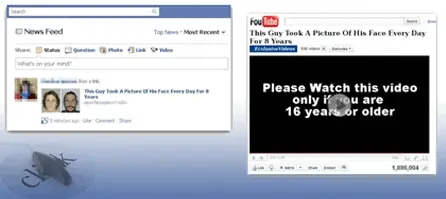
In one example noted in the complaint, the scammers overlay the Facebook “Like” button with a link that promises to reveal the results of: “This man took a picture of his face every day for 8 years!!” Of course, the promised content often does not exist and the tricked user is then directed through a series of prompts taking them off of Facebook and through a host of unrelated advertising and subscription service offers, where the scammers receive money for each misdirected user.

In another example, a Facebook user would see a link to a video on a friend’s wall. If the user clicked on the link, a pop up would appear asking the user to verify their age. Clicking on the verification box, the user would unknowingly share the video on their own Facebook wall.

In some cases, Facebook users don’t even need to click the “like” button to spread the spam on their Facebook pages. In the process called “clickjacking,” a hidden code in enticing-looking links activates Facebook’s “like” function and puts it on the users’ friends’ news feeds.

How this Affects SEO

We bring up this lawsuit to draw attention to this black hat and negative advertising practice. It can have a big impact on SEO and online marketing for businesses. Spam is never good and so on the most basic level if you get your own Facebook page wrapped up even indirectly with this type of scam, Facebook could take action against your business page. Beyond just that, there’s the negative PR that comes from being linked to a spam scam. If people think you are spamming them, you’ll lose more “fans” and “likes” than you would ever gain by the scam campaign.

Facebook is a powerful marketing tool, but as a merchant you should be aware of the pitfalls and obstacles you can encounter while using it. Stay on top of issues like this, and you can avoid any potential long-term harm to your SEO and consequently your business.

What to do if You Get Scammed

If you do make the mistake of clicking on a link spread via a clickjacking scam, follow these easy tips to lessen the damage:

  • Check your Facebook news feed and remove any offending links that you might have spammed out to your friends.
  • Hover your mouse over the top right hand corner of the post and you should see a small “x” which will allow you to remove it.
  • If you entered your mobile phone number, you should keep a close eye on your cellphone bill and notify your carrier to prevent bogus charges from stinging you in the wallet.
  • Remember to be wary of any suspicious links. If you really want to watch a video chances are that it’s available for free — without you having to complete any surveys — on legitimate video sites like YouTube.

Going forward, it’s essential that you stay informed about the latest scams spreading fast across Facebook and other internet attacks. Keep following The Official Merchant Services Blog, or the Host Merchant Services Facebook Page, as we routinely update both with the latest news and information on any tech industry issues that affect businesses and merchants.

Adscend Denies Clickjacking

According to this Computerworld article, Adscend Media has denied the allegations filed against them. The company said in its own statement responding to the filing of the two lawsuits, “At no time did we engage in the activity alleged in the complaints.”

The article also states that Adscend is pointing the finger at its own affiliates, claiming their customers shoulder the culpability: “Adscend is hired by advertisers that pay the company each time someone clicks on their page or advertisement. Adscend in turn often hires affiliates to drive traffic to the sites. It’s those affiliates that Adscend is now pointing a finger at. ‘We are undertaking an investigation to determine whether any of Adscend Media’s affiliates engaged in the activity alleged by the Attorney General’s office and Facebook. If they did, we are fully certain that the activity was conducted without the company’s knowledge,’ the company said in its statement.”

The Washington Attorney General’s office doesn’t buy that claim and replied in the suit that: “Defendants create and provide their affiliates with technology that is designed to deceive Facebook users into visiting websites that pay defendants for the referral traffic. Defendants encourage and pay their affiliates to create Facebook pages that are titled and designed to ‘bait’ users into visiting other websites.”

Top Free Online Shopping Carts

Today The Official Merchant Services Blog shifts its focus to the E-Commerce industry — specifically some tips we’ve found online to help small businesses with their e-commerce solution.

An article written by Nova Scotian Vangie Beal details the ins and outs of ten open source online shopping carts that are available to merchants or really anyone who wants to sell things on the internet. Beal’s been covering small business, e-commerce and internet technology for more than a decade with her writing. You can find the original article here.

E-Commerce has become an integral part of the economy throughout the world. Shoppers have embraced online shopping as part of their normal shopping routine. So businesses have responded by jumping into e-commerce and providing those consumers with competitive options that focus on the convenience that can be had with the click of a few buttons — the classic clicks vs. bricks debate is showing that clicks beat bricks.

So what do Merchants need to know about E-Commerce to get started?

Step One: Get A Payment Processor

The first step is something Host Merchant Services can handle — payment processing. Merchants need to accept payment in the form of credit cards and debit cards to stay healthy and viable as a business. So merchants need to incorporate payment processing solutions both in their brick and mortar stores as well as on their website with their online shopping solution. Host Merchant Services provides merchants with these options — along with free equipment and a guaranteed low rate that will save them money.

So step one in setting up your e-commerce business is to get a merchant account, with the services Host Merchant Services provides.

Step Two: Your Online Shopping Cart

Now that you’ve got a merchant account set up and are reedy to process payments online, step two is to get an online shopping cart for your website. As Vangie Beal says in her article, “When shopping for your own e-commerce shopping cart software the most important aspect toconsider is how well the cart software meets your business objectives.”

The shopping cart has to be customizable so that you can alter it to fit your business needs. It also needs to be able to fit your branding so that the shopping cart melds seamlessly with the rest of your website. It needs to be flexible so that as your business grows, your online shopping card and ability to process payments online can also grow. It needs to be secure and it needs to support industry security standards such as PCI compliance.

You can read about PCI Compliance Standards in the Host Merchant Services Article Archive.

We provide a PCI FAQ here. 

We provide a step by step guide on PCI Compliance here.

Open Source Shopping Cart

Vangie Beal’s article discusses the top 10 free or Open Source shopping carts. Beal says “Open source shopping carts are an attractive option. Storeowners might look to open source e-commerce software because it will typically deliver the features and tools to manage a product catalog on a website without the hefty licensing fees that come with proprietary or off-the-shelf packages.”

Continue Reading – Top Free Online Shopping Carts, Part 2

Phishing Scam Alert

Attention Merchants. The Official Merchant Services Blog has been made aware of an e-mail based Phishing campaign designed to trick individuals into providing login credentials for their credit card processing — specifically one of the payment gateways that a merchant uses.

The e-mail generally has a subject title of “Annual Agreement Renewal”  and the body of the message is communicating that their “retail account” or “merchant agreement” is expiring.  When you open the attachment it appears to have a login page prompting a login.

Be advised that this is an attempt at social engineering intended to steal those login credentials. Neither Host Merchant Services nor TransFirst is the source of these e-mails. These e-mails should be disregarded and deleted. This is an industry wide issue that has escalated in recent days. The Official Merchant Services Blog and Host Merchant Services have been made aware of e-mails appearing to be from TransFirst as well as other payment processers.

If you are a merchant and you have been taken in by this scam, please have contact merchant support at 1-800-654-9256 or contact us at Host Merchant Services directly at 1-877-517-HOST (4678).

Host Merchant Services will continue posting notices on our key sites and our social media channels. TransFirst is also getting the word out, posting information as TC, Epay, TransLink, Transfirst.com and other social media channels.

If you have any questions regarding this scam, please contact Host Merchant Services support.

Some Basic Information on Phishing

Phishing is an attempt to acquire information such as usernames, passwords, and credit card details by masquerading as a trustworthy entity in an electronic communication. Communications purporting to be from popular social web sites, auction sites, online payment processors or IT administrators are commonly used to lure the unsuspecting target of the scam. Phishing is usually carried out by e-mail spoofing or instant messaging, and directs users to enter details at a fake website whose look and feel are almost identical to the legitimate one.

How To Defend Against Phishing

The scam artists behind phishing emails are smart and know how to create emails and websites that look like they are official and from well know companies or organisations. Because of this, the typical security measures taken with electronic communication — such as firewalls — don’t stand up to the scams.

There is no real effective software-based means of defending against phishing scams. Common sense tends to be your best defense. Always exercise caution when replying to an email that requests personal information or passwords. Also, never click on links found in such e-mails. Even if you believe the content of the message is genuine you should type the web address into your browser directly to ensure that you are visiting the correct site.

Here are a few  more tips for avoiding phishing scams:

  • If you believe an e-mailed request for information is genuine then call the company to confirm before entering data on a website.
  • If you need to entire sensitive information on a website then look for a padlock in your browser’s status bar to signify that you are on a secuire site.
  • If you believe that you have fallen victim to a phishing scam contact the bank or credit card company immediately so that they can freeze your accounts and take action on your behalf.

For information and tips on how to protect yourself from online scams like phishing or identity theft or credit card fraud you can read this article in the Host Merchant Services Article Archive.

Durbin Amendment Back In the News [2023 Update]

The Official Merchant Services Blog returns to a topic that it covered thoroughly throughout 2011: The Durbin Amendment. With the Stop Online Piracy Act getting most of the headlines lately, Durbin Amendment’s continued impact on the payment processing industry has gone into stealth mode. Until today that is. Stick with us as we offer a whirlwind roundup of all things Durbin related.

Bank of America Took a Beating

We’ll start off our tour Durbin tidbits with this article by ABC News. Apparently Bank of America took a substantial hit from their plan to charge $5 per month to use debit cards. According to the article: “Bank of America’s failed plan to impose a $5 monthly debit card fee led to a 20 percent increase in closed accounts in the last three months of 2011 and a public relations headache.”

The article quotes Bank of America CEO Brian Moynihan as saying, “yes, we had some impact from the $5 debit fee. That’s why we made a decision to reverse it.”

It wasn’t all bad news for Bank of America though, as the bank reported earnings of $2 billion in the last three months of 2011, up from a net loss of $1.2 billion in the same period a year ago, boosted in part from a one-time gain on the sale of China Construction Bank.

Small Lenders Strike it Big

The next little bit of Durbin aftermath comes from this article by NACS online. As was seen in the Host Merchant Services in-depth analysis of the legislation, The Durbin Amendment only applies to lending institutions with assets over $10 billion. Smaller banks and credit unions are exempt from the Durbin Amendment. As a result of being exempt, a Wall Street Journal report cited by the NACS article states that these institutions have been “collecting fees that are often three times those imposed on cards by large banks.” 

For comparison, the article says: “The WSJ notes that a $100 sweater purchased with a debit card would incur a fee of 95 cents on a card issued by a smaller bank and only 26 cents for those issued by big banks. “

The article also suggests that banks face further uncertainty by April 1, 2012, when “all U.S. banks and credit unions must offer retailers more choices of companies used to process debit card transactions, a move that is expected to lower interchange fees further.”

New Target: Credit Card Swipe Fees

Time Magazine Online Feature Moneyland reports something that Host Merchant Services has already touched on before in The Official Merchant Services Blog — that Credit Card Swipe Fees may be the next target of legislators and financial reform. From the Time article: “There’s another interchange fee fight in the offing — this time over credit cards. According to CNBC, equity analysts who cover the financial sector have expressed worry that ongoing litigation involving several major banks could lead to a cap of 0.5% on credit interchange fees — one-fourth of what’s currently charged — potentially dragging down bank earnings. If that happens, consumers who are used to generous credit card rewards programs complete with double miles, accelerated earnings, and big sign-up bonuses might get a rude awakening.”

The Official Merchant Services Blog on December 13, 2011 covered the topic of a Credit Card Swipe Fee. In that blog we wrote: “the plan would end up working much like the Durbin Amendment has worked. Where the idea of reform would get overshadowed by how banks and credit card companies reacted to the law. There would be some shifting, so in that sense the reform would cause change. But that eventually the burden for paying for any losses that banks and credit card companies get forced into through reform would end up squarely on the shoulders of the consumers.”

The Time article notes something that Host Merchant Services already pointed out regarding a Credit Card version of the Durbin Amendment — Banks would take another huge hit because Durbin has language that freed up banks and merchants to market and promote options to the consumer directly. In short, Durbin’s language freed merchants up to promote credit over debit. And because of that, a lot of merchants did just that as Banks offered new programs to make credit the more attractive choice. Subsequent changes that would now penalize Banks for doing that would create a lot of negative momentum for Banks and added onus for consumers who get stuck with no good choices overall.

New Hampshire Law

This article from credit.com reveals that one state legislature is already making moves to see a Credit Card Swipe Fee Cap become reality. As the article states: “A piece of legislation introduced in the New Hampshire House of Representatives, House Bill 1319, has drawn some attention for the way in which it would drastically alter the credit card landscape between businesses and payment processors. The law will limit the amount banks chartered within the state are able to charge businesses for processing credit card transactions to just 1 percent of the total purchase value.”

The article goes on to state that many businesses pay costs that range from 0.67 percent of the transaction’s value to 4.76 percent and that a MasterCard spokesperson told the Nashua Telegraph that the average 1.75 percent.

Cash Still Rules Everything Around Me

Our last news brief on the topic of the Durbin Amendment and swipe fee caps is a little different. This article from the Huffington Post shows a study that reveals cash is still king. The gist of the article: “More than three-quarters, or 79 percent, of consumers said they made a cash purchase in the last seven days, according to a report released on Tuesday from Javelin Strategy & Research, a market research group for financial services. Compare that to about 65 percent of credit and debit cardholders who say they swiped their plastic in the last week.”

The article suggests that this is a consumer reaction to card swipe fees. The article states that consumers are choosing to pay for items with cash to avoid fees on small, everyday purchases. The convenience of plastic gets overrun by the savings consumers perceive they get from going back to cold, hard cash. The study indicates that cash is replacing debit for small purchases, and credit is replacing debit for big purchases and the Durbin Amendment’s lasting legacy may simply be that it pushes Debit out of the consumer’s arsenal of payment options.

Mobile Payments: 2023 and Beyond [2023 Update]

Today The Official Merchant Services Blog updates our outlook on Mobile Payment Technology and the rampant predictions for its success in the near future. We have previously covered the topic with this blog entry on Tuesday, October 18, 2011. The parameters of that blog are still pretty much the current state of Mobile Payments. But there have been some very interesting developments from the end of 2011 and moving into the first quarter of 2012.

Black Friday Boom

The Black Friday business blitz revealed some healthy news for Mobile Payments. According to this article from Seeking Alpha, mobile payments business increased 500% from 2010 on Black Friday. According to the article, PayPal mobile reported the huge increase, coming in at 511% to be exact. PayPal Mobile also noted that there was a 350% increase in mobile shopping on Thanksgiving 2011 when compared to 2010.

According to numbers from the aforementioned IBM research, 17.37% of all consumers used a mobile device on Black Friday to visit a retailer’s site. And 9.73% used a mobile device to make a purchase. The Seeking Alpha article quoted Amanda Pires from PayPal. Pires suggested that this year’s holiday is proving to be the largest mobile holiday shopping season PayPal and eBay has ever seen, and then quoted Pires directly as stating: “The retailers that are taking advantage of mobile shopping are going to win. We expect mobile shopping to continue to be strong throughout the holiday season.”

This is good news for Mobile Payments, as Host Merchant Services research has shown in the past that there have been some bold predictions for growth in Mobile Payments, but that the services were slow in taking hold this year in the U.S. Growth like the numbers cited from Black Friday 2011 should fuel more positive momentum for that consumer payment option.

Host Merchant Services E-Commerce Mobile Payments image

From 2012 Onward

All of this brisk business in the mobile payments sector is indicative of the forecasting that analysts and reporters have been making for the technology. But the obstacle that our Magic 8-Ball suggested hurts the industry still remains: Consumer confidence. There’s still trust issues with mobile payments. This article by Eric Savitz from Forbes really delves into the heart of what we at Host Merchant Services have been saying about Mobile Payments.

Savitz says: “There’s a common thread between these points: there has to be something fundamentally changed about the current point of sale model in order for mobile payments to take off. It’s about added value and convenience to the consumer, and the ability to drive more customers, loyalty, efficiency and lower risk for the merchant and banks and operators involved in the payments process. Think of contactless “tap and pay” credit cards – you may have one in your wallet right now, but you still swipe it anywhere you go. As a consumer, there’s nothing more convenient or inherently better about tapping your card vs. swiping your card if all that matters is making the payment. Would the time spent setting up and configuring a “mobile wallet” be worth it if the only difference at the cash register of Macy’s is that you wave a phone over a terminal rather than swipe a card through one? Doubtful.”

That’s what Host Merchant Services has been saying. It’s about convenience to the consumer. The worries about security are valid. E-Commerce has faced the same problems with security and the same worries. But people have adopted online shopping — as seen with the same Black Friday and holiday shopping season boom in 2011 — to the point where it’s now just a common part of the shopping experience. People can’t even remember back 10 years where online shopping was new, awkward and insecure. It’s just part of their lives now.

And for Mobile Payments to jump off the same type of conversion of consumers has to take place. Convenience will outweigh security concerns and people will just accept the behavior as part of the way they shop. That’s where the Mobile Payments Industry stands right now. On the edge, waiting for the breakthrough that will rocket it into everyday life for shoppers. It has to grow beyond gimmick. Because gimmick won’t carry it forward. It might be easy to do, but as Savitz points out, if there’s no reason to swipe your phone over just using your card in your wallet, people won’t bother.

Small Businesses Susceptible to its Charms

One inroad Mobile Payments are making with consumers is through small businesses. This article from Newsfactor.com delves into how small businesses are seeking mobile payment solutions that free them from reliance on traditional payment solutions. The article discusses how Square has been shaking things up with the changes its made to its business model in 2011, becoming an entire processing solution itself and making its card reader more readily available to merchants. The article then mentions how Gartner Research data shows that the Mobile Payments Industry surged to $86.1 billion in 2011.  The article notes that Square is just one of many viable options that are helping fuel the growth the sector is seeing.

HMSPay

Host Merchant Services recognizes the huge growth potential in this sector of the industry. Beyond their coverage of the latest developments and news that take place in Mobile Payments, Host Merchant Services offers its own mobile payment solution, HMSPay. The solution utilizes a card reader that is attached to a smartphone and an application on the phone which transforms it into a payment processing terminal, complete with signature field and e-mailed receipts.

Host Merchant Services Mobile Payment Solution HMSPay

So What’s Next?

Savitz’ article suggests that the potential breakthrough for Mobile Payments will take place in 2012. And that the catalyst for this breakthrough will be through value added applications of the process. He cites Google Wallet and Isis as showing the most promise in being a catalyst because they both go beyond just having the swipe gimmick and offer “services delivered on top of the payment itself.” He says these additional services will be what prompt consumers to shift into mobile payments. He offers these bullet points:

  • Deals and offers: Highly targeted, relevant offers based on prior buying patterns and current location. Imagine receiving a time-sensitive text message or in-app alert with a coupon to your favorite electronics store after your digital wallet “checks in” that you are within the store.
  • Digital receipts and account information updated in real time to give a comprehensive view of personal and linked accounts while also displaying loyalty rewards status.
  • Real-time, customizable alerts to certify that the purchases being made in an account are valid, based on your phone’s proximity to where the purchase is being made.

So it appears that one promising avenue for the evolution of mobile payments is to essentially make them a virtual wallet “plus.” Something that does more than just allow you to pay with a swipe of your phone. Something that collects the relevant data and helps you manage your shopping right there, at your fingertips. Something that tracks your own shopping trends and makes you aware of deals, then lets you conveniently take advantage of those deals.

It’s a compelling point. Host Merchant Services sees the value in such a transition. The technology works to make the consumer’s shopping experience convenient and comprehensive — something a shopper can’t even consider they could do without in previous years. That’s what happened with e-commerce, after all.

SOPA: Pot Meet Kettle [2023 Update]

The Official Merchant Services Blog has late breaking news to report today. Once again we take on the topic of the Stop Online Piracy Act (SOPA). In perhaps the strangest twist to date for the ongoing saga that is the battle between the entertainment industry to curb piracy and the internet industry to keep their business free of government interference on a micromanaged level — Alex Fitzpatrick from mashable.com reports that SOPA has some SOPA issues.

Lamar Smith Copyright Violation

In Fitzpatrick’s article, found here, it is noted that the sponsor of the Stop Online Piracy Act (H.R. 3261) Lamar Smith has a copyright violation on his own website texansforlamarsmith.com.

The article follows a report from Jamie Lee Curtis Taete over at www.vice.com. Taete investigated Lamar Smith’s website for any potential copyright issues. You can see Taete’s investigation here. Taete describes describes the impetus for the investigation: “US Congressman and poor-toupee-colour-chooser Lamar Smith is the guy who authored the Stop Online Piracy Act. SOPA, as I’m sure you know, is the shady bill that will introduce way harsher penalties for companies and individuals caught violating copyright online (including making the unauthorised streaming of copyrighted content a crime which you could actually go to jail for). If the bill passes, it will destroy the internet and, ultimately, turn the world into Mad Max (for more info, go here).

I decided to check that everything on Lamar’s official campaign website was copyright-cleared and above board. Lamar is using several stock images on his site, two of which I tracked back to the same photographic agency. I contacted the agency to make sure he was paying to use them, but was told that it’s very difficult for them to actually check to see if someone has permission to use their images. (Great news, copyright violators!) However, seeing as they’re both from the same agency and are unwatermarked, it seems fairly likely that he is the only person on the entire internet who is actually paying to use a stock image (and he’d be an idiot not to).

So I took a look back at an archived, pre-SOPA version of his site.”

Caught Red Handed

The violation stems from Lamar Smith using this image:

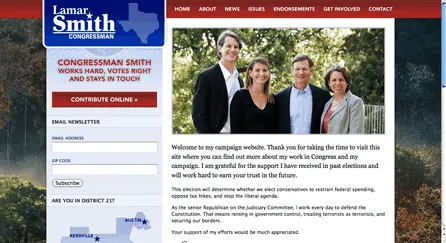
On his site it appeared like this:

Taete fills in the full details of this violation: “I managed to track that picture back to DJ Schulte, the photographer who took it.

And whaddya know? Looks like someone forgot to credit him.

I contacted DJ, to find out if Lamar had asked permission to use the image and he told me that he had no record of Lamar, or anyone from his organization, requesting permission to use it: ‘I switched my images from traditional copyright protection to be protected under the Creative Commons license a few years ago, which simply states that they can use my images as long as they attribute the image to me and do not use it for commercial purposes.

‘I do not see anywhere on the screen capture that you have provided that the image was attributed to the source (me). So my conclusion would be that Lamar Smith’s organisation did improperly use my image. So according to the SOPA bill, should it pass, maybe I could petition the court to take action against www.texansforlamarsmith.com.’

Oh dear. Luckily for DJ, there are people out there like Lamar making new laws to protect the little guy against online copyright theft. Keep fighting that good fight, Lamar!”

No Response Yet

No spokespeople from Lamar Smith have been available for comment on this issue. Maybe when the egg on their faces is removed there’ll be time to address the silliness that stems from the SOPA sponsor not taking enough time to make sure his own site didn’t fall under the extremely broad language that would allow the Department of Justice to shut down his own site.

Luckily for Smith, the bill hasn’t been signed into law just yet, so Google doesn’t have to remove his site from their search engine, and his payment network provider doesn’t have to suspend transactions from the donation portion of his site.

For More Information

To find out more about the Stop Online Piracy Act, you can read the in-depth Host Merchant Services Analysis here.

To read the proposed legislation itself, you can download it here.

Florida’s Proposed E-Commerce Bill

Today The Official Merchant Services Blog is taking a look at a new bill proposed in Florida that attacks the growing E-Commerce industry. The bill — HB 861 — was filed by state Rep. Mike Horner, R-Kissimmee. The bill would require online-only sellers to collect and remit Florida sales taxes, just like other Florida retailers.

Bricks vs. Clicks

This legislation is drawn on the battle that has been brewing for the past decade between brick-and-mortar retailers and online entrepreneurs. Online shopping has become commonplace for the U.S. consumer, and this year’s holiday shopping season saw record business run through E-Commerce.

The Official Merchant Services Blog did a series of posts based on the strength of the E-Commerce industry. In it we reported that in recent years, the boom in online shopping created a shift in shopping trends. Holiday shoppers no longer adhered to Black Friday as the start date for their holiday shopping needs. A 2010 survey conducted by Google and OTX found that 35% of internet users start their holiday shopping prior to the end of summer, months ahead of Black Friday.This shift continued to grow in 2011 as consumers found online shopping extremely convenient.

According to a Star Tribune article from January 16, 2011, Cyber Monday sales rose 16 percent from 2009, and topped $1 billion overall –– marking the first time Cyber Monday hit the billion dollar mark. The record setting didn’t stop on Monday, according to comScore, a company that tracked the sales figures between November and December for the e-commerce industry. Sales on Thanksgiving Day were up 28 percent from the previous year, and overall e-commerce sales topped $32 billion in the holiday shopping period, a 12 percent rise from 2009. Even Black Friday, brick and mortar stores’ biggest holiday shopping day of the year, saw a 9 percent rise in e-commerce to $648 million.

2011 saw those numbers rise even higher. Statistics released from an IBM research unit called Coremetrics found that 20% more consumers shopped online this Black Friday 2011 than did in 2010. The data collected also states that 39% more online shopping happened on Thanksgiving Day itself in 2011 than in 2010.

Trying to Level the Playing Field

The boom in online shopping is what has prompted this bill to be suggested in Florida. In Florida, online retailers are escaping the burden of sales tax for their transactions. And so the bill was created to attempt to level that playing field a bit. According to this bizjournals.com article by Susan R. Miller, “Currently, Florida retailers with a brick-and-mortar location are required to collect and remit sales taxes on purchases made online, while their online-only competitors are not. The bill would require online-only sellers to collect and remit Florida sales taxes, just like other Florida retailers.” 

Miller’s article says that the bill has support of the Florida Alliance for Main Street Fairness, a coalition of small businesses, trade associations and civic groups, including the Florida Retail Federation, Florida Chamber of Commerce and Associated Industries of Florida. The legislation could be part of a larger initiative this year by states nationwide that would require online retailers such as Amazon.com or Overstock.com to collect taxes for online transactions.

The article does note that the bill faces one large obstacle in the local legislature: “However, Senate President Mike Haridopolos has said that such a plan would violate the Florida Legislature’s “no new taxes” pledge and would not pass if it resulted in a net increase in taxes collected by the state.”

Is This the Future?

The suggestion that this is part of a large initiative to attack E-Commerce giants like Amazon and Overstock is certainly of interest. Especially since a large scale move such as that would have a deeper impact on all of the smaller Online Shopping sites that small business people run around the U.S. But there’s some key facts to keep in mind before getting too worried that this is the next big thing like the Durbin Amendment was in 2011:

  1. This is a state bill, not a federal proposal. That means that this is still a very small scale approach.
  2. Florida law isn’t exactly cutting edge. Not to be flippant, but there’s a reason why snarky internet commentary site Fark.com gives Florida its own subject tag.
  3. The bill itself does, as the story states, face some opposition in its own state legislature because of the tax issues.

You can review the exact language of the bill by downloading the PDF here.