This is the latest installment in The Official Merchant Services Blog’sKnowledge Base effort. Well we want to make the payment processing industry’s terms and buzzwords clear. We want to remove any and all confusion merchants might have about how the industry works. Host Merchant Services promises: the company delivers personal service and clarity. So we’re going to take some time to explain how everything works. This ongoing series is where we define industry related terms and slowly build up a knowledge base and as we get more and more of these completed, we’ll collect them in our resource archive for quick and easy access. Today’s term is Debit Cards.
Debit Cards
A debit card (also known as a bank card or check card) A debit card looks like a credit card but works like an electronic check. The thin plastic card that provides the cardholder electronic access to a bank account at a financial institution. Payments made with Debit Cards are deducted directly from that checking or savings account. If a cardholder uses a debit card at a retail store for example, the cardholder or the cashier can run the debit card card through a scanner — oftentimes the very same terminal credit card purchases are swiped through. This action enables the financial institution to verify electronically that the funds are available and approve the transaction. Most debit cards also can be used to withdraw cash at Automated Teller Machines (ATMs).
Unlike credit and charge cards, payments using a debit card are immediately transferred from the cardholder’s designated bank account. This difference is key in one sense, as it creates a completely different set of protocols and standards for debit transactions in the payment processing industry. This can be seen most recently in the Durbin Amendment of the Dodd-Frank Act. The financial reform legislation set a hard cap on debit card swipe fees. But has absolutely no affect on credit card transactions.
For many consumers, the card they carry can be used as both a credit and a debit card when presenting it at a retail store for purchase or using it online. Oftentimes, a consumer is asked to choose between credit or debit.
For the consumer the distinction can have this impact:
The card’s individual rewards program can vary depending on debit or credit. In many cases, a credit transaction reaps greater points or rewards from these types of programs.
A debit transaction can allow for cash back right at the point of sale.
A credit card transaction can have stronger protection. It takes time before it is “batched” out by the merchant. And the credit cards themselves have more fraud protection layers than debit cards typically have.
For the merchant and for the banks involved the impact is this:
The transaction network that the purchase is run through is separate for debit and credit.
The fees associated with the transaction are different. After Durbin, the fees face a hard cap ceiling on what the merchant can be charged. Credit has no such ceiling and so smaller transactions — say purchases under $10 — can end up costing a merchant a bit more in fees.
The distinction between credit and debit was stronger in the 1980s and 1990s, but it still exists. It’s worth knowing what your options are as both a consumer and a merchant.
Today I’d like to take a moment to venture somewhat further afield than I usually do — and then bring it all back home to settle into some insight about E-Commerce. Primarily what I want to look at is the evolution of video games in the past couple of years and how things seem to be gravitating so much more toward E-Commerce friendly offerings while leaving Brick and Mortar video game retailers scrambling to keep up.
Just the other day, EA Games (Electronic Arts) released its financial results for the first quarter of this year and among the most eyebrow-raising statistics to come out of the figures was the breakdown of EA’s profits by platform. Of the three platforms for EA, PC delivered $276 million, the Xbox 360 $292 million and the PS3 $267 million. That means PC games eclipsed the Playstation 3 platform and made a strong bid to catch up to XBox 360 earnings.
PC’s strong showing can be tracked to increased revenues from digital sales. Which says a lot about how video games are changing in their format, evolving to suit consumer needs, and fully embracing the power of E-Commerce. This isn’t exactly a new trend, but it’s solid evidence of the paradigm shift that’s taken place. Video games are ingratiated into our culture these days. The FX Channel exists, and is extremely gamer-centric. People play things like Farmville online and let everyone they can know about their successes in their virtual farmland. Games like Halo and Call of Duty drive console game sales higher and higher. And PC games ranging from World of Warcraft to Minecraft take up large chunks of peoples’ time.
I’ve grown up with video games and am one of the first generations to pretty much be around them for my entire life. So developments like EA’s earnings statement tweak my interest.
Atari’s Raiders of the Lost Ark game that was roundly criticized for how unplayable it was (Spoiler Alert: You had to navigate yourself while using a parachute to break the chute on a branch at the proper angle of descent so you’d slide into the cave under the branch, then dig a hole with the shovel that most people never knew you needed. Yeah, I beat it with luck!) Then we get into Nintendo, Sega, and things ramp up quickly to the current PS3 vs. XBox wars that EA has situated itself comfortably between by making many of its titles accessible on both platforms.
This entire time, the video game market was dominated by a brick and mortar outlet. The arcade of my childhood was a place you went to. The EB Games store I bought Madden Football from was a store I had to visit. I started using pocket change to pay for games and ended up swiping a credit card through a machine, but it was always at a location.
Then came my experience with Massively Multiplayer Online Role Playing Games, and a huge introduction to gaming through E-Commerce. I started out buying a game like Everquest or World of Warcraft from a box at a store. But it had a subscription cost attached to it to keep playing it. And the model was to continue playing it month after month after month after month. The subscription cost was a recurring payment, made through the game’s website. It was e-commerce. And it was just the first step.
Eventually the games stopped shipping boxes. You could buy the expansion directly from the gaming company. It would download directly to your machine. And your game would update. Then companies like Steam got involved. You could now buy games directly from their site and download them. No more going to a store to buy a game. Unless you still played console games. Though all of the most successful Brick and Mortar game shops were also offering their games through their online shopping center.
And the console platforms jumped in big-time, with downloadable content. XBox 360 demonstrates how readily acceptable this evolution has become, and this is why XBox 360 still outpaced PC games in EA’s earnings report. You subscribe to XBox’s “live” service, and you get access to apps and content. You can download new games, updates to games, as well as movies and television shows, all through your XBox.
My own personal example, last winter I ordered NBA2K12 through Gamestop’s online shopping center. Got the game, and downloaded roster updates through XBox live immediately. Then went and watched a movie on Netflix through my XBox. It’s all digital content available directly from your interface. This is growing in leaps and bounds with all gaming companies. PC Gaming’s healthy revenues for EA are because of digital content that is available.
What this means is that video games are now becoming something people purchase online, and download directly to their gaming system. It’s a 100% E-Commerce transaction. For credit card processors that means that cash is no longer involved in the competition for video gamers’ money. It’s quickly becoming all plastic all the time.
Another wrinkle added into this which impacts E-Commerce is the shift away from the subscription based model for those MMORPGs I mentioned above. This is also something revealed in the EA earnings report. Last year EA launched its MMORPG Star Wars: The Old Republic. It won a lot of gaming industry awards, and quickly announced it had over 1 million subscribers. It’s goal was to compete with World of Warcraft, Blizzard Entertainment’s MMORPG giant which had dominated that sector of gaming for years. Unfortunately, the subscription model is a dinosaur and not even the power of the Jedi Knights and their Midichlorian fueled lightsaber gimmicks could change this shift.
Freemium Models had been the new thing in MMORPGs. These were touted as “free to play” games. You purchase the game (though this cost tends to not be all that high since you can get a lot of these games very cheap on Steam for instance), and then you play it without a subscription fee. You then pay for things you want in the game — a common example is bag space to store all of the items and junk you pick up while playing — through micropayments. The game’s free for the basics, but you pay for premium additions. So say you want another bag to store more orc fangs in? You pay a couple of bucks and you get that bag. You want to play the new expansion with the new quest zone? You pay a few more bucks and that expansion is yours. You want a horse to go from place to place faster? You pay a few more bucks. Your game is free, but the stuff you want in the game or the new additions to your game, they all cost money.
This is the model that EA’s Star Wars: The Old Republic announced it was changing to with its earnings report. This effectively killed the only real subscription based MMO left besides World of Warcraft. And it’s not that surprising. The Freemium model makes money and keeps the games going strong. And it keeps getting adapted to the point that its being used in the Console Platform system as well. You can buy added content to many of the most popular XBox games being played right now. You have your XBox Live account, you pay some extra bucks for a new part of the Half-Life story or more stuff to do in Skyrim.
It’s where Video Games are headed. The arcade is dead. The stores selling boxes of games are almost dead. It’s all online and it’s all 100% completely tied in to e-commerce and credit card processing.
Today The Official Merchant Services Blog is taking a look at a bill being debated on the U.S. Senate floor this week. Senate Bill 1832, also known as The Market Place Fairness Act could be the cause of the next big debate in the Payment Processing Industry.
The Law of the Land
In 1992 the Supreme Court ruled in the case Quill v. North Dakota that companies without a “substantial nexus” in the state where their customer lived didn’t have to charge sales tax. Seemingly favoring Internet companies, this ruling was actually handed down two years before the first Web browser, and three years before Amazon ever sold it’s first book. This law still stands today, and is the precedent for online retailers not having to pay state taxes on products shipping nation wide. This new bill looks to rectify that apparent “oversight.”
The Act Itself
The Marketplace Fairness Act would pave the way for states to require online sellers from out of state to begin paying the sales tax they’ve escaped for years. Senator Dick Durbin (D-Ill.) said “The Marketplace Fairness Act would level the playing field for small businesses by allowing states — if they so choose — to treat brick and mortar retailers the same as remote retailers.” Durbin, who is sponsoring this bill, is best known for authoring the Durbin Amendment, a piece of legislation that caused much controversy in the Payment Card Industry when enacted.
The National Conference of State Legislatures estimates the lost tax revenue at $23 billion annually. Senator John Rockefeller (D-W.V.) spoke on the issue, attempting to clear up some of the confusion, “To be clear this debate is not about imposing new taxes. Instead it’s just allowing a state to collect taxes they are currently owed under existing law, but are being systemically avoided.” As another benefit to small business owners, the law would only apply to business processing more than $500,000 annually.
Amazon Action
Amazon has been the most vocal in its support of the Marketplace Fairness Act since it’s introduction last year. Speaking before a congressional hearing, Amazon VP of Global Public Policy Paul Misener told lawmakers that the bill would facilitate the collection of one kind of tax that is already due, but goes largely unpaid. Supporting the argument that it is not a new tax increase.
Opposition
Senator Jim DeMint (R-S.C.) published an op-edin the Wall Street Journal entitled “No Internet Taxation Without Representation.” In the piece DeMint argues that citizens should not be taxed by governments in which they have no political voice — in this case states where they or their company are not physically based. I would argue that this is a cost of interstate commerce, which has been reborn as interstate e-commerce.
DeMint does have a point when he mentions the nearly 10,000 state, local and municipal tax jurisdictions businesses would have to comply with nationwide. He forgets to mention, however, that businesses have access to advanced tax software, such as TaxCloud, which can easily compute the sales tax for any state.
The Verdict
Here at The Official Merchant Services Blog, we see the potential savings this offers to the owners of small businesses nationwide. The Marketplace Fairness Act provides an incentive for states to simplify their sales tax laws, as well as increase revenue from the ever-booming e-commerce industry. Hopefully this will decrease the sales tax burden shared by many small businesses. It simply makes it much easier for millions of business owners — and in turn the states — to collect the taxes already due. Only time will tell how much impact this legislation will have on e-commerce and credit card processing. We will stay on top of any new developments on this law, and how they affect you.
Today The Official Merchant Services Blog delves into the intricate and fascinating world of social media marketing and the pitfalls of Click Fraud. Our interest stems from a recent news story: Limited Pressing, an e-commerce company provides a platform for selling digital music and physical items, stated that they are dropping their Facebook page and removing their company’s Facebook presence because it determined that 80% of the clicks it paid for through Facebook advertising were fraudulent.
What is Click Fraud?
Click fraud is an illegal practice that occurs when individuals click through advertisements — either banner ads or paid text links — to increase the payable number of click throughs to the advertiser. The fraudulent clicks could either be performed by having a person manually click the advertising links or more typically by using automated software or Online bots that are programmed to click these ads repeatedly. Click fraud is sometimes perpetrated by individuals who use the tactic to increase their own personal banner ad revenues; but the most common strategy is click fraud gets harnessed by companies as a way to deplete a competitor’s advertising budget.
This is where Limited Pressing’s problems with their Facebook Page comes in. They feel that the click fraud was eating up their ad budget and making the oft-lauded and extremely popular advertising tool too costly and ineffective.
Limited Research
In this article at clickz.com, Limited states that it determined over a one-month testing period that 80 percent of their Facebook ad clicks were performed by bots. The company doesn’t really delve into where the bots come from, and instead focus their criticism on Facebook’s entire ad platform — suggesting its findings indicate Facebook has a big click fraud problem.
Limited detailed the process they used to determine this bold assertion of click fraud:
“A couple months ago, when we were preparing to launch the new Limited Run, we started to experiment with Facebook ads. Unfortunately, while testing their ad system, we noticed some very strange things. Facebook was charging us for clicks, yet we could only verify about 20% of them actually showing up on our site.
At first, we thought it was our analytics service. We tried signing up for a handful of other big name companies, and still, we couldn’t verify more than 15-20% of clicks. So we did what any good developers would do. We built our own analytic software. Here’s what we found: on about 80% of the clicks Facebook was charging us for, JavaScript wasn’t on. And if the person clicking the ad doesn’t have JavaScript, it’s very difficult for an analytics service to verify the click. What’s important here is that in all of our years of experience, only about 1-2% of people coming to us have JavaScript disabled, not 80% like these clicks coming from Facebook.
So we did what any good developers would do. We built a page logger. Any time a page was loaded, we’d keep track of it. You know what we found? The 80% of clicks we were paying for were from bots. That’s correct. Bots were loading pages and driving up our advertising costs.”
Clickz.com pressed the company for more details on the process they used and the data Limited obtained. But the company had nothing prepared to share with the site yet.
Facebook Strikes Back
Facebook defended its program and its protocols in response to Limited’s claims. The company has said it is investigating the claims that Limited has made, and noted that it has defenses in place for such kind of fraud. A fake click, Facebook said, would come from a fake account, which would be disabled immediately upon discovery.
This Computer World article details Facebook’s defense that the company supplied in an e-mail. The article reveals that Facebook has systems in place that attempt to detect and filter certain click activity, including repetitive clicks from a single user, clicks that appear to be from an automated program or bot, or clicks that are otherwise abusive. Facebook’s systems also look at whether JavaScript is enabled in the browser. And the company reports that according to recent data, nearly all billable clicks resulting from desktop web browsers have JavaScript enabled.
Also, in a second quarter earnings report conference call Facebook said they are continually making efforts to reduce fraudulent activity and fake accounts by becoming better at detecting duplicate accounts.
As reported by clickz.com:
“On a macro level, Facebook now has independent ROI data from more than 60 advertising campaigns using a variety of third-party methodologies like panels and marketing mix models. The results show that 70 percent of campaigns resulted in a return on ad spend of 3x or better, and 49 percent of campaigns showed a return on ad spend of 5x or better.”
Facebook COO Sheryl Sandberg said during that conference call that “attribution is an issue. Marketers need to tie sales back to multiple touches; they may see on Facebook and search later. Our ads work and the ROI is there, so we’re focusing on education.”
The Big Picture
This issue is an important one for payment processors and merchants alike. Much has been made of social media and marketing. Facebook’s ad service is a huge windfall for the company. Much of what I myself have learned about marketing through social media has come directly from webinars and videos I’ve seen given by Sandberg. So if Limited’s claims are anywhere close to accurate, this could be devastating for Facebook — and equally positive for competitors like Google and its Google+ social media hub that still trails Facebook in popularity.
Essentially Facebook ads are at the forefront of the immense push people have made into spending money on social media marketing campaigns. So if only 20% of that money is doing the job, it’s an extreme waste of resources for businesses.
In Facebook’s Defense
There’s much to be said in defense of Facebook at this time however.
First of all, the company is very diligent in its pursuit of click fraud. In our January blog, we explored the activity called Clickjacking and detailed how Facebook has been fighting to curb that kind of fraud. And since the company is now extremely invested in its own profits after its IPO, it really is common sense that they are being forthright in their responses and really are doing the best job they can to curb fraud.
Secondly, Limited’s credibility takes a hit with the other issue it brought to light in its criticism of Facebook. It claimed that Facebook was allegedly holding Limited’s page name hostage. What Limited said was that it wanted to change its name on its Facebook page and that after repeated attempts to contact Facebook about the issue, Limited received a response. Facebook, Limited alleges, would make the name change for Limited if the company agreed to spend $2,000 a month or more in advertising.
Here’s where Limited’s credibility starts to wane. Limited Pressing wants to change its name to Limited Run. That name has been in use by a magazine since October 2010. So there’s no way Limited could get the name changed. Facebook also states that it does not charge for name changes. Facebook clarified that they have a process that business pages have to go through to get a name changed so that it doesn’t confuse its users if a business repeatedly changes its name or changes it to something unrelated. So Limited’s claims of Facebook holding its desired name hostage don’t seem to really pan out, hurting their credibility with their click fraud data.
And finally, the data itself. Limited’s claims tend to run extremely counter to all data released by Facebook itself and Limited has not shared the data or the services it used or page logger it created. They claim more details are forthcoming, but as we saw with the name change claim, the trustworthiness of the information could be very much in doubt.
The Bottom Line
So what are we to make of all this?
I’m taking it with a grain of salt. The accusation is strong enough and Limited does assure us all that they did a lot of data collection. If it turns out to be on the mark, then this is a really big hit for Facebook and something merchants need to consider in terms of how they go about using social media.
Also, a problem I have with Facebook’s defense is that there’s a loophole in the terminology they’re using in their statements: They say that when they detect fraud from fake accounts, they close the account. Simple right? Fraud, fake account, banhammer, done. But the loophole is that fake accounts need to be verified as fake to get closed. And skilled fraudsters will have these fake accounts looking as real as possible or simply replace it just as quickly as it gets nuked. My own experience with FB “drama” leads me to believe that on the one hand I believe Facebook is diligent in canceling the fake accounts it finds, but that the creation of fake accounts is too easy and too easy to fake properly that Facebook may not be affecting the fraud as much as it claims.
Still, I am very disconcerted by the name change issue as it’s pretty obvious to anyone who uses Facebook that it’s not Facebook’s fault you can’t have the name McDonald’s because McDonald’s already has the name.
In conclusion, I would say Facebook Ads are still right where I thought they were before I read these news articles. The huge push into social media is indeed a very powerful marketing tool that many merchants should embrace and utilize to their own benefit. But it’s a refined and subtle tool. It’s not something you just throw money at and expect clicks to turn to profits for your business. Host Merchant Services has found using Facebook ads increased our following quite a bit, but didn’t give us the targeted following of users that we really wanted. In short, we felt we got a lot of bots.
Part of that was our own inexperience with the tools available — though many video and webinar assistances later from Sandberg and Facebook we know how to use the tools much more effectively — and part of it was the Facebook culture itself. Businesses don’t always fit smoothly into the community. Facebook is far more casual and social so a business to business entity like our company, no matter how tech savvy we are, runs into some obstacles on Facebook. Finding the right people to send the ads to is difficult because our target audience isn’t as neatly confined by the tools Facebook provides — for example we found more success with the interest of “tacos” than we did for “business owners.” The more professional community of LinkedIn or the far more expansive twitterverse has ended up being a bit more successful for us.
I feel this might be part of what Limited was running into. I think there is indeed a substantial presence of fake accounts and bots on Facebook. But I also think that Limited’s target market, because of what they do as a business, isn’t exactly something folks on FB are hot to talk about and link-share. What is the hook that people on FB, already too distracted by pithy quotes and vaguebooking activities of their close knit group of friends, to talk about some business’ offer on stuff one of their affiliates can sell?
The TLDR version?Yeah, Facebook ads have a lot of bots and no Facebook can’t catch em all like Pokemons. But 80%? That number seems a tad high. And Social Media advertising is still a very valid and strong marketing tool for business owners.
This is the latest installment in The Official Merchant Services Blog’s Knowledge Base effort. We want to make the payment processing industry’s terms and buzzwords clear. We want to remove any and all confusion merchants might have about how the industry works. The Host Merchant Services promise, we deliver personal service and clarity. So we’re going to take some time to explain how everything works. This ongoing series is where we define industry related terms and slowly build up a knowledge base and as we get more and more of these completed, we’ll collect them in the resource archive for quick and easy access. Today’s term is EMV, or chip-based cards.
Europay, MasterCard, Visa (EMV)
EMV cards, also known as smart cards, were developed and backed by four of the major card brands. First implemented in Europe, the cards rely on an imbedded microchip to send and receive payment data with a merchant’s EMV-enabled terminal or POS system.
The chips, only about 3 by 5 mm in size, transmit unique numbers to the payment processors each time the cards are used. This increases the security since the customers’ name and signature are not used or stored. Making the chip-based cards unaffected by breaches.
These cards have been used in Europe for more than a decade and have appeared in Canada as recently as two years ago. So what’s holding the United States up? That’s right, you guessed it, the price tag. Javelin Strategy & Research estimates the cost of deployment for EMV in the U.S. at about $8.6 billion. The major card brands, however, have decided to make the push from the current magnetic strip standard, to the more secure form, EMV.
AmEx joins the club
In late June, American Express announced that it would be joining Visa and MasterCard, in requiring the chip-based cards. Visa began an aggressive push last year for EMV cards; the company claimed more than a million of the cards were in circulation at the end of 2011. AmEx, however, will require they be implemented in April 2013, instead of the 2015 mandate set by Visa and MasterCard.
Fraud Free
You may find yourself asking, at such a large implementation cost, are EMV cards really worth it? The answer is yes! The savings comes in the form of decreased fraud. The chip-embedded cards are much harder to duplicate than their magnetic strip enabled counterparts. Criminals can modify or replace the information on mag-stripe cards easily. Whereas the signals EMV cards give off, cannot be duplicated.
Fraud in the United States amounted to more than $3.56 billion in 2010. Globally, the U.S. contributed to about 27% of payment-card purchases, yet accounted for 47% of global payment-card fraud.
In summary, EMV cards are coming to the U.S. whether merchants want to accept them or not. The cost to implement them may cause a bit of a sticker shock, but the long-term benefits of virtually eliminating card fraud heavily outweigh it. The decreased fraudulent charges will eventually translate into more savings for you, the merchant.
Today The Official Merchant Services Blog is here to update our readers on the latest development in the lawsuit against Visa Inc., MasterCard Inc. — the largest antitrust settlement in U.S. history. We broke the story last week when we revealed that the card companies agreed to pay more than $6 billion to settle lawsuits from retailers claiming that the card issuers engaged in anti-competitive practices.
The July 13 settlement still needs to be OK’d by a judge, and today we learned that the decision may be getting held up by plaintiffs who do not want the settlement and the money it brings.
The Opposition and Their Position
The National Association of Convenience Stores (NACS), a class plaintiff in the lawsuit, rejected the settlement offer according to their own website. Because the proposed settlement does not introduce competition and transparency into the broken credit card swipe fee market, the NACS Board of Directors unanimously rejected the proposed settlement agreement.
The settlement is the largest antitrust settlement in U.S. history, but NACS was not impressed because it only amounts to less than two months’ worth of swipe fees, based on the estimated $50 billion in swipe fees collected by the credit card companies on an annual basis. Worse, NACS feels that with the settlement there are no fundamental market changes that would constrain Visa and MasterCard from continuing to raise rates.
Wal-Mart Joins Opposition
The NACS opposition was announced almost immediately after the news of the settlement proposal was revealed. It’s taken a little bit of time, but others have started to join the opposition. Wal-Mart Stores Inc, the world’s largest retailer, joined the growing chorus of merchants opposed to the proposed settlement. Wal-Mart said the $7.25 billion settlement would not change a “broken” system of what credit card companies charge retailers for processing credit and debit card payments, known as “swipe fees.”
For the Record
NACS and Wal-Mart share the same criticism of the settlement.
“Not only does the proposed settlement fail to introduce competition and transparency into a clearly broken market, it actually provides Visa and MasterCard with the tools to continue to shield swipe fees from market forces,” said NACS Chairman Tom Robinson, who is also president of Santa Clara, Calif.-based Robinson Oil Corp.
Mirroring the NACS criticism, Wal-Mart said in a statement released by the company, “the proposed settlement would not structurally change the broken market or prohibit credit card networks from continually increasing hidden swipe fees, which already cost consumers tens of billions of dollars each year.”
Robinson also said, “this proposed settlement allows the card companies to continue to dictate the prices banks charge and the rules that constrain the market including for emerging payment methods, particularly mobile payments. Consumers and merchants ultimately will pay more as a result of this agreement — without any relief in sight.”
Wal-Mart again mirrored the NACS statements and went further when it said the settlement would not “prohibit credit card networks from continually increasing hidden swipe fees, which already cost consumers tens of billions of dollars each year,” and would “also constrain emerging payments innovation.” These innovations the opposition keeps referring to most likely include mobile wallets that allow consumers to pay using their smartphones.
Stay on Target
Joining Wal-Mart and NACS as vocal opponents of the settlement was Wal-Mart competitor Target. In a July 20 statement, Target used the now familiar language that the united opposition is using when it said in a statement that: “The proposed settlement would perpetuate a broken system, restrict retailers from any future legal action and offer no long-term relief for retailers or consumers.”
The NACS, Wal-Mart and Target were also joined by SIGMA, an association representing independent motor fuel marketers and chain retailers, in opposing this settlement. And then the National Grocers Association jumped on the anti-settlement bandwagon on July 27. “NGA joined the lawsuit on behalf of its independent retail grocer members over seven years ago to bring about real reform of the anticompetitive credit card swipe fee system,” said NGA president and CEO Peter Larkin in a statement. “This proposed settlement agreement fails in this regard by allowing Visa and MasterCard to continue their dominant anticompetitive practices.”
The Final Word
So as opposition mounts, it may be all for naught. The final decision still rests with a judge. It will be up to U.S. District Court Judge John Gleeson to approve or reject the settlement, a process that will play out in Brooklyn federal court over the next few months.
For today’s installment of The Official Merchant Services Blog, we are bringing you the most recent developments of the now infamous Global Payments Data Breach.
Back in March
When we first reported the breach, it had supposedly affected 50,000 cardholders and revolved around a taxi and parking garage company in the New York City area. Over a short time, media outlets hyped up the story until the alleged number of affected cardholders hit 10,000,000. Global CEO Paul Garcia estimated that closer to 1.5 million card numbers were compromised. Garcia also said that the breach was “self-reported” and “absolutely contained.”
In a quick response to the breach, Visa decided to remove the Atlanta-based processor from its list of “compliant service providers.” This meant for the first time, Global would no longer be Payment Card Industry (PCI) compliant, a major problem for one of the world’s largest payment processors. However, more consequences were to come for Global.
Update # 2
In May we learned that the breach might have actually dated back to June of 2011, a full eight months earlier than previously predicted. Global stuck by it’s story that that the breach only affected 1.5 million cards or less, and occurred in February 2012. The initial source of the breach, however, Brian Krebs and his blog krebsonsecurity.com revealed that “a hacker break-in at credit and debit card processor Global Payments Inc. dates back to at least early June 2011, Visa and MasterCard warned in updated alerts sent to card-issuing banks in the past week.” Krebs also found that Visa and MasterCard were sending periodic alerts to the banks about cards that may need to be re-issued following a security breach at a processor or merchant.
The 3rd time’s the charm
Global Payments executives estimated Thursday that the data breach revealed earlier this year could cost them upwards of $120 million to fix. A large part of which is an $84 million dollar charge from the fourth quarter of fiscal year 2012 to cover fines and initial remediation costs from the payment card networks. Global CFO David Mangum said that the company also anticipates breach-related expenses and insurance payments in fiscal 2013 that could total $28 million or more. All the while, Global is working with a ‘Qualified Security Assessor’ in order to regain the PCI compliance certification they lost when the breach went public.
Tracking Track Data
Track data, is the raw cardholder data contained in a magnetic strip in a credit or debit card. In late May, Global asserted that only Track 2 data had been lost in the breach, which contains account numbers and expiration dates. Track 1 data contains cardholder names, addresses and other crucial data. Global seemed to be insisting that this would lead to less fraud since the thieves could not produce counterfeit cards with the stolen data. Union Savings Bank, based in Danbury, Conn was one of the banks alerted by Visa and MasterCard early, about potential fraud. Visa alerted USB that about 1,000 of its debit accounts were compromised in the Global Payments breach. These details show how Track 2 data alone was enough for criminals to encode the card numbers and expiration dates onto any card equipped with a magnetic strip. These cards can then be used at any merchant accepting signature debit, any transactions that do not require the cardholder to enter a PIN number.
Host Merchant Service’s PCI Compliance Initiative
Looking at the threat of a data breach, Merchants must wonder what the solution can be. Is there protection available?PCI Compliance is a great foundation for transaction security. The standards and protocols set up by the PCI-DSS Council are the first step a merchant needs to take to protect their data. And Host Merchant Servicesoffers a PCI Compliance Initiative that helps its merchants quickly and seamlessly take that step.
Also, one thing to consider if you are a merchant and you are worried about data breaches affecting your bottom line: Host Merchant Services Data Breach Security Program. Click that link to download a PDF explaining the value-added service HMS provides its merchants that goes above and beyond just simple PCI Compliance and helps ensure a merchant’s peace of mind.
The Mobile Payments Technology sector has been the topic of overt optimism for quite some time now. We’ve reported multiple times that industry analysts have predicted large gains in Mobile Payments profits over the short- and long-term future. Our article from 2011 showcased three different research groups and their take on the successful future they felt was in store for Mobile Payments.
More pieces of that predictive puzzle have been falling into place. According to a mobile payments survey conducted by IDC Financial Insights, mobile payments use in the United States has doubled. The May 2012 study looked closely at emerging pay method technologies and discovered that 33 percent of respondents had used their devices for mobile payments at least once.
IDC’s practice director, Aaron McPherson, told QRCode Press that “Based on our results, we expect to see continued growth in open-loop prepaid cards and mobile payments next year, and believe that the improvements being offered in electronic-bill delivery will break electronic-bill presentment and payment out of its doldrums as well.”
The Next Big Affirmation for Mobile Payments
Visa is convinced new payment tech, including mobile payments, are definitely the trend of the future — so much so that the card association giant is poised to showcase the power of the future in the spotlight of the 2012 Olympic Games in London. One of the new technologies Visa is thrusting into the public eye at the Olympics is EMV Chip Cards — something we highlighted back in February. Visa is heavily invested in Smart Card technology so it’s no surprise the company is using its Olympic Games partnership to point some attention at its EMV efforts. But right alongside that EMV push, Visa is also Mobile Payment Technology as a safe and convenient payment option for consumers throughout the London games.
Jim McCarthy, Head of Products at Visa Inc., said “This summer we will be demonstrating the future of payments in London – a future where most consumers will rely on mobile devices, tablets and PCs to manage their daily financial lives.” Visa’s Olympics marketing push for the future of Mobile includes:
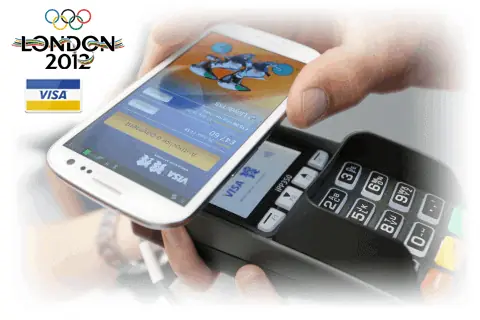
Visa Mobile Payments and Services: A limited edition of the Samsung GALAXY S III, Samsung’s Olympic Games Phone during the London 2012 Games, will be provided to Visa sponsored athletes and trialists. The device will feature an Olympic-branded version of Visa’s mobile payment application, Visa payWave. To make purchases, consumers simply select the Visa icon on the Samsung device and hold the phone to a contactless payment terminal to pay.
Visa Mobile Prepaid: During the London 2012 Games,Visa Inc. will also showcase its newest product – Visa Mobile Prepaid – the first mobile-based Visa product providing consumers in developing countries a payment account that offers Visa’s high standards of security, reliability and global interoperability. By accessing their Visa Mobile Prepaid account on their mobile phone, consumers can send and receive international remittances, pay bills, top-up wireless minutes, and access Visa ATMs.
Setting New Standards
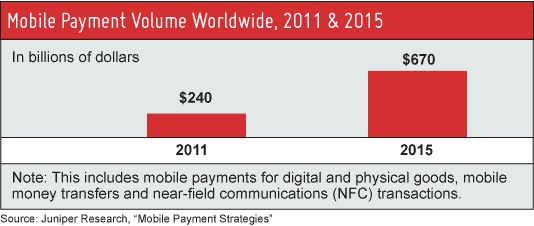
Looking at last year and then at this year’s statistics, Mobile Payments are doing their best to meet the bold predictions analysts have lined up for the future. The sector is growing rapidly and consumers in both the U.S. and around the world are embracing the convenience that the technology brings to their shopping habits. Juniper Research, a company that specializes in the identification and appraisal of high growth opportunities in various mobile telecommunications and applications sectors, put out a publication on July 5, 2011, titled “Mobile Payment Strategies.” Juniper predicted worldwide mobile spending would jump from $240 billion in 2011 to $670 billion in 2015.
Well Juniper is back with a new forecastthat focuses on Near Field Communication (NFC) and this study predicts that in just five years the NFC Mobile Payments market will will exponentially increase and eventually exceed $180 billion — a whopping seven times what it is today. The study forecasts that one in four people from Western Europe and the United States will use NFC as a payment mechanism by 2017.
Juniper cites last year as a turning point for NFC payments and suggests that major consolidation of the technology is the impetus for the predicted growth in the market as consistent standards and protocols will help fuel rapid growth and assuage the security concerns of consumers. Juniper says that in 2011 major technology infrastructure standards were finalized within the NFC Mobile Payments market so that many mobile network operators committed to the market and NFC payment pilots from both mobile operators and financial institutions transitioned to commercial service. And the research firm pointed to NFC-enabled smartphone models being announced by almost all handset manufacturers and Google as a key factor for igniting interest in the mobile payment usage in the U.S.
“This is a critical time for the NFC retail payments market,” said report co-author Dr. Windsor Holden. “Despite the significant progress being made today, the full potential of the market can only be fulfilled if all ecosystem players are equally committed and mobile wallet consortia remain in place.”
Today, The Official Merchant Services Blog is going to tackle a big picture topic in the world of credit card processing. Two weeks ago there was a proposed settlement of a lawsuit against Visa Inc., MasterCard Inc. Lawyers involved in the case claim it is the largest antitrust settlement in U.S. history. The card companies agreed to pay more than $6 billion to settle lawsuits from retailers claiming that the card issuers engaged in anti-competitive practices.
The July 13 settlement proposal — which still needs the OK by a judge — has stipulations that drop requirements that retailers charge the same price for cash and credit purchases. This opens the way for millions of businesses to add checkout fees when customers pay with plastic. In short, the settlement lets retailers push the cost of swipe fees off of them and onto the consumer directly.
A Paradigm Shift
This decision has really started to hit home for me personally. Just last week I was in the emergency room at Christiana Hospital waiting for a family member to be admitted. I got there around 5 a.m. and was in a rush so didn’t really bring much of anything with me. Hours later, I was hungry and in need of a snack. And I didn’t have any cash on me. But the vending machines at this hospital are state of the art. Which means they have fully equipped credit card swipers, allowing you to purchase snacks from them without pocket change or single dollar bills. That realization hit home with me as I noted both the power of credit card processing to be present in all aspects of my own life, and just exactly how much closer we’ve really gotten to being a cashless society. One of the last holdovers from the previous generation’s use of coins — vending machines — were now accepting credit cards. It was convenient and really helped me out in a time where I was far too worried about everything but having cash on me.
It will allow merchants the power to offset their processing fees in a very direct fashion that gives them control and power.
It will give the consumers themselves the incentive to start using cash again.
That first bullet point is good for the credit card processing industry as it allows merchants to feel more in control of their business and lets credit card processors offer more attractive savings directly to potential merchant accounts. But that gets offset by the second bullet point, as the consumer is then the direct decision maker on the purchase and has the power to affect the entire credit card processing industry by not using the plastic at all.
So Something’s Gotta Give, Right?
This boils down to an issue of convenience for the consumer. Plastic has always been the more convenient option. It’s easier to carry around than cash. And with a huge push still being made by Mobile Payment Processing Technology to make it even easier than plastic, cash still seems like it can be on the way out as we still careen quickly toward a cashless society.
But when faced with a choice between using cash and saving money, or using plastic and taking the hit on added surcharges directly, there will be a lot of consumers who will gladly switch back to cash. It won’t be that hard an adjustment to ease back into one’s daily life for shopping habits.
But, E-Commerce
The thing is, though, there’s still a really big chance these surcharges are going to hit consumers hard as too much advancement has been made in the technological infrastructure of a cashless society — namely the rise of e-commerce. Consumers today have taken to shopping online, and all of those sales utilize a credit card. A Rasmussen Reports poll in April 2012 showed that 43% of Americans said they have gone through a full week without paying for anything in cash or coins. And The Official Merchant Services Blog has reported avidly on how pervasive and commonplace online shopping has become for the typical U.S. Consumer. A move back to cash may simply not be all that effective now that people are used to the convenience and control that online shopping — and mobile shopping — provides.
Don’t Forget Durbin
This decision is the second major event concerning limitations placed on swipe fees in credit card processing. Last year the Durbin Amendment to the Dodd-Frank Act took effect. This amendment placed a hard cap on debit card swipe fees. And it’s affect is still rippling through the payment processing industry as big banks, the credit card associations, and processors all try to figure out ways to recoup the billions of dollars in projected losses that stem from having the swipe fee capped at 24 cents or so.
The one thing we can learn from the Durbin Amendment, however, is that the use of convenient swiping that debit cards provide has not been ground to a halt by Durbin, and e-commerce is still booming. It seems unlikely that this settlement concerning credit card swipe fees will curb the growth of e-commerce to the point where we take a huge step back into a cash-filled society.
HostingCon2012 is in full swing, and Host Merchant Services is in the thick of the action. Here’s a picture from today:
That’s our very own dynamic duo Ken and Justin Hemmel working the booth with our partner OpenSRS.
This partnership — which began in April — brings Host Merchant Services, the premier provider of payment processing and e-commerce services for small businesses and medium businesses, to OpenSRS Offers, the platform that allows OpenSRS Resellers to extend valuable third-party offers and discounts to their customers.
The partnership is bolstered by HMS’ experience with the web hosting industry and HostingCon is a perfect venue for the company to present its ongoing initiative to provide E-Commerce focused companies a robust solution for processing credit cards online.
“We don’t write a business off as high risk just because it sells its products or services online,” says Host Merchant Services CEO Lou Honick. “HMS understands the needs of e-commerce merchants and works tirelessly to provide them with the right services at the best possible rate.”
Also, don’t forget that Honick will participate in a panel discussion on the topic of Best Practices for Payment Processing at 9 a.m. on Wednesday July 18. The panel offers hosting providers tactics for reducing payment processing costs and reducing risk. Honick is part of a panel of payment processing industry experts addressing the conference.


 PC’s strong showing can be tracked to increased revenues from digital sales. Which says a lot about how video games are changing in their format, evolving to suit consumer needs, and fully embracing the power of E-Commerce. This isn’t exactly
 Atari’s Raiders of the Lost Ark game that was roundly criticized for how unplayable it was (Spoiler Alert: You had to navigate yourself while using a parachute to break the chute on a branch at the proper angle of descent so you’d slide into the cave under the branch, then dig a hole with the shovel that most people never knew you needed. Yeah, I beat it with luck!) Then we get into Nintendo, Sega, and things ramp up quickly to the current PS3 vs. XBox wars that EA has situated itself comfortably between by making many of its titles accessible on both platforms.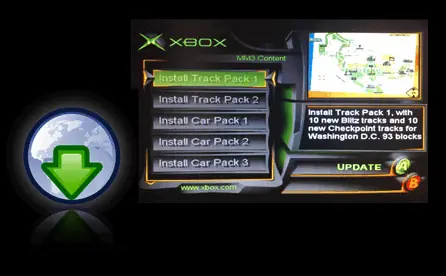


 Facebook defended its program and its protocols in response to Limited’s claims. The company has said it is investigating the claims that Limited has made, and noted that it has defenses in place for such kind of fraud. A fake click, Facebook said, would come from a fake account, which would be disabled immediately upon discovery.
 In May we learned that the breach might have actually

 Well Juniper is back with
  That first bullet point is good for the credit card processing industry as it allows merchants to feel more in control of their business and lets
  This decision is the second major event concerning limitations placed on swipe fees in credit card processing. Last year