Tag Archives: merchant services

The Future of PCI and Data Security

Today The Official Merchant Services Blog marks the triumphant return to the timely topic of PCI DSS and cardholder data security. This tantalizing topic has been touted time and again in the peerless pages of our payment processing chronicles.

Days of Future Past

The crafty criminals that defraud, hack and swipe courageous consumers for their cardholder data are a constant concern for the entire credit card processing and data security sector. The industry has to be ever vigilant in its commitment to curb the high tech criminal activities and keep that cardholder data safe.

Retailers need to be eagle-eyed when it comes to defending data and securing customer information. They also need to be prepared for disaster, with a protocol-based plan of action for the worst case scenario — the dreaded data breach. But none of these advance preparations will save a merchant from data breach dangers if the merchant is unaware of PCI DSS, what it all means and what the requirements for PCI Compliance are.

The misdirection and misinformation out there about the process of PCI Compliance has led to complacency among many merchants. Face front true believers, we’ve even expressed the fantastic facts and figures to support merchant apathy regarding PCI Compliance in previous published purveyances of PCI related blogs.

The media gloms onto the gargantuan headlines of something as garish as a Global Payments data breach and the searing spotlight of data security dazzles the masses with the terrifying tidbits of these capricious crimes. But the nature of the crime has the danger spreading to small business merchants more and more frequently in the past few years. In fact, this article from Convenience Store Decisions, it is suggested that the heinous hackers and nefarious fraudsters are backing away from the big fish and targeting the smaller retailers with easier to breach defenses.

The CS Decisions scribe John Lofsock posits that one of the prime reasons for this shift can be pinpointed to an alteration in the criminals’ own dastardly demographics. Today’s hacker is becoming less the angst ridden, misunderstood teenager with whiz-bang keyboard and coding powers and turning into a far more treacherous group of villains. As the article puts it, “When hackers run up against businesses with sophisticated information technology and up-to-date security, they’ll turn to easier systems, including those of small non-profit agencies and family businesses.”

Datapocalypse Now

So what does a merchant do? The hale and hoary Host Merchant Services PCI Compliance pioneers readily suggest utilizing their very own PCI Compliance Initiative.  PCI Compliance is a fantastic foundation for top notch transaction security. The superlative standards and powerful protocols set up by the powers that be on the PCI-DSS Council are a forceful first step any enterprising merchant needs to take to protect their data. This is why helpful Host Merchant Services offers a power-packed PCI Compliance Initiative that gets merchants quickly and seamlessly up to speed.
Add to that amazing Initiative the second step that Merchants can take to shore up their security: Host Merchant Services Data Breach Security Program. Click that link to download a PDF explaining the value-added service HMS provides its merchants that goes above and beyond just simple PCI Compliance and helps ensure a merchant’s peace of mind. This program offers data breach insurance.

The article from CS Decisions quotes Trinette Huber, of Sinclair Oil Corp. in Salt Lake City as saying “as a merchant, I can go through all the steps to do this and do it in good faith, and yet if I have a breach — which is entirely possible — the PCI council will say I wasn’t literally compliant.”

This is where breach insurance comes into play true believers. The Data Breach Insurance that cutting edge and customer-oriented companies like Host Merchant Services offers can curb the pernicious penalties that merchants face when a breach occurs. As we’ve stated time and again here on The Official Merchant Services Blog, security only begins with PCI Compliance. It’s a never-ending battle for safety, justice and the power of payment processing. Merchant Services providers need to work in conjunction with merchants to stay out in front of any and all security issues. And even then, disaster can occur, so a solid data security plan will have backup protocols like data breach insurance.

The CS Decisions article also quotes Huber as saying that PCI “is asking thousands of merchants to do something (the credit card companies) should be doing themselves. They should be fixing the magnetic stripe (in credit/debit cards) so it’s not something that can be easily stolen, instead of asking merchants to fix (the security issues) for them.” 

That concern right there is why Visa has been pushing so hard for its EMV chip program with newer, more secure smartcards that have worked so well in Canada and Europe. Huber is noted in the article for describing the overbearing cost that the switch to EMV could entail for small business owners, as well as the fact that the EMV chips have been in place for decades and have already had data compromised before.

So if not EMV, Then What?

Will no canny crusader for competent credit card processing and dependable data transfer step up to take the challenge presented by the PCI DSS? John Lofsock, the audacious author of the article we’ve been analyzing, thinks that Point to Point Encryption (P2PE) might be the champion the industry needs. This tantalizing technology that is newer than EMV chips apparently ensures that credit card data is protected from the moment it is swiped all the way through to the nanosecond it arrives with the payment processor. This could curry favor with retailers because it completely eliminates the need for the retailer to secure cardholder data, as the retailer never has possession of said data.

The real boon, as noted by Lofsock, is that the P2PE method will make it much cheaper for merchants to be PCI Compliant by removing the need for merchants to deal with network segmentation and other costly and time-consuming parts of the compliance process like the audit.

It is noted that PCATS and PCI are preparing future standards that deal with P2PE so it is on their radar.

In the meantime, Host Merchant Services continues to offer the lowest PCI Compliance rates in the industry, as well as a vigorous PCI Compliance Initiative that seeks to inform and educate everyone interested as to the details of the process, step-by-step.


Discover Teams Up with PayPal

Discover Teams Up with PayPal [2023 Update]

The Official Merchant Services Blog continues to shine its spotlight of educational information directly on the Mobile Payments Industry. This bristling business sector keeps creating buzz among payment processing persons as well as overall economic assortments. One minute people are predicting hundreds of billions of dollars in revenue will get generated by consumers embracing the cashless society model and conveniently swiping their phones to pay for every little thing that catches their eye. The next minute people are predicting U.S. consumers are too wary and cautious and not ready to expose their information to the cloud and the criminals trying to crack their way into that cloud.

This titanic tug-of-war between “the next big thing” that economic analysts desperately desire M-Payments to become and the “hold your horses hombre” caution that those same analysts caveat the slow acceptance in U.S. markets has been defining the media coverage of the Mobile Wallet Madness for more than a year. But the potential for prodigious profits has pushed the possibilities of mobile payment processing through the morass of misgivings.

Merchants United!

As we purposely pointed out to our peerless readers just mere days ago, the Merchant Customer Exchange was formed. This epic assemblage of retail industry giants teams Wal-Mart Stores Inc., Best Buy Co. and Target Corp, 7-Eleven  Inc., Alon Brands Inc., CVS Caremark Corp., Darden Restaurants Inc., Lowes Co., Sunoco Inc., Sears Holding Corp. and the Publix Supermarket chains into a mega-group of retail merchant might on a mobile wallet mission.

Coming on the heels of Visa’s saturation of the 2012 London Olympics with all things Mobile and all things Visa, the mighty mingling of the MCX merchants applied unforeseen amounts of pressure on the mobile payment marketplace.

Mobile Payment Paring: Discover and PayPal

On August 22 PayPal, owned by eBay, announced a deal with Discover Financial Services to bring PayPal access to the 7 million merchants in Discover’s network. This deal will begin in the second quarter of 2013 and the announcement was made a mere two weeks after Square partnered up with Starbucks to let customers pay with Square’s app at the 7,000 U.S. Starbucks locations.

Excelsior! Retail titans are teaming up with mobile gadgeteers in one mass scramble to make it to market before the U.S. consumer becomes firmly affixed on the easiest and most widespread brand — as is wont to happen with U.S. shopper market behavior.

The PayPal deal is a particular point of note because PayPal itself is pushing from the online marketplace back into the physical realm of brick and mortar. This may indeed help bridge the gap from e-commerce to old fashioned commerce, and that bifrost of payment processing could very well buttress mobile payment processing in a brave new world of cashles-sness and contactless transactions.

The super-powered pairing of Discover and PayPal drove stock prices for each company, with Discover gaining 3.9% and eBay gaining 2.5% on the market the day the announcement was made. This arrangement will greatly accelerate PayPal’s in-store payment efforts. By riding on Discover’s network, PayPal can get into more locations  and get there quickly. Best of all this movement doesn’t requiring any significant integration work by merchants. That potentially puts PayPal at a big advantage against rival mobile payment systems such as Google Wallet, Isis, and Square.
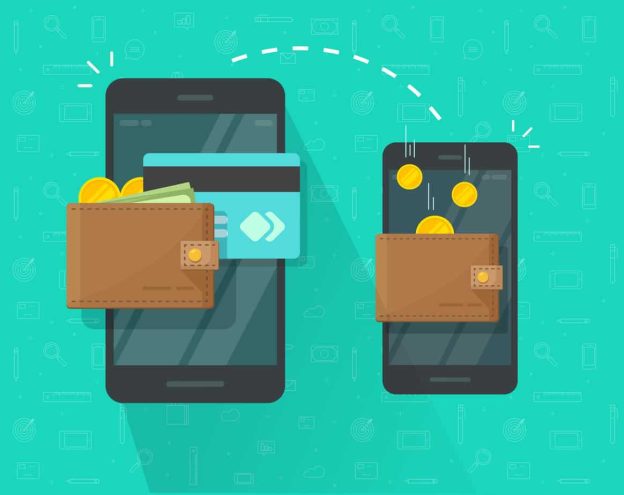
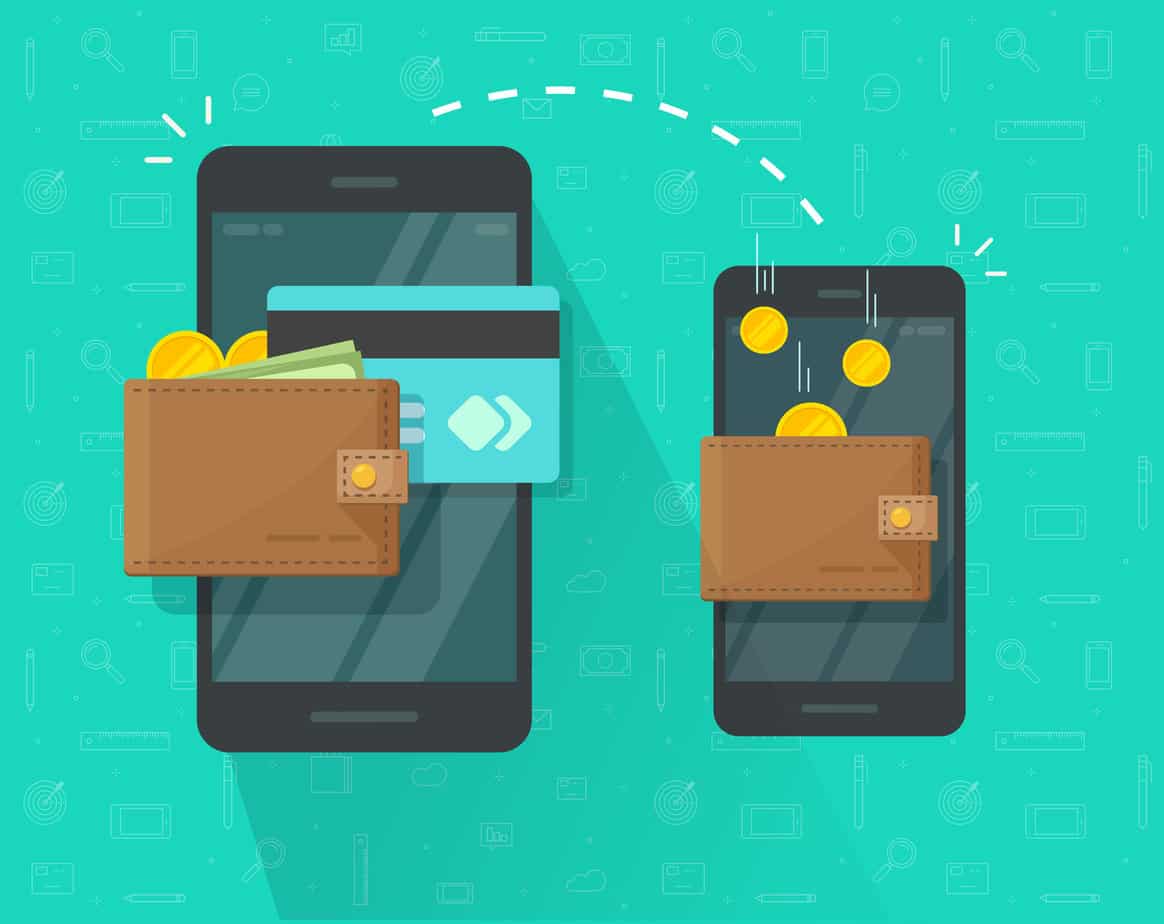

Discover is integrating PayPal’s payment system into its software, which will be uploaded to millions of point-of-sale terminals that support Discover Card payments. PayPal’s branding and rules will be presented to consumers who choose to pay in store with PayPal. PayPal currently has more than 50 million U.S. customers who will be able to take advantage of in-store payments.

Industry Terms: Merchant Cash Advance

This is the latest installment in The Official Merchant Services Blog’s Knowledge Base effort. Well we want to make the payment processing industry’s terms and buzzwords clear. We want to remove any and all confusion merchants might have about how the industry works. Host Merchant Services promises: the company delivers personal service and clarity. So we’re going to take some time to explain how everything works. This ongoing series is where we define industry related terms and slowly build up a knowledge base and as we get more and more of these completed, we’ll collect them in our resource archive for quick and easy access. Today’s term is Merchant Cash Advance.

Merchant Cash Advance

Merchant Cash Advance is a lump sum payment to a business in exchange for an agreed upon percentage of future credit card and/or debit card profits. The way this works is Merchant Cash Advance companies provide funds to businesses in exchange for a percentage of the businesses daily credit card income. This percentage is taken directly from the processor that clears and settles the credit card payment. A company’s remittances are drawn from customers’ debit- and credit-card purchases on a daily basis until the obligation has been met. Most providers form partnerships with credit card payment processors and take payments directly from a business owner’s card-swipe terminal.

A Merchant Cash Advance companies is most often used by retail businesses that do not qualify for regular bank loans. A business cash advance can be expensive compared with interest on a bank loan, ranging from 10% to 100% effective interest. Merchant cash advances are not loans – they are a sale of a portion of future credit and/or debit card sales. Therefore merchant cash advance companies claim that they are not bound by specific laws that would limit interest rates.

Despite the cost of merchant cash advances, the structure has many advantages over the structure of a conventional loan. Most importantly, payments to the merchant cash advance company fluctuate directly with the merchant’s sales volumes, giving the merchant greater flexibility with which to manage their cash flow, particularly during a slow season. Additionally, the ease, simplicity and speed of the application process, as well as the lower security position (i.e. behind that of the bank and landlord) associated with merchant cash advances are significant advantages.

There are generally three different repayment methods for the business:

  • Split Withholding, or Split Funding: When the credit card processing company automatically splits the credit card sales between the business and the finance company per the agreed portion (generally 10% to 22%). This is generally the most common and preferred method of collecting funds for both the clients and finance companies since it is seamless.
  • Lock Box or Trust Bank Account Withholding: All of the business’s credit card sales are deposited into bank account controlled by the finance company and then the agreed upon portion is forwarded onto the business via ACH, EFT or wire. This is the least preferred method since it results in a one-day delay in the business receiving the proceeds of their credit card sales.
  • ACH Withholding: When the finance company receives the credit card processing information and deducts its portion directly from the business’s checking account via ACH.


Find out more about Merchant Cash Advance options here.

And sign up for one here.

mobile wallet

Mega Retailers Jump into Mobile Wallets [2023 Update]

Today the Official Merchant Services Blog will continue with our Mobile Commerce theme. A group of 14 Major U.S. Retailers recently announced that they have decided to join forces and create their own mobile wallet application. The group, which includes Wal-Mart Stores Inc., Best Buy Co. and Target Corp., will call itself Merchant Customer Exchange, or MCX.

MCX has no official launch date as of today, but the merchants are determined to jump head first into the expanding mobile payments market. The network of merchants also includes 7-Eleven  Inc., Alon Brands Inc., CVS Caremark Corp., Darden Restaurants Inc., Lowes Co., Sunoco Inc., Sears Holding Corp. and the Publix Supermarket chains.

Merchant Customer Exchange

MCX seeks to corner a piece of the mobile payments market, expected to balloon from $172 billion this year to $600 billion by 2016. The new merchant super group plans on offering a mobile-commerce solution capable of seamlessly integrating a wide range of consumer offers, promotions and retail programs. The application will be available through virtually any smart phone.

This move comes about a week after Starbucks announced partnering with Square, a mobile processing start-up that uses smart phone attachments to accept credit cards. Now MCX will not only compete with Square, it has taken away 14 potential partners from the processor. MCX is also bad news for Google, which has been expanding its own mobile wallet platform, called Google Wallet over the past year. Google Wallet uses NFC, or near field communication to transmit payment data from a customers smart phone to an NFC-enabled payment terminal.

Mega-Merchants

With these mega retailers coming together, a new perspective can be used to develop mobile wallet apps. The retailers want to focus on ease of use and security for the consumer.

“As merchants, no one understands our customers’ shopping and payment experience better than we do, and we’re confident that together we can develop a technology solution that makes that experience more engaging, convenient and efficient,” said Mark Williams, president of financial services at Best Buy.

Mike Cook, corporate vice president and assistant treasurer of Wal-Mart said, “the MCX platform will employ secure technology to deliver an efficiency-enhancing mobile solution available to all merchant categories, including retail stores, casual dining, petroleum and e-commerce.”

Now with many more contenders in the mobile commerce arena, the only thing consumers can do is wait for the dust to settle. The great race to mobile wallet supremacy has begun!Host Merchant Services will keep you up to date on all new technology developments and potential partnerships relating to the mobile payments world.

What Brand is Your Wallet? [2023 Update]

Today The Official Merchant Services Blog keeps examining the rapidly growing payment processing sector of Mobile Payments. With an never ending stream of deals being made by startups and established companies developing the latest gimmicks and technology to bring mobile payments and mobile wallets to the average everyday U.S. consumer driving the marketplace, it’s easy to get lost in a sea of mobile payment processing media hype.

In our blog yesterday we were able to see how some of that disconnect works. Visa pushed mobile payment technology aggressively at the London games. Their plans were almost scuttled by a malfunction with the processing terminals during a men’s soccer match between Great Britain and United Arab Emirates. The crowd was cranky as they were unable to pay for concessions using a mobile phone or a credit card. They had to resort to cash, and many patrons were unprepared for the anachronism.

This wrinkle in Visa’s mobile plans underscores how fragile mobile payment technology still is; and it also highlights how close we’ve come to a cashless society — the kind of society where mobile payments promise to be a thriving and convenient way to pay for goods and services.

The Knock on Mobile Wallets

The continued skepticism U.S. consumers have with mobile payments can be found summarized well in this L.A. Times article by David Lazarus. The main theme is something we’ve covered extensively in the past year: Mobile Payments are the future, but people are worried that the payment processing is not secure. It seems that for almost every story published about how mobile wallets are going to revolutionize e-commerce and make billions and billions of dollars in profit, there’s a story like this one that says consumers are worried about security, fraud and identity theft.

These are valid concerns. Much like regular old online shopping — which has become ingratiated into the average U.S. consumer’s shopping habits — the threat of tech savvy criminals stealing pertinent payment information is an ongoing issue. Everything from phising scams to data breaches affect e-commerce. But none of it has stopped the juggernaut from steam rolling consumer buying habits. Everyone shops online because of the ease and convenience. This is powered by how easy it is for people to be online, click some buttons and buy something. The power of convenience trumps security concerns.

This will happen for mobile wallets as well. Once the technology gets out in front of people they will flock to it because it is easy to use and available where they shop.

Convenience is the Key

So what I believe is the current obstacle holding Mobile Payments back from making a huge splash with U.S. consumers is the fractured marketplace. They’re not readily available at the store when you go there. There’s too many variations on the theme. And too many different companies trying to inject a new technological advance into the sector before it gets traction with consumers. We covered the top types of Mobile Payment technologies recently, and even keeping our analysis to just a few contenders we’re stuck noticing a competition between Near Field Communication driven “Swipe Phone” technology and QR-Code driven “Scan” technology.

iPhone 4S Drives Mobile Commerce

Recent reports by Monetate show it gets even simpler than that — Smartphones themselves. Gone will be the advertising slogan of Captial One, “What’s in your wallet?” that questions what plastic card you use. Instead it will be “What brand is your wallet?” Or rather, which smartphone are you using to pay for things with — iPhone or Android?

According to the data from Monetate, the answer used to be in doubt as late as Q4 2011; and is now a resounding iPhone by Q2 2012. Monetate released its E-Commerce Quarterly Report for the second quarter of 2012, and the figures showed some dramatic changes in smartphone usage driving e-commerce traffic.

According to the report, “Leading e-commerce websites receive 3.31% of their total visits from smartphones running Android, up from 1.76% last year and an increase of 85% in total shopping sessions. These same websites receive 5.41% of their traffic from iPhones compared to 2.45% a year earlier, an increase of 117% in total shopping sessions over the same time period.”

The data showed that in Q4 of 2011 websites received 1.99% of their total visits from Androids and just 2.25% of their visits from iPhones, suggesting the two competing smartphone systems were about dead even. The iPhone 4S was released that quarter however, and iPhones spiked way ahead of the Android.

Despite that spike in iPhone usage, the report indicated that shoppers on Android-powered smartphones converted better than iPhone users — Android converting at a 1.26% clip and iPhone at a 1.00% clip.

What Does This All Mean?

Well even with iPhone getting a bigger spike than Android, both phones grew their e-commerce usage in 2012. That means the goal of realizing those heady revenue predictions from companies like Juniper and Gartner Research are on course. The security concerns may make good copy for the media, but the real obstacle remains saturation in the actual physical marketplace. Give people more opportunities to pay with their phones and they will readily begin to pay with their phone. It will start off as some new gimmick people want to try. And then it will become second nature.

Industry Terms: Discount Rate

This is the latest installment in The Official Merchant Services Blog’s Knowledge Base effort. Well we want to make the payment processing industry’s terms and buzzwords clear. We want to remove any and all confusion merchants might have about how the industry works. Host Merchant Services promises: the company delivers personal service and clarity. So we’re going to take some time to explain how everything works. This ongoing series is where we define industry related terms and slowly build up a knowledge base and as we get more and more of these completed, we’ll collect them in our resource archive for quick and easy access. Today’s term is Discount Rate.

Discount Rate

The simple definition of the term Discount Rate as it applies to merchant accounts — it is a combination of the fees charged by the card acquirer to the merchant for processing payment card transactions. So what that’s really saying is the Discount Rate is what the payment processor charges the merchant so that they can make profit off of the transaction — it’s not really a discount in any sense of the word when defined like that.

So let’s break this down a little more to understand this buzzword beyond just the obvious. A Merchant Account has a variety of fees. Some of these fees are charged periodically, such as a monthly service fee. Others can be charged on a per-item or percentage basis, such as a Chargeback Fee. Some fees are set by the merchant account provider.

The majority of the per-item and percentage fees, however, are passed through the merchant account provider to the credit card issuing bank according to a schedule of rates called interchange fees, which are set by Visa, Discover, and Mastercard.

Each merchant services provider has real costs in addition to the wholesale interchange fees, and creates profit by adding a mark-up to all the fees they have to take on to provide their services in the first place. The discount rate comprises the combination of dues, fees, assessments, network charges and that additional mark-up merchants are required to pay for accepting credit and debit cards. The largest of these fees by far is the Interchange fee.

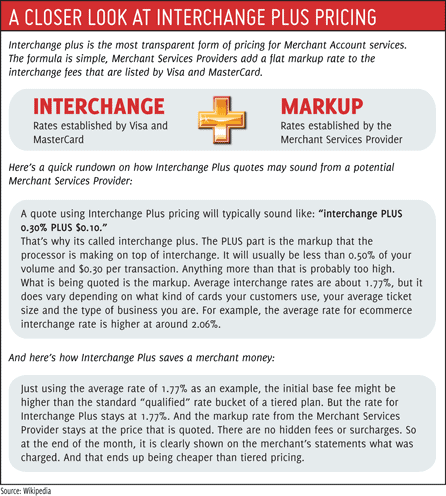
There are a number of pricing models that merchant services providers utilize, but Host Merchant Services uses the Interchange Plus pricing plan.

Interchange Plus pricing means that the acquirer charges you a variable MSC consisting of the cost price plus a fixed markup. Interchange Plus Pricing  is exclusively how we quote at Host Merchant Services. Interchange Plus, also known as Cost Plus, pricing gives the customer a fixed rate over published Interchange Fees. This pricing format is normally quoted as a discount rate (percentage fee) along with a per item or authorization fee. The great thing about Interchange Plus pricing is that you always know exactly what you are paying to your processor to services your account. Think of Interchange, and all the associated fees, as an unavoidable cost. No matter who you process with, you have to pay these fees. They may be labeled differently, or wrapped up in a confusing pricing tier, but one way or the other, you are paying Interchange fees. By understanding the markup you pay over Interchange, you know exactly what you pay to your processor and exactly what is going to the card associations. That allows you to make a decision on whether or not the markup seems reasonable for the service you get and choose your processing partner accordingly.

Here’s a small graphic explaining the basics of how Interchange Plus works.

Industry Terms: Payment Gateway

This is the latest installment in The Official Merchant Services Blog’s Knowledge Base effort. We want to make the payment processing industry’s terms and buzzwords clear. We will eliminate any and all confusion merchants might have about how the industry works. At Host Merchant Services, we promise to deliver personal service and clarity. So we’re going to take some time to explain how everything works. This ongoing series is where we define industry related terms and slowly build up a knowledge base and as we get more and more of these completed, we’ll collect them in the resource archive for quick and easy access.

Payment Gateway

Today we will focus on Payment Gateways and how they work, in order to wrap up our week of E-commerce driven content. A payment gateway allows E-commerce merchants to accept credit cards on their websites. Sensitive payment information is encrypted by the gateway to ensure that it passes securely between the customer and the merchant. We have defined a POS, or point of sale system already for the Knowledge Base. A payment gateway can be considered a virtual point of sale system. The gateway acts as a “middle man,” allowing communication between online shopping carts or virtual terminals and the banks processing the transaction.

The process can be broken down like this, it starts when a customer places an order on a website by pressing the “Submit Order” button in an online shopping cart. The payment gateway then forwards the transaction information to the payment processor used by the merchant’s acquiring bank. From there the payment processor forwards that information to the appropriate card association (ex Visa, MasterCard). The credit card issuing bank receives the request, or the Authorization and does the necessary credit or debit check and then sends a response back to the processor in the form of an approval code (ex approved, denied). Next the processor forwards the authorization response back to the payment gateway. After receiving the response, the gateway forwards it on to the website, which then evaluates it as a relevant response and relays the outcome to the merchant and cardholder. Finally, the merchant then fulfills the customers order, then after a batch the acquiring bank receives the funds, and deposits them into the merchants bank account.

Payment gateways can be stand-alone systems designed for integration with other 3rd party systems, or they can be bundled with their own shopping carts and virtual terminals. It’s worth noting that most merchants will not need to install additional software on their own servers to run a basic payment gateway. Some payment gateway providers are simple to implement, but do not offer much customization. Others are more complex but can be customized to your needs.

Host Merchant Services offers a variety of E-commerce solutions to fit your business, including Transaction Central, our own cutting edge in house payment gateway. HMS is able to interface with most of the major Payment Gateways out there, including Authorize.net. We also offer unparalleled protection for all of our merchants in the form of our PCI Compliance Initiative.


E-Commerce: Robust and Full of Life

Today The Official Merchant Services Blog keeps on rolling along with the topic of E-Commerce. We’ve recently been looking at some of the interesting individual aspects of the sector, such as our blog about E-Commerce and Video Games the other day and our blog about Social Media Commerce yesterday. We’ve consistently reported how pervasive and commonplace online shopping has become over the past decade. Gone is the shiny newness of using a mouse to do all of your Christmas shopping. It’s now something mundane that we see most consumers in U.S. households doing when they need either the convenience of going online, or the power they have to find exactly what they want when local brick and mortar venues may not have the service or product desired.

A huge fuss has been made repeatedly over the past two years that Mobile Payment Processing, or M-Payments, are going to reap billions of dollars of profit worldwide and online shopping will shift and embrace shopping anywhere with one’s smartphone.

The King is Dead

This article from Jasper Bell at Econsultancy goes so far as to suggest that E-Commerce is dead and that a new hybrid concept, called Distributed Commerce. Bell calls it a “shift from this direct model, to an indirect, more agile way of selling.”

Bell cites the growth of social media and mobile phone usage. Bell discusses the power of what he calls “peer-influenced content” — essentially word of mouth advertising on social networks, or more simply put, you get turned on to a good or service because your Facebook friends tell you it’s cool or your twitter feed blows up — as a key factor in the paradigm shift.

He also demonstrates that the fluid ability to move from the virtual space on your mobile device to the physical realm of the area you are in and then back into the virtual realm of another device or a channel makes marketing and eventually commerce much more flexible and agile, keeping up with the consumer no matter where they go or how they get there. The International Data Corporation backs up that assertion with its findings that indicated 45% to 60% of smartphone users conducted due diligence on store prices and inventory from their devices. IDC also falls into line with companies like Garnter and Juniper about the healthy future of m-payments, predicting that by 2014 more than $50 billon will be spent on merchandise globally by consumers using their smartphones.

This agility for consumers to shop wherever using their phones as both assistants and payment option is something we have delved into with our look at the variety of Mobile Payments options. And Bell makes a really compelling point that people flip quickly between a product search on their phone’s internet access to a purchase ready state in mere clicks. Distributed Commerce is what Bell calls the evolution of E-Commerce. And it is probably the strongest reason why all of our coverage of mobile payments is still listed under the category flag of E-Commerce. We at The Official Merchant Services Blog already acknowledged this natural connection and kept them together in the larger picture of E-Commerce.

As Bell says in his article, “Commerce today is less about ‘selling in’ a channel but selling ‘through’ a channel, reaching out to consumers wherever they are and selling in that context.”


The Other Shoe

Bell’s compelling evidence for the rise of M-Payments sets his article on a course to then predict a downfall in E-Commerce. We think this is mainly due to his definition of E-Commerce referring primarily to shopping online through a PC or Mac desktop computer — ye old visit to amazon.com from your home computer. We of course lump M-Payments into the overall umbrella of E-Commerce. We also don’t feel the juggernaut that is E-Commerce is so easily deconstructed by the baby steps of M-Payments just yet.

Twenty Five Percenters

Juggernaut is too timid a term to describe E-Commerce. This infographic from Big Commerce asks the question “Will M-Commerce Overtake E-Commerce?” If you skip right down to the bottom of the graphic, the sub section titled “Brace Yourself” you find this stunning and overpowering fact: E-Commerce is expected to generate $1 trillion in revenue by 2014. The graphic also states that 54% of all retail purchases will be made online by 2014. Comparatively, M-Commerce is predicted to hit $119 billion worldwide by 2015. Mobile Payments are not going to be the death of E-Commerce just yet.

And this article by Media Post News says pretty much just that — estimating that even by 2017 m-commerce will match about 24.4% of the overall e-commerce pie. All of these projections point to staggering growth for mobile payments, but moving right along with that is the firmly established e-commerce sector that will continue to take more and more of the standard retail pie as it nom-nom-noms its way to massive revenue generation.

Big Time Processing Opportunities

What this means in terms of the payment processing industry and all the companies like Host Merchant Services that facilitate credit card transactions for merchants is simple: Our economy is going cashless. We are driving full steam ahead into a realm where we buy things with phones that will function like credit cards, or we just hop on a device/tablet/computer and click-touch-click our way to purchases. This means more and more of the purchases people make will carry the processing fees that credit card processors make their margin of profit from. As the economy becomes completely tied in to credit transactions through E-Commerce, payment processing becomes a standard. It’s something Merchants need to know about and that’s why The Official Merchant Services Blog exists.

Industry Terms: CVV

This is the latest installment in The Official Merchant Services Blog’s Knowledge Base effort.  We want to make the payment processing industry’s terms and buzzwords clear.  We will eliminate any and all confusion merchants might have about how the industry works.  At Host Merchant Services, we promise to deliver personal service and clarity.  So we’re going to take some time to explain how everything works.  This ongoing series is where we define industry related terms and slowly build up a knowledge base and as we get more and more of these completed, we’ll collect them in the resource archive for quick and easy access.

Card Verification Value (CVV)

In continuing with our E-Commerce focused blogs this week, I thought it would be appropriate to introduce the term Card Verification Value, or CVV. There are two types of CVV codes, called CVV1 and 2, respectively. The CVV1 is embedded in the magnetic stripe of track 2 of a card. The purpose of the first CVV is to verify data stored on a card is valid and was issued by a bank when used in person.

The second and more prominent CVV2 is a three-digit code (Visa, MasterCard) printed on the back of credit and debit cards.  American Express cards have a ‘Unique card code’ that is four-digits long and printed on the front. Discover has a 3-digit code on the back of its cards, but refers to this as a CID (Card Identification Number). These codes are used in card not present transactions occurring over the Internet, or MOTO as an added security feature to prevent fraudulent purchases. The code is meant to verify that the customer has the card in their possession.

Security Benefits

For Merchants:

Merchants requiring CVV2 codes for their card not present transactions can dramatically reduce fraud in their businesses. Using this extra layer of protection can stop breached or fraudulent cards from going through. Avoiding potential retrievals and chargeback fees.

For Consumers:

Entering your CVV2 code when purchasing online products verifies that you are who you say you are. Under Visa regulations, merchants cannot store CVV2 codes in their databases.  This means any card numbers lost in a breach would be less useful. In this sense, a consumer is protected on both sides of a transaction, once when verifying the purchase, and then again in terms of breach or fraud security.

Social Media Commerce: Tweet, Like, Buy

Today’s installment of the Official Merchant Services Blog is on the rise of E-commerce in social media. Last week, we covered the E-commerce offerings of the video game industry in detail. Today, I’d like to take a look at the role E-commerce is beginning to play in the realm of Facebook, Twitter and other social media websites.

Social Media User Base

Social media sites have expanded rapidly over the last few years.  For those who don’t remember, Facebook started out as a place strictly for college level students to network. Now all-inclusive, Facebook is the world’s most populated social gaming and media platform with 955 million users worldwide.

Twitter is second with over 500 million users worldwide, LinkedIn is third with just about 175 million, and Google + trails all three with about 90 million. With such a massive user base to reach out to, an E-commerce presence is the next logical step, and as usual, Facebook is taking the lead. This article will focus on what Facebook has done to streamline the E-commerce aspect of social media.

“Like” Pages

It’s safe to say most Facebook users are familiar with the “Like” button and similarly, the “Like” pages. These pages describe the interests and activities of the user, offer updates to certain products and promotions, as well as allow users to share their thoughts on those products.

The end goal of any merchants Facebook “Like” page is the get the most number of “Likes” and subsequently the most number of page views and purchases of your particular product. The problem lies with differentiating potential customers from current ones. If someone “likes” a page for a product, they may already own it, be saving their money for that product, or just think its neat but don’t want or need it. As of right now, Facebook has no way to separate these users.

Social E-Commerce

According to Facebook’s SEC Form Q-10, 1.6% of users spent over $1 billion on Virtual goods (accessories for virtual characters, tools in Farmville, etc) in the first six months of 2012. That is money spent on items never seen outside of the browser. If the market for non-tangible goods can be that lucrative, the market for actual goods Facebook users enjoy must be bigger.

Carol Rozwell, Vice President at the tech research firm Gartner had a call to action for merchants unsure of the potential for social media e-commerce.  “It’s crucial that organizations implement approaches to handling social media now. The effort involved in addressing social media commentary is not good cause to ignore relevant comments or solvable issues.” According to Gartner, although more than 50% of organizations track social media only 23% actually collect and analyze data.

In June, Facebook made a move to simplify mobile e-commerce payments by decreasing the number of steps involved in checking out, from seven individual steps to two, and eliminating the need to type. The Facebook mobile app SkyBucks, is another innovation in E-commerce, it allows you to charge your virtual accessories to your phone bill directly.

More recently, the social media giant rolled out an offer for stores using Shopify.  Since partnering, Facebook is now offering free $50 Facebook Ad credits. This is in addition to the credits from Google AdWords and Amazon Products that Shopify merchants already enjoy. The promotion is another step for Facebook in the E-commerce direction.

The “Want” Button

Above I identified a need Facebook had, the ability to discriminate between current and potential customers for their advertisers and business users. In early July, the Ecommerce Times had a story on Facebooks next big thing: The “want” button.

The button will allow users to create ‘wish list’ of products that they like or want, but do not currently have. Merchants will want to focus on who has marked their product as ‘wanted’ and who has not. The benefits of the “want” button go beyond sales. The button would allow for highly targeted marketing as well as a sharing of ‘wish lists’ between users. Ultimately the goal should be for the wish list to take its place among the social media landscape, along side a user’s general info and status updates.

For the Consumer

To the average consumer and Facebook user, this should add to the ease of purchases that has increased recently. With the additional “want” info that the site will collect, you will be able to see what your friends and family want, add similar items to your personal wish list, and research potential gifts for you friends discretely. All of which add value to Facebook’s ever-increasing platform.

For the Merchant

For merchants looking to expand on Facebook, the E-commerce addition will do wonders. The added marketing affects will help businesses increase name recognition and sales, while still connecting with the end user. It seems to me, that Facebooks E-commerce push will benefit all involved.