Tag Archives: knowledge base

Industry Terms: Visa International Service Assessment (ISA)

This is the latest installment in The Official Merchant Services Blog’s Knowledge Base effort. We want to make the payment processing industry’s terms and buzzwords clear. We want to remove any and all confusion merchants might have about how the industry works. Host Merchant Services promises: we deliver personal service and clarity. So we’re going to take some time to explain how everything works. This ongoing series is where we define industry related terms and slowly build up a knowledge base and as we get more and more of these completed, we’ll collect them in our resource archive for quick and easy access.

Today we will take another look at international processing, and the fees associated with accepting an international card.  Yesterday we defined the MasterCard Cross Border Fee, and today we will explain the Visa International Service Assessment.

Visa implemented an international service assessment (ISA) fee of 40 basis points (0.40%) in April of 2008. This fee applies to all transactions involving a U.S. based business and a credit or debit card issued outside of the U.S. The ISA is also separate from interchange rates and from Visa’s standard assessment fee, which is currently 11 basis points (0.11%).

For example, the ISA fee of 0.40% will be added to a transaction where a customer uses a Visa-branded card issued out of the United States to buy something here in Delaware.

The ISA is one of two fees Visa currently charges for international card usage, the other is the International Acquirer Fee, a separate 45 basis point fee (0.45%), which applies under the exact same circumstances as the ISA. Visa began charging the IAF in October 2009.

The total fees Visa charges for a transaction involving an international card processed in the U.S. is the sum of the ISA fee (0.40%), the Visa standard assessment (0.11%), and the International Acquirer Fee (0.45%), which comes to almost a full percent above interchange, 96 basis points (0.96%).

Industry Terms: Discount Rate

This is the latest installment in The Official Merchant Services Blog’s Knowledge Base effort. Well we want to make the payment processing industry’s terms and buzzwords clear. We want to remove any and all confusion merchants might have about how the industry works. Host Merchant Services promises: the company delivers personal service and clarity. So we’re going to take some time to explain how everything works. This ongoing series is where we define industry related terms and slowly build up a knowledge base and as we get more and more of these completed, we’ll collect them in our resource archive for quick and easy access. Today’s term is Discount Rate.

Discount Rate

The simple definition of the term Discount Rate as it applies to merchant accounts — it is a combination of the fees charged by the card acquirer to the merchant for processing payment card transactions. So what that’s really saying is the Discount Rate is what the payment processor charges the merchant so that they can make profit off of the transaction — it’s not really a discount in any sense of the word when defined like that.

So let’s break this down a little more to understand this buzzword beyond just the obvious. A Merchant Account has a variety of fees. Some of these fees are charged periodically, such as a monthly service fee. Others can be charged on a per-item or percentage basis, such as a Chargeback Fee. Some fees are set by the merchant account provider.

The majority of the per-item and percentage fees, however, are passed through the merchant account provider to the credit card issuing bank according to a schedule of rates called interchange fees, which are set by Visa, Discover, and Mastercard.

Each merchant services provider has real costs in addition to the wholesale interchange fees, and creates profit by adding a mark-up to all the fees they have to take on to provide their services in the first place. The discount rate comprises the combination of dues, fees, assessments, network charges and that additional mark-up merchants are required to pay for accepting credit and debit cards. The largest of these fees by far is the Interchange fee.

There are a number of pricing models that merchant services providers utilize, but Host Merchant Services uses the Interchange Plus pricing plan.

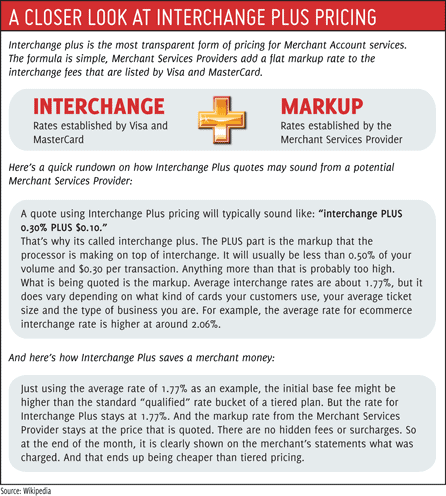
Interchange Plus pricing means that the acquirer charges you a variable MSC consisting of the cost price plus a fixed markup. Interchange Plus Pricing  is exclusively how we quote at Host Merchant Services. Interchange Plus, also known as Cost Plus, pricing gives the customer a fixed rate over published Interchange Fees. This pricing format is normally quoted as a discount rate (percentage fee) along with a per item or authorization fee. The great thing about Interchange Plus pricing is that you always know exactly what you are paying to your processor to services your account. Think of Interchange, and all the associated fees, as an unavoidable cost. No matter who you process with, you have to pay these fees. They may be labeled differently, or wrapped up in a confusing pricing tier, but one way or the other, you are paying Interchange fees. By understanding the markup you pay over Interchange, you know exactly what you pay to your processor and exactly what is going to the card associations. That allows you to make a decision on whether or not the markup seems reasonable for the service you get and choose your processing partner accordingly.

Here’s a small graphic explaining the basics of how Interchange Plus works.

Industry Terms: Payment Gateway

This is the latest installment in The Official Merchant Services Blog’s Knowledge Base effort. We want to make the payment processing industry’s terms and buzzwords clear. We will eliminate any and all confusion merchants might have about how the industry works. At Host Merchant Services, we promise to deliver personal service and clarity. So we’re going to take some time to explain how everything works. This ongoing series is where we define industry related terms and slowly build up a knowledge base and as we get more and more of these completed, we’ll collect them in the resource archive for quick and easy access.

Payment Gateway

Today we will focus on Payment Gateways and how they work, in order to wrap up our week of E-commerce driven content. A payment gateway allows E-commerce merchants to accept credit cards on their websites. Sensitive payment information is encrypted by the gateway to ensure that it passes securely between the customer and the merchant. We have defined a POS, or point of sale system already for the Knowledge Base. A payment gateway can be considered a virtual point of sale system. The gateway acts as a “middle man,” allowing communication between online shopping carts or virtual terminals and the banks processing the transaction.

The process can be broken down like this, it starts when a customer places an order on a website by pressing the “Submit Order” button in an online shopping cart. The payment gateway then forwards the transaction information to the payment processor used by the merchant’s acquiring bank. From there the payment processor forwards that information to the appropriate card association (ex Visa, MasterCard). The credit card issuing bank receives the request, or the Authorization and does the necessary credit or debit check and then sends a response back to the processor in the form of an approval code (ex approved, denied). Next the processor forwards the authorization response back to the payment gateway. After receiving the response, the gateway forwards it on to the website, which then evaluates it as a relevant response and relays the outcome to the merchant and cardholder. Finally, the merchant then fulfills the customers order, then after a batch the acquiring bank receives the funds, and deposits them into the merchants bank account.

Payment gateways can be stand-alone systems designed for integration with other 3rd party systems, or they can be bundled with their own shopping carts and virtual terminals. It’s worth noting that most merchants will not need to install additional software on their own servers to run a basic payment gateway. Some payment gateway providers are simple to implement, but do not offer much customization. Others are more complex but can be customized to your needs.

Host Merchant Services offers a variety of E-commerce solutions to fit your business, including Transaction Central, our own cutting edge in house payment gateway. HMS is able to interface with most of the major Payment Gateways out there, including Authorize.net. We also offer unparalleled protection for all of our merchants in the form of our PCI Compliance Initiative.

 

Industry Terms: Debit Cards

This is the latest installment in The Official Merchant Services Blog’s Knowledge Base effort. Well we want to make the payment processing industry’s terms and buzzwords clear. We want to remove any and all confusion merchants might have about how the industry works. Host Merchant Services promises: the company delivers personal service and clarity. So we’re going to take some time to explain how everything works. This ongoing series is where we define industry related terms and slowly build up a knowledge base and as we get more and more of these completed, we’ll collect them in our resource archive for quick and easy access. Today’s term is Debit Cards.

Debit Cards

debit card (also known as a bank card or check card) A debit card looks like a credit card but works like an electronic check. The thin plastic card that provides the cardholder electronic access to a bank account at a financial institution. Payments made with Debit Cards are deducted directly from that checking or savings account. If a cardholder uses a debit card at a retail store for example, the cardholder or the cashier can run the debit card card through a scanner — oftentimes the very same terminal credit card purchases are swiped through. This action enables the financial institution to verify electronically that the funds are available and approve the transaction. Most debit cards also can be used to withdraw cash at Automated Teller Machines (ATMs).

Unlike credit and charge cards, payments using a debit card are immediately transferred from the cardholder’s designated bank account. This difference is key in one sense, as it creates a completely different set of protocols and standards for debit transactions in the payment processing industry. This can be seen most recently in the Durbin Amendment of the Dodd-Frank Act. The financial reform legislation set a hard cap on debit card swipe fees. But has absolutely no affect on credit card transactions.

For many consumers, the card they carry can be used as both a credit and a debit card when presenting it at a retail store for purchase or using it online. Oftentimes, a consumer is asked to choose between credit or debit.

For the consumer the distinction can have this impact:

  • The card’s individual rewards program can vary depending on debit or credit. In many cases, a credit transaction reaps greater points  or rewards from these types of programs.
  • A debit transaction can allow for cash back right at the point of sale.
  • A credit card transaction can have stronger protection. It takes time before it is “batched” out by the merchant. And the credit cards themselves have more fraud protection layers than debit cards typically have.

For the merchant and for the banks involved the impact is this:

  • The transaction network that the purchase is run through is separate for debit and credit.
  • The fees associated with the transaction are different. After Durbin, the fees face a hard cap ceiling on what the merchant can be charged. Credit has no such ceiling and so smaller transactions — say purchases under $10 — can end up costing a merchant a bit more in fees.

The distinction between credit and debit was stronger in the 1980s and 1990s, but it still exists. It’s worth knowing what your options are as both a consumer and a merchant.

Industry Terms: Revenue Share

This is the latest installment in The Official Merchant Services Blog’s Knowledge Base effort. Well we want to make the payment processing industry’s terms and buzzwords clear. We want to remove any and all confusion merchants might have about how the industry works. Host Merchant Services promises: the company delivers personal service and clarity. So we’re going to take some time to explain how everything works. This ongoing series is where we define industry related terms and slowly build up a knowledge base and as we get more and more of these completed, we’ll collect them in our resource archive for quick and easy access. Today’s terms are Revenue Share and Strategic Partnership.

Revenue Share

At its most general definition, Revenue Sharing refers to the sharing of profits among different groups. One form shares between the general partner(s) and limited partners in a limited partnership. Another form shares with a company’s employees, and another between companies in a business alliance.

When applied to the Payment Processing Industry, revenue sharing is a bit more specifically involved in a cost per sale sharing of profits and accounts for about 80% of affiliate compensation programs. E-commerce web site operators using revenue sharing pay affiliates a certain percentage of sales revenues generated by customers whom the affiliate refer via various advertising methods. Another form of online revenue sharing consists in people working together and registering online in a way similar to that of a corporation, and sharing the proceeds.

A third form of revenue sharing on the internet consists of enticing internet users to sign up and create content by offering a share of advertising revenue.

Strategic Partnership

A strategic partnership is a formal alliance between two commercial enterprises, usually formalized by one or more business contracts but falls short of forming a legal partnership or, agency, or corporate affiliate relationship. Typically two companies form a strategic partnership when each possesses one or more business assets that will help the other, but that each respective other does not wish to develop internally.

To Learn More …

To learn more about Revenue Sharing, you should: Register for Host Merchant Services Free Webinar on Tuesday June 12, 2012 at 10 a.m.

Industry Terms: Point of Sale

This is the latest installment in The Official Merchant Services Blog’s Knowledge Base effort. Well we want to make the payment processing industry’s terms and buzzwords clear. We want to remove any and all confusion merchants might have about how the industry works. Host Merchant Services promises: the company delivers personal service and clarity. So we’re going to take some time to explain how everything works. This ongoing series is where we define industry related terms and slowly build up a knowledge base and as we get more and more of these completed, we’ll collect them in our resource archive for quick and easy access. Today’s terms is Point of Sale (POS).

Point of Sale (POS)

The location at which a payment card transaction occurs, usually by way of a device such as a credit card terminal or cash register. The term is usually associated with retail points-of-sale, but also applies to any initial point where the customer presents payment to the merchant, such as by telephone or Internet.

The location is also sometimes referred to as Point of purchase (POP) or Checkout.

Point of Sale Terminal (POS Terminal)

A terminal at the point of sale, connected via telecommunication lines to a central computer. Authorization, recording and transmission of electronic transactions are performed through the terminal. A POS terminal manages the selling process by a salesperson accessible interface. The same system allows the creation and printing of the receipt.

The retail industry is one of the predominant users of POS terminals. A Retail Point of Sales system typically includes a computer, monitor, cash drawer, receipt printer, customer display and a barcode scanner, and the majority of retail POS systems also include a debit/credit card reader.

Restaurant POS refers to point of sale (POS) software that runs on computers, usually touch screen terminals or wireless handheld devices. Restaurant POS systems assist businesses to track transactions in real time. Typical restaurant POS software is able to print guest checks, print orders to kitchens and bars for preparation, process credit cards and other payment cards, and run reports. In addition, some systems implement wireless pagers and electronic signature capture devices.