
Tag Archives: Interchange

Interchange Plus Follow-Up

The Official Merchant Services Blog looks at an interesting opinion article we found on Practical E-Commerce. We recently did a 2-part series on the differences between Tiered Pricing plans and Interchange Plus pricing plans. And in it we heralded Interchange Plus and explained why Host Merchant Services uses what we feel is the superior pricing plan to benefit its merchants.

The article begins by introducing the author: “Contributor Phil Hinke is a credit-card veteran who now consults with merchants on lowering their processing costs. Hinke believes the credit card processing industry is often unfair to merchants. He believes the Durbin Amendment — which lowers debit card interchange rates — is fostering deceptive pricing practices by some merchant account providers. He explains his views in the article below.”

This bring together the topic of Merchant Account pricing plans with the Durbin Amendment, something The Official Merchant Services Blog has also been covering in detail. Deceptive pricing practices are something Host Merchant Services strives to overcome in the industry. And one of the key factors the company chose Interchange Plus pricing is because of the transparency which lets merchants see fees on their statements much better than tiered pricing plans.

But Mr. Hinke’s article is an eye-opener because it details ways in which even Interchange Plus pricing can be manipulated to hide fees from merchants: “I am a strong proponent of interchange-plus pricing and, to date, I have never recommend tiered pricing for merchants. (I addressed the differences between interchange-plus and tiered pricing at“Notable Views: Credit Card Veteran on ‘Onerous’ Processing Rates,” a previous article.) However, merchants on interchange-plus pricing can still be grossly overpaying for their card processing. In fact, of the hundreds of merchant statements I have analyzed, the majority of merchants that were overpaying were already on interchange plus, which gives merchants only the potential for fair prices — nothing more.

I recently showed a merchant who was already on interchange plus pricing that he could save money by changing to a provider with a higher processing rate. How could that be? The processing rate is just one of many costs the merchant pays. In this case, the merchant account provider had given the merchant what seemed to be an enticing rate. However, it also hit the merchant with copious monthly and annual fees. Those fees more than offset the rate savings.”

This is a compelling point. And one of the areas where Host Merchant Services is able to stay competitive. Interchange Plus is a tool that a Merchant Services Provider can use to give its customers fair prices. But it’s only a tool. MSPs can still do their best to mark up fees and manipulate the process for profit maximization. As Mr. Hinke points out Interchange Plus only gives merchants potential for fair pricing. It still needs a motivated, hungry MSP in place looking to save merchants money by taking advantage of the tool.

An MSP like Host Merchant Services utilizes that tool along with its overall philosophy to guarantee its merchants savings, transparency and customer service. In that way, Interchange Plus works for the merchant, because it is part of the overall plan to have merchants stick with the company because they are getting value for the services. As Chief Operations Officer Dan Honick often says to clients, “You stay with us because you’re happy.”

Tiered vs. Interchange Plus Part 2

The Official Merchant Services Blog continues it’s two-part series on Tiered Pricing vs. Interchange Plus. After yesterday’s blog defined what Three-Tier pricing looks like, we now take a closer look at how it falls apart and does not save merchants money. Then we’ll outline Interchange Plus pricing and highlight why Host Merchant Services uses this plan to save its merchants money.

Where the Problems Occur

The three tiers of a typical Tiered Pricing plan are commonly referred to as rate buckets or buckets. And Merchant Service Providers who use tiered pricing structures for their customers utilize a “qualification matrix” that dictates which rate bucket the various interchange categories will qualify to. That means that the fees can shift from month to month as a merchant consistently fails to meet the “standard” transaction of the Qualified bucket. Thus each month they consistently have to pay surcharges from the other two buckets which aren’t adequately displayed or described on their statement.

And because these fees and surcharges from the other two bucket rate tiers are often hidden, that makes it difficult to accurately compare rates and fees from competing providers unless a merchant knows how each provider will be qualifying those categories. Because the categories aren’t directly comparable and because the qualification matrix can shift fees on a merchant from month to month, a common occurrence is a merchant can look at two separate tiered pricing offers from different Merchant Services Providers that look nearly identical because they use the same language for each tier, and yet could be different by hundreds of dollars each month.

Merchants Have to do the Hard Part

This puts the responsibility squarely on the shoulders of the merchant. They need to read the fine print of their statement and understand the subtle differences between the tiers to note when they get shifted to a different tier. This is the most common way Merchant Services Providers make money. The sales pitch when signing the merchant focuses on the low end bucket that saves the customer the most money. But then once the processing starts, buckets shift and the merchant gets a lot more charges than they initially signed up for.

So if your statement shows that you have a lot of mid-qualified or non-qualified surcharges each month, it’s time to consider switching to Interchange Plus, the pricing structure that Merchant Service Providers like Host Merchant Services offers.

The Advantage of Interchange Plus

Interchange Plus pricing is based on the “interchange” tables published by both Visa and MasterCard. At first that may seem like a daunting pricing plan. But it ends up being a lot easier to understand, completely transparent to the merchant, and less expensive than tiered pricing plans. Interchange plus pricing has the merchant pay the exact interchange fee from the tables in addition to a flat markup fee from their Merchant Services Provider. That’s where the name comes from: It’s the Interchange fee Plus the markup fee. This eliminates all of the hidden fees you would find in a tiered pricing plan. And gets rid of surcharges that merchants would incur for transactions that don’t fit the standardized portion of the rate bucket matrix. You pay what you are told you will be paying.

This makes it less popular than tiered pricing plans where Merchant Services Providers can make quite a bit of money off of those surcharges due to the latitude they have in defining their tiered bucket rates. But Interchange Plus makes statements easier to read, customer service easier to provide to merchants, and savings much easier to guarantee. All of those elements are cornerstones of Host Merchant Services. So Interchange Plus is the best fit for the company and for their customers.

Tiered Pricing vs. Interchange Plus

Today The Official Merchant Services Blog is going to delve into the murky world of hidden fees and tiered pricing plans. This is the first in a two-part series and it focuses on Tiered Pricing. Host Merchant Services offers an Interchange Plus pricing plan. The company offers this plan because of its transparency and the savings it can provide when compared to the far more popular tiered pricing plans. To get a better grasp of why Interchange Plus works so good for Host Merchant Services, it helps to understand what is happening with a tiered pricing plan and how that kind of plan works.

Hidden Fees From Tiered Pricing Plans Unfair to Merchants

Tiered credit card pricing can be unfair to small business owners. Many credit card payment processors calculate merchant costs using a tiered pricing structure. These tiered pricing levels increase the costs for merchants by suggesting they are paying one rate, but hiding other fees into the statements and in the end the merchant is paying a higher percentage. The answer to this problem is Interchange plus pricing.

Host Merchant Services uses Interchange Plus. And this pricing structure is the most transparent and easiest to read system in terms of the statement and the way fees are charged. The merchant sees everything they are being charged for in their statement. Nothing is hidden, and there are no shenanigans employed in getting merchants to think they are saving with a low rate that ends up being made up for in a series of other fees snuck into each statement.

Three tier pricing is currently one of the most popular pricing structures used in the payment processing industry. Here’s a table that defines the three tiers:

It’s all About The Surcharges

Tiered pricing plans start with the qualified rate. This is the standard fee a merchant is charged when they accept and process a credit card or debit card transaction. This is also the lowest rate the merchant can incur. Transactions that don’t qualify for the standard set forth at that rate get hit with various surcharges. And its these surcharges where the processor starts to make a lot of profit. And its these surcharges which are usually the hidden fees that don’t show up on a merchant’s statement.

There are over 500 different interchange categories between the major credit card companies and each category has its own charge that is comprised of a percentage and often a per transaction fee. The three tier pricing structure merges all of these charges into three buckets. And a Merchant Services Provider has its own discretion, to an extent, as to which bucket or tier they place these categories.

These underlying interchange categories are not disclosed on a tiered pricing plan so there’s no way of knowing into which bucket each category is being charged. This is where hidden fees crop up.


Why the Durbin Amendment Got it Right [2023 Update]

The people in Washington aren’t exactly popular these days, and mostly for good reason.  Unemployment is high, the so-called economic recovery is weak, and small businesses are hurting.  However, another round of stimulus is on its way, and this time it might just work.  Even better, this stimulus comes at the expense of banks that got us into this mess to begin with. To be fair, there is plenty of blame to spread around but that is a topic for another day.  The Durbin Amendment went into effect October 1st, and many businesses will see a significant reduction in their monthly debit card processing fees.  This isn’t just for pin-based transactions, but applies to all Visa and Mastercard logo signature debit cards, as well as card-not-present debit card transactions via Internet and phone order.  On average, fees will be reduced by over 1% per transaction, resulting in a windfall for small business.

There are a lot of arguments against the Durbin Amendement.  I’ll outline and debunk the major ones here:

The savings will not get passed along to the merchants.

True, your merchant services company is not required to pass the savings along to you.  If you are on tiered pricing instead of Interchange plus, you aren’t going to receive the benefits.  But this is also creating a huge opportunity for merchant services companies like us to introduce customers to the benefits of our pricing model and to save them a very significant amount of money.  In short, if you’re merchant services company isn’t passing the savings along to you, it’s time to find a new merchant services company.

Merchants will not pass the savings along to their consumers.  

Again, true, but not necessarily the point.  In a free market, any time you create margin, you create opportunity.  Businesses all over the country are getting a little relief in their margins.  Some will choose to use that margin to compete on price.  Some will pocket the profits.  Many will use that extra profit to reinvest and grow their businesses through hiring and infrastructure enhancements.  No matter how you slice it, this is money directly to small business and that is great for the economy.

Banks will charge fees to offset the lost revenue.  

Sure, this is happening at some high profile institutions like Bank of America.  But other banks are also using it as an opportunity to lure you away.  Banks are limited by competition in terms of how much of the fee they can pass along to you before you bolt to a competitor.  That is the free market working the way it should.  When you take monopolistic fees like Interchange that are unavoidable to merchants and move them to the front of the transaction, consumers and small businesses ultimately win.  You now have the ability to shop for the best deal, where transaction costs were previously hidden and passed along in other ways.

Overall, the Durbin Amendment should provide a multi-billion dollar boost to small businesses everywhere, and the government didn’t have to shell out taxpayer dollars to make it happen.  Sure, it may be somewhat arbitrary, and too much regulation is never a good thing, but the card associations that impose Interchange fees operate as a cartel with monopolistic powers, so the government has a valuable role to play in the process.  We should all celebrate the Durbin Amendment and the tremendous benefits to small business.  If you’re not setup to take advantage of the savings, what are you waiting for?  Apply now!

Durbin Amendment About To Be In Effect

On the last day of September, Durbin Amendment Eve if you will, The Official Merchant Services Blog is about ready to end its Countdown to Durbin Series. Today we take a look at the big news that has the media buzzing.

Bank of America Reacts to Durbin

Bank of America, the largest bank in the country going by deposits, announced it is going to begin charging its customers a $5 monthly fee to use debit cards. The bank will begin charging the fee next year for the bank’s basic checking accounts. It will apply only to debit card purchases and not to ATM withdrawals, online bill payments or mobile phone transfers, the company said.

Consumer Backlash and Cut Up Cards

Bank of America announced this change, which will take effect for its customers in 2012, and were soundly slammed with negative feedback. Our first link comes from Fox Business Network, where Gerri Willis cut up her debit card on the air in reaction to the news from Bank of America. “Right here, right now, I’m going to show Bank of America what I think of their fees,” she said before using a pair of scissors on her card.

Durbin Slams Bank of America

Our next link comes from The Washington Post. It picks up the topic, mentioning what Willis did on the air. It then offers Bank of America’s defense of this new fee, stating that the bank is doing this to recoup losses that will come from the cap on debit card swipe fees that the Durbin Amendment will put into place tomorrow on October 1. Then the article quotes Senator Dick Durbin: “Bank of America is trying to find new ways to pad their profits by sticking it to its customers,” Durbin said in a statement Thursday. “It’s overt, unfair, and I hope their customers have the final say.”

Bank of America Already in Crisis

While this move was quite predictable, and falls into line with Host Merchant Services’ previously published analysis of how banks will react to the Durbin Amendment, the news is quite incendiary because of Bank of America’s current situation. Which is mentioned in the third article we highlight on Bank of America, by Fox News: “the Bank of America decision drew outrage for several reasons. The company is the largest U.S. bank by deposits. And it reaped $45 billion in federal bailout money — receiving the first chunk in 2008 and the rest in 2009 to cope with losses at Merrill Lynch. “

The article also mentions that Bank of America did pay back the government all of the bailout money.

Bank of America a Microcosm of Durbin’s Impact

A fourth article, from the Christian Science Monitor, sums up quite succinctly how this news is quite standard Durbin Amendment fallout: “So in other words, Bank of America is shifting a part of the fee obligation from merchants to customers.”

As we’ve seen in the ongoing Countdown to Durbin series, this is one of the most expected moves that banks are making. Shifting the burden of the fees away from merchants and putting it squarely on the shoulders of the consumers. This avoids the scope of the Durbin Amendment’s regulations and lets the banks continue to reap profits from the billion dollar payment processing industry.

Rounding out the coverage of Bank of America and its announced monthly debit fees we find:

The Chicago Tribune offers a quick glance at Bank of America’s plan here.

The Baltimore Sun blogs to its readers to avoid these types of fees by switching to ATM only.

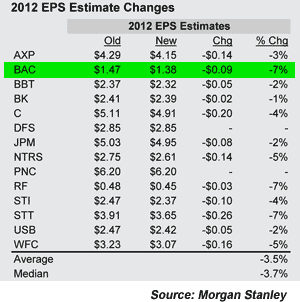
And the final little tidbit we offer you today on the eve of Durbin enactment comes from The Street, reporting that Morgan Stanley cut 2012 earnings estimates for Bank of America and 11 other banks.

This chart, while the story states is not entirely tied to Bank of America’s recent announcement or to the Durbin Amendment, does show that banks will be affected by the Durbin Amendment. They will have to make changes to deal with the losses they expect to take from a hard cap on fees that they were profiting from, and if Bank of America is any indicator, the burden of those changes will go from the merchants who used to get hit with the swipe fees to the consumer who will now have to pay more to support the use of debit cards.

Durbin Amendment Almost Here

The Official Merchant Services Blog once again takes up the task of analyzing the media reports revolving around the Durbin Amendment and the changes it will bring to how banks do business with their customers because of its cap on debit card swipe fees. We continue to use Host Merchant Services‘ own analysis as the foundation of the comparisons we make regarding other media sources and their take on the legislation and its impact.

Durbin on Durbin

The first article comes from a Chicago-based radio station WLS 890 AM. It’s an interesting read because it quotes the legislation’s namesake, Senator Dick Durbin from Illinois. It’s one of the few articles that includes Durbin’s perspective on the legislation as we get closer to the October 1 date of when the law takes effect. The article begins with a brief explanation of what Durbin sought to do with the legislation:

“Sen. Dick Durbin told reporters Tuesday afternoon that the debit card fees retailers have to pay will go down Saturday thanks to the Durbin Amendment.”

It then offers a lively retort from J.P. Morgan Chase executive Jamie Dimon: “The big boss at J.P. Morgan Chase, Jamie Dimon, calls this ‘price fixing at its worst’ that will surely cause banks to raise fees on customers with deposit accounts. “

While many of the articles on this amendment have been dancing around the confrontation between consumers and banks over the Durbin Amendment this article dives right into the rhetoric, giving it a much more active tone for the reader and an insight into the debate that framed and spawned the legislation. It helps that the article ties this confrontational perspective into the legislation’s author and Durbin’s motivation for working on the amendment. Citing a letter that Durbin wrote to Dimon back in April, the article states: “Durbin said to Dimon, ‘Your industry is used to getting its way with many members of Congress and with your regulators. The American people deserve to know the real story about the interchange fee system and the ways that banks in general — and Chase in particular — have abused that system.’ “

But the basic conclusion is pretty much the same as the other articles focusing on the amendment and what changes it will bring on October 1. The conclusion is that banks will react by creating more fees for their customers and just recouping the losses from the swipe fee cap in other areas not covered by the legislation. Durbin is quoted in the article, calling that tactic “indefensible” but conceding it is the likely outcome of the amendment. The article sums it up: “So what the government giveth, the banks may take away.”

The Cost of Doing Business

The next article we look at is an Associated Press piece located on Bloomberg’s website. It’s a report that reveals how much money American Express spent in the second quarter of this year to lobby Congress and fight against the implementation of the Durbin Amendment.

American Express Co. spent $610,000 in the second quarter to lobby the federal government on rules involving the fees charged to merchants for processing payments and other issues, according to a disclosure report.”

The article notes that the company spent the same amount of money in the previous quarter of 2011, but that they spent 3% more money in the second quarter of 2010 comparatively. The article also notes that Amex doesn’t offer debit card services, but does offer interchange services on credit card payments, suggesting that was the reason it spent money to lobby Congress on the topic. The money wasn’t solely spent on lobbying against the Durbin Amendment. And the article notes that: “Amex representatives also lobbied the federal government on legislation involving online tracking of consumer behavior and the protection of personal information, cyber security, financial regulatory reform, consumer financial protection and issues related to reloadable prepaid cards, patent reform, tax reform and reform of the U.S. Postal Service.”

So what we see in today’s Countdown to Durbin is a look at how heated the debate still is between the legislation’s namesake and the big banks that are targeted by the reform. The intensity of this debate was such that American Express even spent more than $600,000 in a single quarter to lobby against it in 2011.