Tag Archives: Interchange

Durbin Double Down

Durbin Double Down [2023 Update]

In this installment of the Official Merchant Services Blog, we look at the actions several retail trade groups and merchant advocates have taken to further the fight against the antitrust settlement proposed by Visa and MasterCard.  We have touched upon this subject several times before, however these steps may have been the most drastic yet.

In an open letter last week to leading members of congress, the National Retail Federation (NRF), the Retail Industry Leaders Association (RILA), and seven other large retail-related groups expressed their frustration with the pending litigation in the U.S. District Court for the Eastern District of New York, saying that the outcome could further “entrench the Visa/MasterCard duopoly.”

The groups called on congress to pay attention to the state court settlement, in an attempt to escalate the issue and garner attention from lawmakers and Americans.

The groups argue, “The proposed settlement, which was negotiated by Visa, MasterCard and lawyers purporting to represent the merchant community, is one-sided and preserves the very anti competitive actions that were the genesis of the lawsuits.”

“Given the important oversight role of Congress and your continued interest in this important issue, we write today to urge you to reject the false claims from the card networks and their representatives.” The letter also stated “The proposed settlement does nothing to resolve the failures in the electronic payment market and continued Congressional involvement in these issues is imperative. We look forward to keeping you fully informed as the legal process moves forward and the chorus of objections grows.”

RILA’s Brian Dodge described the problem retailers face, “Visa and MasterCard centrally set fees that are ultimately paid by merchants and collected by issuing banks. With two fee schedules imposed by two companies that control 70 percent of the marker there is no meaningful competition.”

The groups argue that the $7.2 billion dollar settlement is not the problem, even going so far as to accuse Visa and MasterCard of using the pending settlement exchanges as penitence for maintaining the status quo.

In a statement released in July, just after the settlement was announced Visa said it believes that the settlement is in the best interests of all parties involved. “This agreement should remove the distraction of litigation for all parties,” said Joshua R. Floum, general counsel of Visa Inc. “We will go forward with a focus on helping retailers grow their businesses and providing them with efficient and valuable payment options.”

On October 3rd, these retail and trade groups will appear before a court seeking to order the Federal Reserve Board to start over in devising regulations for implementing the controversial amendment’s provisions because the Fed allegedly did not follow the amendment’s dictates in setting the debit card rules now in place. The trade groups and retailers sued the Fed last November in an effort to start the rule-setting process anew. In a May filing, the plaintiffs said the board “manufactured ambiguity” in its interpretation of the amendment’s language. A Federal Reserve spokesperson would not comment about the upcoming hearing, although attorneys for the Fed said the board properly implemented the law’s directives regarding the authorization and settlement costs that could be considered in regulating debit card interchange, as well as which costs to exclude.

Retail groups continue to fight both the Interchange settlement and the Federal Reserve Boards Durbin rules.  There seems to be no end in sight for this case, and only time will tell if the Fed will be forced to reset its Durbin amendment rules and regulations and start anew.

NRF Opposes Interchange Settlement

It’s been a little while since the Official Merchant Services Blog touched on the increasingly sensitive topic of the Credit Card Interchange Settlement. We first talked about the possibility of ‘The Big Cash Comeback’ when the settlement was first announced, and later we discussed the opposition to the settlement.

Seven years after the first lawsuits were actually filed against the bank card networks and some leading banks, a tentative settlement was reached on July 13 of this year.  The agreement has had many mixed reviews, and some big name retailers have come out against it, including most recently the National Retailers Foundation, the nations largest retail trade association.  The NRF’s members operate 3.6 million stores nationwide, however the organization itself is not involved in the lawsuit, which includes individual and class merchants as well as trade-group plaintiffs.

Under the proposal, the main defendants, Visa and MasterCard will pay $6.6 billion in damages and temporarily reduce interchange rates to save merchants another $1.2 billion. Merchants also will get greater freedom to surcharge card transactions and could form bargaining groups to negotiate interchange with the networks. In return, the networks will be freed from future legal challenges from merchants regarding interchange rates and merchant rules, even from merchants that didn’t participate in the current lawsuit.

I think the key points here are the temporary reduction of interchange rates as well as the fact that all merchants give up their rights to sue Visa and MasterCard upon accepting the settlement.  Merchants will most certainly be satisfied by the reduction of interchange rates, but the drop will only be temporary.  After a few months Visa and MasterCard will raise them again, and continue to collect outlandish fees for credit card transactions.  Also, not every merchant is involved in this suit. I don’t think it’s a good deal for merchants to give up any of their rights, particularly the rights to any future litigation.

The National Association of Truck Stop Operators (NATSO) released a statement on Monday, announcing their dismissal of the settlement, “We joined this lawsuit in search of real reform to a broken system, one that is shielded from normal competitive forces. This proposed settlement does not achieve this goal. It lacks meaningful fixes to a system that allowed Visa and MasterCard to set artificially high swipe fees and provided retailers and consumers with no choice except to pay.”

This statement echo’s the cries of dissenters, who say the settlement protects the status quo more than anything, and will not change the way the networks set interchange.

In conclusion, the settlement still faces harsh criticism, and Visa and MasterCard have not had much to say to those who oppose it.  Only time will tell if the plaintiffs decide to accept the deal, or push back for a settlement more in their favor.  Host Merchant Services will keep you informed of all the latest news involving this legal battle between the merchants and the card-issuing giants.

Changes to Interchange Fees

Breaking News from The Official Merchant Services Blog: MasterCard and Discover have announced interchange increases and modifications to take effect October 2012. Specific association modifications such as these are beyond the control of payment processors like Host Merchant Services. They come directly from the big card associations themselves. These changes affect all merchant card processors and their customers, meaning these changes in fees and rates travel in a straight line from Visa, MasterCard and Discover to the merchants.

The Meat and Potatoes

MasterCard will be reducing the Consumer Debit rate from 1.64% + $0.16 to 1.60% + $0.15. MasterCard will increase the Small Ticket Debit rate from 1.30 + $0.02 to 1.30 + $0.03.

Discover Card will be enacting several changes to their PSL Public Services interchange fee programs. Rates will increase from 1.50% +$0.10 to 1.55% + $0.10. Discover PSL Card-Not-Present/E-Commerce Premium Plus will increase from 2.30% + $0.10 to 2.35% + $0.10. Discover will also increase Key Enter Premium Plus from 2.10% + $0.10 to 2.15% + $0.10.

Add These Fees to the Pile

These changes come on the heels of a series of changes we reported back in February. Visa’s new Fixed Acquirer Network Fee and Transaction Integrity Fee made all of the headlines back then, but MasterCard also implemented its new annual Acquirer License Fee. This fee took effect in July 2012. MasterCard also implemented a new annual Type III Third Party Processor (TPP) Registration Fee in July 2012.

MasterCard based these fees on a full year of 2011 volume for each merchant, and for 2012 only the fees are 50% of the total fee calculated — since they cover only half of the year. MasterCard passed these fees through on a pro-rata basis and all acquired MasterCard credit and signature debit volume was utilized to determine the annual volume for both programs. PIN debit volume was excluded.

The changes to Discover Card’s PSL Public Services interchange fee programs are also in addition to a series of changes Discover announced back in February. Discover introduced a US Commercial Large Ticket Interchange program, increasing its assessment fee by .005%. Discover also changed existing card present Interchange rates for transactions less than $15 for Express Service merchants (Local Commuter, Bus Lines, Toll & Bridge Fees, Restaurants, Fast Food Restaurants, News/Dealer Stands, Laundries, Dry Cleaners, Quick Copy & Reproductions, Parking Lots/Garages, Car Washes, Motion Picture Theaters and Video Entertainment Rentals) and less than $25 for Taxi/Limo merchants.

Pay Attention to Your Statement

As stated above, these changes are made directly to Interchange rates from the Card Associations.  Unlike Visa’s much ballyhooed FANF, which is a completely new fee and not subject to regulation from the Durbin Amendment, these fees fall under the scope and purview of Interchange, and thus Durbin.

Merchants will begin to see the following text on their August Statements to explain the changing fees:

Visa, MasterCard, Discover Card Services have announced category introductions and modifications to their current interchange structures. These changes may affect your current pricing effective October 2012. Further detail specific to these changes and impacts to your merchant account will be detailed on your September merchant statement. As previously disclosed on your February and March merchant statements, MasterCard introduced the new MC licensing fee. Beginning in August 2012, the new licensing fee of $.005 will be included with the MasterCard NABU billing and appear as “MC assoc NABU/license fee”. Thank you for your continued business.

Industry Terms: Interchange


Interchange

Interchange is a term used in the payment card industry to describe a fee paid between banks for the acceptance of card based transactions. Usually it is a fee that a merchant’s bank (the “acquiring bank”) pays a customer’s bank (the “issuing bank”).

In a credit card or debit card transaction, the card-issuing bank in a payment transaction deducts the interchange fee from the amount it pays the acquiring bank that handles a credit or debit card transaction for a merchant. The acquiring bank then pays the merchant the amount of the transaction minus both the interchange fee and an additional, usually smaller fee for the acquiring bank or ISO, which is often referred to as a discount rate, an add-on rate, or passthru.

For cash withdrawal transactions at ATMs, however, the fees are paid by the card-issuing bank to the acquiring bank (for the maintenance of the machine).

These fees are set by the credit card networks, and are the largest component of the various fees that most merchants pay for the privilege of accepting credit cards. Visa, Mastercard, and Discover are each known as card associations. And each card association has their own rate sheets known as Interchange Reimbursement Fees. These fees make up the majority of what you pay to your processor and they vary greatly depending on the card type accepted.

Download Visa’s Interchange Fees Here

Merchant Services Document Download Graphic

Download MasterCard’s Interchange Fees Here

Merchant Services Document Download Graphic


Interchange Plus Pricing

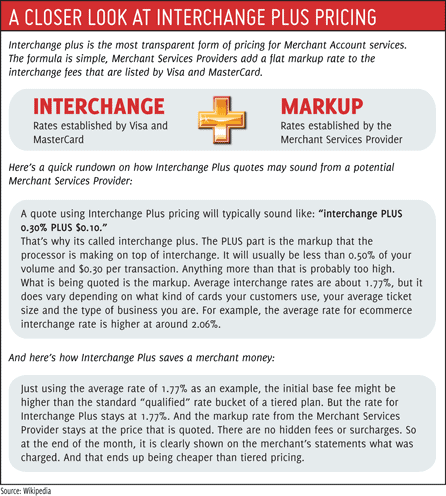
Interchange Plus pricing means that the acquirer charges you a variable MSC consisting of the cost price plus a fixed markup. Interchange Plus Pricing  is exclusively how we quote at Host Merchant Services. Interchange Plus, also known as Cost Plus, pricing gives the customer a fixed rate over published Interchange Fees. This pricing format is normally quoted as a discount rate (percentage fee) along with a per item or authorization fee. The great thing about Interchange Plus pricing is that you always know exactly what you are paying to your processor to services your account. Think of Interchange, and all the associated fees, as an unavoidable cost. No matter who you process with, you have to pay these fees. They may be labeled differently, or wrapped up in a confusing pricing tier, but one way or the other, you are paying Interchange fees. By understanding the markup you pay over Interchange, you know exactly what you pay to your processor and exactly what is going to the card associations. That allows you to make a decision on whether or not the markup seems reasonable for the service you get and choose your processing partner accordingly.

Here’s a small graphic explaining the basics of how Interchange Plus works:

Host Merchant Services infographic on Interchange Plus pricing

Visa, MasterCard Add New Fees

The Official Merchant Services Blog has just learned that Visa and MasterCard are planning to add new processing fees in the coming months — fees specifically targeted toward Debit Card Swipe transactions. These new fees, which we are consolidating and dubbing as “Card Association Fees” are going to complicate the pricing process for Merchant Services Providers in 2012.

Tricky Fees

Visa, MasterCard and Discover are the main players in the “card associations” and they are the driving force behind interchange and interchange rates. These associations periodically review and modify their interchange rate structures and billing strategies. What this means is that normally each year the big credit card companies get together and increase interchange rates. But after the Durbin Amendment went into effect in 2011, the credit card associations are taking pause and tweaking their own strategy. So effective April 2012 there are new Card Association Fees being implemented and these fees are not interchange fees. These are brand new processing fees created by the associations.

Visa’s New Fees

Visa has announced that beginning April 1, 2012, it will be introducing a trio of new fees:

  • A Transaction Integrity Fee
  • Revisions to its Network Acquirer Processing Fee
  • A Fixed Acquirer Network Fee (FANF)

Transaction Integrity Fee: Visa’s Transaction Integrity Fee is a new $0.10 fee that will apply to U.S. domestic regulated and non-regulated purchase transactions made with a Visa Debit card or Visa Prepaid card that fail or do not request Custom Payment Service (CPS) qualification. The CPS rates are Visa’s best rates and apply to both regulated and non-regulated transactions. This new fee can be viewed as a definite response from Visa to the Durbin Amendment’s interchange rate cap and finance reform/regulatory changes.  This is part of the ninja-style set of moves The Official Merchant Services Blog has cited would be the reaction to the Durbin Amendment.

Network Acquirer Processing Fee: The Network Acquirer Processing Fee on Visa-branded signature debit will be reduced — going from $0.0195 per authorization to $0.0155 per authorization. The fee for credit card authorization will remain $0.0195 per authorization.

Fixed Acquirer Network Fee: FANF will apply to the acceptance of all Visa-branded products and is based on both the size and the number of merchant locations. The FANF fee will be based on volume reported in July 2012. Visa will require U.S. acquirers to provide new merchant location reporting for the tracking of this fee. The new reporting requirements will include a monthly breakdown of acquired merchants, number of merchant locations, and merchant sales volume by merchant Taxpayer ID. For Card Present merchants, with the exception of Fast Food Restaurants, a merchant Taxpayer ID with physical locations will be assessed FANF on a per-location rate basis. For example, Card Present Merchants with one to three locations will see a pass through per location per month fee of $2. Price per location per month will increase according to the number of locations – upwards of $65 month for merchants exceeding 4000 locations. Card Present High Volume MCC Merchants with one to three locations will see a pass through per location per month fee of $2.90. Price per location per month will increase according to location — upwards of $85 month for merchants exceeding 4000 locations. Customer Not Present, merchant aggregators and merchants primarily operating as Fast Food Restaurants (MCC 5814) will be assessed based on gross merchant sales volume originating from any Visa-branded card. Merchants that fall into this category with monthly gross sales volume ranging from less than $50 a month on the low end will see a $2 a month fee- to merchants with gross sales exceeding $400 million at a $40,000 a month fee. There are some 18 tiers, with a merchant falling into a volume tier of $8,000 to $39,999 a month seeing a new $15 per month FANF fee.

Visa will also effectively waive the FANF for eligible Charitable and Social Service Organizations (MCC 8398). The FANF waiver for Charitable and Social Service Organizations will be provided through a quarterly rebate process that Visa has indicated will be defined at a later date.

Continue Reading – Visa, MasterCard Add New Fees, Part 2 

Finding Quality Merchant Services [2023 Update]

Today The Official Merchant Services Blog is playing a bit of catch up. The story we’re going to highlight and discuss is almost three weeks old. It was intended to run earlier, but technical difficulties with the blog’s production kept it from appearing until now. However, we feel the story is still worth some attention due to the issue it highlights about the payment processing industry.

The story comes to us from a Chicago, IL section of the Better Business Bureau (BBB). This article from the BBB says that the organization has seen a 42% rise in complaints against credit card processing services. The article, which originally was posted by the BBB on December 15 found that complaints were up for the 12 month period in 2011 compared to the previous 12 months. The breakdown was specifically 110 complaints in the recent 12 month period versus  77 complaints in the period prior.

Not Just In Chicago

The complaints aren’t just lodged in Chicago. This article from Fox40.com details similar complaints in Sacramento, CA. The article states: “The Better Business Bureau is warning businesses to beware of sales pitches by credit card processors that don’t reveal key details that could end up costing business owners more than they bargained for.”

And it quotes Caitlin Peterson of the Better Business Bureau of Northern California as saying “We’ve had over 1,700 complaints this year against the merchant processing business.”

What the Problem Is ?

From reading through the two articles — as well as an older BBB article about issues in the St. Louis, MO area — the problems that merchants are encountering are really straightforward. Business owners are being approached by salespeople offering big savings on their payment processing. And then once the merchant signs a contract with that person, they are saddled with hidden fees for services they were not told about. In short, the business owner is led to believe they are getting a great deal but end up having to pay out more because of all the things not mentioned in the deal. So complaints against payment processors rise in select areas.

Pricing and Transparency

This type of behavior is the exact reason Host Merchant Services utilizes its philosophy of Interchange Plus pricing and no hidden fees. These types of issues are why CEO Lou Honick says “Host Merchant Services is about bringing trust to the payment industry.”

“Payment processing is confusing,” says Honick, noting the ease in which merchants can get saddled with the types of issues that have cropped up with the BBB complaints. “The big guys make it difficult to understand exactly what your rate is and what fees are associated with accepting credit cards. We deliver personal service and clarity. Our people care about customer service and will take the time to explain how everything works.”

Honick also cites the process that Host Merchant Services uses to directly counter the problems that business owners encounter with other processors: “We believe that when you get your statement every month, you should understand every item, and it should match what you were promised in the sales process. If you have a question, there is a live person at Host Merchant Services ready to assist you.”

The Details

One of the primary ways Host Merchant Services combats the practices that lead to these complaints is with their pricing structure. Host Merchant Services uses Interchange Plus pricing instead of the more standard tiered pricing format. Interchange Plus makes statements easier to read, customer service easier to provide to merchants, and savings much easier to guarantee. Here’s a small graphic explaining the basics of how Interchange Plus works:

You can review a comparison between Host Merchant Services Interchange Plus pricing — which is simple and transparent — and the tiered pricing plans that other processors use in a two-part blog series that The Official Merchant Services Blog ran in October, 2023.

  • Part One
  • Part Two
  • Follow Up

What the BBB Advises ?

The BBB advises merchants take these steps to avoid getting stuck with the issues that their complainants have encountered:

Ask around.

The BBB suggests getting at least three estimates from different Payment Network Providers and to checkout he BBB Business Review of the merchant processing service. They also suggest asking fellow business leaders for referrals.

Know where to turn.

The BBB advises you check up on the support team that a potential Merchant Services Provider offers you. Can you contact them 24 hours a day? What is their response like outside of typical business hours? And the BBB advises you make sure their technical support can handle your needs as that kind of support is vital to your business’ success.

Try them out.

The BBB says that you should not settle without a trial period. You should make sure that the payment processor you choose has a 100 percent money-back guarantee before selecting them. Make sure their service works for you, and make sure they keep their promises to you.

Don’t get locked in to a long term contract.

The BBB is very clear on this. Never commit to a long term agreement that locks you in. Make the merchant services provider earn your business each and every month.

Get references.

The BBB advises that you get the payment processor to provide you with references. And then suggests you spend some time checking up on those references.

Make sure you know what you’re being charged for.

The BBB says that if you have a question regarding a fee that you were charged, ask the merchant services provider. Don’t let them hide fees on you. Make sure you understand your statement.

How Host Merchant Services Stacks Up 

Host Merchant Services falls in line with what the BBB advises merchants to do. The company places a big emphasis on transparency. Their salespeople will explain a merchant’s statement in detail. One of strengths of the offering from Host Merchant Service is their guarantee to save a merchant money. They achieve this by a statement analysis. Not only will Host Merchant Services explain the details of what your statement and fees are, completely transparent, while you process with them, they’ll also explain where the hidden fees are with your current statement.

Host Merchant Services will provide references. They do not lock you in to a contract. They do not charge you a termination fee. They provide free equipment and free paper for your terminals. And they offer 24-7-365 customer service where they guarantee you will talk to a real person that will help you out with your issues. You can even initiate a live chat with HMS Support right from any page on their web site.

As Host Merchant Services COO Dan Honick says, “You stay with us because you’re happy.”

Merchant Services: Statement Sleuth

The Official Merchant Services Blog is here to share information with merchants to get them better prepared to understand how the payment processing industry works. This premise stems from Host Merchant Services and its philosophy to bring trust to the industry.

Payment processing can be confusing. And nowhere is that more evident than in a merchant’s processing statement. One of the ways some processors make their money is by hiding fees within the arcane labyrinth of a monthly statement, making the fees and the numbers difficult to understand.

Host Merchant Services believes that when one of its merchants receives their statement every month, that merchant should understand the items on the statement and that the fees should match what was promised in the sales process.

So in an attempt to help everyone understand that process better, The Official Merchant Services Blog is going to shine a spotlight on statements and see what there is to see.

What Is a Merchant Statement?

Every month, you receive a Merchant Statement from the company that processes your transactions. These transactions include Debit and Credit Card Transactions. This statement summarizes your net sales for all the cards that you process. It also provides your monthly transaction volume as well as provides you with an itemized list of your daily transactions. You can also see the majority of your debit and credit card processing fees. This is where we’re going to shine the spotlight, as this is where fees get hidden. Your fees on your statement include:

  • your transaction fee
  • your monthly discount rate for your Credit Cards
  • your monthly terminal fee (if you do not own your credit/debit card machine).
  • your Interchange charges
  • any chargebacks
  • third-party transactions
  • credit adjustments

The tricky part about these fees is that each company assembles their statement in a different way. Each payment processing provider has a unique statement layout structure, so most of the characteristics of the statement are the same but are put there in a different order. It forces merchants –– especially those who have used more than one processor in their time in business –– to do all of the eagle-eyed investigating themselves.

We’ll stick to the basics and then when that’s done, we’ll take a moment to explain why Host Merchant Services might be a little less confusing than other Payment Network Providers.

Card Deposit Summary

It’s pretty common for the Card Deposit Summary to be prominently displayed in a merchant statement. A lot of times it’s the first item a merchant will see on their statement. The phrasing may be a tad different –– perhaps it’s called a fund summary –– but for the most part it’s the opening line on each merchant services provider’s statement. The summary tends to include a laundry list of statement data, such as:

  • Amount of transactions incurred in that month
  • The dollar amount of those transactions
  • What credit cards were used
  • Any discount or coupon usage charges

Often this information is presented as individual daily line items, but some payment processors may combine all the data into one section.

Credit Card Fee Summaries

After the deposit summary information, most statements provide some sort of variation of how much the credit card issuer charged per transaction. This is usually called the Summary of Card Fees. As we explained in a previous blog series, a lot of payment processors offer a tiered pricing plan. And this is the section of the statement where you will see fees being charged for “qualified transactions.” That term specifically relates to your qualified tier in the pricing plan you signed up for. This section should include any fees, discounts and rates applied to transactions made through your merchant count. Most payment processors provide a complete list of card fee categories in this section, since qualified and non-qualified pricing tiers differ. Also included should be a listing for gross sales amounts per credit card and any fees and discounts applied to specific card transactions.

Transaction Fees

This section is an extension of the Summary of Card Fees section. This section lists each fee related to card transactions in dollar amounts. This can be a daunting section to sift through as the terminology used in this section is extensive. There is no shortage of card fee categories, and you’ll see chargebacks and batch header fees and ACH return fees mentioned here. This is why Host Merchant Services says payment processing can be confusing. The statements sometimes overwhelm merchants with tiny fees and cryptic buzzwords. Within that morass, the black hat companies will hide fees that some merchants aren’t aware they are paying or –– even worse –– aren’t aware they don’t even need to pay.

No Hidden Fees Guarantee

Now that some light has been shed upon the statement, and we can see where the fees get hidden and where the confusion takes place, it’s time to take a look at a much simpler way of doing this: Host Merchant Services offers a processing plan with no hidden fees. The company offers its merchants an Interchange Plus pricing plan. So right off the bat, there are no tiered pricing plan issues, so its merchants are not hit with “non-qualified” tier penalties and fees. Host Merchant Services also eschews a long-term contract. So there is no application or set up fee. No annual fee. No Non AVS Adjustment fee. Host Merchant Services does not penalize you with termination fees. Host Merchant Services also does not lock its merchants into contracts for equipment. The company provides free equipment, including free terminal paper. The prices that the company quotes during the application process are grandfathered, and will not increase at all during the lifetime of the business relationship.

It’s a simple and straightforward plan, really. Host Merchant Services shows you exactly what you will be charged on your monthly statement. The company has swept away many of the added charges that other companies hide on statement fees. And then the company sticks to the plan they quoted its merchant. The company will be happy to review your statement and help you find areas where you can save money each month.

Host Merchant Services Click Here Button

For more information contact the company here.

So monthly statements may be extremely confusing –– to the point where one thinks it is being done on purpose. But using some of the guidelines put forth here, or using Host Merchant Services itself, you can find your way through the puzzle that is payment processing.

Nonprofit Reduced Merchant Rates

Interchange Change For Charities

A really short entry in The Official Merchant Services Blog today. More of a news flash for merchants:

Effective October 15, 2011, Visa introduces the Consumer Credit Card Charity Interchange Rate Program for charitable organizations –– which specifically only refers to organizations with the Merchant Category Code (MCC) of 8398, Charitable and Social Service Organizations – Fundraising. Processing requirements for this program will be the same as those for the current CPS Retail 2 Program (the previous interchange program that was available to charitable contributions). The new rates for this program are 1.35% + $0.05.

Host Merchant Services offers this great low rate affected by Visa’s recent announcement in addition to the quality customer service and targeted focus of HMS processing solutions. Download our quick reference guide here to have all the information on this new interchange rate at your fingertips.

More Durbin Amendment Follow Up [2023 Update]

The Official Merchant Services Blog continues its in-depth look at an interesting opinion article we found on Practical E-Commerce. We recently did a 2-part series on the differences between Tiered Pricing plans and Interchange Plus pricing plans. And in it we heralded Interchange Plus and explained why Host Merchant Services uses what we feel is the superior pricing plan to benefit its merchants. Phil Hinke’s article went beyond just the pricing plans, however, so we split our analysis up into two separate entries. This one will focus on the Durbin Amendment.

Durbin Amendment Can Bring Added Fees

Hinke’s article goes on to discuss some of the effects of the Durbin Amendment in relation to MSPs and their offerings: “No merchant should make a decision solely based on the savings analysis done by a merchant account provider, even if it is a well-known provider or financial institution. I am seeing biased and flawed savings analyses presented to merchants. The most common flaw is identifying savings that take the merchant’s existing debit and credit card volume, then showing a projected savings based on the entire volume being at the lower Durbin Amendment regulated debit card rates. Make sure all savings analyses show an accurate breakdown of credit and debit card volume for your business. Also, remember that the Durbin-Amendment-regulated rates will probably only affect 60-70 percent of your debit transactions, since it applies only to financial institutions with more than $10 billion in assets. The remaining transactions will still be at the previous unregulated rate.”

Hinke again makes a compelling point. Much of the Durbin Amendment analysis that was presented in the media solely focused on consumers and the banks. Rarely did traditional media sources delve into what would happen with the transaction processing side of things after October 1, 2011. Host Merchant Services addressed this in their Durbin Amendment analysis, however, citing the very issue that MSPs could indeed soak up savings from the Durbin Amendment: “There is also speculation that the merchant won’t see much of the savings in the first place. And this speculation is tied directly to the payment processing industry. The basics of the industry are that merchants do not deal directly with large credit card issuers like Visa and MasterCard. Rather, they deal with acquirers, or middle men, who offer payment processing of credit cards and debit cards to merchants through their acquirer company’s own goods and services. The rampant speculation is that the acquirers will reap the large savings from the Durbin Amendment, since they are in line between the credit company and the merchant, and will shift high fees right back onto the merchant. This wiggle room in the middle, if it takes place as predicted, could see a large short term spike in profits for acquirers.”

Knowing is More Than Half the Battle

Hinke also suggests Merchants really get involved in a discussion with an MSP that gives them an analysis and an offer: “However, I believe merchants should ask these companies tough questions before using them. This includes asking how the third party makes money, and who is paying that company.”

Host Merchant Services is proactive in this area. The company provides articles on its web site covering specific and helpful topics. Host Merchant Services provides The Official Merchant Services Blog to keep its customers up to date on the latest news affecting their business and the processing industry. The company guarantees savings, transparency on statements, and 24x7x365 customer support. The goal is to keep its merchants happy and informed. Interchange Plus in the hands of Host Merchant Services is the perfect tool. Because it’s goals take advantage of the strengths of the pricing plan.

In Conclusion

Mr. Hinke’s article is insightful. It demonstrates some of the problems that can still occur with an Interchange Plus pricing plan and strives to get merchants to be vigilant with their statements and processing fees that are on their statements.