Tag Archives: interchange plus

HMS Small Ticket Program

Today’s edition of the Official Merchant Services Blog will discuss the best way for merchants to save money on fees when accepting credit or debit cards for smaller transactions. Host Merchant Services is committed to bringing its clients the lowest fees in the industry. Our Small Ticket Program is a feature that helps us do just that for those merchants who process transactions at $15 or less.

Many merchants have seen debit savings thanks to the Durbin Amendment, which caps the Interchange Fees that Visa and MasterCard charge for debit cards at $0.24 and 5 basis points. Smaller merchants do not see the savings when running transactions under $15, since the 24-cent per item fee and the 5 basis points amount to 2.1% of the total ticket, before any additional fees are incorporated.

The Small Ticket Program however, allows qualifying merchants to pay a per item fee of only 5 cents, while paying an interchange rate of 1.6% for Visa. MasterCard has set its small ticket rate at 4 cents and 1.55%. This program saves merchants money on lower transaction amounts, since the per item fee is less of a burden on them in terms of overall effective rate.

The Interchange category for small tickets is available for merchants who are on Interchange Plus pricing, and who qualify under the Visa business types listed below.  Merchants enrolled in flat rate pricing or any type of three-tiered pricing will not be able to utilize these savings, which is just another way Interchange Plus pricing is truly the best out there.

While some processing companies hide added percentage points in the difference that exists between small ticket and large ticket processing, Host Merchant Services gives the savings directly to you. Our Small Ticket Program offers a better Interchange category and a lower per item fee, saving you more money in processing fees for all purchases $15 or less.

Visa opened up the types of businesses that qualify for Small Ticket Processing in November, 2010. Now each of these industries qualify:

  • Local Commuter Transport
  • Limos & Taxis
  • Bus Lines
  • Bridge & Road Fees/Tolls
  • Grocery Stores/Supermarkets
  • Convenience Stores
  • Service Stations
  • Fast Food Restaurant
  • Drug Stores
  • Book Stores
  • News Dealers, Newsstands
  • Dry Cleaners
  • Quick Copy, Reproduction & Blueprint
  • Parking Lots & Garages
  • Car Washes
  • Motion Picture Theater
  • Video Tape Rental Stores
  • Post Stamps/Government Only


If you qualify under any one of these categories, contact Host Merchant Services for your small ticket savings right away. Host Merchant Services promises: we deliver personal service and clarity and as always, we want to keep merchants informed of any potential savings.

Industry Terms: Interchange


Interchange

Interchange is a term used in the payment card industry to describe a fee paid between banks for the acceptance of card based transactions. Usually it is a fee that a merchant’s bank (the “acquiring bank”) pays a customer’s bank (the “issuing bank”).

In a credit card or debit card transaction, the card-issuing bank in a payment transaction deducts the interchange fee from the amount it pays the acquiring bank that handles a credit or debit card transaction for a merchant. The acquiring bank then pays the merchant the amount of the transaction minus both the interchange fee and an additional, usually smaller fee for the acquiring bank or ISO, which is often referred to as a discount rate, an add-on rate, or passthru.

For cash withdrawal transactions at ATMs, however, the fees are paid by the card-issuing bank to the acquiring bank (for the maintenance of the machine).

These fees are set by the credit card networks, and are the largest component of the various fees that most merchants pay for the privilege of accepting credit cards. Visa, Mastercard, and Discover are each known as card associations. And each card association has their own rate sheets known as Interchange Reimbursement Fees. These fees make up the majority of what you pay to your processor and they vary greatly depending on the card type accepted.

Download Visa’s Interchange Fees Here

Merchant Services Document Download Graphic

Download MasterCard’s Interchange Fees Here

Merchant Services Document Download Graphic


Interchange Plus Pricing

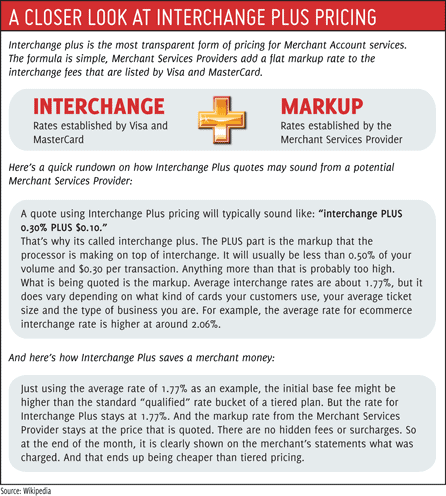
Interchange Plus pricing means that the acquirer charges you a variable MSC consisting of the cost price plus a fixed markup. Interchange Plus Pricing  is exclusively how we quote at Host Merchant Services. Interchange Plus, also known as Cost Plus, pricing gives the customer a fixed rate over published Interchange Fees. This pricing format is normally quoted as a discount rate (percentage fee) along with a per item or authorization fee. The great thing about Interchange Plus pricing is that you always know exactly what you are paying to your processor to services your account. Think of Interchange, and all the associated fees, as an unavoidable cost. No matter who you process with, you have to pay these fees. They may be labeled differently, or wrapped up in a confusing pricing tier, but one way or the other, you are paying Interchange fees. By understanding the markup you pay over Interchange, you know exactly what you pay to your processor and exactly what is going to the card associations. That allows you to make a decision on whether or not the markup seems reasonable for the service you get and choose your processing partner accordingly.

Here’s a small graphic explaining the basics of how Interchange Plus works:

Host Merchant Services infographic on Interchange Plus pricing

Finding Quality Merchant Services [2023 Update]

Today The Official Merchant Services Blog is playing a bit of catch up. The story we’re going to highlight and discuss is almost three weeks old. It was intended to run earlier, but technical difficulties with the blog’s production kept it from appearing until now. However, we feel the story is still worth some attention due to the issue it highlights about the payment processing industry.

The story comes to us from a Chicago, IL section of the Better Business Bureau (BBB). This article from the BBB says that the organization has seen a 42% rise in complaints against credit card processing services. The article, which originally was posted by the BBB on December 15 found that complaints were up for the 12 month period in 2011 compared to the previous 12 months. The breakdown was specifically 110 complaints in the recent 12 month period versus  77 complaints in the period prior.

Not Just In Chicago

The complaints aren’t just lodged in Chicago. This article from Fox40.com details similar complaints in Sacramento, CA. The article states: “The Better Business Bureau is warning businesses to beware of sales pitches by credit card processors that don’t reveal key details that could end up costing business owners more than they bargained for.”

And it quotes Caitlin Peterson of the Better Business Bureau of Northern California as saying “We’ve had over 1,700 complaints this year against the merchant processing business.”

What the Problem Is ?

From reading through the two articles — as well as an older BBB article about issues in the St. Louis, MO area — the problems that merchants are encountering are really straightforward. Business owners are being approached by salespeople offering big savings on their payment processing. And then once the merchant signs a contract with that person, they are saddled with hidden fees for services they were not told about. In short, the business owner is led to believe they are getting a great deal but end up having to pay out more because of all the things not mentioned in the deal. So complaints against payment processors rise in select areas.

Pricing and Transparency

This type of behavior is the exact reason Host Merchant Services utilizes its philosophy of Interchange Plus pricing and no hidden fees. These types of issues are why CEO Lou Honick says “Host Merchant Services is about bringing trust to the payment industry.”

“Payment processing is confusing,” says Honick, noting the ease in which merchants can get saddled with the types of issues that have cropped up with the BBB complaints. “The big guys make it difficult to understand exactly what your rate is and what fees are associated with accepting credit cards. We deliver personal service and clarity. Our people care about customer service and will take the time to explain how everything works.”

Honick also cites the process that Host Merchant Services uses to directly counter the problems that business owners encounter with other processors: “We believe that when you get your statement every month, you should understand every item, and it should match what you were promised in the sales process. If you have a question, there is a live person at Host Merchant Services ready to assist you.”

The Details

One of the primary ways Host Merchant Services combats the practices that lead to these complaints is with their pricing structure. Host Merchant Services uses Interchange Plus pricing instead of the more standard tiered pricing format. Interchange Plus makes statements easier to read, customer service easier to provide to merchants, and savings much easier to guarantee. Here’s a small graphic explaining the basics of how Interchange Plus works:

You can review a comparison between Host Merchant Services Interchange Plus pricing — which is simple and transparent — and the tiered pricing plans that other processors use in a two-part blog series that The Official Merchant Services Blog ran in October, 2023.

  • Part One
  • Part Two
  • Follow Up

What the BBB Advises ?

The BBB advises merchants take these steps to avoid getting stuck with the issues that their complainants have encountered:

Ask around.

The BBB suggests getting at least three estimates from different Payment Network Providers and to checkout he BBB Business Review of the merchant processing service. They also suggest asking fellow business leaders for referrals.

Know where to turn.

The BBB advises you check up on the support team that a potential Merchant Services Provider offers you. Can you contact them 24 hours a day? What is their response like outside of typical business hours? And the BBB advises you make sure their technical support can handle your needs as that kind of support is vital to your business’ success.

Try them out.

The BBB says that you should not settle without a trial period. You should make sure that the payment processor you choose has a 100 percent money-back guarantee before selecting them. Make sure their service works for you, and make sure they keep their promises to you.

Don’t get locked in to a long term contract.

The BBB is very clear on this. Never commit to a long term agreement that locks you in. Make the merchant services provider earn your business each and every month.

Get references.

The BBB advises that you get the payment processor to provide you with references. And then suggests you spend some time checking up on those references.

Make sure you know what you’re being charged for.

The BBB says that if you have a question regarding a fee that you were charged, ask the merchant services provider. Don’t let them hide fees on you. Make sure you understand your statement.

How Host Merchant Services Stacks Up 

Host Merchant Services falls in line with what the BBB advises merchants to do. The company places a big emphasis on transparency. Their salespeople will explain a merchant’s statement in detail. One of strengths of the offering from Host Merchant Service is their guarantee to save a merchant money. They achieve this by a statement analysis. Not only will Host Merchant Services explain the details of what your statement and fees are, completely transparent, while you process with them, they’ll also explain where the hidden fees are with your current statement.

Host Merchant Services will provide references. They do not lock you in to a contract. They do not charge you a termination fee. They provide free equipment and free paper for your terminals. And they offer 24-7-365 customer service where they guarantee you will talk to a real person that will help you out with your issues. You can even initiate a live chat with HMS Support right from any page on their web site.

As Host Merchant Services COO Dan Honick says, “You stay with us because you’re happy.”

More Durbin Amendment Follow Up [2023 Update]

The Official Merchant Services Blog continues its in-depth look at an interesting opinion article we found on Practical E-Commerce. We recently did a 2-part series on the differences between Tiered Pricing plans and Interchange Plus pricing plans. And in it we heralded Interchange Plus and explained why Host Merchant Services uses what we feel is the superior pricing plan to benefit its merchants. Phil Hinke’s article went beyond just the pricing plans, however, so we split our analysis up into two separate entries. This one will focus on the Durbin Amendment.

Durbin Amendment Can Bring Added Fees

Hinke’s article goes on to discuss some of the effects of the Durbin Amendment in relation to MSPs and their offerings: “No merchant should make a decision solely based on the savings analysis done by a merchant account provider, even if it is a well-known provider or financial institution. I am seeing biased and flawed savings analyses presented to merchants. The most common flaw is identifying savings that take the merchant’s existing debit and credit card volume, then showing a projected savings based on the entire volume being at the lower Durbin Amendment regulated debit card rates. Make sure all savings analyses show an accurate breakdown of credit and debit card volume for your business. Also, remember that the Durbin-Amendment-regulated rates will probably only affect 60-70 percent of your debit transactions, since it applies only to financial institutions with more than $10 billion in assets. The remaining transactions will still be at the previous unregulated rate.”

Hinke again makes a compelling point. Much of the Durbin Amendment analysis that was presented in the media solely focused on consumers and the banks. Rarely did traditional media sources delve into what would happen with the transaction processing side of things after October 1, 2011. Host Merchant Services addressed this in their Durbin Amendment analysis, however, citing the very issue that MSPs could indeed soak up savings from the Durbin Amendment: “There is also speculation that the merchant won’t see much of the savings in the first place. And this speculation is tied directly to the payment processing industry. The basics of the industry are that merchants do not deal directly with large credit card issuers like Visa and MasterCard. Rather, they deal with acquirers, or middle men, who offer payment processing of credit cards and debit cards to merchants through their acquirer company’s own goods and services. The rampant speculation is that the acquirers will reap the large savings from the Durbin Amendment, since they are in line between the credit company and the merchant, and will shift high fees right back onto the merchant. This wiggle room in the middle, if it takes place as predicted, could see a large short term spike in profits for acquirers.”

Knowing is More Than Half the Battle

Hinke also suggests Merchants really get involved in a discussion with an MSP that gives them an analysis and an offer: “However, I believe merchants should ask these companies tough questions before using them. This includes asking how the third party makes money, and who is paying that company.”

Host Merchant Services is proactive in this area. The company provides articles on its web site covering specific and helpful topics. Host Merchant Services provides The Official Merchant Services Blog to keep its customers up to date on the latest news affecting their business and the processing industry. The company guarantees savings, transparency on statements, and 24x7x365 customer support. The goal is to keep its merchants happy and informed. Interchange Plus in the hands of Host Merchant Services is the perfect tool. Because it’s goals take advantage of the strengths of the pricing plan.

In Conclusion

Mr. Hinke’s article is insightful. It demonstrates some of the problems that can still occur with an Interchange Plus pricing plan and strives to get merchants to be vigilant with their statements and processing fees that are on their statements.