Tag Archives: interchange fees

Industry Terms: Visa International Service Assessment (ISA)

This is the latest installment in The Official Merchant Services Blog’s Knowledge Base effort. We want to make the payment processing industry’s terms and buzzwords clear. We want to remove any and all confusion merchants might have about how the industry works. Host Merchant Services promises: we deliver personal service and clarity. So we’re going to take some time to explain how everything works. This ongoing series is where we define industry related terms and slowly build up a knowledge base and as we get more and more of these completed, we’ll collect them in our resource archive for quick and easy access.

Today we will take another look at international processing, and the fees associated with accepting an international card.  Yesterday we defined the MasterCard Cross Border Fee, and today we will explain the Visa International Service Assessment.

Visa implemented an international service assessment (ISA) fee of 40 basis points (0.40%) in April of 2008. This fee applies to all transactions involving a U.S. based business and a credit or debit card issued outside of the U.S. The ISA is also separate from interchange rates and from Visa’s standard assessment fee, which is currently 11 basis points (0.11%).

For example, the ISA fee of 0.40% will be added to a transaction where a customer uses a Visa-branded card issued out of the United States to buy something here in Delaware.

The ISA is one of two fees Visa currently charges for international card usage, the other is the International Acquirer Fee, a separate 45 basis point fee (0.45%), which applies under the exact same circumstances as the ISA. Visa began charging the IAF in October 2009.

The total fees Visa charges for a transaction involving an international card processed in the U.S. is the sum of the ISA fee (0.40%), the Visa standard assessment (0.11%), and the International Acquirer Fee (0.45%), which comes to almost a full percent above interchange, 96 basis points (0.96%).

NRF Opposes Interchange Settlement

It’s been a little while since the Official Merchant Services Blog touched on the increasingly sensitive topic of the Credit Card Interchange Settlement. We first talked about the possibility of ‘The Big Cash Comeback’ when the settlement was first announced, and later we discussed the opposition to the settlement.

Seven years after the first lawsuits were actually filed against the bank card networks and some leading banks, a tentative settlement was reached on July 13 of this year.  The agreement has had many mixed reviews, and some big name retailers have come out against it, including most recently the National Retailers Foundation, the nations largest retail trade association.  The NRF’s members operate 3.6 million stores nationwide, however the organization itself is not involved in the lawsuit, which includes individual and class merchants as well as trade-group plaintiffs.

Under the proposal, the main defendants, Visa and MasterCard will pay $6.6 billion in damages and temporarily reduce interchange rates to save merchants another $1.2 billion. Merchants also will get greater freedom to surcharge card transactions and could form bargaining groups to negotiate interchange with the networks. In return, the networks will be freed from future legal challenges from merchants regarding interchange rates and merchant rules, even from merchants that didn’t participate in the current lawsuit.

I think the key points here are the temporary reduction of interchange rates as well as the fact that all merchants give up their rights to sue Visa and MasterCard upon accepting the settlement.  Merchants will most certainly be satisfied by the reduction of interchange rates, but the drop will only be temporary.  After a few months Visa and MasterCard will raise them again, and continue to collect outlandish fees for credit card transactions.  Also, not every merchant is involved in this suit. I don’t think it’s a good deal for merchants to give up any of their rights, particularly the rights to any future litigation.

The National Association of Truck Stop Operators (NATSO) released a statement on Monday, announcing their dismissal of the settlement, “We joined this lawsuit in search of real reform to a broken system, one that is shielded from normal competitive forces. This proposed settlement does not achieve this goal. It lacks meaningful fixes to a system that allowed Visa and MasterCard to set artificially high swipe fees and provided retailers and consumers with no choice except to pay.”

This statement echo’s the cries of dissenters, who say the settlement protects the status quo more than anything, and will not change the way the networks set interchange.

In conclusion, the settlement still faces harsh criticism, and Visa and MasterCard have not had much to say to those who oppose it.  Only time will tell if the plaintiffs decide to accept the deal, or push back for a settlement more in their favor.  Host Merchant Services will keep you informed of all the latest news involving this legal battle between the merchants and the card-issuing giants.

Durbin Aftermath: Banks Go Ninja Style

The Official Merchant Services Blog continues its far reaching and ongoing coverage of the Durbin Amendment and the aftermath of what this legislation brings. Just a quick recap of what the Durbin Amendment did: On October 1, the legislation put in place a cap on interchange fees from debit card usage. Prior to the legislation taking affect, the fee merchants were charged on the average transaction was around 44 cents. The cap put in place by this finance reform legislation put the ceiling for the fee at 21 cents, with provisions in place that allowed most banks to reach a maximum of 24 cents for the transaction. This cut into the profits that banks were essentially “banking on.”

Host Merchant Services provided an extensive and thorough analysis of the Durbin Amendment before it took affect. And our analysis predicted the same reaction from the banking industry that many other media sources predicted –– Banks would not want to lose those profits. Billions of dollars were at stake. The banking industry’s reaction is pretty straightforward: The burden of the fees would be shifted to other parts of the services they offer. The costs and fees would go from the merchants, to the consumer.

Bank of America Takes the Heat

There was a very public media backlash over “Round 1” of this plan, as people slammed the banks for their plans to add monthly fees to debit card usage. The most notable reaction was against Bank of America, who announced they were going to charge customers a $5 monthly fee to use debit cards. This announcement polarized the Occupy Wall Street movement giving them a target for their ire and then was slammed in a wide variety of media outlets (including one Fox News Anchor who cut her debit card up on the air).

This very public display prompted all the banks considering this kind of fee to back off of the idea. With Bank of America itself being the last to relent.

The Burden of Billions

But that didn’t solve the problem. The big banks still have billions of dollars in losses from the hard cap on interchange fees that they need to make up for. And so the current plan is to spread them out through their other services. The customers are still going to shoulder the burden of these billions of dollars. It’s just now the burden is going to be much harder to spot. Which makes for less media coverage and more customer acceptance –– it’s just not as easy to slam banks for doing things like raising the cost of replacing a lost debit card or charging a fee for opening a basic checking account. The debit card usage fee was a sexy, easy to highlight news byte that could be latched onto. A news anchor could make their point with a pair of scissors. But what now? The billions of dollars are still there to be dropped onto bank customers. But now it’s tiny bits here for one service, tiny bits there for another service. It just can’t be wrapped up into one easy to characterize news angle.

Sneaking Fees Onto Consumers By Stealth

ABC News does its best to try, however, offering this article to explain that banks are now going ninja style with their plan of action. Sneaky fees hidden and peppered about their services. All combining to help make up the ground they were going to lose. But most of them deposited around their whole suite of services that it is much harder to latch on like a pit bull and berate them for doing this.  The ABC Article states: “After an uproar of protests, the largest banks have said they are not going to charge customers for debit card purchases, but hidden overdraft, ATM and other fees are likely to rise, say consumer advocates.”

The New York Times also mentions that banks are trying to avoid the noise with this plan B of theirs: “Even as Bank of America and other major lenders back away from charging customers to use their debit cards, many banks have been quietly imposing other new fees. Need to replace a lost debit card? Bank of America now charges $5 — or $20 for rush delivery. Deposit money with a mobile phone? At U.S. Bancorp, it is now 50 cents a check. Want cash wired to your account? Starting in December, that will cost $15 for each incoming domestic payment at TD Bank. Facing a reaction from an angry public and heightened scrutiny from regulators, banks are turning to all sorts of fees that fly under the radar. Everything, it seems, has a price.”

A moneymorning.com article which recapped the New York Times article cites the Durbin Amendment as a direct catalyst for this strategy: “Banks blame increased regulations that limit fees and other charges for wiping out an estimated $12 billion in yearly income. Now it costs banks between $200 and $300 a year to maintain a retail checking account, but they only take in about $85 to $115 in fees per account per year. “

Durbin Not The Cause?

The ABC News Article offers a counter to Durbin being the easy scapegoat: “[Ed] Mierzwinski [consumer program director  of U.S. Public Interest Research Group] said he believes banks are offering more a la carte services from what used to be one package offered to consumers. He said the trend is similar to what telephone companies have done over the years. ‘They’re un-bundling what used to be part of service and charging you more for it,’ he said. ‘Everybody blames Durbin. That’s hooey.’ “

Much of this was already predicted. Analysts that saw what Durbin was going to do knew the banks would have to scramble to recoup their perceived losses. Billions of dollars that they counted on couldn’t just disappear from their business plans and projections. That they would work added fees and rising costs of their other services was pretty much a no-brainer. These other areas of their service were not mentioned or affected by the finance reform legislation. Leaving banks open to make these kinds of adjustments. Occupy Wall Street is far more focused on house foreclosure practices than they are on the fee a bank charges you for using another bank’s card at their ATM.

The Bottom Line

And the bottom line is, the Dodd-Frank Act and its Durbin Amendment simply didn’t take enough of the variables into account to deal with this reaction. Even after all of this was predicted by the people on both sides of the debate. Yes, these changes are more stealthy than the straight up, in-your-face debit card usage fee. But no, they’re not that surprising. Just like a ninja in a boat full of pirates, these changes are standing on the deck as quiet as can be. But are very easy to see.

The Allure of Credit Cards for Holiday Shopping

With the Holiday Shopping Season fast approaching –– Black Friday is 11 days away, Cyber Monday is 14 days away –– the payment processing industry is still getting the last pieces in place for a brisk rush in the use of credit and debit cards. The Official Merchant Services Blog continues its series focusing on the impact the holiday shopping season is going to have on both the e-commerce industry and merchant services in general.

The battlefield is set between Debit cards and Credit cards. Debit cards received a huge boon from the federal government in the form of a cap on interchange fees that went live on October 1, 2011 in the form of the Durbin Amendment. This cap restricts the interchange fees that can be applied to Signature debit card transactions. The cap restricts the charge to between 21 and 24 cents per transaction. This is a huge cut from the previous average of 44 cents per transaction, and presents debit card transactions as an attractive option for merchants to start accepting right as we slip into the big holiday shopping rush.

That has left Credit card issuers scrambling for a response, trying to stay competitive and keep consumers answering “Credit” at the checkout line.

This Reuters article suggests one of the big campaigns that credit card issuers are going to push this year is a significant raise in rewards programs for their customers, tempting them to choose credit as their swipe of choice to get access to those sweet sweet rewards. A focus on cash back and travel rewards push the right buttons for consumers while holiday shopping.

A Look At The Numbers

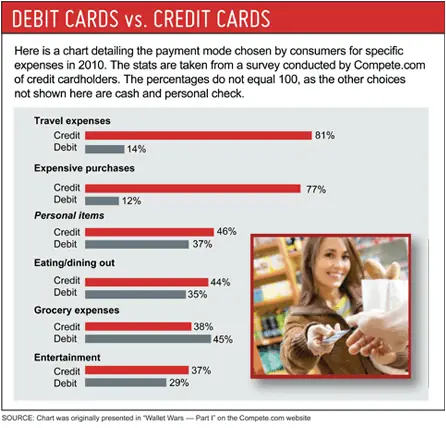
Here’s a small chart detailing the dichotomy between debit card usage and credit card usage from consumers in 2010:

The chart breaks down the chosen method of payment among a survey of credit card owners from 2010. Key numbers to note are the Travel category –– which is dominated by credit card use. It is unlikely that the Durbin Amendment and its changes are going to really affect that sector. But looking at the category listed as “Personal Items” –– which would tend to be the category for holiday gift purchases –– you’ll see a much tougher competition between the two transaction choices. This is where the Durbin Amendment changes to debit card swipe fees are going to have a large impact. And this is where the juicier cash back rewards have credit card issuers hoping they can keep things competitives.

According to the Reuters article: “For example, both Chase (CCF.A) and Citibank C.UL have cards that are offering new applicants $200 in cash back after they spend $500 on their cards.”

You Have to Dig to Find the Best Deals

Some of the best deals are not always displayed in easy to find places. The Reuters article cites a Citibank deal. On the Citi website it advertises the deal as $150 cash back on your first $500 of purchases. But then if you dig deeper by google searching “Citi Dividend $200” you find the better deal directly.

Making it Work For You

The really effective strategy to maximize these deals is to combine them with other deals you will be hit with during the holiday shopping season. The Reuters article notes: “Some cards (such as the Upromise card) have their own shopping portals that combine their rebates with rebates from merchants. In other cases, you can use your rewards points directly for holiday shopping; American Express (AXP.N) awards can be paid directly to Amazon for purchases, for example.”

This type of deal stacking gives consumers a lot of shopping incentive to choose credit as their swipe choice.

More Durbin Amendment Follow Up [2023 Update]

The Official Merchant Services Blog continues its in-depth look at an interesting opinion article we found on Practical E-Commerce. We recently did a 2-part series on the differences between Tiered Pricing plans and Interchange Plus pricing plans. And in it we heralded Interchange Plus and explained why Host Merchant Services uses what we feel is the superior pricing plan to benefit its merchants. Phil Hinke’s article went beyond just the pricing plans, however, so we split our analysis up into two separate entries. This one will focus on the Durbin Amendment.

Durbin Amendment Can Bring Added Fees

Hinke’s article goes on to discuss some of the effects of the Durbin Amendment in relation to MSPs and their offerings: “No merchant should make a decision solely based on the savings analysis done by a merchant account provider, even if it is a well-known provider or financial institution. I am seeing biased and flawed savings analyses presented to merchants. The most common flaw is identifying savings that take the merchant’s existing debit and credit card volume, then showing a projected savings based on the entire volume being at the lower Durbin Amendment regulated debit card rates. Make sure all savings analyses show an accurate breakdown of credit and debit card volume for your business. Also, remember that the Durbin-Amendment-regulated rates will probably only affect 60-70 percent of your debit transactions, since it applies only to financial institutions with more than $10 billion in assets. The remaining transactions will still be at the previous unregulated rate.”

Hinke again makes a compelling point. Much of the Durbin Amendment analysis that was presented in the media solely focused on consumers and the banks. Rarely did traditional media sources delve into what would happen with the transaction processing side of things after October 1, 2011. Host Merchant Services addressed this in their Durbin Amendment analysis, however, citing the very issue that MSPs could indeed soak up savings from the Durbin Amendment: “There is also speculation that the merchant won’t see much of the savings in the first place. And this speculation is tied directly to the payment processing industry. The basics of the industry are that merchants do not deal directly with large credit card issuers like Visa and MasterCard. Rather, they deal with acquirers, or middle men, who offer payment processing of credit cards and debit cards to merchants through their acquirer company’s own goods and services. The rampant speculation is that the acquirers will reap the large savings from the Durbin Amendment, since they are in line between the credit company and the merchant, and will shift high fees right back onto the merchant. This wiggle room in the middle, if it takes place as predicted, could see a large short term spike in profits for acquirers.”

Knowing is More Than Half the Battle

Hinke also suggests Merchants really get involved in a discussion with an MSP that gives them an analysis and an offer: “However, I believe merchants should ask these companies tough questions before using them. This includes asking how the third party makes money, and who is paying that company.”

Host Merchant Services is proactive in this area. The company provides articles on its web site covering specific and helpful topics. Host Merchant Services provides The Official Merchant Services Blog to keep its customers up to date on the latest news affecting their business and the processing industry. The company guarantees savings, transparency on statements, and 24x7x365 customer support. The goal is to keep its merchants happy and informed. Interchange Plus in the hands of Host Merchant Services is the perfect tool. Because it’s goals take advantage of the strengths of the pricing plan.

In Conclusion

Mr. Hinke’s article is insightful. It demonstrates some of the problems that can still occur with an Interchange Plus pricing plan and strives to get merchants to be vigilant with their statements and processing fees that are on their statements.

Interchange Plus Follow-Up

The Official Merchant Services Blog looks at an interesting opinion article we found on Practical E-Commerce. We recently did a 2-part series on the differences between Tiered Pricing plans and Interchange Plus pricing plans. And in it we heralded Interchange Plus and explained why Host Merchant Services uses what we feel is the superior pricing plan to benefit its merchants.

The article begins by introducing the author: “Contributor Phil Hinke is a credit-card veteran who now consults with merchants on lowering their processing costs. Hinke believes the credit card processing industry is often unfair to merchants. He believes the Durbin Amendment — which lowers debit card interchange rates — is fostering deceptive pricing practices by some merchant account providers. He explains his views in the article below.”

This bring together the topic of Merchant Account pricing plans with the Durbin Amendment, something The Official Merchant Services Blog has also been covering in detail. Deceptive pricing practices are something Host Merchant Services strives to overcome in the industry. And one of the key factors the company chose Interchange Plus pricing is because of the transparency which lets merchants see fees on their statements much better than tiered pricing plans.

But Mr. Hinke’s article is an eye-opener because it details ways in which even Interchange Plus pricing can be manipulated to hide fees from merchants: “I am a strong proponent of interchange-plus pricing and, to date, I have never recommend tiered pricing for merchants. (I addressed the differences between interchange-plus and tiered pricing at“Notable Views: Credit Card Veteran on ‘Onerous’ Processing Rates,” a previous article.) However, merchants on interchange-plus pricing can still be grossly overpaying for their card processing. In fact, of the hundreds of merchant statements I have analyzed, the majority of merchants that were overpaying were already on interchange plus, which gives merchants only the potential for fair prices — nothing more.

I recently showed a merchant who was already on interchange plus pricing that he could save money by changing to a provider with a higher processing rate. How could that be? The processing rate is just one of many costs the merchant pays. In this case, the merchant account provider had given the merchant what seemed to be an enticing rate. However, it also hit the merchant with copious monthly and annual fees. Those fees more than offset the rate savings.”

This is a compelling point. And one of the areas where Host Merchant Services is able to stay competitive. Interchange Plus is a tool that a Merchant Services Provider can use to give its customers fair prices. But it’s only a tool. MSPs can still do their best to mark up fees and manipulate the process for profit maximization. As Mr. Hinke points out Interchange Plus only gives merchants potential for fair pricing. It still needs a motivated, hungry MSP in place looking to save merchants money by taking advantage of the tool.

An MSP like Host Merchant Services utilizes that tool along with its overall philosophy to guarantee its merchants savings, transparency and customer service. In that way, Interchange Plus works for the merchant, because it is part of the overall plan to have merchants stick with the company because they are getting value for the services. As Chief Operations Officer Dan Honick often says to clients, “You stay with us because you’re happy.”

Why the Durbin Amendment Got it Right [2023 Update]

The people in Washington aren’t exactly popular these days, and mostly for good reason.  Unemployment is high, the so-called economic recovery is weak, and small businesses are hurting.  However, another round of stimulus is on its way, and this time it might just work.  Even better, this stimulus comes at the expense of banks that got us into this mess to begin with. To be fair, there is plenty of blame to spread around but that is a topic for another day.  The Durbin Amendment went into effect October 1st, and many businesses will see a significant reduction in their monthly debit card processing fees.  This isn’t just for pin-based transactions, but applies to all Visa and Mastercard logo signature debit cards, as well as card-not-present debit card transactions via Internet and phone order.  On average, fees will be reduced by over 1% per transaction, resulting in a windfall for small business.

There are a lot of arguments against the Durbin Amendement.  I’ll outline and debunk the major ones here:

The savings will not get passed along to the merchants.

True, your merchant services company is not required to pass the savings along to you.  If you are on tiered pricing instead of Interchange plus, you aren’t going to receive the benefits.  But this is also creating a huge opportunity for merchant services companies like us to introduce customers to the benefits of our pricing model and to save them a very significant amount of money.  In short, if you’re merchant services company isn’t passing the savings along to you, it’s time to find a new merchant services company.

Merchants will not pass the savings along to their consumers.  

Again, true, but not necessarily the point.  In a free market, any time you create margin, you create opportunity.  Businesses all over the country are getting a little relief in their margins.  Some will choose to use that margin to compete on price.  Some will pocket the profits.  Many will use that extra profit to reinvest and grow their businesses through hiring and infrastructure enhancements.  No matter how you slice it, this is money directly to small business and that is great for the economy.

Banks will charge fees to offset the lost revenue.  

Sure, this is happening at some high profile institutions like Bank of America.  But other banks are also using it as an opportunity to lure you away.  Banks are limited by competition in terms of how much of the fee they can pass along to you before you bolt to a competitor.  That is the free market working the way it should.  When you take monopolistic fees like Interchange that are unavoidable to merchants and move them to the front of the transaction, consumers and small businesses ultimately win.  You now have the ability to shop for the best deal, where transaction costs were previously hidden and passed along in other ways.

Overall, the Durbin Amendment should provide a multi-billion dollar boost to small businesses everywhere, and the government didn’t have to shell out taxpayer dollars to make it happen.  Sure, it may be somewhat arbitrary, and too much regulation is never a good thing, but the card associations that impose Interchange fees operate as a cartel with monopolistic powers, so the government has a valuable role to play in the process.  We should all celebrate the Durbin Amendment and the tremendous benefits to small business.  If you’re not setup to take advantage of the savings, what are you waiting for?  Apply now!

Durbin Amendment Is Here

Today is the day. October 1, 2011 the changes brought on by the Durbin Amendment take effect. The Official Host Merchant Services Blog has been running its Countdown to Durbin series leading up to today. We end our series with one last gallop through the media coverage of the law.

Durbin Amendment Costs People Their Job

The most attention grabbing link we found on the day of Durbin taking effect was this article from Credit Newsline, stating the Durbin Amendment forced a Texas bank to close branches and lay people off. The article stated:

“The Laredo, Texas-based International Bancshares Corp. announced on Friday that it will shutter 55 grocery store branches and lay off approximately 500 people in response to the Durbin Amendment, which will cap what banks can charge merchants for debit card transactions.

“Government many times passes regulations that end up hurting the very people they were intended to help,” International Bancshares Corp. chairman and CEO Dennis Nixon said. “This appears to be one of those cases.

Nixon said that the $11.8 billion International Bancshares will close the grocery store branches so that it can continue offering free checking to its customers following the new interchange legislation, which takes effect on Oct. 1. The company said that it relied on revenue from debit card fees to cover the cost of free products and services for consumers and is shutting the branches to offset the loss of revenue.”

The last bit we’ll leave you with comes from Fox Business Network, and it’s a save the date tidbit on October 1:

“The significance of Oct. 1 is not limited to the world of plastic cards. Thomas Edison opened the first electric lamp factory on this date in 1880. Yellowstone and Yosemite National Park, in 1890, were established by the U.S. Congress. And on October 1, 1992, the Cartoon Network launched. In any case, you and your local store owners may not look at your debit card, or your credit card, in quite the same way again.”

Remember to read Host Merchant Services’ extensive analysis of the Durbin Amendment here. And we’ll be back to regular blog reporting on Monday but will most likely have more information related to the Durbin Amendment going forward as the banking industry is just getting started with its plans to react to this law and the changes it brings.

Durbin Amendment About To Be In Effect

On the last day of September, Durbin Amendment Eve if you will, The Official Merchant Services Blog is about ready to end its Countdown to Durbin Series. Today we take a look at the big news that has the media buzzing.

Bank of America Reacts to Durbin

Bank of America, the largest bank in the country going by deposits, announced it is going to begin charging its customers a $5 monthly fee to use debit cards. The bank will begin charging the fee next year for the bank’s basic checking accounts. It will apply only to debit card purchases and not to ATM withdrawals, online bill payments or mobile phone transfers, the company said.

Consumer Backlash and Cut Up Cards

Bank of America announced this change, which will take effect for its customers in 2012, and were soundly slammed with negative feedback. Our first link comes from Fox Business Network, where Gerri Willis cut up her debit card on the air in reaction to the news from Bank of America. “Right here, right now, I’m going to show Bank of America what I think of their fees,” she said before using a pair of scissors on her card.

Durbin Slams Bank of America

Our next link comes from The Washington Post. It picks up the topic, mentioning what Willis did on the air. It then offers Bank of America’s defense of this new fee, stating that the bank is doing this to recoup losses that will come from the cap on debit card swipe fees that the Durbin Amendment will put into place tomorrow on October 1. Then the article quotes Senator Dick Durbin: “Bank of America is trying to find new ways to pad their profits by sticking it to its customers,” Durbin said in a statement Thursday. “It’s overt, unfair, and I hope their customers have the final say.”

Bank of America Already in Crisis

While this move was quite predictable, and falls into line with Host Merchant Services’ previously published analysis of how banks will react to the Durbin Amendment, the news is quite incendiary because of Bank of America’s current situation. Which is mentioned in the third article we highlight on Bank of America, by Fox News: “the Bank of America decision drew outrage for several reasons. The company is the largest U.S. bank by deposits. And it reaped $45 billion in federal bailout money — receiving the first chunk in 2008 and the rest in 2009 to cope with losses at Merrill Lynch. “

The article also mentions that Bank of America did pay back the government all of the bailout money.

Bank of America a Microcosm of Durbin’s Impact

A fourth article, from the Christian Science Monitor, sums up quite succinctly how this news is quite standard Durbin Amendment fallout: “So in other words, Bank of America is shifting a part of the fee obligation from merchants to customers.”

As we’ve seen in the ongoing Countdown to Durbin series, this is one of the most expected moves that banks are making. Shifting the burden of the fees away from merchants and putting it squarely on the shoulders of the consumers. This avoids the scope of the Durbin Amendment’s regulations and lets the banks continue to reap profits from the billion dollar payment processing industry.

Rounding out the coverage of Bank of America and its announced monthly debit fees we find:

The Chicago Tribune offers a quick glance at Bank of America’s plan here.

The Baltimore Sun blogs to its readers to avoid these types of fees by switching to ATM only.

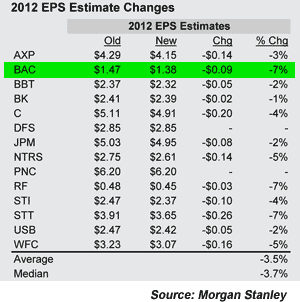
And the final little tidbit we offer you today on the eve of Durbin enactment comes from The Street, reporting that Morgan Stanley cut 2012 earnings estimates for Bank of America and 11 other banks.

This chart, while the story states is not entirely tied to Bank of America’s recent announcement or to the Durbin Amendment, does show that banks will be affected by the Durbin Amendment. They will have to make changes to deal with the losses they expect to take from a hard cap on fees that they were profiting from, and if Bank of America is any indicator, the burden of those changes will go from the merchants who used to get hit with the swipe fees to the consumer who will now have to pay more to support the use of debit cards.