Tag Archives: Host Merchant Services

Top Free Online Shopping Carts

Today The Official Merchant Services Blog shifts its focus to the E-Commerce industry — specifically some tips we’ve found online to help small businesses with their e-commerce solution.

An article written by Nova Scotian Vangie Beal details the ins and outs of ten open source online shopping carts that are available to merchants or really anyone who wants to sell things on the internet. Beal’s been covering small business, e-commerce and internet technology for more than a decade with her writing. You can find the original article here.

E-Commerce has become an integral part of the economy throughout the world. Shoppers have embraced online shopping as part of their normal shopping routine. So businesses have responded by jumping into e-commerce and providing those consumers with competitive options that focus on the convenience that can be had with the click of a few buttons — the classic clicks vs. bricks debate is showing that clicks beat bricks.

So what do Merchants need to know about E-Commerce to get started?

Step One: Get A Payment Processor

The first step is something Host Merchant Services can handle — payment processing. Merchants need to accept payment in the form of credit cards and debit cards to stay healthy and viable as a business. So merchants need to incorporate payment processing solutions both in their brick and mortar stores as well as on their website with their online shopping solution. Host Merchant Services provides merchants with these options — along with free equipment and a guaranteed low rate that will save them money.

So step one in setting up your e-commerce business is to get a merchant account, with the services Host Merchant Services provides.

Image for Host Merchant Services article on credit card processing

Step Two: Your Online Shopping Cart

Now that you’ve got a merchant account set up and are reedy to process payments online, step two is to get an online shopping cart for your website. As Vangie Beal says in her article, “When shopping for your own e-commerce shopping cart software the most important aspect toconsider is how well the cart software meets your business objectives.”

The shopping cart has to be customizable so that you can alter it to fit your business needs. It also needs to be able to fit your branding so that the shopping cart melds seamlessly with the rest of your website. It needs to be flexible so that as your business grows, your online shopping card and ability to process payments online can also grow. It needs to be secure and it needs to support industry security standards such as PCI compliance.

You can read about PCI Compliance Standards in the Host Merchant Services Article Archive.

We provide a PCI FAQ here. 

We provide a step by step guide on PCI Compliance here.

PCI Compliance

Open Source Shopping Cart

Vangie Beal’s article discusses the top 10 free or Open Source shopping carts. Beal says “Open source shopping carts are an attractive option. Storeowners might look to open source e-commerce software because it will typically deliver the features and tools to manage a product catalog on a website without the hefty licensing fees that come with proprietary or off-the-shelf packages.”

Continue Reading – Top Free Online Shopping Carts, Part 2

Phishing Scam Alert

Attention Merchants. The Official Merchant Services Blog has been made aware of an e-mail based Phishing campaign designed to trick individuals into providing login credentials for their credit card processing — specifically one of the payment gateways that a merchant uses.

The e-mail generally has a subject title of “Annual Agreement Renewal”  and the body of the message is communicating that their “retail account” or “merchant agreement” is expiring.  When you open the attachment it appears to have a login page prompting a login.

Be advised that this is an attempt at social engineering intended to steal those login credentials. Neither Host Merchant Services nor TransFirst is the source of these e-mails. These e-mails should be disregarded and deleted. This is an industry wide issue that has escalated in recent days. The Official Merchant Services Blog and Host Merchant Services have been made aware of e-mails appearing to be from TransFirst as well as other payment processers.

If you are a merchant and you have been taken in by this scam, please have contact merchant support at 1-800-654-9256 or contact us at Host Merchant Services directly at 1-877-517-HOST (4678).

Host Merchant Services will continue posting notices on our key sites and our social media channels. TransFirst is also getting the word out, posting information as TC, Epay, TransLink, Transfirst.com and other social media channels.

If you have any questions regarding this scam, please contact Host Merchant Services support.

Host Merchant Services image on phishing scams

Some Basic Information on Phishing

Phishing is an attempt to acquire information such as usernames, passwords, and credit card details by masquerading as a trustworthy entity in an electronic communication. Communications purporting to be from popular social web sites, auction sites, online payment processors or IT administrators are commonly used to lure the unsuspecting target of the scam. Phishing is usually carried out by e-mail spoofing or instant messaging, and directs users to enter details at a fake website whose look and feel are almost identical to the legitimate one.

How To Defend Against Phishing

The scam artists behind phishing emails are smart and know how to create emails and websites that look like they are official and from well know companies or organisations. Because of this, the typical security measures taken with electronic communication — such as firewalls — don’t stand up to the scams.

There is no real effective software-based means of defending against phishing scams. Common sense tends to be your best defense. Always exercise caution when replying to an email that requests personal information or passwords. Also, never click on links found in such e-mails. Even if you believe the content of the message is genuine you should type the web address into your browser directly to ensure that you are visiting the correct site.

Here are a few  more tips for avoiding phishing scams:

  • If you believe an e-mailed request for information is genuine then call the company to confirm before entering data on a website.
  • If you need to entire sensitive information on a website then look for a padlock in your browser’s status bar to signify that you are on a secuire site.
  • If you believe that you have fallen victim to a phishing scam contact the bank or credit card company immediately so that they can freeze your accounts and take action on your behalf.

For information and tips on how to protect yourself from online scams like phishing or identity theft or credit card fraud you can read this article in the Host Merchant Services Article Archive.

Durbin Amendment Back In the News [2023 Update]

The Official Merchant Services Blog returns to a topic that it covered thoroughly throughout 2011: The Durbin Amendment. With the Stop Online Piracy Act getting most of the headlines lately, Durbin Amendment’s continued impact on the payment processing industry has gone into stealth mode. Until today that is. Stick with us as we offer a whirlwind roundup of all things Durbin related.

Bank of America Took a Beating

We’ll start off our tour Durbin tidbits with this article by ABC News. Apparently Bank of America took a substantial hit from their plan to charge $5 per month to use debit cards. According to the article: “Bank of America’s failed plan to impose a $5 monthly debit card fee led to a 20 percent increase in closed accounts in the last three months of 2011 and a public relations headache.”

The article quotes Bank of America CEO Brian Moynihan as saying, “yes, we had some impact from the $5 debit fee. That’s why we made a decision to reverse it.”

It wasn’t all bad news for Bank of America though, as the bank reported earnings of $2 billion in the last three months of 2011, up from a net loss of $1.2 billion in the same period a year ago, boosted in part from a one-time gain on the sale of China Construction Bank.

Small Lenders Strike it Big

The next little bit of Durbin aftermath comes from this article by NACS online. As was seen in the Host Merchant Services in-depth analysis of the legislation, The Durbin Amendment only applies to lending institutions with assets over $10 billion. Smaller banks and credit unions are exempt from the Durbin Amendment. As a result of being exempt, a Wall Street Journal report cited by the NACS article states that these institutions have been “collecting fees that are often three times those imposed on cards by large banks.” 

For comparison, the article says: “The WSJ notes that a $100 sweater purchased with a debit card would incur a fee of 95 cents on a card issued by a smaller bank and only 26 cents for those issued by big banks. “

The article also suggests that banks face further uncertainty by April 1, 2012, when “all U.S. banks and credit unions must offer retailers more choices of companies used to process debit card transactions, a move that is expected to lower interchange fees further.”

New Target: Credit Card Swipe Fees

Time Magazine Online Feature Moneyland reports something that Host Merchant Services has already touched on before in The Official Merchant Services Blog — that Credit Card Swipe Fees may be the next target of legislators and financial reform. From the Time article: “There’s another interchange fee fight in the offing — this time over credit cards. According to CNBC, equity analysts who cover the financial sector have expressed worry that ongoing litigation involving several major banks could lead to a cap of 0.5% on credit interchange fees — one-fourth of what’s currently charged — potentially dragging down bank earnings. If that happens, consumers who are used to generous credit card rewards programs complete with double miles, accelerated earnings, and big sign-up bonuses might get a rude awakening.”

The Official Merchant Services Blog on December 13, 2011 covered the topic of a Credit Card Swipe Fee. In that blog we wrote: “the plan would end up working much like the Durbin Amendment has worked. Where the idea of reform would get overshadowed by how banks and credit card companies reacted to the law. There would be some shifting, so in that sense the reform would cause change. But that eventually the burden for paying for any losses that banks and credit card companies get forced into through reform would end up squarely on the shoulders of the consumers.”

The Time article notes something that Host Merchant Services already pointed out regarding a Credit Card version of the Durbin Amendment — Banks would take another huge hit because Durbin has language that freed up banks and merchants to market and promote options to the consumer directly. In short, Durbin’s language freed merchants up to promote credit over debit. And because of that, a lot of merchants did just that as Banks offered new programs to make credit the more attractive choice. Subsequent changes that would now penalize Banks for doing that would create a lot of negative momentum for Banks and added onus for consumers who get stuck with no good choices overall.

New Hampshire Law

This article from credit.com reveals that one state legislature is already making moves to see a Credit Card Swipe Fee Cap become reality. As the article states: “A piece of legislation introduced in the New Hampshire House of Representatives, House Bill 1319, has drawn some attention for the way in which it would drastically alter the credit card landscape between businesses and payment processors. The law will limit the amount banks chartered within the state are able to charge businesses for processing credit card transactions to just 1 percent of the total purchase value.”

The article goes on to state that many businesses pay costs that range from 0.67 percent of the transaction’s value to 4.76 percent and that a MasterCard spokesperson told the Nashua Telegraph that the average 1.75 percent.

Cash Still Rules Everything Around Me

Our last news brief on the topic of the Durbin Amendment and swipe fee caps is a little different. This article from the Huffington Post shows a study that reveals cash is still king. The gist of the article: “More than three-quarters, or 79 percent, of consumers said they made a cash purchase in the last seven days, according to a report released on Tuesday from Javelin Strategy & Research, a market research group for financial services. Compare that to about 65 percent of credit and debit cardholders who say they swiped their plastic in the last week.”

The article suggests that this is a consumer reaction to card swipe fees. The article states that consumers are choosing to pay for items with cash to avoid fees on small, everyday purchases. The convenience of plastic gets overrun by the savings consumers perceive they get from going back to cold, hard cash. The study indicates that cash is replacing debit for small purchases, and credit is replacing debit for big purchases and the Durbin Amendment’s lasting legacy may simply be that it pushes Debit out of the consumer’s arsenal of payment options.

Mobile Payments: 2023 and Beyond [2023 Update]

Today The Official Merchant Services Blog updates our outlook on Mobile Payment Technology and the rampant predictions for its success in the near future. We have previously covered the topic with this blog entry on Tuesday, October 18, 2011. The parameters of that blog are still pretty much the current state of Mobile Payments. But there have been some very interesting developments from the end of 2011 and moving into the first quarter of 2012.

Black Friday Boom

The Black Friday business blitz revealed some healthy news for Mobile Payments. According to this article from Seeking Alpha, mobile payments business increased 500% from 2010 on Black Friday. According to the article, PayPal mobile reported the huge increase, coming in at 511% to be exact. PayPal Mobile also noted that there was a 350% increase in mobile shopping on Thanksgiving 2011 when compared to 2010.

According to numbers from the aforementioned IBM research, 17.37% of all consumers used a mobile device on Black Friday to visit a retailer’s site. And 9.73% used a mobile device to make a purchase. The Seeking Alpha article quoted Amanda Pires from PayPal. Pires suggested that this year’s holiday is proving to be the largest mobile holiday shopping season PayPal and eBay has ever seen, and then quoted Pires directly as stating: “The retailers that are taking advantage of mobile shopping are going to win. We expect mobile shopping to continue to be strong throughout the holiday season.”

This is good news for Mobile Payments, as Host Merchant Services research has shown in the past that there have been some bold predictions for growth in Mobile Payments, but that the services were slow in taking hold this year in the U.S. Growth like the numbers cited from Black Friday 2011 should fuel more positive momentum for that consumer payment option.

Host Merchant Services E-Commerce Mobile Payments image

From 2012 Onward

All of this brisk business in the mobile payments sector is indicative of the forecasting that analysts and reporters have been making for the technology. But the obstacle that our Magic 8-Ball suggested hurts the industry still remains: Consumer confidence. There’s still trust issues with mobile payments. This article by Eric Savitz from Forbes really delves into the heart of what we at Host Merchant Services have been saying about Mobile Payments.

Savitz says: “There’s a common thread between these points: there has to be something fundamentally changed about the current point of sale model in order for mobile payments to take off. It’s about added value and convenience to the consumer, and the ability to drive more customers, loyalty, efficiency and lower risk for the merchant and banks and operators involved in the payments process. Think of contactless “tap and pay” credit cards – you may have one in your wallet right now, but you still swipe it anywhere you go. As a consumer, there’s nothing more convenient or inherently better about tapping your card vs. swiping your card if all that matters is making the payment. Would the time spent setting up and configuring a “mobile wallet” be worth it if the only difference at the cash register of Macy’s is that you wave a phone over a terminal rather than swipe a card through one? Doubtful.”

That’s what Host Merchant Services has been saying. It’s about convenience to the consumer. The worries about security are valid. E-Commerce has faced the same problems with security and the same worries. But people have adopted online shopping — as seen with the same Black Friday and holiday shopping season boom in 2011 — to the point where it’s now just a common part of the shopping experience. People can’t even remember back 10 years where online shopping was new, awkward and insecure. It’s just part of their lives now.

And for Mobile Payments to jump off the same type of conversion of consumers has to take place. Convenience will outweigh security concerns and people will just accept the behavior as part of the way they shop. That’s where the Mobile Payments Industry stands right now. On the edge, waiting for the breakthrough that will rocket it into everyday life for shoppers. It has to grow beyond gimmick. Because gimmick won’t carry it forward. It might be easy to do, but as Savitz points out, if there’s no reason to swipe your phone over just using your card in your wallet, people won’t bother.

Small Businesses Susceptible to its Charms

One inroad Mobile Payments are making with consumers is through small businesses. This article from Newsfactor.com delves into how small businesses are seeking mobile payment solutions that free them from reliance on traditional payment solutions. The article discusses how Square has been shaking things up with the changes its made to its business model in 2011, becoming an entire processing solution itself and making its card reader more readily available to merchants. The article then mentions how Gartner Research data shows that the Mobile Payments Industry surged to $86.1 billion in 2011.  The article notes that Square is just one of many viable options that are helping fuel the growth the sector is seeing.

HMSPay

Host Merchant Services recognizes the huge growth potential in this sector of the industry. Beyond their coverage of the latest developments and news that take place in Mobile Payments, Host Merchant Services offers its own mobile payment solution, HMSPay. The solution utilizes a card reader that is attached to a smartphone and an application on the phone which transforms it into a payment processing terminal, complete with signature field and e-mailed receipts.

Host Merchant Services Mobile Payment Solution HMSPay

So What’s Next?

Savitz’ article suggests that the potential breakthrough for Mobile Payments will take place in 2012. And that the catalyst for this breakthrough will be through value added applications of the process. He cites Google Wallet and Isis as showing the most promise in being a catalyst because they both go beyond just having the swipe gimmick and offer “services delivered on top of the payment itself.” He says these additional services will be what prompt consumers to shift into mobile payments. He offers these bullet points:

  • Deals and offers: Highly targeted, relevant offers based on prior buying patterns and current location. Imagine receiving a time-sensitive text message or in-app alert with a coupon to your favorite electronics store after your digital wallet “checks in” that you are within the store.
  • Digital receipts and account information updated in real time to give a comprehensive view of personal and linked accounts while also displaying loyalty rewards status.
  • Real-time, customizable alerts to certify that the purchases being made in an account are valid, based on your phone’s proximity to where the purchase is being made.

So it appears that one promising avenue for the evolution of mobile payments is to essentially make them a virtual wallet “plus.” Something that does more than just allow you to pay with a swipe of your phone. Something that collects the relevant data and helps you manage your shopping right there, at your fingertips. Something that tracks your own shopping trends and makes you aware of deals, then lets you conveniently take advantage of those deals.

It’s a compelling point. Host Merchant Services sees the value in such a transition. The technology works to make the consumer’s shopping experience convenient and comprehensive — something a shopper can’t even consider they could do without in previous years. That’s what happened with e-commerce, after all.

SOPA: Pot Meet Kettle [2023 Update]

The Official Merchant Services Blog has late breaking news to report today. Once again we take on the topic of the Stop Online Piracy Act (SOPA). In perhaps the strangest twist to date for the ongoing saga that is the battle between the entertainment industry to curb piracy and the internet industry to keep their business free of government interference on a micromanaged level — Alex Fitzpatrick from mashable.com reports that SOPA has some SOPA issues.

Lamar Smith Copyright Violation

In Fitzpatrick’s article, found here, it is noted that the sponsor of the Stop Online Piracy Act (H.R. 3261) Lamar Smith has a copyright violation on his own website texansforlamarsmith.com.

The article follows a report from Jamie Lee Curtis Taete over at www.vice.com. Taete investigated Lamar Smith’s website for any potential copyright issues. You can see Taete’s investigation here. Taete describes describes the impetus for the investigation: “US Congressman and poor-toupee-colour-chooser Lamar Smith is the guy who authored the Stop Online Piracy Act. SOPA, as I’m sure you know, is the shady bill that will introduce way harsher penalties for companies and individuals caught violating copyright online (including making the unauthorised streaming of copyrighted content a crime which you could actually go to jail for). If the bill passes, it will destroy the internet and, ultimately, turn the world into Mad Max (for more info, go here).

I decided to check that everything on Lamar’s official campaign website was copyright-cleared and above board. Lamar is using several stock images on his site, two of which I tracked back to the same photographic agency. I contacted the agency to make sure he was paying to use them, but was told that it’s very difficult for them to actually check to see if someone has permission to use their images. (Great news, copyright violators!) However, seeing as they’re both from the same agency and are unwatermarked, it seems fairly likely that he is the only person on the entire internet who is actually paying to use a stock image (and he’d be an idiot not to).

So I took a look back at an archived, pre-SOPA version of his site.”

Caught Red Handed

The violation stems from Lamar Smith using this image:

DJ Schulte's image that SOPA sponsor Lamar Smith used without giving credit to.

On his site it appeared like this:

Host Merchant Services reposts image from Lamar Smith's website with a SOPA level copyright violation.

Taete fills in the full details of this violation: “I managed to track that picture back to DJ Schulte, the photographer who took it.

And whaddya know? Looks like someone forgot to credit him.

I contacted DJ, to find out if Lamar had asked permission to use the image and he told me that he had no record of Lamar, or anyone from his organization, requesting permission to use it: ‘I switched my images from traditional copyright protection to be protected under the Creative Commons license a few years ago, which simply states that they can use my images as long as they attribute the image to me and do not use it for commercial purposes.

‘I do not see anywhere on the screen capture that you have provided that the image was attributed to the source (me). So my conclusion would be that Lamar Smith’s organisation did improperly use my image. So according to the SOPA bill, should it pass, maybe I could petition the court to take action against www.texansforlamarsmith.com.’

Oh dear. Luckily for DJ, there are people out there like Lamar making new laws to protect the little guy against online copyright theft. Keep fighting that good fight, Lamar!”

No Response Yet

No spokespeople from Lamar Smith have been available for comment on this issue. Maybe when the egg on their faces is removed there’ll be time to address the silliness that stems from the SOPA sponsor not taking enough time to make sure his own site didn’t fall under the extremely broad language that would allow the Department of Justice to shut down his own site.

Luckily for Smith, the bill hasn’t been signed into law just yet, so Google doesn’t have to remove his site from their search engine, and his payment network provider doesn’t have to suspend transactions from the donation portion of his site.

For More Information

To find out more about the Stop Online Piracy Act, you can read the in-depth Host Merchant Services Analysis here.

To read the proposed legislation itself, you can download it here.

Florida’s Proposed E-Commerce Bill

Today The Official Merchant Services Blog is taking a look at a new bill proposed in Florida that attacks the growing E-Commerce industry. The bill — HB 861 — was filed by state Rep. Mike Horner, R-Kissimmee. The bill would require online-only sellers to collect and remit Florida sales taxes, just like other Florida retailers.

Bricks vs. Clicks

This legislation is drawn on the battle that has been brewing for the past decade between brick-and-mortar retailers and online entrepreneurs. Online shopping has become commonplace for the U.S. consumer, and this year’s holiday shopping season saw record business run through E-Commerce.

The Official Merchant Services Blog did a series of posts based on the strength of the E-Commerce industry. In it we reported that in recent years, the boom in online shopping created a shift in shopping trends. Holiday shoppers no longer adhered to Black Friday as the start date for their holiday shopping needs. A 2010 survey conducted by Google and OTX found that 35% of internet users start their holiday shopping prior to the end of summer, months ahead of Black Friday.This shift continued to grow in 2011 as consumers found online shopping extremely convenient.

According to a Star Tribune article from January 16, 2011, Cyber Monday sales rose 16 percent from 2009, and topped $1 billion overall –– marking the first time Cyber Monday hit the billion dollar mark. The record setting didn’t stop on Monday, according to comScore, a company that tracked the sales figures between November and December for the e-commerce industry. Sales on Thanksgiving Day were up 28 percent from the previous year, and overall e-commerce sales topped $32 billion in the holiday shopping period, a 12 percent rise from 2009. Even Black Friday, brick and mortar stores’ biggest holiday shopping day of the year, saw a 9 percent rise in e-commerce to $648 million.

2011 saw those numbers rise even higher. Statistics released from an IBM research unit called Coremetrics found that 20% more consumers shopped online this Black Friday 2011 than did in 2010. The data collected also states that 39% more online shopping happened on Thanksgiving Day itself in 2011 than in 2010.

Trying to Level the Playing Field

The boom in online shopping is what has prompted this bill to be suggested in Florida. In Florida, online retailers are escaping the burden of sales tax for their transactions. And so the bill was created to attempt to level that playing field a bit. According to this bizjournals.com article by Susan R. Miller, “Currently, Florida retailers with a brick-and-mortar location are required to collect and remit sales taxes on purchases made online, while their online-only competitors are not. The bill would require online-only sellers to collect and remit Florida sales taxes, just like other Florida retailers.” 

Miller’s article says that the bill has support of the Florida Alliance for Main Street Fairness, a coalition of small businesses, trade associations and civic groups, including the Florida Retail Federation, Florida Chamber of Commerce and Associated Industries of Florida. The legislation could be part of a larger initiative this year by states nationwide that would require online retailers such as Amazon.com or Overstock.com to collect taxes for online transactions.

The article does note that the bill faces one large obstacle in the local legislature: “However, Senate President Mike Haridopolos has said that such a plan would violate the Florida Legislature’s “no new taxes” pledge and would not pass if it resulted in a net increase in taxes collected by the state.”

Is This the Future?

The suggestion that this is part of a large initiative to attack E-Commerce giants like Amazon and Overstock is certainly of interest. Especially since a large scale move such as that would have a deeper impact on all of the smaller Online Shopping sites that small business people run around the U.S. But there’s some key facts to keep in mind before getting too worried that this is the next big thing like the Durbin Amendment was in 2011:

  1. This is a state bill, not a federal proposal. That means that this is still a very small scale approach.
  2. Florida law isn’t exactly cutting edge. Not to be flippant, but there’s a reason why snarky internet commentary site Fark.com gives Florida its own subject tag.
  3. The bill itself does, as the story states, face some opposition in its own state legislature because of the tax issues.

You can review the exact language of the bill by downloading the PDF here.

Finding Quality Merchant Services [2023 Update]

Today The Official Merchant Services Blog is playing a bit of catch up. The story we’re going to highlight and discuss is almost three weeks old. It was intended to run earlier, but technical difficulties with the blog’s production kept it from appearing until now. However, we feel the story is still worth some attention due to the issue it highlights about the payment processing industry.

The story comes to us from a Chicago, IL section of the Better Business Bureau (BBB). This article from the BBB says that the organization has seen a 42% rise in complaints against credit card processing services. The article, which originally was posted by the BBB on December 15 found that complaints were up for the 12 month period in 2011 compared to the previous 12 months. The breakdown was specifically 110 complaints in the recent 12 month period versus  77 complaints in the period prior.

Not Just In Chicago

The complaints aren’t just lodged in Chicago. This article from Fox40.com details similar complaints in Sacramento, CA. The article states: “The Better Business Bureau is warning businesses to beware of sales pitches by credit card processors that don’t reveal key details that could end up costing business owners more than they bargained for.”

And it quotes Caitlin Peterson of the Better Business Bureau of Northern California as saying “We’ve had over 1,700 complaints this year against the merchant processing business.”

A graphic from Host Merchant Services detailing the rise in complaints against credit card processors for the BBB

What the Problem Is ?

From reading through the two articles — as well as an older BBB article about issues in the St. Louis, MO area — the problems that merchants are encountering are really straightforward. Business owners are being approached by salespeople offering big savings on their payment processing. And then once the merchant signs a contract with that person, they are saddled with hidden fees for services they were not told about. In short, the business owner is led to believe they are getting a great deal but end up having to pay out more because of all the things not mentioned in the deal. So complaints against payment processors rise in select areas.

Pricing and Transparency

This type of behavior is the exact reason Host Merchant Services utilizes its philosophy of Interchange Plus pricing and no hidden fees. These types of issues are why CEO Lou Honick says “Host Merchant Services is about bringing trust to the payment industry.”

“Payment processing is confusing,” says Honick, noting the ease in which merchants can get saddled with the types of issues that have cropped up with the BBB complaints. “The big guys make it difficult to understand exactly what your rate is and what fees are associated with accepting credit cards. We deliver personal service and clarity. Our people care about customer service and will take the time to explain how everything works.”

Honick also cites the process that Host Merchant Services uses to directly counter the problems that business owners encounter with other processors: “We believe that when you get your statement every month, you should understand every item, and it should match what you were promised in the sales process. If you have a question, there is a live person at Host Merchant Services ready to assist you.”

The Details

One of the primary ways Host Merchant Services combats the practices that lead to these complaints is with their pricing structure. Host Merchant Services uses Interchange Plus pricing instead of the more standard tiered pricing format. Interchange Plus makes statements easier to read, customer service easier to provide to merchants, and savings much easier to guarantee. Here’s a small graphic explaining the basics of how Interchange Plus works:

Interchange Plus by Host Merchant Services

You can review a comparison between Host Merchant Services Interchange Plus pricing — which is simple and transparent — and the tiered pricing plans that other processors use in a two-part blog series that The Official Merchant Services Blog ran in October, 2023.

  • Part One
  • Part Two
  • Follow Up

What the BBB Advises ?

The BBB advises merchants take these steps to avoid getting stuck with the issues that their complainants have encountered:

Ask around.

The BBB suggests getting at least three estimates from different Payment Network Providers and to checkout he BBB Business Review of the merchant processing service. They also suggest asking fellow business leaders for referrals.

Know where to turn.

The BBB advises you check up on the support team that a potential Merchant Services Provider offers you. Can you contact them 24 hours a day? What is their response like outside of typical business hours? And the BBB advises you make sure their technical support can handle your needs as that kind of support is vital to your business’ success.

Try them out.

The BBB says that you should not settle without a trial period. You should make sure that the payment processor you choose has a 100 percent money-back guarantee before selecting them. Make sure their service works for you, and make sure they keep their promises to you.

Don’t get locked in to a long term contract.

The BBB is very clear on this. Never commit to a long term agreement that locks you in. Make the merchant services provider earn your business each and every month.

Get references.

The BBB advises that you get the payment processor to provide you with references. And then suggests you spend some time checking up on those references.

Make sure you know what you’re being charged for.

The BBB says that if you have a question regarding a fee that you were charged, ask the merchant services provider. Don’t let them hide fees on you. Make sure you understand your statement.

How Host Merchant Services Stacks Up 

Host Merchant Services falls in line with what the BBB advises merchants to do. The company places a big emphasis on transparency. Their salespeople will explain a merchant’s statement in detail. One of strengths of the offering from Host Merchant Service is their guarantee to save a merchant money. They achieve this by a statement analysis. Not only will Host Merchant Services explain the details of what your statement and fees are, completely transparent, while you process with them, they’ll also explain where the hidden fees are with your current statement.

Host Merchant Services will provide references. They do not lock you in to a contract. They do not charge you a termination fee. They provide free equipment and free paper for your terminals. And they offer 24-7-365 customer service where they guarantee you will talk to a real person that will help you out with your issues. You can even initiate a live chat with HMS Support right from any page on their web site.

As Host Merchant Services COO Dan Honick says, “You stay with us because you’re happy.”

E-Commerce: Review and Preview

The Official Merchant Services Blog begins our second year of blogging with a look at one of our favorite topics: E-Commerce.

2011 saw huge gains for online shopping. As reported in The Official Merchant Services Blog on Cyber Monday, online shopping was strong on Black Friday. IBM research unit Coremetrics stated that 20% more consumers shopped online Black Friday 2011 than did in 2010. The data collected also states that 39% more online shopping happened on Thanksgiving Day 2011. The ease of online shopping is infiltrating the traditional brick-and-mortar retail event and Host Merchant Services‘ analysis of it held true –– sales numbers across the board rose from 2010, so overall Black Friday had a boost for retail, but clicks from e-commerce continue to grow and cut into the sales from bricks.

Also, mobile payments saw a huge increase during the holiday shopping season. According to this article from Seeking Alpha, mobile payments business increased 500% from 2010 on Black Friday. According to the article, PayPal mobile reported the huge increase, coming in at 511% to be exact. PayPal Mobile also noted that there was a 350% increase in mobile shopping on Thanksgiving 2011 when compared to 2010.

The Numbers Keep Coming In

This article by Internet Retailer demonstrates that Black Friday was just the beginning. There were more than 3,000 transactions totaling $141.6 billion in 2011 in the marketing, media, technology and service industries according to data collected by investment banking firm Petsky Prunier LLC. Of those transactions the E-Commerce and digital media segment was the most active, with 1,159 deals valued at more than $44 billion.

All of this activity demonstrates strength in the E-Commerce industry, and suggests that 2012 is a year primed for continued growth and success — which combines with the already rampant predictions of success for Mobile Payments within the E-Commerce industry.

Host Merchant Services Online Shopping E-Commerce Credit Card Payment Processing Image.

Is There A Bubble?

This article from moneycontrol.com asks the question, “Will the E-Commerce Bubble Burst?”

Comparing the recent success to the success of internet companies in 2000 and 2001, the article tries to figure out if the bubble will burst like it did back then for tech companies. The author’s opinion is that the similarities are only on the surface, and that the two situations are vastly different — suggesting that in the end, it’s not a bubble that is going to burst but rather an industry that is going to grow and evolve. The article looks specifically at the E-Commerce sector in India, but does spend time detailing the big picture globally.

Online Shopping is Now Commonplace

To really underscore the potential growth that E-Commerce has in 2012, this article from Daily Deal Media talks about how popular online shopping is becoming with moms. The article cites a BabyCenter survey which suggests that: “71% of moms regularly turn to websites such as shopping engines and review sites to compare prices. Another 56% admit to searching for coupons or digital discount opportunities on a regular basis.”

This is a compelling point in regards to the overall picture of E-Commerce. It has become more and more commonplace in everyday life for shoppers around the world. Mothers are turning to it for the convenience of being able to get shopping done quickly and efficiently, according to the article. And it is just become an ingrained part of our economy, fueling the potential for further growth.

Host Merchant Services E-Commerce Mobile Payments image

Mobile Payments Big Problem

The potential growth for Mobile Payments is huge. But the one thing holding it back in the U.S. is security. Just as online shopping has become more and more commonplace, people have gotten comfortable with making payments online. That brings risk, as phishing scams and credit card fraud has increased. But security standards like the PCI DSS have helped to make the mainstream comfortable with clicking the pay button and giving out their payment information.

Mobile Payments, however, are not quite there yet in terms of acceptance. This article from the Chicago Tribune discusses the looming security issues that the mobile payments market faces. As the article states: “While the first mobile virus dates back to June 2004, risks from hackers remained limited because of the relatively small size of the market. But this has changed with the surge in the smartphone segment, which this year outgrew the PC market, and the new dominance of Google’s Android software. The emergence of mobile payments, which allows shoppers to swipe their phones at a cash register, is whetting the interest of hackers and data thieves.”

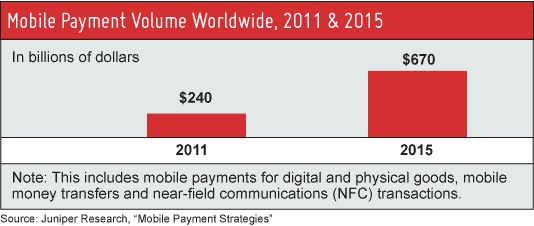
The article states that fewer than 5% of smartphone users have security software installed on their device, according to Juniper Research — the same Juniper Research that predicts Mobile Payments will increase to a $670 billion industry by 2015. And a study by Deloitte cited in the article suggests that for companies in the technology, media and telecom sector expect data stored on staff mobile devices to be their biggest security headache in 2012.

Essentially that’s the biggest obstacle holding back the Mobile Payments industry. The sheer convenience the technology brings to the payment industry is extremely powerful and so despite security concerns it continues to be developed and pushed. 2012 will see growth in the industry, despite the security issues. And as consumers get more and more familiar and comfortable with the phone swipe style of payment, the industry will boom.

A List for 2011

And just for fun, here’s a list from Mashable.com detailing who they think were the biggest winners and losers from 2011 in E-Commerce.

  • Their winners include: Amazon, Apple, Wal-Mart and Gilt Groupe.
  • Their losers include: Barnes and Noble, HP, Netflix and Sony.

Click the link to read why each company made the list.

customer service

Customer Service: A Cautionary Tale [2023 Update]

In what will likely be the last blog of 2011, The Official Merchant Services Blog is going right back to the basics. We’re going to give our readers a recap of a story that’s been the buzz of the internet for the past couple of days and which illustrates why customer service is so very very important for a business — good old fashioned and extremely basic customer service.

The Story, So Far

Penny Arcade, an extremely popular webcomic focused on video games and video game culture, written by Jerry Holkins and illustrated by Mike Krahulik, also has a regular blog. On that blog artist Krahulik posted the entire transcript of a dialog between a customer– named only as “Dave” in the coverage of the event — and the marketing/customer service person representing the Avenger Controller. This device was originally designed by David Kotkin, an art teacher, to help one of his pupils, who suffered from epidermolysis bullosa, to play games for prolonged periods without irritation.

You can read the entire transcript of the dialog at Penny Arcade here.

The recap is pretty simple. Dave went through the contact information given on the web for the product, and asked their customer service department when the product would arrive because it was late. The controller was advertised as being available in early December, and by December 16, Dave had not received the item that he had paid for in advance.

As seen in the transcript, the initial responses from Paul Christoforo of Ocean Marketing, the PR contact for iControl (the manufacturers and distributors of Kotkin’s design), were short and still vague. But then tempers flared, and Christoforo stepped over the line, attacking his own customer: “put on your big boy hat and wait it out like everyone else. The benefit is a token of our appreaciation for everyone no one is special including you or any first time buyer . Feel free to cancel we need the units were back ordered 11,000 units so your 2 will be gone fast. Maybe I’ll put them on eBay for 150.00 myself. Have a good day Dan.”

That sparked the entire fiasco. Christoforo continued to be rude and flippant in correspondence with Dave, as well as others, including Krahulik.

The Avenger Controller, object that started the customer service fiasco for Ocean Marketing.

The Internet Intervenes

Christoforo was nonplussed by Dave’s contacts in the e-mails. Even when Krahulik himself got involved, Christoforo did not believe Krahulik was who he said he was, and laughed at the idea that this negative publicity was going to impact his marketing. The conversation sort of soars from that point as Christoforo has it out with Krahulik. Christoforo threatens to initiate a smear campaign against the comic strip and Krahulik just posts the entirety of the e-mails, along with Christoforo’s information. With battle lines drawn, and sides chosen, the internet steps in — since Penny Arcade is indeed a very widely read web comic, it gets a lot of attention, especially from gamers who would all be potential customers for the product Christoforo is marketing.

First Round Knockout

The results of the smear campaign vs. Krahulik’s blog post and eventual comic strip?

  • This investigation, originally posted on Reddit, and later preserved as a .jpg
  • Christoforo shuts down his twitter account
  • Christoforo apologizes and asks for the spam to stop
  • Controller-N drops Ocean Marketing

So in essence, the internet retorted against the terrible customer service offered by Ocean Marketing and Paul Christoforo. The smear campaign he threatened against Penny Arcade never got off the ground. Ocean Marketing got slammed by a legion of video game players and Penny Arcade fans. Bad PR ruined Christoforo’s marketing business in mere days.

Captain Obvious to the Rescue

Without going too deep into the details of this internet battle between the forces of good gamers and misguided or misanthropic marketers — you can follow the fascinating set of links as this story is still picking up steam — Host Merchant Services is just going to cut to the chase.

Customer Service is a vital component of a business. Any business. That includes those doing marketing for video game controllers.

Host Merchant Services has provided some tips in the past on how to get into good customer service habits. You can read the blog post here. Customer Service is part of the core philosophy of Host Merchant Services. You can read CEO Lou Honick’s blog about customer service at the Web Host Industry Review here. It’s just The Official Merchant Services Blog didn’t think it would ever have to post a series of tips that included: “Do not curse at your customers, and do not call them stupid — especially in writing.”

Every customer is important. And as the person handling customer service, it’s definitely in your best interest to treat those customers with respect. Lashing out or trying to bully a customer is going to, at the very least, lose you that business. In this case, it lost the person more than just one customer. The whole entire exchange blew up in their face.

All of this could have been avoided with some very basic customer service strategies:

  • Do not argue with your customers.
  • Do not talk down to or insult your customers.
  • Listen to them and give their feedback or complaints your time and understanding.
  • Be honest with your customers. No one likes to hear that their product is late, but they’ll be much more willing to deal with you and your company if you’re honest with them and do not try to lie your way around the issue.

Honey, not Vinegar

After seeing the entirety of the mess Christoforo made, don’t you think the entire thing could have been avoided if Christoforo had been honest and polite? And if he had offered some form of compensation for the obvious mistake in shipping the company he represented had made? A discount? A rebate? A gift card? If Christoforo had spent just half the time performing actual customer service instead of writing insults and snark back to his customer, none of this would have happened.

That’s the lesson here. Customer Service needs to embrace the goal of long-term customer relationship building. As cathartic as the initial insults may have been for Christoforo, giving in to his frustration ultimately backfired for him and his business. Taking a hit on one customer due to having to be polite, and maybe even offer compensation for the mistake in shipping, would have saved Christoforo a lot of trouble.

This is a cautionary tale. Customer Service is important. Especially in the world of e-commerce where if things line up just right — you tick off a customer who has an open channel to one of the most widely read web comics — you could face the full force wrath of the internet.