Tag Archives: hms

Industry Terms: AVS

This is the latest installment in The Official Merchant Services Blog’s Knowledge Base effort. We want to make the payment processing industry’s terms and buzzwords clear. We want to remove any and all confusion merchants might have about how the industry works. Host Merchant Services promises: the company delivers personal service and clarity. So we’re going to take some time to explain how everything works. This ongoing series is where we define industry related terms and slowly build up a knowledge base and as we get more and more of these completed, we’ll collect them in our resource archive for quick and easy access. Today’s term is the Address Verification System, or AVS.

The system was designed by card issuers to aid in the detection of suspicious credit card transaction activity, and verify that the cardholder’s address info matches what the banks have on file. The service is provided as part of a credit card authorization for mail order/telephone order transactions (MOTO) or Internet e-commerce transactions.  A code is received with an authorization result that determines the level of accuracy of the address match. This verification helps secure the most favorable interchange rates for the merchant.

Visa, MasterCard, Discover, and American Express support this service, and when paired with a CVV confirmation the result is a secure, verified transaction. To verify a customer’s address, a merchant will need the cardholder’s billing ZIP code and the house or apartment number of the billing address.  The merchant does not need to enter in the street, city or state of the cardholder.  While AVS is not intended for use as absolute protection against suspicious transaction activity, it is an important step in securing non-face-to-face transactions. Host Merchant Services recommends to all merchants that they secure these types of orders with both AVS and CVV.

Reminder: Hypercom Name Change

Host Merchant Services wants to take a quick moment to remind readers of The Official Merchant Services Blog, as well as its own merchants of a change that took place in 2011 with Hypercom — the company that manufactures one of the most popular brands of point of sale terminals that HMS provides.

In October, 2011 it was announced that Hypercom USA formally changed its corporate name to Equinox Payments, LLC. In addition to selling new Equinox terminals, software and services, the company continues to support the very popular Hypercom-branded products in the U.S.

Hypercom US was sold to private equity firm The Gores Group in August 2011 as part of a deal to allay competition concerns when Verifone acquired the rest of Hypercom’s global business.

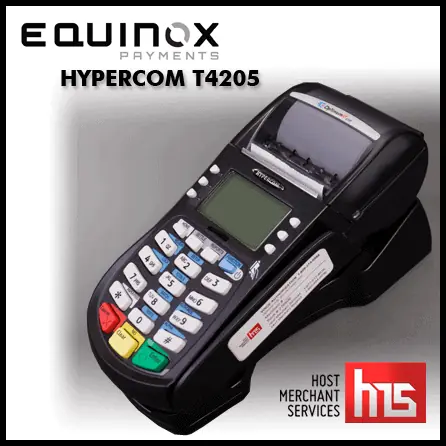
Former Hypercom product names have remained unchanged, but products are now showing up in marketing materials as branded Equinox or co-branded Equinox and Hypercom. Equinox says they will maintain the Hypercom brand for an extended period of time to reinforce Equinox’s continued support of Hypercom-branded products and services. So it’s been a slow evolution, which is why HMS is offering this reminder. We wish to clear up any confusion with our merchants regarding Hypercom and Equinox due to the popularity of the T4205 Hypercom terminal among our various customers.

The Companies Involved

Equinox Payments, headquartered in Scottsdale, Arizona, is a leading payment terminal manufacturer and related secure software provider. Through its commercial offices in the United States, Latvia, Manila and Australia, and a service repair facility in Mexico, Equinox’s more than 200 employees deliver secure payment terminals, applications and services to hundreds of thousands of merchants. Equinox is a portfolio company of The Gores Group, LLC.

The Gores Group, LLC is a private equity firm focused on acquiring controlling interests in mature and growing businesses which can benefit from the firm’s operating experience and flexible capital base. The firm combines the operational expertise and detailed due diligence capabilities of a strategic buyer with the seasoned M&A team of a traditional financial buyer. The Gores Group, which was founded in 1987 by Alec E. Gores, has become a leading investor having demonstrated over time a reliable track record of creating substantial value in its portfolio companies alongside management. The firm’s current private equity fund has committed equity capital of more than $4 billion. Headquartered in Los Angeles, The Gores Group maintains offices in Boulder, CO, and London.

hms news merchants

HMS News: For Our Merchants [2023 Update]

Today The Official Merchant Services Blog is just going to offer a quick update on some services Host Merchant Services provides directly for its current customers. Today our site launched a page for our current merchants to go to in order to access online assistance services. There are currently two:

TRUPCI

We’ve pushed our PCI Compliance Initiative for quite some time now. Host Merchant Services goal is to make it easy for our customers to stay PCI Compliant. The details of the PCI Compliance Initiative are:

  • A Free PCI Compliance Analysis of your business by HMS.
  • A Free PCI Compliance Scan.
  • A report compiled for your business regarding its PCI Compliance issues and what it needs to do to become PCI Compliant.
  • All totaled, this is a suite of services with a $100 value that you get at no extra cost.

And finally we’ve gotten great results from the program. For our current merchants who wish to roll up their sleeves and get into the process with us step-by-step, they can go to their TRUPCI assistant.

LOGIN HERE

Additional Resources 

If you choose to process with HMS, we will also walk you through the entire procedure step by step, making PCI Compliance an easy and hassle free operation for you.

  • You can also access our PCI Compliance FAQ here.
  • And read our step by step guide to becoming PCI Compliant as a level 4 Merchant (the most common level used for PCI Compliance).

Host Merchant Services knows that your business needs secure transactions to function. And we’re here to make the process of PCI Compliance easy, understandable and consistent for you each year.

In House Gateway

We’ve also been pushing our custom designed E-Commerce packages. And part of that offer includes the in-house payment gateway that lets you run your transactions completely online.

To access the Host Merchant Services in-house Payment Gateway:

LOGIN HERE

Durbin Backlash: Bank of America

Today The Official Merchant Services Blog will take you through a quick roundup of the backlash over the Durbin Amendment. Host Merchant Services has kept  its finger on the pulse of this legislation as it weaved its way through congress and into reality. The HMS article section gives you a comprehensive analysis of the legislation, which also very accurately predicted its impact on consumers, merchants and banks. The Official Merchant Services Blog also ran a 10-day series leading up to the October 1 start date for the legislation, titled Countdown to Durbin. That series selected relevant articles from around the internet and compared them to HMS’ detailed analysis of the legislation.

Since then, the story has continued to grow. It’s been spurred on by Bank of America, who announced in 2012 it would be charging its customers $5 per month to use debit cards. This move was clearly the bank’s response to the cap on swipe fees, and garnered quick and scathing negative reaction, as noted in this blog during the Durbin series. The bank was blasted for adding this fee after taking federal bailout money in the past. The bank was criticized for being the largest bank in terms of debit card transactions and thus one of the primary targets of the legislation. A Fox News anchor even cut up her debit card on the air to express her outrage over this news.

And then the protesters got involved.

Bank of America Gives Wall Street Protesters a Target

While initially the protesters on Wall Street were criticized for not having as much organization or specific goals as movements from decades prior, the Durbin Amendment and the Bank of America fees polarized enough people to fix that hole in the campaign right up. A Los Angeles Times article had this to say on it: “The announcement by Bank of America Corp. last week that it would charge customers $5 a month to use their debit cards has rung up animosity from coast to coast.

Coming amid growing anti-Wall Street protests, BofA’s new fee has become a focal point for anger and frustration about the flailing economy and Washington’s attempts to help the nation recover from the financial crisis.

Some banks are testing similar, though lower, debit card fees. But BofA was the first major player to take the plunge. And since it is the nation’s largest bank — as well as the beneficiary of one of the biggest taxpayer bailouts — the move has put a target on its red-white-and-blue logo.”

In our Countdown to Durbin blog series, The Official Merchant Services Blog cited reports that the first banks to put forth Debit card fees would indeed become a target and get negative reactions over their move. But the timing of the Wall Street protests that sorely needed something to latch onto, combined with Bank of America’s history with federal bailout money, and their foreclosure practices amplified the backlash. People began getting rowdy about it. And visiting Bank of America lobbies to be rowdy about it.

  • This Boston Herald article describes arrests made in protest of Bank of America: “Two dozen trespassing protesters were happily hauled off from Bank of America’s downtown offices last night in a gesture of civil disobedience against what they say are the leading lender’s unfair foreclosure practices.”
  • This Chicago Sun-Times article reports arrests were made at a Hyatt Regency and Bank of America in Chicago as part of the growing big bank/big business protest.
  • This Huffington Post article has images from a Los Angeles protest where 500 people stormed the downtown, including 10 protesters that were arrested in a Bank of America lobby.
  • And this Shore News Today article reports the protests spread to a Bank of America branch in Somers Point, New Jersey.

So What’s Next?

With all of the backlash and the protesting, one has to ask what the next step is? This ABC News 10 article suggests Online Banking: “According to financial website “Daily Finance”, many Americans are closing out their accounts and opting for online banks due to frustration over new debit card fees.”

E-commerce is booming and consequently this has created a much more viable niche for online banking. The article goes on to quote financial consultant Katrina Semmes: “Online banks are certainly worth looking into, but you need to do your homework to make sure they are reputable.” Semmes advised people to seek out the more recognized online banks.

“Semmes pointed out that some of the benefits of online banking include higher money market rates, 24/7 access to your account, and a reduction in one’s carbon footprint, meaning you don’t have to drive to the bank. She said some of the cons include a lack of ATMs with some online banks, no personal touch, and longer processing times for deposits and documents requiring signatures.”

But Online Banking isn’t the only reaction being touted. This Los Angeles Times article details how smaller banks and credit unions are primed to swoop in and grab disgruntled customers: “Regional and community banks such as L.A.’s City National Corp. and Chula Vista’s PacTrust Bank are lining up to take the anti-Bank of America pledge: no debit-card fees. For now, at least.

It’s an appealing come-on following BofA’s decision to charge customers $5 a month to swipe the cards — even for bankers who say new Federal Reserve regulations have unfairly capped what they can charge merchants for accepting the cards.”

Coming Full Circle

Although the most fascinating reaction to the Durbin Amendment can be found in this Huffington Post articlewhich details a call for a Justice Department Investigation: “House Democrats responding to the recent announcement of a new Bank of America debit card fee are calling for a Department of Justice investigation into Wall Street banks, charging that the timing of that announcement and the announcement of similar fees at other banks suggests possible collusion among the major players.

Bank of America, SunTrust, JPMorgan Chase and Wells Fargo have all recently announced new debit card fees. The banks cite a need to raise revenue to make up for diminished profits coming from merchant swipe fees as a result of recently passed reform legislation.”

A Short Opinion Break

So this is how things went with Durbin … It was introduced as an amendment to the Dodd-Frank Wall Street Reform and Consumer Protection Act. It’s goal was finance reform, specifically targeted at easing the burden of the consumer by putting a cap on debit card swipe fees. It was lobbied against in Congress by banks and credit card companies. Its debit card swipe fee cap was changed from the extreme 12 cent cap to a 21 cent cap with provisions that raise it to 24 cents. And then it was pushed back to October 1st, giving everyone time to prepare, and speculate what would happen. Most every report, story and analysis that came out about what would happen suggested that because the general scope of the reform legislation left all these other avenues there for banks to respond, that banks would do exactly what they did: Shift the fees to the consumer instead of the merchant.

All of that happens, like clockwork. And the government’s response? To push for the Department of Justice to investigate the banks for doing what many people, including the banks, said they would do.

Merchants are Slacking on Security

According to a study by Verizon, 79% of organizations were not fully compliant with the Payment Card Industry Data Security Standard (PCI DSS) in their initial audit in 2010. That’s about the same level as the previous year, the first year the study was done. This is distressing news since PCI Compliance is extremely important for merchants and non-compliance carries heavy penalties.

Host Merchant Services offers its customers and potential customers a PCI Compliance Initiative, which includes a free scan, analysis and report.

HMS works with its customers to ensure they are PCI Compliant, offering resources, information and assistance every step of the way.


Secure transactions are important for merchants and a key element of the customer service HMS provides. Which is what makes the following statistics from the Verizon study somewhat disconcerting, considering how easy PCI Compliance is to maintain through Host Merchant Services:

This article by Information Week delves into the statistics from the Verizon report, and offers five reasons why merchants are letting their PCI Compliance slip each year.

1. Businesses See PCI As A Burden. PCI isn’t exactly a new standard, or complying with it a new requirement. Why aren’t more businesses taking it to heart? “Well, it’s hard to say, but one common reason is that they have not internalized the fact that PCI DSS is to help them (as well as card brands and banks) with security. It is not to punish them for failing an audit. PCI is seen by many as an ‘externality,’ not something they ‘adopted for themselves,'” said Gartner analyst Anton Chuvakin in an interview.”

Host Merchant Services understands that PCI Compliance, especially being an annual requirement, can be an added burden on its customers. That’s why HMS created its PCI Compliance Initiative. The company seeks to shoulder that burden for its customers, making PCI Compliance as hassle-free as possible.

2. Merchants Don’t Maintain Continuous Compliance. Many businesses don’t pursue PCI as a way to improve security, but rather treat it as a compliance obligation. “PCI is still often seen as a ‘one time per year’ thing, and such an attitude is pretty harmful–but mostly to the merchants themselves, by the way. Organizations keep ‘doing it over,’ not maintaining it,” said Chuvakin.”

Host Merchant Services, due to CEO Lou Honick‘s prior experience with the web  hosting industry, has a keen insight into how essential the security that PCI Compliance is attempting to standardize can be for its merchants. Which is another key reason why HMS is so involved in seeing that its merchants maintain their PCI Compliance.

3. Poor Awareness Means Lackluster Effort. Compliance officers–or perhaps senior managers–are failing to educate themselves about PCI, and according to Verizon’s research, the greater awareness of PCI found in a business, the greater the actual compliance. “The more aware your organization is of the standard, the more prepared you are for the type of approach you take,” said Verizon’s Mack.”

Host Merchant Services also understands the trouble it can be keeping informed on PCI details and information. Which is why the company’s PCI Compliance Initiative includes easily available online resources to answer as many questions about PCI as possible, an online guide for the most common merchant classification to become PCI Compliant, as well as offering all of this information directly to the merchants face-to-face or on the phone. The goals of the program are to keep the merchant informed, make PCI Compliance easy to understand and easier to maintain.

4. Compliance Checklists Trump Security Posture. To help businesses better comply with PCI, the council in 2009 released the PCI DSS Prioritized Approach to help businesses know which aspects of PCI to address first to most mitigate the risks to cardholder data. But Verizon saw a 10% drop in use of the prioritized approach, and little use of it overall. “

This issue is handled by HMS’ PCI Initiative as well. The company is there working directly with merchants step-by-step on PCI Compliance. So the checklists are handled, but there is also the HMS agent’s expertise on hand with each item on the checklist. So the merchant’s overall security posture is still taken into account. PCI Compliance is an important part of a merchant’s security and Host Merchant Services keeps that in mind through each part of the compliance process.

5. Businesses Not Prepping For PCI 2.0? Businesses that skimp on continuous compliance may soon find themselves called to account as they move to PCI DSS 2.0, with which businesses could have begun demonstrating compliance as of October 2010.”

Host Merchant Services stays up to date on PCI Compliance standards and takes all of the burden onto the company’s shoulders. HMS keeps its merchants well informed about changes, but also does all of the hard work to explain the details and make sure its customers are continuously compliant.

If you take some time to review the PCI Compliance information we have on our site you’ll see that the process is straightforward and it is easy for us to maintain compliance for our customers. This is a path we walk down with our customers. Security is essential in payment processing. And we are here to ensure our merchants are secure and do not backslide into a position where they could get heavy penalties for non-compliance.

The statistics from the Verizon study are somewhat dismaying to read. But our analysis of them seems to indicate that it’s simply an example of where HMS’ focus on customer service steps things up. PCI Compliance can be easy to slack on when the onus is completely on the merchant’s shoulders. And a lot of Merchant Services Providers haven’t taken HMS’ unique approach so the burden remains on the merchant. At Host Merchant Services we take the burden, and help keep you informed, up to date and secure. PCI Compliance is too important to let slide.


E-Commerce uses Mobile Payments and Near Field Communications as new Merchant Services Solutions

Payment Processing Changes and How They Effect Small Businesses

It used to be one of the big decisions a small business had to make was whether or not to accept credit cards. But with E-commerce booming and consumers continually reaching for plastic instead of paper for their transactions, that decision has pretty much been made for small businesses. They have to accept some form of card payment as fewer people carry cash. However, the technology for payment processing is advancing at a high rate right now. And many studies predict mobile payments are on the verge of transforming the way people pay for things even more than before. The future of payment processing is ripe for change.

The Current Payment Processing Landscape At A Glance

Merchant Services, by its very nature, is an industry that for the most part seeks to work unnoticed by the consumer. The companies performing this service, which can be explained here in this Host Merchant Services infographic, tend to make their money off of percentages of a penny. Transaction by transaction those percentages grow into pennies, and as volume increases even further those pennies increase into dollars.

A lot of small business owners have horror stories about their payment processors because a really common practice that companies in the industry started to do to each other to compete better, was to boost the expenses from those transactions, and those percentages of pennies, with hidden fees and contractual obligations.

It got so bad that federal legislation, in the form of the Durbin Amendment, was passed as a way to combat debit card swipe fees. Host Merchant Services is already tracking the effects of those changes in a series right here on the Official Merchant Services Blog.

Changing the Game

But that’s not the only way the game is changing. Some companies, like Host Merchant Services, see the opportunity being created by the old standard. So HMS shines light on hidden fees, cuts away the fat from these agreements and HMS even goes so far as to not hold its merchants to contracts or termination fees.  Many of the features you find at Host Merchant Services are designed specifically to appeal to small business owners. A service oriented Merchant Services solution that lets the merchant know exactly what they are paying on their statement.

Technology Adds its Own Wrinkle

Beyond just what Host Merchant Services is doing to change the model for Merchant Services Providers, the industry is being shaped by advances in technology, specifically the potential for profits from mobile payments. Small Business Owners are starting to find the convenience of being able to process a payment anywhere can give them more flexibility to reach their customers. And so the companies developing the technology for these mobile payments are racing to reach the market with their ideas and advances.

Square Up  –  In 2009 the Co-Founder of Twitter, Jack Dorsey, introduced a breakthrough device that allows both individuals and businesses to swipe and process credit cards directly on their iPhone or Android phone. While Square was not the first company to do this, what set them apart was their fee structure and their lack of a contract. Square has no contract, does not have any monthly fees and only charges when a card is swiped or keyed in. They currently charge 2.75% of the transaction for each swiped card. This is their big selling point because Square lets small businesses that did not have the resources prior to begin accepting credit cards. This is appealing to small businesses with low or inconsistent volume that would normally be burdened by the heavy costs associated with setting up a merchant account.

Google Wallet  – On the other side of the payment world there is Google, who partnered with Citibank to create a new product called Google Wallet. This new mobile payment technology allows consumers to attach a credit card number to an embedded near-field communications (NFC) chip in their Android phone. This in turn gives that person the ability to make payments by swiping their mobile phone next to a chip reader.

NFC technology has been around for about a decade, and is still being tested in target market areas. Google Wallet will be tested first in New York City and Google hopes to roll it out for the rest of the country in 2012. Host Merchant Services noted this previously in an article.

HMSPay  – Host Merchant Services offers its own mobile payment solution, HMSPay. This is similar to Square in that it’s a device that attaches to an iPhone. And its big selling point is that it adheres to HMS’ standards of service and savings. Merchants who use it are able to get ultra-competitive rates that let small businesses take credit cards without being overwhelmed by hidden fees and other excesses found in the Merchant Services industry.