Tag Archives: EMV

EMV Compliance

Guide to EMV Compliance

EMV compliance states that a point-of-sale layout can accept EMV-compatible credit cards. The business also has a reader for handling EMV cards. If a customer enters a store and inserts their credit card into a machine slot, that store complies with EMV rules. The store at issue is probably not EMV compliant if it can only accept magstripe payments. 

Compliance with EMV is a global payment technology standard developed by MasterCard and Visa member groups to protect customers against fraudulent transactions. As you might have guessed from the term, EMV stands for Europe, MasterCard, and Visa. The other organizations have also joined in on the EMV standard, which is a more secure choice.

The American Express, Discover, JCB, MasterCard, Union Pay, and Visa member groups in 1993 joined together to create chip technology to protect themselves from the frequent breaches of the 2010s. With the use of Magstripe technology, more people lost their data, and fraudsters became adept. Since magstripe data could work in multiple transactions, theft only required taking the data of a person for a long time before it was discovered. Chip technology addresses such data leakage.

Technology Chip

By assigning separate, anonymous tokens for every transaction through a computer chip, EMV chip technology overpowers the magstripe technology, rendering any data taken virtually useless. The transaction content cannot be utilized at another time.

For numerous transactions, Magstripe data is lucrative to thieves. EMV compliance will not prevent anyone from stealing data, but it will make selling and using that data much tougher than before. That is why the EMV compliance statistics are so outstanding.

Steps to EMV Compliance

EMV compliance for merchants entails upgrading current chip technology hardware. This change must work throughout your entire firm if a transaction that does not employ EMV does not conform to your work. While non-EMV transactions can still be accepted, they are exposed to risk and subject to the same legislation as non-EMV transactions. Note that this applies only to transactions involving the use of a genuine card. For online transactions, the old limits still apply.

You should not only be concerned about obligations. Customers do not like firms with which they are dangerous. It is a terrible experience for customers, and when there is fraud, they generally lose faith in the organization.

The EMV Chip Specification aims to strengthen face-to-face payment transaction security by incorporating components that minimize fraud caused by fake, lost, or stolen cards. The characteristics described in the EMV Chip Specifications are as follows:

  • The chip card system checks that the card is genuine to safeguard both online and offline transactions from counterfeit fraud.
  • Risk management parameters will set the conditions through which the issuer allows an offline transaction and the conditions that compel on-line transactions for authorization, such as exceeding offline limitations.
  • Digital signature of payment data for completeness of transactions.
  • More comprehensive verification mechanisms for cardholder protection against card fraud, plus verification for cases where a card is lost or stolen.

Steps to EMV Compliance

It’s now easier than ever to become EMV compliant. All you have to do now is get a POS system that accepts EMV cards and mobile readers for chip cards.

Steps to EMV Compliance

One of the main advantages of changing to EMV is the ability to combat remittances and avoid paying for both the services provided and the customer’s loss.

If you haven’t already done so, switching to EMV will be the most beneficial, but there are other tactics you can do to support it.

How to Stop Chargebacks

  • Make the switch to EMV right away.
  • Keep a record of all receipts and orders of purchase
  • Prevent fraud with the newest 3DSecure technology from internet technologies, including AVS, card verification, and VISA.
  • Include a tracking number for shipments.
  • Confirm the delivery for the customer.
  • Record information about the customer and previous orders that the person has made.
How to Stop Chargebacks

You Can Upgrade EMV In Moments

You may have postponed EMV updates due to the associated hardware and software costs, but we are pleased to report that switching is easier today. And, regardless of the amount you spend on switching, you’re going to save money in the long term because you can protect chargebacks and avoid further physical transaction fraud.

Why Compliance Is Critical

It’s always an essential subject, but compliance has a direct influence on small and medium-sized enterprises.

In the past, if someone had stolen a credit card and completed a fraudulent purchase, the issuer of the credit card was held accountable. It’s been like this for years until compliance with EMV became a factor.

When a fraudulent transaction is conducted, it works less on the card and more on your failure to use the chip as intended. As a result, liability moves from the issuer of the credit card to the company concerned.

As of October 2018, if you only accept magnetic credit card payments, all fraud-related charges and end-of-story costs will be blamed on you. But EMV compliance ensures you’ll avoid these liability-related issues. The move will probably cover more than the upgrade cost, depending on the business you are running and the average dollar amount for each transaction.

Can EMV Influence Your PCI Compliance Work?

The EMV chip does not comply with PCI compliance rules, nor does it reduce the vendor’s PCI coverage. Whether or not EMV is implemented, compliance with PCI is necessary. To fully protect client information in card transactions, all merchants and service providers must comply with EMV and PCI requirements. Even in combination, these guidelines are not 100% effective against fraud. But the cardholder and the vendor have better protection here than if they were battling alone. EMV and PCI collaborate to enable safe and secure card transactions for traders, customers, and issuers.

veterinary customer paying with the smartphone 144486397

6 Contactless Payment Methods For Your Vet Clinic Checkout [2023 Update]

People are using contactless payment methods more than ever. While the move towards contactless payments had started before the global pandemic, the issue has hastened this shift. People are more willing to complete these payments because they know they are safer to follow. But there’s also the benefit of how easy it is to complete payments through such means.

Veterinary clinics can benefit from many of these contactless payment methods. You can use six different methods to help your vet clinic bring in revenue from your customers. These are convenient solutions to use at your clinic’s checkout station, plus they can support various features.

These payment solutions are vital when you consider the worries your clients might hold. Pet owners often have various concerns surrounding their pets’ health. Asking for payment may be insensitive or harsh at times. A contactless payment solution will be ideal for ensuring the client stays comfortable and that there will still be a way for that person to pay for a pet’s needs.

Customer-Facing Devices

The first contactless payment method to explore entails using a customer-facing device. You can place a terminal on the client’s side of the counter. The terminal will link with a virtual terminal that you control.

Using a customer-facing device will be easier to follow than if someone had to give you a card. The customer will also feel comfortable, as that person will always control one’s card. The card will stay intact, plus the person doesn’t have to give out more details than what one might be comfortable with sending at a time.

You will need to initiate the transfer through a virtual terminal browser. The client will then follow the prompts on the customer-facing device to complete the payment.

Everything will stay in a secure cloud system. The cloud computing system will ensure you can access the data you collect from anywhere. But you’ll need to ensure your setup is fully secure and encrypted while meeting all PCI standards for operation.

NFC

Near-field communication or NFC payments are very popular today. An NFC payment allows a customer to wave a card or another device over a terminal. The device can include a phone, band, or another item that features the customer’s payment data.

The NFC transaction process is contactless and provides a faster way to complete the payment. It also uses heavy-duty encryption that ensures the card’s data will not be lost when transferred.

Some NFC-based solutions like Google Pay and Apple Pay come with two-part verification features. A customer could add a fingerprint or a small code to a transaction to confirm one’s identity. Considering how much money someone might spend at a vet clinic on a pet’s needs, using a payment method that is safe and secure will be essential to review. An NFC transaction allows the customer to complete the payment without risking anything being lost in the general process.

EMV

The EMV chip-based card platform has been used by vet clinics for a while now. But it is becoming increasingly contactless, as card brands that support the EMV platform no longer require signatures for transactions on EMV-based devices.

Your vet clinic doesn’t have to retain payment receipts anymore if you use EMV payments. The process does not require much physical contact. You won’t have to pass a pen or pad to anyone anymore. It is easier to manage the payment, plus your business becomes greener by saving on paper.

You can use your virtual terminal to load up your receipts without having to print anything of value. You can text or email digital receipts to your customers as they request them.

Website Collection

Another choice is to collect customers’ data through your website. People might be more comfortable paying for services online instead of in person.

A customer can review the outstanding balance someone has for services at your clinic. You can provide a login account or other data for the customer to access. The customer can then pay for the services as necessary.

The website can also include complete invoices for people to review. You can upload all billing data online to help people see what they are paying for, reducing the risk of billing errors. The process is ideal for some of the more expensive things you might provide to people.

Phone Collection

Another solution to see involves secure phone payments. You can establish a phone payment system through a cloud-based virtual terminal. The terminal will be accessible by phone app and can connect the payment info people provide to your records.

The customer will provide one’s payment data through a phone app or a mobile version of your website. The customer can also provide a fingerprint or other secondary verification signal for one’s security.

The virtual terminal can collect the customer’s data to ensure you know who makes legitimate payments for a pet’s needs. You can contact the customer if you notice any discrepancies surrounding the transaction you’re planning.

Upfront Collection

The last of the contact-free payment options for your vet clinic involves collecting a client’s card and other data before providing services for their pets. You can ensure the customer’s data is on hand by collecting it once. The customer can submit new payment data as necessary or if the person wants to use a different payment method for the transaction.

By collecting the data, you can charge people based on the services they utilize. You can then send digital copies of their receipts. The effort reduces the stress associated with paying for things. The point is especially critical for more emotional needs, including surgeries and end-of-life practices surrounding one’s pets.

These six solutions for your vet clinic are worthwhile solutions worth trying. Be sure when planning your efforts that you know what you’re getting out of a system. You will have an easier time managing your clinic when you see what works for your general needs.

man paying with smartphone at gas station 124516558

Less Than Half of Major Fuel Merchants Meet Extended EMV Deadline

ACI Worldwide reports that most major American fuel merchants do not meet EMV standards for their automated fuel dispensers or AFDs. The issue comes as the EMV deadline had already been pushed back by a few years. Some groups representing the fuel merchant industry are asking that the EMV deadline be pushed back once more.

ACI Worldwide reports that as of April 2021, about 48 percent of fuel merchants in the United States meet EMV standards. The number means that most automated fuel dispensers cannot support EMV cards. They can collect magstripe cards, but they don’t support EMV cards that are easier to read and reduce the risk of purchase theft. Because of this point, they could experience fraud and theft-related losses if any negative events occur in their spaces.

ACI gathered this information from fuel merchants that represent nearly 45,000 gas stations throughout the United States. These include stations at convenience stores, grocery stores, and other spots. About half of all merchants also expect to be EMV-compliant before the year ends.

What Is the Deadline?

The most significant concern surrounding fuel merchants not supporting EMV payments is that the EMV deadline has been extended a few times. The original deadline to become EMV-compliant was October 1, 2017. Businesses that were not EMV-compliant at the time would be held liable for any cases of fraud or other issues that develop due to not being compliant. Card firms would not be responsible for losses at businesses that don’t meet compliance standards.

The major credit card networks agreed to extend the deadline to October 2020. But the global pandemic caused a substantial disruption in efforts to become compliant. The extension was moved to April 17, 2021.

All the major credit card networks have agreed upon these deadlines. Visa and MasterCard established these deadlines at the start. American Express and Discover both joined in on those dates later. Whether each of these networks will agree to expand these deadlines remains unclear, especially since many businesses have held enough time to make their businesses compliant and ready to support these cards.

A Request For Another Extension

The deadline to be EMV-compliant has expired, but that hasn’t stopped gas stations from trying to extend the deadline. The National Association of Truck Stop Operates, the Society of Independent Gasoline Marketers of America, and Energy Marketers of American are all asking for another deadline extension. They want the deadline to move over to EMV support for AFDs to move to October 2021. They have sent requests to all the top card networks.

These groups claim that the pandemic has made it harder for businesses to switch their AFDs over to setups that can accept EMV cards. They argue that companies that can make these EMV devices have extended backlogs that make it hard for them to get new systems ready before the deadline. It could take two to three months after ordering something for a gas station to get the pumps it requires, for example.

The request is immediate and concerning for many businesses, especially as a business will be liable for any cases of fraud that develop. The potential losses from fraud can be dramatic, and most gas stations and truck stops cannot afford to manage those losses at this time.

Combinations Can Be a Concern

There’s also a concern over how many oil companies and store chains have an assortment of point of sale systems. They offer different fuel pumps, indoor card readers, and other systems that accept cards of all types. It might be tough for some companies to support one specific card type, especially as people use various card layouts in their spaces.

Each part of the payment chain at a location may use different readers and systems. Some chains argue that until each part of the chain uses the same readers and setups, it would be impossible for some sites to change their AFDs.

Important Statistics of Note

There are some interesting statistics to review surrounding how these oil companies are handling their EMV setups:

  • Royal Dutch Shell announced it was going to get all 14,000 of its stations EMV-compliant before October 2020. Although the company said a thousand stations were compliant at the start of 2020, Shell hasn’t offered any updates over what’s working.
  • About a fifth of places that don’t have EMV support on their pumps are undecided over what they will manage.
  • About a third of places without EMV pumps say they don’t have the software necessary to keep these systems running. A few others are also waiting to receive software certification.
  • Some chains have high store counts. They may not have enough funds to work with when getting their pumps ready for EMV standards.
  • Some businesses also aren’t convinced that these EMV pumps will work well. There is uncertainty over how well customers can start using EMV cards. Customers may feel that these chip-based cards aren’t going to work as well as older models.
  • There’s also the argument that some businesses might not be comfortable with some of the high interchange rates for EMV card transactions. Other businesses claim they manage enough cash-based transactions for fuel to where they might not need to get new pumps to work.

The general hope is that these businesses recognize how EMV cards are becoming more commonplace. As more stations start to get compliant AFDs, it will be a matter of time before more groups join in. Magstripe-only cards are also becoming less common, and some newer cards may not come with those stripes. The need to accept EMV cards will become more critical as time moves forward.

Whether these stations will get another deadline extension remains unclear. But the concern here is that most gas stations and truck stops don’t have AFDs that meet EMV compliance standards. The need for these businesses to get new pumps is critical, especially since they are liable for possible fraud issues that may develop.

The Top Reasons You Should Switch to EMV

The Top Reasons You Should Switch to EMV [2023 Update]

What’s the first word that comes to mind when you think of credit cards? If it’s fraud, you’re onto something. Hacking and identity theft are at all-time highs, especially during the pandemic. As a merchant, it’s your job to minimize the risk for your consumers in order to stay in business.

One of the best ways to do that is to switch to EMV or chip technology rather than magnetic strip credit cards. Even though it’s an added expense on your part and will require a little work, there are many reasons you should consider it.

EMV is Harder to Hack

Thieves have an easy time stealing information from a magnetic strip credit card. EMV credit card processing encrypts the data, so it’s harder to hack. EMV transactions each have a unique code that’s for that transaction only. Even if hackers got a hold of it, the code wouldn’t help them on any other transaction.

When you make it harder for thieves to hack information, customers are more likely to visit your business. They don’t want to put their information at risk and when you show you’ll minimize the risk, they’ll visit your business.

Customers Want It

By now, most customers realize the importance of the chip card. Most credit card companies have replaced consumers’ credit cards with EMV cards and consumers know it’s safer. Some customers won’t visit a business if they don’t accept chip cards because they know their information is protected.

Merchant Processors May Hold You Accountable

mastercard

Some merchant processors hold their merchants liable for counterfeit transactions. If a customer’s information is stolen at your place of business and it’s because you don’t accept EMV cards, the merchant processor can hold you liable for the damages.

It’s the Standard

People everywhere, including internationally, expect to pay with a chip card. If your business doesn’t have it, they may not trust you as much. Consumers want businesses up with the times, especially when it comes to security, so it’s important to show you are with the times and willing to do whatever is necessary to keep them safe. 

How to Switch to EMV

It’s not as hard as you think to switch over to EMV credit card processing. You may need new equipment and there may be set up fees, but it’s a one-time charge that will pay off in spades when your customers see you taking their safety seriously.

Take Credit Card Processing Seriously

It’s important to always take credit card processing seriously. Consumers need you to protect their information and merchant processors want you to hold up your end of the bargain, too. It’s a collective effort to keep hackers away. While no one can prevent it 100%, if everyone works together, you can minimize the risk for everyone.

Adding EMV chip cards to your credit card processing protocol is the best way to keep your customers safe today. 

Chef In Hotel Or Restaurant Kitchen Cooking Only Hands Prepared Beef Steak With Vegetable Decoration 81415061

Restaurants Feeling the Negative Effects of the Pandemic as Winter Approaches

More than 100,000 restaurants have closed since the start of the pandemic and as many as 40% of restaurant owners don’t think their restaurant will make it through the winter if things continue the way they are going according to the National Restaurant Association.

The pandemic isn’t just affecting independent restaurants either. Chain restaurants are just as much at risk as the smaller establishments.

Costs aren’t any Lower

A big part of the problem is not only that sales are down, but costs are just as high as they were before. In fact, some restaurants state their labor costs exceed their pre-pandemic level because of the stricter measures put in place to ensure everyone’s safety.

Relief isn’t Coming

Another big part of the problem is the lack of relief. While the restaurant industry is grateful for the relief they received, it’s not enough to keep them going. They’ve waited as long as they could and now with the winter months upon us and outdoor dining nearly impossible in many areas of the country, more restaurants will hurt in a big way.

More Workers will be Furloughed or Laid Off

The restaurant industry fully expects to have to lay off or furlough even more workers during the winter months. With most restaurants restricted to curbside pickup and delivery, there is a much lower need for employees in the restaurant. Beyond a few kitchen staff and one or two front-of-the-house employees, restaurants can’t afford to keep others on staff for much longer if they want to try to stay in business.

Most restaurants are running at less than 80% of their normal staffing levels and many other restaurants had to pull back even further.

A Bleak Outlook

Restaurants have a bleak outlook for the winter and even the spring months. Even the restaurants that are making it right now have a meager outlook for the future. Only 6% of restaurant owners think things will get better for them by March.

What can Restaurants Do?

Right now without more relief, there isn’t much restaurant owners can do but try their best. They can offer new services, foods, and market their curbside and delivery services, but beyond that, their hands are tied.

They have little money to do much else and have to preserve what they have so they can keep their doors open and potentially keep some staff working.

It’s a bitter pill to swallow for the entire country. No restaurants in any state are doing well right now. Everyone is just getting by, but with the winter coming, everyone can’t help but worry about what comes next.

Who will be the next restaurant to close? Will the government pull through in time to save more restaurants during their time of need? Only time, patience, and a lot of thinking outside of the box will tell what the future holds for our restaurant industry.

American EMV Adoption Marks One Year

Just over 12 months have gone by since the merchant services and credit card processing industry in the United States faced the historical EMV liability shift. October 1, 2015 was the big day.

Switching to the Europay, MasterCard and Visa (EMV) system has been a major responsibility in terms of installing terminals and educating shoppers and merchants about the use of chip cards.

Credit card processing has not been affected as much; in fact, fraudulent transactions due to counterfeit cards have decreased substantially since October of last year. Nonetheless, the shift has also uncovered some realities that American retailers must confront.

The Good News about Chip Cards

In the United States, more than 700 million credit and debit chip cards are currently in circulation. This is certainly encouraging to learn a few weeks prior to the busy holiday shopping season. Nearly 45% of shoppers who have the new cards are using them more than three times per week. There are about 2 million merchants that have implemented the new chip card terminals, and more than half of these retailers are small-to-medium businesses.

The Current EMV in the United States

The most salient problem with the liability shift is related to the terminal experience. Merchant service providers report getting complaints from their clients about the extra time it takes to complete a chip card transaction with the new terminals, which require shoppers to insert or dip their cards and input a PIN on a keypad.

The old “swipe and sign” transaction of legacy credit and debit cards used to be a lot faster, but it was also very problematic in terms of counterfeiting and fraud. In Europe, chip cards have been around for more than a decade, and thus credit card companies such as MasterCard and Visa are working on ways to speed up the checkout experiences, and this is already being implemented in some places.

Credit card processing companies are reporting another unpleasant reality associated with the switch: the increase in chargebacks has been inversely proportionate to the reduction in counterfeit fraud cases. For businesses such as restaurants, chargebacks have been a major hindrance because owners were not prepared for the sudden deluge. Payment networks such as MasterCard have indicated that chargeback volume will decrease as chip cards become the new American standard.

Fraud Costs Cut in Half Since the Introduction of EMV

Great news for the credit card processing industry: Just one year into the shift towards the Europay, MasterCard and Visa (EMV) system in the United States, and counterfeit fraud costs have been slashed by just over 50%.

According to a report issued by credit card giant MasterCard in mid-September, counterfeit fraud costs are being sharply reduced thanks to more American merchants adopting the EMV system for accepting chip cards.

The report covers the period from April 2015 to April 2016, and it looks at the two million American businesses that have successfully installed the new terminals. The situation for merchants who have not yet switched to the chip card system is not looking good, as their counterfeit fraud costs climbed an astonishing 77%.

MasterCard described the reduction in fraudulent transactions thanks to chip card terminals as being very positive for shoppers, merchants, and banks.

This positive trend can be attributed to a sharp drop in counterfeit credit and debit cards. When American shoppers complete transactions with their new chip cards, unique codes are being created for every purchase. These codes can only be produced when the chips on the cards communicate with the new EMV terminals. This level of sophistication was absent from the old magnetic stripe system.

Shifting to the chip card system initially brought about some technical and behavioral concerns. Although credit card processing has not been substantially changed by the shift, there has been a learning curve for consumers plus longer lines at the register in some stores.

The initial terminal woes are being alleviated by smart practices. When European merchants switched to the chip card system years ago, they also went through some growing pains; however, those were eventually overcome. The same can be expected to happen in the United States as MasterCard plans to roll out M/Chip Fast, which is an enhancement that will speed transactions at the register. This enhancement will hopefully be in place in time for the busy holiday shopping season.

FitPay: A Truly Wearable Payment Option

In the fragmented world of mobile payments, one company is taking advantage of unifying existing technologies for the benefit of shoppers.

FitPay is a California company that was envisioned by veterans of the mobile payments industry. This innovative tech firm has paid close attention to shoppers who have been largely underwhelmed by “contactless” mobile payments powered by the near-field connectivity (NFC) chips found in select smartphones.

Tech giants from Apple to Google to PayPal have attempted to disrupt the mobile payments scene through various methods. Digital wallets, NFC smartphones, and even key chain fobs have not become ubiquitous, and one of the reasons for the lack of widespread adoption is that major tech firms are trying to establish a new standard of payment instead of leveraging existing technology.

FitPay sees a problem with coming up with a new payment standard. When it comes to transactions at the cash register, the United States has proven to be averse to change. One clear example of this aversion is the implementation of the Europay MasterCard and Visa (EMV), which is not moving along as swiftly as industry analysts expected.

FitPay: Taking Advantage Of The Emerging Technology

FitPay: Taking Advantage Of The Emerging Technology

Instead of coming up with yet another new payment system, FitPay is taking advantage of two technologies on the rise: wearable smart devices and EMV terminals. The company has developed an API with a corresponding SDK that can marry credit and debit cards to wearable devices such as smartwatches. Part of the strategy is to give shoppers a functional enticement to wear their smartwatches by allowing them to make payments at EMV terminals.

The idea behind being able to pay with smartwatches and other wearable devices is that many shoppers do not feel comfortable taking out their smartphones at the checkout lines. With smartwatches, however, they are already wearing the device loaded with a credit or debit card that they can use anywhere an EMV system has been implemented. This new and exciting contactless payment platform is scheduled to launch in November, just in time for the busy holiday shopping season.

What Are Wearable Payment Options

What Are The Wearable Payment Options

Well, it’s pretty straightforward. A wearable payment option refers to using devices that you wear on your body to make payments without needing cash or cards. These devices can come in forms like smartwatches, fitness trackers, bracelets, or embedded chips in clothes or accessories.

The way these wearable payment options function is through a technology called near-field communication (NFC). By connecting your device to your bank account or credit card information you can securely transfer money with a tap or wave of your wrist. This removes the hassle of rummaging through wallets and purses to find the card while waiting in line at a store.

One of the key benefits of using wearable payments is their convenience and ease of use. With this technology strapped to your wrist or attached to your clothing, making a purchase becomes as effortless as lifting an arm or touching a button. There’s no need to carry around bulky wallets filled with cards that could potentially be lost or stolen.

When it comes to security concerns about adopting this payment method, rest assured that wearable payments come with security features that safeguard against fraud and unauthorized transactions. Many devices nowadays require authentication, such, as fingerprint scans or facial recognition before processing any payments.

Like any technology wearables also have limitations and drawbacks. Some retailers haven’t upgraded their point-of-sale systems to accept NFC payments which limits the places where wearable payment options can be used for purchases.

However, we shouldn’t forget that these technologies offer exciting possibilities for developments in transaction methods. There might be some limitations as compared to cards and wallets that are common today, but the future is promising.

How Does It Work?

Wearable payment devices such as smartwatches or fitness bands allow individuals to link their bank accounts or credit cards through an app. This integration enables transactions with a tap or a swipe, on these devices. This feature enables individuals to make payments by tapping their device on a compatible point-of-sale terminal.

When you make a purchase the device uses Near Field Communication (NFC) technology to send encrypted payment data to the merchant’s terminal. The transaction is then processed instantly deducting the specified amount from your linked account.

This seamless integration eliminates the need to carry wallets or search for cards at checkout counters. With a tap of your wrist, you can effortlessly breeze through payments without dealing with cash or swiping cards.

In addition, many wearable devices offer features like transaction history tracking and budget management tools that help users stay organized and effortlessly keep track of their spending habits.

In terms of functionality wearable payment options are designed with user-friendliness and intuitiveness in mind. They utilize existing technologies such as NFC and biometrics to ensure transactions while providing convenience at every step.

Benefits Of Using Wearable Payment Options

Benefits Of Using Wearable Payment Options

The advantages of using payments are all about convenience and ease. Of fumbling through your wallet or bag to find your credit card you simply need to tap your wrist or wave your hand over a payment terminal. It’s quick and seamless. It removes the hassle of carrying cards.

Another great thing about wearable payments is how they simplify transactions in places. Especially during festivals when the shops are crowded, this payment option comes as a blessing.

Wearable payments also offer a layer of security compared to traditional methods. With features like authentication and tokenization, it becomes much harder for unauthorized individuals to access your information. This gives you peace of mind knowing that even if you misplace your device it would be challenging for someone to carry out fraudulent transactions.

Moreover, wearing smart devices that integrate payment capabilities means fewer items to carry around or potentially lose. By consolidating functions into one compact accessory – such as a smartwatch or fitness tracker – you have everything conveniently accessible on your wrist without the need for bulky wallets.

The advantages of utilizing wearable payments are centered around convenience, speed, enhanced security features, reduced clutter, from cards, and increased opportunities for integrating loyalty rewards programs.

Limitations Of Using Wearable Payments

However, it is important to acknowledge that wearable payment options also have their limitations and drawbacks. It is crucial to consider these factors before embracing this technology.

A key limitation is the issue of compatibility. Not all devices or merchants support wearable payment options, which means there may be situations where you cannot use your device for transactions. Additionally, different wearables may have varying levels of compatibility with payment platforms making it challenging to switch between devices without facing obstacles.

Another drawback is the reliance on technology and battery life. Wearable devices require a power source to function hence it becomes necessary to ensure that your device remains charged at all times. If your device runs out of battery while you’re, on the go you will be unable to make any payments until it is recharged.

There are concerns, about the security of payments. Even though encryption and authentication methods have improved there is always a risk of data breaches or hacking attempts. Storing information on a device that could potentially be lost or stolen raises understandable security concerns.

The cost can also be a barrier for some people considering payments. These devices often come with a high price tag compared to traditional payment methods like credit cards or cash. Additionally, there might be fees associated with using wearable payment platforms or services tied to wearables.

The Future Of Wearable Payment Options

Undoubtedly the future of payments looks promising. With technology advancing and a growing demand for convenience wearable devices are becoming a part of our daily lives. They seamlessly integrate into our routines. Enhance how we carry out transactions.

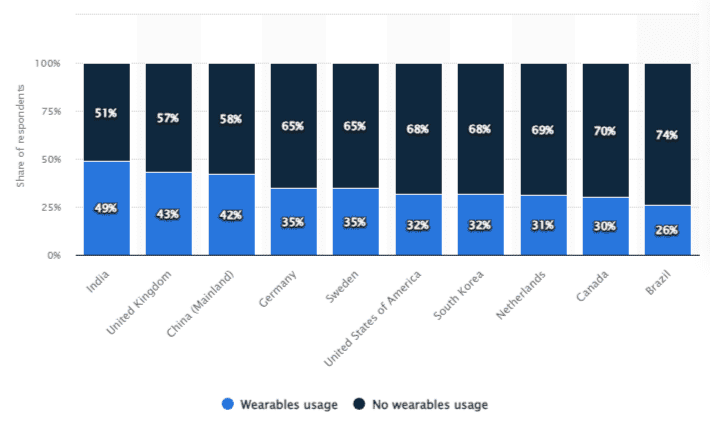
Source: Statista – Wearable devices usage in selected countries as of September 2023

One captivating aspect of the future of payments is the potential for convenience. Just imagine a world where you can effortlessly pay for your morning coffee or groceries by tapping your smartwatch or bracelet eliminating the need to rummage through your wallet or purse. Wearables can make transactions faster and more efficient than before.

Furthermore, as technology continues to evolve, so do security measures surrounding wearable payments. Biometric authentication such as fingerprint scanning or facial recognition can provide an extra layer of protection against fraud and unauthorized access to personal information.

We can anticipate innovations, in payment options as we move forward. There will likely be a range of wearables that cater to individual preferences and styles. The range of possibilities is vast, from fitness trackers that also function as payment devices to clothing that has payment capabilities built in.

Chip Card Checkout

Speeding up Chip Card Checkout Times with Visa

Over the last couple of years, more retailers and providers of merchant services in the United States have been settling into the new Europay, MasterCard and Visa (EMV) credit card processing system. As EMV acceptance expands, business owners will start to see more technology upgrades offered by through their merchant services providers.

One current quirk of chip card acceptance is that shoppers believe it takes too long in comparison to the old magnetic stripe system that enabled the swipe transaction. Current EMV implementations do not allow swiping; instead, shoppers have to insert their cards into the credit card processing terminals and wait for the processes of verification and authorization to be completed.

What is a Quick Chip?

Quick Chip, a new EMV technology improvement by Visa, which is starting to make its way to select merchants, aims to make transactions smoother at the register. With Quick Chip, chip card acceptance will be vastly improved for Visa chip card holders.

How Quick Chip Benefit the Shoppers and Business Owners

In essence, Quick Chip speeds up the checkout process for the benefit of shoppers and business owners. This new merchant services upgrade allows shoppers to insert their cards into the terminal and wait just one or two seconds. Upon receiving acknowledgment, shoppers can retrieve their cards and put them away in their wallets, purses or pockets.

To a certain extent, the Visa Quick Chip emulates the swipe transactions of yesteryear, which were very satisfying for both store clerks and consumers. With this upgrade, which rolled out in select California stores in late July, the crucial check out experience speeds up considerably for the purpose of making shoppers happier.

A very advantageous aspect of Quick Chip is that it can be rapidly implemented. The first installation in California was a network of chip card terminals at a chain of grocery stores with seven locations. In only one week, the new system was running flawlessly.

When it comes to credit card processing, speed is of the essence. The Quick Chip system comes at a time when shoppers at major metropolitan areas have noticed that lines at the cash register are getting longer and moving slower due to the new chip card systems. This could be a good argument in favor of near field communications (NFC) payment systems and smartphone wallets, but this transition will take a while. For the time being, solutions such as Visa Quick Chip are the kind of technology upgrades that merchants and shoppers are looking for.

Data Breach at Wendy’s Expands to Over 1000 Locations

Data security issues at Wendy’s have now been super-sized.

Following whispers of a data breach in January, Wendy’s finally confirmed payment security issues in May, when spokesmen admitted fewer than 300 stores had been affected by malware. Now, the company admits the real number of compromised restaurants is over 1,000.

Thieves installed malware on POS card terminals to capture card numbers, cardholder names, verifications values, expiration dates, service codes and other critical data. Wendy’s stated that CVV codes were not at risk. The malware has been called “highly sophisticated in nature and extremely difficult to detect.”

The initial claim of fewer than 300 affected stores was cast into doubt by reports from card issuers that fraudulent charge volume indicated a far larger distribution throughout the chain’s 5,800 U.S. locations. Wendy’s states that the attack came in two separate waves, making it difficult to determine the total size of the data breach when it was first detected. Investigators first determined the scope as only 300 locations, only to be hit by a second, mutated strain of the malware soon thereafter.

The attack appears to have been the result of compromised security credentials used for remote access by third-party POS service companies. These companies are often hired by franchisees to manage POS systems in their restaurants, and most access them remotely. Of the 5,800 Wendy’s restaurants in the U.S., only about 630 are owned and operated by Wendy’s itself, with the remainder in the hands of local franchise owners. None of the company-owned stores have been implicated in the data breach.

In response to their discovery of the larger scale of the breach, Wendy’s has compiled a searchable database of affected locations. This database is accessible to customers on the company website.

The affected locations had not yet moved to the use of EMV chip cards. Gavin Waugh, vice president and treasurer at The Wendy’s Company, believes that the attack might not have been prevented by use of EMV. Wendy’s declined to provide a timetable for the completion of the rollout of EMV to their network of restaurants.

Gartner Group analyst Avivah Litan states that although many locations have received and installed EMV-capable terminals, not all have activated them. She acknowledged that there is a backlog of requests at the companies who certify EMV readiness for merchants ready to move to the new standard.