Tag Archives: E-Commerce

Industry Terms: Interchange


Interchange

Interchange is a term used in the payment card industry to describe a fee paid between banks for the acceptance of card based transactions. Usually it is a fee that a merchant’s bank (the “acquiring bank”) pays a customer’s bank (the “issuing bank”).

In a credit card or debit card transaction, the card-issuing bank in a payment transaction deducts the interchange fee from the amount it pays the acquiring bank that handles a credit or debit card transaction for a merchant. The acquiring bank then pays the merchant the amount of the transaction minus both the interchange fee and an additional, usually smaller fee for the acquiring bank or ISO, which is often referred to as a discount rate, an add-on rate, or passthru.

For cash withdrawal transactions at ATMs, however, the fees are paid by the card-issuing bank to the acquiring bank (for the maintenance of the machine).

These fees are set by the credit card networks, and are the largest component of the various fees that most merchants pay for the privilege of accepting credit cards. Visa, Mastercard, and Discover are each known as card associations. And each card association has their own rate sheets known as Interchange Reimbursement Fees. These fees make up the majority of what you pay to your processor and they vary greatly depending on the card type accepted.

Download Visa’s Interchange Fees Here

Merchant Services Document Download Graphic

Download MasterCard’s Interchange Fees Here

Merchant Services Document Download Graphic


Interchange Plus Pricing

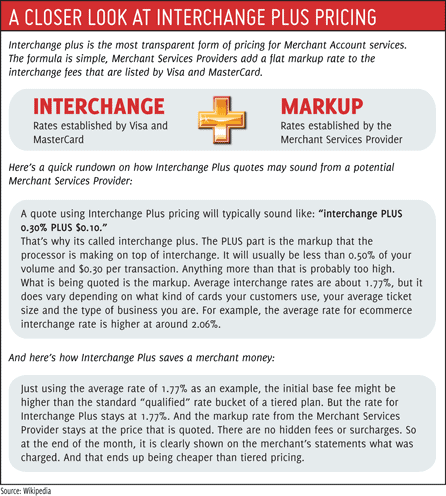
Interchange Plus pricing means that the acquirer charges you a variable MSC consisting of the cost price plus a fixed markup. Interchange Plus Pricing  is exclusively how we quote at Host Merchant Services. Interchange Plus, also known as Cost Plus, pricing gives the customer a fixed rate over published Interchange Fees. This pricing format is normally quoted as a discount rate (percentage fee) along with a per item or authorization fee. The great thing about Interchange Plus pricing is that you always know exactly what you are paying to your processor to services your account. Think of Interchange, and all the associated fees, as an unavoidable cost. No matter who you process with, you have to pay these fees. They may be labeled differently, or wrapped up in a confusing pricing tier, but one way or the other, you are paying Interchange fees. By understanding the markup you pay over Interchange, you know exactly what you pay to your processor and exactly what is going to the card associations. That allows you to make a decision on whether or not the markup seems reasonable for the service you get and choose your processing partner accordingly.

Here’s a small graphic explaining the basics of how Interchange Plus works:

Host Merchant Services infographic on Interchange Plus pricing

Visa Investigation Update

On May 2 it was revealed by Visa CEO Joe Saunders that the credit card giant was being investigated by the Department of Justice for violation of antitrust laws. One of the key elements of the DoJ’s interest in Visa for antitrust violations is its new fee, the Fixed Acquirer Network Fee (FANF) which went into effect on April 1, 2012. Saunders stated that the investigation began on March 13, prior to the fees taking effect.

Saunders revealed that Visa was being investigated during Visa Inc.’s Fiscal Q2 2012 Earnings Conference Call, which prompted The Official Merchant Services Blog to take its readers through the strange roller coaster ride that was Visa’s beginning of May in THIS BLOG HERE.

The strength of Visa’s earnings in the last quarter was framed immediately by Saunders in the conference call: Credit. As Saunders says, “In the U.S., payment volumes increased 6% for all products. Our star performer for fiscal second quarter was credit. Building on that, we continue to invest in new and expanded long-term credit relationships with our largest U.S. clients to drive growth in our core business.”

The other side of that statement, however, is debit. Where MasterCard took great strides — notably adding the nation’s largest debit card institution Bank of America, which switched from Visa.

Visa claims it was hampered by the Durbin Amendment in terms of making earnings from debit in the last quarter.  As Saunders said in the conference call, “So far, the situation is playing out as we expected, and in line with our updated guidance for fiscal 2012 as well as our guidance for fiscal 2013. During the March quarter, U.S. aggregate debit payment volumes slowed to 2% growth and, as expected, has continued to decline in April. Interlink is bearing the brunt of the regulatory impact.”

Saunders then took a moment to emphasize the individual differences between Visa Debit — the well known Visa check cards that get swiped through terminals around the country — and Interlink, Visa’s PIN-debit product. Saunders noted that Visa’s swipe debit grew, but grew very slowly. And then went into detail about how Interlink was the company’s worst performer in the quarter, “We posted negative payment volume growth in each month of the March quarter. More recently, between the compliance deadline of April 1 and April 28, Interlink payment volume has experienced notable deterioration. Keep in mind, though, that in the March quarter, Interlink contributed less than 10% of U.S. debit revenue and about 2% of Visa Inc.’s overall revenue and was our lowest yielding product in the U.S. market. “

At this point in the call Saunders shifted into a very general discussion of Visa’s “strategies to compete” — essentially their new fees, including FANF, the Transaction Integrity Fee and a revised Network Acquirer Processing Fee. That led Saunders to discuss the Department of Justice investigation: “On March 13, prior to the April 1 implementation date, the U.S. Department of Justice Antitrust Division issued a civil investigative demand requesting additional information about PIN-authenticated Visa Debit and elements of our new debit strategies, including the fixed acquirer fee. In March, we met with the department twice and provided materials in response to the CID. We are confident our actions are appropriate and that our response to the DOJ supports that.”

More Commentary from Visa

During the question and answer period of the conference call, Saunders stepped up to defend Visa’s new fees. Saunders says that the fees are part of “the total structure we’ve put to deal with the Durbin regulation. We are not making money per se off of that fee. The combination of discounts and incentives that we have put together, I think, actually relate in a modest loss in the amount of $100 million a year. So we aren’t doing this with the intent of raising prices.”

Then another question comes up in the call asking about the outlook the company has for recovering from the losses in Debit due to Durbin. Saunders very vocally defends the company’s fees and strategies: “Let me just follow up on that and make perfectly clear one thing, and that is that we are never going to regain all of the market share that we had in the debit card business. Nothing that we say or none of our strategies suggest that that will happen or could happen. And nothing that we have done or thought about or said anticipates that it will happen. The environment has changed by regulation. We are operating in a different world, and we are going to live forever with less share than we once had.”

The TLDR Version from Visa

So essentially Visa’s CEO has revealed the company is being investigated by the DoJ for antitrust violations because its new fees could circumvent the point of the Durbin Amendment’s reform. But Saunders states the company is cooperating with the government probe, and stoutly defends the fees as not circumventing Durbin. Saunders says the fees don’t recoup the losses that the company will incur from the hard cap, and that the company is still taking a downturn in the debit sector even with the fees in effect. He admits that these fees are part of their strategy to deal with the legislation but feels that the company isn’t violating antitrust laws.

The transcript of the entire conference call can be read HERE at Seeking Alpha. Many thanks to them for providing it for use to bloggers and media outlets.

Trending … Social Gifting [2023 Update]

The Official Merchant Services Blog keeps its finger on the pulse of e-commerce, and today we’re giving you the scoop on the latest hot trend … Social Gifting.

What is Social Gifting?

Social Gifting is the activity where consumers on social media channels like Facebook can individually, or in groups, purchase gifts for their friends. Virtual Gifting, or the act of giving someone a gift through an app or a website, was covered right here on November 2, 2011. In our Virtual Gifting Blog we had these prophetic words to say about the activity: “As smartphones ingrain themselves more and more into our society, virtual gifting is going to become a much more commonplace activity. Driving the strength of e-commerce higher and higher. “

The Virtual Gifting Blog was a follow up to the November 1, 2011 blog entry on Mobile Gift Cards. We explained how the process of mobile gift cards works: “The standard way Mobile Gift Cards are designed to work is: The card is sent via email, Facebook or text. The recipient is notified that he or she has a Gift Card, and can take their smartphone into the store and use it immediately. The store clerk simply scans a bar code from the recipient’s phone, and the card is applied to the balance.”

The two key points to take from The Official Merchant Services Blog’s 2011 coverage are:

  • We recognized this trend as being on the cutting edge last year and have been staying ahead of the technology curve effectively.
  • Social Gifting is just the latest mutation in the process, adding in the social media and group aspect to virtual gift technology.

Wrapp That Gavel Up, B!

What prompted Social Gifting to get kicked up a notch in media coverage is that Swedish start-up Wrapp launched a U.S. version of its application with 15 high-profile merchants including H&M, Gap and Sephora. Wrapp takes the form of a mobile application for iOS or Android that you download and then connect to your Facebook account. Once you download the app, you can send gifts or promotional gift cards to people within your network. There is also a Web version of the application.

Since Wrapp launched its first app in November 2011, nearly 180,000 people have used it to give their Facebook friends more than 1.5 million free promotional gift cards for nearly 60 major retailers, according to the company’s background information.

The Pros and Cons

Wrapp cites its biggest strength is that the practice of social gifting often results in sales much larger than the original gift — each sale averages 4 times to 6 times the value. That’s an alluring idea that many retailers will find an attractive marketing tool. But there are some serious concerns about the trend as retailers still feel burned by the rise of the spammy empire that is “the daily deal.”

Groupon and its legion of imitators have helped undermine prices for some businesses (especially small ones) and downright burned others, when the businesses couldn’t keep up with the opportunistic one-time customers they acquired through the big one-time deals that trended in 2011. That has many people gun-shy in terms of social gifting, since the daily deal empire was also built through social media outlets like Facebook and Twitter.

This blog titled “Social Gifting: Helping or Hurting Business?” from techzone360 delves into the negative impact Social Gifting could have. The key criticism is made here: “As it turns out, the overwhelming majority of recipients make sure not to go a penny over the budget of the gift cards – which also isn’t very out of line or unreasonable either. The major flaw in this system is with the mom and pop stores. Sure, everyone wants a lot of business – how else would they make money? But when 500 people come swarming into a business that’s only prepared to deal with 10 or 15 customers at a time, things can get messy.”

But Wrapp CEO Hjalmar Winbladh told smartplanet.com in this blog: “You and I get to give our friends free gifts and promotional cards from great retailers, the gifts we give are stored in our friends’ phones so they’re always with them when they want to buy something they really want, and the merchants get a proven customer acquisition and retention platform built on Wrapp’s friend-to-friend marketing for conducting performance-based campaigns.”

The Full List

The company is comprised of executives that are big players in the retail and social media sectors.  The folks who founded Wrapp are: COO Carl Fritjofsson who was a strategy advisor to Groupon.se; CTO Andreas Ehn was Spotify’s first chief technology officer. The aforementioned Winbladh previously co-founded a mobile software company in Sweden called Sendit, which was acquired by Microsoft in 1999. Wrapp’s chairman, Fabian Månsson, is the former CEO of H&M and Eddie Bauer. In January, the company raised $10.5 million in Series A funding from Greylock Partners and Atomico. And LinkedIn founder Reid Hoffman is on the board of directors, along with Skype founder Niklas Zennström.

The full list of 15 retailers included in Wrapp’s U.S. service are:

  • Björn Borg – designer underwear
  • Brooklyn Industries – innovative designer clothes for men and women
  • Fab – daily design inspirations and sales
  • GANT – American sportswear with a European touch
  • Gap – casual, optimistic, American style
  • H&M – family fashion and quality at the best price
  • Happy Socks – designer socks online
  • Rovio Entertainment – creator of the globally successful Angry Birds franchise
  • Sephora – unparalleled beauty paradise of makeup, skincare, fragrances, hair care and more
  • SpaFinder Wellness – feel-good possibilities from massage to yoga, Pilates and fitness classes
  • The Wall Street Journal – the country’s largest newspaper and leading business publication
  • Threadless – amazing graphic tees from a global community of designers
  • Warby Parker – eyewear with a purpose
  • Wayfair – furniture, lighting, cookware, and more for the home
  • WeSC – street style clothing and accessories

Debit, Merchants and Durbin

Today The Official Merchant Services Blog jumps feet first into an update on everyone’s favorite payment processing industry-focused legislation, the Durbin Amendment. We’ve covered the topic extensively since the blog began. You can read the Host Merchant Services in-depth and official analysis of the legislations itself by CLICKING HERE.

The legislation took effect October 1, 2011. With May beginning its seventh month of officially being on the books, some studies on its impact are starting to come to light.

CardHub’s Interchange Fee Study

According to a study released by Card Hub, the Durbin amendment will cost big banks $8.06 billion and smaller banks $329.4 million on an annual basis. The study, FOUND HERE, also notes in its 2012 impact assessment that the interchange fees charged by large banks (those with more than $10 billion in total assets) have decreased significantly since the Federal Reserve’s interchange fee cap took effect – falling 59.3% for signature transactions and 32.4% for PIN transactions.

The CardHub study is a work in progress and has been updated multiple times with new information as the Durbin Amendment made its way through Congress and ultimately took effect on October 1, 2011. On May 1, 2012 the Federal Reserve for the first time announced hard data on the law’s practical effect, and Card Hub’s 2012 Impact Study concluded that the law has ended up costing banks almost $8.4 billion on an annual basis.

Speaking of the Fed …

The Federal Reserve released statistics on May 1 summarizing the Durbin Amendment’s actual affect on the banking industry through the first six month’s of the law’s existence. The central bank found that in those six months of Durbin’s controversial cap on debit swipe fees being in place, banks subject to the cap saw their average fees drop by 45 percent. This makes some very simple mathematical sense when you consider that prior to Durbin the average fee was 43 cents per transaction, and Durbin itself set a hard cap of 21 cents and 5 basis points — essentially coming out to a 24 cents per transaction upper limit. The only wiggle room on the entire process is found in small banks, who are not subject to the hard cap, but those banks, according to the CardHub study only account for 15 percent of the total market share, so their variance will only have a small impact on the data. And as noted in the Federal Reserve’s data, small banks have held steady with their interchange fees on swipe debit, keeping them at the pre-Durbin height of 43 cents per transaction average.

S&P Releases a Study As Well

Standard and Poor’s released its Durbin Amendment Impact study as well, titling it “U.S. Banks are Changing Their Strategies to Mitigate The Financial Impact Of The Durbin Amendment.”

You can read the study at THIS LINK HERE. The basics of the study echo much of what Host Merchant Services‘ analysis predicted last year.

Essentially banks are going to make up the loss incurred by the hard cap in other areas. They are already well on their way to cutting out special programs and offers such as free checking and subsequently raising fees and instituting new fees into their services throughout their bank’s offerings. In short, banks simply moved the fees to other things consumers have to pay for.

The study concludes: “The Durbin Amendment has affected the financial industry in a number of ways, but perhaps not in the ways legislators intended. The benefits to consumers seem largely negligible as banks have sought other ways to generate revenue or cut services.”

Fuel is the Fire

Added to the 6-month impact studies, the Durbin Amendment also popped up into the news at the end of April due to a bold claim made by the Electronic Payments Coalition: Gas retailers were pocketing $1 billion in windfall from the Durbin Amendment and not passing any savings on to consumers. The math behind this claim is not nearly as direct as the headlines made it out to be. So follow along on this. According to the EPC:

  1. The Durbin amendment to Dodd-Frank legislation has seen interchange rates slashed by about 70% for debit card payments for fuel.
  2. With high gas prices likely to play a major role in this year’s presidential elections, the EPC commissioned research from Phoenix Marketing International on the prevalence of debit card use at the pump.
  3. A poll of 5166 consumers shows that 36% of all payments for fuel are made with a debit card – half of all non-cash transactions. The debit card share of both transactions and dollars is higher than any other payment method.
  4. With US Energy Information Administration figures showing that nearly 134 billion gallons of gas were sold in 2011, this means that approximately 48 billion gallons were purchased using debit, claims the EPC.
  5. Yet, despite the $1 billion a year this gives merchants “there continues to be no evidence that retailers are passing along savings,” according to the EPC.

That’s a bit of a leap. Using data from about 5,200 people in a poll and then tying it into the full figures from the US Energy Information Administration on fuel consumption ties two pieces of data together in a relationship that is not a direct connection.

CLICK HERE to view the full Phoenix Marketing Report.

Not so Fast

The National Association of Convenience Stores (NACS) and the Petroleum Marketers Association of America (PMAA) strongly condemned the findings of the EPC report. Both organizations claim the data is seriously flawed.

The NACS replied to the EPC report in multiple media outlets, stating the EPC the study is based on simple arithmetic that shows a lack of understanding about what causes high fuel prices and whether retailers even profit from them. NACS spokesman Jeff Lenard said: “When prices rise, retailers usually cut margins because they want to remain price competitive even if their wholesale costs increased. Data from OPIS shows that the average national markup (gross margin) for gas was 13.0 cents per gallon over the first quarter of the year. We estimate that expenses to sell gas are around 15 cents per gallon, so average retailers experienced an entire quarter where they lost money selling gas.”

Lenard also cited the NACS Fuels Report for 2012 as showing consumer price sensitivity with gas purchases, saying that consumers are aware of discounts and have used them. You can read that Fuels Report at THIS LINK HERE.

In Conclusion

Six months into the Durbin Amendment things are shaping up much like Host Merchant Services predicted. The legislation remains controversial, but that is largely due to the way the legislation was written with large enough loopholes for the banks to easily adjust to the restrictions of the reform. The gas price gouging story seems more sensational sizzle than quantitative substance. Proving that gas prices remain a hot button political talking point in election years, but the whole issue, to us here at Host Merchant Services, seems to be blown out of proportion when you consider that credit cards get used at the pump and they are not subject to any reform legislation currently.


Visa’s Ups and Downs

The Official Merchant Services Blog takes a look at Visa’s wild ride between May 2 and May 3. In the midst of a very active first quarter of 2012, Visa’s earnings report came in. The San Francisco based credit card giant then took a ride on a roller coaster in the span of two days after the report was released.

The Up Vote

The company had good news to report on May 2: Visa said Wednesday that its profit for the first three months of the year was up 30 percent from the year before, primarily because credit card use rose in the United States and overseas. Bloomberg broke down some key statistics from the report in their story here: “The company said Americans rang up 12 percent more on their charge cards for the quarter. Debit card use grew by only 4 percent to $284 million, however, the slowest growth in a year.”

So the boost in Visa profits is tied to an increase in the use of credit cards in the first three months of the year. But it appears the Durbin Amendment, financial reform legislation designed to address problems with swipe debit fees, has slowed down debit card use. As the Bloomberg article reports, the Durbin Amendment appears to be having an impact on profits: “Banks have eliminated some debit card rewards programs since October, when the government limited the fees banks can charge stores for card transactions.”

The profit breakdown for the quarter paints a very rosy picture. Visa’s net income was $1.3 billion, or $1.60 per share. Wall Street was expecting $1.51. Revenue rose 15 percent to $2.6 billion. Wall Street was expecting $2.48 billion.

The Down Turn

And then the roller coaster ride took a dip. Bloomberg reported the next day, May 3, that Visa stock took a decline based on the details of a U.S. Antitrust Probe into Visa’s Debit Strategy. The article states: “Visa Inc., the payments network that has lost market share amid new debit-card rules, slid as much as 4.5 percent in extended trading after disclosing a U.S. antitrust probe into the firm’s pricing and strategy.”

Visa adjusted the network’s fee structure to defend its leading market share after the Durbin Amendment took effect in October. On March 13, the U.S. Justice Department’s antitrust division issued a civil investigative demand asking for information about Visa’s debit strategy. Bloomberg quotes Visa Chief Executive Officer Joseph W. Saunders as saying in a conference call: “We are confident our actions are appropriate and that our response to the DOJ supports that.”

According to Saunders Visa has received four other requests for information from the Justice Department since 2007, and all have been resolved with Visa’s full cooperation.

The Durbin Factor

The Visa news comes after recent announcement from MasterCard, which stated that their own first-quarter profit increased 21 percent to $682 million. Like Visa, MasterCard’s profits also beat Wall Street estimates.

Speculation suggests that the hard cap on Debit Card Swipe fees imposed by the Durbin Amendment from October 2011 may have helped MasterCard take some market share away from Visa. MasterCard has been winning deals to handle processing of debit transactions according to the company’s Chief Financial Officer Martina Hund-Mejean.

Bloomberg quotes Hund Mejean as saying in a conference call to analysts: “In every quarter we’re going after business very surgically and opportunistically. You can see those results in our numbers.”

And according to Tien-tsin Huang, a JP Morgan Chase & Co. analyst in a May 1 research note, Bank of America Corp. — the biggest debit-card issuer and catalyst of post-Durbin media frenzy — switched to MasterCard.

Visa’s Fees Bite Back

Visa changed its debit-card fees in April, creating new fees like the Fixed Acquirer Network Fee (FANF) in an attempt to create incentives for merchants to route more transactions on the company’s network. The fees, which had been variable were broken into various components. To read more about those fees, you can CLICK HERE to see Host Merchant Services‘ own coverage of the April fees. The Bloomberg article suggests that Bank of America switched to MasterCard in reaction to the new Visa fees and MasterCard’s own surgical strike against Visa’s market share.

Internet Security

Security is one of the defining internet issues of this decade.  While there is not one distinct body of law that governs a company’s rights and responsibilities, there are methods to prioritize compliance efforts.  This issue is relatively unique to the internet space since the laws and regulations that apply come from many different areas.  In recent years the Federal Trade Commission (FTC) has taken an increasingly prominent role in responding to these problems.  In addition, almost every state has some sort of law that at least requires reporting of unauthorized disclosure of information.  Indeed many state laws, particularly Massachusetts and California, go substantially beyond simple breach disclosure and mitigation.

Host Merchant Services is located in Delaware. The Delaware Security Breach Notification Law can be reviewed in its entirety at This Link.

While many agencies, such as the SEC, have regulations that address security issues in the industries they regulate, the FTC is the agency primarily tasked with addressing internet security issues.  The FTC has the authority to prosecute companies and individuals who engage in deceptive trade practices.  The best way to determine the enforcement priorities of the FTC is to look at recent enforcement actions.  These actions have focused on the “locked door” problem:  Many companies focus on the number of locks they’ve placed on the door to data, as opposed to making sure these doors do not become unlocked over time.

Sloppy security practices are an issue that the FTC has said is simply screaming for regulatory and enforcement activity.

Time and time again, the FTC has stated that companies must have procedures in place to ensure that their businesses are secure, to detect security vulnerabilities, and inform customers and, if necessary,  regulators, when unauthorized disclosures are discovered.  To avoid FTC action, internet businesses need to shift some of their security thinking and strategy from high profile areas to basic security and process control schemes.  This could involve redeploying resources from traditional security screening measures (such as trying to breach firewalls) to creating change control processes, training staff on quality control and ensuring that vendors actually meet the security standards you need — and that they profess to have.

It is a bit trickier to generalize about state security statutes.  That said, most state laws have relatively similar goals to their federal counterparts.  As an initial matter you should ensure that your entire “ecosystem” has the same, or similar, breach definitions.  Doing so avoids gaps that lead to misinformation and failure to comply with breach definitions set out in your state laws.  A second component of general compliance is to create both internal and external notification plans.  Your internal plan should create a system where both employees and vendors are alerted to a possible breach.  External plans should contain at a minimum a statement of what is known about the breach, mitigation efforts, a contact point, and future steps you are taking regarding the breach.  You should identify which information will be excluded from these notification efforts because of confidentiality or other restrictions.

A final component of a state compliance plan is to anticipate how you will fold in state regulators and law enforcement entities.  At a minimum, these will be agencies in the state in which you are located, but may, in some instances, include regulatory agencies in other states.  It is important not to play hide-the-ball and simply fail to provide the regulatory and law enforcement notifications required by law.  In making these notifications, you should involve your attorney to determine how much information you are required to disclose, and methods of protecting your company from litigation.

For More Information

For more legal information you can visit my site:

David Snead’s Home Page

Merchant Services Document Download Graphic

To learn more about PCI Compliance, Host Merchant Services offers these resources:

PCI Compliance FAQ

Merchant Services Document Download Graphic

PCI Compliance Guide

Merchant Services Document Download Graphic

Disclaimer:  Legal decisions must be made based on your unique situation. Please consult with an attorney prior to making decisions based on this post.

Industry Terms: Chargeback

This is the latest installment in The Official Merchant Services Blog’s Knowledge Base effort. Well we want to make the payment processing industry’s terms and buzzwords clear. We want to remove any and all confusion merchants might have about how the industry works. Host Merchant Services promises: the company delivers personal service and clarity. So we’re going to take some time to explain how everything works. This ongoing series is where we define industry related terms and slowly build up a knowledge base and as we get more and more of these completed, we’ll collect them in our resource archive for quick and easy access. Today’s term is:

Chargeback

Chargeback typically refers to the act of returning funds to a consumer. The action is forcibly initiated by the issuing bank of the card used by a consumer to settle a debt. Essentially what happens is a consumer disputes a transaction, and the credit card company’s bank responds by taking the money back from the Merchant and returning it to the consumer.

Customers dispute charges to their credit card usually when goods or services are not delivered within the specified time frame, goods received are damaged, or the purchase was not authorized by the credit card holder — the latter being the most common reason for a chargeback.

The chargeback mechanism exists primarily for consumer protection. To start a chargeback a consumer will contact their credit card company and ask for a chargeback. The dispute process then begins. During the dispute process he merchant will have to provide proof they rendered service properly. If the merchant can’t provide sufficient evidence, the credit card company debits the transaction amount from the merchant’s account and credits it to the consumer’s account. Additionally, the credit card company charges the merchant a chargeback fee as a penalty.

With each chargeback the issuer selects and submits a numeric reason code. This feedback can help the merchant and acquirer diagnose errors  and improve customer satisfaction. The code also helps the merchant better investigate the transaction in order to find proof during the Dispute Process. Reason codes vary by bank network, but fall in four general categories:

  • Technical: Expired authorization, non-sufficient funds, or bank processing error.
  • Clerical: Duplicate billing, incorrect amount billed, or refund never issued.
  • Quality: Consumer claims to have never received the goods as promised at the time of purchase.
  • Fraud: Consumer claims they did not authorize the purchase or identity theft.


For transactions where the original invoice was signed by the consumer, the merchant may dispute a chargeback with the assistance of the merchant’s acquiring bank. The acquirer and issuer mediate in the dispute process, following rules set forth by the corresponding bank network or card association. If the acquirer prevails in the dispute, the funds are returned to the acquirer, and then to the merchant.

The merchant’s acquiring bank accepts the risk that the merchant will remain solvent over time, and thus has an incentive to take a keen interest in the merchant’s products and business practices. Reducing consumer chargebacks is crucial to this endeavor. To encourage compliance, acquirers may charge merchants a penalty for each chargeback received. Payment service providers, such as PayPal, have a similar policy. In addition, Visa and MasterCard may levy severe fines against acquiring banks that retain merchants with high chargeback frequency. Acquirers typically pass such fines directly to the merchant. Merchants whose ratios stray too far out of compliance may trigger card association fines of $100 or more per chargeback.

For More Information

To find out more about Chargebacks and to gain some Chargeback Tips, be sure to CLICK HERE and read The Official Merchant Services Blog entry from January 9, 2012.

VexxHost Partnership

One constant struggle that we’ve seen with our customers is the ability to perform credit card transactions on their website.  While there are plenty of credit card processing companies in the market, it always seems like you need a degree in finance in order to understand all the fees involved, not to mention the plethora of documentation to go through.

Host Merchant Services Partner VexxHost LogoIt may also seem that a lot of the times, the credit card providers’ interests are not aligned with those of the merchant.  While a business has to operate with the interest of making profits through offering a service, however, it is important to draw the line and understand the limit of what a company should charge for to maintain a good relationship with their customers.

As a company, we were extremely happy to partner and work with Host Merchant Services.  When we were initially approached and presented with the opportunity that Host Merchant Services presents for their customers, it was undeniable that HMS works with their customer’s best interests.

All of our existing and new web hosting customers are now eligible for a $75 voucher that will cover their credit card processing fees, which means that all of VEXXHOST customers can now get started and offer payments via credit card either on their online e-commerce website or even in their store, as Host Merchant Services is not limited to online credit card processing.

From small things like having no contracts or any hidden fees up to the important details such as a locked-in lifetime rate that will never change and free equipment (such as terminals and supplies) for customers that do offline credit card processing. Host Merchant Services always goes to make sure that the customer is getting the best treatment they can possibly get.

We really hope that this partnership is equally beneficial, allowing our customers to leverage HostMerchantServices to process their credit cards online, if not start offering it now.  VEXXHOST customers can get started by simply clicking the “Merchant Account” icon from their cPanel control panel to get started!