HostingCon 2012 is right around the corner. And The Official Merchant Services Blog is pleased to announce that Host Merchant Services CEO Lou Honick will be there to participate in a panel discussion on the topic of Best Practices for Payment Processing. The discussion, scheduled for 9 a.m. Wednesday July 18, offers hosting providers tactics for reducing payment processing costs and reducing risk. Honick is part of a panel of payment processing industry experts addressing the conference.
“As a three-time keynote panelist, I’m excited to return as a speaker this year,” said Honick of his speaking engagement. “Panel discussions at HostingCon have been consistently excellent at packing a high level of knowledge and experience into a single session. Having been the CEO of a hosting company for 11 years, and now at the helm of Host Merchant Services for three years, I’m able to bring a great perspective on best practices for credit card processing in hosted services.”
HostingCon, celebrating its 8th anniversary, is the foremost conference and trade show for the hosted services industry. The best and the brightest from the industry will be attending the event from July 16 – 18 at the John B. Hynes Veterans Memorial Convention Center in Boston, MA.
“As a specialist in partnering with web hosting companies, I’m glad to share my experiences from both sides of the table to help attendees reduce costs, decrease fraud, comply with regulations, and maintain security.”
Host Merchant Services specializes in providing world-class customer service and support to its credit card processing customers. The company takes a different approach to merchant services, focusing on delivering the industry’s lowest processing rates while providing industry-leading service and support. Host Merchant Services, headquartered in Newark, Delaware, specializes in partnering with web hosting and other professional services companies to offer payment processing to their customers.
This approach stems from Honick’s experience in the web hosting industry. Honick got his start in the hosting industry as the founder of HostMySite.com, growing it from a two person operation in 1997, to an industry leader with 240 employees and over 100,000 customers at the time it was acquired by a private equity firm in June of 2008. He transferred the same successful approach to the credit card processing industry when he began Host Merchant Services in 2009.
To learn more about HostingCon 2012 visit their website.
Host Merchant Services will also be there in force to promote their special offer program with partner OpenSRS. OpenSRS partnered with Host Merchant Services back in April.
This partnership brings Host Merchant Services, the premier provider of payment processing and e-commerce services for small businesses and medium businesses, to OpenSRS Offers, the platform that allows OpenSRS Resellers to extend valuable third-party offers and discounts to their customers.
The partnership is bolstered by HMS’ experience with the web hosting industry and HostingCon is a perfect venue for the company to present its ongoing initiative to provide E-Commerce focused companies a robust solution for processing credit cards online.
“We don’t write a business off as high risk just because it sells its products or services online,” added Honick. “HMS understands the needs of e-commerce merchants and works tirelessly to provide them with the right services at the best possible rate.”
Today The Official Merchant Services Blog wants to review the details of VISA’s newFixed Acquirer Network Fee (FANF). On April 1, 2012, Visa began charging this new fee. But it has taken about this long for it to catch up to merchants and their statements. The process sort of knocked its way down like dominoes falling — The fees went in effect in April, but were based on May’s activity, so didn’t show up until June’s statements, that many merchants are now noticing here in July.
These fees are new, and start to show up on statements where they hadn’t appeared before and they have the appearance of being hidden fees. This development goes against the Host Merchant Services policy of no hidden fees. Which is why we’ve attacked this story so vigorously in our blog, trying to keep our readership up to date on these new card association fees affecting the credit card processing industry.
The HMS Guarantee
Host Merchant Services wants to assure its customers that it sticks by its guarantee. HMS will never increase their fees for their customers. HMS continues to offer the guaranteed lowest rate. And that rate is frozen. Unfortunately, Card Association Fees are new, and are not part of any current pricing model. They are also mandated and initiated by the credit card companies themselves — Visa, MasterCard and Discover. All processors everywhere will be adding them to their pricing structure. So your statement will start showing new fees moving forward. But we here at Host Merchant Services will help explain what they are, where they come from and why they’re just now appearing on your statement. So please feel free to contact us if you have any questions about your statement.
Now About Those Fees
FANF is the most high profile of the new fees. But it’s name is a bit misapplied, as the fee itself is not “fixed” in any sense of the word. The FANF is a monthly fee that will affect all merchants to a varying degree. For card present businesses like retailers, the amount of the Fixed Acquirer Network Fee will be based on the number of locations a business has. For card not present businesses like e-commerce operations, the FANF will be based on gross Visa processing volume. So the “Fixed” fee’s actual amount varies based on multiple factors. Those variables are:
Merchant Category Code (MCC)
The merchant category code used to classify a business plays a role in the amount of the FANF charged each month. However, the impact of the MCC is very minimal, amounting to a difference of $0.90 – $1.10 for most businesses (less than fifty locations).
Acceptance Method
The main factor in determining the amount of the FANF is whether a business processes the majority of its transactions in a card present or card not present environment.
Card Present Businesses
(Excluding Fast Food Restaurants / MCC 5814) The amount of the Fixed Acquirer Network Fee for card present businesses will be based number of locations. Businesses with one location will be charged $2 – $2.90 a month, up to $85 a month for businesses with 4,000 or more locations.
Card-Not-Present Businesses
(As well as Fast Food Restaurants / MCC 5814) For card-not-present businesses, the amount of the FANF will be based on gross Visa processing volume. Card-not-present businesses will see a greater impact from the FANF than card-present businesses due to the fee being determined by volume.
For example: card-not-present business processing between $8,000 and $39,999 will be hit with a Fixed Acquirer Network Fee of $15 a month opposed to just $2 for a card present business with similar volume and one location.
Other Fees
Besides FANF, Visa also is implementing a Transaction Integrity Fee and making revisions to its Network Acquirer Processing Fee. Visa’s Transaction Integrity Fee is a new $0.10 fee that will apply to U.S. domestic regulated and non-regulated purchase transactions made with a Visa Debit card or Visa Prepaid card that fail or do not request Custom Payment Service (CPS) qualification. On the other hand, the Network Acquirer Processing Fee on Visa-branded signature debit will be reduced — going from $0.0195 per authorization to $0.0155 per authorization. The fee for credit card authorization will remain $0.0195 per authorization.
Today The Official Merchant Services Blog has learned of a new partnership agreement between Host Merchant Services and cloud hosting services provider. With HostingCon 2012 right around the corner, this partnership announcement is well-timed. Credit card processing firm Host Merchant Services has announced that it has entered into a strategic marketing partnership with ServInt.
Servint is the latest provider to join a partner program that has taken the web hosting and cloud services industry by storm. This alliance will give ServInt the ability to provide flexible and customizable merchant services and credit card processing to its customers quickly and efficiently.
ServInt, based in McLean, VA, has been providing managed hosting services to businesses and enterprises around the world since 1995. Today, they offer a full portfolio of VPS, dedicated, IaaS cloud and PaaS Java hosting to clients in more than 130 countries.
Partnering with Host Merchant Services, the premier provider of payment processing and e-commerce services for small businesses and medium businesses, lets ServInt maintain its high level of quality customer service while offering a guaranteed best-rate plan for merchant services. ServInt customers will be able to accept credit card payments easily from a merchant services provider that is intimately familiar with the needs of cloud hosting customers and e-commerce merchants.
Host Merchant Services is a registered Independent Sales Organization (ISO) with Visa U.S.A. and MasterCard International with bank sponsorship provided by Wells Fargo Bank, Walnut Creek, CA. The company specializes in providing world class customer service and support to its credit card processing customers.
“ServInt is an outstanding, reseller-centric, cloud services company that we are excited to partner with,” said Host Merchant Services CEO Lou Honick. “Host Merchant Services shares ServInt’s dedication to quality customer service. Their customers will benefit greatly from a seamlessly integrated payment processing solution, from a provider that really understands their needs. ServInt customers will enjoy transparent pricing, 24x7x365 customer support, and a skilled technical support team to assist them in quickly integrating the service to their website.”
ServInt COO Christian Dawson added, “ServInt prides itself on being one of the most reseller-friendly service providers in the hosting marketplace. Our partnership with Host Merchant Services further enhances our ability to meet the needs of this critical segment of our customer base, as it adds a critical business product to the best-of-breed support services we offer – at very favorable terms – to the hosting reseller community.”
The partnership is part of a Host Merchant Services initiative to provide web hosts and cloud operators like ServInt a fast and transparent third party solution for processing credit cards. The Host Merchant Services partner programhas been gaining traction at a rapid rate to become the “go to” choice for web hosts that want the best mix of revenue sharing and quality service without onerous contracts or commitments.
Host Merchant Services COO Dan Honick sums it up by saying, “Our customers and partners stay with us because they are happy with our service.”
About ServInt
ServInt is a pioneering provider of high-reliability, managed cloud hosting services for enterprises worldwide. Founded in Northern Virginia in 1995, ServInt provides a range of IaaS, PaaS, VPS and dedicated server packages to hosting service resellers, web designers, developers and online businesses in more than 130 countries. To learn more about ServInt’s cloud, VPS and dedicated hosting solutions you can visit their website http://www.servint.net/.
About Host Merchant Services
Host Merchant Services is a different type of merchant services company which focuses on delivering the industry’s lowest processing rates while providing industry-leading service and support. The company’s products include merchant services and credit card processing. Host Merchant Services is the only merchant services company with a partner program that guarantees unsurpassed pricing, support, and customer service. The company is headquartered in Newark, Delaware and executes all operations with the manifesto of “bringing trust to merchant serivces”.
To learn more about Host Merchant Services visit https://www.hostmerchantservices.com
Yesterday, The Official Merchant Services Blog defined the term Mobile Payment Processing for its readers. We bring this topic up frequently because it’s one of the hottest trends in credit card processing. Today we’re going to update our coverage of the topic. We have been framing almost every discussion of the topic around a set of studies done last year.
We’ve dug deeper on the topic to find new numbers — mostly from Internet Retailer and their very helpful industry statistics category.
The Mark of SORO
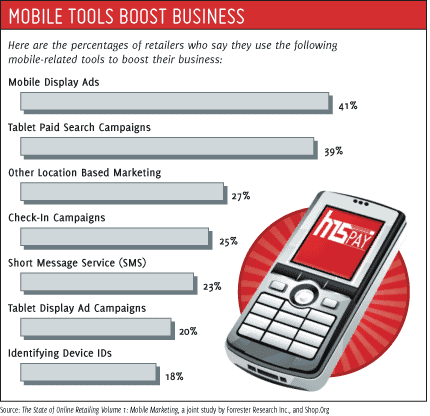
According to The State of Online Retailing Volume 1: Mobile Marketing, 91% of retailers have a mobile strategy in place. Produced annually in partnership between Shop.org and Forrester Research, The State of Retailing Online (SORO) study is the highly anticipated research that brings details of all aspects of eCommerce — from marketing, social media and mobile to KPIs, mobile and profitability — to the online retail community. For the first of two 2012 studies, Shop.org, RAMA and Forrester Research have embarked on a “deep dive” study of all things mobile marketing. Its findings are based on survey responses from 59 retailers, including merchants that operate stores, sell only on the web and manufacturers selling directly to consumers and details how retailers are implementing smartphone and tablet marketing into their sales mix.
According to the study, mobile generated 4.7% of total web sales for the retailers surveyed in 2011, with tablet users accounting for 3.2% and smartphone users accounting for 1.5%.
Essentially the data in the study indicates that e-commerce is slowly but steadily integrating more and more aspects of mobile commerce. The driving force spurring much of the conversion along appears to be coming from social media and e-mail campaigns. Mid-sized retailers — those with annual sales between $10 million and $100 million — say mobile e-mail optimization is their top tool for mobile marketing.
Also the study revealed the popularity of Quick Response Codes. The study says small and large retailers — those with annual sales of less than $10 million or more than $100 million, respectively — cite their use of quick-response codes or other barcode scanning tools as the top tool they use for mobile marketing, even though only 15% of smartphone users say they’ve ever scanned a code, the report says.
Burger King, Smart Phones and QR Codes
The information about QR Codes is significant when you factor in two of the latest breaking news stories in the mobile payments processing category.
First, Burger King just announced it has partnered with Qualcomm’s mobile commerce arm, Firethorn Mobile, for the BK Mobile Crown Card (BK MCC) initiative, which will start in 50 restaurants across Utah and surrounding areas. The platform will allow Android and iOS smartphone users to scan QR codes found on in-store counters and drive-thrus to make a payment via the BK MCC app, which is available on Google Play and the App Store. The transaction will then be processed through the user’s registered debit or credit card account.
Second, the NCR Corporation has developed a way to withdraw money from an ATM that uses your smart phone and a QR Code. According to this article by Digital Trends: “Developed by the NCR Corporation, the payments group within the company has created a way to withdraw cash from an ATM without having to pull an ATM card out of a purse or wallet.”
Here’s how the process works:
A bank customer with an Android or iOS smartphone with a built-in camera approaches an ATM and launches the NCR application.
After the app loads, the customer enters the four digit PIN number tied to their bank account on the smartphone touchscreen.
When the pin is accepted, the app brings up all bank accounts related to the customer’s account.
At this point, the customer can choose if they want to withdraw money from their checking or savings account.
After picking an account, the customer chooses a dollar figure on the smartphone touchscreen. (In the NCR example, there are preset dollar figures in addition to a custom option to withdraw a specific amount of cash).
Once the dollar figure is picked, the customer taps the scan button to launch the camera on the smartphone.
Then the customer scans the QR code on the ATM screen with the camera application.
The transaction is confirmed and cash is dispensed.
The customer gets an electronic receipt on the smartphone screen as well.
According NCR management, the entire process takes about ten seconds to complete. In addition, someone waiting in line at an ATM could hypothetically run through all the first steps on the smartphone and would be ready to scan the QR code immediately when they reached the front of the line.
Payment processing can be confusing even for the experts in the industry. The system seems to be purposely designed to be difficult to understand even the most basic things, like what exactly your rate is and what fees are associated with accepting credit cards.
But accepting credit cards has become a necessity for businesses today. People are shifting toward a paperless society quickly, and online shopping has become a staple to even the most resistant consumer. As a business owner you need to become an expert on payment processing and do so quickly if you wish to keep ahead of the curve and not get burned by hidden fees and surcharges that cut directly into your profits.
Which credit card processing company should you get your merchant account from? Credit card processing fees, transaction fees, statements fees, PCI DSS fees, annual fees, all pile up. And these fees vary a lot from processor to processor.
Today, The Official Merchant Services Blog is going to give our faithful readers a quick and effective guide on how to compare and evaluate credit card processing companies.
Not All Processors Are Alike
There are many processors that offer merchant accounts and let small, medium and large businesses accept credit cards in brick and mortar locations as well as online through their website. There’s even a huge push today for mobile payments — letting merchants accept payments directly through their mobile phone from just about anywhere. With the wide variety of options, business owners may feel overwhelmed when trying to find the processor that suits them best.
Finding a processor and getting a merchant account isn’t easy.
For starters, the card associations — Visa, MasterCard, Discover and American Express — all have their own rate sheets know as Interchange Reimbursement Fees. These fees make up the majority of what a merchant pays to their processor and they vary greatly depending on the card type accepted. The rates and categories are complex, and confusing to follow for just one of the card companies. All of them together combine to make a maze of fees and categories that most merchants get lost in.
Second, many banks don’t offer merchant accounts directly to small businesses, so those businesses need to go through third party providers for a merchant account. These third party processors have different fee structures among themselves and different rules. So business owners face a lot of confusing variety from both the card association as well as the processor.
To add even more layers to this, businesses that process credit card orders online need to pass their transactions through an online gateway system. Whatever shopping card software is used has to interface with that gateway, so integration from shopping cart to gateway to processor is extremely important.
So let’s dig right in and see what’s what from the processor side of things.
First: Their Rates and Fees
For payment processors, a variety of things about you and your business can influence the discount rate and various fees they charge you for accepting charge cards as payment. Some of those factors include:
The number of years you’ve been in business
The percentage of your sales that are made over the phone or the internet
The type of business you are in
Your personal credit rating
The average dollar amount of each sales transaction
Your monthly sales volume
Keeping all of that in mind, discount rates tend to range from 2.24 to 3 percent for home run and small businesses that accept Mail Order/Telephone Order transactions. These transactions are higher risk and carry higher fees. To find out more, read our knowledge base article on MO/TO.
You’ll find in your search for a processor, however, that many processors advertise discount fees less than 2 percent. These lower fees are for swiped transactions — sales made by running the customer’s credit card through a machine. These card present transactions are more secure and much less risky so fees and penalties tend to be much lower. And online transactions through secure payment gateways also carry less fees and penalties than card-not-present transactions. Keep all that in mind when comparing pricing and rates between offers from payment processors.
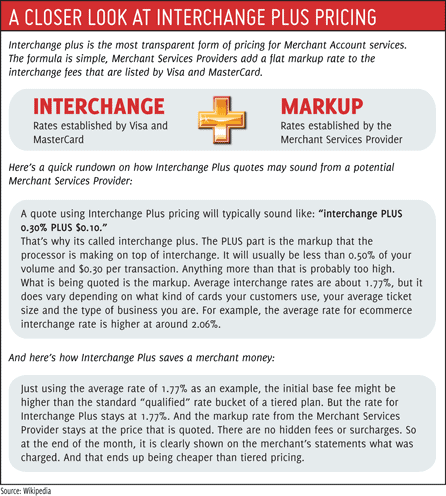
Another key to rates and pricing was touched on before by The Official Merchant Services Blog when we compared Tiered Pricing to Cost Plus Pricing. To recap, Cost Plus Pricing tends to end up costing the merchant less because the merchants don’t get dinged for higher surcharges from other rate buckets. So a tiered pricing rate offer will seem lower than it actually ends up being.
Second: Other Fees
The discount rate isn’t the only fee to consider when comparison shopping. Business owners should also consider the application fees, the initial cost of equipment, per-transaction fees (a fee you pay on top of the discount rate for each transaction you process), monthly minimums that affect your fees, voice verification charges, address verification fees (if extra), monthly statement fees and any other added costs a processor will charge you. Something to always keep in mind, processors are very flexible in how they present your proposal and they could offer you a much lower discount rate with a higher per-transaction fee if your average ticket price is low but your transaction volume is high.
Also pay close attention to the cost of equipment and/or software for processing the transactions. Equipment can vary in cost between different processors by hundreds of dollars, even for the exact same piece of equipment. Merchants should try their best to not lease equipment or software. Buy the items outright. By leasing a credit card terminal you lock yourself into a term-contract that may not be something you can cancel without a heavy penalty. And you pay more for the item than its actual cost in the long run.
Third: Read the Fine Print
Be sure to read all application forms and contracts presented to you very carefully. Read all of the small print. Some processors will attempt to charge you if you want to stop processing charges through them in less than two or three years — termination fees. That termination fee can also be completely separate from any penalties you incur when canceling a lease of a terminal. If you plan to do a lot of MO/TO, pay careful attention to what the contract says about the percent of transactions you can process as phone orders (non-swiped). What the salesman says to you during the pitch process may not be what the application actually says because the offer is being given to you at a best case scenario and isn’t taking into account details like added surcharges for card-not-present transactions. At the end of the day, the contract carries the weight over the salesman’s pitch.
Also take into consideration what conditions the company can terminate your account and whether or not there are monthly minimums and maximums. Much of the juggling between different rate buckets in a tiered pricing proposal hinges on being able to surcharge you for details like exceeding a monthly maximum or failing to reach a minimum.
Fourth: The Application Process
Some companies will eagerly attempt to send a representative directly to your place of business — including your home if that’s where you do your business from. Part of this is to pitch the services to you in person. But another part is to be present on site, and to take a photograph of your location. This is part of the application process and is done to verify that you are at the location you say you are. Some other companies can do online site surveys or accept photos and information you yourself provide.
During the process of applying for a merchant account you should be prepared to furnish these items to the company:
A copy of your business license or certificate of doing business
Your driver’s license
Profit and Loss Statements
Copes of previous years’ tax returns
A photo of your office
All processors require two-way access to your bank account once you are accepted. This allows the processor to deposit funds into your account and also allows them to withdraw funds if there are chargebacks.
Comparison: Host Merchant Services
Just for comparison’s sake, here’s quick rundown of Host Merchant Services in the context of the tips we just provided you.
Host Merchant Services offers cost plus pricing. This is transparent pricing where we show and explain all of the fees you are charged. The company also guarantees to offer you the best rate, claiming that if the company can’t save a merchant money they will give them a $100 gift card for their time. And the company guarantees that it will not raise its merchant’s rates. Ever.
The company has no hidden fees. Host Merchant Services also cuts off a lot of the fees that other processors charge — there’s no annual fee, no application fee, no monthly minimums, and the lowest PCI Fee int he industry.
The company provides free equipment — both a credit card terminal and receipt paper.
Host Merchant Services provides customer support for integration of payment gateway services. The company has a variety of gateway options that will integrate with almost all of the shopping carts out there — and will help its merchants get integrated. HMS also offers its own in-house gateway with no transaction fees and full AP for custom integration with any software package.
Today The Official Merchant Services Blog is updating its coverage of the Global Payments Data Breach. The big bomb Global just dropped is that apparently there was a second data breach.
The story, initially broken by Ellen Messmer at Network Worldstated that Global Payments itself revealed this latest news.
Data Breach II: Credit Card Boogaloo
From the Global Payments Website: “The Company’s ongoing investigation recently revealed potential unauthorized access to servers containing personal information collected from a subset of merchant applicants. It is unclear whether the intruders looked at or took any personal information from the Company’s systems; however, the Company will notify potentially-affected individuals in the coming days with helpful information and make available credit monitoring and identity protection insurance at no cost. The notifications are unrelated to cardholder data and pertain to individuals associated with a subset of the Company’s U.S. merchant applicants.”
So What Was Compromised?
This second breach compromised the personal information of a subset small merchants that applied to be clients of Global Payments — and the company stressed that this set of merchants was different than the ones exposed in the first breach. The exposed information includes the sort of personal information the Atlanta processor uses as part of its underwriting process. The company stressed that it does not have evidence that any fraudsters obtained or misused the merchant applicants’ information — but the servers that contained that information were possibly accessed by an unauthorized party. Last time we updated this story, we provided information from Brian Krebs about how information from the first data breach could have been used by fraudsters.
Something to keep in mind regarding Global’s claims that the second breach did not lead to fraud is that Global still maintains that the information that was compromised in its first breach was not involved in fraud — even after Krebs dug up examples of fraud happening to Global customers in his blog entry here.
Wait, What?
The author of the official updated statement released by Global — Jane Elliot from Investor Relations — added this caveat to the statement: “This announcement may contain certain forward-looking statements within the meaning of the ‘safe-harbor’ provisions of the Private Securities Litigation Reform Act of 1995. Statements that are not historical facts, including management’s expectations regarding future events and developments, are forward-looking statements and are subject to significant risks and uncertainties. Important factors that may cause actual events or results to differ materially from those anticipated by such forward-looking statements include the following: further results of the continuing investigation of the unauthorized access of our processing system, including the discovery of additional card data or information implicated in the incident; the effect of our remediation efforts on operations; the impact of fines or penalties from the card networks and state authorities on our results of operations; and other risks detailed in the company’s SEC filings, including the most recently filed Form 10-Q or Form 10-K, as applicable. The company undertakes no obligation to revise any of these statements to reflect future circumstances or the occurrence of unanticipated events.”
That reads like a very wordy hedge against the way this story has evolved to date. To put it another way, much of what Global has already stated, including clinging to the claim that the breach is contained and the number of compromised cards was just 1.5 million, has already been contradicted by information revealed by Visa and MasterCard.
Visa and MasterCard issued new alerts on May 15 suggesting the breach dated back to January 2011 — an exposure window significantly longer than what was originally reported by Global when news of the breach surfaced in late March. Visa’s alerts in March, which Brian Krebs used to break the story, indicated the breach occurred sometime between Jan. 21, 2012, and Feb. 25, 2012. Global used those alerts to help underscore their assertion that the breach was small and contained. But on April 26, an updated advisory from Visa put the suspected intrusion date closer to June 7, 2011. Setting the length of exposure for compromised cards back six months. And then Visa and MasterCard released information that pushed the date back an entire year from the initial alert, to January 30, 2011. This vaults the figure of compromised cards to 7 million — much higher than the 1.5 million “or less” suggested by Global in their official statement.
All this contradiction over the length and severity of the breach had been met with silence from Global Payments. They had offered no further comment other than to link to their website. But with this latest batch of statements, they’re now adding that very long caveat. And they apparently intend to clear matters up even further in June. The Company plans to provide additional information regarding the potential financial impact, the PCI compliance process and the status of the investigation not later than its July 26, 2012 year-end earnings call according to Paul R. Garcia, chairman and CEO of Global Payments.
The Official Merchant Services Blog will be following this story as close as ever now. It’s getting more complicated and convoluted. Hopefully that earnings call will clear the air a bit. But it still seems like the reporters digging into this, as well as Visa and MasterCard have a very different set of facts than the ones Global is sharing with people.
Today we just want to remind all of our readers and subscribers of the upcoming Host Merchant Services webinar. On Tuesday June 12, 2012, at 10 a.m., CEO Lou Honick will be giving a 30-minute presentation on the Host Merchant Services Partnership Program as well as a quick introduction on how credit card processing works. After the presentation there will be a 10-minute Q&A period. The webinar is absolutely free to any and all interested in attending.
You can find the registration form here AT THIS LINK.
As stated before this webinar focuses on the partnership program — a bold offering from Host Merchant Services where we help businesses make money by sharing revenues with them from referrals they bring to us. The system goes beyond the normal lead-referral system, giving the partners potential for a much larger share of the revenue. HMS does all the work on its own to set up the partner’s customers for credit card processing. Host Merchant Services provides the partner’s customers with a complete payment processing and financial transaction service quickly and easily. Once the customer has their merchant account set up and has begun processing, the partner then begins to earn a steady and consistent stream of shared revenue with each and every monthly processing statement.
Or you can Register for the Free Webinar and get walked through the entire process, see how the partnership works, and learn about how Host Merchant Services will make you money and keep your customers happy.
This is the latest installment in The Official Merchant Services Blog’s Knowledge Base effort. Well we want to make the payment processing industry’s terms and buzzwords clear. We want to remove any and all confusion merchants might have about how the industry works. Host Merchant Services promises: the company delivers personal service and clarity. So we’re going to take some time to explain how everything works. This ongoing series is where we define industry related terms and slowly build up a knowledge base and as we get more and more of these completed, we’ll collect them in our resource archive for quick and easy access. Today’s terms are Revenue Share and Strategic Partnership.
Revenue Share
At its most general definition, Revenue Sharing refers to the sharing of profits among different groups. One form shares between the general partner(s) and limited partners in a limited partnership. Another form shares with a company’s employees, and another between companies in a business alliance.
When applied to the Payment Processing Industry, revenue sharing is a bit more specifically involved in a cost per sale sharing of profits and accounts for about 80% of affiliate compensation programs. E-commerce web site operators using revenue sharing pay affiliates a certain percentage of sales revenues generated by customers whom the affiliate refer via various advertising methods. Another form of online revenue sharing consists in people working together and registering online in a way similar to that of a corporation, and sharing the proceeds.
A third form of revenue sharing on the internet consists of enticing internet users to sign up and create content by offering a share of advertising revenue.
Strategic Partnership
A strategic partnership is a formal alliance between two commercial enterprises, usually formalized by one or more business contracts but falls short of forming a legal partnership or, agency, or corporate affiliate relationship. Typically two companies form a strategic partnership when each possesses one or more business assets that will help the other, but that each respective other does not wish to develop internally.
The Official Merchant Services Blog has some breaking news to report. Host Merchant Services is offering its very first Webinar. On Tuesday June 12, 2012, at 10 a.m., CEO Lou Honick will be giving a 30-minute presentation on the Host Merchant Services Partnership Program as well as a quick introduction on how credit card processing works. After the presentation there will be a 10-minute Q&A period. The webinar is absolutely free to any and all interested in attending.
You can find the
registration form here AT THIS LINK.
What is the Partnership Program?
The Partnership Program that Host Merchant Services has devised is a way for businesses to expand their monthly revenue through referrals. It goes beyond the normal lead-referral system however, and as such gives the partners a larger share of the revenues. With the Host Merchant Services partnership program, HMS helps its potential partners earn monthly revenue through the business transactions of their very own customers. HMS does all the work on its own to set up the partner’s customers for credit card processing. The company provides the partner’s customers with a complete payment processing and financial transaction service quickly and easily. Once the customer has their merchant account set up and has begun processing, the partner then begins to earn a steady and consistent stream of shared revenue with each and every monthly processing statement.
Happy Customers are the Key
Host Merchant Services makes it easy for its partners to find leads and generate revenue. The company does this through the features of its HMS Guarantee. Each lead a partner brings to Host Merchant Services is offered these features:
Great Rate. HMS saves its customers money on their processing. The company pledges that if it can’t save one of its partner’s referrals money on processing, the company will give that referral a $100 Gift Card for their time.
Great Service. Host Merchant Services is about bringing trust to the payment processing industry and the company strives to go the extra mile with its commitment to superior customer service. The company has live people available 24x7x365 to take technical support and customer service calls. As company CEO Lou Honick says, “We pledge that if our customers have a problem, we will fix it.”
No Hidden Fees. Host Merchant Services offers a pricing model that has no annual fee, no application fee, no monthly minimums and the lowest PCI Fee in the industry.
Lifetime Rate. Host Merchant Services offers a straightforward “cost plus” pricing model and the rate is guaranteed. The company grandfathers that rate and will not raise it. The only time the rates change is when the card associations — MasterCard, Visa and Discover — raise the rates for everyone.
No Contracts. Host Merchant Services does not lock its customers into a term contract or charge them early termination fees. As CFO Dan Honick likes to say, “Our customers stay with us because they are happy with our service.”
This combination of features adds plenty of enticement to a partner’s customer base to add Host Merchant Services as its credit card processor. Making Host Merchant Services a reliable company for the partner to refer to its customer base. Host Merchant Services does all of the work to set the referral up with a merchant account, to install a robust payment processing solution, and to keep the customer happy with superior customer service month after month. It’s a safe and easy way for a business to add more revenue to its bottom line each month.
For More Information
You can visit our Partnership FAQ Page HERE AT THIS LINK to get more information. Or contact the company at 1-877-571-4678.
Or you can Register for the Free Webinar and get walked through the entire process, see how the partnership works, and learn about how Host Merchant Services will make you money and keep your customers happy.
Today The Official Merchant Services Blog is going to get a bit personal, for me at least. I’m going to take a moment to talk about print media, and its withering industry. Or, think of it this way: I’ll be talking about the rise to power of E-Commerce — the industry that has helped deliver excruciating body blows to print media over the past decade, knocking it to the mat time and time again.
My history with print media goes back. Way back. All the way back to the beginning of my own career. I’ve worked for four different newspapers, the most high profile being the Asian Edition of the Wall Street Journal at the turn of the millennium. I’ve illustrated various comic strips and published my own comic book. I’ve worked for a printing company in Delaware. Along the way I’ve essentially learned how to make a printed publication from beginning to end; the only skill I lack is the ability to actually push the buttons on a printing press. But every other step, from concept to creation to pre-production to layout and design to editorial to post production I’ve done during my career.
And all of these skills are endangered because of E-Commerce. (Well not really; most the skills translate easily into the virtual media world which is why I’ve been able to transition my career; but everything involving production kind of gets tossed out the window, replaced with skills revolving around web safe colors, pixel sizes and screen ratios).
A really vast, somewhat oversimplified recap of the internet’s impact on newspapers, comic books and book publishing can be summed up by my own career. One of the companies I used to work for, Gannett (publisher of the USA Today), used to have an empire built on small to mid-size suburban community newspapers. They were everywhere. Including Lansdale, PA — where I worked for a time. Gannett was slow to embrace online news though. And the transition from the late 1990s to the aughts left Gannet in a position to streamline and essentially drop a lot of those small and mid-size papers from its stable.
At the same time, I was trying my best to get some traction going in my quest to be a freelance illustrator for comic books. Things didn’t quite work out. I never became the regular artist on The Flash or Spider-man like I dreamed of doing when I was younger. I did however get paid for doing a few projects and got quite a bit of my art published.
Still, steady work was hard to find. And the comic book industry appeared to be dying because of the problems that all of print media now faced.
The major publishers (DC Comics and Marvel Comics) were no longer selling millions of copies of their books. In fact, sales these days are horribly low, with top books barely cracking 100k in sales volume. This reduction in volume can be linked to its distribution channel. Comics stopped appearing in mainstream outlets because the sole distributor of the material, Diamond, only catered to specialized direct market hobby shops (comic book shops). You couldn’t find them at the local supermarket or the local 7-11 anymore. The comic book “rack” was gone. I’d go so far as to make the claim that today, in 2012, the two major comic book companies are really just stables for intellectual properties. Disney and Time Warner wanted Marvel and DC not so much for their ability to publish millions of paper periodicals every month. Instead they wanted the comic book companies for the properties that could at any moment be turned into $100 million blockbuster movie franchises.
So the comic book industry ended up being sold as a niche hobby, and stopped being made as a mass medium periodical. Big companies bought the two biggest publishers of those comics just to keep the ideas and licensing on ice for future movie potential. Print media, it is dying.
And then then there was the issue with comic strips. Newspapers shrunk the comics section over decades. When Action Comics first appeared in newspaper print in thge 1940s, the comic strip took up half a broadsheet, which back then was much larger than the broadsheet sizes for newspapers of today. But by the time Bill Watterson and Gary Larson gave up on two of the most popular comic strips of all-time (Calvin and Hobbes and The Far Side), the newspaper strip had shrunk to 3 tiny postage stamp sized panels shoved into the back end of the feautres/lifestyle sections of most papers.
Then the internet hit newspapers big time, as people went online for their news. They got the stories for free. And newspapers could no longer compete. Comic strips were a casualty of that shift in media.
So right now, survival instinct is kicking in for the comic art form. The internet allows both the strip and the comic book format room to breathe, and easier distribution. Penny Arcade is what I feel to be the best example of the modern comic strip, giving renewed life to the art that newspapers were choking out of their shrinking pulp empire. Penny Arcade can publish in color (because it’s online), can publish unorthodox sizes (because it’s online) and offer their content for free (online). They then make a killing selling collected editions (many sales being made … online) of the same content daily readers get for free. They adapted and brought the art form onto a new stage. Meanwhile … print media continues to not adapt.
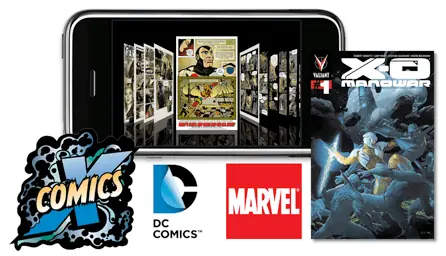
Comic Books are starting to finally embrace the changing landscape. ComiXology offers Marvel, DC and independent publishers through their mobile application. You can purchase and download all of your favorite comic books directly to your iPhone, Android, iPad or Kindle. You no longer need to go to direct order hobby shops. Your comic books no longer need to take up physical space. They’re right there at your fingertips — your entire collection just a thumbtap away. While they may be a bit unwieldy and tiny on the smartphones, they look rather luxurious and eye-popping on a larger device like a Kindle (where, not so surprisingly, I’ve been reading my comic books in 2012).
That brings me to the Kindle — or more generally, the reader devices and THIS BLOG HERE from Michael Essany at Daily Deal Media. The article resonates with me. A number of my close friends used to work at Borders Books and Music in their twenties. Last year the local Borders closed up shop. And all we currently have in our local area is a Barnes and Noble located in the Christiana Mall.
The most striking thing about their store in the mall is when you walk in their front door you are immediately overwhelmed by their eBook section, with large signage telling you all about the Nook (their version of the Kindle).
That sight at my own local big box book store really drives home Essany’s second paragraph, when he writes, “Although many avid readers are mourning the noticeable loss of traditional big box and mom-and-pop book retailers, the economics of eCommerce and the popularity of eBooks are quickly dispatching publishing companies, paperback publications, and even print magazines to the trash receptacle of history.”
The point Essany is making was driven home even further when I attempted to make a quick trip to that Barnes and Noble for a book on a work-related topic: Web Design. I knew the right section of the store to go to, but couldn’t find the title I was looking for. I used their interface terminal in the store to look that title up. Apparently it was in stock as an eBook. And I could order a regular print version of it from there, but had to order it as an online purchase and have it delivered to my house days later. The entire point of my trip was to get the book that day, otherwise I’d have gone online when I got home from work instead. So I kept browsing, and found every single book they had under the topic of web design was only available either through an online purchase or as an eBook.
E-Commerce is winning
In terms of printed media E-Commerce is absolutely dominating. Essany cites a statistic to back up this outlook, writing that according to the Yankee Group (a research company we’ve cited ourselves when they made projections on The Future of Mobile Payments), consumers will purchase approximately 381 million eBooks next year with an average selling price of $7.
Most impressive
My own research for this very blog during last year’s holiday shopping season demonstrated what to me has become a very obvious aspect of the economy: shopping online is a common thing for people to do. That means E-Commerce is making buckets of money. Each one of those transactions are part of the payment processing industry. The foundation is there. People have found the convenience of shopping online so powerful that it outweighs the risk of fraud. So more and more people have taken to solving their shopping problems online. I know that I myself do this. It’s so much easier to look for a product online and know you’re getting what you want with a few clicks, than it is to go trudging out to a store that may or may not have the item you want.
Last year in a Blog Post about the upcoming holiday shopping season, I reported “A 2010 survey conducted by Google and OTX found that 35% of internet users start their holiday shopping prior to the end of summer, months ahead of Black Friday. This trend is only continuing to grow as consumers find online shopping convenient to their shopping habits, easy to do, and the wide selection lets them find great deals on price.”
This trend in shopper behavior combines with the rise of virtual media like eBooks like Voltron to form a very powerful lion-fisted, right-left combo to the solar plexus of Print Media’s crumbling empire.
And you know what? I’m OK with this.
I’m a voracious reader. But I’m also under the thrall of the convenience of online shopping. I truly do turn to the internet first for most products I’m interested in. This is heightened when I want to purchase a book, a magazine or a comic book. It’s just so much easier. The only time I’ve wanted to wander into a book store to buy a book was when I wanted it right then, with no wait on delivery. And I found the remnants of the only big chain bookstore in my local area to have already forced the decision upon me: If I wanted a book about web design, I needed to go directly to the web to get it.
I’ve been using the ComiXology app this year. And when the company that I once worked for (Valiant Comics) as a production intern returned to the comic book industry after a long hiatus, publishing a comic book I once did post production work for (X-O Manowar), I immediately jumped onto my phone to purchase it. I find that I read more web comic strips than I ever read in a newspaper. I find I go to the web for my news. Or my phone. I’ve even found myself reading straight up only published electronically eBooks this year. I still prefer printed books, but for me they’ll be online purchases. I’ll buy the collected editions of comics I like, but do so online. I’ll buy printed books of titles I really just want to curl up with and turn the pages of, but I’ll make the purchase online. It’s gotten so pervasive in my life that I now buy tickets to sporting events online, brands of tea I can’t find at my local supermarket online, all of my roller derby referee equipment and rules books online. I even bought my ticket to The Avengers on my phone through Fandango and had it delivered to my phone as a mobile ticket.
E-Commerce is where it’s at. And publishers of the written word need to embrace this shift. Maybe it’s easier for me to do so because I work in the payment processing industry and get to see firsthand how big and booming E-Commerce is.


 HostingCon, celebrating its 8th anniversary, is the foremost conference and trade show for the hosted services industry. The best and the brightest from the industry will be attending the event from July 16 – 18 at the John B. Hynes Veterans Memorial Convention Center in Boston, MA.
 Host Merchant Services specializes in providing world-class customer service and support to its credit card processing customers. The company takes a different approach to merchant services, focusing on delivering the industry’s lowest processing rates while providing industry-leading service and support. Host Merchant Services, headquartered in Newark, Delaware, specializes in partnering with web hosting and other professional services companies to offer payment processing to their customers.






 Visa and MasterCard issued new alerts on May 15 suggesting the breach dated back to January 2011 — an exposure window significantly longer than what was originally reported by Global when news of the breach surfaced in late March. Visa’s alerts in March, which Brian Krebs used to