Tag Archives: discover

Changes to Interchange Fees

Breaking News from The Official Merchant Services Blog: MasterCard and Discover have announced interchange increases and modifications to take effect October 2012. Specific association modifications such as these are beyond the control of payment processors like Host Merchant Services. They come directly from the big card associations themselves. These changes affect all merchant card processors and their customers, meaning these changes in fees and rates travel in a straight line from Visa, MasterCard and Discover to the merchants.

The Meat and Potatoes

MasterCard will be reducing the Consumer Debit rate from 1.64% + $0.16 to 1.60% + $0.15. MasterCard will increase the Small Ticket Debit rate from 1.30 + $0.02 to 1.30 + $0.03.

Discover Card will be enacting several changes to their PSL Public Services interchange fee programs. Rates will increase from 1.50% +$0.10 to 1.55% + $0.10. Discover PSL Card-Not-Present/E-Commerce Premium Plus will increase from 2.30% + $0.10 to 2.35% + $0.10. Discover will also increase Key Enter Premium Plus from 2.10% + $0.10 to 2.15% + $0.10.

Add These Fees to the Pile

These changes come on the heels of a series of changes we reported back in February. Visa’s new Fixed Acquirer Network Fee and Transaction Integrity Fee made all of the headlines back then, but MasterCard also implemented its new annual Acquirer License Fee. This fee took effect in July 2012. MasterCard also implemented a new annual Type III Third Party Processor (TPP) Registration Fee in July 2012.

MasterCard based these fees on a full year of 2011 volume for each merchant, and for 2012 only the fees are 50% of the total fee calculated — since they cover only half of the year. MasterCard passed these fees through on a pro-rata basis and all acquired MasterCard credit and signature debit volume was utilized to determine the annual volume for both programs. PIN debit volume was excluded.
The changes to Discover Card’s PSL Public Services interchange fee programs are also in addition to a series of changes Discover announced back in February. Discover introduced a US Commercial Large Ticket Interchange program, increasing its assessment fee by .005%. Discover also changed existing card present Interchange rates for transactions less than $15 for Express Service merchants (Local Commuter, Bus Lines, Toll & Bridge Fees, Restaurants, Fast Food Restaurants, News/Dealer Stands, Laundries, Dry Cleaners, Quick Copy & Reproductions, Parking Lots/Garages, Car Washes, Motion Picture Theaters and Video Entertainment Rentals) and less than $25 for Taxi/Limo merchants.

Pay Attention to Your Statement

As stated above, these changes are made directly to Interchange rates from the Card Associations.  Unlike Visa’s much ballyhooed FANF, which is a completely new fee and not subject to regulation from the Durbin Amendment, these fees fall under the scope and purview of Interchange, and thus Durbin.

Merchants will begin to see the following text on their August Statements to explain the changing fees:

Visa, MasterCard, Discover Card Services have announced category introductions and modifications to their current interchange structures. These changes may affect your current pricing effective October 2012. Further detail specific to these changes and impacts to your merchant account will be detailed on your September merchant statement. As previously disclosed on your February and March merchant statements, MasterCard introduced the new MC licensing fee. Beginning in August 2012, the new licensing fee of $.005 will be included with the MasterCard NABU billing and appear as “MC assoc NABU/license fee”. Thank you for your continued business.

Discover Teams Up with PayPal

Discover Teams Up with PayPal [2023 Update]

The Official Merchant Services Blog continues to shine its spotlight of educational information directly on the Mobile Payments Industry. This bristling business sector keeps creating buzz among payment processing persons as well as overall economic assortments. One minute people are predicting hundreds of billions of dollars in revenue will get generated by consumers embracing the cashless society model and conveniently swiping their phones to pay for every little thing that catches their eye. The next minute people are predicting U.S. consumers are too wary and cautious and not ready to expose their information to the cloud and the criminals trying to crack their way into that cloud.

This titanic tug-of-war between “the next big thing” that economic analysts desperately desire M-Payments to become and the “hold your horses hombre” caution that those same analysts caveat the slow acceptance in U.S. markets has been defining the media coverage of the Mobile Wallet Madness for more than a year. But the potential for prodigious profits has pushed the possibilities of mobile payment processing through the morass of misgivings.

Merchants United!

As we purposely pointed out to our peerless readers just mere days ago, the Merchant Customer Exchange was formed. This epic assemblage of retail industry giants teams Wal-Mart Stores Inc., Best Buy Co. and Target Corp, 7-Eleven  Inc., Alon Brands Inc., CVS Caremark Corp., Darden Restaurants Inc., Lowes Co., Sunoco Inc., Sears Holding Corp. and the Publix Supermarket chains into a mega-group of retail merchant might on a mobile wallet mission.

Coming on the heels of Visa’s saturation of the 2012 London Olympics with all things Mobile and all things Visa, the mighty mingling of the MCX merchants applied unforeseen amounts of pressure on the mobile payment marketplace.

Mobile Payment Paring: Discover and PayPal

On August 22 PayPal, owned by eBay, announced a deal with Discover Financial Services to bring PayPal access to the 7 million merchants in Discover’s network. This deal will begin in the second quarter of 2013 and the announcement was made a mere two weeks after Square partnered up with Starbucks to let customers pay with Square’s app at the 7,000 U.S. Starbucks locations.

Excelsior! Retail titans are teaming up with mobile gadgeteers in one mass scramble to make it to market before the U.S. consumer becomes firmly affixed on the easiest and most widespread brand — as is wont to happen with U.S. shopper market behavior.

The PayPal deal is a particular point of note because PayPal itself is pushing from the online marketplace back into the physical realm of brick and mortar. This may indeed help bridge the gap from e-commerce to old fashioned commerce, and that bifrost of payment processing could very well buttress mobile payment processing in a brave new world of cashles-sness and contactless transactions.

The super-powered pairing of Discover and PayPal drove stock prices for each company, with Discover gaining 3.9% and eBay gaining 2.5% on the market the day the announcement was made. This arrangement will greatly accelerate PayPal’s in-store payment efforts. By riding on Discover’s network, PayPal can get into more locations  and get there quickly. Best of all this movement doesn’t requiring any significant integration work by merchants. That potentially puts PayPal at a big advantage against rival mobile payment systems such as Google Wallet, Isis, and Square.

Discover is integrating PayPal’s payment system into its software, which will be uploaded to millions of point-of-sale terminals that support Discover Card payments. PayPal’s branding and rules will be presented to consumers who choose to pay in store with PayPal. PayPal currently has more than 50 million U.S. customers who will be able to take advantage of in-store payments.

Industry Terms: CVV

This is the latest installment in The Official Merchant Services Blog’s Knowledge Base effort.  We want to make the payment processing industry’s terms and buzzwords clear.  We will eliminate any and all confusion merchants might have about how the industry works.  At Host Merchant Services, we promise to deliver personal service and clarity.  So we’re going to take some time to explain how everything works.  This ongoing series is where we define industry related terms and slowly build up a knowledge base and as we get more and more of these completed, we’ll collect them in the resource archive for quick and easy access.

Card Verification Value (CVV)

In continuing with our E-Commerce focused blogs this week, I thought it would be appropriate to introduce the term Card Verification Value, or CVV. There are two types of CVV codes, called CVV1 and 2, respectively. The CVV1 is embedded in the magnetic stripe of track 2 of a card. The purpose of the first CVV is to verify data stored on a card is valid and was issued by a bank when used in person.

The second and more prominent CVV2 is a three-digit code (Visa, MasterCard) printed on the back of credit and debit cards.  American Express cards have a ‘Unique card code’ that is four-digits long and printed on the front. Discover has a 3-digit code on the back of its cards, but refers to this as a CID (Card Identification Number). These codes are used in card not present transactions occurring over the Internet, or MOTO as an added security feature to prevent fraudulent purchases. The code is meant to verify that the customer has the card in their possession.

Security Benefits

For Merchants:

Merchants requiring CVV2 codes for their card not present transactions can dramatically reduce fraud in their businesses. Using this extra layer of protection can stop breached or fraudulent cards from going through. Avoiding potential retrievals and chargeback fees.

For Consumers:

Entering your CVV2 code when purchasing online products verifies that you are who you say you are. Under Visa regulations, merchants cannot store CVV2 codes in their databases.  This means any card numbers lost in a breach would be less useful. In this sense, a consumer is protected on both sides of a transaction, once when verifying the purchase, and then again in terms of breach or fraud security.

Industry Terms: Interchange


Interchange

Interchange is a term used in the payment card industry to describe a fee paid between banks for the acceptance of card based transactions. Usually it is a fee that a merchant’s bank (the “acquiring bank”) pays a customer’s bank (the “issuing bank”).

In a credit card or debit card transaction, the card-issuing bank in a payment transaction deducts the interchange fee from the amount it pays the acquiring bank that handles a credit or debit card transaction for a merchant. The acquiring bank then pays the merchant the amount of the transaction minus both the interchange fee and an additional, usually smaller fee for the acquiring bank or ISO, which is often referred to as a discount rate, an add-on rate, or passthru.

For cash withdrawal transactions at ATMs, however, the fees are paid by the card-issuing bank to the acquiring bank (for the maintenance of the machine).

These fees are set by the credit card networks, and are the largest component of the various fees that most merchants pay for the privilege of accepting credit cards. Visa, Mastercard, and Discover are each known as card associations. And each card association has their own rate sheets known as Interchange Reimbursement Fees. These fees make up the majority of what you pay to your processor and they vary greatly depending on the card type accepted.

Download Visa’s Interchange Fees Here

Merchant Services Document Download Graphic

Download MasterCard’s Interchange Fees Here

Merchant Services Document Download Graphic


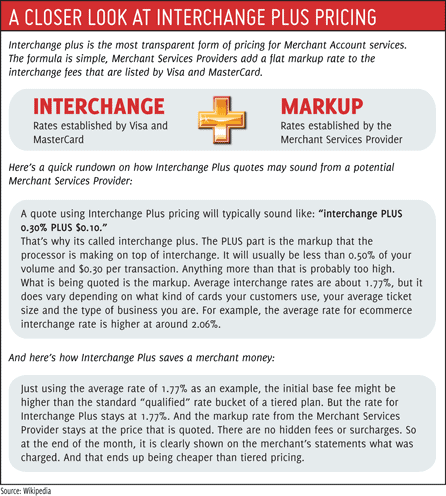
Interchange Plus Pricing

Interchange Plus pricing means that the acquirer charges you a variable MSC consisting of the cost price plus a fixed markup. Interchange Plus Pricing  is exclusively how we quote at Host Merchant Services. Interchange Plus, also known as Cost Plus, pricing gives the customer a fixed rate over published Interchange Fees. This pricing format is normally quoted as a discount rate (percentage fee) along with a per item or authorization fee. The great thing about Interchange Plus pricing is that you always know exactly what you are paying to your processor to services your account. Think of Interchange, and all the associated fees, as an unavoidable cost. No matter who you process with, you have to pay these fees. They may be labeled differently, or wrapped up in a confusing pricing tier, but one way or the other, you are paying Interchange fees. By understanding the markup you pay over Interchange, you know exactly what you pay to your processor and exactly what is going to the card associations. That allows you to make a decision on whether or not the markup seems reasonable for the service you get and choose your processing partner accordingly.

Here’s a small graphic explaining the basics of how Interchange Plus works:

Host Merchant Services infographic on Interchange Plus pricing

Partial Payments Reminder

Today The Official Merchant Services Blog is going to step off its SOPA soap box and return to a much more focused and specific topic — Partial Payment Authorization.

In November, 2011 Partial Payment Authorization was mandated by MasterCard and Discover. This mandate requires merchants to support partial payments on their terminals. Host Merchant Services reported on this mandate and you can read about it here in our Article Archive.

Pay Attention To The Purchase

We’re bringing this back up because there has been some confusion lately among merchants about this particular issue and this mandate. What keeps happening is that merchants are not noticing when the partial payment pops up on their terminal. This is a problem because of the way these payments function. If you do not notice that it is a partial payment and do not obtain the rest of the payment from the customer, they can walk out of your store with their purchase and you lose money.

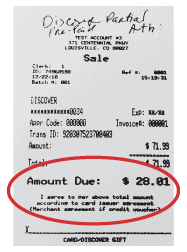
So you need to really pay attention to the purchase. It will show up on your terminal screen. It will also show up on the receipt. Here is an example of what a receipt will look like:

Host Merchant Services Sample Receipt for Partial Authorization

In cases where only a partial authorization is returned, the merchant will need to collect another form of payment for the difference. In the instance where the cardholder does not have another form or payment to pay the difference or wants to use a different form of payment for the full amount, a real time partial authorization reversal must be performed in order to free up the funds that were previously held up by the authorization.

Host Merchant Services offers step-by-step guides on how to perform these real time partial authorization reversals.

You can download them here in our Resources Section.

Which Businesses Are Affected?

The other area of confusion that seems to be cropping up with Partial Authorization is which businesses are affected by this mandate. Not all businesses are currently required to use Partial Authorization. However, there is a long list of businesses that are, and this list includes the most popular merchant codes. Here is the list:

To Recap

So just to review, Partial Payment Authorization is mandated by MasterCard and Discover. The listed businesses above are absolutely required to utilize it. It is easy to lose track of when these occur if you do not pay attention to the receipt or to your terminal when running the transaction through. The most common mistake is someone processing the transaction is in a rush and the receipt looks very similar to a normal, approved, full transaction when run through. Terminals do not have a sound or warning that this type of partial payment happened. So time and attention to detail are required for these payments moving forward. When a partial authorization happens you need to have your customer offer an alternate payment for the remainder of the transaction or you need to reverse the transaction right then and there.

For More Information

Host Merchant Services is available to walk any interested merchants through this process. You can contact us and we will be glad to explain how partial authorization works. Or you can take advantage of the materials we offer on this very website. To get more information regarding Partial Payment Authorization, you can:


Merchant Services: Discover on Discover

A previous post by The Official Merchant Services Blog featured a story about what credit card companies are doing to make themselves the more alluring choice instead of debit during this holiday shopping season. Today’s post is a bit of a follow up to that, with a specific program that one credit card company is offering to merchants that will take things up a notch significantly.

Host Merchant Services is able to offer an exclusive deal to its merchants with the new Add Discover on Discover plan. This plan comes at just the right time for merchants as holiday shopping will increase their traffic and sales. This offer from Discover, through Host Merchant Services is bold. It essentially gives qualifying merchants a year of being able to process Discover payments at no cost. Add Discover on Discover gives the merchants no fees when their customers swipe a Discover card. And they have this benefit for an entire year.

The Details of the Plan

To qualify for the Add Discover on Discover program from Host Merchant Services, you must have not processed any Discover cards in the past six months of doing business. Discover card processing includes Discover, Diners Club International, BCcard, China Union Pay, JCB and DinaCard. That’s it. That’s all you need to qualify. Once you qualify it’s a series of easy steps to get the program started:

  1. Enroll in the program by December 31, 2011.
  2. Confirm your enrollment with a required test transaction.
  3. Update signage at your place of business (or on your website if you are an e-commerce only merchant).
  4. Inform your employees and actively promote Discover to your customers to start reaping the savings.

Once you’ve been verified you will receive written notice from Discover. Within 10 business days of your acceptance you’ll receive a welcome letter with free Discover signage and tips for increasing your sales with Discover.

Benefits of the Plan

This plan is really good for merchants that haven’t been accepting Discover cards. Every Discover transaction you process for 12 full months will cost you nothing  –– no limits, no exceptions. Coming right at the end of the year, this plan is the type of holiday shopping incentive that is extremely lucrative for merchants. Discover makes a big push to get merchants to promote using their cards at a time when the interchange fees on debit card usage got hard capped by the Durbin Amendment.

Durbin Amendment Works For This Too

In fact, one of the other features of the Durbin Amendment can help Discover get added hype and promotional assistance from this Add Discover on Discover plan. As Host Merchant Services pointed out in their Dubin Amendment analysis earlier this year, one of the key pieces of the legislation focuses on competition within the payment processing industry: “[The Durbin Amendment] seeks to stop major credit and debit card networks from imposing penalties on small businesses, merchants and government agencies. The law applies to banks with over $10 billion in assets and restricts these large banks and credit card companies from using their dominant market power to force merchants to accept anti-competitive restrictions. To put it simply, large credit card companies are no longer able to punish merchants for offering discounts to customers for using another card network; or discounts for using cash, check, debit card or gift card and loyalty cards; or set a minimum or maximum transaction amount for payment by card.”

So what this means is Discover can usher in this new program –– which offers no transaction fees for a year –– to attract merchants, and those merchants seeing how much more of a savings this can provide them over other options can freely promote Discover over the competition, with no fear of punishment or penalty. Durbin lets a merchant promote the better deal for their business.

For More Information

This landmark offer only lasts until December 31, 2011. If you are interested in finding out more about it, feel free to Contact Host Merchant Services.

You can also read more about the offer by downloading one of the two PDFs Host Merchant Services provides on its resource page:

Discover on Discover For Merchants

Discover on Discover Sales Aid