Tag Archives: debit cards

Industry Terms: Debit Cards

This is the latest installment in The Official Merchant Services Blog’s Knowledge Base effort. Well we want to make the payment processing industry’s terms and buzzwords clear. We want to remove any and all confusion merchants might have about how the industry works. Host Merchant Services promises: the company delivers personal service and clarity. So we’re going to take some time to explain how everything works. This ongoing series is where we define industry related terms and slowly build up a knowledge base and as we get more and more of these completed, we’ll collect them in our resource archive for quick and easy access. Today’s term is Debit Cards.

Debit Cards

debit card (also known as a bank card or check card) A debit card looks like a credit card but works like an electronic check. The thin plastic card that provides the cardholder electronic access to a bank account at a financial institution. Payments made with Debit Cards are deducted directly from that checking or savings account. If a cardholder uses a debit card at a retail store for example, the cardholder or the cashier can run the debit card card through a scanner — oftentimes the very same terminal credit card purchases are swiped through. This action enables the financial institution to verify electronically that the funds are available and approve the transaction. Most debit cards also can be used to withdraw cash at Automated Teller Machines (ATMs).

Unlike credit and charge cards, payments using a debit card are immediately transferred from the cardholder’s designated bank account. This difference is key in one sense, as it creates a completely different set of protocols and standards for debit transactions in the payment processing industry. This can be seen most recently in the Durbin Amendment of the Dodd-Frank Act. The financial reform legislation set a hard cap on debit card swipe fees. But has absolutely no affect on credit card transactions.

For many consumers, the card they carry can be used as both a credit and a debit card when presenting it at a retail store for purchase or using it online. Oftentimes, a consumer is asked to choose between credit or debit.

For the consumer the distinction can have this impact:

  • The card’s individual rewards program can vary depending on debit or credit. In many cases, a credit transaction reaps greater points  or rewards from these types of programs.
  • A debit transaction can allow for cash back right at the point of sale.
  • A credit card transaction can have stronger protection. It takes time before it is “batched” out by the merchant. And the credit cards themselves have more fraud protection layers than debit cards typically have.

For the merchant and for the banks involved the impact is this:

  • The transaction network that the purchase is run through is separate for debit and credit.
  • The fees associated with the transaction are different. After Durbin, the fees face a hard cap ceiling on what the merchant can be charged. Credit has no such ceiling and so smaller transactions — say purchases under $10 — can end up costing a merchant a bit more in fees.

The distinction between credit and debit was stronger in the 1980s and 1990s, but it still exists. It’s worth knowing what your options are as both a consumer and a merchant.

The Allure of Credit Cards for Holiday Shopping

With the Holiday Shopping Season fast approaching –– Black Friday is 11 days away, Cyber Monday is 14 days away –– the payment processing industry is still getting the last pieces in place for a brisk rush in the use of credit and debit cards. The Official Merchant Services Blog continues its series focusing on the impact the holiday shopping season is going to have on both the e-commerce industry and merchant services in general.

The battlefield is set between Debit cards and Credit cards. Debit cards received a huge boon from the federal government in the form of a cap on interchange fees that went live on October 1, 2011 in the form of the Durbin Amendment. This cap restricts the interchange fees that can be applied to Signature debit card transactions. The cap restricts the charge to between 21 and 24 cents per transaction. This is a huge cut from the previous average of 44 cents per transaction, and presents debit card transactions as an attractive option for merchants to start accepting right as we slip into the big holiday shopping rush.

That has left Credit card issuers scrambling for a response, trying to stay competitive and keep consumers answering “Credit” at the checkout line.

This Reuters article suggests one of the big campaigns that credit card issuers are going to push this year is a significant raise in rewards programs for their customers, tempting them to choose credit as their swipe of choice to get access to those sweet sweet rewards. A focus on cash back and travel rewards push the right buttons for consumers while holiday shopping.

A Look At The Numbers

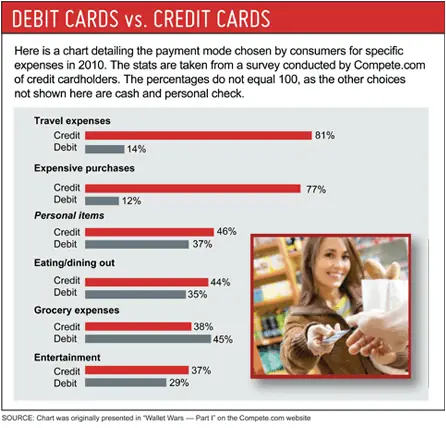
Here’s a small chart detailing the dichotomy between debit card usage and credit card usage from consumers in 2010:

The chart breaks down the chosen method of payment among a survey of credit card owners from 2010. Key numbers to note are the Travel category –– which is dominated by credit card use. It is unlikely that the Durbin Amendment and its changes are going to really affect that sector. But looking at the category listed as “Personal Items” –– which would tend to be the category for holiday gift purchases –– you’ll see a much tougher competition between the two transaction choices. This is where the Durbin Amendment changes to debit card swipe fees are going to have a large impact. And this is where the juicier cash back rewards have credit card issuers hoping they can keep things competitives.

According to the Reuters article: “For example, both Chase (CCF.A) and Citibank C.UL have cards that are offering new applicants $200 in cash back after they spend $500 on their cards.”

You Have to Dig to Find the Best Deals

Some of the best deals are not always displayed in easy to find places. The Reuters article cites a Citibank deal. On the Citi website it advertises the deal as $150 cash back on your first $500 of purchases. But then if you dig deeper by google searching “Citi Dividend $200” you find the better deal directly.

Making it Work For You

The really effective strategy to maximize these deals is to combine them with other deals you will be hit with during the holiday shopping season. The Reuters article notes: “Some cards (such as the Upromise card) have their own shopping portals that combine their rebates with rebates from merchants. In other cases, you can use your rewards points directly for holiday shopping; American Express (AXP.N) awards can be paid directly to Amazon for purchases, for example.”

This type of deal stacking gives consumers a lot of shopping incentive to choose credit as their swipe choice.

chargeback ratio

Durbin Saga: Banks Reconsider Fees [2023 Update]

The Official Merchant Services Blog brings you a breaking news story following the ongoing aftermath of the Durbin Amendment legislation. Yesterday, Bank of America announced it was going to cancel its $5 monthly debit card fee plan. This falls in line with similar announcements from Sun Trust, Regions Financial Corp., JP Morgan Chase & Co. and Wells Fargo all stating they were no longer going to test monthly debit card usage fees at all.

As previously reported, there has been a staunch amount of criticism and backlash against Bank of America after it announced it was going to charge customers a $5 monthly fee to simply use their debit card. The bank was one of a group of banks gearing up to charge fees for debit card usage, all in a response to a debit card swipe fee cap that was instituted by the financial reform legislation in the Durbin Amendment. This reaction was predicted by Host Merchant Services earlier in the year when the company analyzed the Durbin Amendment and its potential impact.

As reported by The New York Times yesterday: “Bank of America blinked on Tuesday. The bank, the nation’s second-largest, said it was abandoning its plan to charge customers a $5 fee to use their debit cards for purchases. Only a month earlier, the bank had announced the new charge, immediately setting off a huge uproar from consumers.”

Primary Target

Bank of America became the most high profile target of consumer backlash and had a polarizing effect throughout the media on this issue, thrusting the Durbin Amendment and big banks firmly into the spotlight. Part of what made Bank of America the primary target for the Durbin Amendment stories was that they were the only bank that declined to test the fees, deciding to just add the fee starting in 2012. Another part that made Bank of America a target was their position as the leading bank in terms of debit card transactions. And finally, Bank of America made such a tantalizing target because of its history with receiving federal bailout money and their foreclosure practices which caught the attention of the Occupy Wall Street protest movement.

As reported in a Business Week article: “Bank of America Corp. is scrapping its plan to charge a $5 monthly fee for making debit card purchases after an uproar and threatened exodus by customers.The about-face comes as customers petitioned the bank, and mobilized to close their accounts and take their business elsewhere.”

You can review much of that saga in Host Merchant Services own Countdown to Durbin blog series.

Last Bank Standing

And while the customer outcry and criticism was certainly a factor, it’s also worth noting that Bank of America came to this decision after all the other major banks backed off fees. As reported by the New York Times: “Despite an outpouring of complaints online and at branch offices, the bank had remained steadfast in its plans until last Friday, according to a person briefed on the situation, planning to ease just some of the conditions for avoiding the fee. But over the weekend, after two major competitors — Wells Fargo and the nation’s largest bank, JPMorgan Chase — said they were backing away from their plans to levy similar charges, two high-ranking Bank of America officers recommended to Brian Moynihan, the bank’s chief executive, that the bank simply drop the fee.Then, on Monday morning, when SunTrust, a regional bank in Atlanta, said that it, too, would abandon its $5 charge, Bank of America was left standing alone, the last major bank planning the fee. The announcement came on Tuesday.”

And also reported by Business Week: “The outcry had already prompted other major banks, including JPMorgan Chase & Co. and Wells Fargo & Co., to cancel tests of similar debit card fees last week. SunTrust Banks and Regions Financial Corp. followed suit on Monday.”

What Next?

This move by the banks, however, leaves them still searching for a way to offset the losses that the Durbin Amendment and other financial reforms are going to force onto them. The New York Times article suggests: “Now that all the large banks have decided not to impose the debit fee, experts said, they will find other ways to fill the hole. ‘Those revenues paid for a lot of things,’ said Joe Gillen, chief executive of Pinnacle Financial Strategies, a bank consultant in Houston.

Now, he said, consumers can expect more fees over time. ‘It will be slow and gradual, but they will bring those revenues back,’ Mr. Gillen said.”

And the Business Week Article stated: “In particular, banks in the past year have blamed their fee hikes on a new federal regulation championed by Senator Dick Durbin of Illinois. The law, which went into effect last month, caps the amount banks can charge merchants whenever customers swipe their debit cards. JPMorgan has said it would lose $300 million each quarter as a result of the regulation; Wells Fargo said it would lose $250 million a quarter.”

The Official Merchant Services Blog will continue to keep you updated on all aspects of the Durbin Amendment. With the banks backing off of their proposed fees, it looks like the next development may hinge on the viability of the October 14 bill introduced into Congress to repeal the Durbin Amendment.

Florida Adds New Twist in Durbin Drama [2023 Update]

The Official Merchant Services Blog has learned of the latest twist in the ongoing saga about the Durbin Amendment. The legislation, which was tacked onto the Dodd-Frank Wall Street Reform and Consumer Protection Act, caps the fees banks can charge for the use of debit cards. It went into effect on October 1, 2011. Host Merchant Services provided an extensive analysis of the legislation months ago, and The Official Merchant Services Blog ran a series leading up to October 1st titled Countdown to Durbin.

Since then the frenzy over the legislation has sky rocketed. The Occupy Wall Street movement embraced Bank of America as a target for its protests. Congressmen have suggested a Department of Justice investigation into big banks for antitrust violations. And lawmakers have even suggested repealing the amendment and going back to square one.

But Florida state Lawmakers have, by far, come up with the boldest response — a bill that would prohibit banks, including Bank of America, from charging customers fees to use debit cards.

A Miami Herald article had this to say: “A House Democrat disgusted by big banks and their new monthly fees for using debit cards proposed on Monday to make those charges illegal for Florida customers.

It may be a dream for angry consumers, but it begs a few questions. The biggest being, can it even happen?

Lake Worth Rep. Jeff Clemens says yes. His bill would prevent banks from imposing a dormancy fee or service fee on customers using debit cards.”

This is a fascinating suggestion on how to deal with the issue. Banks have been putting forth the idea that these fees are their way of dealing with the huge losses the debit fee cap would bring them. Going from 44 cents a transaction to 24 cents a transaction was going to bring about an overall dearth of billions of dollars for the industry. And banks were very up front about how they would deal with this restriction: They would shift it from the merchants who were having to pay these fees for each swipe, to the consumers — their customers — with new fees for debit card use.

The backlash for these consumer targeted fees has been extremely negative, with Bank of America getting much of the spotlight due to their $5 per month fee that they say will take effect in January 2012.

Key Points about the Durbin Amendment

So one Florida lawmaker has decided to head that off at the pass, and restrict banks’ ability to do that at all, at least in the state of Florida. Whether this happens or not, this move does at least demonstrate a few key things about the Durbin Amendment:

  • It’s very design left a loophole for banks to shift the fees. Which means its ability to reform what it wanted to reform was hampered at the very stage of its inception.
  • Florida Lawmakers might only be closing one of the holes in the law if they implement this, and not even very effectively, but they at least set an example as to how lawmakers should have approached the idea of reform in the first place.
  • Instead of repealing the amendment, or investigating banks with the Department of Justice, the Florida Lawmakers knee-jerk reactionary bill at least tries to work with the bill.

The ability of the law to actually work is somewhat in doubt. Clemens cited in the article: “the 2009 U.S. Supreme Court case Cuomo vs. Clearing House Association, in which the court decided federal law did not preempt states from enforcing their own laws in cases against national banks.”

But Anthony DiMarco, a spokesperson for the Florida Bankers Association responded in the article with: “the state cannot impose the law because of the country’s longstanding dual banking system. State banks comply with state law and a few national regulations, he said, and national banks answer mostly to federal regulators like the FDIC. Big banks are allowed to charge fees under federal law.”

In the end, though, all this bill would end up doing is force banks, in Florida at least, to simply shift to another tactic. As the article states: Trish Wexler, Electronic Payments Coalition spokeswoman [said that if] Clemens’ idea is law, “consumers are either going to lose their debit cards or they’re going to pay another way.

So essentially this story makes for an engaging mental exercise in the legislative process and a very fascinating turn in the Durbin Amendment’s aftermath. The bill still has to pass for the legality of it to become an issue. Then the legality of it has to be addressed. Then the banks’ response has to happen. But it’s nice to see a fresh take on how to deal with financial reform get offered up. Maybe it’ll get the federal government off the track of a Justice Department investigation and on the track of reforming their own reforms?

Durbin Backlash: Bank of America

Today The Official Merchant Services Blog will take you through a quick roundup of the backlash over the Durbin Amendment. Host Merchant Services has kept  its finger on the pulse of this legislation as it weaved its way through congress and into reality. The HMS article section gives you a comprehensive analysis of the legislation, which also very accurately predicted its impact on consumers, merchants and banks. The Official Merchant Services Blog also ran a 10-day series leading up to the October 1 start date for the legislation, titled Countdown to Durbin. That series selected relevant articles from around the internet and compared them to HMS’ detailed analysis of the legislation.

Since then, the story has continued to grow. It’s been spurred on by Bank of America, who announced in 2012 it would be charging its customers $5 per month to use debit cards. This move was clearly the bank’s response to the cap on swipe fees, and garnered quick and scathing negative reaction, as noted in this blog during the Durbin series. The bank was blasted for adding this fee after taking federal bailout money in the past. The bank was criticized for being the largest bank in terms of debit card transactions and thus one of the primary targets of the legislation. A Fox News anchor even cut up her debit card on the air to express her outrage over this news.

And then the protesters got involved.

Bank of America Gives Wall Street Protesters a Target

While initially the protesters on Wall Street were criticized for not having as much organization or specific goals as movements from decades prior, the Durbin Amendment and the Bank of America fees polarized enough people to fix that hole in the campaign right up. A Los Angeles Times article had this to say on it: “The announcement by Bank of America Corp. last week that it would charge customers $5 a month to use their debit cards has rung up animosity from coast to coast.

Coming amid growing anti-Wall Street protests, BofA’s new fee has become a focal point for anger and frustration about the flailing economy and Washington’s attempts to help the nation recover from the financial crisis.

Some banks are testing similar, though lower, debit card fees. But BofA was the first major player to take the plunge. And since it is the nation’s largest bank — as well as the beneficiary of one of the biggest taxpayer bailouts — the move has put a target on its red-white-and-blue logo.”

In our Countdown to Durbin blog series, The Official Merchant Services Blog cited reports that the first banks to put forth Debit card fees would indeed become a target and get negative reactions over their move. But the timing of the Wall Street protests that sorely needed something to latch onto, combined with Bank of America’s history with federal bailout money, and their foreclosure practices amplified the backlash. People began getting rowdy about it. And visiting Bank of America lobbies to be rowdy about it.

  • This Boston Herald article describes arrests made in protest of Bank of America: “Two dozen trespassing protesters were happily hauled off from Bank of America’s downtown offices last night in a gesture of civil disobedience against what they say are the leading lender’s unfair foreclosure practices.”
  • This Chicago Sun-Times article reports arrests were made at a Hyatt Regency and Bank of America in Chicago as part of the growing big bank/big business protest.
  • This Huffington Post article has images from a Los Angeles protest where 500 people stormed the downtown, including 10 protesters that were arrested in a Bank of America lobby.
  • And this Shore News Today article reports the protests spread to a Bank of America branch in Somers Point, New Jersey.

So What’s Next?

With all of the backlash and the protesting, one has to ask what the next step is? This ABC News 10 article suggests Online Banking: “According to financial website “Daily Finance”, many Americans are closing out their accounts and opting for online banks due to frustration over new debit card fees.”

E-commerce is booming and consequently this has created a much more viable niche for online banking. The article goes on to quote financial consultant Katrina Semmes: “Online banks are certainly worth looking into, but you need to do your homework to make sure they are reputable.” Semmes advised people to seek out the more recognized online banks.

“Semmes pointed out that some of the benefits of online banking include higher money market rates, 24/7 access to your account, and a reduction in one’s carbon footprint, meaning you don’t have to drive to the bank. She said some of the cons include a lack of ATMs with some online banks, no personal touch, and longer processing times for deposits and documents requiring signatures.”

But Online Banking isn’t the only reaction being touted. This Los Angeles Times article details how smaller banks and credit unions are primed to swoop in and grab disgruntled customers: “Regional and community banks such as L.A.’s City National Corp. and Chula Vista’s PacTrust Bank are lining up to take the anti-Bank of America pledge: no debit-card fees. For now, at least.

It’s an appealing come-on following BofA’s decision to charge customers $5 a month to swipe the cards — even for bankers who say new Federal Reserve regulations have unfairly capped what they can charge merchants for accepting the cards.”

Coming Full Circle

Although the most fascinating reaction to the Durbin Amendment can be found in this Huffington Post articlewhich details a call for a Justice Department Investigation: “House Democrats responding to the recent announcement of a new Bank of America debit card fee are calling for a Department of Justice investigation into Wall Street banks, charging that the timing of that announcement and the announcement of similar fees at other banks suggests possible collusion among the major players.

Bank of America, SunTrust, JPMorgan Chase and Wells Fargo have all recently announced new debit card fees. The banks cite a need to raise revenue to make up for diminished profits coming from merchant swipe fees as a result of recently passed reform legislation.”

A Short Opinion Break

So this is how things went with Durbin … It was introduced as an amendment to the Dodd-Frank Wall Street Reform and Consumer Protection Act. It’s goal was finance reform, specifically targeted at easing the burden of the consumer by putting a cap on debit card swipe fees. It was lobbied against in Congress by banks and credit card companies. Its debit card swipe fee cap was changed from the extreme 12 cent cap to a 21 cent cap with provisions that raise it to 24 cents. And then it was pushed back to October 1st, giving everyone time to prepare, and speculate what would happen. Most every report, story and analysis that came out about what would happen suggested that because the general scope of the reform legislation left all these other avenues there for banks to respond, that banks would do exactly what they did: Shift the fees to the consumer instead of the merchant.

All of that happens, like clockwork. And the government’s response? To push for the Department of Justice to investigate the banks for doing what many people, including the banks, said they would do.

Durbin Amendment About To Be In Effect

On the last day of September, Durbin Amendment Eve if you will, The Official Merchant Services Blog is about ready to end its Countdown to Durbin Series. Today we take a look at the big news that has the media buzzing.

Bank of America Reacts to Durbin

Bank of America, the largest bank in the country going by deposits, announced it is going to begin charging its customers a $5 monthly fee to use debit cards. The bank will begin charging the fee next year for the bank’s basic checking accounts. It will apply only to debit card purchases and not to ATM withdrawals, online bill payments or mobile phone transfers, the company said.

Consumer Backlash and Cut Up Cards

Bank of America announced this change, which will take effect for its customers in 2012, and were soundly slammed with negative feedback. Our first link comes from Fox Business Network, where Gerri Willis cut up her debit card on the air in reaction to the news from Bank of America. “Right here, right now, I’m going to show Bank of America what I think of their fees,” she said before using a pair of scissors on her card.

Durbin Slams Bank of America

Our next link comes from The Washington Post. It picks up the topic, mentioning what Willis did on the air. It then offers Bank of America’s defense of this new fee, stating that the bank is doing this to recoup losses that will come from the cap on debit card swipe fees that the Durbin Amendment will put into place tomorrow on October 1. Then the article quotes Senator Dick Durbin: “Bank of America is trying to find new ways to pad their profits by sticking it to its customers,” Durbin said in a statement Thursday. “It’s overt, unfair, and I hope their customers have the final say.”

Bank of America Already in Crisis

While this move was quite predictable, and falls into line with Host Merchant Services’ previously published analysis of how banks will react to the Durbin Amendment, the news is quite incendiary because of Bank of America’s current situation. Which is mentioned in the third article we highlight on Bank of America, by Fox News: “the Bank of America decision drew outrage for several reasons. The company is the largest U.S. bank by deposits. And it reaped $45 billion in federal bailout money — receiving the first chunk in 2008 and the rest in 2009 to cope with losses at Merrill Lynch. “

The article also mentions that Bank of America did pay back the government all of the bailout money.

Bank of America a Microcosm of Durbin’s Impact

A fourth article, from the Christian Science Monitor, sums up quite succinctly how this news is quite standard Durbin Amendment fallout: “So in other words, Bank of America is shifting a part of the fee obligation from merchants to customers.”

As we’ve seen in the ongoing Countdown to Durbin series, this is one of the most expected moves that banks are making. Shifting the burden of the fees away from merchants and putting it squarely on the shoulders of the consumers. This avoids the scope of the Durbin Amendment’s regulations and lets the banks continue to reap profits from the billion dollar payment processing industry.

Rounding out the coverage of Bank of America and its announced monthly debit fees we find:

The Chicago Tribune offers a quick glance at Bank of America’s plan here.

The Baltimore Sun blogs to its readers to avoid these types of fees by switching to ATM only.

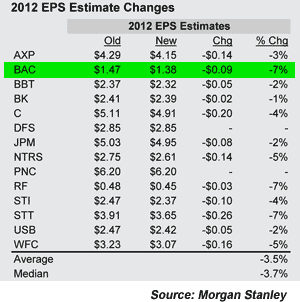
And the final little tidbit we offer you today on the eve of Durbin enactment comes from The Street, reporting that Morgan Stanley cut 2012 earnings estimates for Bank of America and 11 other banks.

This chart, while the story states is not entirely tied to Bank of America’s recent announcement or to the Durbin Amendment, does show that banks will be affected by the Durbin Amendment. They will have to make changes to deal with the losses they expect to take from a hard cap on fees that they were profiting from, and if Bank of America is any indicator, the burden of those changes will go from the merchants who used to get hit with the swipe fees to the consumer who will now have to pay more to support the use of debit cards.

Durbin Amendment Ready To Go [2023 Update]

The Official Merchant Services Blog continues to keep its finger on the pulse of the Durbin Amendment media buzz. The legislation that marks regulation that caps debit card swipe fees begins to take effect on October 1, 2011. And there’s still a lot of scrambling from various media sources to try and predict how banks, merchants and consumers will be impacted by the cap on the billion dollar payment processing industry.

Host Merchant Services has been ahead of the curve in both its analysis of the legislation and its reaction to the legislation.

Today, The Official Merchant Services Blog takes a look at two different articles discussing the Durbin Amendment and the changes it brings.

Banks Plan to Recoup Durbin Losses With Other Fees

The first article comes from mainstreet.com. It’s a pretty standard discussion of the most predicted reaction: Banks will react to the losses that the Durbin Amendment cap places on their swipe fee revenue from previous years by creating new service fees for debit card use. So instead of charging per swipe, the banks move the charge directly to the cardholder as a service fee for having debit card services available to them.

The article cites a robust number of debit card users in the U.S.:

“Americans sure love their debit cards. Between Visa  and MasterCard there are more than 520 million debit cards in use nationwide today. “

That frames the basis of why banks are working to come up with a reaction to the Durbin Amendment. With that many debit card users in the country, there are billions of dollars in profit being cut into with the swipe cap. As the article explains, a quarterly survey of debit card use by financial consumers produced by Manhattan-based Auriemma Consulting Group finds: “banks remain stung by changes in debit card fees (called interchange fees) that reduced the amount of fees banks could charge customers for debit card transactions. The changes, which were triggered by the Durbin Amendment in the Dodd-Frank financial reform bill, basically cut debit card transaction fees in half, the ACG reports.”

The article goes on to explain how many banks are wary over the consumer backlash that could result from charging monthly fees for debit card use and scaling back or restricting reward points programs. The article quotes  Ed Lawrence, director of the debit marketing roundtable at the ACG as saying: “The first-movers to institute debit/checking fees in a given market will experience the most scrutiny and possible attrition, along with negative press; as others follow, customers will have fewer places to move to.”

The conclusion drawn from the article is that Durbin puts the banks in a position where they have to react with changes in how they offer debit card services. And the most likely choices are consumer fees for debit card usage and/or reward points programs being restricted or removed. The banks know these choices will be unpopular with consumers but there’s likely to be a domino effect where once a few banks do it, many more will follow suit, leaving consumers with less and less alternatives.

Some Tips On Dealing With Durbin

The second article comes from USA Today’s Money section. Sandra Block offers some insight into Durbin that mirrors much of the insight every other article about Durbin that The Official Merchant Services Blog has reviewed. But Block offers consumers advice on how to deal with the changes that Durbin is going to bring to their wallets: “The good news: There are numerous ways to avoid these fees. Some tips …”

Block offers four basic tips for consumers to do in response to their bank’s reaction to the Durbin Amendment.

  • Tip 1: Forget about interest checking accounts. Block notes that the increased cost of maintaining this type of account ($5,587 for the interest account vs. $585 for the non-interest account) isn’t worth the 0.08% interest the account offers.
  • Tip 2: Set up direct deposit. Block notes that many banks offer to waive checking account fees for customers who set up direct deposit.
  • Tip 3: Consider switching to a small bank or credit union. Block notes that banks and credit unions with assets lower than $10 million are exempt from the Durbin Amendment changes.
  • Tip 4: Watch out for Debit Card fees. Block’s final tip is for consumers to pay close attention to their debit card fees. Many banks may not change immediately and be slower to react to Durbin so consumers should be aware of the details of their statements going forward.

The Official Merchant Services Blog keeps finding the same theme that the media is bringing up about the Durbin Amendment. Banks do not want to lose the billions of dollars that their transaction fees were bringing them prior to the swipe fee cap. So they are going to find ways to move things around to keep the revenues coming in. And many of the proposed changes are ideas that will end up being shouldered by the consumers. The demographic that this finance reform legislation was initially supposed to assist.

What Durbin Will Change

Roundup of What Durbin Will Change

The changes to interchange fees and debit card transactions brought on by the Durbin Amendment are just days away. The Official Merchant Services Blog is going to give its readers a quick hit of some of the chatter that is heating up the internet as we close in on the day the changes take effect. As with the previous articles, we’ll be using Host Merchant Services’ own Durbin Analysis as the foundation for comparison. We’ll be touching on 3 separate articles today so the comparison will be brief and focus on the highlights.

Citigroup Focuses on Credit Cards

The first article we find comes from The Wall Street Journal. This article points out how Citigroup is reacting to the changes that its competitors Wells Fargo and SunTrust are making because of the Durbin Amendment. Both of which were reported in our last Countdown To Durbin Blog, but can be summed up as both of those banks are going to implement a fee for debit card use that its customers have to pay each month.

Citigroup, according to the Wall Street Journal, is pushing an aggressive credit card campaign to its customers. Citi mailed an estimated 346 million credit card offers to North American customers in the third quarter of this year, the Wall Street Journal reported in the article.  The article suggests this move is at least partially motivated by a void that will be created by the Durbin Amendment:

“One potential void was created last year by an addition to the Dodd-Frank Act, which overhauled financial regulation. Known as the Durbin Amendment, the new rules, which go into effect in October, will limit the fees that banks collect from merchants each time a debit card is swiped, making cards far less profitable for the issuers.

As a result, some issuers are making debit cards less attractive by charging monthly fees and eliminating rewards. Citi is hoping to capitalize on this change by convincing dissatisfied debit customers to use its credit cards instead.”

This builds off of what our previous article found, that Durbin focuses on debit card transactions so one viable reaction to the Durbin changes is to switch focus to Credit Card Processing.

Consumer Reaction To “Too Many Fees”

The next article we cite comes from an NBC news affiliate in Indianapolis, IN, wthr.com. This article contains some evocative reaction from consumers regarding debit card fees. It cites what Regions Bank is doing in reaction to the changes from the Durbin Amendment:

“Regions issued a statement saying regulations have changed and, as a result, banks are adjusting how they cover the costs of providing debit cards. For some customers, that will mean a monthly fee for a debit card beginning in October. While Regions and other banks say the change is necessary, it isn’t popular.”

Which we have cited before as being a very popular reaction from banks regarding the federal regulations. This article quotes debit card using consumer reaction:

“I think it’s my money and I shouldn’t have to pay to use it,” said Andrea Moxley.

“Enough is enough. Too many fees,” said another woman.

This underscores the reaction that many of these articles are finding. Consumers, the group the legislation was supposed to help with its reforms, are not pleased with the shifted burdens that end up not helping them in the end.

Merchants Can Save

The final article we cite comes from Jennifer D’Angelo. It’s a blog of hers that goes into detail about how Merchants can take advantage of the Durbin Amendment changes to save money. D’Angelo suggests Merchants can save up to $1,200 per year because of the Durbin Amendment. She states:

“Under a new law called the Durbin Amendment that takes effect Oct. 1, any merchant that takes debit cards — from retail stores, restaurants, gas stations, and small businesses like chiropractor’s offices — could be eligible for up to $1,200 a year in savings on debit card processing.

In order to be eligible for savings, you need to ask your payment processor if they are passing along the benefits under the Durbin Amendment.”

It’s a very short piece that essentially suggests contacting your payment processor for more information about savings. But it does include the statistics about the cap the Durbin Amendment brings to debit card swipe fees (the previously reported 24 cents on the average purchase) as well as the cost of swipe fees in the past year (the also previously reported 44 cents on the average purchase). Which underscores how much of a difference the Durbin Amendment is forcing on the individual transactions.

These articles give three different perspectives on the Durbin Amendment: Bank, Consumer and Merchant. And gets right to the heart of the issue: Where will the savings that the legislation was designed to create actually end up going? Banks are making moves to protect the huge profit margins the fees provided them prior to the regulation. Merchants are capable of getting some savings, but it hinges on what their payment processors can do. And consumers may end up having to pay the same amount as fees get shifted to other, unregulated areas in the infrastructure of bank services.