Tag Archives: debit

Credit Card Vs Debit Card Processing Trends

The Millennial Generation is the Debit Card Generation

Cash or plastic? When members of Generation Y are asked this point-of-sale (POS) question, they are more likely to choose plastic, but not necessarily a credit card. According to research by PSCU, a payment processing provider for American credit unions, older members of the Millennial Generation, those who are between the ages of 31 and 38, tend to prefer debit card payments over lines of credit by a margin of 40% versus 36%.

Credit vs. Debit

The PSCU survey shows that paying with credit is more popular among members of Generation X, but things get interesting with younger members of the Millennial Generation, those who are between the ages of 23 and 30, who happen to prefer credit at an even higher rate than their Generation X counterparts. The youngest in the Millennial Generation cohort are evenly split in their credit over debit cards preferences at 29%; they actually prefer to make payments with cash, but instead of bills and coins they really like digital platforms such as Venmo, Google Wallet, Snapcash, PayPal, Facebook Messenger, and others. These young consumers, who are between the ages of 18 and 22, really like the idea of doing away with plastic and using their smartphones, which suggests that they are the perfect segment for digital currencies.

Young adults who are part of the Millennial Generation may not always realize that the payment processing structure of their beloved digital wallets are actually debit cards, but this is not something they worry about; they do not like carrying plastic cards and only keep a small amount of cash on hand just in case. They understand the concept of credit over debit, and this is probably why they prefer the latter; when they learn about the struggles many of their parents went through when revolving consumer credit was widely available, they prefer not to bother with this aspect of personal finance.

What Should Credit Card Companies Do?

Other personal finance research studies on the payment patterns of the Millennial Generation shed light on another aspect of credit and debit cards that young adults dislike, specifically data breaches. Such security issues are being considered by younger consumers, but there is also a certain aversion to the traditional banking system. It should be noted that a little over 25 percent of younger Americans have never used a credit or debit card, they think that checks are antiquated, and they dislike the idea of having to stand in line at the bank. They don’t mind using prepaid cards, which are another form of debit cards, as long as they are tied to mobile apps and have a disposable feel to them.

What should banks and issuers of payment cards do to entice the Millennial Generation? Mobile apps and innovation are clearly the answer, and they should start looking into digital currencies, perhaps beginning with safer options such as the USDC managed by investment banking giant Goldman Sachs. Something else to keep in mind is that younger consumers like rewards, social media features, and the ability to instantly transfer small amounts of cash.
Discover “On Us” Program

Today The Official Merchant Services Blog  will focus on an exclusive deal offered to merchants by Host Merchant Services, a second year of the Discover “On Us” plan, formerly the Add Discover On Discover promotion. This plan comes at just the right time for merchants as holiday shopping will increase their traffic and sales. This offer from Discover, through Host Merchant Services is bold and exciting. It essentially gives qualifying merchants a year of being able to process Discover payments at no costDiscover “On Us” gives the merchants no fees when their customers swipe a Discover card. And they have this benefit for an entire year.

The Details of the Plan

To qualify for the Discover “On Us” program from Host Merchant Services, you must have not processed any Discover cards in the past six months of doing business. Discover card processing includes Discover, Diners Club International, BCcard, China Union Pay, JCB and DinaCard. That’s it. That’s all you need to qualify. Once you qualify it’s a series of easy steps to get the program started:

  1. Enroll in the program anytime before December 31st, 2013.
  2. Confirm your enrollment with a required test transaction.
  3. Update signage at your retail store (or on your website if you are an e-commerce only merchant).
  4. Inform your employees and actively promote Discover to your customers to start reaping the savings.


Once you’ve been verified you will receive written notice from Discover. Within 10 business days of your acceptance you’ll receive a welcome letter with free Discover signage and tips for increasing your sales with Discover.

Benefits of the Plan

This plan is really good for merchants that haven’t been accepting Discover cards. Every Discover transaction you process for 12 full months will cost you nothing  –– no limits, no exceptions. Coming right at the end of the year, this plan is the type of holiday shopping incentive that is extremely lucrative for merchants.

Durbin Amendment Works For This Too

In fact, one of the features of the Durbin Amendment can help Discover get added hype and promotional assistance from this Discover “On Us” plan. As Host Merchant Services pointed out in their Durbin Amendment analysis earlier this year, one of the key pieces of the legislation focuses on competition within the payment processing industry: “[The Durbin Amendment] seeks to stop major credit and debit card networks from imposing penalties on small businesses, merchants and government agencies. The law applies to banks with over $10 billion in assets and restricts these large banks and credit card companies from using their dominant market power to force merchants to accept anti-competitive restrictions. To put it simply, large credit card companies are no longer able to punish merchants for offering discounts to customers for using another card network; or discounts for using cash, check, debit card or gift card and loyalty cards; or set a minimum or maximum transaction amount for payment by card.”

So what this means is Discover can usher in this program –– which offers no transaction fees for a year –– to attract merchants, and those merchants seeing how much more of a savings this can provide them over other options can freely promote Discover over the competition, with no fear of punishment or penalty. Durbin lets a merchant promote the better deal for their business.

For More Information

This landmark offer lasts until December 31, 2013. The Discover “On Us” Program will extend 12 months of free Discover processing to merchants who qualify, even if implemented on December 31st, 2013, the merchant would be able to utilize the program through December 31st, 2014. If you are interested in finding out more about it, feel free to Contact Host Merchant Services.

Interchange Settlement Given Preliminary OK

On Friday, the Judge presiding over the controversial Interchange Settlement case in Brooklyn, N.Y. gave preliminary approval to the settlement of credit card interchange litigation announced July 13. The Official Merchant Services Blog recently explained why the controversial Interchange settlement was being considered for preliminary approval, despite the backlash from merchants and large corporations. We also began talking about the possibility of ‘The Big Cash Comeback’ when the settlement was first announced, and later we discussed the opposition to the settlement.

U.S. District Judge John Gleeson indicated in late October that his cursory review showed that the settlement probably met the legal requirements for preliminary approval. He scheduled a hearing for Nov. 9 to get input from lawyers for the merchant plaintiffs and network and bank defendants. The judge said final approval requires a higher standard, and lawyers don’t expect final sign-off anytime before 2013. Opponents argued that the plan didn’t even meet the lower threshold for a preliminary approval.

The National Retail Federation, the leading retail-industry trade group and an outspoken foe of the agreement, quickly issued a statement saying it would “explore all legal options.” But the Electronic Payments Coalition, a lobbying group of card networks and banks, said it viewed Gleeson’s ruling “as further indication that this historic settlement is a fair and balanced resolution to the epic swipe-fee battle.”

The NRF’s Mallory Duncan said in a statement  that “retailers, their customers and competition would suffer irreparable harm if this one-sided deal is allowed to move forward. We will consult with our attorneys and act as soon as possible to correct this injustice.” The NRF is not a plaintiff in this case, and made no mention of which legal remedies it would pursue.

MasterCard Inc. general counsel Noah Hanft said in a statement that the settlement “was reached with the assistance of the court and was supported by the merchant class representing millions of large and small retailers, and prominent trade groups across the country.” MasterCard also said it remains confident that “the court will grant final approval in the coming months.”

Visa Inc. said “this settlement is a fair and reasonable compromise for all parties. It is the result of two years of negotiation between retailers, their legal counsel, the networks, financial institutions and two highly regarded mediators under the supervision of the court.”

Merchants and some trade associations sued Visa, MasterCard, and about a dozen banks in 2005 alleging credit card interchange is unfair under federal antitrust laws. With a trial set for September 2012, the parties reached a settlement that calls for the defendants to pay more than $6 billion in damages and temporarily lower credit interchange to the tune of $1.2 billion. The networks also are to grant relief from some of their rules, including an easing of restrictions on surcharging, and let merchants negotiate in groups in the interchange-setting process. In return, the merchants are to agree not to sue the networks over interchange and rules in the future.

Opponents said the plan would protect what they view as anti-competitive interchange practices from further challenges by merchants, even from merchants that don’t yet exist. Opponents also questioned the value of the new surcharging freedoms, noting that 10 states prohibit the practice. This settlement attempts to force a one-size-fits-all solution onto a wildly diverse group of merchants, which may be extremely unsuccessful.

While we have discussed this settlement from different aspects previously, noting the advantages it would seem to give the Issuing Banks over merchants, the settlement seems to be proceeding along without any further adjustment or negotiation. Although it is not finalized yet, the dissenter’s cries seem to be going unheard, as they believe that the settlement protects the status quo more than anything, and will not change the way the networks set interchange. Host Merchant Services will keep you informed of all the latest news involving this legal battle between the merchants and the card-issuing giants.

HMS Small Ticket Program

Today’s edition of the Official Merchant Services Blog will discuss the best way for merchants to save money on fees when accepting credit or debit cards for smaller transactions. Host Merchant Services is committed to bringing its clients the lowest fees in the industry. Our Small Ticket Program is a feature that helps us do just that for those merchants who process transactions at $15 or less.

Many merchants have seen debit savings thanks to the Durbin Amendment, which caps the Interchange Fees that Visa and MasterCard charge for debit cards at $0.24 and 5 basis points. Smaller merchants do not see the savings when running transactions under $15, since the 24-cent per item fee and the 5 basis points amount to 2.1% of the total ticket, before any additional fees are incorporated.

The Small Ticket Program however, allows qualifying merchants to pay a per item fee of only 5 cents, while paying an interchange rate of 1.6% for Visa. MasterCard has set its small ticket rate at 4 cents and 1.55%. This program saves merchants money on lower transaction amounts, since the per item fee is less of a burden on them in terms of overall effective rate.

The Interchange category for small tickets is available for merchants who are on Interchange Plus pricing, and who qualify under the Visa business types listed below.  Merchants enrolled in flat rate pricing or any type of three-tiered pricing will not be able to utilize these savings, which is just another way Interchange Plus pricing is truly the best out there.

While some processing companies hide added percentage points in the difference that exists between small ticket and large ticket processing, Host Merchant Services gives the savings directly to you. Our Small Ticket Program offers a better Interchange category and a lower per item fee, saving you more money in processing fees for all purchases $15 or less.

Visa opened up the types of businesses that qualify for Small Ticket Processing in November, 2010. Now each of these industries qualify:

  • Local Commuter Transport
  • Limos & Taxis
  • Bus Lines
  • Bridge & Road Fees/Tolls
  • Grocery Stores/Supermarkets
  • Convenience Stores
  • Service Stations
  • Fast Food Restaurant
  • Drug Stores
  • Book Stores
  • News Dealers, Newsstands
  • Dry Cleaners
  • Quick Copy, Reproduction & Blueprint
  • Parking Lots & Garages
  • Car Washes
  • Motion Picture Theater
  • Video Tape Rental Stores
  • Post Stamps/Government Only


If you qualify under any one of these categories, contact Host Merchant Services for your small ticket savings right away. Host Merchant Services promises: we deliver personal service and clarity and as always, we want to keep merchants informed of any potential savings.

Mastercard Credit Card 19100982

MasterCard Site Tools

Today The Official Merchant Services Blog takes a close look today at card association juggernaut and industry titan MasterCard. A card association is a network of issuing banks and acquiring banks that process payment cards of a specific brand, and along with Visa, MasterCard is one of the big wigs in the industry — Card associations Visa and MasterCard each comprise over 20,000 card issuing banks.. They help set the standard for the payment processing industry. Other payment card association brands include Discover, Diner’s Club, American Express and JCB. Among United States consumers alone, over 600,000,000 payment cards are in circulation. Visa, MasterCard and American Express issuers co-brand with the individual card association, for example, “WellsFargo-Visa” or “Citi-MasterCard.”

Making Moves

It was reported here in our May 4, 2012 Blog Entry, that MasterCard was gaining ground in the Swipe Debit sector of revenue, potentially crowding in on Visa’s dominance.  Speculation suggested that the hard cap on Debit Card Swipe fees imposed by the Durbin Amendment from October 2011 may have helped MasterCard take some of that market share away from Visa.

MasterCard has been winning deals to handle processing of debit transactions according to the company’s Chief Financial Officer Martina Hund-Mejean. Bloomberg quotes Hund Mejean as saying in a conference call to analysts: “In every quarter we’re going after business very surgically and opportunistically. You can see those results in our numbers.”

And according to Tien-tsin Huang, a JP Morgan Chase & Co. analyst in a May 1 research note, Bank of America Corp. — the biggest debit-card issuer and catalyst of post-Durbin media frenzy — switched to MasterCard.

Mastercard Credit Card 19100982

Collaboration on Chip Cards

On May 21, MasterCard proposed the formation of a cross-industry group to foster collaboration and alignment between networks, issuers, merchants, acquirers, processors, terminal manufacturers, card manufacturers and other groups for the implementation of EMV technology in the United States. This proposal comes from MasterCard’s January Roadmap for the transition to EMV, something the entire credit card industry is moving toward including Visa and which we discussed in our February 7, 2012 Blog Entry. MasterCard emphasized this need for a payments ecosystem to be fully aligned across the board, citing the upcoming implementation of EMV standards in the U.S. as the catalyst for that need.

You can read more about MasterCard’s take on EMV at their Website Here.

MasterCard’s Web Site Tools

Speaking of their Website … MasterCard has a very useful resource available to its visitors.

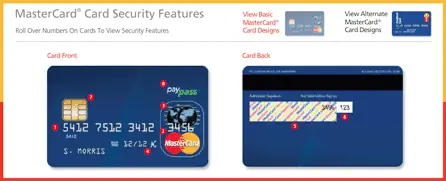
It’s Demos Page, FOUND HERE, has a flash demo that goes through the anatomy of a credit card. This helps people understand the process of using them for payments by breaking the entire item down visually. As it says in the demo, a card is more than just a piece of plastic.

Here’s a screenshot of the demo in action:


CLICK HERE to view it.

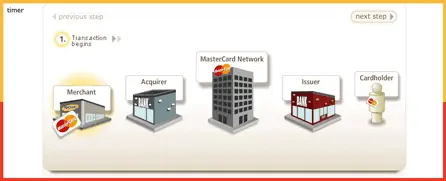
More interesting to us in the Merchant Services industry, is the next demo, the anatomy of a transaction demo. It’s a flash graphic that walks you through, step by step, a transaction. It gives you an nice journey through each step your payment takes from the moment of purchase.

Here’s a screenshot of the demo in action:


CLICK HERE to view it.

The demo page is a useful resource for any readers at all interested in how payment processing or credit cards work and should at least be thought of as an addition to one’s “favorites” tab.