Tag Archives: credit cards

How Does Credit Card Processing Work?

Today The Official Merchant Services Blog gets extra visual with a step by step breakdown of how Credit Card Processing works.

This is the latest installment in The Official Merchant Services Blog’s Knowledge Base effort. We want to make the payment processing industry’s terms and buzzwords clear. We want to remove any and all confusion merchants might have about how the industry works. Host Merchant Services promises: the company delivers personal service and clarity. So we’re going to take some time to explain how everything works. This ongoing series is where we define industry related terms and slowly build up a knowledge base and as we get more and more of these completed, we’ll collect them in our resource archive for quick and easy access. Today we build off of our previous knowledge base entry on just credit cards. We noticed that we’ve been adding to this database for months now and kind of skipped over some of the most basic elements of the industry. So now that we’ve defined credit cards, we want to take you on a journey through credit card processing, detailing exactly how it happens.

CREDIT CARD PROCESSING

Host Merchant Services is able to guarantee its customers savings and the lowest rates possible. By understanding how credit card processing works, where the money gets made off of the transactions themselves and where those hidden fees actually are, you can gain some valuable insight into how Host Merchant Services is able to make its guarantee. Here’s a step-by-step breakdown that sheds light on where the fees from each transaction come from:

How Does Credit Card Processing Work?

The way credit card processing companies make money for themselves can sometimes be a confusing labyrinth where fees are hidden, percentages are tied to things not listed on statements and the deal you think you are getting isn’t the best deal you can actually get. Host Merchant Services is dedicated to giving its merchants the lowest price guaranteed, and the company strives to maintain transparency with no hidden fees. So take a walk with us and see behind the curtain as you learn exactly where the money is being made when you swipe a customer’s credit card.

Step One: A customer visits a store.

Step Two: Customer purchases $10 worth of merchandise.

Step Three: The customer swipes his credit card through a payment processing terminal such as a Hypercom T4205 from Equinox Payments to pay for the merchandise.

Step Four: The card reader recognizes who the customer is and contacts the bank that issued the credit card.

Step Five: The customer’s bank sends $10 to the merchant’s bank.

Step Six: Then the merchant’s bank deposits $9.80 to the merchant’s bank account.

Step Seven: That remaining 20 cents, a 2% fee, is taken from the $10 and given to the customer’s bank.

Step Eight: The customer’s bank then splits the 20 cents with the credit card company.*

* Depending on the specific company, country and merchant, the percentage can range from 1% to 6%. The amount the bank gets and the amount Visa gets is a negotiated deal. Also, Visa and MasterCard charge the banks an annual fee to be a part of their network in the first place.

Where The Money Gets Made

Credit card companies make money in a variety of ways. This graphic lists four of them.

Credit Card Companies make money in a variety of ways. Here are the four most common:

One: The most common way credit card companies make money is through fees, such as the annual fee, overlimit fee and past due fees.

Two: Another way credit card companies make money is through interest on revolving loans if the card balance is not paid in full each month.

Three: As explained above, the card issuer (the bank that issued the card and/or the issuer network, be it Visa, MasterCard, Discover) makes a percentage of each item you purchase from a merchant who accepts your credit card. The rates range from 1% to 6% for each purchase.

Four: The card issuer can also make money through ancillary avenues, such as selling your name to a mailing list or selling advertisements along with your monthly billing statement.

SOURCE: Information for this article was gathered from www.creditscore.net, the movie Superman III, Wikipedia and Authorize.net.

Continue Next – How Payment Gateways Work >

Merchant Services: Statement Sleuth

The Official Merchant Services Blog is here to share information with merchants to get them better prepared to understand how the payment processing industry works. This premise stems from Host Merchant Services and its philosophy to bring trust to the industry.

Payment processing can be confusing. And nowhere is that more evident than in a merchant’s processing statement. One of the ways some processors make their money is by hiding fees within the arcane labyrinth of a monthly statement, making the fees and the numbers difficult to understand.

Host Merchant Services believes that when one of its merchants receives their statement every month, that merchant should understand the items on the statement and that the fees should match what was promised in the sales process.

So in an attempt to help everyone understand that process better, The Official Merchant Services Blog is going to shine a spotlight on statements and see what there is to see.

What Is a Merchant Statement?

Every month, you receive a Merchant Statement from the company that processes your transactions. These transactions include Debit and Credit Card Transactions. This statement summarizes your net sales for all the cards that you process. It also provides your monthly transaction volume as well as provides you with an itemized list of your daily transactions. You can also see the majority of your debit and credit card processing fees. This is where we’re going to shine the spotlight, as this is where fees get hidden. Your fees on your statement include:

  • your transaction fee
  • your monthly discount rate for your Credit Cards
  • your monthly terminal fee (if you do not own your credit/debit card machine).
  • your Interchange charges
  • any chargebacks
  • third-party transactions
  • credit adjustments

The tricky part about these fees is that each company assembles their statement in a different way. Each payment processing provider has a unique statement layout structure, so most of the characteristics of the statement are the same but are put there in a different order. It forces merchants –– especially those who have used more than one processor in their time in business –– to do all of the eagle-eyed investigating themselves.

We’ll stick to the basics and then when that’s done, we’ll take a moment to explain why Host Merchant Services might be a little less confusing than other Payment Network Providers.

Card Deposit Summary

It’s pretty common for the Card Deposit Summary to be prominently displayed in a merchant statement. A lot of times it’s the first item a merchant will see on their statement. The phrasing may be a tad different –– perhaps it’s called a fund summary –– but for the most part it’s the opening line on each merchant services provider’s statement. The summary tends to include a laundry list of statement data, such as:

  • Amount of transactions incurred in that month
  • The dollar amount of those transactions
  • What credit cards were used
  • Any discount or coupon usage charges

Often this information is presented as individual daily line items, but some payment processors may combine all the data into one section.

Credit Card Fee Summaries

After the deposit summary information, most statements provide some sort of variation of how much the credit card issuer charged per transaction. This is usually called the Summary of Card Fees. As we explained in a previous blog series, a lot of payment processors offer a tiered pricing plan. And this is the section of the statement where you will see fees being charged for “qualified transactions.” That term specifically relates to your qualified tier in the pricing plan you signed up for. This section should include any fees, discounts and rates applied to transactions made through your merchant count. Most payment processors provide a complete list of card fee categories in this section, since qualified and non-qualified pricing tiers differ. Also included should be a listing for gross sales amounts per credit card and any fees and discounts applied to specific card transactions.

Transaction Fees

This section is an extension of the Summary of Card Fees section. This section lists each fee related to card transactions in dollar amounts. This can be a daunting section to sift through as the terminology used in this section is extensive. There is no shortage of card fee categories, and you’ll see chargebacks and batch header fees and ACH return fees mentioned here. This is why Host Merchant Services says payment processing can be confusing. The statements sometimes overwhelm merchants with tiny fees and cryptic buzzwords. Within that morass, the black hat companies will hide fees that some merchants aren’t aware they are paying or –– even worse –– aren’t aware they don’t even need to pay.

No Hidden Fees Guarantee

Now that some light has been shed upon the statement, and we can see where the fees get hidden and where the confusion takes place, it’s time to take a look at a much simpler way of doing this: Host Merchant Services offers a processing plan with no hidden fees. The company offers its merchants an Interchange Plus pricing plan. So right off the bat, there are no tiered pricing plan issues, so its merchants are not hit with “non-qualified” tier penalties and fees. Host Merchant Services also eschews a long-term contract. So there is no application or set up fee. No annual fee. No Non AVS Adjustment fee. Host Merchant Services does not penalize you with termination fees. Host Merchant Services also does not lock its merchants into contracts for equipment. The company provides free equipment, including free terminal paper. The prices that the company quotes during the application process are grandfathered, and will not increase at all during the lifetime of the business relationship.

It’s a simple and straightforward plan, really. Host Merchant Services shows you exactly what you will be charged on your monthly statement. The company has swept away many of the added charges that other companies hide on statement fees. And then the company sticks to the plan they quoted its merchant. The company will be happy to review your statement and help you find areas where you can save money each month.

Host Merchant Services Click Here Button

For more information contact the company here.

So monthly statements may be extremely confusing –– to the point where one thinks it is being done on purpose. But using some of the guidelines put forth here, or using Host Merchant Services itself, you can find your way through the puzzle that is payment processing.

Merchant Services: Why You Need a Processor

The Official Merchant Services Blog functions on the logical premise that our readers are interested in the topics we cover, most notably merchant services. We strive to bring you useful news, tips, and insight that can help you as both a merchant and a consumer. That means that sometimes we delve into complex topics, like our multipart series on Payment Gateways. And other times we tackle newsworthy topics, like Google+ being opened up for business pages.

But today we’re going to get down to the basics and discuss the very heart of merchant services: Credit Card Processing. Credit cards, the plastic payment solution has become the most convenient form of payment for countless consumers. Why is it important for merchants to give their customers the option to pay with a credit card –– specifically on that merchant’s web site? Here are 10 of the top reasons we think credit card processing is an important option for merchants:

  • Competitive Advantage: If your business has the most options and the most flexible payment systems, you have an edge over your competition.
  • More Sales: Data collected on consumers shows that credit card owners buy 25 times more merchandise than customers who pay cash.
  • Cashless Society: We’re not there yet, but the trend in online shopping and electronic payment systems indicates that credit card and debit card processing are quickly becoming the preferred methods of payment. This will take center stage in business news next week when Black Friday goes right up against Cyber Monday.
  • Convenience: One of the primary reasons credit and debit card transactions are becoming so popular is because buying goods online with just a few mouse clicks is extremely convenient to consumers.
  • Impulse Sales: Credit Cards give customers the freedom to buy on impulse, spending money on previously unplanned merchandise. Cash is finite and in the pocket. But plastic lets customers reach beyond what they have in hand.
  • Enhanced Advertising: Customers are more likely to shop at businesses that accept their credit card. As such, they tend to look for and read ads from businesses that accept their credit cards first over other ads.
  • Steadier Sales: Credit Card business has less peaks. Cash using consumers buy heavily on payday and just before holidays, but credit card using consumers make purchases whenever they need to.
  • Larger Volume: Accepting credit cards helps merchants attain higher unit sales and extra orders.
  • More Expensive Merchandise: Credit card customers are sometimes less conscious of slight price differences. They are more likely to spend a bit extra at a merchant simply because they accept their form of payment instead of seeking out wholesalers or discounters who do not accept their credit card.

We’re interested in your feedback. What other reasons would you add to this list?

Tips and Terms

Revenues generated by credit card use are fast approaching the $200 billion mark. Your business can benefit  by offering credit card payment processing. To understand the process better, we’re going to define some of the important terms involved in credit card processing and give some insight into how it all works:

Acquirer – a bank, which is often a 3rd party provider, who processes and settles merchant credit card payments.  This can be a bank providing your merchant account or a service that provides it to your processing company.  The acquirer works with the credit card issuer.

Authorization – is the first step that happens after the credit card is swiped.  The purchase and card information are sent to the acquirer who, in turn, sends the same information to the credit card issuer.  The credit card issuer then accepts or declines the transaction.  If accepted, an authorization code is generated and the purchase transaction is continues to the next step, namely: batching.

Batching – is the review process done by a merchant on all credit card transactions for the business day.  The review process involves ensuring all credit card transactions are authorized and signed by the cardholder.  After the review process, the merchant sends the information as a batch to the acquirer to receive clearing for payment.

Cardholder – he is the customer as specified on the credit card, the customer so to speak.

Card network – these are networks that act as an intermediary between the acquirer and the issuer.  Card networks transfer the information originating from the acquirer to the issuer about the purchase.  This happens in the authorization process.

Clearing – the third step in the payment process which happens after the acquirer sends the batch information through the card network to the issuing bank.  The card network acts as a router depending on the credit card issuer found on the purchase detail.  This process permits revenues for both the issuing bank and the card network called the interchange fee.  After deduction of interchange fees, the issuing bank sends the information back to the acquirer through the same card network used.

Discount fee – this fee is paid for by merchants to the acquirer to cover processing costs.

Funding – the fourth step in the credit card payment process.  This involves the acquirer sending back the transaction information to the merchant less the discount fee.  The merchant receives the remainder of the payment and is now considered paid.  This generates the cardholder’s billing statement and accounts are funded appropriately.

Interchange fee – the fee charged by card networks and card issuers to the merchants.  This fee is regulated to about 1 to 3 percent of the total purchase amount and covers the costs associated with credit card acceptance.

Issuer – the financial institution who issues credit card products to its customers.  Examples of major issuers include Discover, Amex, Visa and Mastercard.

A Step By Step Guide

And finally, to get an easy to read visual guide on how Credit Card Processing works, please visit the Host Merchant Services article archive here:

How Credit Card Processing Works

The Allure of Credit Cards for Holiday Shopping

With the Holiday Shopping Season fast approaching –– Black Friday is 11 days away, Cyber Monday is 14 days away –– the payment processing industry is still getting the last pieces in place for a brisk rush in the use of credit and debit cards. The Official Merchant Services Blog continues its series focusing on the impact the holiday shopping season is going to have on both the e-commerce industry and merchant services in general.

The battlefield is set between Debit cards and Credit cards. Debit cards received a huge boon from the federal government in the form of a cap on interchange fees that went live on October 1, 2011 in the form of the Durbin Amendment. This cap restricts the interchange fees that can be applied to Signature debit card transactions. The cap restricts the charge to between 21 and 24 cents per transaction. This is a huge cut from the previous average of 44 cents per transaction, and presents debit card transactions as an attractive option for merchants to start accepting right as we slip into the big holiday shopping rush.

That has left Credit card issuers scrambling for a response, trying to stay competitive and keep consumers answering “Credit” at the checkout line.

This Reuters article suggests one of the big campaigns that credit card issuers are going to push this year is a significant raise in rewards programs for their customers, tempting them to choose credit as their swipe of choice to get access to those sweet sweet rewards. A focus on cash back and travel rewards push the right buttons for consumers while holiday shopping.

A Look At The Numbers

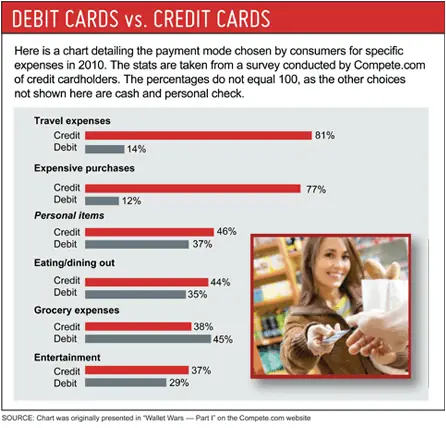
Here’s a small chart detailing the dichotomy between debit card usage and credit card usage from consumers in 2010:

The chart breaks down the chosen method of payment among a survey of credit card owners from 2010. Key numbers to note are the Travel category –– which is dominated by credit card use. It is unlikely that the Durbin Amendment and its changes are going to really affect that sector. But looking at the category listed as “Personal Items” –– which would tend to be the category for holiday gift purchases –– you’ll see a much tougher competition between the two transaction choices. This is where the Durbin Amendment changes to debit card swipe fees are going to have a large impact. And this is where the juicier cash back rewards have credit card issuers hoping they can keep things competitives.

According to the Reuters article: “For example, both Chase (CCF.A) and Citibank C.UL have cards that are offering new applicants $200 in cash back after they spend $500 on their cards.”

You Have to Dig to Find the Best Deals

Some of the best deals are not always displayed in easy to find places. The Reuters article cites a Citibank deal. On the Citi website it advertises the deal as $150 cash back on your first $500 of purchases. But then if you dig deeper by google searching “Citi Dividend $200” you find the better deal directly.

Making it Work For You

The really effective strategy to maximize these deals is to combine them with other deals you will be hit with during the holiday shopping season. The Reuters article notes: “Some cards (such as the Upromise card) have their own shopping portals that combine their rebates with rebates from merchants. In other cases, you can use your rewards points directly for holiday shopping; American Express (AXP.N) awards can be paid directly to Amazon for purchases, for example.”

This type of deal stacking gives consumers a lot of shopping incentive to choose credit as their swipe choice.

A Different Kind of +1

The Official Merchant Services Blog takes a moment to look at a transition in marketing strategies that is extremely relevant to small business : Postage. The United States Postal Service announced this week that it is going to raise its postal rates. Most notable is the cost of the first class stamp is going up one cent from $0.44 to $0.45.

Some other drastic changes are being investigated as well, as cited in that article from Reuters: “The Postal Service has asked Congress for permission to drastically overhaul its business, including cutting Saturday mail delivery and eliminating a massive annual payment to prefund retiree health benefits. The agency also is studying thousands of post offices and processing facilities for possible closure.”

Digital Over Direct Mail

This change is indicative of a shift in how the country does business. And it’s not really all that surprising. The USPS has to react to more than just competition from Federal Express and UPS. Businesses are thriving on the internet. And that makes using more traditional means of marketing –– i.e. print-based marketing –– too little bang for a business owner’s buck.

Which brings us to this interesting article from Multichannel Merchant that suggests that suggests that the postal rate increase is going to cut into the amount of printed materials that businesses mail –– specifically catalogs. Printed direct mail marketing materials, in my experience, have always had a really low impact with customers. Catalogs were usually stronger than other direct mail marketing pieces, for sure. But overall junk mail is called junk mail for the very reason that people ignore it. You send out thousands of direct mail items and are hoping to get dozens of responses, if you’re lucky. So things were already looking bleak for the future of direct mail marketing strategies.

The 2012 postal rate increase only furthers things a long right at the time when internet based marketing strategies are becoming very user friendly for just about everyone.

Social Media Plus One

Social Media can have a much stronger impact with your customers when utilized properly. And there are a lot of easy-to-find resources to help small business owners take advantage of Social Media. Getting tips on how to best use Facebook Ads and Google Ads and Twitter feeds to reach customers organically and generate strong responses to your business and its activities. Host Merchant Services provides some of those resources itself. This very blog is designed with the intent of reaching out to our merchants to help keep them on top of trends and news that help their business thrive. The company also provides an article archive on topics related to the industry so merchants can understand processing better. The company actively keeps its Facebook presence updated. It’s all part of the goal of reaching out to our merchants to help their business run better. The company also provides e-commerce solutions and social media and marketing advice and analysis for its customers. Beyond just the marketing aspects, Host Merchant Services is here to provide its merchants the assistance they need for their e-commerce opportunities.

So take this 2012 postal rate increase as a sign of how marketing for your small business now exists in a very different environment, and you have an opportunity to reach out to customers with the money you don’t give the USPS. You can reconsider reaching out via direct mail and focus on reaching out to your customers through facebook, twitter, your own site and blog, or any combination thereof. At the very least you’ll avoid those higher postal rates, and should be able to drum up just as many points of contact as your mailers were generating.

Print Still Has Its Place

Keep in mind, this isn’t a suggestion to go completely digital. You don’t have to abandon print-based marketing strategies. But you can certainly give serious consideration to adjusting how much you budget for them. If the price increase isn’t worth your money, you can scale back and focus your efforts and resources on something web-based. Use the postal rate increase as a catalyst for boosting your businesses’ e-commerce. Sticking to the most basic plan:

  • You can have your business online, with a website.
  • You can offer your products online, with a catalog.
  • You can process transactions online, through your website and its catalog.
  • You can use a merchant services provider like Host Merchant Services, to handle those transactions.
  • You can then connect to customers and potential customers through social media services like Facebook or Google Ads or Twitter.

From the Multichannel Merchant Article: “Deb Dyer, vice president of marketing for bedding merchant Cuddledown, says the rate increase “won’t keep us from sending catalogs to our house file or prospects, but it will make us look at other digital prospect opportunities and programs.” “

Information Flows Digitally Now

And that’s really what the postal rate increase is most likely going to do for a lot of other merchants. Give them the perfect opportunity to explore the powerful tools they have at their disposal with social media and e-commerce solutions. To put it in perspective, as I was reading the article I link here from Multichannel Merchant, my eyes were drawn to the Facebook “Share” button, Google “Plus One” button and Twitter “Tweet” button that were all conveniently placed on the left-hand side of the article. It’s all right there. One click and you can get yourself involved in a whole new marketing plan for your business.

In short, a lot of people have stopped getting their news from print media. They ignore direct mail sending it to the trash as junk mail. But they’re still consumers and you can reach them with well executed social media marketing strategies. The United States Postal Service is just reminding you that you have this option, albeit indirectly.

E-Commerce uses Mobile Payments and Near Field Communications as new Merchant Services Solutions

Payment Processing Changes and How They Effect Small Businesses

It used to be one of the big decisions a small business had to make was whether or not to accept credit cards. But with E-commerce booming and consumers continually reaching for plastic instead of paper for their transactions, that decision has pretty much been made for small businesses. They have to accept some form of card payment as fewer people carry cash. However, the technology for payment processing is advancing at a high rate right now. And many studies predict mobile payments are on the verge of transforming the way people pay for things even more than before. The future of payment processing is ripe for change.

The Current Payment Processing Landscape At A Glance

Merchant Services, by its very nature, is an industry that for the most part seeks to work unnoticed by the consumer. The companies performing this service, which can be explained here in this Host Merchant Services infographic, tend to make their money off of percentages of a penny. Transaction by transaction those percentages grow into pennies, and as volume increases even further those pennies increase into dollars.

A lot of small business owners have horror stories about their payment processors because a really common practice that companies in the industry started to do to each other to compete better, was to boost the expenses from those transactions, and those percentages of pennies, with hidden fees and contractual obligations.

It got so bad that federal legislation, in the form of the Durbin Amendment, was passed as a way to combat debit card swipe fees. Host Merchant Services is already tracking the effects of those changes in a series right here on the Official Merchant Services Blog.

Changing the Game

But that’s not the only way the game is changing. Some companies, like Host Merchant Services, see the opportunity being created by the old standard. So HMS shines light on hidden fees, cuts away the fat from these agreements and HMS even goes so far as to not hold its merchants to contracts or termination fees.  Many of the features you find at Host Merchant Services are designed specifically to appeal to small business owners. A service oriented Merchant Services solution that lets the merchant know exactly what they are paying on their statement.

Technology Adds its Own Wrinkle

Beyond just what Host Merchant Services is doing to change the model for Merchant Services Providers, the industry is being shaped by advances in technology, specifically the potential for profits from mobile payments. Small Business Owners are starting to find the convenience of being able to process a payment anywhere can give them more flexibility to reach their customers. And so the companies developing the technology for these mobile payments are racing to reach the market with their ideas and advances.

Square Up  –  In 2009 the Co-Founder of Twitter, Jack Dorsey, introduced a breakthrough device that allows both individuals and businesses to swipe and process credit cards directly on their iPhone or Android phone. While Square was not the first company to do this, what set them apart was their fee structure and their lack of a contract. Square has no contract, does not have any monthly fees and only charges when a card is swiped or keyed in. They currently charge 2.75% of the transaction for each swiped card. This is their big selling point because Square lets small businesses that did not have the resources prior to begin accepting credit cards. This is appealing to small businesses with low or inconsistent volume that would normally be burdened by the heavy costs associated with setting up a merchant account.

Google Wallet  – On the other side of the payment world there is Google, who partnered with Citibank to create a new product called Google Wallet. This new mobile payment technology allows consumers to attach a credit card number to an embedded near-field communications (NFC) chip in their Android phone. This in turn gives that person the ability to make payments by swiping their mobile phone next to a chip reader.

NFC technology has been around for about a decade, and is still being tested in target market areas. Google Wallet will be tested first in New York City and Google hopes to roll it out for the rest of the country in 2012. Host Merchant Services noted this previously in an article.

HMSPay  – Host Merchant Services offers its own mobile payment solution, HMSPay. This is similar to Square in that it’s a device that attaches to an iPhone. And its big selling point is that it adheres to HMS’ standards of service and savings. Merchants who use it are able to get ultra-competitive rates that let small businesses take credit cards without being overwhelmed by hidden fees and other excesses found in the Merchant Services industry.


What Durbin Will Change

Roundup of What Durbin Will Change

The changes to interchange fees and debit card transactions brought on by the Durbin Amendment are just days away. The Official Merchant Services Blog is going to give its readers a quick hit of some of the chatter that is heating up the internet as we close in on the day the changes take effect. As with the previous articles, we’ll be using Host Merchant Services’ own Durbin Analysis as the foundation for comparison. We’ll be touching on 3 separate articles today so the comparison will be brief and focus on the highlights.

Citigroup Focuses on Credit Cards

The first article we find comes from The Wall Street Journal. This article points out how Citigroup is reacting to the changes that its competitors Wells Fargo and SunTrust are making because of the Durbin Amendment. Both of which were reported in our last Countdown To Durbin Blog, but can be summed up as both of those banks are going to implement a fee for debit card use that its customers have to pay each month.

Citigroup, according to the Wall Street Journal, is pushing an aggressive credit card campaign to its customers. Citi mailed an estimated 346 million credit card offers to North American customers in the third quarter of this year, the Wall Street Journal reported in the article.  The article suggests this move is at least partially motivated by a void that will be created by the Durbin Amendment:

“One potential void was created last year by an addition to the Dodd-Frank Act, which overhauled financial regulation. Known as the Durbin Amendment, the new rules, which go into effect in October, will limit the fees that banks collect from merchants each time a debit card is swiped, making cards far less profitable for the issuers.

As a result, some issuers are making debit cards less attractive by charging monthly fees and eliminating rewards. Citi is hoping to capitalize on this change by convincing dissatisfied debit customers to use its credit cards instead.”

This builds off of what our previous article found, that Durbin focuses on debit card transactions so one viable reaction to the Durbin changes is to switch focus to Credit Card Processing.

Consumer Reaction To “Too Many Fees”

The next article we cite comes from an NBC news affiliate in Indianapolis, IN, wthr.com. This article contains some evocative reaction from consumers regarding debit card fees. It cites what Regions Bank is doing in reaction to the changes from the Durbin Amendment:

“Regions issued a statement saying regulations have changed and, as a result, banks are adjusting how they cover the costs of providing debit cards. For some customers, that will mean a monthly fee for a debit card beginning in October. While Regions and other banks say the change is necessary, it isn’t popular.”

Which we have cited before as being a very popular reaction from banks regarding the federal regulations. This article quotes debit card using consumer reaction:

“I think it’s my money and I shouldn’t have to pay to use it,” said Andrea Moxley.

“Enough is enough. Too many fees,” said another woman.

This underscores the reaction that many of these articles are finding. Consumers, the group the legislation was supposed to help with its reforms, are not pleased with the shifted burdens that end up not helping them in the end.

Merchants Can Save

The final article we cite comes from Jennifer D’Angelo. It’s a blog of hers that goes into detail about how Merchants can take advantage of the Durbin Amendment changes to save money. D’Angelo suggests Merchants can save up to $1,200 per year because of the Durbin Amendment. She states:

“Under a new law called the Durbin Amendment that takes effect Oct. 1, any merchant that takes debit cards — from retail stores, restaurants, gas stations, and small businesses like chiropractor’s offices — could be eligible for up to $1,200 a year in savings on debit card processing.

In order to be eligible for savings, you need to ask your payment processor if they are passing along the benefits under the Durbin Amendment.”

It’s a very short piece that essentially suggests contacting your payment processor for more information about savings. But it does include the statistics about the cap the Durbin Amendment brings to debit card swipe fees (the previously reported 24 cents on the average purchase) as well as the cost of swipe fees in the past year (the also previously reported 44 cents on the average purchase). Which underscores how much of a difference the Durbin Amendment is forcing on the individual transactions.

These articles give three different perspectives on the Durbin Amendment: Bank, Consumer and Merchant. And gets right to the heart of the issue: Where will the savings that the legislation was designed to create actually end up going? Banks are making moves to protect the huge profit margins the fees provided them prior to the regulation. Merchants are capable of getting some savings, but it hinges on what their payment processors can do. And consumers may end up having to pay the same amount as fees get shifted to other, unregulated areas in the infrastructure of bank services.