Tag Archives: credit card processing

Phishing Scam Alert

Attention Merchants. The Official Merchant Services Blog has been made aware of an e-mail based Phishing campaign designed to trick individuals into providing login credentials for their credit card processing — specifically one of the payment gateways that a merchant uses.

The e-mail generally has a subject title of “Annual Agreement Renewal”  and the body of the message is communicating that their “retail account” or “merchant agreement” is expiring.  When you open the attachment it appears to have a login page prompting a login.

Be advised that this is an attempt at social engineering intended to steal those login credentials. Neither Host Merchant Services nor TransFirst is the source of these e-mails. These e-mails should be disregarded and deleted. This is an industry wide issue that has escalated in recent days. The Official Merchant Services Blog and Host Merchant Services have been made aware of e-mails appearing to be from TransFirst as well as other payment processers.

If you are a merchant and you have been taken in by this scam, please have contact merchant support at 1-800-654-9256 or contact us at Host Merchant Services directly at 1-877-517-HOST (4678).

Host Merchant Services will continue posting notices on our key sites and our social media channels. TransFirst is also getting the word out, posting information as TC, Epay, TransLink, Transfirst.com and other social media channels.

If you have any questions regarding this scam, please contact Host Merchant Services support.

Some Basic Information on Phishing

Phishing is an attempt to acquire information such as usernames, passwords, and credit card details by masquerading as a trustworthy entity in an electronic communication. Communications purporting to be from popular social web sites, auction sites, online payment processors or IT administrators are commonly used to lure the unsuspecting target of the scam. Phishing is usually carried out by e-mail spoofing or instant messaging, and directs users to enter details at a fake website whose look and feel are almost identical to the legitimate one.

How To Defend Against Phishing

The scam artists behind phishing emails are smart and know how to create emails and websites that look like they are official and from well know companies or organisations. Because of this, the typical security measures taken with electronic communication — such as firewalls — don’t stand up to the scams.

There is no real effective software-based means of defending against phishing scams. Common sense tends to be your best defense. Always exercise caution when replying to an email that requests personal information or passwords. Also, never click on links found in such e-mails. Even if you believe the content of the message is genuine you should type the web address into your browser directly to ensure that you are visiting the correct site.

Here are a few  more tips for avoiding phishing scams:

  • If you believe an e-mailed request for information is genuine then call the company to confirm before entering data on a website.
  • If you need to entire sensitive information on a website then look for a padlock in your browser’s status bar to signify that you are on a secuire site.
  • If you believe that you have fallen victim to a phishing scam contact the bank or credit card company immediately so that they can freeze your accounts and take action on your behalf.

For information and tips on how to protect yourself from online scams like phishing or identity theft or credit card fraud you can read this article in the Host Merchant Services Article Archive.


Durbin Amendment Back In the News [2023 Update]

The Official Merchant Services Blog returns to a topic that it covered thoroughly throughout 2011: The Durbin Amendment. With the Stop Online Piracy Act getting most of the headlines lately, Durbin Amendment’s continued impact on the payment processing industry has gone into stealth mode. Until today that is. Stick with us as we offer a whirlwind roundup of all things Durbin related.

Bank of America Took a Beating

We’ll start off our tour Durbin tidbits with this article by ABC News. Apparently Bank of America took a substantial hit from their plan to charge $5 per month to use debit cards. According to the article: “Bank of America’s failed plan to impose a $5 monthly debit card fee led to a 20 percent increase in closed accounts in the last three months of 2011 and a public relations headache.”

The article quotes Bank of America CEO Brian Moynihan as saying, “yes, we had some impact from the $5 debit fee. That’s why we made a decision to reverse it.”

It wasn’t all bad news for Bank of America though, as the bank reported earnings of $2 billion in the last three months of 2011, up from a net loss of $1.2 billion in the same period a year ago, boosted in part from a one-time gain on the sale of China Construction Bank.

Small Lenders Strike it Big

The next little bit of Durbin aftermath comes from this article by NACS online. As was seen in the Host Merchant Services in-depth analysis of the legislation, The Durbin Amendment only applies to lending institutions with assets over $10 billion. Smaller banks and credit unions are exempt from the Durbin Amendment. As a result of being exempt, a Wall Street Journal report cited by the NACS article states that these institutions have been “collecting fees that are often three times those imposed on cards by large banks.” 

For comparison, the article says: “The WSJ notes that a $100 sweater purchased with a debit card would incur a fee of 95 cents on a card issued by a smaller bank and only 26 cents for those issued by big banks. “

The article also suggests that banks face further uncertainty by April 1, 2012, when “all U.S. banks and credit unions must offer retailers more choices of companies used to process debit card transactions, a move that is expected to lower interchange fees further.”

New Target: Credit Card Swipe Fees

Time Magazine Online Feature Moneyland reports something that Host Merchant Services has already touched on before in The Official Merchant Services Blog — that Credit Card Swipe Fees may be the next target of legislators and financial reform. From the Time article: “There’s another interchange fee fight in the offing — this time over credit cards. According to CNBC, equity analysts who cover the financial sector have expressed worry that ongoing litigation involving several major banks could lead to a cap of 0.5% on credit interchange fees — one-fourth of what’s currently charged — potentially dragging down bank earnings. If that happens, consumers who are used to generous credit card rewards programs complete with double miles, accelerated earnings, and big sign-up bonuses might get a rude awakening.”

The Official Merchant Services Blog on December 13, 2011 covered the topic of a Credit Card Swipe Fee. In that blog we wrote: “the plan would end up working much like the Durbin Amendment has worked. Where the idea of reform would get overshadowed by how banks and credit card companies reacted to the law. There would be some shifting, so in that sense the reform would cause change. But that eventually the burden for paying for any losses that banks and credit card companies get forced into through reform would end up squarely on the shoulders of the consumers.”

The Time article notes something that Host Merchant Services already pointed out regarding a Credit Card version of the Durbin Amendment — Banks would take another huge hit because Durbin has language that freed up banks and merchants to market and promote options to the consumer directly. In short, Durbin’s language freed merchants up to promote credit over debit. And because of that, a lot of merchants did just that as Banks offered new programs to make credit the more attractive choice. Subsequent changes that would now penalize Banks for doing that would create a lot of negative momentum for Banks and added onus for consumers who get stuck with no good choices overall.

New Hampshire Law

This article from credit.com reveals that one state legislature is already making moves to see a Credit Card Swipe Fee Cap become reality. As the article states: “A piece of legislation introduced in the New Hampshire House of Representatives, House Bill 1319, has drawn some attention for the way in which it would drastically alter the credit card landscape between businesses and payment processors. The law will limit the amount banks chartered within the state are able to charge businesses for processing credit card transactions to just 1 percent of the total purchase value.”

The article goes on to state that many businesses pay costs that range from 0.67 percent of the transaction’s value to 4.76 percent and that a MasterCard spokesperson told the Nashua Telegraph that the average 1.75 percent.

Cash Still Rules Everything Around Me

Our last news brief on the topic of the Durbin Amendment and swipe fee caps is a little different. This article from the Huffington Post shows a study that reveals cash is still king. The gist of the article: “More than three-quarters, or 79 percent, of consumers said they made a cash purchase in the last seven days, according to a report released on Tuesday from Javelin Strategy & Research, a market research group for financial services. Compare that to about 65 percent of credit and debit cardholders who say they swiped their plastic in the last week.”

The article suggests that this is a consumer reaction to card swipe fees. The article states that consumers are choosing to pay for items with cash to avoid fees on small, everyday purchases. The convenience of plastic gets overrun by the savings consumers perceive they get from going back to cold, hard cash. The study indicates that cash is replacing debit for small purchases, and credit is replacing debit for big purchases and the Durbin Amendment’s lasting legacy may simply be that it pushes Debit out of the consumer’s arsenal of payment options.

Finding Quality Merchant Services [2023 Update]

Today The Official Merchant Services Blog is playing a bit of catch up. The story we’re going to highlight and discuss is almost three weeks old. It was intended to run earlier, but technical difficulties with the blog’s production kept it from appearing until now. However, we feel the story is still worth some attention due to the issue it highlights about the payment processing industry.

The story comes to us from a Chicago, IL section of the Better Business Bureau (BBB). This article from the BBB says that the organization has seen a 42% rise in complaints against credit card processing services. The article, which originally was posted by the BBB on December 15 found that complaints were up for the 12 month period in 2011 compared to the previous 12 months. The breakdown was specifically 110 complaints in the recent 12 month period versus  77 complaints in the period prior.

Not Just In Chicago

The complaints aren’t just lodged in Chicago. This article from Fox40.com details similar complaints in Sacramento, CA. The article states: “The Better Business Bureau is warning businesses to beware of sales pitches by credit card processors that don’t reveal key details that could end up costing business owners more than they bargained for.”

And it quotes Caitlin Peterson of the Better Business Bureau of Northern California as saying “We’ve had over 1,700 complaints this year against the merchant processing business.”

What the Problem Is ?

From reading through the two articles — as well as an older BBB article about issues in the St. Louis, MO area — the problems that merchants are encountering are really straightforward. Business owners are being approached by salespeople offering big savings on their payment processing. And then once the merchant signs a contract with that person, they are saddled with hidden fees for services they were not told about. In short, the business owner is led to believe they are getting a great deal but end up having to pay out more because of all the things not mentioned in the deal. So complaints against payment processors rise in select areas.

Pricing and Transparency

This type of behavior is the exact reason Host Merchant Services utilizes its philosophy of Interchange Plus pricing and no hidden fees. These types of issues are why CEO Lou Honick says “Host Merchant Services is about bringing trust to the payment industry.”

“Payment processing is confusing,” says Honick, noting the ease in which merchants can get saddled with the types of issues that have cropped up with the BBB complaints. “The big guys make it difficult to understand exactly what your rate is and what fees are associated with accepting credit cards. We deliver personal service and clarity. Our people care about customer service and will take the time to explain how everything works.”

Honick also cites the process that Host Merchant Services uses to directly counter the problems that business owners encounter with other processors: “We believe that when you get your statement every month, you should understand every item, and it should match what you were promised in the sales process. If you have a question, there is a live person at Host Merchant Services ready to assist you.”

The Details

One of the primary ways Host Merchant Services combats the practices that lead to these complaints is with their pricing structure. Host Merchant Services uses Interchange Plus pricing instead of the more standard tiered pricing format. Interchange Plus makes statements easier to read, customer service easier to provide to merchants, and savings much easier to guarantee. Here’s a small graphic explaining the basics of how Interchange Plus works:

You can review a comparison between Host Merchant Services Interchange Plus pricing — which is simple and transparent — and the tiered pricing plans that other processors use in a two-part blog series that The Official Merchant Services Blog ran in October, 2023.

  • Part One
  • Part Two
  • Follow Up

What the BBB Advises ?

The BBB advises merchants take these steps to avoid getting stuck with the issues that their complainants have encountered:

Ask around.

The BBB suggests getting at least three estimates from different Payment Network Providers and to checkout he BBB Business Review of the merchant processing service. They also suggest asking fellow business leaders for referrals.

Know where to turn.

The BBB advises you check up on the support team that a potential Merchant Services Provider offers you. Can you contact them 24 hours a day? What is their response like outside of typical business hours? And the BBB advises you make sure their technical support can handle your needs as that kind of support is vital to your business’ success.

Try them out.

The BBB says that you should not settle without a trial period. You should make sure that the payment processor you choose has a 100 percent money-back guarantee before selecting them. Make sure their service works for you, and make sure they keep their promises to you.

Don’t get locked in to a long term contract.

The BBB is very clear on this. Never commit to a long term agreement that locks you in. Make the merchant services provider earn your business each and every month.

Get references.

The BBB advises that you get the payment processor to provide you with references. And then suggests you spend some time checking up on those references.

Make sure you know what you’re being charged for.

The BBB says that if you have a question regarding a fee that you were charged, ask the merchant services provider. Don’t let them hide fees on you. Make sure you understand your statement.

How Host Merchant Services Stacks Up 

Host Merchant Services falls in line with what the BBB advises merchants to do. The company places a big emphasis on transparency. Their salespeople will explain a merchant’s statement in detail. One of strengths of the offering from Host Merchant Service is their guarantee to save a merchant money. They achieve this by a statement analysis. Not only will Host Merchant Services explain the details of what your statement and fees are, completely transparent, while you process with them, they’ll also explain where the hidden fees are with your current statement.

Host Merchant Services will provide references. They do not lock you in to a contract. They do not charge you a termination fee. They provide free equipment and free paper for your terminals. And they offer 24-7-365 customer service where they guarantee you will talk to a real person that will help you out with your issues. You can even initiate a live chat with HMS Support right from any page on their web site.

As Host Merchant Services COO Dan Honick says, “You stay with us because you’re happy.”

E-Commerce: Review and Preview

The Official Merchant Services Blog begins our second year of blogging with a look at one of our favorite topics: E-Commerce.

2011 saw huge gains for online shopping. As reported in The Official Merchant Services Blog on Cyber Monday, online shopping was strong on Black Friday. IBM research unit Coremetrics stated that 20% more consumers shopped online Black Friday 2011 than did in 2010. The data collected also states that 39% more online shopping happened on Thanksgiving Day 2011. The ease of online shopping is infiltrating the traditional brick-and-mortar retail event and Host Merchant Services‘ analysis of it held true –– sales numbers across the board rose from 2010, so overall Black Friday had a boost for retail, but clicks from e-commerce continue to grow and cut into the sales from bricks.

Also, mobile payments saw a huge increase during the holiday shopping season. According to this article from Seeking Alpha, mobile payments business increased 500% from 2010 on Black Friday. According to the article, PayPal mobile reported the huge increase, coming in at 511% to be exact. PayPal Mobile also noted that there was a 350% increase in mobile shopping on Thanksgiving 2011 when compared to 2010.

The Numbers Keep Coming In

This article by Internet Retailer demonstrates that Black Friday was just the beginning. There were more than 3,000 transactions totaling $141.6 billion in 2011 in the marketing, media, technology and service industries according to data collected by investment banking firm Petsky Prunier LLC. Of those transactions the E-Commerce and digital media segment was the most active, with 1,159 deals valued at more than $44 billion.

All of this activity demonstrates strength in the E-Commerce industry, and suggests that 2012 is a year primed for continued growth and success — which combines with the already rampant predictions of success for Mobile Payments within the E-Commerce industry.

Is There A Bubble?

This article from moneycontrol.com asks the question, “Will the E-Commerce Bubble Burst?”

Comparing the recent success to the success of internet companies in 2000 and 2001, the article tries to figure out if the bubble will burst like it did back then for tech companies. The author’s opinion is that the similarities are only on the surface, and that the two situations are vastly different — suggesting that in the end, it’s not a bubble that is going to burst but rather an industry that is going to grow and evolve. The article looks specifically at the E-Commerce sector in India, but does spend time detailing the big picture globally.

Online Shopping is Now Commonplace

To really underscore the potential growth that E-Commerce has in 2012, this article from Daily Deal Media talks about how popular online shopping is becoming with moms. The article cites a BabyCenter survey which suggests that: “71% of moms regularly turn to websites such as shopping engines and review sites to compare prices. Another 56% admit to searching for coupons or digital discount opportunities on a regular basis.”

This is a compelling point in regards to the overall picture of E-Commerce. It has become more and more commonplace in everyday life for shoppers around the world. Mothers are turning to it for the convenience of being able to get shopping done quickly and efficiently, according to the article. And it is just become an ingrained part of our economy, fueling the potential for further growth.

Host Merchant Services E-Commerce Mobile Payments image

Mobile Payments Big Problem

The potential growth for Mobile Payments is huge. But the one thing holding it back in the U.S. is security. Just as online shopping has become more and more commonplace, people have gotten comfortable with making payments online. That brings risk, as phishing scams and credit card fraud has increased. But security standards like the PCI DSS have helped to make the mainstream comfortable with clicking the pay button and giving out their payment information.

Mobile Payments, however, are not quite there yet in terms of acceptance. This article from the Chicago Tribune discusses the looming security issues that the mobile payments market faces. As the article states: “While the first mobile virus dates back to June 2004, risks from hackers remained limited because of the relatively small size of the market. But this has changed with the surge in the smartphone segment, which this year outgrew the PC market, and the new dominance of Google’s Android software. The emergence of mobile payments, which allows shoppers to swipe their phones at a cash register, is whetting the interest of hackers and data thieves.”

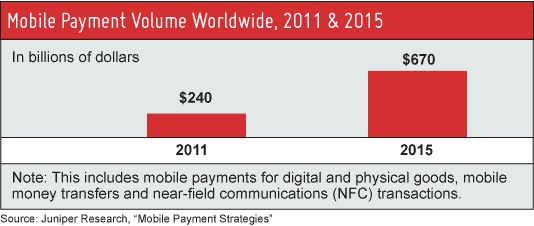
The article states that fewer than 5% of smartphone users have security software installed on their device, according to Juniper Research — the same Juniper Research that predicts Mobile Payments will increase to a $670 billion industry by 2015. And a study by Deloitte cited in the article suggests that for companies in the technology, media and telecom sector expect data stored on staff mobile devices to be their biggest security headache in 2012.

Essentially that’s the biggest obstacle holding back the Mobile Payments industry. The sheer convenience the technology brings to the payment industry is extremely powerful and so despite security concerns it continues to be developed and pushed. 2012 will see growth in the industry, despite the security issues. And as consumers get more and more familiar and comfortable with the phone swipe style of payment, the industry will boom.

A List for 2011

And just for fun, here’s a list from Mashable.com detailing who they think were the biggest winners and losers from 2011 in E-Commerce.

  • Their winners include: Amazon, Apple, Wal-Mart and Gilt Groupe.
  • Their losers include: Barnes and Noble, HP, Netflix and Sony.

Click the link to read why each company made the list.

Merchant Services: Statement Sleuth

The Official Merchant Services Blog is here to share information with merchants to get them better prepared to understand how the payment processing industry works. This premise stems from Host Merchant Services and its philosophy to bring trust to the industry.

Payment processing can be confusing. And nowhere is that more evident than in a merchant’s processing statement. One of the ways some processors make their money is by hiding fees within the arcane labyrinth of a monthly statement, making the fees and the numbers difficult to understand.

Host Merchant Services believes that when one of its merchants receives their statement every month, that merchant should understand the items on the statement and that the fees should match what was promised in the sales process.

So in an attempt to help everyone understand that process better, The Official Merchant Services Blog is going to shine a spotlight on statements and see what there is to see.

What Is a Merchant Statement?

Every month, you receive a Merchant Statement from the company that processes your transactions. These transactions include Debit and Credit Card Transactions. This statement summarizes your net sales for all the cards that you process. It also provides your monthly transaction volume as well as provides you with an itemized list of your daily transactions. You can also see the majority of your debit and credit card processing fees. This is where we’re going to shine the spotlight, as this is where fees get hidden. Your fees on your statement include:

  • your transaction fee
  • your monthly discount rate for your Credit Cards
  • your monthly terminal fee (if you do not own your credit/debit card machine).
  • your Interchange charges
  • any chargebacks
  • third-party transactions
  • credit adjustments

The tricky part about these fees is that each company assembles their statement in a different way. Each payment processing provider has a unique statement layout structure, so most of the characteristics of the statement are the same but are put there in a different order. It forces merchants –– especially those who have used more than one processor in their time in business –– to do all of the eagle-eyed investigating themselves.

We’ll stick to the basics and then when that’s done, we’ll take a moment to explain why Host Merchant Services might be a little less confusing than other Payment Network Providers.

Card Deposit Summary

It’s pretty common for the Card Deposit Summary to be prominently displayed in a merchant statement. A lot of times it’s the first item a merchant will see on their statement. The phrasing may be a tad different –– perhaps it’s called a fund summary –– but for the most part it’s the opening line on each merchant services provider’s statement. The summary tends to include a laundry list of statement data, such as:

  • Amount of transactions incurred in that month
  • The dollar amount of those transactions
  • What credit cards were used
  • Any discount or coupon usage charges

Often this information is presented as individual daily line items, but some payment processors may combine all the data into one section.

Credit Card Fee Summaries

After the deposit summary information, most statements provide some sort of variation of how much the credit card issuer charged per transaction. This is usually called the Summary of Card Fees. As we explained in a previous blog series, a lot of payment processors offer a tiered pricing plan. And this is the section of the statement where you will see fees being charged for “qualified transactions.” That term specifically relates to your qualified tier in the pricing plan you signed up for. This section should include any fees, discounts and rates applied to transactions made through your merchant count. Most payment processors provide a complete list of card fee categories in this section, since qualified and non-qualified pricing tiers differ. Also included should be a listing for gross sales amounts per credit card and any fees and discounts applied to specific card transactions.

Transaction Fees

This section is an extension of the Summary of Card Fees section. This section lists each fee related to card transactions in dollar amounts. This can be a daunting section to sift through as the terminology used in this section is extensive. There is no shortage of card fee categories, and you’ll see chargebacks and batch header fees and ACH return fees mentioned here. This is why Host Merchant Services says payment processing can be confusing. The statements sometimes overwhelm merchants with tiny fees and cryptic buzzwords. Within that morass, the black hat companies will hide fees that some merchants aren’t aware they are paying or –– even worse –– aren’t aware they don’t even need to pay.

No Hidden Fees Guarantee

Now that some light has been shed upon the statement, and we can see where the fees get hidden and where the confusion takes place, it’s time to take a look at a much simpler way of doing this: Host Merchant Services offers a processing plan with no hidden fees. The company offers its merchants an Interchange Plus pricing plan. So right off the bat, there are no tiered pricing plan issues, so its merchants are not hit with “non-qualified” tier penalties and fees. Host Merchant Services also eschews a long-term contract. So there is no application or set up fee. No annual fee. No Non AVS Adjustment fee. Host Merchant Services does not penalize you with termination fees. Host Merchant Services also does not lock its merchants into contracts for equipment. The company provides free equipment, including free terminal paper. The prices that the company quotes during the application process are grandfathered, and will not increase at all during the lifetime of the business relationship.

It’s a simple and straightforward plan, really. Host Merchant Services shows you exactly what you will be charged on your monthly statement. The company has swept away many of the added charges that other companies hide on statement fees. And then the company sticks to the plan they quoted its merchant. The company will be happy to review your statement and help you find areas where you can save money each month.

Host Merchant Services Click Here Button

For more information contact the company here.

So monthly statements may be extremely confusing –– to the point where one thinks it is being done on purpose. But using some of the guidelines put forth here, or using Host Merchant Services itself, you can find your way through the puzzle that is payment processing.

Superior Customer Service

As we close in on the Holiday Shopping Season, customer service becomes more and more important. That’s not to say customer service was unimportant prior to now; it’s just that most businesses –– e-commerce ventures as well as brick and mortar stores –– see a large increase in consumer activity during the Holiday Shopping Season. Any customer service mistakes that get made in this time period end up being magnified due to the time of year.

As part of its ongoing series about Holiday Shopping, The Official Merchant Services Blog wanted to take a moment to examine customer service.

By The Numbers

It’s important to not let customer service fall to the wayside in favor of more direct methods of obtaining profits. While marketing campaigns and aggressive sales techniques can see quick results in black and white numbers, customer service is the foundation for maintaining a long-term sales relationship. The old adage about how it costs more to acquire a new customer than it does to retain an old one is what’s at work here. A 2010 MediaPost report indicated that U.S. businesses lose approximately $83 billon each year as a result of poor customer service. The report also indicated that 71 percent of U.S. customers have ended a business relationship based on poor customer service. The report also noted that poor customer service has an impact on a business’ competition –– the study cited by MediaPost found that 61 percent of customers surveyed said that they take their business to a competitor when they end a relationship with a company due to poor customer service.

Do Not Panic

While those numbers from that survey are compelling, our first bit of advice is: Do Not Panic. Just like Customer Service is a long-term relationship building tool, it’s also an aspect of your business that you can take your time building. So even if you hit a few customer service snags on Black Friday, or there’s some pitfalls for your e-commerce business’ customer service on Cyber Monday, it’s not time to panic. Take it easy, and keep the focus on the long-term goal of quality customer service.

Anecdotes and Analysis

We’ve all experienced horror stories that back up the numbers cited above. It could be something as simple as walking into a store looking to purchase a specific product and not receiving any assistance. I’ve had this happen to me quite a lot when walking into a specific retail chain near where I live. I’ve gone there multiple times looking to purchase printer cartridges. And each time I have trouble finding the specific type I’m looking for and it seems I can never get an employee to even ask me if I need help. It’s made me stop going there and I now buy my printer supplies online instead.

What horror stories have you experienced? What’s the worst customer service incident you’ve encountered? Has it affected your approach to your own business and the customer service you provide?

Make Good Customer Service a Habit

Host Merchant Services makes customer service a part of their core business philosophy. It’s part of the Payment Network Provider’s overall goal to bring trust to the payment industry. And it’s part of why this merchant services blog exists. The company wants to share information with customers as well as potential customers, and take the time to explain the confusing aspects of the payment processing industry. Customer Service defines the approach to the customer relationship; it’s why Host Merchant Services makes guarantees such as no contracts and no termination fees; it’s the basis for how Host Merchant Services offers free terminals to our merchants.

Merchant Services and Payment Network Providers need quality Customer Service

Defining Good Customer Service

Using that background in customer service focus, Host Merchant Services offers some easy tips to help you enhance your customer service:

Make a Good First Impression

A customer’s first contact with your business should be a positive experience, no matter if that contact is a telephone call, an internet click through or face to face.

Real People Over Automated Responses

Contact between customers and potential customers hinges on interaction between real people. This applies mainly to the way your business takes phone calls or handles internet contact. Try to cut down on phone trees and automated telephone recordings with confusing menus. For your e-commerce businsess, make sure your website is designed well and easy to navigate. Give your visitors a convenient hub to continue to visit. And make sure you clearly mark how to contact you for customer service related issues.

Be honest, Offer Facts

Do not sugarcoat things when dealing with your customers. While it may be uncomfortable to deliver bad news, customers and potential customers prefer honest and factual information. Trying to sugarcoat things makes them feel like you are being manipulative and will have a negative impact.

Get Back To People

Follow up with people who contact you. Delays in returning voicemails, neglecting e-mails, not responding to posts to your twitter, are all negatives in customer service. If someone takes the time to try to contact you, the best thing you can do to maintain good customer service is to get back to them promptly.

Work With Your Customers

When you do interact with your customers via phone calls, e-mails or face to face, remember to work with them –– not against them. Listen to what they are telling you. They contacted you with a concern, so take in their information. Be polite. Most customer service issues revolve around customer complaints. But if you listen to them and are polite with them, you take a huge step forward toward getting their issue resolved. Customers want to be heard, and they want you take action on their behalf. Even if you can’t do exactly what they want, the process is there for you to help them feel like they are valuable to your business.

Stick To Your Plan

That’s the basics of it. It’s really just a process that involves you interacting with your customers on a human level. Getting back to them promptly. Giving them your focused attention. And doing what you can to make them feel like they are valuable to your business. This is all about building a long-term business relationship. So while you may experience an increase in the static you get from irate customers through November and December, if you stick to a plan that focuses on customer service and relationship building, you will navigate through the storm of the Holiday Shopping Season.

We want to hear from you. What does good customer service mean to you? Better yet, what does it mean to your customers? When they define good customer service, does your business immediately come to their minds? What are some tips you would offer for obtaining excellent customer service?

Merchant Services: Why You Need a Processor

The Official Merchant Services Blog functions on the logical premise that our readers are interested in the topics we cover, most notably merchant services. We strive to bring you useful news, tips, and insight that can help you as both a merchant and a consumer. That means that sometimes we delve into complex topics, like our multipart series on Payment Gateways. And other times we tackle newsworthy topics, like Google+ being opened up for business pages.

But today we’re going to get down to the basics and discuss the very heart of merchant services: Credit Card Processing. Credit cards, the plastic payment solution has become the most convenient form of payment for countless consumers. Why is it important for merchants to give their customers the option to pay with a credit card –– specifically on that merchant’s web site? Here are 10 of the top reasons we think credit card processing is an important option for merchants:

  • Competitive Advantage: If your business has the most options and the most flexible payment systems, you have an edge over your competition.
  • More Sales: Data collected on consumers shows that credit card owners buy 25 times more merchandise than customers who pay cash.
  • Cashless Society: We’re not there yet, but the trend in online shopping and electronic payment systems indicates that credit card and debit card processing are quickly becoming the preferred methods of payment. This will take center stage in business news next week when Black Friday goes right up against Cyber Monday.
  • Convenience: One of the primary reasons credit and debit card transactions are becoming so popular is because buying goods online with just a few mouse clicks is extremely convenient to consumers.
  • Impulse Sales: Credit Cards give customers the freedom to buy on impulse, spending money on previously unplanned merchandise. Cash is finite and in the pocket. But plastic lets customers reach beyond what they have in hand.
  • Enhanced Advertising: Customers are more likely to shop at businesses that accept their credit card. As such, they tend to look for and read ads from businesses that accept their credit cards first over other ads.
  • Steadier Sales: Credit Card business has less peaks. Cash using consumers buy heavily on payday and just before holidays, but credit card using consumers make purchases whenever they need to.
  • Larger Volume: Accepting credit cards helps merchants attain higher unit sales and extra orders.
  • More Expensive Merchandise: Credit card customers are sometimes less conscious of slight price differences. They are more likely to spend a bit extra at a merchant simply because they accept their form of payment instead of seeking out wholesalers or discounters who do not accept their credit card.

We’re interested in your feedback. What other reasons would you add to this list?

Tips and Terms

Revenues generated by credit card use are fast approaching the $200 billion mark. Your business can benefit  by offering credit card payment processing. To understand the process better, we’re going to define some of the important terms involved in credit card processing and give some insight into how it all works:

Acquirer – a bank, which is often a 3rd party provider, who processes and settles merchant credit card payments.  This can be a bank providing your merchant account or a service that provides it to your processing company.  The acquirer works with the credit card issuer.

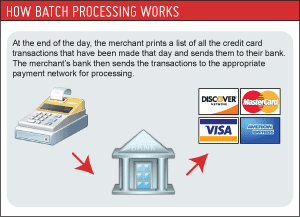
Authorization – is the first step that happens after the credit card is swiped.  The purchase and card information are sent to the acquirer who, in turn, sends the same information to the credit card issuer.  The credit card issuer then accepts or declines the transaction.  If accepted, an authorization code is generated and the purchase transaction is continues to the next step, namely: batching.

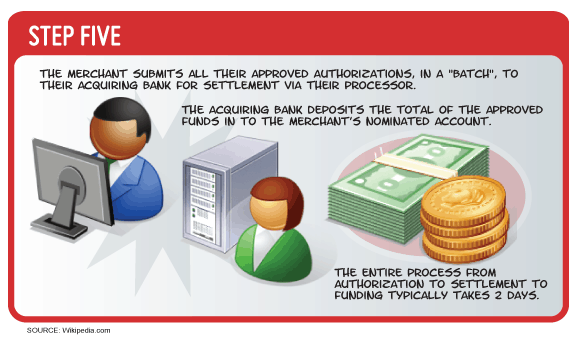
Batching – is the review process done by a merchant on all credit card transactions for the business day.  The review process involves ensuring all credit card transactions are authorized and signed by the cardholder.  After the review process, the merchant sends the information as a batch to the acquirer to receive clearing for payment.

Cardholder – he is the customer as specified on the credit card, the customer so to speak.

Card network – these are networks that act as an intermediary between the acquirer and the issuer.  Card networks transfer the information originating from the acquirer to the issuer about the purchase.  This happens in the authorization process.

Clearing – the third step in the payment process which happens after the acquirer sends the batch information through the card network to the issuing bank.  The card network acts as a router depending on the credit card issuer found on the purchase detail.  This process permits revenues for both the issuing bank and the card network called the interchange fee.  After deduction of interchange fees, the issuing bank sends the information back to the acquirer through the same card network used.

Discount fee – this fee is paid for by merchants to the acquirer to cover processing costs.

Funding – the fourth step in the credit card payment process.  This involves the acquirer sending back the transaction information to the merchant less the discount fee.  The merchant receives the remainder of the payment and is now considered paid.  This generates the cardholder’s billing statement and accounts are funded appropriately.
Interchange fee – the fee charged by card networks and card issuers to the merchants.  This fee is regulated to about 1 to 3 percent of the total purchase amount and covers the costs associated with credit card acceptance.

Issuer – the financial institution who issues credit card products to its customers.  Examples of major issuers include Discover, Amex, Visa and Mastercard.

A Step By Step Guide

And finally, to get an easy to read visual guide on how Credit Card Processing works, please visit the Host Merchant Services article archive here:

How Credit Card Processing Works

Are Smartphones the Credit Cards of the Future?

Credit card processing will continue to evolve over the next generation, according to a prominent consultant with deep roots in the industry. And, inevitably, merchants who accept plastic will need to keep pace with the changes, working with their merchant services providers to stay on top of new technology.

Jerome Svigals — known as the “father of the credit card” for his work engineering the magnetic stripe technology on which it is based — predicts that within a decade high-end mobile phones (smartphones) will supersede plastic as the primary payments vehicle.

“Banks have got to start thinking ahead for this transition period,” the former IBM project manager told American Banker magazine recently. “If they don’t, they are going to be left with a set-up that will not be useful in this new environment.”

In his report “Retail Bank 2020: A Roadmap for the Future”, Svigals maintains that the U.S. retail banking industry will evolve to have three supporting pillars: smartphones, the Internet and intelligent banking applications. The Internet, he says, will become the primary banking channel, with smartphones elevated to the channel of choice for transferring funds, opening accounts and applying for loans.

Approximately 35% of today’s bank transactions take place at teller stations; Svigals’ predicts that number will shrink to 15% by 2020 and 5% by 2029. The shift to the Internet will result in 55% of transactions, 50% of service requests and 45% of sales being initiated online by the end of the decade; in 20 years, 80% of all transactions will be Web based.

The technology exists to make smartphones the rulers of the banking universe. Earlier this summer, PayPal demonstrated its new phone-to-phone payment mechanism that uses NFC (near field communications) radio technology that will be built into future handsets. The video showed two users exchanging funds by merely touching their phones together.

Meanwhile, AT&T, Verizon Wireless, and T-Mobile are partnering to develop a mobile payment system that works with smartphones. Businessweek says such a system would “turbocharge mobile payments in the U.S.”

With cash and checks steadily falling in popularity with U.S. consumers, non-cash alternatives like credit/debit cards and electronic payments already account for more than half of all their purchases, according to the industry newsletter The Nilson Report. Additionally, more than half of U.S. consumers — and close to 80% of those in the 18-to-34 age bracket coveted by retailers — will rely on mobile financial services within five years, according to Boston consulting firm Mercatus. These statistics appear to support the idea that smartphones will replace credit cards for a majority of consumers in the near future.

Of course, in the near term the transition from credit cards to smartphones for financial transactions may resemble a see-saw: Consumers holding off on adopting mobile payments until enough merchants accept them, and merchants delaying implementation until enough consumers demand it. But the trend seems clear. Smartphone owners, start your engines!