
Tag Archives: credit card issuers

Are Credit Card Rewards Points Programs Harmful?

Over the course of the past ten years, credit card providers have ramped up their efforts to woo consumers with point-based loyalty programs.

Custom gift cards and loyalty cards are a great way to encourage repeat business and so many merchants have embraced the concept that the credit card providers have pushed. These redeemable Transaction Cards let customers make flexible decisions when purchasing goods or services from a merchant.

Early in the history of credit cards, most financial institutions were too dignified to offer game-like rewards systems involving point accumulation. As time went by, it became increasingly clear that nearly all types of credit card users were energized and excited by point systems. In the early part of the last decade, easy credit led to a dizzying proliferation of rewards programs. Although credit limits and eligibility requirements have tightened in recent years, credit card issuers maintain loyalty programs as integral parts of their marketing initiatives.

On an individual, case-by-case basis, rewards programs create very attractive incentives for customers. The public record abounds with stories of individuals who use reward points to gain earn free flights, hotel stays and other financial advantages. Collectively, some loyalty programs inspire widespread exploitation and abuse.

Since point-based reward programs are textbook examples of gamification, it is little surprise that many program members are gaming these systems irresponsibly. These individuals have perfected cunning “ghost transactions” that earn points without adding real value to the economy.

One popular technique is to purchase numerous gift cards with credit, only to use the gift balances to pay off credit card balances in a circular fashion. Though most of these schemes are technically legal, they consume manpower and resources in an exploitative manner. Point churning is a zero-sum game that leads to more expensive payments processing for retailers. Ultimately, many of these increased costs are passed on to the general public.

Point system abusers only account for a small percentage of loyalty program members. Even for ordinary users, rewards programs aren’t always as beneficial as they first appear. Individuals who use loyalty programs need to read and understand the fine print of program rules and regulations. In many cases, gains from cashing in points are fully offset by the costs of using additional credit. At their best, loyalty programs are engaging systems that spur responsible spending. However, economists argue that aggressive rewards programs can distort incentives and upset natural credit use patterns.

Here at Host Merchant Services, we are sensitive to how responsible credit card use contributes to the health of the broader economy. We provide our customers with tools to better understand and fulfill the needs of the public. Flexible, responsive payment processing encourages consumers to use credit with caution and care.
The Allure of Credit Cards for Holiday Shopping

With the Holiday Shopping Season fast approaching –– Black Friday is 11 days away, Cyber Monday is 14 days away –– the payment processing industry is still getting the last pieces in place for a brisk rush in the use of credit and debit cards. The Official Merchant Services Blog continues its series focusing on the impact the holiday shopping season is going to have on both the e-commerce industry and merchant services in general.

The battlefield is set between Debit cards and Credit cards. Debit cards received a huge boon from the federal government in the form of a cap on interchange fees that went live on October 1, 2011 in the form of the Durbin Amendment. This cap restricts the interchange fees that can be applied to Signature debit card transactions. The cap restricts the charge to between 21 and 24 cents per transaction. This is a huge cut from the previous average of 44 cents per transaction, and presents debit card transactions as an attractive option for merchants to start accepting right as we slip into the big holiday shopping rush.

That has left Credit card issuers scrambling for a response, trying to stay competitive and keep consumers answering “Credit” at the checkout line.

This Reuters article suggests one of the big campaigns that credit card issuers are going to push this year is a significant raise in rewards programs for their customers, tempting them to choose credit as their swipe of choice to get access to those sweet sweet rewards. A focus on cash back and travel rewards push the right buttons for consumers while holiday shopping.

A Look At The Numbers

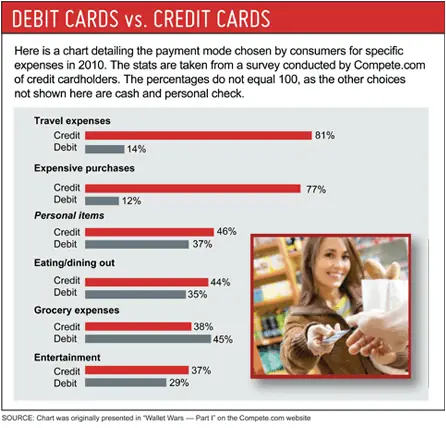
Here’s a small chart detailing the dichotomy between debit card usage and credit card usage from consumers in 2010:

The chart breaks down the chosen method of payment among a survey of credit card owners from 2010. Key numbers to note are the Travel category –– which is dominated by credit card use. It is unlikely that the Durbin Amendment and its changes are going to really affect that sector. But looking at the category listed as “Personal Items” –– which would tend to be the category for holiday gift purchases –– you’ll see a much tougher competition between the two transaction choices. This is where the Durbin Amendment changes to debit card swipe fees are going to have a large impact. And this is where the juicier cash back rewards have credit card issuers hoping they can keep things competitives.

According to the Reuters article: “For example, both Chase (CCF.A) and Citibank C.UL have cards that are offering new applicants $200 in cash back after they spend $500 on their cards.”

You Have to Dig to Find the Best Deals

Some of the best deals are not always displayed in easy to find places. The Reuters article cites a Citibank deal. On the Citi website it advertises the deal as $150 cash back on your first $500 of purchases. But then if you dig deeper by google searching “Citi Dividend $200” you find the better deal directly.

Making it Work For You

The really effective strategy to maximize these deals is to combine them with other deals you will be hit with during the holiday shopping season. The Reuters article notes: “Some cards (such as the Upromise card) have their own shopping portals that combine their rebates with rebates from merchants. In other cases, you can use your rewards points directly for holiday shopping; American Express (AXP.N) awards can be paid directly to Amazon for purchases, for example.”

This type of deal stacking gives consumers a lot of shopping incentive to choose credit as their swipe choice.