Tag Archives: contactless payments

Should my Business Adopt Contactless Payments? [2023 Update]

A Guide To Contactless Payments

What are contactless payments, and how do they work? Are they completely safe, and should you opt for the convenience of contactless payments? Over the years, technology has changed, and it has brought innovations in the way we conduct business and also in the way we many things. One of the innovations in technology is contactless payments and the tap and go form of payments. This article will talk about how you can use contactless payments, and it will also help you differentiate between contactless and cashless payments.

Contactless Vs. Cashless Payments

Contactless payments are two terms that are often used interchangeably, but these two terms are very different. Cashless payments are payments that are made without using cash and bank transfers, credit card payments, etc. are all categorized under cashless payments. Contactless payments are the form of payments that use radio frequency identification technology to make payments. Some examples include Apple Pay, Google Pay, and Samsung Pay. Instead of swiping your card, you simply wave your card to make payments, and you don’t require any signature or any pin number entered on the payment terminal. All you need to do is wave your card or smartphone near the payment terminal, and your payment is made. With smart phones, authentication may be required in the form of a pin, facial recognition, or a fingerprint scan.

What Are The Problems With Contactless Payments?
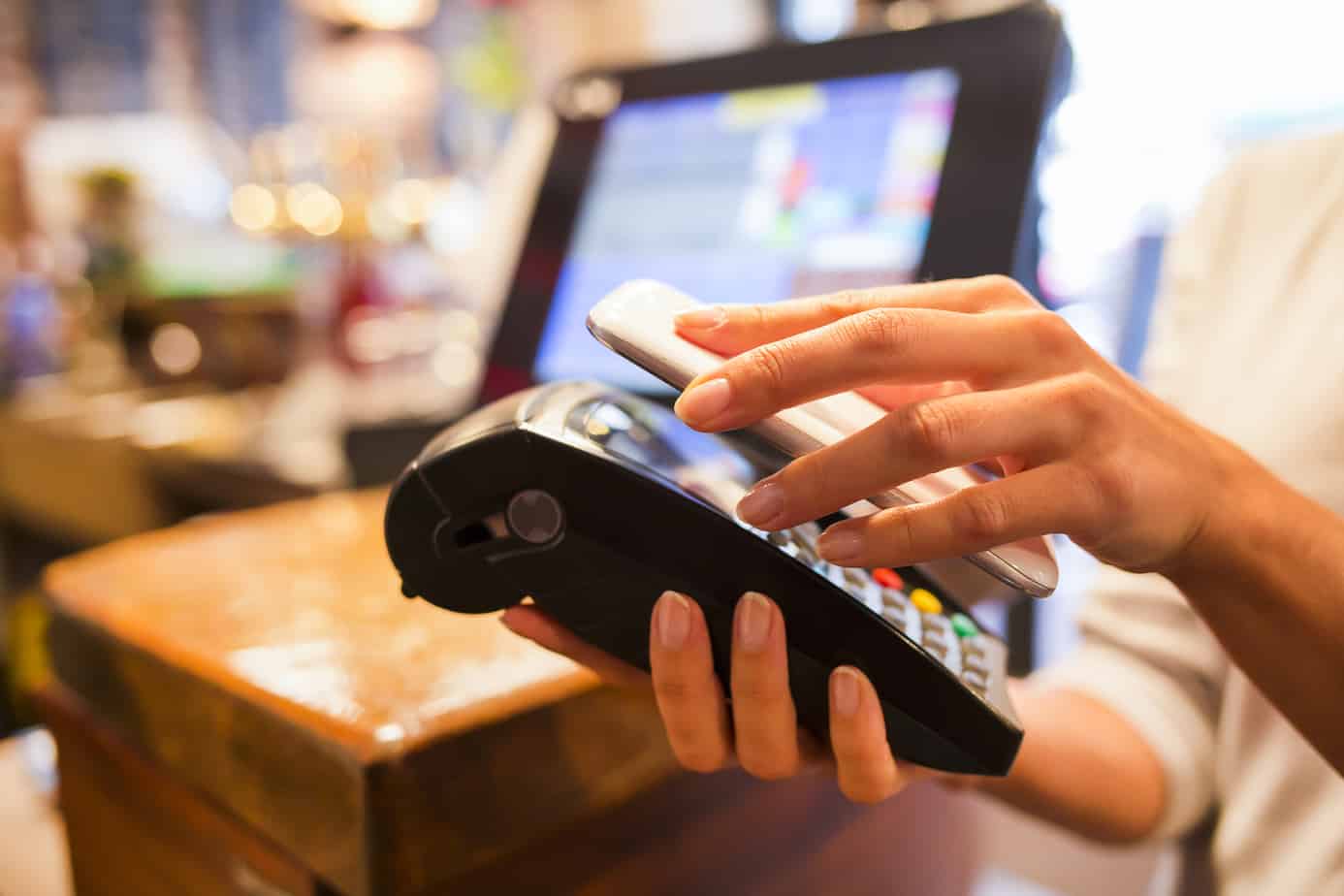
nfc apple pay google pay

Many customers are using contactless payments with their smartphones.

Like every form of payment, contactless payments are not that perfect, and they come in with their own share of problems. With contactless payments, many customers worry about fraud and whether or not their financial information will be safe. The perpetrator needs to gain access to your card to make contactless payments, and in most cases, you are notified by your bank about unusual transactions taking place, and you can easily block that card. Over time, in-person fraud has become more and more challenging to carry out, and most forms of contactless payments are PCI compliant, which protects consumers.

Why Should Businesses Adopt Contactless Payments?

Contactless payments are easy to carry out, and they are also convenient for your customers. Customer convenience is the topmost priority for businesses, and therefore companies should work on adapting measures that help make things easier for their clients. Your clients will think that you have an upgraded and futuristic approach towards the way you do business, and it will leave an overall positive impression. With the advent of technology, there are many more payment options available like Apple Pay and NFC, and many people don’t merely rely on their credit and debit cards for payments. Some customers also use their fitness watches and their wristbands for contactless payments. If you’re thinking about accepting contactless payments, then you should also consider the type of customers your business attracts. If your business attracts people that are more technologically oriented, then installing contactless payment systems can be a good option for your business, but even if not, most contactless payment terminals still allow more traditional payments like EMV chip cards. At Host Merchant Services, most solutions we offer are enabled for NFC and contactless payments at no extra cost, so our merchants are ready when their customers begin adopting these technologies.
Frequently Asked Questions

Contactless Payments

Contactless Payments on the Rise [2023 Update]

When we cast our eye across the pond and towards the rest of the world, we start to notice some very different point-of-sale (PoS) consumer behavior. In somewhere around 25 of our closest international buddies, more than 50% of all face-to-face Visa transactions are done via contactless payment. If we look over to the Australians even, that number easily passes 90%.

It’s not as if this was never attempted in the United States. There was an attempt at a broad-scale issuance of contactless cards more than a decade ago, but it didn’t quite work out thanks to lukewarm consumer attitudes and the high costs to issue them. These, and others, were pretty clear signs that it was a bit too early for the U.S. to make its first foray into tap-to-pay. Inhibitors like these, though, are long gone now, so it seems 2020 is the time for a second go now that a real market opportunity has arisen.

The United States now finds itself ready to join ranks with other leading nations where contactless payments are, if not the dominant form of payment, at least a prominent way to go about business. There are many factors, such as open-loop contactless ticketing being finally introduced to major metro systems across the country such as New York’s MTA and the LA Metro, that can further push the opportunities for a contactless cards market in the U.S., along with the following aspects:

We as consumers love our cards:

We’ve had contactless mobile wallet options like Apple Pay and Google Pay for some years now, but the uptake may not quite have been what we’d all expected, which may indicate how much more we prefer to use our actual cards. According to research undertaken by 451, 60% of consumers who prefer to avoid using their mobile wallet do so because there’s either “no need” or they have a “preference for traditional payment methods.”

The cost of issuing the cards has fallen:

The cost of issuing a contactless card has fallen in recent years, due in part international card issuers. It shouldn’t even cost a dollar for our financial institutions to issue a new contactless card, maybe not even 80 cents. This is compared to the $2 it would have cost just a few years ago.

Merchant acceptance is growing:

Thanks to the EMV (Europay, Mastercard and Visa) liability shift in the U.S. just over 4 years ago in October of 2015, the implementation of dual interface PoS terminals (i.e. terminals that offer both contact and contactless transactions) has come along a lot more rapidly. Now, of all Visa transactions in the U.S., more than 60% of them occur on a contactless-enabled machine. On top of this, more than 75% of the country’s top 100 merchants are currently offering contactless payments as an option at the checkout.

PSCU Prepared for Contactless Cards Growth in 2020

With a predicted rush in 2020 for more merchants and customers to jump onto the contactless payment cards bandwagon, PSCU announced earlier this week that they are fully prepared to handle whatever will be coming their way over the following year.

Contactless Credit Card PaymentsHaving already rolled out more than half a million NFC (Near Field Communication) enabled cards via natural reissuance to members amongst 14 owner credit unions, the credit union service organization (CUSO) PSCU anticipates that they will be distributing in excess of 3 million new NFC enabled cards throughout 2020 to more than 100 credit unions.
By keeping themselves ahead of coming payment innovations, PSCU can help to ensure that its owner credit unions members’ accounts are most frequently used, and by offering NFC enabled cards to owners, Jeremiah Lotz, managing vice president of digital experience and payment products at PSCU said, “We help our credit unions achieve top of wallet status” as the adoption of tap to pay solutions continues to rise.

The second yearly Eye on Payments study by PSCU has shown that 25 percent of respondents make transactions with an NFC enabled card a few times per month. They have cited reasons such as ease, convenience, speed, and security, while non-users stated that the stores they frequent aren’t as of yet accepting NFC enabled card transactions.

With an ever-increasing number of merchants each year opting into NFC technology and accepting NFC enabled payments, it’s believed that more consumers will begin to adopt the technology and participate. As many as 95 percent of all payment card terminals feature NFC enabled capabilities, according to Visa, and as of October 2019, 80 percent of the top 10 merchants were accepting NFC transactions.

Jeremiah Lotz has also stated: “Credit unions should be prepared to not only offer contactless cards to their members, but also have information readily available to educate members on how to use these new payment methods and ascertain whether a merchant’s point of sale terminal is contactless enabled.”

The PSCU’s original model is scale and collaboration, and for more than the past 40 years, the company has leveraged its influence on behalf of credit unions and their members. To this day, PSCU provides an end to end competitive advantage that helps to enable the secure growth of credit unions, making sure that they are able to meet ever-evolving consumer demands.

Frequently Asked Questions

Canadians Prefer Contactless Payments

Near field communication (NFC) transactions have been rising steadily all over the world for several years now, and in Canada, the dominance of mobile payment technology is no exception.

Near Field Communication Mobile PaymentAccording to Visa Inc’s Canadian unit, Canadians are now more comfortable than ever with the use of mobile payment technology, with as many as 52% of 1,000 people polled in a recent survey saying that they contactless transactions regularly. In addition to this, 80% said that they consider contactless payments as “a very convenient way to pay,” and 45% praised their security.

In the first quarter of 2019 alone, near field communication made via platforms such as contactless credit cards, wearables, and mobile devices saw an increase of almost 25% since the previous year, accounting overall for 51.5% of total transactions made.

There are eight stand-out provinces of Canada that are really leading the way when it comes to contactless payments. The province of New Brunswick has seen 51% of its transactions become contactless followed by Saskatchewan (51.6%), Alberta (52.1%), British Columbia (53.5%), Ontario (54%), Nova Scotia (55.2%), Manitoba (58.2%), and Prince Edward Island leading the charge at 59.2% of all transactions.

One huge factor that has contributed to the increase in contactless payments is the recent rise of the digital wallet. Technologies such as Apple Pay and Google Pay, while they may have started somewhat slowly, soon started to pick up speed as Canadians started to realize the benefits and ease of simply paying with their phones, which most of us, especially the millennial and Gen Z generations, will more than likely have in our hands already anyway, as opposed to searching for their credit cards.

It should be worth noting too that, while contactless transactions in Canada make up 51.5% of all transactions, in the neighboring U.S., that figure drops to a pretty staggeringly low 3%. In spite of being one of the highest adopters of smartphones in the whole world (at a rate of 77% in 2018), statistics show that as much as 89% of all U.S. consumers are still shunning mobile payments, making the U.S. one of the lowest adopters of contactless technologies in the world, and Canada one of the highest.