
Tag Archives: card transaction

A Look at VeriFone’s Vx Evolution

The Official Merchant Services Blog has been covering the basics of payment processing, offering insight and tips on the general topics of the credit card and debit card transaction industry for merchants. Today we’re going to go a little deeper, and delve into a nuts and bolts topic: payment terminals. This kicks off the first two-part series where we shine a spotlight on specific terminals that are available to merchants. After the first two-parter, we’ll occasionally revisit the topic of terminals and look at offerings from other terminal manufacturers.

Keep in mind that Host Merchant Services offers free terminals to its merchants, so reviewing what’s available and finding the terminal that fits you best can create a lot of savings on your processing bottom line in the long run. Our first spotlight shines on terminal manufacturer VeriFone, specifically the Vx series.

The Vx Evolution

VeriFone offers a series of terminals on its Vx Platform that have been slightly rebranded as the Vx Evolution. The terminals are being marketed under this evolution tag as being proven, advanced and evolved. What that boils down to is a new look with some upgrades to a line of terminals that have a history of working and working well.

VeriFone lauds the Nine Advantages of the Proven Vx Platform:

  • The Verix system that the terminals use has a decade of proven use.
  • The terminals maximize communication, speed and flexibility, support value-added transactions and deliver multi-app capability that essentially enables applications to securely co-exist on the same device.
  • A seamless transition for the next generation of the line, letting you continue to run the hundreds of existing applications that work on Verix.
  • The worldwide use and support for the popular Vx platform.
  • The lack of obstacles for platform switching, making it quick and easy to get started on a Vx platform terminal if you switch from another brand.
  • The Vx series of devices is idea for virtually any vertical market or end-use scenario.
  • The enhanced toolkit, clear guidelines and helpful documentation let users quickly build solutions based on Vx Evolution’s core technologies and capabilities.
  • The intuitive user interface helps the Vx platform get deployed quickly.
  • The ARM RealView Developer Suite (RVDS) 4.0 Complier helps you compile your applications with the Verix eVo Toolkit.

 

You can review those advantages in a downloadable PDF found here.

The Other Two Benefits of Vx

VeriFone also is lauding two other advantages for its Vx Evolution of terminals: speed and security.

The Need for Speed

According to VeriFone, the Vx Evolution delivers secure payment processing eight times faster than its competition. It claims it can do this with a superior single processor that outperforms dual processors that competitors use. Using the metric of MIPS –– Million Instructions Per Second –– this graphic shows how VeriFone’s 500 MIPS ARM 11 processor works:
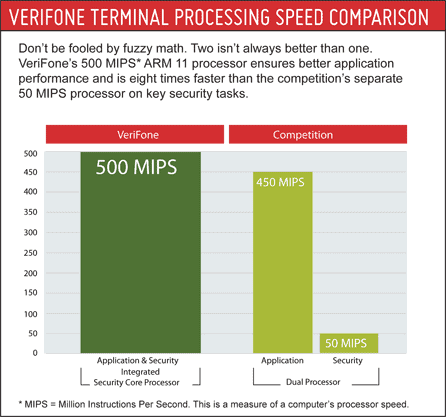
Essentially what VeriFone is saying is that competitors use a 450 MIPS processor to run applications and a second 50 MIPS processor to handle critical security tasks. They claim this slows down secure transactions to 50 MIPS. But VeriFone, with its Vx Evolution brand, utilizes a built-in, integrated security processor. It’s running at 500 MIPS for everything –– applications and security.

You can fully review VeriFone’s documentation on speed by downloading a PDF about it here.

Staying up to Date on Security

The next advantage VeriFone is lauding its Vx Evolution brand with is security. This is of particular interest to The Official Merchant Services Blog because we’ve written in the past about PCI Security Standards. In fact, we took a close look at a study by Verizon that showed 79% of merchants surveyed were not fully compliant with PCI DSS standards.


Host Merchant Services offers a free PCI analysis for merchants and makes PCI Compliance a priority for its merchants. Which is why the Vx Evolution brand is noteworthy.

According to VeriFone their Full Spectrum Security package –– which is standard with all of its Vx terminals in the platform –– gets their terminals up to PCI PED 2.0 standards. So Host Merchant Services, in its push to keep all of its merchants compliant year in and year out, embraces the Vx platform of terminals that are stamped with the PCI PED 2.0 Approved seal.

At a time when many merchants are having issues maintaining the old PCI security standards, the VeriFone terminals are stepping up their game and making it easier for merchants to maintain the new PCI compliance standards. This lets Host Merchant Services merchants stay compliant moving forward and gives HMS a leg up in its initiative for quick, easy, and worry-free PCI Compliance.

You can read more about the security benefits of Vx Evolution by downloading a PDF here.

To Be Continued …

In the next part of this series, we’re going to look at the terminals themselves and see how they apply those Nine Advantages VeriFone has lauded.

In the meantime, what do you think of this branding? Have you used any Vx terminals? In the past? In the present? Let us know.

Tiered vs. Interchange Plus Part 2

The Official Merchant Services Blog continues it’s two-part series on Tiered Pricing vs. Interchange Plus. After yesterday’s blog defined what Three-Tier pricing looks like, we now take a closer look at how it falls apart and does not save merchants money. Then we’ll outline Interchange Plus pricing and highlight why Host Merchant Services uses this plan to save its merchants money.

Where the Problems Occur

The three tiers of a typical Tiered Pricing plan are commonly referred to as rate buckets or buckets. And Merchant Service Providers who use tiered pricing structures for their customers utilize a “qualification matrix” that dictates which rate bucket the various interchange categories will qualify to. That means that the fees can shift from month to month as a merchant consistently fails to meet the “standard” transaction of the Qualified bucket. Thus each month they consistently have to pay surcharges from the other two buckets which aren’t adequately displayed or described on their statement.

And because these fees and surcharges from the other two bucket rate tiers are often hidden, that makes it difficult to accurately compare rates and fees from competing providers unless a merchant knows how each provider will be qualifying those categories. Because the categories aren’t directly comparable and because the qualification matrix can shift fees on a merchant from month to month, a common occurrence is a merchant can look at two separate tiered pricing offers from different Merchant Services Providers that look nearly identical because they use the same language for each tier, and yet could be different by hundreds of dollars each month.

Merchants Have to do the Hard Part

This puts the responsibility squarely on the shoulders of the merchant. They need to read the fine print of their statement and understand the subtle differences between the tiers to note when they get shifted to a different tier. This is the most common way Merchant Services Providers make money. The sales pitch when signing the merchant focuses on the low end bucket that saves the customer the most money. But then once the processing starts, buckets shift and the merchant gets a lot more charges than they initially signed up for.

So if your statement shows that you have a lot of mid-qualified or non-qualified surcharges each month, it’s time to consider switching to Interchange Plus, the pricing structure that Merchant Service Providers like Host Merchant Services offers.

The Advantage of Interchange Plus

Interchange Plus pricing is based on the “interchange” tables published by both Visa and MasterCard. At first that may seem like a daunting pricing plan. But it ends up being a lot easier to understand, completely transparent to the merchant, and less expensive than tiered pricing plans. Interchange plus pricing has the merchant pay the exact interchange fee from the tables in addition to a flat markup fee from their Merchant Services Provider. That’s where the name comes from: It’s the Interchange fee Plus the markup fee. This eliminates all of the hidden fees you would find in a tiered pricing plan. And gets rid of surcharges that merchants would incur for transactions that don’t fit the standardized portion of the rate bucket matrix. You pay what you are told you will be paying.

This makes it less popular than tiered pricing plans where Merchant Services Providers can make quite a bit of money off of those surcharges due to the latitude they have in defining their tiered bucket rates. But Interchange Plus makes statements easier to read, customer service easier to provide to merchants, and savings much easier to guarantee. All of those elements are cornerstones of Host Merchant Services. So Interchange Plus is the best fit for the company and for their customers.

Tiered Pricing vs. Interchange Plus

Today The Official Merchant Services Blog is going to delve into the murky world of hidden fees and tiered pricing plans. This is the first in a two-part series and it focuses on Tiered Pricing. Host Merchant Services offers an Interchange Plus pricing plan. The company offers this plan because of its transparency and the savings it can provide when compared to the far more popular tiered pricing plans. To get a better grasp of why Interchange Plus works so good for Host Merchant Services, it helps to understand what is happening with a tiered pricing plan and how that kind of plan works.

Hidden Fees From Tiered Pricing Plans Unfair to Merchants

Tiered credit card pricing can be unfair to small business owners. Many credit card payment processors calculate merchant costs using a tiered pricing structure. These tiered pricing levels increase the costs for merchants by suggesting they are paying one rate, but hiding other fees into the statements and in the end the merchant is paying a higher percentage. The answer to this problem is Interchange plus pricing.

Host Merchant Services uses Interchange Plus. And this pricing structure is the most transparent and easiest to read system in terms of the statement and the way fees are charged. The merchant sees everything they are being charged for in their statement. Nothing is hidden, and there are no shenanigans employed in getting merchants to think they are saving with a low rate that ends up being made up for in a series of other fees snuck into each statement.

Three tier pricing is currently one of the most popular pricing structures used in the payment processing industry. Here’s a table that defines the three tiers:

It’s all About The Surcharges

Tiered pricing plans start with the qualified rate. This is the standard fee a merchant is charged when they accept and process a credit card or debit card transaction. This is also the lowest rate the merchant can incur. Transactions that don’t qualify for the standard set forth at that rate get hit with various surcharges. And its these surcharges where the processor starts to make a lot of profit. And its these surcharges which are usually the hidden fees that don’t show up on a merchant’s statement.

There are over 500 different interchange categories between the major credit card companies and each category has its own charge that is comprised of a percentage and often a per transaction fee. The three tier pricing structure merges all of these charges into three buckets. And a Merchant Services Provider has its own discretion, to an extent, as to which bucket or tier they place these categories.

These underlying interchange categories are not disclosed on a tiered pricing plan so there’s no way of knowing into which bucket each category is being charged. This is where hidden fees crop up.