
Tag Archives: card swipe

chargeback ratio

Durbin Saga: Banks Reconsider Fees [2023 Update]

The Official Merchant Services Blog brings you a breaking news story following the ongoing aftermath of the Durbin Amendment legislation. Yesterday, Bank of America announced it was going to cancel its $5 monthly debit card fee plan. This falls in line with similar announcements from Sun Trust, Regions Financial Corp., JP Morgan Chase & Co. and Wells Fargo all stating they were no longer going to test monthly debit card usage fees at all.

As previously reported, there has been a staunch amount of criticism and backlash against Bank of America after it announced it was going to charge customers a $5 monthly fee to simply use their debit card. The bank was one of a group of banks gearing up to charge fees for debit card usage, all in a response to a debit card swipe fee cap that was instituted by the financial reform legislation in the Durbin Amendment. This reaction was predicted by Host Merchant Services earlier in the year when the company analyzed the Durbin Amendment and its potential impact.

As reported by The New York Times yesterday: “Bank of America blinked on Tuesday. The bank, the nation’s second-largest, said it was abandoning its plan to charge customers a $5 fee to use their debit cards for purchases. Only a month earlier, the bank had announced the new charge, immediately setting off a huge uproar from consumers.”

Primary Target

Bank of America became the most high profile target of consumer backlash and had a polarizing effect throughout the media on this issue, thrusting the Durbin Amendment and big banks firmly into the spotlight. Part of what made Bank of America the primary target for the Durbin Amendment stories was that they were the only bank that declined to test the fees, deciding to just add the fee starting in 2012. Another part that made Bank of America a target was their position as the leading bank in terms of debit card transactions. And finally, Bank of America made such a tantalizing target because of its history with receiving federal bailout money and their foreclosure practices which caught the attention of the Occupy Wall Street protest movement.

As reported in a Business Week article: “Bank of America Corp. is scrapping its plan to charge a $5 monthly fee for making debit card purchases after an uproar and threatened exodus by customers.The about-face comes as customers petitioned the bank, and mobilized to close their accounts and take their business elsewhere.”

You can review much of that saga in Host Merchant Services own Countdown to Durbin blog series.

Last Bank Standing

And while the customer outcry and criticism was certainly a factor, it’s also worth noting that Bank of America came to this decision after all the other major banks backed off fees. As reported by the New York Times: “Despite an outpouring of complaints online and at branch offices, the bank had remained steadfast in its plans until last Friday, according to a person briefed on the situation, planning to ease just some of the conditions for avoiding the fee. But over the weekend, after two major competitors — Wells Fargo and the nation’s largest bank, JPMorgan Chase — said they were backing away from their plans to levy similar charges, two high-ranking Bank of America officers recommended to Brian Moynihan, the bank’s chief executive, that the bank simply drop the fee.Then, on Monday morning, when SunTrust, a regional bank in Atlanta, said that it, too, would abandon its $5 charge, Bank of America was left standing alone, the last major bank planning the fee. The announcement came on Tuesday.”

And also reported by Business Week: “The outcry had already prompted other major banks, including JPMorgan Chase & Co. and Wells Fargo & Co., to cancel tests of similar debit card fees last week. SunTrust Banks and Regions Financial Corp. followed suit on Monday.”

What Next?

This move by the banks, however, leaves them still searching for a way to offset the losses that the Durbin Amendment and other financial reforms are going to force onto them. The New York Times article suggests: “Now that all the large banks have decided not to impose the debit fee, experts said, they will find other ways to fill the hole. ‘Those revenues paid for a lot of things,’ said Joe Gillen, chief executive of Pinnacle Financial Strategies, a bank consultant in Houston.

Now, he said, consumers can expect more fees over time. ‘It will be slow and gradual, but they will bring those revenues back,’ Mr. Gillen said.”

And the Business Week Article stated: “In particular, banks in the past year have blamed their fee hikes on a new federal regulation championed by Senator Dick Durbin of Illinois. The law, which went into effect last month, caps the amount banks can charge merchants whenever customers swipe their debit cards. JPMorgan has said it would lose $300 million each quarter as a result of the regulation; Wells Fargo said it would lose $250 million a quarter.”

The Official Merchant Services Blog will continue to keep you updated on all aspects of the Durbin Amendment. With the banks backing off of their proposed fees, it looks like the next development may hinge on the viability of the October 14 bill introduced into Congress to repeal the Durbin Amendment.

Durbin Amendment About To Be In Effect

On the last day of September, Durbin Amendment Eve if you will, The Official Merchant Services Blog is about ready to end its Countdown to Durbin Series. Today we take a look at the big news that has the media buzzing.

Bank of America Reacts to Durbin

Bank of America, the largest bank in the country going by deposits, announced it is going to begin charging its customers a $5 monthly fee to use debit cards. The bank will begin charging the fee next year for the bank’s basic checking accounts. It will apply only to debit card purchases and not to ATM withdrawals, online bill payments or mobile phone transfers, the company said.

Consumer Backlash and Cut Up Cards

Bank of America announced this change, which will take effect for its customers in 2012, and were soundly slammed with negative feedback. Our first link comes from Fox Business Network, where Gerri Willis cut up her debit card on the air in reaction to the news from Bank of America. “Right here, right now, I’m going to show Bank of America what I think of their fees,” she said before using a pair of scissors on her card.

Durbin Slams Bank of America

Our next link comes from The Washington Post. It picks up the topic, mentioning what Willis did on the air. It then offers Bank of America’s defense of this new fee, stating that the bank is doing this to recoup losses that will come from the cap on debit card swipe fees that the Durbin Amendment will put into place tomorrow on October 1. Then the article quotes Senator Dick Durbin: “Bank of America is trying to find new ways to pad their profits by sticking it to its customers,” Durbin said in a statement Thursday. “It’s overt, unfair, and I hope their customers have the final say.”

Bank of America Already in Crisis

While this move was quite predictable, and falls into line with Host Merchant Services’ previously published analysis of how banks will react to the Durbin Amendment, the news is quite incendiary because of Bank of America’s current situation. Which is mentioned in the third article we highlight on Bank of America, by Fox News: “the Bank of America decision drew outrage for several reasons. The company is the largest U.S. bank by deposits. And it reaped $45 billion in federal bailout money — receiving the first chunk in 2008 and the rest in 2009 to cope with losses at Merrill Lynch. “

The article also mentions that Bank of America did pay back the government all of the bailout money.

Bank of America a Microcosm of Durbin’s Impact

A fourth article, from the Christian Science Monitor, sums up quite succinctly how this news is quite standard Durbin Amendment fallout: “So in other words, Bank of America is shifting a part of the fee obligation from merchants to customers.”

As we’ve seen in the ongoing Countdown to Durbin series, this is one of the most expected moves that banks are making. Shifting the burden of the fees away from merchants and putting it squarely on the shoulders of the consumers. This avoids the scope of the Durbin Amendment’s regulations and lets the banks continue to reap profits from the billion dollar payment processing industry.

Rounding out the coverage of Bank of America and its announced monthly debit fees we find:

The Chicago Tribune offers a quick glance at Bank of America’s plan here.

The Baltimore Sun blogs to its readers to avoid these types of fees by switching to ATM only.

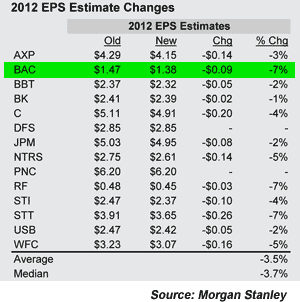
And the final little tidbit we offer you today on the eve of Durbin enactment comes from The Street, reporting that Morgan Stanley cut 2012 earnings estimates for Bank of America and 11 other banks.

This chart, while the story states is not entirely tied to Bank of America’s recent announcement or to the Durbin Amendment, does show that banks will be affected by the Durbin Amendment. They will have to make changes to deal with the losses they expect to take from a hard cap on fees that they were profiting from, and if Bank of America is any indicator, the burden of those changes will go from the merchants who used to get hit with the swipe fees to the consumer who will now have to pay more to support the use of debit cards.

Durbin Amendment Almost Here

The Official Merchant Services Blog once again takes up the task of analyzing the media reports revolving around the Durbin Amendment and the changes it will bring to how banks do business with their customers because of its cap on debit card swipe fees. We continue to use Host Merchant Services‘ own analysis as the foundation of the comparisons we make regarding other media sources and their take on the legislation and its impact.

Durbin on Durbin

The first article comes from a Chicago-based radio station WLS 890 AM. It’s an interesting read because it quotes the legislation’s namesake, Senator Dick Durbin from Illinois. It’s one of the few articles that includes Durbin’s perspective on the legislation as we get closer to the October 1 date of when the law takes effect. The article begins with a brief explanation of what Durbin sought to do with the legislation:

“Sen. Dick Durbin told reporters Tuesday afternoon that the debit card fees retailers have to pay will go down Saturday thanks to the Durbin Amendment.”

It then offers a lively retort from J.P. Morgan Chase executive Jamie Dimon: “The big boss at J.P. Morgan Chase, Jamie Dimon, calls this ‘price fixing at its worst’ that will surely cause banks to raise fees on customers with deposit accounts. “

While many of the articles on this amendment have been dancing around the confrontation between consumers and banks over the Durbin Amendment this article dives right into the rhetoric, giving it a much more active tone for the reader and an insight into the debate that framed and spawned the legislation. It helps that the article ties this confrontational perspective into the legislation’s author and Durbin’s motivation for working on the amendment. Citing a letter that Durbin wrote to Dimon back in April, the article states: “Durbin said to Dimon, ‘Your industry is used to getting its way with many members of Congress and with your regulators. The American people deserve to know the real story about the interchange fee system and the ways that banks in general — and Chase in particular — have abused that system.’ “

But the basic conclusion is pretty much the same as the other articles focusing on the amendment and what changes it will bring on October 1. The conclusion is that banks will react by creating more fees for their customers and just recouping the losses from the swipe fee cap in other areas not covered by the legislation. Durbin is quoted in the article, calling that tactic “indefensible” but conceding it is the likely outcome of the amendment. The article sums it up: “So what the government giveth, the banks may take away.”

The Cost of Doing Business

The next article we look at is an Associated Press piece located on Bloomberg’s website. It’s a report that reveals how much money American Express spent in the second quarter of this year to lobby Congress and fight against the implementation of the Durbin Amendment.

American Express Co. spent $610,000 in the second quarter to lobby the federal government on rules involving the fees charged to merchants for processing payments and other issues, according to a disclosure report.”

The article notes that the company spent the same amount of money in the previous quarter of 2011, but that they spent 3% more money in the second quarter of 2010 comparatively. The article also notes that Amex doesn’t offer debit card services, but does offer interchange services on credit card payments, suggesting that was the reason it spent money to lobby Congress on the topic. The money wasn’t solely spent on lobbying against the Durbin Amendment. And the article notes that: “Amex representatives also lobbied the federal government on legislation involving online tracking of consumer behavior and the protection of personal information, cyber security, financial regulatory reform, consumer financial protection and issues related to reloadable prepaid cards, patent reform, tax reform and reform of the U.S. Postal Service.”

So what we see in today’s Countdown to Durbin is a look at how heated the debate still is between the legislation’s namesake and the big banks that are targeted by the reform. The intensity of this debate was such that American Express even spent more than $600,000 in a single quarter to lobby against it in 2011.

Durbin Amendment Ready To Go [2023 Update]

The Official Merchant Services Blog continues to keep its finger on the pulse of the Durbin Amendment media buzz. The legislation that marks regulation that caps debit card swipe fees begins to take effect on October 1, 2011. And there’s still a lot of scrambling from various media sources to try and predict how banks, merchants and consumers will be impacted by the cap on the billion dollar payment processing industry.

Host Merchant Services has been ahead of the curve in both its analysis of the legislation and its reaction to the legislation.

Today, The Official Merchant Services Blog takes a look at two different articles discussing the Durbin Amendment and the changes it brings.

Banks Plan to Recoup Durbin Losses With Other Fees

The first article comes from mainstreet.com. It’s a pretty standard discussion of the most predicted reaction: Banks will react to the losses that the Durbin Amendment cap places on their swipe fee revenue from previous years by creating new service fees for debit card use. So instead of charging per swipe, the banks move the charge directly to the cardholder as a service fee for having debit card services available to them.

The article cites a robust number of debit card users in the U.S.:

“Americans sure love their debit cards. Between Visa  and MasterCard there are more than 520 million debit cards in use nationwide today. “

That frames the basis of why banks are working to come up with a reaction to the Durbin Amendment. With that many debit card users in the country, there are billions of dollars in profit being cut into with the swipe cap. As the article explains, a quarterly survey of debit card use by financial consumers produced by Manhattan-based Auriemma Consulting Group finds: “banks remain stung by changes in debit card fees (called interchange fees) that reduced the amount of fees banks could charge customers for debit card transactions. The changes, which were triggered by the Durbin Amendment in the Dodd-Frank financial reform bill, basically cut debit card transaction fees in half, the ACG reports.”

The article goes on to explain how many banks are wary over the consumer backlash that could result from charging monthly fees for debit card use and scaling back or restricting reward points programs. The article quotes  Ed Lawrence, director of the debit marketing roundtable at the ACG as saying: “The first-movers to institute debit/checking fees in a given market will experience the most scrutiny and possible attrition, along with negative press; as others follow, customers will have fewer places to move to.”

The conclusion drawn from the article is that Durbin puts the banks in a position where they have to react with changes in how they offer debit card services. And the most likely choices are consumer fees for debit card usage and/or reward points programs being restricted or removed. The banks know these choices will be unpopular with consumers but there’s likely to be a domino effect where once a few banks do it, many more will follow suit, leaving consumers with less and less alternatives.

Some Tips On Dealing With Durbin

The second article comes from USA Today’s Money section. Sandra Block offers some insight into Durbin that mirrors much of the insight every other article about Durbin that The Official Merchant Services Blog has reviewed. But Block offers consumers advice on how to deal with the changes that Durbin is going to bring to their wallets: “The good news: There are numerous ways to avoid these fees. Some tips …”

Block offers four basic tips for consumers to do in response to their bank’s reaction to the Durbin Amendment.

  • Tip 1: Forget about interest checking accounts. Block notes that the increased cost of maintaining this type of account ($5,587 for the interest account vs. $585 for the non-interest account) isn’t worth the 0.08% interest the account offers.
  • Tip 2: Set up direct deposit. Block notes that many banks offer to waive checking account fees for customers who set up direct deposit.
  • Tip 3: Consider switching to a small bank or credit union. Block notes that banks and credit unions with assets lower than $10 million are exempt from the Durbin Amendment changes.
  • Tip 4: Watch out for Debit Card fees. Block’s final tip is for consumers to pay close attention to their debit card fees. Many banks may not change immediately and be slower to react to Durbin so consumers should be aware of the details of their statements going forward.

The Official Merchant Services Blog keeps finding the same theme that the media is bringing up about the Durbin Amendment. Banks do not want to lose the billions of dollars that their transaction fees were bringing them prior to the swipe fee cap. So they are going to find ways to move things around to keep the revenues coming in. And many of the proposed changes are ideas that will end up being shouldered by the consumers. The demographic that this finance reform legislation was initially supposed to assist.

E-Commerce uses Mobile Payments and Near Field Communications as new Merchant Services Solutions

Payment Processing Changes and How They Effect Small Businesses

It used to be one of the big decisions a small business had to make was whether or not to accept credit cards. But with E-commerce booming and consumers continually reaching for plastic instead of paper for their transactions, that decision has pretty much been made for small businesses. They have to accept some form of card payment as fewer people carry cash. However, the technology for payment processing is advancing at a high rate right now. And many studies predict mobile payments are on the verge of transforming the way people pay for things even more than before. The future of payment processing is ripe for change.

The Current Payment Processing Landscape At A Glance

Merchant Services, by its very nature, is an industry that for the most part seeks to work unnoticed by the consumer. The companies performing this service, which can be explained here in this Host Merchant Services infographic, tend to make their money off of percentages of a penny. Transaction by transaction those percentages grow into pennies, and as volume increases even further those pennies increase into dollars.

A lot of small business owners have horror stories about their payment processors because a really common practice that companies in the industry started to do to each other to compete better, was to boost the expenses from those transactions, and those percentages of pennies, with hidden fees and contractual obligations.

It got so bad that federal legislation, in the form of the Durbin Amendment, was passed as a way to combat debit card swipe fees. Host Merchant Services is already tracking the effects of those changes in a series right here on the Official Merchant Services Blog.

Changing the Game

But that’s not the only way the game is changing. Some companies, like Host Merchant Services, see the opportunity being created by the old standard. So HMS shines light on hidden fees, cuts away the fat from these agreements and HMS even goes so far as to not hold its merchants to contracts or termination fees.  Many of the features you find at Host Merchant Services are designed specifically to appeal to small business owners. A service oriented Merchant Services solution that lets the merchant know exactly what they are paying on their statement.

Technology Adds its Own Wrinkle

Beyond just what Host Merchant Services is doing to change the model for Merchant Services Providers, the industry is being shaped by advances in technology, specifically the potential for profits from mobile payments. Small Business Owners are starting to find the convenience of being able to process a payment anywhere can give them more flexibility to reach their customers. And so the companies developing the technology for these mobile payments are racing to reach the market with their ideas and advances.

Square Up  –  In 2009 the Co-Founder of Twitter, Jack Dorsey, introduced a breakthrough device that allows both individuals and businesses to swipe and process credit cards directly on their iPhone or Android phone. While Square was not the first company to do this, what set them apart was their fee structure and their lack of a contract. Square has no contract, does not have any monthly fees and only charges when a card is swiped or keyed in. They currently charge 2.75% of the transaction for each swiped card. This is their big selling point because Square lets small businesses that did not have the resources prior to begin accepting credit cards. This is appealing to small businesses with low or inconsistent volume that would normally be burdened by the heavy costs associated with setting up a merchant account.

Google Wallet  – On the other side of the payment world there is Google, who partnered with Citibank to create a new product called Google Wallet. This new mobile payment technology allows consumers to attach a credit card number to an embedded near-field communications (NFC) chip in their Android phone. This in turn gives that person the ability to make payments by swiping their mobile phone next to a chip reader.

NFC technology has been around for about a decade, and is still being tested in target market areas. Google Wallet will be tested first in New York City and Google hopes to roll it out for the rest of the country in 2012. Host Merchant Services noted this previously in an article.

HMSPay  – Host Merchant Services offers its own mobile payment solution, HMSPay. This is similar to Square in that it’s a device that attaches to an iPhone. And its big selling point is that it adheres to HMS’ standards of service and savings. Merchants who use it are able to get ultra-competitive rates that let small businesses take credit cards without being overwhelmed by hidden fees and other excesses found in the Merchant Services industry.