Tag Archives: bank of america

Bank of America to pay $772 Million Penalty

On Wednesday April 9, 2014 Bank of America settled a lawsuit and agreed to pay $772 million in penalties for deceiving millions of customers into buying costly and unneeded services when they signed up for credit cards.

The Crux of the Case

The Consumer Financial Protection Bureau said that Bank of America illegally deceived 2.9 million customers into buying extra credit card services those customers did not need and that Bank of America charged others for needless credit monitoring between 2000 and 2012.

“Bank of America both deceived consumers and unfairly billed consumers for services not performed,” Richard Cordray, director of CFPPB told the Associated Press. The settlement deal is the largest refund amount ordered to date by the CFPPB, and is the biggest settlement over credit card “add-on” services won by the federal government.

Bank of America will also have to pay an additional $20 million penalty to the Consumer Financial Protection Bureau and $25 million to the Office of the Comptroller of the Currency.

Delving into the details of the settlement, some of the misleading practices included Bank of America telemarketers telling customers that the first 30 days of a service were free when instead the customers were charged. Also, the bank led customers to believe that they were merely agreeing to receive additional information about add-on services, when in fact the bank was enrolling those customers into the services during calls.

Bank of America released a statement saying that the bank had already refunded money to a “majority” of the affected customers.

Bank of America’s Been to the Dance Before

This isn’t the first time Bank of America has been hit hard by its desire to charge customers fees. Back in 2011, when the Durbin Amendment going into effect was all the rage, Bank of America came up with a plan to charge their customers a fee for using their debit cards.

Bank of America stated its reason for this fee was to offset predicted losses the bank would incur because of the Durbin Amendment.

This went over like a lead balloon, and eventually Bank of America backed off this idea. It’s no mere coincidence that this fee and the resultant backlash heralds from the time period covered in the lawsuit. It seems back in those days, Bank of America was just really into adding fees for everything it could think of.

Transparent Pricing and No Fees

Host Merchant Services was hip to the pitfalls of fees right from its inception. HMS delivers personal service and clarity. The company promises no hidden fees. And a transparent pricing plan so that its customers are not saddled with all of these “add-ons” that Bank of America was so gung-ho about in 2011.  HMS  believes that when you get your statement every month, you should understand every item, and it should match what you were promised in the sales process.

Bank of America Cutting Jobs

The Wall Street Journal, citing a document they obtained on September 20, revealed Bank of America has plans to cut 16,000 jobs by the end of the year.

This move is not exactly surprising news since the company had already discussed plans to shave 30,000 jobs in a plan to trim jobs and cut costs by the end of 2013. The move, however, does accelerate the earlier plan from cost cutting that would take more than a year — and eliminate annual expenses by $5 billion — to cost cutting that will happen right now.  The overall plan of cutting 30,000 jobs is designed to help the company offset unprofitable moves such as the 2008 takeover of Countrywide Financial Corp.

In fact, Forbes, in this article reporting the news of the job cuts, characterizes the mortgage section of the bank as something that “has hamstrung the bank” citing specifically the acquisition of Countrywide. The article notes that 3,200 of the job cuts could come from the division overseeing new mortgages.

Overall, these proposed cuts will bring Bank of America’s workforce down to 260,000 overall employees by year’s end — a number that drops the bank from being the biggest employer in the U.S. banking industry. After this round of cuts hits the company’s bottom line, Bank of America would fall behind Wells Fargo and JP Morgan Chase.

The Official Merchant Services Blog is citing these cuts because beyond the issues brought up with Bank of America’s acquisition of Countrywide, one of the other key factors in the bank losing profits was the Durbin Amendment. Back on October 13, 2011 we reported Bank of America felt a huge national backlash based on its reaction to the Durbin Amendment. The bank decided to offset losses it would incur from the legislation’s hardcap on debit swipe fees — losses which Forbes reported in March 2012 to be $441 million in Q4 of 2011 when compared to Q4 2010 — by initiating a $5 monthly transaction fee for using their debit cards.

This type of move was predicted by Host Merchant Services in its Durbin Amendment analysis, and was embraced by a host of large, debit card focused banks, besides just Bank of America. JP Morgan Chase, Sun Trust, Regions Financial Corp., and Wells Fargo all had plans to charge a similar fee. But consumer backslash was intense, media scrutiny was focused, and Bank of American in particular felt the brunt of the Occupy Wall Street movement at the time. So the banks all backed off of the idea to implement these added fees.

The hardcap being what it is, however, left Bank of America with the continued problem: Losses.

So as part of a combination of bad moves, Durbin included, the bank is faced with the decision that to stay profitable they have to cut jobs. Some analysts, such as Anthony Polini, for the investment firm Raymond James, feel these belt-tightening measures are evidence of an agile and healthy company. “The company is doing great,” the analyst said in this article, “It’s another phase of expense control.”

The bank’s stock price took a hit based on the news as shares closed down 0.82 percent to $9.11 on Friday.

Durbin Amendment Fallout

Today The Official Merchant Services Blog offers a really quick update on the fallout from The Durbin Amendment. You’ll recall Host Merchant Services offered a thorough analysis of the legislation before it took effect.

Much of the current media coverage for this topic revolves around something we predicted in that analysis: “The banks, not wanting to take a $9 to $10 billion dollar loss in revenues for the year, will simply add fees to other payment options or get rid of premiums and extras that they had been offering.” We also stated: “Higher fees on checking accounts and the removal of debit card rewards programs were suggested as a response banks would have.”

Banks Lead the Charge With New Fees

This article from twincities.com reports pretty much what we’ve been reporting about the response banks are having with the Durbin Amendment. The article, dubbing this strategy as Bank Fees 2.0, states: “Three months after banks scrapped plans for debit card fees, it’s becoming clearer how they intend to recoup money lost in the Dodd-Frank financial reform law. Instead of one new fee, prepare to be sold more products, offered new service packages, lose debit rewards and face more fees in general.”

This creditcards.org article reports the same: “So [the banks] enter 2012 chastened … and still facing a revenue gap. How are they going to make it up?  In fees, of course!  Just not the fees you were expecting. The Bank of America mess taught them a lesson; trying to unilaterally slap all their customers with a new fee is going to end badly, especially in the current climate, where the man on the street is hopping mad about big bank behavior.  So instead, they’re going to be sneaky about it.”

The article then offers a checklist of fees that could be forthcoming.

  • Minimum Balance requirements to increase for formerly free services such as checking accounts.
  • Penalty fees to go up.
  • One-time service fees — such as for opening a safety deposit box, or taking out a money order — to go up.

And then finally The Baltimore Sun offered this article which states that banks plan to add a wide variety of fees to help offset the losses from the Durbin Amendment. The article states “There are nearly 50 different fees consumers can wind up paying, depending on the services they use and how they use them, according to some consumer advocates’ latest estimates.” The article then quotes Alex Matjanec, co-founder of MyBankTracker.com, a consumer-finance information website describing the fees, “Most of these fees are not the in-your-face charges, such as the debit-card fee that caused the big uproar. Many are flying under the radar. But they could have a big long-term effect on your money if you aren’t paying attention.”

The sneaky fees were something we covered in The Official Merchant Services Blog entry on November 16, 2011: “Banks are now going ninja style with their plan of action. Sneaky fees hidden and peppered about their services. All combining to help make up the ground they were going to lose. But most of them deposited around their whole suite of services that it is much harder to latch on like a pit bull and berate them for doing this.”

Big Bank, Big Losses

The losses that banks need to make up are starting to come in and be reported. It was predicted they would be in the billions, and the latest analysis of fourth quarter earnings reports state that right now it’s about $6 billion in loss. The two largest banks handling these types of transactions — Bank of America and Wells Fargo — equal roughly $800 million of that loss. Here is an infographic breaking down the four biggest banks and their fourth quarter losses from the Durbin Amendment cap:

Durbin Aftermath: Banks Go Ninja Style

The Official Merchant Services Blog continues its far reaching and ongoing coverage of the Durbin Amendment and the aftermath of what this legislation brings. Just a quick recap of what the Durbin Amendment did: On October 1, the legislation put in place a cap on interchange fees from debit card usage. Prior to the legislation taking affect, the fee merchants were charged on the average transaction was around 44 cents. The cap put in place by this finance reform legislation put the ceiling for the fee at 21 cents, with provisions in place that allowed most banks to reach a maximum of 24 cents for the transaction. This cut into the profits that banks were essentially “banking on.”

Host Merchant Services provided an extensive and thorough analysis of the Durbin Amendment before it took affect. And our analysis predicted the same reaction from the banking industry that many other media sources predicted –– Banks would not want to lose those profits. Billions of dollars were at stake. The banking industry’s reaction is pretty straightforward: The burden of the fees would be shifted to other parts of the services they offer. The costs and fees would go from the merchants, to the consumer.

Bank of America Takes the Heat

There was a very public media backlash over “Round 1” of this plan, as people slammed the banks for their plans to add monthly fees to debit card usage. The most notable reaction was against Bank of America, who announced they were going to charge customers a $5 monthly fee to use debit cards. This announcement polarized the Occupy Wall Street movement giving them a target for their ire and then was slammed in a wide variety of media outlets (including one Fox News Anchor who cut her debit card up on the air).

This very public display prompted all the banks considering this kind of fee to back off of the idea. With Bank of America itself being the last to relent.

The Burden of Billions

But that didn’t solve the problem. The big banks still have billions of dollars in losses from the hard cap on interchange fees that they need to make up for. And so the current plan is to spread them out through their other services. The customers are still going to shoulder the burden of these billions of dollars. It’s just now the burden is going to be much harder to spot. Which makes for less media coverage and more customer acceptance –– it’s just not as easy to slam banks for doing things like raising the cost of replacing a lost debit card or charging a fee for opening a basic checking account. The debit card usage fee was a sexy, easy to highlight news byte that could be latched onto. A news anchor could make their point with a pair of scissors. But what now? The billions of dollars are still there to be dropped onto bank customers. But now it’s tiny bits here for one service, tiny bits there for another service. It just can’t be wrapped up into one easy to characterize news angle.

Sneaking Fees Onto Consumers By Stealth

ABC News does its best to try, however, offering this article to explain that banks are now going ninja style with their plan of action. Sneaky fees hidden and peppered about their services. All combining to help make up the ground they were going to lose. But most of them deposited around their whole suite of services that it is much harder to latch on like a pit bull and berate them for doing this.  The ABC Article states: “After an uproar of protests, the largest banks have said they are not going to charge customers for debit card purchases, but hidden overdraft, ATM and other fees are likely to rise, say consumer advocates.”

The New York Times also mentions that banks are trying to avoid the noise with this plan B of theirs: “Even as Bank of America and other major lenders back away from charging customers to use their debit cards, many banks have been quietly imposing other new fees. Need to replace a lost debit card? Bank of America now charges $5 — or $20 for rush delivery. Deposit money with a mobile phone? At U.S. Bancorp, it is now 50 cents a check. Want cash wired to your account? Starting in December, that will cost $15 for each incoming domestic payment at TD Bank. Facing a reaction from an angry public and heightened scrutiny from regulators, banks are turning to all sorts of fees that fly under the radar. Everything, it seems, has a price.”

A moneymorning.com article which recapped the New York Times article cites the Durbin Amendment as a direct catalyst for this strategy: “Banks blame increased regulations that limit fees and other charges for wiping out an estimated $12 billion in yearly income. Now it costs banks between $200 and $300 a year to maintain a retail checking account, but they only take in about $85 to $115 in fees per account per year. “

Durbin Not The Cause?

The ABC News Article offers a counter to Durbin being the easy scapegoat: “[Ed] Mierzwinski [consumer program director  of U.S. Public Interest Research Group] said he believes banks are offering more a la carte services from what used to be one package offered to consumers. He said the trend is similar to what telephone companies have done over the years. ‘They’re un-bundling what used to be part of service and charging you more for it,’ he said. ‘Everybody blames Durbin. That’s hooey.’ “

Much of this was already predicted. Analysts that saw what Durbin was going to do knew the banks would have to scramble to recoup their perceived losses. Billions of dollars that they counted on couldn’t just disappear from their business plans and projections. That they would work added fees and rising costs of their other services was pretty much a no-brainer. These other areas of their service were not mentioned or affected by the finance reform legislation. Leaving banks open to make these kinds of adjustments. Occupy Wall Street is far more focused on house foreclosure practices than they are on the fee a bank charges you for using another bank’s card at their ATM.

The Bottom Line

And the bottom line is, the Dodd-Frank Act and its Durbin Amendment simply didn’t take enough of the variables into account to deal with this reaction. Even after all of this was predicted by the people on both sides of the debate. Yes, these changes are more stealthy than the straight up, in-your-face debit card usage fee. But no, they’re not that surprising. Just like a ninja in a boat full of pirates, these changes are standing on the deck as quiet as can be. But are very easy to see.

chargeback ratio

Durbin Saga: Banks Reconsider Fees [2023 Update]

The Official Merchant Services Blog brings you a breaking news story following the ongoing aftermath of the Durbin Amendment legislation. Yesterday, Bank of America announced it was going to cancel its $5 monthly debit card fee plan. This falls in line with similar announcements from Sun Trust, Regions Financial Corp., JP Morgan Chase & Co. and Wells Fargo all stating they were no longer going to test monthly debit card usage fees at all.

As previously reported, there has been a staunch amount of criticism and backlash against Bank of America after it announced it was going to charge customers a $5 monthly fee to simply use their debit card. The bank was one of a group of banks gearing up to charge fees for debit card usage, all in a response to a debit card swipe fee cap that was instituted by the financial reform legislation in the Durbin Amendment. This reaction was predicted by Host Merchant Services earlier in the year when the company analyzed the Durbin Amendment and its potential impact.

As reported by The New York Times yesterday: “Bank of America blinked on Tuesday. The bank, the nation’s second-largest, said it was abandoning its plan to charge customers a $5 fee to use their debit cards for purchases. Only a month earlier, the bank had announced the new charge, immediately setting off a huge uproar from consumers.”

Primary Target

Bank of America became the most high profile target of consumer backlash and had a polarizing effect throughout the media on this issue, thrusting the Durbin Amendment and big banks firmly into the spotlight. Part of what made Bank of America the primary target for the Durbin Amendment stories was that they were the only bank that declined to test the fees, deciding to just add the fee starting in 2012. Another part that made Bank of America a target was their position as the leading bank in terms of debit card transactions. And finally, Bank of America made such a tantalizing target because of its history with receiving federal bailout money and their foreclosure practices which caught the attention of the Occupy Wall Street protest movement.

As reported in a Business Week article: “Bank of America Corp. is scrapping its plan to charge a $5 monthly fee for making debit card purchases after an uproar and threatened exodus by customers.The about-face comes as customers petitioned the bank, and mobilized to close their accounts and take their business elsewhere.”

You can review much of that saga in Host Merchant Services own Countdown to Durbin blog series.

Last Bank Standing

And while the customer outcry and criticism was certainly a factor, it’s also worth noting that Bank of America came to this decision after all the other major banks backed off fees. As reported by the New York Times: “Despite an outpouring of complaints online and at branch offices, the bank had remained steadfast in its plans until last Friday, according to a person briefed on the situation, planning to ease just some of the conditions for avoiding the fee. But over the weekend, after two major competitors — Wells Fargo and the nation’s largest bank, JPMorgan Chase — said they were backing away from their plans to levy similar charges, two high-ranking Bank of America officers recommended to Brian Moynihan, the bank’s chief executive, that the bank simply drop the fee.Then, on Monday morning, when SunTrust, a regional bank in Atlanta, said that it, too, would abandon its $5 charge, Bank of America was left standing alone, the last major bank planning the fee. The announcement came on Tuesday.”

And also reported by Business Week: “The outcry had already prompted other major banks, including JPMorgan Chase & Co. and Wells Fargo & Co., to cancel tests of similar debit card fees last week. SunTrust Banks and Regions Financial Corp. followed suit on Monday.”

What Next?

This move by the banks, however, leaves them still searching for a way to offset the losses that the Durbin Amendment and other financial reforms are going to force onto them. The New York Times article suggests: “Now that all the large banks have decided not to impose the debit fee, experts said, they will find other ways to fill the hole. ‘Those revenues paid for a lot of things,’ said Joe Gillen, chief executive of Pinnacle Financial Strategies, a bank consultant in Houston.

Now, he said, consumers can expect more fees over time. ‘It will be slow and gradual, but they will bring those revenues back,’ Mr. Gillen said.”

And the Business Week Article stated: “In particular, banks in the past year have blamed their fee hikes on a new federal regulation championed by Senator Dick Durbin of Illinois. The law, which went into effect last month, caps the amount banks can charge merchants whenever customers swipe their debit cards. JPMorgan has said it would lose $300 million each quarter as a result of the regulation; Wells Fargo said it would lose $250 million a quarter.”

The Official Merchant Services Blog will continue to keep you updated on all aspects of the Durbin Amendment. With the banks backing off of their proposed fees, it looks like the next development may hinge on the viability of the October 14 bill introduced into Congress to repeal the Durbin Amendment.

Florida Adds New Twist in Durbin Drama [2023 Update]

The Official Merchant Services Blog has learned of the latest twist in the ongoing saga about the Durbin Amendment. The legislation, which was tacked onto the Dodd-Frank Wall Street Reform and Consumer Protection Act, caps the fees banks can charge for the use of debit cards. It went into effect on October 1, 2011. Host Merchant Services provided an extensive analysis of the legislation months ago, and The Official Merchant Services Blog ran a series leading up to October 1st titled Countdown to Durbin.

Since then the frenzy over the legislation has sky rocketed. The Occupy Wall Street movement embraced Bank of America as a target for its protests. Congressmen have suggested a Department of Justice investigation into big banks for antitrust violations. And lawmakers have even suggested repealing the amendment and going back to square one.

But Florida state Lawmakers have, by far, come up with the boldest response — a bill that would prohibit banks, including Bank of America, from charging customers fees to use debit cards.

A Miami Herald article had this to say: “A House Democrat disgusted by big banks and their new monthly fees for using debit cards proposed on Monday to make those charges illegal for Florida customers.

It may be a dream for angry consumers, but it begs a few questions. The biggest being, can it even happen?

Lake Worth Rep. Jeff Clemens says yes. His bill would prevent banks from imposing a dormancy fee or service fee on customers using debit cards.”

This is a fascinating suggestion on how to deal with the issue. Banks have been putting forth the idea that these fees are their way of dealing with the huge losses the debit fee cap would bring them. Going from 44 cents a transaction to 24 cents a transaction was going to bring about an overall dearth of billions of dollars for the industry. And banks were very up front about how they would deal with this restriction: They would shift it from the merchants who were having to pay these fees for each swipe, to the consumers — their customers — with new fees for debit card use.

The backlash for these consumer targeted fees has been extremely negative, with Bank of America getting much of the spotlight due to their $5 per month fee that they say will take effect in January 2012.

Key Points about the Durbin Amendment

So one Florida lawmaker has decided to head that off at the pass, and restrict banks’ ability to do that at all, at least in the state of Florida. Whether this happens or not, this move does at least demonstrate a few key things about the Durbin Amendment:

  • It’s very design left a loophole for banks to shift the fees. Which means its ability to reform what it wanted to reform was hampered at the very stage of its inception.
  • Florida Lawmakers might only be closing one of the holes in the law if they implement this, and not even very effectively, but they at least set an example as to how lawmakers should have approached the idea of reform in the first place.
  • Instead of repealing the amendment, or investigating banks with the Department of Justice, the Florida Lawmakers knee-jerk reactionary bill at least tries to work with the bill.

The ability of the law to actually work is somewhat in doubt. Clemens cited in the article: “the 2009 U.S. Supreme Court case Cuomo vs. Clearing House Association, in which the court decided federal law did not preempt states from enforcing their own laws in cases against national banks.”

But Anthony DiMarco, a spokesperson for the Florida Bankers Association responded in the article with: “the state cannot impose the law because of the country’s longstanding dual banking system. State banks comply with state law and a few national regulations, he said, and national banks answer mostly to federal regulators like the FDIC. Big banks are allowed to charge fees under federal law.”

In the end, though, all this bill would end up doing is force banks, in Florida at least, to simply shift to another tactic. As the article states: Trish Wexler, Electronic Payments Coalition spokeswoman [said that if] Clemens’ idea is law, “consumers are either going to lose their debit cards or they’re going to pay another way.

So essentially this story makes for an engaging mental exercise in the legislative process and a very fascinating turn in the Durbin Amendment’s aftermath. The bill still has to pass for the legality of it to become an issue. Then the legality of it has to be addressed. Then the banks’ response has to happen. But it’s nice to see a fresh take on how to deal with financial reform get offered up. Maybe it’ll get the federal government off the track of a Justice Department investigation and on the track of reforming their own reforms?

Durbin Backlash: Bank of America

Today The Official Merchant Services Blog will take you through a quick roundup of the backlash over the Durbin Amendment. Host Merchant Services has kept  its finger on the pulse of this legislation as it weaved its way through congress and into reality. The HMS article section gives you a comprehensive analysis of the legislation, which also very accurately predicted its impact on consumers, merchants and banks. The Official Merchant Services Blog also ran a 10-day series leading up to the October 1 start date for the legislation, titled Countdown to Durbin. That series selected relevant articles from around the internet and compared them to HMS’ detailed analysis of the legislation.

Since then, the story has continued to grow. It’s been spurred on by Bank of America, who announced in 2012 it would be charging its customers $5 per month to use debit cards. This move was clearly the bank’s response to the cap on swipe fees, and garnered quick and scathing negative reaction, as noted in this blog during the Durbin series. The bank was blasted for adding this fee after taking federal bailout money in the past. The bank was criticized for being the largest bank in terms of debit card transactions and thus one of the primary targets of the legislation. A Fox News anchor even cut up her debit card on the air to express her outrage over this news.

And then the protesters got involved.

Bank of America Gives Wall Street Protesters a Target

While initially the protesters on Wall Street were criticized for not having as much organization or specific goals as movements from decades prior, the Durbin Amendment and the Bank of America fees polarized enough people to fix that hole in the campaign right up. A Los Angeles Times article had this to say on it: “The announcement by Bank of America Corp. last week that it would charge customers $5 a month to use their debit cards has rung up animosity from coast to coast.

Coming amid growing anti-Wall Street protests, BofA’s new fee has become a focal point for anger and frustration about the flailing economy and Washington’s attempts to help the nation recover from the financial crisis.

Some banks are testing similar, though lower, debit card fees. But BofA was the first major player to take the plunge. And since it is the nation’s largest bank — as well as the beneficiary of one of the biggest taxpayer bailouts — the move has put a target on its red-white-and-blue logo.”

In our Countdown to Durbin blog series, The Official Merchant Services Blog cited reports that the first banks to put forth Debit card fees would indeed become a target and get negative reactions over their move. But the timing of the Wall Street protests that sorely needed something to latch onto, combined with Bank of America’s history with federal bailout money, and their foreclosure practices amplified the backlash. People began getting rowdy about it. And visiting Bank of America lobbies to be rowdy about it.

  • This Boston Herald article describes arrests made in protest of Bank of America: “Two dozen trespassing protesters were happily hauled off from Bank of America’s downtown offices last night in a gesture of civil disobedience against what they say are the leading lender’s unfair foreclosure practices.”
  • This Chicago Sun-Times article reports arrests were made at a Hyatt Regency and Bank of America in Chicago as part of the growing big bank/big business protest.
  • This Huffington Post article has images from a Los Angeles protest where 500 people stormed the downtown, including 10 protesters that were arrested in a Bank of America lobby.
  • And this Shore News Today article reports the protests spread to a Bank of America branch in Somers Point, New Jersey.

So What’s Next?

With all of the backlash and the protesting, one has to ask what the next step is? This ABC News 10 article suggests Online Banking: “According to financial website “Daily Finance”, many Americans are closing out their accounts and opting for online banks due to frustration over new debit card fees.”

E-commerce is booming and consequently this has created a much more viable niche for online banking. The article goes on to quote financial consultant Katrina Semmes: “Online banks are certainly worth looking into, but you need to do your homework to make sure they are reputable.” Semmes advised people to seek out the more recognized online banks.

“Semmes pointed out that some of the benefits of online banking include higher money market rates, 24/7 access to your account, and a reduction in one’s carbon footprint, meaning you don’t have to drive to the bank. She said some of the cons include a lack of ATMs with some online banks, no personal touch, and longer processing times for deposits and documents requiring signatures.”

But Online Banking isn’t the only reaction being touted. This Los Angeles Times article details how smaller banks and credit unions are primed to swoop in and grab disgruntled customers: “Regional and community banks such as L.A.’s City National Corp. and Chula Vista’s PacTrust Bank are lining up to take the anti-Bank of America pledge: no debit-card fees. For now, at least.

It’s an appealing come-on following BofA’s decision to charge customers $5 a month to swipe the cards — even for bankers who say new Federal Reserve regulations have unfairly capped what they can charge merchants for accepting the cards.”

Coming Full Circle

Although the most fascinating reaction to the Durbin Amendment can be found in this Huffington Post articlewhich details a call for a Justice Department Investigation: “House Democrats responding to the recent announcement of a new Bank of America debit card fee are calling for a Department of Justice investigation into Wall Street banks, charging that the timing of that announcement and the announcement of similar fees at other banks suggests possible collusion among the major players.

Bank of America, SunTrust, JPMorgan Chase and Wells Fargo have all recently announced new debit card fees. The banks cite a need to raise revenue to make up for diminished profits coming from merchant swipe fees as a result of recently passed reform legislation.”

A Short Opinion Break

So this is how things went with Durbin … It was introduced as an amendment to the Dodd-Frank Wall Street Reform and Consumer Protection Act. It’s goal was finance reform, specifically targeted at easing the burden of the consumer by putting a cap on debit card swipe fees. It was lobbied against in Congress by banks and credit card companies. Its debit card swipe fee cap was changed from the extreme 12 cent cap to a 21 cent cap with provisions that raise it to 24 cents. And then it was pushed back to October 1st, giving everyone time to prepare, and speculate what would happen. Most every report, story and analysis that came out about what would happen suggested that because the general scope of the reform legislation left all these other avenues there for banks to respond, that banks would do exactly what they did: Shift the fees to the consumer instead of the merchant.

All of that happens, like clockwork. And the government’s response? To push for the Department of Justice to investigate the banks for doing what many people, including the banks, said they would do.


Durbin Amendment About To Be In Effect

On the last day of September, Durbin Amendment Eve if you will, The Official Merchant Services Blog is about ready to end its Countdown to Durbin Series. Today we take a look at the big news that has the media buzzing.

Bank of America Reacts to Durbin

Bank of America, the largest bank in the country going by deposits, announced it is going to begin charging its customers a $5 monthly fee to use debit cards. The bank will begin charging the fee next year for the bank’s basic checking accounts. It will apply only to debit card purchases and not to ATM withdrawals, online bill payments or mobile phone transfers, the company said.

Consumer Backlash and Cut Up Cards

Bank of America announced this change, which will take effect for its customers in 2012, and were soundly slammed with negative feedback. Our first link comes from Fox Business Network, where Gerri Willis cut up her debit card on the air in reaction to the news from Bank of America. “Right here, right now, I’m going to show Bank of America what I think of their fees,” she said before using a pair of scissors on her card.

Durbin Slams Bank of America

Our next link comes from The Washington Post. It picks up the topic, mentioning what Willis did on the air. It then offers Bank of America’s defense of this new fee, stating that the bank is doing this to recoup losses that will come from the cap on debit card swipe fees that the Durbin Amendment will put into place tomorrow on October 1. Then the article quotes Senator Dick Durbin: “Bank of America is trying to find new ways to pad their profits by sticking it to its customers,” Durbin said in a statement Thursday. “It’s overt, unfair, and I hope their customers have the final say.”

Bank of America Already in Crisis

While this move was quite predictable, and falls into line with Host Merchant Services’ previously published analysis of how banks will react to the Durbin Amendment, the news is quite incendiary because of Bank of America’s current situation. Which is mentioned in the third article we highlight on Bank of America, by Fox News: “the Bank of America decision drew outrage for several reasons. The company is the largest U.S. bank by deposits. And it reaped $45 billion in federal bailout money — receiving the first chunk in 2008 and the rest in 2009 to cope with losses at Merrill Lynch. “

The article also mentions that Bank of America did pay back the government all of the bailout money.

Bank of America a Microcosm of Durbin’s Impact

A fourth article, from the Christian Science Monitor, sums up quite succinctly how this news is quite standard Durbin Amendment fallout: “So in other words, Bank of America is shifting a part of the fee obligation from merchants to customers.”

As we’ve seen in the ongoing Countdown to Durbin series, this is one of the most expected moves that banks are making. Shifting the burden of the fees away from merchants and putting it squarely on the shoulders of the consumers. This avoids the scope of the Durbin Amendment’s regulations and lets the banks continue to reap profits from the billion dollar payment processing industry.

Rounding out the coverage of Bank of America and its announced monthly debit fees we find:

The Chicago Tribune offers a quick glance at Bank of America’s plan here.

The Baltimore Sun blogs to its readers to avoid these types of fees by switching to ATM only.

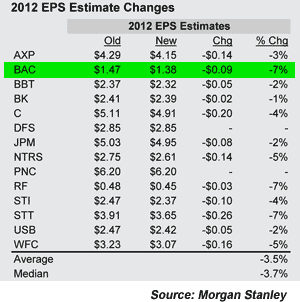
And the final little tidbit we offer you today on the eve of Durbin enactment comes from The Street, reporting that Morgan Stanley cut 2012 earnings estimates for Bank of America and 11 other banks.

This chart, while the story states is not entirely tied to Bank of America’s recent announcement or to the Durbin Amendment, does show that banks will be affected by the Durbin Amendment. They will have to make changes to deal with the losses they expect to take from a hard cap on fees that they were profiting from, and if Bank of America is any indicator, the burden of those changes will go from the merchants who used to get hit with the swipe fees to the consumer who will now have to pay more to support the use of debit cards.