Tag Archives: acquirer

Industry Terms: Interchange


Interchange

Interchange is a term used in the payment card industry to describe a fee paid between banks for the acceptance of card based transactions. Usually it is a fee that a merchant’s bank (the “acquiring bank”) pays a customer’s bank (the “issuing bank”).

In a credit card or debit card transaction, the card-issuing bank in a payment transaction deducts the interchange fee from the amount it pays the acquiring bank that handles a credit or debit card transaction for a merchant. The acquiring bank then pays the merchant the amount of the transaction minus both the interchange fee and an additional, usually smaller fee for the acquiring bank or ISO, which is often referred to as a discount rate, an add-on rate, or passthru.

For cash withdrawal transactions at ATMs, however, the fees are paid by the card-issuing bank to the acquiring bank (for the maintenance of the machine).

These fees are set by the credit card networks, and are the largest component of the various fees that most merchants pay for the privilege of accepting credit cards. Visa, Mastercard, and Discover are each known as card associations. And each card association has their own rate sheets known as Interchange Reimbursement Fees. These fees make up the majority of what you pay to your processor and they vary greatly depending on the card type accepted.

Download Visa’s Interchange Fees Here

Merchant Services Document Download Graphic

Download MasterCard’s Interchange Fees Here

Merchant Services Document Download Graphic


Interchange Plus Pricing

Interchange Plus pricing means that the acquirer charges you a variable MSC consisting of the cost price plus a fixed markup. Interchange Plus Pricing  is exclusively how we quote at Host Merchant Services. Interchange Plus, also known as Cost Plus, pricing gives the customer a fixed rate over published Interchange Fees. This pricing format is normally quoted as a discount rate (percentage fee) along with a per item or authorization fee. The great thing about Interchange Plus pricing is that you always know exactly what you are paying to your processor to services your account. Think of Interchange, and all the associated fees, as an unavoidable cost. No matter who you process with, you have to pay these fees. They may be labeled differently, or wrapped up in a confusing pricing tier, but one way or the other, you are paying Interchange fees. By understanding the markup you pay over Interchange, you know exactly what you pay to your processor and exactly what is going to the card associations. That allows you to make a decision on whether or not the markup seems reasonable for the service you get and choose your processing partner accordingly.

Here’s a small graphic explaining the basics of how Interchange Plus works:
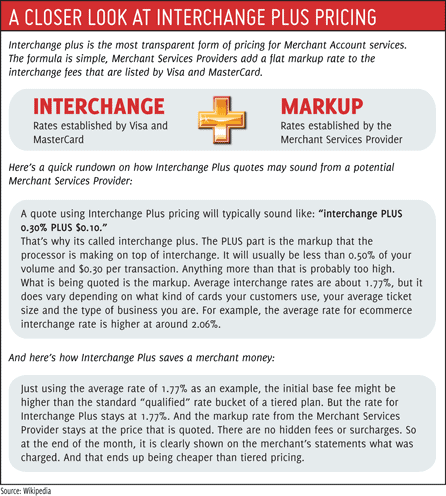
Host Merchant Services infographic on Interchange Plus pricing

Industry Terms: Chargeback

This is the latest installment in The Official Merchant Services Blog’s Knowledge Base effort. Well we want to make the payment processing industry’s terms and buzzwords clear. We want to remove any and all confusion merchants might have about how the industry works. Host Merchant Services promises: the company delivers personal service and clarity. So we’re going to take some time to explain how everything works. This ongoing series is where we define industry related terms and slowly build up a knowledge base and as we get more and more of these completed, we’ll collect them in our resource archive for quick and easy access. Today’s term is:

Chargeback

Chargeback typically refers to the act of returning funds to a consumer. The action is forcibly initiated by the issuing bank of the card used by a consumer to settle a debt. Essentially what happens is a consumer disputes a transaction, and the credit card company’s bank responds by taking the money back from the Merchant and returning it to the consumer.

Customers dispute charges to their credit card usually when goods or services are not delivered within the specified time frame, goods received are damaged, or the purchase was not authorized by the credit card holder — the latter being the most common reason for a chargeback.

The chargeback mechanism exists primarily for consumer protection. To start a chargeback a consumer will contact their credit card company and ask for a chargeback. The dispute process then begins. During the dispute process he merchant will have to provide proof they rendered service properly. If the merchant can’t provide sufficient evidence, the credit card company debits the transaction amount from the merchant’s account and credits it to the consumer’s account. Additionally, the credit card company charges the merchant a chargeback fee as a penalty.

With each chargeback the issuer selects and submits a numeric reason code. This feedback can help the merchant and acquirer diagnose errors  and improve customer satisfaction. The code also helps the merchant better investigate the transaction in order to find proof during the Dispute Process. Reason codes vary by bank network, but fall in four general categories:

  • Technical: Expired authorization, non-sufficient funds, or bank processing error.
  • Clerical: Duplicate billing, incorrect amount billed, or refund never issued.
  • Quality: Consumer claims to have never received the goods as promised at the time of purchase.
  • Fraud: Consumer claims they did not authorize the purchase or identity theft.


For transactions where the original invoice was signed by the consumer, the merchant may dispute a chargeback with the assistance of the merchant’s acquiring bank. The acquirer and issuer mediate in the dispute process, following rules set forth by the corresponding bank network or card association. If the acquirer prevails in the dispute, the funds are returned to the acquirer, and then to the merchant.

The merchant’s acquiring bank accepts the risk that the merchant will remain solvent over time, and thus has an incentive to take a keen interest in the merchant’s products and business practices. Reducing consumer chargebacks is crucial to this endeavor. To encourage compliance, acquirers may charge merchants a penalty for each chargeback received. Payment service providers, such as PayPal, have a similar policy. In addition, Visa and MasterCard may levy severe fines against acquiring banks that retain merchants with high chargeback frequency. Acquirers typically pass such fines directly to the merchant. Merchants whose ratios stray too far out of compliance may trigger card association fines of $100 or more per chargeback.

For More Information

To find out more about Chargebacks and to gain some Chargeback Tips, be sure to CLICK HERE and read The Official Merchant Services Blog entry from January 9, 2012.

Hand Inserting Credit Card To A Pos Terminal Payment Terminal Flat Design Vector 64931018

A is for Acquirer

We’ve been working hard the past 7 months at The Official Merchant Services Blog to offer our readers a knowledge base — a place to come frequently to get clear and useful information about the payment processing industry. But we’re always looking to take things a step further. We want to offer more information and be even more helpful. I was recently inspired by this article over at UniBul’s Credit Card Blog which offers a definition of 21 confusing payment processing terms. Credit Card Processing has a lot of buzzwords that get used. This type of technical or industry language can sometimes make understanding statements very difficult for merchants.

Well we want to make these terms clear and remove the confusion. This is part of the ongoing service Host Merchant Services promises: the company delivers personal service and clarity. So we’re going to take some time to explain how everything works. This is going to be an ongoing series where we define industry related terms and slowly build up a knowledge base. We’ll start with the same term that kicked off the UniBul blog. But our coverage is going to go a bit deeper than just a definition. We’ll provide a little extra context. And as we get more and more of these completed, we’ll collect them in our resource archive for quick and easy access.

Hand Inserting Credit Card To A Pos Terminal Payment Terminal Flat Design Vector 64931018

Acquirer

An acquiring bank (or acquirer) is the bank or financial institution that processes credit and or debit card payments for products or services for a merchant. The term acquirer indicates that the financial institution accepts or acquires credit card transactions from the card-issuing banks within an association. The best known (credit) card Associations are Visa, MasterCard, American Express, Discover, Diners Club, JCB and China UnionPay.

An acquirer is contacted to authorize a credit card or debit purchase. The acquirer will either approve or decline the debit or credit card purchase amount. If approved the acquirer will then settle the transaction by placing the funds into the seller’s account.

Every time you use your credit or debit card you are using the services of an acquirer. An Acquirer will charge a monthly and/or a per transaction fee to the stores or merchants to facilitate transactions. Acquirers need to be licensed with credit card companies, such as Visa or MasterCard.

To get a better understanding of how payment processing works, you can view this infographic.

Merchant Services News Briefs

The Official Merchant Services Blog has two news items related to Host Merchant Services and the transaction processing industry to announce today.

PCI Compliance Initiative

First, Host Merchant Services would like to announce its PCI Compliance Initiative is kicking into high gear with a new special offer from its partner HostMySite.com. Host Merchant Services is offering a Free Compliance Package for online merchants. It’s a $100 value in terms of services being offered. With this initiative you get:

  • A Free PCI Compliance Analysis of your business by HMS.
  • A Free PCI Compliance Scan.
  • A report compiled for your business regarding its PCI Compliance issues and what it needs to do to become PCI Compliant.


All HostMySite.com customers can access the plan through the special offers tab in the partnership website here. And any other merchants interested in this offer can contact Host Merchant Services directly through this page on the HMS site.

TransFirst’s New Software

Our next news item is Host Merchant Services acquirer TransFirst® has formed a strategic alliance with Planet Group, Inc. The two Companies will collaborate on a new, proprietary back-end processing system.

TransFirst®, a leading provider of secure transaction processing services and payment enabling technologies, has entered into a strategic alliance with Planet Group, Inc., an information technology company dedicated to the financial payment space, to build a proprietary back-end processing system.

Under the partnership, TransFirst will combine the best components of its OnTrak merchant management system with the processing power of Planet Group’s Acquire360 software, creating an industry-leading solution for TransFirst’s merchant customers and sales partners. The ability to control the processing environment will give TransFirst the opportunity for more flexibility in terms of pricing, reporting, customization and statement production, as well as speed-to-market and additional ability to penetrate new business verticals.

In conjunction with the Planet Group alliance, TransFirst has made the strategic decision to continue its long-standing business relationship with TSYS as its preferred front-end system provider. TSYS’ best-inclass position for dial and IP authorization and capture technology, combined with Transaction ExpressTM, TransFirst’s innovative proprietary payment gateway, will create a solid foundation for future success.

“This venture will allow TransFirst to leverage its rapidly increasing scale and maximize efficiencies to help us better serve our clients and partners,” says John Shlonsky, president and CEO of TransFirst.

“Having our own back-end system will simplify our back office and create an ease of operations that will contribute to our already significant growth. We are confident that Planet Group will be an outstanding partner as we move forward with new solutions that will enhance our company’s market value. We are equally pleased to extend our relationship with TSYS and look forward to continuing to work with them in the future.”

“This deal with TransFirst lands right in our sweet spot as a company,” says Tom Nichting, president and CEO of Planet Group, Inc. “Because Planet Group is dedicated to providing software and consulting services to the financial payment space, there’s nothing better than working with a company like TransFirst, which fits solidly into our target for partnership. We look forward to providing the technology and support that will produce a mutually successful venture.”