Author Archives: hostmerchantservices

Small Businesses Require Receipt Signatures

Should Small Businesses Require Receipt Signatures

In our daily lives, we sign a variety of paperwork. We do this in person, for example with receipts at restaurants, and digitally, by signing something like an online banking form. Many of the products and services we use every day require our signatures. But, should small businesses require receipt signatures? Let us discuss it in this article.

Some consider this an outmoded formality, particularly in low-stakes contexts such as a restaurant or retail store, however, legally binding signatures are required for contracts and professional agreements. Each person or business that signs these documents agrees to the terms and accepts responsibility if something goes wrong.

Whether you sign documents in person or electronically, it’s critical to understand the many types of agreements that require a legal signature and what makes a signature legally enforceable. As businesses continue to become more modern and offer digital solutions, they rely more heavily on electronic documentation. The following explains the reasoning behind why many small businesses no longer are required to collect signatures, and what they are using as another layer of security.

Should my Customer Sign Receipts

Do Small Businesses Require Receipt Signatures?

receipt payment

If you have an EMV-compliant card reader, collecting receipt signatures is optional. EMV cards are chip cards, and since the card’s information is kept on a chip rather than a magnetic stripe, the information has different encryption and is more secure.

When it comes to preventing credit card theft, EMV outperforms receipt signatures. According to Visa, counterfeit fraud has decreased by 76% for EMV-compliant merchants since 2015.

Some small businesses, like diners, use receipts to collect tips or as evidence of permission for work orders or recognition of work that has been done, and may still find receipt signatures valuable. Businesses no longer need to get signatures for chip cards and contactless transactions, putting an end to a practice that had become a mundane task for both customers and businesses.

Signature Requirements For Receipts

The receipt signature requirements don’t really do anything to reduce fraud, as evidenced by users drawing smiley faces or nonsensical gibberish on signature lines for years. Many retailers have long stopped checking receipt signatures against cards, preferring to speed up checkout lines rather than add an extra layer of chargeback protection. So it is not mandatory that small businesses require receipt signatures under some laws or for some additional advantage.

Signature requirement

Of course, merchants of all sizes can still request identification from customers before consenting to conduct a transaction, so the signature is substantially less important in this situation. Due to the technological developments of contactless payments and EMV terminals, merchants are likely extremely relieved that they can remove the signature requirement as a part of their transaction process.

Signatures, especially with chip cards, add a little bit of added security to EMV transactions and will only slow down the checkout process. Swiped cards are a different story; their signature requirement still applies. A signed credit card receipt isn’t a huge deterrent against fraud, but it’s better than nothing and should still be applied when customers are swiping cards.

Why Were Customer Signatures Required

Credit card businesses have relied on receipt signatures to avoid fraud for decades. They required merchants to collect and record customer signatures so that if a transaction was challenged, the shopkeeper could produce a signed receipt demonstrating that the buyer was physically present in the store and accepted the purchase.

Without this proof, retailers were liable for chargeback losses. They were also held accountable if the signature on the receipt did not correspond to the signature on file or the card. Chip readers have supplanted customer signatures with the introduction of EMV-compliant card readers.

How Does No-Signature Transaction Work

Before EMV technology, the typical method of validating a credit card purchase was to sign a receipt. Signature restrictions did not keep fraud away, and the procedure was less secure. Credit card firms discovered a more secure approach to safeguard cardholders from fraudulent or unauthorized transactions while expediting the in-store checkout process. Here are three things you should know about the non-signature transaction process:

Card duplication

Due to the fact that EMV readers and NFC terminals are being used more frequently, card duplication fraud is significantly decreasing. This is the process where after a customer makes a card transaction, the merchants’ credit card terminals capture the customer’s card information illegally. This is called credit card skimming – or card duplication – and this has significantly decreased since the implementation of EMV chip cards and contactless payments.

Authentication

When you place your chip card into a top-of-the-line POS system, you will see an alert like “do not remove your card.” During this time, the chip, the small microprocessor on the credit card, sends a unique code to the issuing bank and back to the terminal in order to verify the card. Only when the card has been verified will the customer be told to “remove card.”

Unique code

EMV cards generate a unique code for each transaction that your bank validates each time, and the code cannot be re-used. A scammer or person trying to impersonate you cannot replicate a transaction using a fake card with stolen data at an EMV terminal because it would not generate the proper code and end it to the bank. This is why it is courageous for businesses to have EMV terminals in order to protect all customers from credit card fraud.

Conclusion

Many merchants believe it is “better to be safe than sorry” and continue to require signatures. Putting a signature on the receipt really won’t help much regarding chargebacks and fraud allegations. Payment technology has progressed much beyond that. It is entirely up to you whether you require signatures for credit card transactions, but remember that credit card brands do not require it from any merchant at any time for any transaction. Sometimes, merchants will require a signature for purchases over a certain dollar amount, typically over $1000.00.

There are certainly advantages and disadvantages to eliminating signatures. Even if you remove them from your EMV credit card receipts, you may find it useful to include a signature requirement in different types of contracts or work orders. Signatures are useful for more than just authorizing credit card transactions, and they can protect you as a merchant many ways depending on the type of business that you do.


credit card processing service agreement

What to Look For in Your Credit Card Processing Service Agreement

At this point, you should be aware that the credit card processing industry is mostly made up of smoke and mirrors. There is minimal openness about how credit card processing fees work, what your organization will spend as an expense to process cards, and the specific terms around opening a merchant account with different merchant service providers. Therefore, it is important to understand the credit card processing service agreement that is the basis of any association with the provider company.

Just because a sales representative tells you something verbally does not mean that the same verbiage will be reflected or included in your agreement. Whether you own a bakery, restaurant, retail store, or professional services firm, your customers have high expectations, particularly regarding the forms of payments you accept and the simplicity of the transaction.

Offering your customers more payment alternatives can mean the difference between you making a sale and a customer turning elsewhere. This is why selecting a merchant services provider is so important. Choosing a provider who can assist you in meeting your customers expectations is critical to the success of your organization.

How Does a Merchant Service Agreement Work?

When signing up with a merchant services provider for a merchant account to process credit and debit cards, there is a process that they are responsible for when enabling your business to process payments. During a transaction, the acquiring bank performs the following processes to process and accepts electronic payments as part of the merchant processing agreement: These are important factors that are covered under the credit card processing service agreement.

  • The credit card is swiped, chipped or tapped
  • The acquirer obtains the card information from the payment terminal
  • This acquirer, a financial institution, transmits the data to a payment processor
  • The Card Association then communicates this information to the bank that issued the card
  • The transaction is approved or denied by the issuing bank
  • If the transaction is approved, the credit card association sends a code to the issuing bank
  • The identical code is sent to the acquirer
  • The code is subsequently transmitted to the merchant’s credit card machine
  • This code authorizes the transaction, and the payment terminal can generate a receipt for the customer
  • The merchant will have funds deposited into their account in the following 48 hours

What to Look For in Your Merchant Credit Card Processing Service Agreement

Termination fees

The first thing to look for in your credit card processing service agreement is the charge that you will have to pay when you terminate the agreement.

You can be charged an early termination fee if you cancel your merchant account before the agreed-upon date. Many merchant services agreements include a termination fee; however, in recent years, more businesses have shifted to a month-to-month deal with no cancellation penalty.

Early termination fees range from $295 and $750. Some companies demand this fee even if your company closes or is sold to a new owner. Keep in mind the amount of the termination cost, if any. Depending on the merchant services provider that you select, the early termination fee is only negotiable sometimes. Clarify with your merchant services provider whether or not they will charge you a fee if you decide to cancel early.

Liquidated damage clauses

A liquidated damage clause in the agreement might make switching processors nearly impossible. A liquidated damages clause states that if your company ceases to process, the merchant services provider will charge you for the amount of profit they estimate to receive during your contract term. Liquidated damage clauses are important and an integral part of a credit card processing service agreement.

Assume your merchant services provider earns $500.00 monthly from your company in credit card processing fees. For example, if you signed a three-year contract with a merchant services provider, but after 18 months you have to close your business, your merchant services provider will charge you for the difference, in this case, an additional 18 months, of their expected profit based on your contract. That would be about $9,000.00. Make sure that your merchant services agreements do not have liquidated damage clauses.

Contract length

Confirm the term length of the merchant agreement you are considering before moving forward with opening an account. If there is a term, it is typically three or five years. There should be a contract length specified in the merchant application. However, as long as an early termination fee of $0.00 is listed, opening an account with most merchant service providers should be considered a month-to-month agreement.

Red Flags in Merchant Service Agreements

merchant using credit card machine

Below are some examples of what red flags to look for in a merchant credit card processing service agreement.

High fees and extra charges

The majority of the complaints concern discriminatory charges. Some payment processors charge merchants for early termination or PCI compliance. For example, the usual charge for early termination is roughly $400. However, numerous merchants have complained online about paying much more in the name of early termination for merchant services providers across the industry.

Contract cancellation

Many processors levy an early contract termination cost. However, this also occurs when an annual fee is charged. Suppose the processor does not charge an early cancellation fee. In that case, they may charge on a month-to-month basis, which is considered preferable to annual contracts if you are just starting with their services.

Charging an early termination charge is an unjust business practice. Some merchant service providers make their cancellation process so difficult that if you wish to cancel, you will be bounced from department to department until you give up and continue to use their services.

Non-cancellable agreements

Leasing POS terminals or payment gateways might be significantly more expensive than purchasing them. Certain processors require you to pay for the entire lease term, rendering the contract non-cancellable. Ultimately, their true cost is many times greater than the cost of purchasing the gateway or processing equipment yourself.

Conclusion

credit card processing

If your company accepts credit and debit card payments, having a thorough understanding of your merchant agreement is critical to your success. As a business owner, you have the authority to select a partner that best meets your requirements and works with you in a transparent and honest way. Review your agreement or contact your merchant services provider to ensure you are making the best decision for your company. To make sure that you are getting the best terms and rates possible, make sure that when you are having these conversations to have read all of the fine print and to address all of your concerns when negotiating.

content strategy

How To Develop a Content Strategy for Your Business

If you’ve been trying to rank higher on Google, or even get to the first page, establishing a strong content strategy is one of the secrets to success. Especially for small businesses, this can be a challenging task. It never hurts to refresh your content strategy, whether you’re up to date on new tactics, or you’ve been utilizing the same methods for years. Creating fresh content ensures that you are staying current with your customers, being original as a business, and engaging your prospects and current customers. Let’s review what makes a solid content strategy and how to develop one.

What is a Content Strategy?

content marketing and strategy

Building a content strategy is part of a larger marketing plan and should be aligned with your specific business goals, especially those related to sales and marketing. A content strategy can help you achieve your goals, whether they be to boost revenue or drive more traffic to certain pages on your website.

Your strategy should outline whom you intend to reach, what goals you hope to achieve with the content you create, and the channels you intend to publish on. Your technique, however, should be adaptable. Even the best plans sometimes fall short, or what worked in the past may no longer work for your company. Furthermore, your strategy should adjust and evolve as you learn more about how your audience reacts to your content and as the objectives your company is trying to achieve changes.

The good news is that you can pivot if you have a content plan in place. You can quickly detect what is and isn’t helping you achieve your desired goals because part of your strategy should involve tracking and monitoring the outcomes of what you’re producing.

Why Should You Create Content?

Content marketing helps businesses plan and create steady and low-cost sources of web traffic and potential leads. For example, if you can publish just one blog post that receives consistent organic traffic with an embedded link to an e-book or free service, that link will continue to generate leads for you over time as long as that blog post continues to get organic traffic.

pay per click works fine with content

Your evergreen content’s steady flow of visitors and leads will allow you to experiment with various revenue-generating marketing tactics, such as distributed content, pay-per-click advertising, and social media advertising. Furthermore, your content will not only help you acquire leads but will also educate your current and potential clients as well as increase brand awareness about your organization as a whole.

Building a Framework for Your Content Strategy

Set Your Goals for Building a Content Strategy

Establishing defined business goals and KPIs is essential before launching any new content marketing plan. After all, you can’t establish a plan, monitor program effectiveness, or communicate the ROI to stakeholders in the company if you don’t have set objectives. Also, ensure that your objectives are both measurable and timely.

Research Your Audience

Establishing a buyer persona to act as a fictitious representation of your consumer is the first step in defining your audience. Begin with your most typical customer type and evaluate their typical demographics. Where are they located, what are their interests, and what are their aspirations and needs? Creating a detailed picture of how your customer becomes aware of your brand will help you optimize your sales funnel and call to actions on the content that you create.

Run a Content Analysis

Most brands begin with blog postings in the early stages. If you wish to experiment with alternative formats, you can do a content audit to determine your best and worst-performing material. You can then take that information and utilize it to decide which how to move forward with the content that you’re producing.

You should review your prior year’s content marketing efforts and results if you’ve been with a company for a while. Understanding what you can do better in the following year comes from analyzing the content that you’ve previously produced.

No matter what stage you’re at, a content audit will help you decide what resonates most with your audience, find gaps in your topic clusters, and help you generate new content ideas.

Measure Your Results

Measuring the impact of your content marketing activities is a vital part of developing an effective content strategy. Producing content without assessing your customers or traffics response is similar to having a phone conversation on mute. You must understand what your audience likes and dislikes and why.

Ask Your Customers for Suggestions

Data analysis can be a very helpful tool, but it only gives you black-and-white numbers on a scale with many shades of gray. Listening to your customers will help you reach the rest of that spectrum. Your customers need to know that you’re listening to them on social media, so ask them for suggestions and feedback and talk to them often.

Use Keywords

Analyze your keywords using tools such as SEMRush and Moz to understand better where you rank. You can also use Google Search Console or Google Keyword Planner to uncover keywords you may have overlooked.

Employ Your Content Strategy

The first phase of the equation only consists of a content strategy and is focused content creation. The final stage is the amplification of the content that you have already produced. Find out where your audience hangs out online and publish your material there to reach them to boost the traffic that you are currently getting. To effectively leverage the power of your employees, clients, and others in your network who can help you boost your content, you’ll need to think strategically about all the tools you have at your disposal and what platforms on the internet best suit your industry.

Types of Content Marketing

good quality content for social media
  • Ebooks
  • Videos
  • Blog posts
  • Social media
  • Infographics
  • Podcasts
  • White papers
  • Case studies

Conclusion

Every day, consumers and individual B2B customers are overwhelmed with an exorbitant amount of content that they suffer from cognitive overload. As a result, much of what people encounter is quickly closed or filtered away. This means that your content marketing approach needs to be dialed in and adaptable to what gains the markets attention. Create a plan that gets you recognized, drives traffic, promotes engagement, and boosts your overall conversions.

Consider creating more than just a single piece of content, rather, focus on trying to create experiences that fit into the buying funnel for your product or service. Creating content that fits into your larger consumer journey instead is a better tactic, and long-term winners will be the companies that give the best digital experience.

You should keep in mind that only above average content and a well-formed strategy for developing and producing your content can help you rank higher. If you have a website that loads fast, that has a good quality and user-friendly navigation and a good server to host the site, then you have set your set up for success. If you are constantly developing your content strategy and producing engaging and related content on top of a healthy website framework, you’ll have better odds to rank higher on Google and drive more traffic to your business.

content strategy

How To Develop a Content Strategy for Your Business

If you’ve been trying to rank higher on Google, or even get to the first page, establishing a strong content strategy is one of the secrets to success. Especially for small businesses, this can be a challenging task. It never hurts to refresh your content strategy, whether you’re up to date on new tactics, or you’ve been utilizing the same methods for years. Creating fresh content ensures that you are staying current with your customers, being original as a business, and engaging your prospects and current customers. Let’s review what makes a solid content strategy and how to develop one.

What is a Content Strategy?

content marketing and strategy

Building a content strategy is part of a larger marketing plan and should be aligned with your specific business goals, especially those related to sales and marketing. A content strategy can help you achieve your goals, whether they be to boost revenue or drive more traffic to certain pages on your website.

Your strategy should outline whom you intend to reach, what goals you hope to achieve with the content you create, and the channels you intend to publish on. Your technique, however, should be adaptable. Even the best plans sometimes fall short, or what worked in the past may no longer work for your company. Furthermore, your strategy should adjust and evolve as you learn more about how your audience reacts to your content and as the objectives your company is trying to achieve changes.

The good news is that you can pivot if you have a content plan in place. You can quickly detect what is and isn’t helping you achieve your desired goals because part of your strategy should involve tracking and monitoring the outcomes of what you’re producing.

Why Should You Create Content?

Content marketing helps businesses plan and create steady and low-cost sources of web traffic and potential leads. For example, if you can publish just one blog post that receives consistent organic traffic with an embedded link to an e-book or free service, that link will continue to generate leads for you over time as long as that blog post continues to get organic traffic.

pay per click works fine with content

Your evergreen content’s steady flow of visitors and leads will allow you to experiment with various revenue-generating marketing tactics, such as distributed content, pay-per-click advertising, and social media advertising. Furthermore, your content will not only help you acquire leads but will also educate your current and potential clients as well as increase brand awareness about your organization as a whole.

Building a Framework for Your Content Strategy

Set Your Goals for Building a Content Strategy

Establishing defined business goals and KPIs is essential before launching any new content marketing plan. After all, you can’t establish a plan, monitor program effectiveness, or communicate the ROI to stakeholders in the company if you don’t have set objectives. Also, ensure that your objectives are both measurable and timely.

Research Your Audience

Establishing a buyer persona to act as a fictitious representation of your consumer is the first step in defining your audience. Begin with your most typical customer type and evaluate their typical demographics. Where are they located, what are their interests, and what are their aspirations and needs? Creating a detailed picture of how your customer becomes aware of your brand will help you optimize your sales funnel and call to actions on the content that you create.

Run a Content Analysis

Most brands begin with blog postings in the early stages. If you wish to experiment with alternative formats, you can do a content audit to determine your best and worst-performing material. You can then take that information and utilize it to decide which how to move forward with the content that you’re producing.

You should review your prior year’s content marketing efforts and results if you’ve been with a company for a while. Understanding what you can do better in the following year comes from analyzing the content that you’ve previously produced.

No matter what stage you’re at, a content audit will help you decide what resonates most with your audience, find gaps in your topic clusters, and help you generate new content ideas.

Measure Your Results

Measuring the impact of your content marketing activities is a vital part of developing an effective content strategy. Producing content without assessing your customers or traffics response is similar to having a phone conversation on mute. You must understand what your audience likes and dislikes and why.

Ask Your Customers for Suggestions

Data analysis can be a very helpful tool, but it only gives you black-and-white numbers on a scale with many shades of gray. Listening to your customers will help you reach the rest of that spectrum. Your customers need to know that you’re listening to them on social media, so ask them for suggestions and feedback and talk to them often.

Use Keywords

Analyze your keywords using tools such as SEMRush and Moz to understand better where you rank. You can also use Google Search Console or Google Keyword Planner to uncover keywords you may have overlooked.

Employ Your Content Strategy

The first phase of the equation only consists of a content strategy and is focused content creation. The final stage is the amplification of the content that you have already produced. Find out where your audience hangs out online and publish your material there to reach them to boost the traffic that you are currently getting. To effectively leverage the power of your employees, clients, and others in your network who can help you boost your content, you’ll need to think strategically about all the tools you have at your disposal and what platforms on the internet best suit your industry.

Types of Content Marketing

good quality content for social media
  • Ebooks
  • Videos
  • Blog posts
  • Social media
  • Infographics
  • Podcasts
  • White papers
  • Case studies

Conclusion

Every day, consumers and individual B2B customers are overwhelmed with an exorbitant amount of content that they suffer from cognitive overload. As a result, much of what people encounter is quickly closed or filtered away. This means that your content marketing approach needs to be dialed in and adaptable to what gains the markets attention. Create a plan that gets you recognized, drives traffic, promotes engagement, and boosts your overall conversions.

Consider creating more than just a single piece of content, rather, focus on trying to create experiences that fit into the buying funnel for your product or service. Creating content that fits into your larger consumer journey instead is a better tactic, and long-term winners will be the companies that give the best digital experience.

You should keep in mind that only above average content and a well-formed strategy for developing and producing your content can help you rank higher. If you have a website that loads fast, that has a good quality and user-friendly navigation and a good server to host the site, then you have set your set up for success. If you are constantly developing your content strategy and producing engaging and related content on top of a healthy website framework, you’ll have better odds to rank higher on Google and drive more traffic to your business.

pareto analysis

What is Pareto Analysis?

Those who are in control are always faced with constantly making decisions. Which decisions should be dealt with first? How do you prioritize? To answer that question, many company leaders tend to use a Pareto Analysis. The Pareto Analysis assists in prioritizing decisions by determining which will have the most impact on your overall business goals and which will have the least.

Pareto Analysis is a statistical decision-making technique used to select a small number of activities with a significant overall influence on outcome. It employs the Pareto Principle, which is also known as the 80/20 rule. The 80/20 rule states that 80% of all outcomes are derived from 20% of causes.

For decision-makers, the final outcome is the most important thing. When working towards creating your idea outcome, decision-makers want to keep the amount of effort or input as minimal as possible. The Pareto Analysis helps such decision-makers to make the correct decisions that will have the most significant affect on what they are trying to achieve. Politicians and policymakers also use this analysis to plan their strategies.

The best part of this analysis is that it shows a leaders problems and potential outcomes in the form of numbers. These 80/20 rule numbers can be used to generate charts which then makes it very easy for decision makers to analyze their input vs the expected output of any given decision. Within an organization, any problem can be analyzed for each of the departments. The expected input to achieve a targeted output can be set with the problem analysis.

Companies can then allocate their resources based on the Pareto Analysis to improve their productivity and efficiency.

What Is Pareto Analysis?

Pareto Analysis is a technique used in business decision-making, but it also has applications in welfare economics and quality control. It is largely based on the “80-20 rule.” As a decision-making technique, the Pareto Analysis statistically distinguishes a small number of good or undesirable input factors that have the largest impact on an outcome.

The Pareto analysis assumes that you can obtain 80% of a project’s benefit by completing 20% of the work or that 80% of issues can be traced back to 20% of the causes. This is also known as the 80/20 rule and the Pareto Analysis is an extremely effective decision-making tool. In the broadest sense, it is a technique for gathering the information needed to define level of priority around your job functions and specific tasks.

Take, for example, quality enhancement. A few core factors (20%) create most problems (80%). This method is also known as the vital few and the trivial many. After understanding the Pareto analysis explanation now let us understand the history.

Pareto Analysis History

In 1906, Italian economist Vilfredo Pareto determined that 80% of Italy’s land was owned by only 20% of the population. He continued his research and discovered that unequal wealth distribution was consistent throughout Europe. The wealthiest 20% of a country’s population accounts for an estimated 80% of the country’s wealth or overall income, according to the 80-20 rule.

The principle was proposed in the late 1940s by Romanian-born American engineer and management consultant Joseph M. Juran. He coined it after the Italian economist Vilfredo Pareto, who found that 80% of income went to 20% of the population in Italy. After conducting polls in a few other countries, Pareto discovered that his findings fit into a similar distribution.

What is a Pareto Chart?

chart on screen

A Pareto Chart is a statistical chart that ranks causes or problems in descending order of frequency and cumulative impact. A histogram graphic is utilized inside the Pareto chart to rank the reasons behind the impact.

How to make a Pareto Chart?

To fully grasp the full meaning of the Pareto Analysis, it is necessary to investigate the stages that assist users in identifying problem areas and their causes to develop appropriate solutions. Here is a checklist for creating a Pareto chart and analyzing the aspects to consider before deciding to take a specific course of action.

Identify the problems 

Make a list of all the issues you need to resolve or decisions you need to make.

List the causes 

Determine the fundamental source of each problem.

Score the problems 

Now, list the issues you’ve identified in order of significance. The type of issue you’re looking to solve will determine the scoring technique you choose.

Group the problems 

Sort the issues according to their root cause.

Add up scores 

Now, total the points for each group you’ve selected. The group with the highest score should be your top priority, while the group with the lowest score should be your lowest priority. 

Take action 

Start taking care of the problems’ causes. Starting to work on the most important problem or the most important set of problems first will help expedite creating solutions.

Pareto Analysis Breakdown & Examples

  • 80% of accidents are caused by 20% of drivers
  • 80% of your profit comes from 20% of your items and services
  • 20% of your items and services cause 80% of consumer complaints
  • 20% of criminals commit 80% of crimes
  • 80% of travel is to 20% of the overall destinations
  • 80% of all income is earned by 20% of the world’s population

Pros and Cons of Pareto Analysis

Pros

  • Aids in the identification and determination of the root causes of flaws or difficulties
  • It aids in prioritizing the most serious issue for a problem and attempting to eliminate it first
  • Determines the whole impact of a problem
  • It improves problem-solving and decision-making abilities
  • It aids in time management and frees up time for decision makers
  • It is useful in every sort of leadership decision regardless of industry

Cons

  • Does not offer solutions to problems
  • Only useful for determining or identifying a problem’s root causes
  • Focuses mostly on historical data or your organization

Conclusion

As a leader, when there appears to be too many options to choose from and there are so many things going on that it is hard to determine what is most important inside an organization, the Pareto Analysis aims to aid in the discovery of the most critical and significant options. Having the ability to access accurate data is required when implementing the Pareto Analysis affectively. However, if done correctly, the Analysis can help break down a large problem into smaller pieces, help you decide on where to spend your time, and help improve how you utilize your companies resources.

health banner

10 Ways to Improve Your Employees’ Well-Being

Your organization may hold its head high on being an excellent employer, however, even if you have the best intentions, there are indirect instances where certain practices can harm your employees’ well-being. Working conditions and obligations are a significant source of stress for many people. Experts believe that companies must prioritize their employees’ well-being and health, and focusing on these factors has resulted in a positive correlation in employee morale, productivity, and retention.

This article will break down what employee well-being is and give you 10 ways to improve and encourage a healthy environment and behaviors for your staff. Improving employee well-being should top the priority list of an organization as your people are your number one asset.

What is Employee Health & Wellness?

Employee wellness is a larger concept that includes employee health however, many professions and businesses use them interchangeably.

What is Employee Health & Wellness

Employee well-being has been a Human Resources term in recent decades, with many professionals discussing the topic. It revolves around how your employee feels about all functions of their job as well as work-life balance. This encompasses their personal life, health, relationships, finances, and functions of their job.

Employee health, in this sense, refers to employees’ immediate health. However, employee well-being is more than a person’s physical health. It also includes an employee’s emotional and mental health. Taking these factors into consideration will help you design a system that allows your employees to thrive and produce for your organization, while also aiding to the positive growth of their physical and mental well-being.

10 Ways to Improve Your Employees’ Health and Well-Being

improve your employee health

Have a Plan

The first and most important stage is creating a plan to cultivate workplace well-being. This strategy should clearly define what you want to achieve, how you intend to achieve it, who will be accountable for implementing these tactics, as well as a timeline for implementation and tracking progress. You may also survey or facilitate meetings to examine and hear from your staff directly on how they feel about their workplace well-being. Ensure that the goals are striving to hit will help your company and your employees’ quality of life inside and outside of the workplace.

Establish a Welcoming Work Environment

The well-being of your employees may be significantly impacted by a few purposeful direct actions in employee physical space. For instance, indoor plants increase ventilation in the office by releasing oxygen into the air and absorbing carbon dioxide. According to research, workplace air quality improvements can boost employee productivity by up to 11%. Additionally exposing your staff to natural light and enabling them to make healthy choices around the office has also been known to drastically increase staff members’ efficiency.

Employee Health & Wellness - Establish a Welcoming Work Environment

Flexible Scheduling

The ability to focus on health-related problems is one of the most underestimated yet critically significant aspects of employee well-being. Both hourly and paid employees are busier than ever, leaving minimal time to focus on exercise, food, or exploring their health-related concerns. Providing your employees with the ability to work a more flexible schedule might give them the necessary wiggle room they need to spend time focusing on their well-being on their own.

Give Employees More Control Over Their Work

Having minimal control over how work is done has been related to lower mental health and greater incidents of heart disease. Additionally, the combination of high work demands and limited job management dramatically raises the risk of diabetes and death from cardiovascular causes. Increasing an employee’s autonomy and enabling them to perform tasks and make decisions that they are in full control of can have a significant impact on an employee’s well-being.

Personal Development Opportunities

Personal development is a fantastic way for employees to increase their potential, talent, and income. It is a continuous process that doesn’t conclude with a course, book, or lecture and it allows employees to take full control of themselves. Personal development is a continuous opportunity to gain self-awareness and enable your team members to grow. Providing personal development workshops, lectures, book clubs, activities, and additional resources can help your employees grow aspects of themselves that increase their perception of themselves while also allowing them to develop hard skills to succeed at work.

Team Relationships

Everyone wants their employees to get along, and no one expects them to be best friends. To promote healthy working relationships, consider adopting team-building activities, lunches and nights out, casual meetings, interdepartmental competitions, and other ways that you can have your employees interact unrelated to work.

When employees are comfortable with each other, they are more likely to be open to sharing their thoughts and opinions with their coworkers and contributing to a pleasant and social work atmosphere. Therefore, a healthy team relationship is important to strive towards. Therefore to improve your employees’ well-being, you should encourage creating a healthy relationship with their team.

Employee Exercise Competitions

Humans are naturally competitive, and businesses can benefit from this characteristic to increase employee well-being and health. Creating employee exercise challenges allows groups of employees to get involved, work together, and compete against one another in a fun environment. You can design several challenge stages for different fitness levels, well-being goals, health and mobility levels, and more. You can track employee’s progress and also set group goals for bigger rewards to be earned.

Employee Appreciation and Awards

Employees want to be appreciated for their efforts, and this acknowledgment can go a significantly long way. Appreciation doesn’t necessarily have to come in money or expensive bonuses. It can even take the form of compliments, a simple “thank you,” or public praise to a certain employee who has made major contributions to a team. Employee recognition is directly correlated to improved job happiness, productivity, and efficiency on the job.

Mindfulness Meditation

Physical health and exercise are not the only aspects of employee well-being. It also has to do with mental wellness. One of the most effective methods to improve your employees’ mental health is to teach and practice mindfulness – the practice of living in the present moment rather than the past or the future.

You can combine mindfulness training with various smartphone apps, ranging from meditation-focused apps to all-around health-related apps containing mindfulness and breathing activities. A more grounded way of life can help your employees reduce stress, and improve their feeling of calmness and autonomy, which can boost their working productivity.

Allow Remote Working Days

Allowing your employees to work from home or an outside location (such as a coffee shop, park, or at home) one day per week can have drastic effects on their quality of life and attitude towards you as an employer. This remote workday can allow for more transparent communication between you and your staff member, and the change of scenery can evoke new thoughts and ideas. Furthermore, this freedom communicates that you trust your staff to be self-directed, which leads to their increased emotional well-being and engagement.

Conclusion

Be it a small business or a large organization, satisfied employees are more creative and more likely to stay with a company long-term. Constantly improving and working to cultivate positive employee-well being should be something you are always focused on as an employer.

The more you improve your employees’ well-being, the more likely it is that you will achieve your overall organizational goals.

You can begin to improve your employees’ well-being by discovering what they truly want and talking with them directly. Many of these techniques are simple and inexpensive, such as making staff feel included, soliciting feedback, and acknowledging their accomplishments. Taking these points into consideration and making changes in how you think about and interact with your staff will have a positive impact on your organization as a whole.

Google Will Accept Cryptocurrency

Google Will Accept Cryptocurrency Payments as Result of New Coinbase Partnership

Coinbase Global, a cryptocurrency exchange provider, recently announced a relationship with Google and its parent company, Alphabet. Google announced that they will accept cryptocurrency payments as part of a new Coinbase partnership. This is a two-way street, with both companies making a significant commitment to the other. Coinbase is also transitioning its cloud-based operations from Amazon Web Services (AWS) to Google Cloud. In exchange, Google Cloud and their clients will be enabled to process cryptocurrency payments through Coinbase.

This Google-Coinbase deal is a win-win situation, with the global community of crypto-focused developers benefiting the most. We’re excited to see these two firms take this important step together. Here’s what this means for stakeholders on both sides of the deal.

What Will Google and Coinbase Partnership Entail?

Google’s cloud computing business is critical to its long-term success. The sector is constantly expanding, is very profitable, and enables Google to expand their revenue steams and not just focus on marketing revenue. This agreement with Coinbase enables Google to fill a market gap by allowing crypto companies to pay for cloud storage with digital currency. There are no significant competitors who allow companies to current do this with cryptocurrency.

This is significant because the core idea underlying many Web3 and crypto businesses is a desire to move aside from using fiat currency such as the US dollar. Many of these companies would prefer to use solutions that accept cryptocurrency payments if they had the option, but until now, they simply did not exist on a large enough scale right now.

Will This Partnership Work?

To begin, the offer will be limited between Google and Coinbase and Google intends to provide the service to a limited number of Web3 clients, with payments handled by Coinbase Commerce. This system accepts ten digital currencies, including the usual suspects like Bitcoin cash, Bitcoin, Litecoin, Ethereum, and Dogecoin.

As a result, this partnership enables Google to create an offering they currently do not have, which will broaden their consumer base and diversify their revenue streams. Coinbase will charge a percentage of the fees that pass through their platform which will also increase their B2B revenue aside from their typical income from retail trading costs.

Coinbase Commerce works like any other payment provider, such as Amazon Pay, Apple Pay, and even Visa and Mastercard. These networks operate by charging a small fee for processing the transaction. The only difference is that these payments are made in crypto rather than fiat currency.

Why is This Arrangement Significant for Google?

After everything is said and done, Coinbase will have earned a new revenue stream since cryptocurrency-based payments for Google Cloud services will be routed through Coinbase for a fee. Simultaneously, Google Cloud took another step into the world of blockchain ledgers and cryptocurrencies, opening the way for a complete Web 3.0 experience.

This is a significant advancement for Web 3.0 and the future of the internet, and Google deserves credit for pioneering this venture. Google’s conglomerate revenue is fueled by the internet’s first two iterations, beginning with read-only web pages and progressing to social media dialogues. In these well-worn systems, Google assists users in finding the information they need while dually targeting those users with digital advertisements for products and services that are relevant to them.

Web 3.0, if completely achieved, could potentially mark the end of Google’s existing business model. Since blockchain systems are so adaptable, content creators will be able to take direct control of their ideas. Earning money from your articles, videos, games, and other media will be a much easier process. Intermediaries like Google’s AdSense service may eventually have a smaller role in monetizing original ideas, which in turn would affect Google’s primary revenue stream. A new type of Google crypto payments system will certainly emerge out of the Coinbase-Google deal.

How This Partnership Will Impact Future Cryptocurrency?

As part of their new collaboration, both Google and Coinbase have stated that they will consider how they can assist other organizations in managing their crypto portfolios and integrating cryptocurrency into their business models.

This is still a developing industry, but veteran Bitcoiners assume that over time, more and more businesses will hold Bitcoin on their balance sheets. So far, this strategy has been adopted by a small number of very large size corporations.

Traditional finance departments use trusted third parties to hold investments on behalf of a company. Companies such as Microsoft, Apple, and Amazon, have billions of dollars in cash available at any given time, which is stored in accounts with central banks such as Goldman Sachs, JP Morgan Chase, and Bank of America.

The problem for these businesses is determining how to store their assets. Businesses can trust that their assets and cash is safe because the aforementioned banking organizations are highly regulated. However with crypto, things become a little more complicated.

Digital currencies are, by definition, decentralized. This means there is so single entity or trustworthy party that is needed to support the transaction, and asset safety is solely the holder’s responsibility. There is a big potential to add a reliable third party into crypto storage, asset management and processing, similar to the deficit in payment processing that Google is trying to fill. It’s ironic, given that Bitcoin was invented to avoid exactly that. It is also very interesting that Coinbase already provides a very similar service through a program called Coinbase Prime, however they are trying to expand this with this new Google Partnership.

Conclusion

growth of cryptocurency as google accepts it

Undoubtedly, tech giants are becoming more interested in blockchain and Web3.0. Last year, Facebook rebranded itself Meta to capitalize on the benefits of the metaverse and offer the Facebook product under an umbrella with other tech products. They have even introduced the NFT capability to Facebook users. Microsoft is developing a decentralized data warehouse to further their Web 3.0 efforts. And now, Google and Coinbase have joined hands. The movement to adopt new technology is continuing at a rapid pace and is being implemented more frequently as it becomes more widely available.

The news that Google will accept cryptocurrency will be welcomed by small businesses and organizations. Many merchants and individual’s had invested in crypto during the last few years, during the pandemic. When Google begins to accept cryptocurrency, it will not only increase different coins value helping individuals, but it will enable businesses to utilize crypto for certain segments of their operation.

Small businesses make up the majority of the US economy. They generate a large amount of taxes for the government and also heavily contribute to the overall economic GDP. Unfortunately, in the crypto space, they have been ignored up until now. As Google will accept cryptocurrency after this announcement, even smaller merchants can benefit. The biggest challenge small business face is cash flow and revenue generation. With Google now accepting crypto payments from merchants and individuals, they are paving the way for digital currencies payment systems to be adopted by other large companies.

Best Crypto Exсhаngеѕ and Apps оf 2023

Best Crypto Exchanges and Apps of 2025

A cryptocurrency exchange account is a good place to begin if you want to purchase or sell cryptocurrencies. You may purchase and sell cryptocurrencies as well as tokens such as Bitcoin, Ethereum, and Dogecoin on crypto exchanges, which operate similarly to online brokerage platforms.

Considerations such as the types of assets that may be used, the costs involved, the accepted forms of payment, and the safety measures in place should be taken into account while selecting a cryptocurrency exchange. When compiling this list of the top cryptocurrency exchanges, we took into account the aforementioned criteria to better assist you in making an informed decision.

List Of Best Crypto Exсhаngеѕ and Apps оf 2025

Crурtо.соm

Since its 2016 inception, Crypto.com has grown to become one of the most prominent cryptocurrency trading platforms worldwide. Over 250 different cryptos are supported, and it’s presently available in 90 countries.

crypto

Image source

Crypto.com offers a wide range of digital asset goods, including cryptocurrency-yielding crypto items, a crypto visa card, and its own blockchain, Crypto.org Chain.

However, the Crypto.com mobile app sticks out the most. While most cryptocurrency exchanges’ mobile applications only mirror the cryptocurrency trading website, Crypto.com’s app was designed to provide customers with access to the whole ecosystem of this exchange while they’re on the move. Customers may use the app to purchase, trade, and pay using cryptocurrency, as well as earn interest on their holdings.

Even though Crypto.com has a ton of items and services, their customer service leaves a lot to be desired. In addition, trading costs of up to 0.075% may be incurred until larger quantities of trades are executed.

Crypto.com’s variety of goods and services, as well as its vast number of supported assets, make it a strong contender for the best mobile crypto trading experience.

Gemini

Gemini, introduced in 2014 by Tyler and Cameron Winklevoss, is notable for its commitment to stringent security measures and regulatory oversight. The New York-based exchange provides users with hot wallet insurance to protect their assets in the event of a hack. To further lessen the possibility of fraud, it also requires users to go through an identity verification procedure.

gemini

Image source

Gemini also offers the choice to evaluate and authorize trading account login devices, and it strongly recommends that its users implement two-factor authentication for further account security. Gemini’s SOC 2 certification is another noteworthy security aspect. This certification confirms that independent auditors have examined and confirmed the organization’s security and regulation compliance systems.

Gemini was designed with experienced traders in mind; it offers a top-notch trading dashboard and accepts more than seventy-five different cryptos and tokens. Gemini not only accepts cryptocurrencies as payment but also provides its customers with a cryptocurrency reward card.

There are distinct pricing systems for Gemini’s primary platform and its active trader platform. Trades over $200 cost a staggering 1.49% in commission on the major platform. Making and taking orders platform for active trading might cost up to 0.4% in fees. However, those costs will go down with more volume. The prices here are likewise quite steep. Gemini’s security features are among the best in the industry; thus, the somewhat hefty charge may be worth it.

Traders and investors who value safety in their transactions will find a lot to like in Gemini.

BitMart

Image source

BitMart was launched in 2017, and it is currently accessible in over 180 different countries across the world. Over a thousand different cryptos and tokens may be bought, sold, and stored there.

BitMart, a cryptocurrency exchange headquartered in the Cayman Islands, has quickly become a major market for lesser-known digital currencies. For investors seeking to diversify their portfolios with freshly launched or obscure crypto assets, BitMart may be the best option because it provides a wider variety of assets and trading pairings than its market-leading competitors.

Customers of BitMart may also utilize the Earn function of the exchange to get interested on cryptocurrency reserves. When users have the exchange’s native token, BMX, they are eligible for discounted trading fees.

Despite BitMart’s extensive features for seasoned crypto traders, the exchange has been met with mixed reviews from customers. There were multiple reports of withdrawal problems, inadequate customer service, and a lack of disclosure as examples of user concerns. Still, some praise may be found within the criticism.

Kraken

Image source

Kraken is one of the most trusted cryptocurrency exchanges since it has been around since 2011 and is accessible to users all over the globe. Kraken Pro is a high-quality trading platform offered by the San Francisco-based exchange, Kraken. Investors may buy, trade, and store over 120 cryptocurrencies on the site, and the costs are quite cheap.

In the earliest stages of the cryptocurrency industry, this feature-rich exchange quickly rose to prominence as the platform of choice for institutional investors. This reputation has been maintained.

Kraken provides not one but two platforms for its users: the primary trading platform and the more advanced Kraken Pro. The Pro interface of the exchange includes 13 different types of orders and lightning-fast execution, in addition to highly customized chart analysis tools and deep visibility into the order books. Kraken facilitates margin trading for cryptocurrencies and the execution of crypto derivatives trading methods in addition to traditional spot trading.

Cash App

Image source

Introduced in 2013 by Block, Inc. (formerly known as Square, Inc.), Cash App enables users in the US and UK to send, spend, deposit, and invest money. A mobile banking app that facilitates P2P payments and includes an investing component. Cash App users may put their money into stocks, ETFs, and even Bitcoin. Cash App stands out from its competitors because it allows users to transfer their Bitcoins to a different wallet service, something that neither Robinhood nor Venmo does.

Cash App Chief Executive Officer Jack Dorsey said in early 2022 that the business has begun pushing out features for the Bitcoin Lightning Network, which would allow for quick, nearly cost-free Bitcoin transfers.

Cash App’s custodial in-app wallet is the biggest negative of using the app to purchase and keep Bitcoin, as the corporation is responsible for safeguarding your digital assets. Although custodial wallets have many advantages, they are generally considered less safe than other types of wallets. However, given that Bitcoin may be removed from Cash App, cryptocurrency can be transferred to a private wallet for which you have the private keys.

Bisq

Image source

Bisq, which debuted in 2014, is a piece of open-source software that facilitates the decentralized trading of a variety of cryptocurrencies and tokens between users located anywhere in the world. At the moment, it can handle more than a hundred different types of digital content.

Users of this decentralized exchange are not subject to a mandatory “Know Your Customer” (KYC) authentication procedure, nor is the trading program restricted to users in any particular geographical region. Users of Bisq have the option of using bank wire transfers, ACH transactions, and even cash deposits for buying and selling Bitcoin and other cryptocurrencies.

Bisq is well-liked among Bitcoin purists because it upholds the principles upon which Bitcoin was founded—among them, decentralization, privacy, and sovereignty—but it is not an easy exchange for newcomers to use. New users may find the escrow method employed in peer-to-peer trading confusing, and both infrequent and frequent traders may be put off by the relatively delayed deal execution. Since trading volumes are less than those seen on consolidated worldwide exchanges, the marketplace is geared toward making smaller deals.

Bisq provides everything you need to purchase and sell Bitcoin on a decentralized, KYC-free platform, making it ideal for experienced crypto investors.

Conclusion

Choosing the right cryptocurrency exchange is crucial if you want to start trading or making an investment in cryptocurrencies. The greatest digital asset trading platform may be found regardless of whether you prioritize a wide variety of digital assets, reasonable costs, or a convenient mobile interface.

To get in on the action in the rapidly growing mobile trading market, we recommend Crypto.com. For the most privacy, Bisq is the greatest decentralized exchange, while Gemini has the highest security. Kraken is a great option for seasoned traders and those concerned about costs. Cash App serves the needs of Bitcoin traders, while Bitmart is our top pick for those interested in trading a wider variety of altcoins. Think about what you hope to achieve and what you need from this transaction.

ravencoin

What is Ravencoin (RVN)? A P2P Blockchain with Decentralized Mining

Bitcoin is the biggest blockchain network that enables users to transfer money without the involvement of a third party. However, its transaction fee is getting high with time and the average block time has also significantly increased.

Moreover, it doesn’t support the creation of other crypto assets on its network. On the other hand, blockchain networks like Ethereum, Cardano, and Solana are giving multiple opportunities to users to take advantage of the blockchain industry.

Ravencoin is a similar kind of network that enables users to create a new class of crypto assets. But it’s an open-source fork of Bitcoin’s codebase.

What is Ravencoin (RVN)?

Ravencoin is an open-source network that enables users to create new crypto tokens that can either represent NFTs or real-world assets like securities, commodities, collectibles, and more. The companies can also use this network to transfer loyalty rewards to their subscribers.

Unlike Bitcoin, it has an average block time of 1 minute only. It offers 5,000 RVN tokens as a reward to the validators who help with creating a block. Furthermore, it has a maximum supply of 21 billion RVN tokens.

The best thing about Ravencoin is that it enables everyone to participate in the block creation process.

KawPow

Ravencoin uses a modified version of the proof-of-work consensus protocol known as KawPow. It involves a network of computers that help with validating transactions while ensuring the platform’s security. It provides an opportunity for everyone who is interested in mining but can’t afford to install expansive and expensive hardware.

Unique Tokens

Companies and small businesses can reward their community members by distributing RVN tokens. They can define the fungibility of the token by adding special characteristics like the token’s name, the number of tokens, and more. Everyone is allowed to create a new token within the network.

And the first person who creates a new token is considered to be the owner of that particular token. However, they need to burn an equal amount of RVN tokens when creating a new unique token.

Rewards

The network participants can use RVN tokens to pay dividends or send rewards to the community members. For example, small businesses can create new tokens to raise funds for their business. They can set a price according to their preferences.

So, if a business has issued 20,000 tokens at a price of $0.10, it can easily raise $2,000 to run its operations. Later on, they can distribute rewards among users who contributed to their growth.

Messaging Stakeholders

The lack of communication is a common issue in the blockchain industry. Ravencoin is dedicated to fixing this ongoing communication problem through its advanced features. Ravencoin enables token issuers to communicate with the tokenholders whenever they want to send new proposals.

The token issuers no longer need to use third-party resources to interact with the community members.

Privacy

Although Ravencoin builds communication between the token issuers and token holders, it doesn’t hinder the user’s identity at all. It separates public addresses from user identities to ensure safe and secure transactions.

Voting

In the traditional financial system, companies need to spend hundreds of dollars to collect the email addresses of their shareholders. And they face problems with ensuring the transparency of the voting procedure. On the contrary, Ravencoin distributes voting power among its community members.

RVN token holders can vote for several proposals depending on the number of tokens they hold. They can also send their tokens to different addresses when casting a vote for a particular position.

Mining Mechanism

Unlike Bitcoin, Ravencoin uses the X16R mining algorithm to provide a higher level of network decentralization. It eliminates the need for using expensive computer hardware while allowing everyone to participate in the mining process.

Ravencoin Brief History

Ravencoin was launched on the ninth anniversary of Bitcoin in 2018. Ravencoin tried to mimic Bitcoin’s launch by refraining from private token sales. Furthermore, the team didn’t add any master nodes to the network. The team was dedicated to maintaining a democratized token supply.

The team didn’t allocate any RVN tokens for the developers to avoid all kinds of controversies. The network appreciates the contribution of everyone through its open-source nature.

How Does Ravencoin Work?

As it’s mentioned, Ravencoin modified Bitcoin’s codebase to provide a better experience to the users. It uses a modified version of the Proof-of-work consensus protocol to provide everyone with the opportunity to participate in the block creation process.

The community members can connect their CPUs to the network to become a validator. The network creates an equation when a new transaction is requested. These equations can be solved with a normal CPU. RVN tokens have an essential role in this platform because businesses need to burn their RVN tokens to create new unique tokens.

RVN Tokenomics

RVN is the native token of Ravencoin that is used for the transfer of value. The users can also burn RVN tokens to create unique tokens for real-life assets. With a circulating supply of 10.5 billion tokens, RVN has a market cap of $425 million. It ranks among the 100 best cryptocurrencies in terms of market cap.

It has a maximum supply of 21 billion tokens that will be released over time.

Conclusion

Ravencoin is a fork of Bitcoin designed to enhance the adoption of blockchain. It incorporates a modified version of the proof-of-work consensus protocol to support the participation of all community members. Feel free to get in touch with us if you need more information about how Ravencoin works.

Digital Technology is Improving Restaurant Employee Retention

How Digital Technology is Improving Restaurant Employee Retention

Many restaurants struggle to keep up when it comes to employee retention. People tend to abruptly leave jobs, forcing management to scramble to hire replacements. Due to this, other workers are required to put in long hours while a new hire is being scouted out and trained. However, there are ways to solve these problems and decrease the gaps in your labor force. Digital technology can be an important tool. Let us understand how digital technology is improving restaurant employee retention.

Your restaurant can increase the hiring process and employee retention of staff by investing in specialized digital solutions. Additionally, you can maximize productivity and streamline your operations by utilizing the full capacity of your current team.

This article will detail how these digital technologies can increase employee retention in your restaurant.

Face the reality – Use Digital Technology For Restaurant Employee Retention

use technology in restaurant kitchen

Workplace satisfaction is one of the main goals technology adoption attempts to accomplish, as restaurants undergo digital transformation and integrate technology into their operations and business models. Technology can automate many typically time-consuming and repetitive processes that result in stress and burnout in the restaurant industry.

This extra labor available for use reduces workload, boosts output for other activities, and enhances general workplace satisfaction. Thus, digital technology is improving restaurant employee retention by reducing the overall workload on the team.

Technology is becoming increasingly necessary to maintain your company. Implementing tech typically has a low barrier to entry and produces a positive return on investment. It is important to work with a seasoned technology provider who will take the time to understand the specifics of your business. 

Employee Turnover is a Significant Issue for Restaurants

staff retention in restaurant

You should be relieved to learn that you’re not the only one if you believed staff turnover was a problem specific to your restaurant. The hospitality sector’s turnover rate has reached a post-recession high of 74.9%. According to a 7shifts survey, a server typically works for one month and 26 days. However, not all staff members depart within this window of time.

What should a manager do with staff turnover rates reaching all-time highs and employees quitting soon after starting?

Most people have heard much about customer-facing digital technology but not as much about apps and software created to enhance restaurant employee operations. Technology can lower labor costs, lower employee turnover, and improve the working environment. It can improve the productivity of a staff member and reduce work frustration.

Easy management of employee turnover is an integral part of restaurant employee retention.

Custom Restaurant Employee Apps for Businesses

modern apps for restaurant staff retention

The target for any employer is to increase productivity. The goal for restaurant employees is to have a better internal working environment. Giving employees access to digital app technologies that improve business operations will help them achieve this goal.

Here are some digital technologies you can use now that you know why they can significantly impact your brand and restaurant employee retention

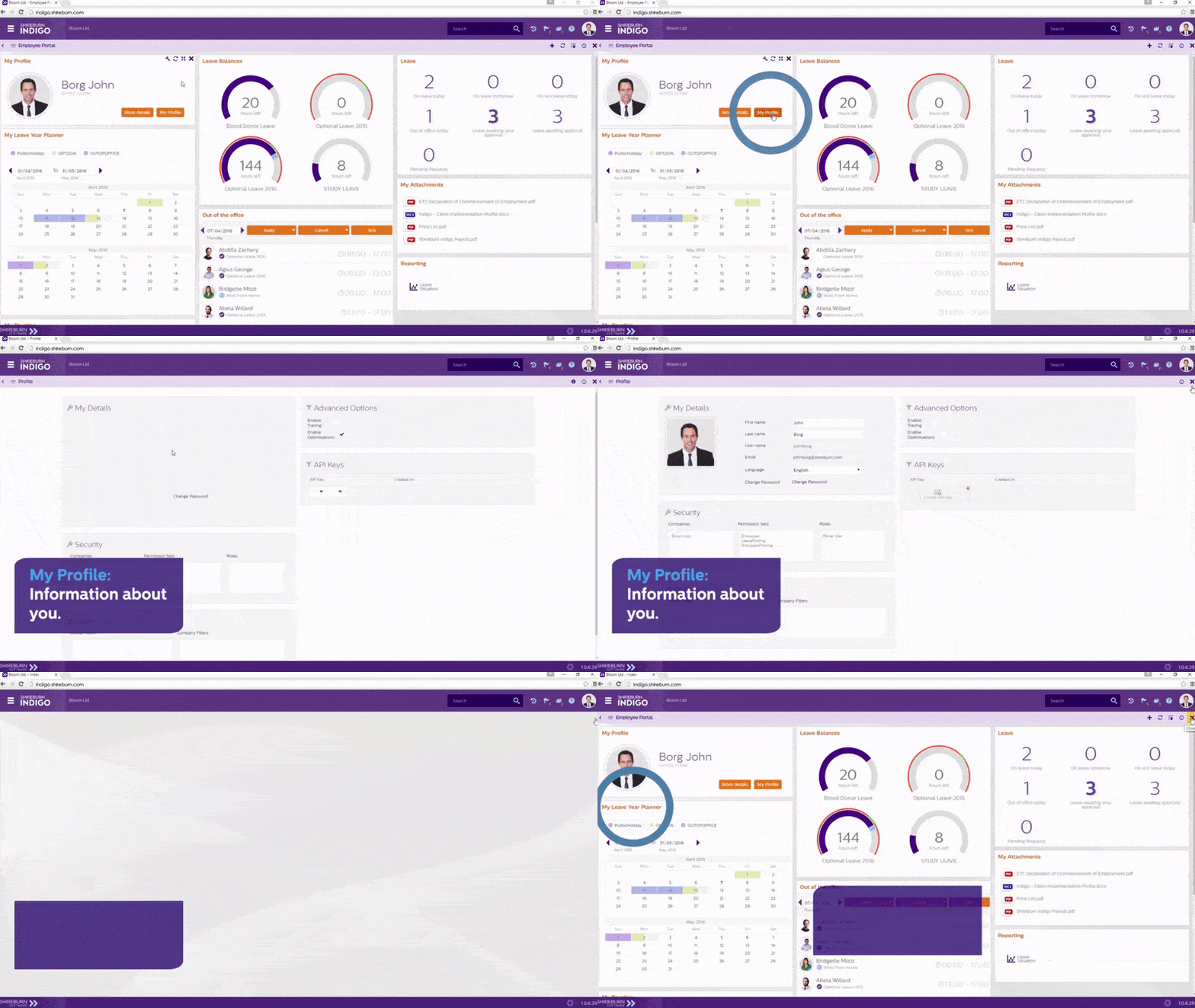
Restaurant employee portals

Administrators, personnel, and other external stakeholders can use an employee portal to access company resources as a contact management system and communications platform.

retain your employees with a good portal

A closed system for corporate communication is known as a brand intranet. An employee portal enables broader, external contact with brand information, suppliers, and services that help staff members carry out their everyday tasks. An employee portal helps all the stakeholders have transparent and self-assessing access to their productivity.

Remember, a transparent and efficient system can help in restaurant employee retention successfully and digital technology can do that easily.

These are some attributes of an employee portal:

  • Integrate with current employee development and user progress programs or brand data collection platforms.
  • Customize brand operations with improved accessibility and a unique user experience.
  • Manage operations while providing users and staff with the best possible experience.

A portal offers a wide range of service options. Similarly, it serves as a mediator to provide content sources compiled in an easy-to-use interface.

Intranets 

Companies use intranets as a private network to communicate with only their workers to promote learning and development. Because brand intranets are internal, staff members can utilize them for information searching, internal communication, workflow, ordering, scheduling, etc. It makes life easier for employees who need to communicate quickly and easily with appropriate parties through the proper channels to do everyday responsibilities.

The following are the main factors to take into account: 

  • A cooperative process with employees increases productivity, fosters trust, and facilitates communication. 
  • One point of contact between management and staff can help ensure everyone is on the same page.
  • Intranets offer a storehouse for branded goods, training, and other initiatives that improve culture and the working environment.
  • Interactive restaurant intranets unlock the potential of staff, which boosts revenue.

Intranets establish dependable channels within brands that support policies and control procedures as a participation tool. This tool promotes consistency and a better working environment for employees. Brands with intranets that provide structure and communication for every aspect of the organization consistently receive positive employee feedback. 

Dashboards and business intelligence

One significant improvement is making all the data that supports your restaurant accessible with ease via dashboards and business intelligence. Employees benefit from data measurement technology solutions that offer analytical insight through the tracking resources provided by an interactive dashboard.

This solution maintains an even playing field for all team members. You can store all hourly, daily, weekly, and monthly data necessary to make decisions on dashboards. Dashboards make procedures possible at every level. Everyone needs to have their finger on the restaurant’s pulse. 

An even playing field gives hardworking and smart employees to perform better and at the same time motivates the nonperforming staff to do better. A healthy competitive atmosphere can help in restaurant employee retention in a much better way. Digital technology can create that balance and healthy atmosphere in your restaurant.

For the personnel, who now feel empowered, this is freeing. Employees can contribute to deciding what business intelligence is crucial, how data should be presented, and how to act on it to get desired results.

Dashboards that simplify understanding data links and purchase interactions also assist employees. In other words, dashboards offer source analysis to track customer satisfaction and performance KPIs. 

Restaurant employee retention and gamification apps

Restaurants are under more pressure than ever to keep their good employees. Providing your business with custom retention and gamification software is an employee investment that strengthens the bonds between all team members.

You probably don’t consider applications and software when considering staff retention, but you should. Apps for human resources can help increase employee confidence and departmental cooperation among the restaurant staff.

What are these apps used for?

  • Utilize a retention app created for anonymous feedback to understand your business’s work environment better. This tool gives information about all employee levels and positions and the conversations between managers, supervisors, and staff.
  • Establish a staff resource section where employees can advance their growth or assist in collaboration with others, observing their progress as the task progresses.
  • When combined with feedback and suggestion boxes, this tool helps track employee morale and mood to report how workers feel at work and can assist lower attrition.
  • Offering surveys to gauge employee engagement can improve company culture, and supervisor reviews can help keep your best restaurant employees on board immediately.
  • Make it simple and convenient for workers to view their hourly, daily, and weekly schedules, request time off, and provide other thorough feedback regarding staffing needs and other required resources.

Retaining employees is crucial to the success of any organization. Enhancing your restaurant staff’s well-being is vital in a similar vein. Your employees are an investment, and retention tools can assist you in better comprehending your restaurant’s work culture from your staff’s perspective.

Kitchen display system (KDS)

Tools that make their daily lives easier are appreciated by restaurant workers, most especially for impending orders and preparations. A kitchen display system (KDS) should be a vital component of every location for a particular brand.

Kitchen staff and front-of-house staff may communicate easily with the help of kitchen display apps. They combine all orders from third-party channels, websites, kiosks, and mobile devices. With its simple user interface, straightforward menus, and connectivity with payment processors, KDS offers visibility and organization.

Mobile POS (mPOS)

The introduction of mobile POS apps streamlines daily operations for restaurant staff. A portable device that mimics a typical POS system is a mobile POS system. As a result, it serves as a register or card reader to complete transactions. Mobile POS uses the brand’s data connection on digital devices (smartphones, tablets, etc.) to accept payments through the app, interacting and converting customers from anywhere at any time. 

How does mPOS improve the employee experience? This tool expedites the check-out procedure and frees restaurant workers to help customers or handle other necessary tasks. Because of this, guests are served more swiftly and efficiently. This solution undoubtedly makes the server’s job more accessible and painless. 

Are You Ready to Use Digital Technology to Boost Employee Retention at Your Restaurant?

Employee turnover in the hospitality sector is at an all-time high, with most servers resigning within two months of starting their jobs. However, with the help of digital technologies, you may beat the statistics and boost employee retention in your restaurant. Implementing technology such as employee portals, kitchen display systems (KDS), and mobile point of sale (mPOS), among others, can improve employee working conditions at your restaurant and increase staff retention. Digital technologies have helped increase operations in various other sectors, like healthcare, banking, and many others; there’s no reason why they can’t help you retain your best employees.