Author Archives: hostmerchantservices

Credit Card Processing Agent

How to Become a Credit Card Processing Agent

In the ever-evolving globalized market, as services transition to eCommerce and online setups – merchants are increasingly relying on ever-expanding cashless payment methods. The plus side to this is that the individuals benefitting the most from these changes are the merchants themselves. The credit card processing business is at the front line of this exciting modernization, capitalizing on this developing and evolving new niche in the globalized market.

The benefits of this career path for anyone interested in how to become a credit card processing agent are not just financial – this industry is a surefire way to implement professional growth and build a sense of accomplishment as you work hand in hand with the innovators.

This article will explore why setting up a credit card processing business is an exceptional opportunity to place yourself at the forefront in the rapidly essential payments industry and how to become a credit card processor.

What does a Credit Card Processing Business entail?

A credit card processing business, a Merchant Service Provider (MSP), or an Independent Sales Organization (ISO) are all titles used interchangeably within the payment processing industry. As a credit card processing business, you are representing an issuing bank to sell their payment processing services.

However, an essential aspect of being a credit card agent is that you must make an upfront investment before the issuing bank officially initiates the credit card processing business into its reseller program. Benefits of doing so include low buy rates – which is the charge for the payment processing service which the credit card agent sells to merchants – something we will dive deeper into below. Another major part of their job is to provide ongoing support to help effectively market the merchant account services.

As always, there is a downside, which in this case would be the upfront investment required to set up the credit card processing business. Often, the issuing bank may not even consider an individual credit card agent for the program, instead requiring the person to become a part of an already existing ISO/MSP.

What are some key traits that make a credit card processing agent successful?

What exactly does being a credit card agent entail? What are you responsible for as a credit card processing business? Well, as with any type of sales agent, the name of the game is to ABC – always be closing. How exactly do you do that?

Approach merchants as respected partners: Credit card agents that can carefully pay attention to and anticipate merchants’ needs are who will be successful. What are the main concerns of the merchants? What can make them successful? Merchants who’ve agreed to have a discussion with a credit card agent in the first place is a great sign and an opportunity to learn more about their business and their pain points. To successfully set up a credit card processing business, entrepreneurs need to address these pain points to ensure a frictionless and hassle-free path to winning over customers.

Be a fast learner: What products are available? What are the types of merchants you may be servicing? Who are the major competitors? What’s Cash Discounting? Is it legal? Will my existing POS system integrate with your merchant account? What is the EMV liability shift? How expansive are the omnichannel payment options with your offering?

What paperwork would the merchant need to fill out? How can the credit card agent support them in the process? The ability to answer these questions, and many others, is the path to how to become a credit card processor. Anyone running a credit processing business should readily have the answers to these questions at their fingertips. That is how you earn trust and get merchants to come to you for honest and reliable solutions.  

Never give up: Keep on keeping on, as the saying goes. Be proactive when it comes to expanding your client base. It will be hard to start with, but you must remember you’re playing the long game. You’re in it to win it. Remember to keep checking in and seeing if they need anything. Advise and inform them of changes within the industry. Be honest with them about how what you have to offer is a more suited solution for their needs.  

The benefits of having your own credit card processing business

Freedom

The 9-5 model grows increasingly outdated with every passing day. The gig and freelance economy are being prioritized along with passive income so people can focus on doing what they want to do in the time they have.

Setting up your own credit card processing business full-time allows credit card agents to dictate how they operate. You decide which customers to pitch, which industries work in, how hard you work, and how much risk you are going to take on.

Innovation

The payment processing industry has been in a state of innovation since Frank McNamara [MF1] left his wallet at home and was inspired to create the first charge card back in the late-‘40s. Since then, businesses have sought to accentuate trade by removing barriers and synergizing the customer’s journey.

Today, the payments industry experiences immense growth from consumers’ interest in mobile and eCommerce transactions – mainly thanks to the shift to online shopping and contactless payments precipitated by shoppers worldwide. Now, with the implementation of digital wallets accelerating more commerce, including cross-border trade, the payment processing industry is at the center of it all to effect change and profit. The question on many entrepreneurs’ minds now is how to become a digital payments agent.

Be your own boss

Running your own credit card processing business requires effort, discipline, and critical communication skills, among other techniques that you must learn. Like most things, you get back as much as you put in.

Unlike businesses such as franchises or retail companies, the up-front costs of starting your own credit card processing business are comparatively minimal. Resellers of payment processing should expect some initial costs for relationship management and marketing software, travel, and office supplies to get started.

Choose your customers

Your success is directly dependent upon whom you work with. That’s why it’s essential to seriously research your options when deciding which merchant service provider to partner with. Merchants demand an omnichannel payment processing solution – because that is what their customers want.

However, a credit card processing business wanting to build trust and loyalty with merchants will not accomplish this if the merchant service provider they are reselling services for offers prohibitive prices on POS equipment leases and has strong contractual language for long-term agreements with excessive early terminations fees such as liquidated damages.

Choosing the right partner will lead to a credit card agent focusing on building long-lasting relationships. It is essential to partner with a merchant acquirer whose values are in tandem with your own.

Fast-growth Industry

eCommerce is expected to cross one trillion dollars in sales in 2022, according to digital research firm eMarketer[MF2] . That’s just in the US. These flourishing businesses will want to partner with a credit card agent to process payments. Payment processing, online payment capabilities, fraud security, and PCI compliance are just some of the things that you can help them with. Additional consultation on which POS equipment is best for their needs, assisting businesses to implement gift card and loyalty programs, integrating with other workflow tools, or doing something as simple as building a website, are all opportunities to expand the credit card processing business or build more loyal customers.

That is the growth potential of the current market. The potential for growth increases when considering the existing pool of customers unsatisfied with current industry incumbents who have equated size with quality.

Shifts in key demographic                                                                   

Flourishing opportunities are nurturing the payment processing industries’ economy – where potential lies with both past and future customers. It’s essential to consider the increasing number of people whose preferences have moved from cash to cashless, and businesses refusing to acknowledge this change will suffer. A prime example is the retail industry, where consumer spending has shifted from the physical to online shopping. 67% of Generation [MF3] Z and 56% of Generation X prefer online shopping over going into a store. Data reflect those of consumers between the ages of 25-44 years[MF4] , less than 20% prefer to use cash, with the remainder preferring card or digital payment solutions.

The trend in the data is clear – there is an overwhelming shift that proves that the payment processing industry will only get more lucrative as there is an ever-growing number of merchants and consumers looking to avoid cash. The demand for credit card processing businesses will only grow.

How can you choose the best credit card processing business partnership program?

The credit card processing business program you partner with will determine the amount you earn. An important factor that some credit card agents fail to understand is that building a business on trust and loyalty will always yield a more effective result than threatening merchants with the legalese of long-term non-cancelable contracts.

You want to build your credit card processing business without requiring any long-term commitments from merchants. The product and service level will be the differentiator to win more customers. Will your business offer 24/7 support? Can you easily integrate merchants’ prior POS equipment and offer additional tertiary services? Having these options on offer with transparent pricing makes your job as a credit card agent much more effortless.

The demographic trends and what they mean for the payment processing industry and the fast-growing career are all factors too appealing to ignore. If building meaningful relationships and developing transferrable skills while being rewarded for it in a secular growth industry sounds of interest to you, then carefully consider being a credit card processing agent.

The economics of setting up a credit card processing business

The buy rate is significant. This is the rate offered to the credit card agent from the merchant acquirer, or MSP. The buy rate includes the rate which the issuing bank and the MSP take at a minimum to process payments. It also consists of the fee available to the credit card agent.

A simple example, the buy rate in an MSP reseller program a credit card agent is part of may be 2.0% + $0.10. The credit card processing business can offer the merchant a rate of 2.5% + $0.15. The margin for the credit card agent in this example is 0.5% + $0.05 on every transaction. It may sound small, but if the merchant you signed up processes 100 transactions per day, averaging $10 per transaction, the credit card earns $10 (100*$10*0.5%) + $5 (100*$0.05), totaling $15 from that one merchant, daily.

Imagine how that can be scaled based on your efforts as a credit card agent working with existing leads and expanding the pipeline every day. This is a tremendous opportunity as more entrepreneurs start businesses and as more consumers shift their spending habits towards cashless.

Conclusion

In closing, the merchant services industry is primed for growth, with all the stars aligning for success for anyone looking to start a credit card processing business. The demographic trends, the industry’s growth potential, and the independence of managing yourself and your fate are just too rewarding to overlook. Suppose you want to build meaningful relationships and transferrable skills in an industry with a history of innovation and a flair for entrepreneurship. In that case, you should consider being a credit card agent full-time.


 [MF1]Hyperlink to the history of CC industry article??

 [MF2]https://www.insiderintelligence.com/content/us-retail-ecommerce-sales-surpass-1-trillion-this-year

 [MF3]https://www.statista.com/statistics/242512/online-retail-visitors-in-the-us-by-age-group/

 [MF4]https://www.frbsf.org/cash/publications/fed-notes/2019/june/2019-findings-from-the-diary-of-consumer-payment-choice/#:~:text=Individuals%20aged%2018%20to%2025,by%20two%20payments%20per%20month.

Figure 7

5 Basic Principles of Accounting

Understanding the 5 Basic Principles of Accounting

When starting your own business, there are many departments that you need to prioritize in the beginning. One such department is the accounting department, which manages your finances through the use of accounting principles.

There are many reasons why setting up an accounting department is important for your company, but the main reason is that it can keep your financial records in an organized fashion. Furthermore, by using various accounting principles, it can make sure that all of the financial records are accurate and updated, ensuring financial safety and efficiency.

Let us discuss this in a bit more detail, taking a look at the importance of accounting, and exploring the five accounting general principles as well.

Basic Accounting: Why Is It Important?

Before understanding the five important principles of accounting, lets first take a look at accounting and why it is an important part of any company. By definition, accounting is a term that is used to explain the process which involves strengthening the financial position of the company, and also ensuring financial transparency and responsibility.

The main purpose of an accounting department is to keep a record of any transactions that they make, the cash flow, and generate profit and loss reports based on the financial information.

In addition to solidifying the finances of a company, the account is also important due to other benefits that it brings to the table:

·       Records All Business Transactions

One of the most important reasons why accounting is essential for every company is because it is through these processes that the company is capable of keeping a systematic record of the company’s finances.

Having access to updated financial records at all times can help companies when comparing their current situation with that of the previous years, allowing them to evaluate their financial position.

·       Helps in Decision Making for the Management

One of the greatest benefits of having a capable accounting department is that the accumulated financial information greatly helps in the decision-making process.

The management team needs accounting in order to make any important decision, mainly due to the fact that accurate financial information can help them evaluate their position when it comes to capital, allowing them to make a well-informed decision.

·       They Meet Legal Requirements

Tax authorities such as the Internal Revenue Service, also known as the IRS, require accurate financial statements in order to properly evaluate the net income and total revenue of the company.

This is done to ensure the legality of the inflow and outflow of capital that is involved with the organization, and this is where accounting comes in.

It is the job of the accounting department to ensure that all of the financial documents are constantly updated and reach the IRS in order to ensure the legality of all the transactions that have occurred within the company.

Basics of Accounting Principles and the Five Types

merchant account vs payment gateway

Information is key in building a trusting relationship with both your clients and your stakeholders as well.

The best way to do that is to keep a record of all of the financial exchanges that have taken place within the company, and the best way to do that is to adopt the basic principles of accounting.

Although there are many regulations and different requirements when it comes to the preparation and organization of the financial statements that are comprised of all the transactions that have taken place in a company, they follow the same accounting principles.

Let us take a look into these five cornerstones of financial development and accounting and understand them in a bit more detail.

The Accrual Principle

When shipping goods to a customer, an exception that may arise may be that the product may be sent in one accounting period, but the customer might have sent you the payment in the next accounting period.

The Accrual accounting principle takes a look at this situation and helps understand when a sale in this particular situation should be recorded in the books.

According to this principle, it is advisable to you recognize the income at the time it is earned regardless of the time you receive it, after which you should recognize the expenses at the time you incur them.

When doing so, the time duration does not hold any importance, and you can recognize the incurring expense at any point in time.

When dealing with financial statements in accordance with the Accrual principle, transaction recognition is closely related to when the business activities take place and not the time at which the money is exchanged.

The Matching Principle

Another key principle that is part of basic accounting is the matching principle, and it normally explores the situation involving the time when a company buys a piece of equipment in one quarter and then uses it for the upcoming quarters.

When facing such a situation, this principle looks at the expenditure that takes place and the time that it should take place.

The main function of the matching principle is to make sure that the company revenue is aligned with the expenses that have taken place.

This means that the company should be able to recognize the expenses around the same time as when they are earning the revenues for them and vice versa.

This is done primarily because recognizing the expenses at the same time can help the organization evenly divide the cost of the equipment over the span of the increasing number of quarters they have used it for.

The Historic Cost Principle

Most of the functionality that is concerned with accounting ties closely to past events. This is partly why comparison and consistency are such important aspects, and in order to ensure that the financial records remain consistent, this principle is taken into account.

Before understanding the historic cost principle, let us first understand what the term “historic cost” exactly means, as it is important to ascertain the purpose behind this key principle.

By definition, the historic cost of a transaction means the real value of the involved resource, such as any cash or liability that is related to the exchange.

The main requirement for a company to implement this principle into its accounting regulation is to record any transaction that takes place at its historic cost.

How it works is that if the resource involved in the exchange goes through an increase in value due to some internal or external factors, it does not affect its value in the official financial records unless allowed by the accounting standards.

This principle and the overall concept behind historic cost are essential, mainly in the case of property.

This is because the real estate market is a volatile one, and if organizations did not follow the concept of historic costs when recording the value of their assets, it could greatly impair future comparisons to evaluate the overall financial situation.

Conservatism Principle

There are times when a company is already aware that an event is about to occur that will incur massive costs for the company. The principle deals with this manner of potential expenditure, and whether it will be recognized in the records.

There are a number of different ways to record such transactions, meaning that there is a possibility that different accountants make a decision that is distinct from each other, and this is where the conservatism principle comes in.

In accordance with this accounting principle, accountants are required to adopt an approach that results in the lowest possible net income, or the utilization of the lowest net assets, when engaging with any merchant services.

Furthermore, accountants should also keep all anticipated costs into account and recognize only the gains that are projected to occur and when they occur.

Principle of Substance Over Form

What makes this different from the other accounting principles is that it requires your company to record the economic value of the transaction and the events as well, rather than just their legal form.

There may be a possibility that the lease can be very brief, lasting for only a few months. In this case, the statement should show the entirety of the expenses paid by the company without having the need to list any asset.

However, if the piece of equipment has been leased for a considerable amount of time, the resulting exchange is similar to a sale and loan in terms of economic value because of the fact that the lease covers the majority of the life of the asset.

When dealing with such a situation, the regulations and laws in accounting dictate that the lease should be treated as a purchase that is done by your company and viewed as a debt that is owed to the individual who has leased the equipment.

Conclusion

The main reason why many accountants and teams integrate the use of proper principles is due to the fact that they offer staff members and management a very easy-to-follow and streamlined path that is tailor-made for different situations. Having strong accounting principles in place in your organization can help you maintain a clean understanding of what your current financial situation is, and help you make accurate decisions based on where you need to go.

How do businesses collect data

How Do Businesses Collect Data? (And what is it used for?)

Data is said to be the new oil. As a result, businesses collect data and commoditize it for various use cases. As data has begun to proliferate in abundance with the advent of the latest mobile technology, such as smartphones and tablets, businesses collect data to the tune of quintillions of bytes generated by billions of consumers worldwide. Data is always waiting to be collected, warehoused, cleansed, organized, analyzed, visualized, and used for a more refined targeting of each smartphone owner.

Some of the most successful publicly listed IT businesses have made a business model of collecting and commoditizing consumer data. In this article, we dive deep into what types of businesses collect data, why they do it, what is it used for, and how do businesses collect data. In this article we will explore the numerous data privacy regulations businesses must adhere to when collecting data and what rights and powers consumers have to protect their data.

Different types of data: How do businesses collect data?

There is a treasure trove of online data generated by consumers. As businesses collect data, they are increasingly hungry to extract as much of that consumer-generated data as possible and analyze it. As a result, companies are building sophisticated tools such as algorithms and combining that with the advent of big data and artificial intelligence to curate highly customized marketing catered to consumers’ preferences. This phenomenon led to the Harvard Business Review publishing an article calling a data scientist the “Sexiest Job of the 21st Century[MF1] .” And that was a decade ago! Today businesses collect data that fall into four main areas. These include:

Personal data – This is any information that includes data that can personally identify an individual and non-personally identifiable data. Data that can personally identify an individual can include gender, address, phone number, social security number, date of birth, etc. Data that fall into non-personally identifying data have web tracking technology that gathers internet search and browser history, IP address that identifies the consumers’ location, and information about the device, such as the type of laptop, tablet, or smartphone used.

Data on user engagement – this category of data collected is the details of how customers use and interact with a company’s various platforms, such as its website, smartphone apps, social media channels, email outreach, customer support portals, and paid advertising.

Behavioral Analytics – data collected to build a behavioral profile of consumers include how often customers shop, the purchases they’ve made, how often and in what ways they use certain products, what pages of a website they often browse, and how long they remain on that page. Detailed qualitative data is also collected that track the movement of a mouse on a laptop/desktop or the scrolling of the page and eyeball tracker on mobile webpage visits.

Attitudinal study of consumers – this data set builds a profile on consumers’ perception of a business’s brand, their favorability and overall customer satisfaction scoring, how desirably a customer views a business’s products and how the company fits into the consumers’ purchasing habits, and criterion.

Why do businesses collect data?

big data word cloud
Keyword Research

There are many reasons why businesses collect data of consumers. Some of these include:

Customer experience – behavioral data on the customer truly does impact business strategy. If the data suggests that certain business strategies on products or the sourcing of specific supply chains do not fit well with consumer preferences and timelines, those areas of operations and product mix are modified for a better fit for the customer.

Targeted marketing – Businesses can better target their audience based on the likes and preferences data collected on consumers. Analyzing consumer data and better understanding the contexts and consumer journeys that drive spending allow businesses to target only those customers who prefer to engage with that business.

To build a more clear profile of the customer – Some businesses already have a certain amount of data about their customers. They look to add additional layers of that data about the customer to have a more wholesome profile of the customer for a better customer experience and safety precautions. A perfect example of this may be a bank app looking to supplement biometric data about its customers to protect the customer account better so that only that person is accessing the data regardless of location or device used. 

Pure profit motivation – not all data collection efforts are well-intentioned. Some data collectors are in it only for the money. A new industry known as data brokers is collecting and compiling large, vast amounts of data, often without the customers’ knowledge or consent, simply to sell it for a profit.

How is data collected by businesses?

data protection

There is a myriad of ways businesses collect data about customers. Some businesses ask their customers for the data directly. Others gather that information indirectly on consumers that may be existing or potential customers. Many companies simply append supplementary data onto their own data sets to enhance consumer profiles.

For starters, businesses build their database on customers when they signup for their services. That profile is expanded as the customer uses the company’s products, visits other products on their website, follows and comments on the company’s social media sites, and calls in or chats about any inquiries or complaints.

This data is enhanced by other information collected, such as the type of device used to access the website, and inferences are made regarding how and when the customer accesses and uses their product. Additional insight is driven by the type of conversations the customer had with the company’s various departments, such as when did the customer talk to the support team, was the customer ever routed to the sales team, or if there has ever been a request for product enhancements shared by the client.

What data privacy regulations must businesses adhere to when collecting data?

data protection

Smartphones and mobile technology are used for every day human interaction and so much more. Although regulators and lawmakers have been behind the curve in adjusting to this new reality of businesses collecting data and understanding how it is used, there is new vigor with four major privacy laws protecting consumer data.

General Data Protection Requirements (GDPR) – issued by the European Union for all businesses targeting the collection of personal data of EU citizens, the regulation sets forth specific guidelines about how data can be collected, where it is stored, and how it is used and shared. There are steep penalties for violators, as much as 4% of annual revenue.

California Consumer Privacy Act – similar to the GDPR but requires consumers to opt out of any effort to collect data by businesses.

Colorado Privacy Act – Scheduled to come into effect on July 1, 2023, CPA is very similar to the California Consumer Privacy Act in that it requires the consumer to opt out of any data collection efforts by businesses.

Virginia Consumer Data Protection Act – This is Virginia’s version of the California Consumer Privacy Act, which requires consumers to opt out of any effort to collect data by businesses. It also requires companies only to collect data needed for their business and inform the consumer of their rights around this law and the different recourse they have. The law will come into effect on January 1, 2023.

How to protect your data?

In an Ipsos poll conducted in 2022[MF2] , 70% of consumers in the US think it has become more difficult to control who has access to their data. Only a third of respondents believed that businesses collecting that data have appropriate controls in place to protect that data. According to that same poll, Ipsos presented six security safeguards around data protection and asked the respondent how many of those safeguards they had implemented. Only a sixth of those questioned had implemented those safeguards. Less than half the respondents had implemented three or fewer safeguards.

The survey found a correlation between those who had the fewest safeguards implemented and how despondent they felt about the ability of regulators and companies to protect their data. More than 70% of those surveyed wanted their online presence to remain anonymous or wanted the ability to erase whatever online data had been collected about them. Nearly 80% of those who participated in the poll wanted a permission-based system for collecting and accessing their data.

All in all, the findings of the survey point to the fact that consumers are concerned about their data being collected but don’t understand how to protect their privacy. Below are some safeguards that privacy experts advise consumers should implement to protect their data and their privacy.

  • Advertising and tracking app blockers – many websites you visit have trackers that track every move made while on their website. These trackers can collect IP addresses to locate you, which device and browser you used to access the website, what pages were visited, and how long you stayed on a particular page. Some trackers even track your activity once you leave the site, tracking activity across the internet to build an entire profile of your online habits, search inquiries, and preferences. Consumers are advised to install browser extensions blocking those ads and tracking technologies.
  • VPN is an encrypted virtual tunnel between the user and the internet. All data goes through this virtual tunnel, masking the user’s IP address. Using a VPN means no one can see what you are visiting online as it is encrypted, and since the IP address is masked, your location is also indecipherable.
  • When the product is free – you’re the product. Social media and hundreds of apps and tools are free to use and share your data. These platforms and apps collect your data to accurately target you for advertisements or to outright sell the information such apps have collected about you. Privacy experts have recommended to avoid free apps and platforms where possible.
  • You don’t always have to use your actual information. That’s not to say one should use fake information on their tax returns. Instead, you don’t need to sign up for the latest cheese or razor blade subscription with your data. Using phony information for such services can safeguard your privacy.

Conclusion

As of fiscal yearend 2021, Google had more than $257.6 billion in annual revenue[MF3] , up by more than 41% from the year before. The company’s market capitalization is over $1.2 trillion[MF4] . More than 80% of that revenue is from advertisements. Meta, the parent company of viral social media platforms such as Facebook and Instagram, had annual revenue of nearly $118 billion for yearend 2021, an increase of 37% from yearend 2020[MF5] . The current market capitalization of the company is over $300 billion[MF6] .

These companies have established trillion-dollar business empires built on collecting and harvesting consumer data and then micro-targeting marketing and advertisements on behalf of their customers. This is the birth of surveillance capitalism, with its widespread data collection and the commoditization of that data in the name of capitalism. This is due to the fact that there is a profit-making motive that arises from the advertising industry seeing endless possibilities from the use of specific personal data points generated from almost every human action possible and then gathered to target consumer behavior with immense accuracy.

Regulators and lawmakers are finally waking up to the power of big tech and looking to enact safeguards to protect consumers’ privacy and data. However, the practice that businesses collect data and the for-profit model that the practice has spawned will not go away. The process will continue to proliferate, albeit with the guardrails of regulation. These companies will continue to operate and flourish around the law with even newer and more clever ways to hook consumers to the latest technological innovation and extract even more data.

Consumers must understand and stay aware of the latest data collection practices that businesses employ and the impact their actions and the use of technology have on the data they are disclosing.


 [MF1]https://hbr.org/2012/10/data-scientist-the-sexiest-job-of-the-21st-century

 [MF2]https://www.ipsos.com/en-us/news-polls/data-privacy-2022

 [MF3]https://www.globaldata.com/data-insights/internet-services-technology-media-and-telecom/googles-revenue/#:~:text=Google’s%20Revenue%20(2002%2D2021%2C%20%24%20billion)&text=Google%2C%20the%20search%20engine%20giant,revenues%20in%202021%20from%20advertisements.

 [MF4]https://www.google.com/finance/quote/GOOGL:NASDAQ?sa=X&ved=2ahUKEwiNnIysiPL7AhUF7KQKHdhuDPIQ3ecFegQIKBAj

 [MF5]https://investor.fb.com/investor-news/press-release-details/2022/Meta-Reports-Fourth-Quarter-and-Full-Year-2021-Results/default.aspx

 [MF6]https://www.google.com/finance/quote/META:NASDAQ

Contract Terms to Avoid

Contract Terms to Avoid and How to Spot Them

Merchant service agreements and the contract terms within it are vital for businesses to carefully review and consider. Many merchants often go to great lengths to evaluate all the different fee arrangements and learn the minutiae of tiered pricing and interchange plus.

They may look at all the payment processors that offer various platform integrations, the latest point of sale equipment, or all the additional tertiary services available. However, there are specific contract terms to avoid and understanding how to spot them is the cornerstone of the process of inquiring about merchant services.

In this article, we will explore why the merchant services contract is so essential and the different contract terms to avoid within them, such as service length clauses, early termination fees, liquidated damages, automatic renewals, and equipment leasing. Additionally, the language associated with these contracts will be highlighted so that merchants can understand what to look out for.

Contract Terms To Avoid- Why understanding merchant services contracts is so important?

spot avoidable contract terms

The legal relationship between the merchant and the payment processor will be based on the contract that is signed. The most impactful step a business owner can take is to read the contract they sign for their merchant account. Given how necessary payment processing is to businesses, we have identified three significant benefits of understanding merchant services contract terms below.

  1. The incentives of payment processing sales teams and merchant services providers don’t always align with the merchant. Often their incentives don’t even align with merchant services providers, the entity that has hired them. Usually, it’s not the sales teams’ fault as they are engaged and retained based on aggressive targets, and failure to meet them results in termination or closing less deals. So, it’s vital to identify how knowledgeable the sales agents are about the product of their specific company and particularly how the payments industry works overall. If they fail that test, it is primarily because the payment processor has not sufficiently invested in training the team and does not have a system in place for a long-term customer retention.
  2. Understanding the contract terms spells out what merchants are paying for. They will know what they are liable for and all the applicable fees. Most importantly, they can make an informed decision on whether it is a fair agreement.
  3. Finally, until the merchant has signed the dotted line, they can still walk away from the deal. Once merchants have read and clearly understood all that they will be responsible for, they still have the chance to walk away and take their business elsewhere where they may find a better alternative that they are more comfortable with.

Clauses for the length of service

This is also known as the term of the agreement. A typical term period of a merchant service agreement is usually three years. Although three years is the most common in the payments industry, some merchant service providers offer contract terms ranging from one year to as long as five years. After that, the length of services is continued on a twelve-month cycle that auto-renews annually.

It is important to note that clauses for the length of service within merchant service agreements are quickly falling out of favor. There are two specific clauses relating to the term length of the contract. One defines the term commitment, the period for which the merchant is contractually obligated to retain the merchant services account with the service provider. The second is the early termination fee, a penalty for ending the agreement before the completion of the term commitment. When negotiating the elimination of length of service clauses, both those clauses need to be waived and written into the contract.

Contract terms that specify term commitments are very unpopular with business owners as they are meant to prohibit businesses from quickly ending the arrangement in order to switch to another payment processor. Merchants are increasingly negotiating to have the term commitment waived and replaced with a monthly billing cycle. At Host Merchant Services, our payment processing service requires no term commitments. Instead of contractually binding terms, we rely entirely on our excellent customer service and low rates to retain customers.

Early termination fees or Liquidated Damages

Contract terms such as early termination fees are a penalty fee levied against merchants for ending their agreement before the contractually obligated term commitment is over. This is usually identified as a fixed fee ranging from $300 to thousands of dollars.

Do not rely on a verbal agreement to waive explicit early termination fees. The most egregious form of an early termination fee is liquidated damages. NEVER sign an agreement includes contract terms such as liquidated damages! This fee is assessed based on the average monthly payment processing fees multiplied by the number of months remaining in the term commitment. Ending an agreement with a merchant service provider that levies liquidated damages can be extremely expensive, specifically if the merchant has a high volume of payments processed and just recently started the contract with the payment processor.

The good news for merchants is that early termination fees and liquidated damages are one of the most common clauses in the merchant services agreement that are waived in a sales negotiation. However, it is vital not to rely on a verbal agreement to waive these fees but to have it written into the merchant services agreement.

Equipment leasing

Payment processors will often market equipment leasing of mobile card readers, countertop systems, or point of sale terminals. Although these leases carry no upfront charges as merchants don’t have to pay their total costs just as they are starting their business, the actual cost of that equipment throughout the duration of the lease may end up being much higher, usually four to five times higher than the original cost of the machines.

Furthermore, equipment leases cannot be canceled and often last the duration of the term commitment identified in the merchant service agreement, anywhere from three to five years—even more reason to clearly understand the contract terms before signing anything. In the event merchants decide to cancel their lease, they must pay the entire amount remaining in the lease.

To put it in perspective, most point of sale countertop terminals that make up those systems cost anywhere from $150 to $300. Most often, mobile card readers are either provided for free or cost no more than $100. A simple online search on sites such as Amazon or eBay can quickly provide comparable equipment rates that are offered in a lease.

Merchants need to ensure that the payment processor does not require proprietary equipment for payment processing. Once merchants have a list of compatible equipment, they can easily compare and shop around for the best rates.

Finally, merchants should beware of any offer for free equipment. What is marketed as free is, in fact, a convoluted form of a combined noncancelable equipment lease and term commitment that locks merchants into long-duration contracts at higher payment processing rates. Once again, carefully read your agreement.

Hidden fees

On top of the standard payment processing fees and the potential of early termination fees, there are myriad hidden fees that a payment processor can levy on a recurring basis. These regular or one-off fees are disclosed in the merchant service agreement. They simply need to be located, and therein lies the challenge.

Merchants can find most of the fees in the Merchant Application section of the merchant service agreement. Furthermore, the area of Terms and Conditions will most often disclose details of chargeback fees. It is essential to beware that many contracts include language, which gives the merchant the liberty to add additional fees not previously outlined in the agreement.

How do you get started? How to spot the contract terms to avoid

find contract terms to avoid

Most merchant service agreements are riddled with contract terms that should be avoided. Although business owners can identify those terms that need to be avoided, they still need to negotiate on those terms to a point where the contract becomes acceptable. With an industry ripe with disreputable participants, unfortunately it is on the merchants to ensure they are not treated dishonestly and unfairly. Below are some simple ways to get started.  

  • Foremost, read the contract! Carefully! There is no other way to say it. The only way to know that merchant service contracts have terms that need to be avoided and then use one’s expertise to spot them successfully is to read the agreement thoroughly.
  • Merchants need to set aside time to read a contract. They should be rested and be able to think clearly to understand all the legal verbiage with which contact terms are written. This is not a task that can be completed within 15 minutes. Instead, expect it to take at least a few hours, possibly three to four hours.
  • Take regular coffee breaks to maintain focus and remain tenacious when devoting time to reading a contract.
  • Use highlighters, post-it notes, and stickers to identify terms and clauses of importance or those which are confusing. Make notes of any clarification that may be required from the sales agent. When in doubt, make a note to request clarification – don’t assume anything!
  • Try to read a digital copy of the contract, which can be easily zoomed into, making reading the fine print more feasible. This also allows the reader to find important terms and conditions via the search function easily.
  • Also, get the physical copy of the agreement, mainly to track any changes that were added explicitly for you, such as any fee waivers.

Even if the payment processor is highly reputable, merchants must read the contract they sign. The idea is to be aware of what you’re signing up for and clearly understand all applicable charges and what the merchant is responsible for to avoid surprises.

Conclusion

Internet forums and the website of the Better Business Bureau are littered with complaints from merchants who said they were promised one thing by the sales agent, and the merchant service provider failed to live up to that promise. The most common response from the payment processor was, ‘It was clearly written in the contract. We can’t be held liable for the client failing to read it and having other expectations.’ Not reading the contract thoroughly and not understanding the terms outlined in it are the root cause of most disputes among merchants and payment processors.

It is crucial for business owners to understand what a merchant account agreement looks like and stipulates. Knowing how those agreements are structured, the important clauses and terms, and how they can be identified and interpreted is essential. Before signing a merchant service agreement, a merchant must be accurately familiar with the length of that service contract, how to cancel that service agreement, what penalties may arise as a result of that cancelation, and if there is a waiver policy for those fees.

That familiarity with important contract terms must be based on what the merchant has read in the contract and not what has been told or promised by the payment processor’s sales team. Merchants should also be familiar with the red flags and how to spot them. It is vital that such contract terms and strictly avoided.

We don’t live in an ideal world. Although the payments industry has come a long way, with many merchant service providers adhering to honest and transparent best practices, many payment processors still slip into contract terms that should be avoided. Building the acumen to spot those terms is an essential part of doing business as merchants increasingly depend on non-cash methods of payments for purchases.

Frequently Asked Questions

5 Best Tanning Salon Software

5 Best Tanning Salon Software

Tanning salons have always sought to offer best-in-class differentiated services, resulting in the best possible customer experience for their typical hectic and busy schedules. As more and more consumers are looking for experiences over material items, customers are seeking quality, a seamless visit experience, and hassle-free choice of payment capabilities.

There are a host of services on offer, including UV tanning, sunless tanning, spray-on, and airbrush tanning. These services are often complimented with additional offers such as merchandising, yoga and spa services, and Cryotherapy. All the various service lines offered to a host of customers throughout the year make tanning salon software that much more important for customer satisfaction, as well as efficiently managing the tanning salon.

As a result, we look at the five best tanning salon software that are currently available in the market. Our criteria for this list of the five best tanning salon software include payment processing capabilities, point of sale systems available and their integration capabilities with the tanning software, customer support, pricing, and finally, the ability of the tanning salon software to streamline operations via tertiary services, such as reporting and analytics, customer and employee management, and client outreach.

5 Best Tanning Salon Software

Bonsai

Image source

One of the best tanning salon software currently available. Bonsai has made a name for itself in many service-based industries, and the company’s POS offerings offer tremendous value for money.

The tanning salon software provider offers a sophisticated POS system that combines a suite of features, customer outreach and loyalty program capabilities built in, sleek hardware, and staff and inventory management tools.

  • POS systems – The POS solution offered Bonsai is packed with features. Tanning salons can easily integrate secure payment processing and seamlessly process payments for EMV chip cards, collect payments via NFC, and traditional magnetic stripe card processing.
  • Support – This is one of the best features of the tanning salon software provider. The company offers US-based client support, available 24/7/365.
  • Pricing
    • Payment processing is fixed at a lifetime rate of Interchange + an agreed upon markup and per transaction fee negotiated between the merchant and the POS company.
    • Monthly costs for the Bonsai software can range from $39.95 – $69.95
    • The POS system may cost an average of $1,200 based on need and scope at the location.
  • Tertiary Services – There are abundant add-on options available for Bonsai’s tanning salon software solution. The additional features include;
    • Bonsai Mobile Analytics app, which includes real-time sales analytics and customized reporting.
    • Appointment booking and waitlist features.
    • Inventory tracking tools that offer low-stock alerts in real time.
    • Employee management and payroll tools

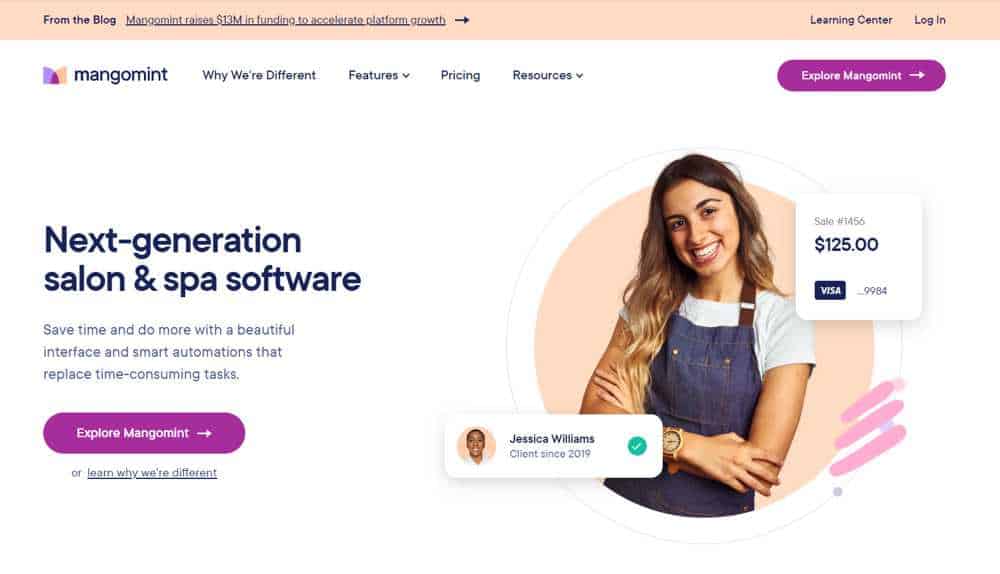
MangoMint

mangomint
image source

This salon software is a great option for tanning salons that need software which is easily customizable if the business has many service providers. The company has a number of niche features as the software caters mainly to salons and spas.

  • Support – MangoMint has a great feature that allows customers to reach out via the software’s in-app chat support function if businesses have any inquiries and would like help with the salon software at any time. The company also mentions on-demand phone support.
  • Pricing
    • MangoMint’s payment processing rates are 2.4% + $0.15/transaction for in-person payments and 2.8% + $0.20/transaction for online payments. For salons processing payments of more than $50,000 per month, MangoMint offers discounts that are discussed based on specific enterprise-client fee arrangements. The company has no long-term contracts, as it employs a month-to-month billing cycle.
    • MangoMint’s salon software price ranges are as follows;
    • Essentials – $165 per month for small businesses with up ten service providers and three locations. Additional locations cost $95 per month
    • Standard – $245 per month for medium-sized businesses with up 20 service providers and five locations. Additional locations cost $135 per month
    • Unlimited – $375 per month for large, salons with unlimited service providers and locations
    • The company offers several tertiary services for a cost, which include:
    • Integrated forms of all kinds have a standard cost of $50/per month and an additional $25 per month for each additional location.
    • The Essential Plan charges $25 per month for integration with MailChimp and WaiverForever marketing apps, each. There are no costs for this integration with the Standard and Unlimited plan offerings
    • There is Shopify and Webhooks integration available with only the Standard and Unlimited plans which cost $50 per month each, but the Shopify monthly cost is waived as part of the Unlimited plan. 
    • MangoMint offers a display and iPad-based POS solutions, along with a mobile card reader. For $100, the company also offers a Bluetooth card reader that can plug into a smartphone. 
  • Many tertiary services come as part of the MangoMint software, starting with the Essentials plan, which includes:
    • Inventory and staff management tools
    • Reporting and analytics
    • Gift card loyalty programs
    • Online booking and calendar management
    • Mobile app

Square

square pos
image source

A close second to Bonsai in offering one of the best tanning salon softwares currently available to tanning businesses. The company got its start in 2009 and remedied a nerve-wracking pain point for businesses. Square offered a quick payment processing setup procedure and pioneered payment processing with mobile card readers that could easily connect to smartphones, bringing mobility to all types of businesses. The company has expanded its lineup of POS terminals and has launched the Square app store, allowing businesses quickly to add whatever features they need from payments and POS software. Today, the company offers tanning salon software that is ideal for relatively small tanning salons.

  • Support – Square has invested a considerable amount of effort during the past few years to develop the company’s Support team. Square now even offers support via social media. The company has an extensive online resource library to answer any questions users may have. Square also fosters a great seller community that merchants reach out to with any inquiries.
  • Pricing
    • Payment processing rate is 2.6% + $0.10/transaction for in-person dipped, swiped, and tapped transactions. Those rates increase if the transaction is online or the card information has to be keyed in.
    • Monthly costs vary depending on the Square add-on features businesses need to use. Below are some examples of their features and costs
    • Square Appointments – $29/month for the Plus tier / $69/month for the Premium tier
    • Square Payroll – $29/month + $5 for each employee
    • Square Loyalty – $45/month
    • Square Marketing – $15/month
    • Square Invoice – $20/ month
    • The POS system is offered for free.
  • Square also has a range of POS solutions that tanning salons can select from. The company has taken traditional and boxy-looking hardware and has turned them into sleek and sexy devices that include two-way screens called Square Register, a single screen called the Square Stand and host of mobile card readers – one for contactless and chip transactions and another for magnetic stripe card transactions. , ranging from
  • Tertiary Services – As you can see from their pricing options, there are a host of additional services Square offers, mostly for an additional cost. The company has its own app store that businesses can use to select the specific tools and features they need and buy.

Vagaro

vagaro
image source

One of the best options for tanning salon softwares, Vagaro also specializes in catering to spas and yoga studios. The company has more than 100 add-on features for businesses to choose from. However, the company’s strongest functionality, which makes it stand out among the competition, is Vagaro’s booking and appointment-setting tool, utilizing a very easy-to-understand drag-and-drop user interface.

  • Support – Vagaro is proud of its Customer Support. There is a section on its website’s landing page showcasing the company’s support record. The company offers 24/7 support via chat, email and phone, and most incoming calls to its support desk are answered within three minutes. Vagaro client’s customer satisfaction rate is an impressive 95%.
  • Pricing
    • The company has processed $2.3 billion in payments for 174,000 businesses in Australia, Canada, the UK, and the US. Vagaro’s payment processing rate is 2.75% for dipped, swiped, and tapped transactions. Those rates increase to 3.5% + $0.15/transaction if the transaction must be keyed in. There is a discount in rates for businesses that processes more than $4,000 per month, the rate of which is 2.2% + $0.19/transaction for dipped, swiped, and tapped transactions and 3.0% + $0.19/transaction for keyed-in transactions.
    • The company has a monthly fee ranging from $25 – $85, depending on appointment volume. Furthermore, there are over a hundred features that are all available at an additional cost of $10 per month per feature. Some of those features include;
    • Customer Reminders via email and texts
    • Customer Tracking
    • Various client outreach forms
    • Accounting and Payroll integration with QuickBooks, Xero, and Gusto
    • Website builder
    • Client Loyalty programs via gift cards
    • Reporting and Analytics
    • The company offers a free mobile card reader when you sign up for the company’s payment processing service. Businesses can purchase other POS equipment directly from the vendor or through Vagaro.

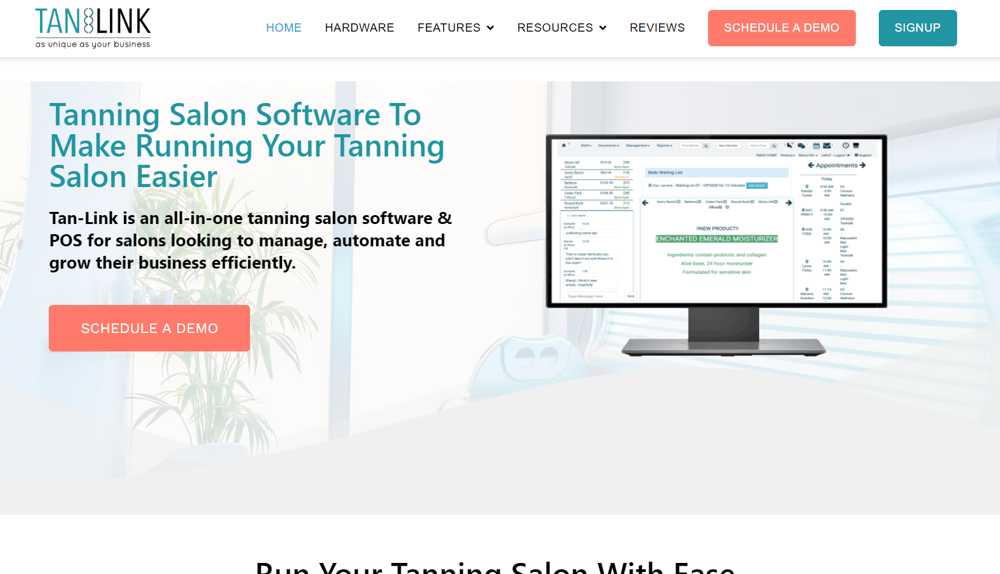
Tan–Link

tan link
image source

Tan–Link is the best tanning salon software for those salons that have a high rate of membership clients. It’s another software targeted purely to salons and has many features that specifically cater to their needs.

  • Support – Tan–Link has a dedicated page for a comprehensive resource library
  • Pricing
    • Tan–Link software cost is broken down into tiered plans ranging from $129 per month to $199 per month, per location. There is an enterprise plan of $250 per month per location and includes differentiated features such a data imports and custom-made reports.
    • The company offers add-ons such as 24-hour kiosks and customized security offerings, all at additional costs, which the company does not disclose on its website.
    • Tan–Link easily integrates with many different payment providers. However, the company does not mention specific payment processing rates that it has secured with any vendors and offers directly.
    • Tan–Link does not directly sell POS systems, however, the company does advise businesses to use iPad tablets and card readers. Tan–Link recommends adding on additional hardware depending on the need of the business to include a desktop, barcode scanners, etc.
  • Many tertiary services come as standard with the Tan–Link software specifically addressing tanning salon needs, including:
    • Real-time status of tanning beds
    • Curbside check-ins
    • Recurring billing
    • Employees, inventory, and customer management functionality
    • Reporting dashboards and tools
    • Loyalty programs

Making software decisions are never easy. The decision becomes even more pronounced if they involve the financial well-being of a business. Tanning salon software is instrumental in making the operation of the business more efficient, allows the salon to offer top-notch customer service, and save money in the process. In offering the five best tanning salon software, we presented specific options informed by our deep industry expertise in tanning salon payments processing. Certain features are vital to the healthy operation of tanning salons, such as the ability to integrate a range of payment processing options, great customer support, pricing that is value-driven and accommodative to the size of the business and software that offers niche add-ons to address tanning salon needs.

Needless to say, with the range of options available, many service providers will offer free trials. Tanning salon business owners are advised to carefully consider the level of handholding and guidance offered during the trial period to gauge the overall expertise and level of service of the different service providers.

Do Not Honor in credit card processing

Do Not Honor: What Does This Mean in Credit Card Processing?

Many merchants may scroll through their merchant account statements to review their processed transactions and see unsuccessful payments with the code: ‘05: DoNotHonor.’ So why does the do not honor error code show up? Who’s to blame for the do not honor decline; the merchant, the banks, or the customer?

Unfortunately, the answer is not always straightforward. Most merchants have seen the standard credit card transaction code ‘05’, also known as the Do Not Honor code. While frustratingly vague, this code can be challenging to explain to customers waiting expectantly to complete their transactions.

In this article, we are going to go into detail about what does do not honor mean, some reasons why a do not honor decline occurs, how to fix it, and why it would be necessary for merchants to familiarize themselves with this error code and the reasons for its occurrence. We also offer some recommendations on how to mitigate the fallout in regard to the customer experience once a do not honor decline is fired off from the issuer.

What does Do Not Honor mean?

Decline code 05, also known as the do not honor code, indicates that the credit card issuer has declined the transaction. It occurs when the credit card authorization request returns a decline because the cardholder’s issuing bank refuses to validate the transaction.

There are a variety of reasons that prompt the issuing bank to send back the do not honor decline.

Some reasons for a do no honor decline

There are many issues that the do not honor code may be referring to. The code is very similar to the Error 404 code many online customers encounter on websites they are trying to make purchases on. Much like the error 404 code, the 05: donothonor code is used because even the issuing bank may not be exactly sure why the charge is denied. As a result, this error code is issued by the issuing bank message as a blanket response to encompass the long list of possible defects in the transaction or in the cardholder’s actions that may have caused it.

Some of the main reasons this code is most commonly used include the following:

  • There is an outstanding preauthorization charge on the cardholder’s account, resulting in insufficient funds to process the current transaction
  • The client has attempted to make this payment after a series of denials on behalf of their issuing bank. After those repeated attempts, the bank has decided to block any activity on the card, flagging it as a risk of being a stolen card or otherwise used fraudulently.
  • The issuing bank is situated in a different country. As a result, the issuer has placed a geographical block on the customer’s card, blocking them from using it if they have not been informed that the cardholder may be traveling.
  • In rare cases, the payment is flagged by the issuing bank’s fraud prevention team because the transaction appears unusual in nature for several reasons, such as the payment being processed late at night or at a unique time based on the cardholder’s traditional shopping patterns, several transactions having occurred together in rapid succession, or the amount being charged is unusually high based on the client’s spending history.
  • The cardholder may be exceeding the card’s credit limit and thus cannot pay for the transaction.
  • It’s also a good idea to check if the card is valid and whether the merchant or the customer has entered all the information incorrectly, as these errors could also cause a decline.
  • There may also be a discrepancy in the security codes used. A mismatch between the AVS or CVC code on the card and what the cardholder or an employee entered when processing the transaction can also result in a do not honor decline.
  • There may be a problem authenticating the transaction. 3D Secure is a security protocol that Visa and Mastercard developed to help reduce the risk of fraud in online credit card transactions. It is also known as the “Verified by Visa” or “Mastercard SecureCode” program.

For online purchases with a credit card enrolled in 3D Secure, the consumer may be prompted to enter an additional security code, usually sent to your phone via SMS or your email address. This code must be entered before the transaction can be completed, providing the cardholder with an extra layer of protection. 3D Secure is designed to verify the cardholder’s identity and ensure that the person making the purchase is the actual owner of the card. This can help reduce the risk of fraudulent transactions, as it makes it more difficult for someone else to use your credit card without your knowledge.

  • At other times, a do not honor decline is the best way for the issuer to stop a transaction. The decline could stem from any abovementioned options and may be a precautionary effort to mitigate risk. However, in some instances where actual fraud is suspected, there are limitations around how the issuer can communicate that back to the merchant, based on an international standard messaging format called ISO 8583.

ISO 8583 is widely used in the payment card industry and is supported by many payment card networks, including Visa, Mastercard, and American Express. ISO 8583 defines a common set of data elements and rules for the exchange of payment card data between financial institutions. The standard is used for the exchange of payment card transactions and related messages between payment card issuers, acquirers, and other financial institutions. It is widely used in the banking and financial industry to facilitate the authorization, clearing, and settlement of payment card transactions.

There is a specific code issuer can use to communicate the potential of fraudulent activity, “59: Suspected fraud.” However, Visa maps a 59: Suspected fraud decline to the 05: donothonor decline option. The card network takes this action to avoid an uncomfortable or possibly dangerous situation in an in-store setting.

It is important to note that the 05: donothonor code doesn’t necessarily imply fraudulent behavior. According to an explanation issued by Visa, most Do Not Honor declines happened for transactions that had less to do with fraud than with a customer error.

According to Visa’s analysis of global declined transactions, do not honor declines are on the rise. In fact, 76% of all international do not honor declines were either a result of insufficient funds or do not honor.


How to fix do not honor declines?

The simplest solution is to ask the customer to use a different payment method or another card to process the transaction. If that is not an option, the next best alternative is to request the client that they contact their issuing bank and inform them of the transaction and the issue they are facing, explaining to the issuer any possible reason that may be causing the do not honor decline that is applicable for the customer. If it is the case, the customer should inform their issuing bank that the decline may be happening because they are traveling, are out of the country, and are trying to purchase a large ticket item that exceeds their usual spending behavior.

Finally, you can ask the client to wait for an extended period, for around three to four hours, before trying the transaction again. The client may attempt too many successive purchases simultaneously, failing card networks’ velocity checks.

Outside of the solutions outlined above, the unfortunate reality is that there are not many other options available for solving this error code as in most or almost every case, it is beyond rare to find out what exactly the specific cause for the error code to show up is.

Using automation to mitigate do not honor declines

Do not honor declines for online transactions can be a cause for concern for most merchants due to the potential loss of sales and customers, possibly permanently. Especially if the merchant cannot explain the reason for the decline, it’s possible that customers may attribute the do not honor decline to some issue with the merchant’s system. However, this does not have to be the case. Below are some potential solutions that merchants can use to fortify their processing platform to reduce any impact on revenue and customer relationships. 

The first option is to over-communicate and start by sending automated emails to customers impacted by do not honor declines, informing them of the error code so you can work with them to remedy the situation. Proactiveness would be the best weapon to turn a skeptical, possibly angry, customer into one that views the merchant as a trusted partner and adviser.

Another solution would be to issue a coupon with a follow-up email to those customers explaining what happened, some potential reasons as to why do not honor decline may have occurred, and reminding them of specific steps they should have taken by now. If the client was trying to buy particular items on sale or other limited-time offers, explain to the customer that they will still be eligible for the offer, extending the limited-time offer for a certain number of days upon receipt of the latest email. 

These automated outreach options are just some of the few ways merchants can stay proactive to mitigate the potentially adverse impacts of a complex transaction decline code. Once implemented, these options can immediately over-communicate with customers, not just for not honor code declines but for any possible error code or chargebacks. These efforts can go a long way in improving the customer experience and can be easily scaled.

Conclusion

The error code ‘05: DoNotHonor’ is very common and also vague in its appearance. Essentially Decline code 05, also known as the Do Not Honor code, is when the payment processing attempt results in a rejection of the transaction’s authentication because the issuer refuses to validate the transaction. The ability to pinpoint the exact source of the ‘05: DoNotHonor’ code is complex as there are many issues that this error code could potentially be referring to. The issuing bank issued the do not honor decline code as an umbrella code

Many merchants may scroll through their merchant account statements to review their processed transactions and see unsuccessful payments with the code: ‘05: DoNotHonor.’ So why does the do not honor error code show up? Who’s to blame for the do not honor decline; the merchant, the banks, or the customer?

Unfortunately, the answer is not always straightforward. Most merchants have seen the standard credit card transaction code ‘05’, also known as the Do Not Honor code. While frustratingly vague, this code can be challenging to explain to customers waiting expectantly to complete their transactions.

In this article, we are going to go into detail about what does do not honor mean, some reasons why a do not honor decline occurs, how to fix it, and why it would be necessary for merchants to familiarize themselves with this error code and the reasons for its occurrence. We also offer some recommendations on how to mitigate the fallout in regard to the customer experience once a do not honor decline is fired off from the issuer.

What does Do Not Honor mean?

Decline code 05, also known as the do not honor code, indicates that the credit card issuer has declined the transaction. It occurs when the credit card authorization request returns a decline because the cardholder’s issuing bank refuses to validate the transaction.

There are a variety of reasons that prompt the issuing bank to send back the do not honor decline.

Some reasons for a do no honor decline

There are many issues that the do not honor code may be referring to. The code is very similar to the Error 404 code many online customers encounter on websites they are trying to make purchases on. Much like the error 404 code, the 05: donothonor code is used because even the issuing bank may not be exactly sure why the charge is denied. As a result, this error code is issued by the issuing bank message as a blanket response to encompass the long list of possible defects in the transaction or in the cardholder’s actions that may have caused it.

Some of the main reasons this code is most commonly used include the following:

  • There is an outstanding preauthorization charge on the cardholder’s account, resulting in insufficient funds to process the current transaction
  • The client has attempted to make this payment after a series of denials on behalf of their issuing bank. After those repeated attempts, the bank has decided to block any activity on the card, flagging it as a risk of being a stolen card or otherwise used fraudulently.
  • The issuing bank is situated in a different country. As a result, the issuer has placed a geographical block on the customer’s card, blocking them from using it if they have not been informed that the cardholder may be traveling.
  • In rare cases, the payment is flagged by the issuing bank’s fraud prevention team because the transaction appears unusual in nature for several reasons, such as the payment being processed late at night or at a unique time based on the cardholder’s traditional shopping patterns, several transactions having occurred together in rapid succession, or the amount being charged is unusually high based on the client’s spending history.
  • The cardholder may be exceeding the card’s credit limit and thus cannot pay for the transaction.
  • It’s also a good idea to check if the card is valid and whether the merchant or the customer has entered all the information incorrectly, as these errors could also cause a decline.
  • There may also be a discrepancy in the security codes used. A mismatch between the AVS or CVC code on the card and what the cardholder or an employee entered when processing the transaction can also result in a do not honor decline.
  • There may be a problem authenticating the transaction. 3D Secure is a security protocol that Visa and Mastercard developed to help reduce the risk of fraud in online credit card transactions. It is also known as the “Verified by Visa” or “Mastercard SecureCode” program.

For online purchases with a credit card enrolled in 3D Secure, the consumer may be prompted to enter an additional security code, usually sent to your phone via SMS or your email address. This code must be entered before the transaction can be completed, providing the cardholder with an extra layer of protection. 3D Secure is designed to verify the cardholder’s identity and ensure that the person making the purchase is the actual owner of the card. This can help reduce the risk of fraudulent transactions, as it makes it more difficult for someone else to use your credit card without your knowledge.

  • At other times, a do not honor decline is the best way for the issuer to stop a transaction. The decline could stem from any abovementioned options and may be a precautionary effort to mitigate risk. However, in some instances where actual fraud is suspected, there are limitations around how the issuer can communicate that back to the merchant, based on an international standard messaging format called ISO 8583.

ISO 8583 is widely used in the payment card industry and is supported by many payment card networks, including Visa, Mastercard, and American Express. ISO 8583 defines a common set of data elements and rules for the exchange of payment card data between financial institutions. The standard is used for the exchange of payment card transactions and related messages between payment card issuers, acquirers, and other financial institutions. It is widely used in the banking and financial industry to facilitate the authorization, clearing, and settlement of payment card transactions.

There is a specific code issuer can use to communicate the potential of fraudulent activity, “59: Suspected fraud.” However, Visa maps a 59: Suspected fraud decline to the 05: donothonor decline option. The card network takes this action to avoid an uncomfortable or possibly dangerous situation in an in-store setting.

It is important to note that the 05: donothonor code doesn’t necessarily imply fraudulent behavior. According to an explanation issued by Visa, most Do Not Honor declines happened for transactions that had less to do with fraud than with a customer error.

According to Visa’s analysis of global declined transactions, do not honor declines are on the rise. In fact, 76% of all international do not honor declines were either a result of insufficient funds or do not honor.


How to fix do not honor declines?

The simplest solution is to ask the customer to use a different payment method or another card to process the transaction. If that is not an option, the next best alternative is to request the client that they contact their issuing bank and inform them of the transaction and the issue they are facing, explaining to the issuer any possible reason that may be causing the do not honor decline that is applicable for the customer. If it is the case, the customer should inform their issuing bank that the decline may be happening because they are traveling, are out of the country, and are trying to purchase a large ticket item that exceeds their usual spending behavior.

Finally, you can ask the client to wait for an extended period, for around three to four hours, before trying the transaction again. The client may attempt too many successive purchases simultaneously, failing card networks’ velocity checks.

Outside of the solutions outlined above, the unfortunate reality is that there are not many other options available for solving this error code as in most or almost every case, it is beyond rare to find out what exactly the specific cause for the error code to show up is.

Using automation to mitigate do not honor declines

Do not honor declines for online transactions can be a cause for concern for most merchants due to the potential loss of sales and customers, possibly permanently. Especially if the merchant cannot explain the reason for the decline, it’s possible that customers may attribute the do not honor decline to some issue with the merchant’s system. However, this does not have to be the case. Below are some potential solutions that merchants can use to fortify their processing platform to reduce any impact on revenue and customer relationships. 

The first option is to over-communicate and start by sending automated emails to customers impacted by do not honor declines, informing them of the error code so you can work with them to remedy the situation. Proactiveness would be the best weapon to turn a skeptical, possibly angry, customer into one that views the merchant as a trusted partner and adviser.

Another solution would be to issue a coupon with a follow-up email to those customers explaining what happened, some potential reasons as to why do not honor decline may have occurred, and reminding them of specific steps they should have taken by now. If the client was trying to buy particular items on sale or other limited-time offers, explain to the customer that they will still be eligible for the offer, extending the limited-time offer for a certain number of days upon receipt of the latest email. 

These automated outreach options are just some of the few ways merchants can stay proactive to mitigate the potentially adverse impacts of a complex transaction decline code. Once implemented, these options can immediately over-communicate with customers, not just for not honor code declines but for any possible error code or chargebacks. These efforts can go a long way in improving the customer experience and can be easily scaled.

Conclusion

The error code ‘05: DoNotHonor’ is very common and also vague in its appearance. Essentially Decline code 05, also known as the Do Not Honor code, is when the payment processing attempt results in a rejection of the transaction’s authentication because the issuer refuses to validate the transaction. The ability to pinpoint the exact source of the ‘05: DoNotHonor’ code is complex as there are many issues that this error code could potentially be referring to. The issuing bank issued the do not honor decline code as an umbrella code to encompass the long list of possible defects that may have caused it.

The best solution for the merchant when they receive these decline codes is to try to attempt the processing of the transaction again; if that doesn’t work, then it is recommended to ask the client to either use another card or pay by cash. The client should immediately try to contact their bank to resolve the issue.

Just because the code has shown up doesn’t mean you have lost the revenue. When it comes to online transactions, make sure your payment gateway is not experiencing any issues and communicate to your client about the error code. Most of the time, the do not honor code results from actions taken by the consumer or the merchant. Maybe the client didn’t inform the issuer that they would be traveling, resulting in a geographical block of their card. Perhaps the security code is being entered erroneously.

That’s not to say there is no cause for alarm, and merchants should not be vigilant. Just as there’s an increase in eCommerce sales and noncash payment methods, there has also been a spike in payments fraud. Merchants should be aware that do not honor code declines are very common, and they should have a firm grasp of what such a decline code means some possible reasons it occurs, and some steps to take to remedy the situation.

Frequently Asked Questions

to encompass the long list of possible defects that may have caused it.

The best solution for the merchant when they receive these decline codes is to try to attempt the processing of the transaction again; if that doesn’t work, then it is recommended to ask the client to either use another card or pay by cash. The client should immediately try to contact their bank to resolve the issue.

Just because the code has shown up doesn’t mean you have lost the revenue. When it comes to online transactions, make sure your payment gateway is not experiencing any issues and communicate to your client about the error code. Most of the time, the do not honor code results from actions taken by the consumer or the merchant. Maybe the client didn’t inform the issuer that they would be traveling, resulting in a geographical block of their card. Perhaps the security code is being entered erroneously.

That’s not to say there is no cause for alarm, and merchants should not be vigilant. Just as there’s an increase in eCommerce sales and noncash payment methods, there has also been a spike in payments fraud. Merchants should be aware that do not honor code declines are very common, and they should have a firm grasp of what such a decline code means some possible reasons it occurs, and some steps to take to remedy the situation.


Difference Between Void and Refund

What is the Difference Between Void and Refund in Credit Card Processing?

Businesses across the world process billions of transactions for a variety of products and services daily. These merchants are highly dependent on the seamless processing of payments as most of these transactions are cashless. However, problems can arise in the processing of these payments stemming from systematic errors or mistakes by either the staff of these companies or the cardholders themselves. This is where a voided transaction or a refund is utilized by merchants, both of which are an integral part of the cashless payments’ lifecycle.

In this article, we are going to explore what the different stages of noncash payment processing are. We will explain what a voided transaction is, what a refund is, the difference between void and refund, and how and when each can be utilized by merchants. We’ll also delve deeper into the usual timespan, how different balances show up in customer accounts depending on if they issue a void or refund, and how they are reversed.

What is the credit card transaction process?

When a credit card transaction is made, the following process occurs:

  1. The cardholder presents their credit card to the merchant and provides their signature or enters their PIN to authorize the transaction.
  2. The merchant’s point-of-sale (POS) terminal, card reader, or payments gateway sends the transaction details, including the purchase amount and credit card information, to the merchant’s acquiring bank or payment processor.
  3. The acquiring bank or payment processor verifies the transaction information and sends it to the card issuer, which is the bank that issued the credit card to the cardholder.
  4. The card issuer checks to see if the cardholder has sufficient credit available and, if so, sends an approval message back to the acquiring bank or payment processor. Within this step, the issuing bank authorizes the transaction by issuing a six-digit code transmitted to the acquiring bank – effectively earmarking the required amount to be set on hold, known as a preauthorized charge, but not having physically transferred them yet. This step is also known as authorization.
  5. The acquiring bank or payment processor sends an approval message to the merchant’s POS terminal, indicating that the transaction has been approved.
  6. The merchant completes the transaction and gives the cardholder a receipt.
  7. The merchant processes the batch to the merchant service provider. The batch process in a credit card transaction refers to the process of grouping and submitting multiple transactions at once for processing. This is typically done at the end of the business day or at predetermined intervals. It is this specific step that settles the transaction, and the card issuer charges the cardholder’s account for the amount of each purchase in the batch, and the acquiring bank or payment processor pays the merchant for each transaction in the batch. This step is also known as settlement.
  8. The card issuer charges the cardholder’s account for the amount of the purchase and the acquiring bank or payment processor pays the merchant for the transaction.
  9. The card issuer sends the cardholder a statement showing the transaction and any other charges or payments made to the account during the billing period. The cardholder is responsible for paying the balance on the account by the due date.

What is a voided transaction?

A voided transaction refers to treating the sale as if it never happened. A voided payment is a transaction that was never settled by the merchant because it was promptly identified as an error and never included in the merchant’s batch processing.

When a void is processed, the credit card issuer is notified that the transaction should be reversed, and the funds that were preauthorized or placed on hold from the cardholder’s account at the authorization stage of the credit card processing are released.

Voids are typically used when a transaction is made in error or when the goods or services being purchased are not delivered or are not as expected. For example, if a customer is accidentally double charged on their credit card, they may request a void to reverse the second charge. Or, if a customer orders a product online and it is not delivered, they may request a void of the original transaction.

To process a void, the merchant must have access to the original transaction information, including the transaction number and the amount of the original charge. The void must also be processed before the credit card issuer settles the original transaction, which typically occurs at the end of the business day. If the transaction has already been settled, it may not be possible to void it and the cardholder may need to request a refund instead.

A voided transaction is a great feature in rectifying or correcting team member mistakes or incorrect transactions that have been processed erroneously. It is important to remember that upon voiding a transaction, the client will still have the authorization visible on their credit card, but they will not actually be charged for this transaction. While it may take some time – the authorization will disappear from the customer’s card. Another upside to this feature is that the merchant is not charged for the transaction since the charge is never included in the batch processing. However, it is important to remember that the merchant will still be required to pay the preauthorization charge fee.

How does a voided transaction work?

When a merchant voids a transaction, you are effectively discarding an authorized sale from the batch of sales that the merchant would typically capture at the end of your business day or at specific intervals during business hours. For example, a merchant who processes 25 sales throughout the day and later realizes that one of those was put through mistakenly, that transaction is excluded from the batch. As the merchant processes that batch of transactions, instead of 25 transactions, only 24 are captured. The transaction is voided prior to the settlement phases of the credit card transaction. Hence it is reversed as if it never happened.

When the merchant voids a transaction, the authorization still appears on the cardholder’s account as that step of the credit card transaction was completed. The merchant will be subject to the cost of that step. However, since the transaction was not included in the batch processing, that authorization will reverse without ever having to pay the payment processing rate, and the customer isn’t charged.

The payments gateway or the POS terminal communicates the merchant’s intent not to settle the authorized payment to the issuing bank, the issuing bank releases the funds reserved from the cardholder’s account as part of the authorization stage.

If a merchant needed to process a voided transaction but accidentally included the transaction for batch processing to be settled, the only option is to process a refund.

What is a refund?

A refund is a transaction that involves returning money to a customer whose card or account has been erroneously charged. This can occur for various reasons, such as returning a product, canceling a service, or issuing a credit for a mistake or error.

To process a refund, the merchant initiates the transaction through their payment processor. The transaction will appear on the customer’s credit card statement at first being charged and then as a refund. The merchant will be charged the payment processing rate for the amount that was initially processed. The merchant may also be charged a nominal fee for processing the refund.

It’s important to understand that once a transaction has been settled, the merchant has no other alternative but to process a refund, according to card network guidelines. Before initiating a refund, there are a few steps the merchant should be aware of:

  • The vendor is still charged the payment processing rate by the merchant service provider for the sale that was authorized. This is because the transaction has gone through and is at the next stage, where it is open to dispute from the client. From the perspective of sale and payment processing, that step is complete and subject to the processing fees.
  • The customer’s funds are in limbo as the refund is considered a separate transaction and is processed as an independent, second offsetting sale. All this means is that the money is first withdrawn from the clients account, and upon completion of the refund process, they are provided the equivalent amount of refund. How long these steps usually take are a source of annoyance for some customers, for which the consumer may also be subject to credit card interest and fees.

What is the difference between void and refund?

The difference between void and refund of the transaction is based simply upon the criteria of whether it has undergone step two of the credit card transaction process – was it is settled or not. A void is a type of transaction that cancels a credit card payment before it is settled, while a refund is a transaction that returns money to a customer after a transaction has been settled.

Here is a breakdown of the key differences between voiding a transaction and issuing a refund:

  • Timing: A void must be initiated before a transaction is settled, while a refund can be issued at any time after the transaction has been settled.
  • Purpose: A void is typically used to cancel a transaction that was made in error, such as when a customer realizes they were charged twice for the same item. A refund, on the other hand, is used to return money to a customer for a variety of reasons, such as returning a product or canceling a service.
  • Effect on the customer: When a transaction is voided, the customer’s credit card account is not affected, and a fully authorized, the charged transaction does not appear on their statement. When a refund is issued, the customer’s credit card account is credited with the refund amount, and the transaction will appear on their statement as a credit.
  • Fees: Merchants may be charged a fee by the merchant account provider for issuing a refund, but they generally will not be charged a fee for voiding a transaction.

How long do voided payments and refunds continue to show on a customer’s accounts?

Typically, a voided transaction will not appear on a customer’s credit card statement at all since it is a cancelation of the payment before it is settled. However, it’s possible that a record of the attempted transaction may appear on the statement, with a notation indicating that it was voided. The typical expected timeline for such voided transaction to appear on the statement is within 24 hours.

A refund, on the other hand, will appear on a customer’s credit card statement as a credit. The length of time that the refund appears on the statement will depend on the billing cycle of the credit card issuer. For example, if the refund is issued during the same billing cycle as the original transaction, it may appear on the same statement as the original transaction. If the refund is issued after the billing cycle has closed, it will appear on the customer’s next statement.

In general, it’s a good idea for merchants to keep records of voids and refunds for their own accounting purposes, even if they do not appear on the customer’s credit card statement. This can help with reconciling accounts and tracking financial transactions.

Conclusion

Once a transaction has been processed, it is not yet deposited into the merchant’s account – the funds are simply reserved on the customer’s account as part of the issuing bank’s duties in a credit card transaction. The funds are only deposited once the transaction is settled once the merchant processes a batch. Voiding a sale is the action of stopping the transaction from being settled. If a merchant needs to void a transaction but has sent the batch for settlement, the only alternative is to process a refund. Merchants generally prefer to void transactions rather than process a refund since a voided transaction isn’t charged a processing fee and involves less hassle for their customers.

Samsung Pay MST

MST Payment Explained: Samsung MST compared to NFC

We live in the age of fast. Fast food, fast work, fast payments and more. In today’s increasingly competitive and convenience-focused marketplace, businesses that cannot keep up with the ever-changing demands of consumers are simply left behind.

That’s why payment flexibility grows increasingly vital to how we run our businesses – after all, the ability to reduce barriers between customers and their transaction preferences is essential to efficient payment design. A common tool used for payments by customers is Samsung Pay MST.

Samsung Pay MST is a technology developed by Samsung that allows compatible devices to transmit payment information to a card reader by simulating the magnetic field generated by a traditional credit or debit card swipe. This allows MST Samsung Pay to be used at merchants that do not have near-field communication (NFC) enabled card readers, which makes it more widely accepted than other mobile payment services that rely solely on NFC.

There are two up-and-coming contactless payment technologies, MST payments, and payments via NFC. As businesses don’t want to be at a disadvantage by losing sales due to the payment technology used, it becomes vital to decide whether to quickly understand if a business should be using MST Samsung Pay or NFC, or both.

In this article, we delve deeper into the details of what is Samsung Pay MST, how MST payments work, and how it compares to NFC. Finally, we look to understand whether or not MST Samsung Pay is still relevant as a payment method for merchants.

What is Samsung Pay MST, and how does it work?

Samsung Pay MST uses Magnetic Secure Transmission (MST) technology to allow customers to make payments with their Samsung Pay-enabled devices at a traditional point of sale terminals equipped with magnetic stripe card readers. MST payments work by generating a magnetic field that simulates the magnetic strip on a physical credit or debit card, allowing the user to make a payment by simply hovering their Samsung Pay-enabled device near the terminal’s card reader. Below is a list of steps of how the process works:

  1. Customer opens the Samsung Pay app on their Samsung Pay-enabled device and selects the card they want to use for payment.
  2. The Samsung device is held near the card reader, and the customer simply waits for the payment to be processed within seconds.
  3. If prompted, the customer can enter their Samsung Pay PIN or their device’s biometric authentication method (such as a fingerprint or facial recognition) to confirm the payment.
  4. The payment is processed, and the transaction will be complete.

MST payments are a convenient way to make payments using a Samsung device. It allows you to use Samsung Pay at any merchant that accepts card payments, even if they don’t have the latest contactless payment terminal.

This technology makes secure and convenient transactions accessible within a three-inch radius of the point of sale terminal. The benefit goes both ways as vendors do not have to worry about upgrading their equipment as Samsung Pay MST is designed to operate on older terminals without any issue.

The MST payments technology was designed by a company called LoopPay, which Samsung acquired in 2015[MF1] . As a result, a drawback to Samsung Pay MST is that it is owned and operated exclusively by Samsung for Samsung devices.

How is that different from NFC options like Android Pay or Apple Pay?

We’ve established that Samsung Pay MST technology uses magnetic signals to mimic the connection created when swiping a traditional credit card. This gives it the competitive edge of being able to operate on all NFC-enabled terminals as well as POS terminals that don’t have contactless payment options available.

For example, if a merchant only has a magnetic stripe card reader and not an NFC terminal, you can still use Samsung Pay to make a payment by holding your phone near the card reader and using MST to transmit the payment information.

In contrast, Android Pay and Apple Pay are mobile payment systems that rely solely on NFC technology to make payments. This means they can only be used at merchants with NFC-enabled payment terminals.

Since Samsung Pay also incorporates NFC technology into its system, increasing the accessibility of its payment method across a diverse range of platforms. Overall, Samsung Pay offers customers a more flexible and convenient way to make mobile payments, as it can be used at a broader range of merchants than just those that accept NFC payments. It is, in essence, a more wholesome digital wallet.

What is NFC, and how does NFC work?

NFC stands for Near Field Communication. It is a short-range wireless technology that allows devices to communicate with each other when they are close together, typically a few centimeters or less. While Samsung pay MST technology operates on magnetic signals, payments via NFC are conducted using an electromagnetic induction link established between the merchant’s POS terminal and the consumer’s phone.

NFC works by using electromagnetic fields to transmit data between devices. When two NFC-enabled devices are brought close together, an NFC reader in one machine creates an electromagnetic field that powers an NFC chip in the other device. The NFC chip then uses this energy to transmit data to the reader.

NFC has several advantages over other types of wireless communication, including high security and fast data transfer speeds. It is also easy to use, requiring no setup or pairing between devices.

While the initial journey of NFC technology was off to a rocky start because of a seeming inability to catch on due to limited accessibility – such as Google Wallet – which was unable to convert customers to their convenient contactless channel due to its limiting favoritism to exclusively NFC enabled Android devices, the significant shift in consumer preferences came along with the introduction of Apple’s NFC payment service Apple Pay in September of 2014[MF2] .

NFCs widespread popularity today can be credited to Apple’s strategy of securing agreements from several hundred thousand vendors in advance, simultaneously releasing the iPhone 6 and 6 Plus as part of this two-pronged strategy, which happened to be the first Apple Pay-enabled devices from the tech giant.

Which is better: MST Samsung Pay or NFC

Samsung Pay MST payments and NFC are both technologies that can be used for contactless payments, but they work differently.

Samsung Pay MST payments technology allows a device to communicate with a card reader by simulating the magnetic field emitted when a card is swiped. This means that Samsung Pay MST devices, only certain Samsung phones, can make contactless payments at any terminal that accepts card payments, even if it doesn’t have NFC capabilities.

On the other hand, NFC is a short-range wireless technology that allows devices to exchange data over a distance of a few centimeters at terminals equipped with NFC technology.

Both MST payments and NFC have their advantages and disadvantages. MST payments technology has a potentially broader reach as it can be used at any card terminal. On the other hand, NFC is generally considered more secure and is widely the underlying technology of digital wallets such as Apple Pay and Google Pay.

Although this may not be much of a decision to make for merchants already up to date with their NFC-equipped POS terminals, an NFC-enabled device can also process MST Samsung Pay.

Which is better may depend on what you value most. If you want the ability to make contactless payments at a broader range of terminals, then MST technology might be a good choice. If you value security more, then NFC might be a better option.

If I support NFC, do I already support Samsung Pay MST?

The simple answer is yes. MST payments technology allows compatible devices to emulate a magnetic stripe card. Samsung Pay MST transmits a magnetic field that can be read by the terminal’s card reader as if it were a physical card, allowing them to be used for payment at terminals that only accept magnetic stripe cards.

Why isn’t Samsung Pay MST more broadly used?

The consumer typically does not recognize a significant difference between NFC and MST payments technology. As Apple and Google both aggressively push towards the expansion of NFC technology, Samsung recently announced that from 2021 onwards, Samsung Pay would focus its efforts on the NFC technology as well, starting with their Galaxy devices portfolio.

The company effectively signaled an end to the Samsung Pay MST technology while still leaving it on for those with mobile devices that already have the technology.

This was surprising since Samsung paid $250 million for the technology and was lauded as an Apple Pay competitor at the time[MF3] .

While MST may have had the advantage, the success and popularity of NFC payments have rendered the MST technology obsolete, especially considering that the latest POS terminals come pre-installed with NFC technology to facilitate contactless payments.

Finally, EMV chip-enabled POS terminals are becoming a requirement, given the EMV liability shift.

The EMV liability shift changed liability for certain types of fraudulent credit card transactions in the United States starting in October 2015. As a result of the EMV liability shift, merchants are responsible for any fraudulent credit card transactions that occur at their business unless the transactions are conducted using an EMV chip card dipped into an EMV-enabled POS terminal.

Merchants who did not have EMV-compliant payment terminals are liable for fraudulent transactions if they accepted payment with a chip card but swiped the card’s magnetic stripe instead of inserting the chip into the terminal.

The EMV standard is widely used worldwide and has effectively reduced fraud in countries where it has been implemented. The EMV liability shift was intended to encourage merchants in the United States to upgrade their payment terminals to accept chip cards, which are more secure than magnetic stripe cards. This is rapidly facilitating the adoption of EMV-compliant payment terminals in the US, further antiquating the Samsung Pay MST technology.

Conclusion

Merchants want the capability of omnichannel payments in order to avoid missed sales solely because of payment technology incompatibility. Samsung Pay MST allows specific Samsung devices to communicate with traditional magnetic stripe card readers.

It generates a magnetic field that can be read by the card reader, allowing the device to make payments or access other secure information stored on a magnetic stripe card. The technology works with traditional card readers, which means consumers can use phones or tablets to make payments at merchants that do not have NFC (Near Field Communication) terminals.

NFC is a technology that allows devices to exchange data by bringing them close together, typically within a few centimeters. NFC payments are more widely used than MST since NFC are now included in almost all smartphones, tablets, and smartwatches and are the cornerstone of digital wallets such as Apple Pay and Google Pay.

On the other hand, MST payments are primarily used in Samsung devices for mobile payments. Finally, the EMV liability shift in 2015 may have dealt a death knell to Samsung Pay MST, as it required merchants to upgrade to EMV-compatible POS terminals to avoid liability stemming from the fraudulent activity of swiping an EMV credit card, further making obsolete the use of the magstripe and any related technology.

Samsung Pay MST (Magnetic Secure Transmission) was a technology incorporated by the company into its smartphone devices after the acquisition of LoopPay in 2015. The $250 million transaction was hoped to allow Samsung to better compete with other digital payment solutions such as Apple Pay and Google Pay. However, since 2021, Samsung has signaled an end to the technology, emphasizing its strategic focus on NFC, given the mass industry-wide adoption of the technology and the regulatory environment focused on future technologies such as EMV.


 [MF1]https://news.samsung.com/us/431-2/

 [MF2]https://www.wsj.com/articles/apple-pay-iphone-wallet-apps-11660780139

 [MF3]https://www.vox.com/2015/5/13/11562614/samsung-paid-around-250-million-for-looppay-its-apple-pay-competitor

Pre Authorization Charge

What Is A Pre Authorization Charge? Understanding Preauths and Holds in Credit Card Processing

In today’s digital world, money rapidly evolves from cash to cashless, and vice versal. According to the Federal Reserve Bank of San Francisco’s 2021 Diary of Consumer Payment Choice report, 45% of all payments were with a credit or debit card. As a result, merchants need to be extra diligent with security and ensure that customers who are presenting a card to make a payment have sufficient funds to do so. Thus, the introduction of the pre authorization charge.

The concept may be evident by name: ‘pre-authorized,’ but the actual process itself is more complicated and intricate. In this article, we will look into what exactly is a pre authorization charge, what they are used for, how pre authorized transactions work, what are their pros and cons. Finally, we also explain if there is a time limit to a preauthorization charge that a merchant processes.

What Is a Preauthorization Charge? 

A preauthorization charge is when merchants place a reserve on the credit or debit card used for payment in the amount of the estimated future order that a customer is expected to pay. In this scenario, the issuing bank ensures that there are sufficient funds to process the payment. It places a hold on that amount in the credit card or the cash balance in an account in the event of a preauthorization debit.

The funds hold resulting from a preauthorization charge only temporarily freezes those funds from being used, effectively prioritizing the merchant which placed the preauthorization charge to be paid first.

For example, a preauthorized charge at a hotel is a hold placed on a customer’s credit or debit card for a specific amount of money, usually to cover the cost of the room, taxes, and any additional charges that may be incurred during the stay. This hold is placed before the customer arrives at the hotel and is often used as a guarantee for the reservation. The preauthorized charge is typically released after the customer checks out of the hotel and any additional charges have been processed.

There are a few things to keep in mind when it comes to hotel preauthorized charges:

  1. The amount of the hold may be higher than the actual cost of the room and any additional charges. This is because hotels often use a pre authorization charge on a customer’s card to cover any incidentals or unexpected expenses that may occur during the stay.
  2. The hold may appear on the customer’s credit or debit card statement as a pending transaction, but it will not actually be charged until the customer checks out of the hotel.
  3. If the customer wishes to use a different form of payment for the final bill, they should inform the hotel at the time of booking or at check-in. The hotel will then release the pre authorization charge on the original form of payment and process the final payment with the new method.
  4. If the customer cancels their reservation, the pre authorization charge should be released automatically. However, it’s always a good idea to check with the hotel to confirm that the hold has been removed.

What are Pre Authorization Charges used for?

Preauths and Holds

Any activity requiring a security deposit is where preauthorization charges are often used. In essence, a pre-authorized charge is a guarantee for both merchant and the consumer. An insurance policy that ensures that the consumer is clear about the charges being incurred with a decent estimate of the overall costs. The merchant is ensured that their business is sufficiently covered for the various services the customer expects to procure.

There are a number of industries that use a pre authorization charge or holds as a way to guarantee a payment or secure a reservation. Some examples include:

Many car rental companies use a pre authorization charge on a customer’s credit or debit card when the customer reserves a vehicle. This hold is usually for the estimated total cost of the rental, including the base rate, taxes, and any additional charges that may be incurred during the rental period. The hold is typically released after the customer returns the vehicle and any additional charges have been processed.

Some airlines may use a pre authorization charge on a customer’s credit or debit card when the customer books a flight. This hold is usually for the total cost of the ticket, including taxes and fees. The hold is typically released after the customer completes the flight and any additional charges have been processed.

Cruise lines may use a pre authorization charge on a customer’s credit or debit card when the customer books a cruise. This hold is usually for the total cost of the cruise, including the base fare, taxes, fees, and any additional charges that may be incurred during the cruise. The hold is typically released after the customer returns from the cruise and any additional charges have been processed.

Many event ticketing companies use a pre authorization charge on a customer’s credit or debit card when the customer purchases tickets. This hold is usually for the total cost of the tickets, including any fees or taxes. The hold is typically released after the event has taken place and any additional charges have been processed.

How do preauthorized charges work? 

The first step consists of choosing your preferred charging method in the online settings section of the merchant’s checkout software. This way, any transactions that go through your online store or website will have the ability to be a pre-authorized charge as opposed to a fully authorized one.

The second step is called ‘capturing funds’, and this is typically a function offered by the payment processor. This process can also be completed over the phone, pretty much the same way you would carry out a standard payment, however, in such an instance, it is important to make sure you explain the pre-authorization to your customer and explain how the funds will be reserved instead of being charged.

Merchants should have the appropriate options adjusted in their payment gateway so that they are able to activate the function that allows pre-authorization. However, it might be under the name reserve as it’s derived from the action of reserving the funds from the customer’s available balance. Once this has been properly set up, there shouldn’t be any issue in authorizing a transaction.

Is there a time limit to a pre authorized charge?

Yes, there is usually a time limit for a pre authorized charge. A pre authorized charge is an authorization given by the cardholder to the merchant to charge their credit or debit card for a certain amount at a later time. This authorization is typically valid for five days.

For hotels, a preauthorization charge is often used to hold a reservation or to secure a room rate. In this case, the pre authorized charge is usually released after the guest checks out of the hotel. However, the length of time for which the preauthorized charge is held may vary depending on the hotel’s policies and the payment processing system they use. Some hotels may hold preauthorized charges for a longer period of time, while others may release them more quickly.

Generally, fully authorized payment from your end has to be concluded and captured before the end of business hours on the fifth day, as typically, the pre-authorized funds are held in the customer’s account until this time period.

Once the five-day limit has lapsed, and the pre-authorization charge has expired, the funds are released, and the cardholder is free to use that balance as they please.

Are there benefits to a preauthorization charge?

Yes, there can be several benefits to a preauthorization charge. Here are a few examples:

  1. Hold a reservation: A preauthorized charge can be used by a hotel to hold a reservation or to secure a room rate. This can be especially useful if you are booking a room well in advance or if you are booking a room during a busy travel season.
  2. Protect against no-shows: A preauthorized charge can also help a business protect against no-shows, the event in which a guest or a renter of a vehicle makes a reservation but did not show up to claim their room or car. By obtaining a preauthorization charge, the merchant can ensure that they will receive payment even if the customer did not show up.
  3. Simplify the process: A pre authorized charge can also make the whole process simpler and more efficient, as the merchant will already have the necessary payment information on file. This can save time for both the customer and the merchant.
  4. Protect against fraud: A preauthorized charge can also help protect against fraud by ensuring that the hotel has the necessary payment information on file before the guest arrives. This can help prevent issues such as unauthorized charges or stolen credit card information.

Overall, a pre authorized charge can be a useful tool for many businesses to secure reservations and protect against fraud, while also simplifying the entire process for both customers and merchants.

The drawbacks of a pre authorized charge

There can be several disadvantages to a pre authorized charge, depending on the specifics of the charge and the merchant’s policies. Here are a few examples:

  1. Limited flexibility: A preauthorized charge can limit the flexibility to change travel plans or to cancel reservations. For example, if customers need to cancel their reservation or if they need to change the dates of their stay, companies may charge a cancellation fee or may not allow them to make the change at all.
  2. Limited funds: A preauthorized charge can also limit the number of funds available on the customer’s credit or debit card, as the charge will be held against the available balance until it is released. This can be an issue if customers need to use their cards for other expenses during their stay.
  3. Hidden fees: Some merchants may also charge additional fees that are not disclosed upfront, such as fees for amenities or services that were not requested. These fees can be added to your preauthorized charge, which may result in unexpected costs.
  4. Difficulty disputing charges: If customers have an issue with a pre authorized charge, such as an unauthorized charge or a billing error, it may be difficult to dispute the charge with the merchant or with your credit card issuer. This can be especially frustrating if isn’t a resolution while the services are being used.

Overall, it is important to carefully review the terms and conditions of a pre authorized charge and to clarify any questions or concerns among the parties well in advance. This can help with the potential risks and limitations of a preauthorized charge for both the merchant and the consumer.

Conclusion

Digital payments are becoming increasingly common worldwide. According to a report by World Bank, the use of digital payments has grown significantly in recent years, particularly in developing countries. Many people now use contactless payments to make purchases online, pay bills, and transfer money to others. Many factors contribute to the increasing popularity of digital payments, including the convenience of making payments from any device with an internet connection, the ability to make payments without carrying cash or credit cards, and the increased security of electronic payments compared to traditional methods.

In this environment of digital payments, the pre authorization charge is a modern-day solution for an ever-evolving and fast-changing digital marketplace where all transactions are slowly moving to cards and digital wallets. This service is increasingly useful for many industries, especially those where a security deposit is essential to ensure the safety and security of both the consumer and the merchant’s best interests.

Merchants typically have five days once a pre authorization charge has been applied, within which time you have to authorize the payment and close out the hold. There are many benefits to using a pre authorization charge, such as safety and security for the merchant, as well as an increase in customer satisfaction and a reduction in charges, such as refunds and processing fees.


 [MF1]https://www.frbsf.org/cash/publications/fed-notes/2021/may/2021-findings-from-the-diary-of-consumer-payment-choice/

Retail Strategies

5 Key Retail Strategies to Prepare for the Holiday Season in 2022

The holiday season is one of the retailers’ busiest times. With so many shopping days packed into such a short period, it’s a critical time for brands to drive sales and stand out from the competition.

If you want to leverage the upcoming holiday season to grow your brand or business, read our top five retail strategies to prepare you for the 2022 holiday season. The holidays are the peak selling time for numerous brands and businesses in nearly every industry. From department stores and specialty retailers to e-commerce sites, many companies use this time of year as their primary opportunity to profit, and with good reason.

The holiday season offers consumers an abundance of opportunities to spend money on gifts, clothes, food, decorations, and more. This is the time when people do not hesitate to spend a lot for their families and friends and because of this, it’s a perfect time for businesses to capitalize on consumer spending habits.

What are Retail Strategies?

Retail strategies are the specific plans retailers use to execute their marketing and sales initiatives. Some of the most important retail strategies include choosing the right product mix, managing inventory, and setting the correct markups. Retailers use the data generated from past seasons to inform their future strategies.

Retailers who develop strong strategies are better equipped to attract customers, increase sales and remain profitable. Successful retail strategies are often crucial in differentiating one retailer from another in an increasingly competitive landscape, especially as online shopping grows.

Why are Retail Strategies Important?

The holiday period is one of the most profitable times of the year for retailers. It’s estimated that holiday sales account for approximately 25% of retailers’ annual revenue in the US. That’s why it’s so important to have a good retail strategy in place to prepare for this period.

To increase sales, retailers should have a clear idea of what their customers want, and their target audience. In addition, retailers should also give customers a reason to shop with them. An attractive sales promotion, for example, is a good way to do this. Another strategy is to offer extremely competitive prices.

This will help retailers attract customers who want to buy products at cheaper prices. Keeping these tips in mind, retailers can make the most of the holiday season by increasing sales during this period.

5 Key Retail Strategies to Prepare for the Holiday Season in 2022

Markups and product mix

One of the first things retailers must do is decide on their product mix. This means determining which items will be stocked on shelves during the holiday season. Retailers need to consider not only what will sell well, but also what will be cost-effective to purchase in bulk. Retailers also need to decide on their markups ahead of time before purchasing inventory.

This is the difference between the price retailers pay for an item and the price they sell. Markups are important because they help retailers understand their profit margins. This information is crucial for retailers who want to make a large profit during the holiday season.

Inventory management

Retailers need to be careful not to overstock items during the holiday season. This can create huge problems around inventory management. Retailers need to be able to forecast how much each item will sell, schedule reorders, and analyzes inventory data to make the most of their inventory.

Customer demand is unpredictable, and retailers can never be sure which items will sell out and remain in stock. To help control the situation, retailers should use a demand-driven inventory management system. This allows retailers to adjust inventory as needed and not make uneducated decisions.

Marketing and promotion

Retailers can use several different strategies to promote their products and boost sales. You can try out different marketing tactics, such as in-store advertising and online marketing. They can also consider running special promotions throughout the holiday season.

These can help retailers generate additional sales and encourage customers to shop with them. While retailers can try out different promotion types to see what works best, promotional discounts are the most common.

Retailers can also consider partnering with other brands to generate additional sales. For example, a coffee shop could partner with a gift card company. This can help the coffee shop promote itself and earn revenue from the gift card company.

Customer service and experience

Retailers can also improve their sales and profits by focusing on the customer experience. This includes everything from how easily customers can find products on the website or the app to how quickly they receive their orders.

This can help improve retailers’ reputations and encourage customers to buy more. Retailers should also create a great shopping experience for customers. This includes having enough employees on the sales floor, answering questions promptly, and shipping orders on time.

Making the most of the holiday season doesn’t just happen during the shopping period. Retailers must prepare for this time of year well in advance. With the right retail strategies, they can better position their brands to thrive during this crucial time of year.

Free shipping and CoD privileges to customers

Finally, retailers can try to take advantage of the rise of free shipping and Cash on Delivery (CoD) privileges this holiday season. More and more customers are expecting these privileges and may be less likely to shop with retailers who don’t offer them. Retailers can try offering customers free shipping or CoD privileges to secure additional sales.

This will help retailers generate additional revenue and encourage customers to shop with them. Retailers who offer these benefits will likely see an increase in sales over the holiday season.

Conclusion

The holiday season is the perfect opportunity for retailers to stand out and increase sales. With so many products being bought during this period, retailers who leverage the upcoming holiday season well can expect an increase in sales. The best way to do this is to create strong retail strategies to help retailers better prepare for the upcoming holiday season.

Retailers need to determine their product mix, when they need to purchase products, how much they’ll spend on them, and more. This will help retailers better position their brands and companies to thrive during this crucial time of year.