



What Are the Top Payment Gateways?
Posted: June 10, 2024 | Updated:
If you want your business to grow, choosing a secure payment gateway for your customers is crucial. Today’s consumers expect various payment options and a seamless checkout experience, which only reliable payment solutions can provide. Keep reading to discover the top payment gateways that can meet all your needs, enhance customer satisfaction, and stimulate growth for your business.
In this article, we’ve outlined the leading payment gateways available for selection. We’ve also included key factors to consider as you evaluate different payment gateways, helping to streamline your decision-making process. Let’s get started.
What Is a Payment Gateway?
A payment gateway is a software application merchants use to process credit cards and other electronic payments. It acts as an encryption system, safeguarding sensitive data like credit card numbers from the customer to the merchant during the transaction process. The gateway facilitates the transfer of transaction data to both the customer’s bank and the merchant’s acquiring bank—the bank that partners with the merchant to handle credit card transactions.
The primary role of a payment gateway is to authorize credit card transactions and ensure the secure transfer of funds from the customer’s account to the merchant’s account. Payment gateways generally incur costs, including a monthly service fee and a fee per transaction.
How Do Payment Gateways Work?
Whether employing a physical card reader or an online payment portal, payment gateways facilitate transactions in similar ways. For mobile and online payments, digital capture files are used to encapsulate card information rather than relying on a physical card reader’s data output. Here’s how the process unfolds:
- A buyer initiates a payment using a card through a physical reader or an e-commerce website.
- Once a transaction occurs, the payment gateway initiates several critical steps. Initially, it transmits the transaction details to the acquiring bank, the merchant, or the acquirer. Next, it identifies the card network associated with the card, such as Visa, American Express, JCB, or MasterCard. The gateway then forwards the transaction data to the appropriate payment switch to ensure it processes through the correct network.
- The payment switch sends the request to the issuing bank (the bank that issued the card) and passes the transaction details along the respective card network. The issuing bank performs fraud checks to confirm the transaction’s legitimacy and verifies that the buyer has sufficient funds to complete the purchase.
- Subsequently, the issuing bank either approves or denies the transaction, communicating this outcome back to the merchant bank and the payment gateway via the card network.
At the point of sale, the issuing bank authorizes credit card payments via the payment gateway. An authorized transaction indicates that the bank has reserved the funds, though the merchant still needs to receive them. This appears as a “pending” transaction on customer statements. In contrast, some debit card transactions are authorized and settled simultaneously, immediately reflecting on the customer’s account.
Typically, the merchant reconciles payments at the day’s end, accounts for tips if necessary, and sends a batch capture or “clearing” file for all pending transactions. Once processed, these transactions are finalized, entitling the merchant to the previously reserved funds. The funds are then credited and cleared into the merchant’s bank account, becoming available upon posting in the merchant account.
What Are the Best Payment Gateways in 2025?
1. Authorize.Net
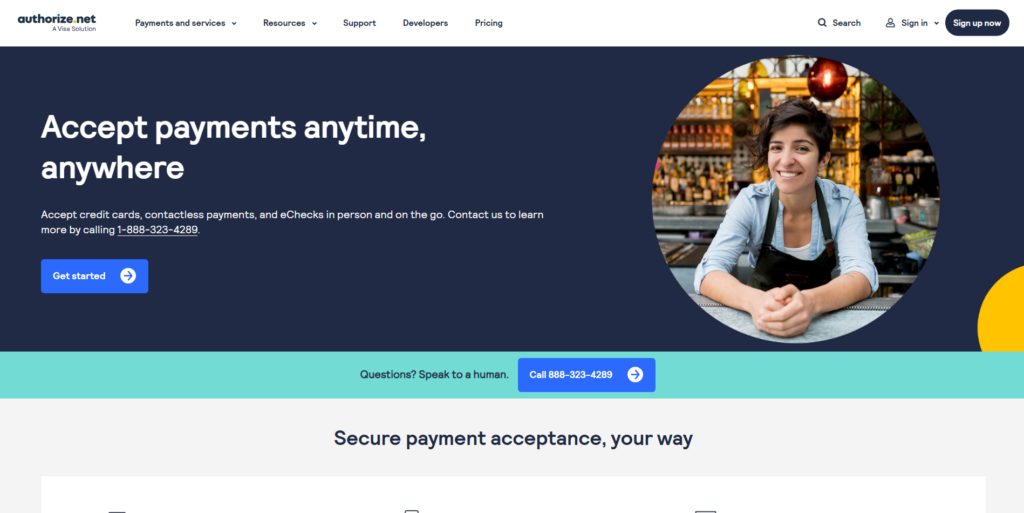
Image source
Authorize.Net is trusted by over 430,000 merchants, processing more than 1 billion transactions and handling $149 billion in payments annually. As a payment solution, Authorize.Net enables businesses to accept a variety of payment options, from traditional methods like debit cards, credit cards, and eChecks to digital payments such as PayPal and Apple Pay.
As a wholly-owned subsidiary of Visa, Authorize.Net simplifies payment processing, making it a low-stress, efficient aspect of business operations and optimizing cash flow.
Regarded as one of the premier online payment gateways in the USA, Authorize.Net supports recurring payments, features advanced fraud detection capabilities, and provides a streamlined approach to PCI DSS compliance.
Key Advantages of Authorize.Net:
- Fraud Prevention Tools: Authorize.Net provides a comprehensive array of sophisticated tools to identify and thwart fraudulent activities. These tools safeguard businesses against chargebacks and losses due to fraud.
- Established Reliability: With its long history as a service provider, Authorize.Net is recognized for its consistent and secure payment processing capabilities, which benefit well-established businesses.
- Subscription Payment Services: Authorize.Net offers an Automated Recurring Billing (ARB) feature that streamlines the management of subscription payments, making it an excellent choice for businesses with recurring service models.
- Diverse Payment Method Support: The platform accommodates a wide variety of payment methods, including credit cards and eChecks. It also seamlessly integrates with different eCommerce systems and accounting software, providing versatility for a range of business needs.
2. PayPal Payflow Pro
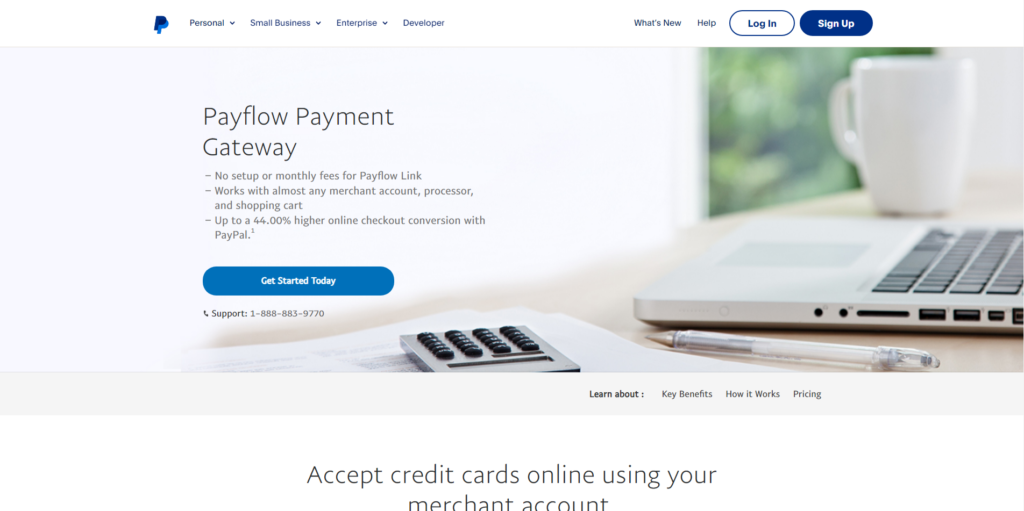
Image source
The PayPal Payflow Pro gateway, previously called Verisign, is accessible to users in the United States, Australia, New Zealand, and Canada. This service differs from other PayPal payment options in that it charges merchants a consistent monthly fee in addition to a set fee per transaction, with no regard to transaction volume.
Payflow Pro, a leading payment gateway, links your online store to your existing internet merchant account. It allows your business to accept credit cards, debit cards, and, in the U.S., PayPal payments. This gateway enhances the customer experience by enabling shoppers to complete their purchases without leaving your site. Additionally, it provides robust security features with access to advanced risk-management systems.
With a substantial user base actively using its services daily to send and receive payments, PayPal has been a dominant force since its founding. It stands as one of the oldest and leading payment gateway providers in the USA.
Key Advantages of PayPal Payflow Pro:
- Recurring Billing Option: If you need to handle recurring payments like monthly membership dues or annual contract renewals, you’ll appreciate the convenience of automatically processing these payments.
- Buyer Authentication: PayPal supports the Verified By MasterCard and Visa SecureCode programs, offering merchant protection for qualified transactions made with MasterCard and Visa.
- Competitive Rates: Payflow Pro stands out with no cancellation fees, monthly minimums, or hidden charges. You benefit from one of the industry’s lowest rates at just $0.10 per transaction.
- Versatile Compatibility: Payflow integrates with major shopping carts and is compatible with nearly every processor. Additionally, for international sales, it accepts PayPal payments in 25 currencies across 202 countries.
- Simplified Compliance and Tracking: As a PCI-compliant solution, Payflow Pro reduces the complexity and expense of adhering to regulatory standards. Manage your finances effectively with PayPal Manager, our online account management dashboard.
3. USPAY
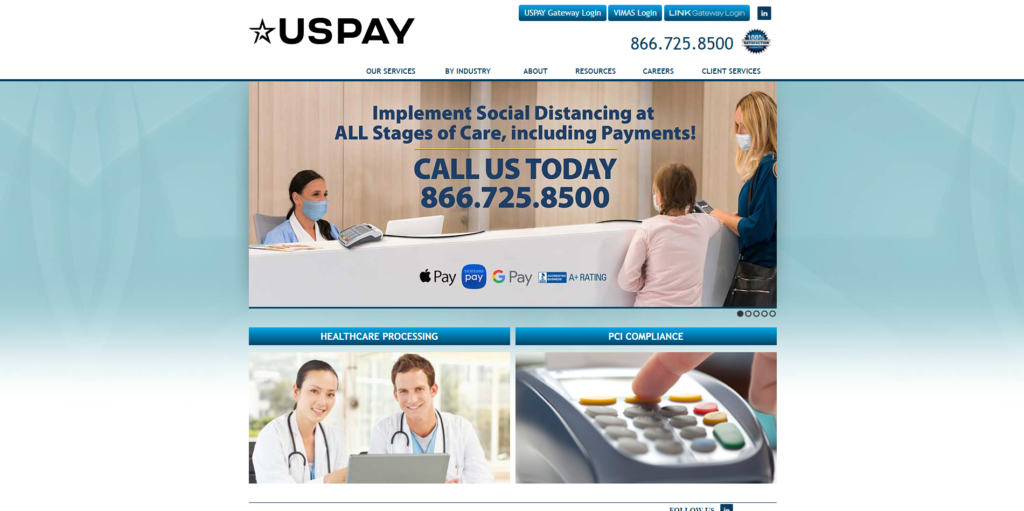
Image source
Originally known as Premier Merchant Processing, USPAY Group provides merchant account services, credit card processing, and payment gateways to over 25,000 clients, according to its website. With USPAY Group, businesses can accept debit and credit card payments, mobile payments, and checks. The company provides a gateway for e-commerce payments and can help businesses offer and manage gift cards or establish customer loyalty programs.
USPAY Group serves various industries, including dining, healthcare, e-commerce, retail, and entertainment. The USPAY Gateway incorporates built-in data security features such as file integrity systems, SSL encryption, and intrusion detection. It also operates a 24/7 monitored network, ensuring protection against data breaches and compliance with the PCI DSS.
Key Advantages of USPAY
- Credit and Debit Cards: USPAY processes payments from all major credit card brands, including VISA, MasterCard, American Express, and Discover, although American Express and Discover may require separate approval. They also handle debit card transactions.
- Check Services: USPAY converts paper checks into electronic transactions through scanning and offers electronic check verification and guarantee services to mitigate the risk of fraudulent or bounced checks.
- Mobile Payments: With USPAY’s mobile solution, businesses can accept payments anywhere using a smartphone swiper and the iProcess App, which is compatible with both Apple and Android devices.
- Gateway: LUCY, USPAY’s proprietary gateway, integrates and routes payments across multiple devices, supporting applications like QuickBooks and Microsoft’s Retail Management System. It also facilitates the creation of recurring payments and customizable, real-time reports.
- Gift and Loyalty Cards: USPAY offers customizable gift and loyalty card programs. Businesses can select from custom-designed cards, semi-custom designs, or combinations. These cards support accessories such as displays and cardholders.
4. Beanstream (Bambora)

Image source
Beanstream, which is now called Bambora, is a startup that offers a virtual terminal and POS app as part of their payment gateway. The Victoria, British Columbia-based business was once founded as an e-commerce software development company. Beanstream provides North American enterprises with risk management, authentication, and payment processing services.
The company’s payment gateway is unique in North America for being bank-neutral. This feature allows you and your merchants to process payments smoothly, regardless of where the merchant account was obtained, provided it is from a North American bank.
The ownership of Beanstream has changed multiple times in the last ten years. LML Payment Systems acquired Beanstream in 2007. It was purchased by Digital River in 2012, and Nordic POS system supplier Bambora acquired it in October 2015.
Key Advantages of Beanstream:
- POS Application: Beanstream offers the sproutPOS app for iOS and Android devices at no additional cost. This app integrates with Beanstream’s card reader, facilitating remote management of transactions and serving as an effective mobile POS solution for businesses without a conventional POS system.
- Hosted Payments Page: Beanstream provides hosted payment carts and forms that process transactions on its servers, enhancing security by not storing sensitive data on your systems. This feature, included in Beanstream’s basic payment package at no extra charge, is ideal for non-profits receiving donations and businesses managing event registrations.
- Automated Recurring Billing: Beanstream supports businesses with subscription models by automating and streamlining recurring billing. The platform allows for the customization of subscription plans, retries failed credit card payments automatically, sends renewal notifications, and includes analytics tools for payment forecasting and customer turnover management.
- Batch Processing: Beanstream offers efficient batch processing for high-volume transactions. Businesses can upload a spreadsheet of credit card details and process all payments simultaneously with a single click, streamlining operations by minimizing manual data entry.
- Virtual Terminal: The virtual terminal from Beanstream features secure data entry, minimal manual processing, pre-authorization support, and comprehensive security logs. The terminal also offers IP-based access restrictions and analytical tools for tracking sales and identifying risky transactions, enhancing security and operational efficiency.
5. NMI
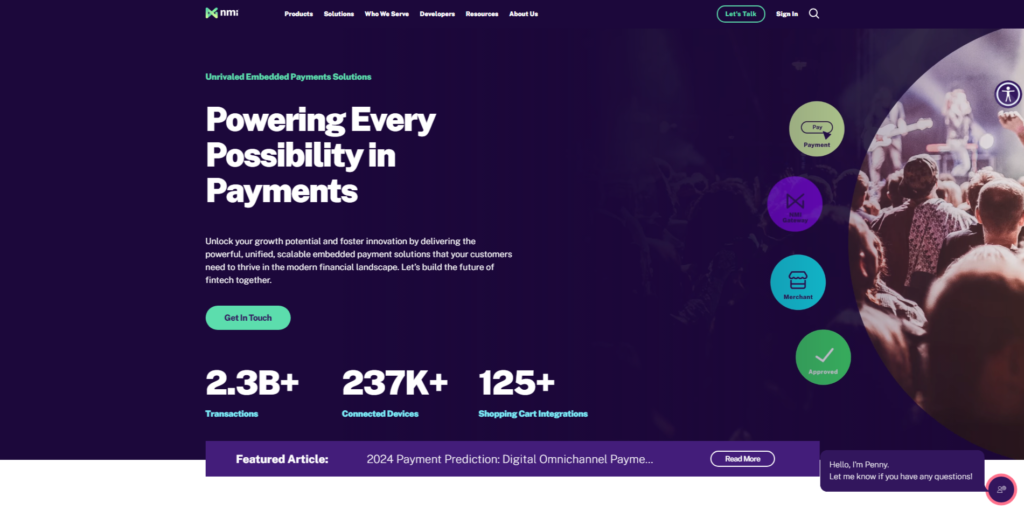
Image source
Network Merchants Incorporated, also known as NMI, is a well-regarded payment gateway service suitable for businesses of various sizes. It provides dependable credit card payment solutions, making it a good choice for those requiring consistent transaction processing. NMI boasts compatibility with over 150 shopping carts, supporting diverse checkout processes across multiple industries. The company prioritizes flexibility and customization, offering efficient payment data management, particularly for online transactions.
NMI’s payment gateway integrates smoothly with websites to enable virtual transactions. Additionally, it features a virtual terminal that allows merchants to enter transactions manually.
The NMI gateway includes several functionalities such as a virtual terminal, a customer storage vault, support for Level III data, batch processing, connections with numerous popular shopping carts, electronic invoicing, recurring billing options, integration with QuickBooks, and a gateway emulator.
Key Advantages of NMI:
- Multi-Currency Support: NMI Payment Gateway supports more than 150 currencies and multiple languages, allowing businesses to expand internationally and serve a diverse global customer base.
- Tokenization and Encryption: NMI employs sophisticated tokenization and encryption technologies to safeguard sensitive customer information and ensure secure transactions. This assists businesses in adhering to industry standards like PCI DSS and in reducing the risk of data breaches.
- Fraud Detection: NMI provides a variety of customizable fraud prevention tools, including velocity filters, address verification service (AVS), and card verification value (CVV) checks. These tools aid businesses in identifying and preventing fraudulent transactions, thereby minimizing chargebacks and financial losses.
- Recurring Billing: NMI Payment Gateway enables businesses to set up and manage recurring billing and subscription payments easily. This feature is particularly useful for subscription-based enterprises or those that offer installment payment options.
- Amazing Integration Options: NMI Payment Gateway integrates efficiently with a broad array of popular eCommerce platforms and shopping carts, facilitating businesses in swiftly accepting payments on their websites. Some of the major platforms that support NMI include Shopify, WooCommerce, Magento, and BigCommerce.
- Analytics and Reporting: NMI provides detailed analytics and reporting capabilities, enabling businesses to monitor transactions, track sales trends, and obtain valuable insights into their payment processing performance.
6. PaySimple
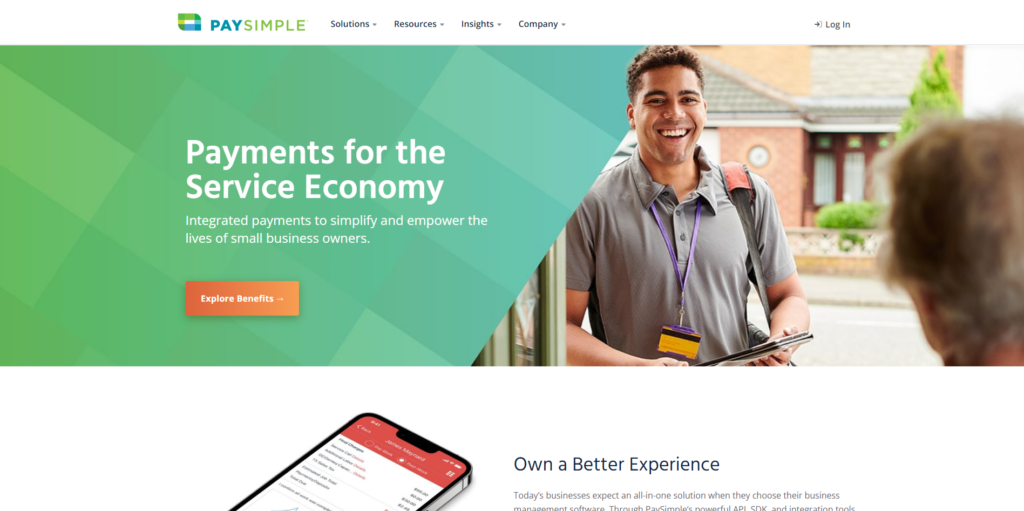
Image source
PaySimple was established in 2006 by Matt Feierstein, Carol Wood, Eric Remer, and other business founders who wanted to make payment collection easier for emerging businesses. They developed an integrated platform called PaySimple, aimed at making payment transactions between retailers and consumers more straightforward. The platform now serves 17,000 customers.
The PaySimple payment gateway speeds up transaction processing for small and medium-sized businesses, using cloud technology to manage transaction costs and data effectively. It supports several payment methods, including ACH payments, credit cards, and paper checks. PaySimple also provides two specialized products: PaySimple POS and PaySimple Pro. These products enhance customer service through features like loyalty programs, analytics tools, and receipt printing capabilities.
The company’s services include customer relationship management (CRM), automated recurring billing, and integrated payment processing. PaySimple is dedicated to ensuring customer satisfaction and providing outstanding support and training. Its help centers offer solutions and FAQs, backed by personalized assistance from an experienced team. With PaySimple, users receive the necessary support to utilize the platform successfully for their business needs.
Key Advantages of PaySimple:
- Effective for Repeat Billing: PaySimple is particularly beneficial for businesses that often handle recurring billing and invoicing. It offers features that allow repeat customers to independently manage their payment methods and access their information through a customer portal. The platform supports ACH and electronic checking, reducing transaction costs for significant recurring payments, such as tuition or gym memberships.
- Adaptable and User-Friendly Platform: PaySimple supports various payment methods, including online and in-person transactions, via card or check. Although its monthly subscription isn’t the cheapest, it provides full access to all features without additional fees for locked or extra features.
- Constant Availability: PaySimple operates continuously, 24/7, throughout the year. This constant operation ensures that all components, such as POS software and payment modules, are always functional, effectively serving businesses like convenience stores and e-commerce platforms.
- QuickBooks Integration: One of the standout features of PaySimple is its integration with QuickBooks Online, allowing automatic and real-time synchronization of payment data. This integration requires a separate QuickBooks Online account and operates in the background, maintaining data consistency across both platforms without manual intervention.
- Robust Security Measures: PaySimple excels in security, offering protections that are on par with other leading payment processors. It uses a 256-bit DigiCert certificate and supports 128-bit encryption. Transactions and data handling are secured with SSL encryption. Additionally, PaySimple meets the strict PCI DSS standards, ensuring secure credit card transactions and building trust for e-commerce and small business owners.
7. PayTrace
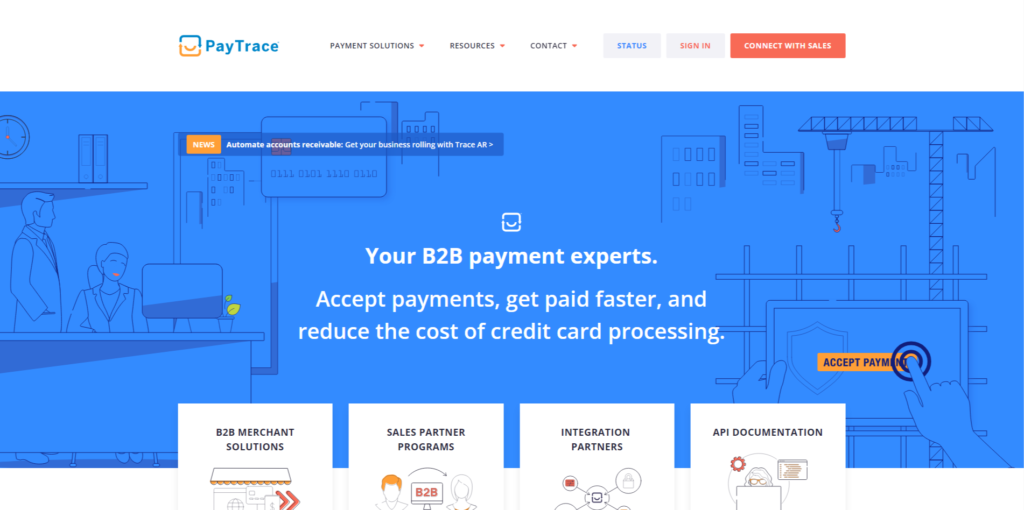
Image source
PayTrace, a well-known payment gateway provider, was established in 2014. It is now recognized as a leading company in the industry, offering secure and easy-to-use payment processing services. Notably, PayTrace is PCI-certified and serves over 35,000 clients, handling more than $10 billion in transactions annually. Its headquarters are located in Spokane, Washington.
The PayTrace gateway provides online businesses with a secure and straightforward method for accepting payments via shopping carts and secure hosted checkout pages. Businesses can accept credit cards, debit cards, and electronic checks while utilizing encryption to minimize the risk of data theft. PayTrace supports payment processing for MasterCard, Visa, AmEx, Discover, Diners’ Club, and JCB. The platform also allows for the emailing of receipts to customers, voiding of transactions, and processing of full or partial refunds. Additionally, receipts can be personalized with business information in the header and footer.
Key Advantages of Paytrace:
- Hosted Payments Page: PayTrace provides a secure payment page hosted on their servers, allowing businesses to set up and start processing payments across various methods quickly.
- Shopping Cart Integration: PayTrace supports integration with multiple popular online shopping carts, catering to the growing needs of e-commerce businesses.
- Mobile Payments: The PayTrace GO app allows for mobile payment processing on both iOS and Android devices, which is useful for businesses that operate on the go.
- Recurring Payments: This feature supports automatic billing cycles for subscriptions and memberships with customizable frequencies.
- API Integration: Developers can integrate PayTrace’s functionalities into e-commerce platforms using their API, which includes helpful tools and sample code.
- Reporting and Analytics: PayTrace provides detailed real-time reporting and management tools, enabling businesses to review transactions, download data, and generate custom reports.
How to Choose the Right Payment Gateway?
- Security Considerations
Security is paramount when selecting a payment gateway. If a payment gateway lacks robust security measures, it could jeopardize both your and your customer’s data and financial safety, ultimately harming your business’s reputation.
Therefore, it is essential to choose a PCI-certified payment gateway that adheres to the latest security protocols. Additionally, an optimal payment gateway should include advanced fraud prevention tools that can detect and thwart fraudulent transactions, ensuring the safety of all financial activities.
- Processing Speed
The speed at which transactions are processed, and funds are transferred from your clients to your bank account is critically important. Fast processing speeds are essential for providing a good customer experience, particularly in e-commerce, where a swift and seamless checkout process is crucial.
A modern payment solution should offer rapid processing times for e-commerce and any business relying on timely payments for goods and services. Thus, selecting a payment gateway that does not compromise processing speed is fundamental to maintaining customer satisfaction and operational efficiency.
- Compatibility and Integration
It’s crucial to ensure that the payment gateway you choose can be seamlessly integrated with your existing platform or website. Many payment gateways provide plugins or APIs compatible with popular e-commerce platforms like Magento, WooCommerce, or Shopify. However, verifying this compatibility is essential.
Additionally, consider how well the payment gateway will work with other systems you use, such as your accounting software, to ensure a smooth operation across your business infrastructure.
- Multi-Currency Support
For home-based businesses aspiring to reach international markets, your payment gateway must support a variety of payment types beyond the commonly used Visa and MasterCard. A gateway capable of handling multiple currencies can significantly ease the process of transacting with customers worldwide, thus facilitating global expansion.
- Recurring Billing Capabilities
As businesses aim to secure more consistent revenue streams, payment gateways need to accommodate recurring payment structures, allowing businesses to implement subscription-based models with fixed monthly fees. The gateway should efficiently handle the transmission of client billing details to the merchant bank for regular deposits into your merchant account. Although credit and debit cards are prevalent for online payments, they present challenges in recurring billing, especially with card expiration dates. To mitigate these issues, consider incorporating alternative payment methods such as direct debits from bank accounts.
Plus, a payment gateway that supports complex recurring billing logic and can adapt to specific business rules adds significant value. This could include customizing billing dates for individual customers or adjusting subscription levels based on the customer’s signup date.
- Customer Service Importance
Effective customer service is critical in managing and resolving issues promptly to prevent revenue loss in online stores. Problems can escalate to service dissatisfaction or raise concerns about potential fraud among customers.
Therefore, choosing a payment gateway that provides excellent customer support is crucial for maintaining customer trust and satisfaction. This helps manage potential issues more effectively and ensures that your customers feel valued and secure when making transactions.
- Choose the Right Model
When using a payment gateway that also handles payment processing, you’ll need to decide between two main pricing models: flat-rate pricing and interchange-plus pricing. Flat-rate pricing offers consistency and is often preferred by new or seasonal businesses or those processing less than approximately $5,000 a month.
This model, utilized by providers like Square or PayPal, typically incurs higher transaction fees compared to interchange-plus pricing but usually does not involve a monthly fee. Its predictability in costs makes it easier for businesses to forecast expenses since the fees don’t vary much over time. Flat-rate pricing is common among payment service providers and simplifies the account setup process.
On the other hand, interchange-plus pricing is more suitable for businesses processing over $5,000 monthly and those who prefer greater transparency in their processing fees. Although setting up a merchant account for this model requires more effort, the potential savings can make it worthwhile, especially for businesses with higher transaction volumes. This model provides a detailed breakdown of the costs associated with each transaction, offering businesses better insight into their expenditures.
 Host Merchant Services Supported Payment Gateways And Point Of Sale
Conclusion
Selecting the right payment gateway is a pivotal decision for businesses seeking growth and customer satisfaction. The leading payment gateways discussed in this article, including Stripe, Adyen, Helcim, PayPal, Authorize.Net, Braintree, and 2Checkout, offer diverse features and advantages tailored to various business needs.
When choosing a payment gateway, key considerations include security, processing speed, compatibility and integration, multi-currency support, recurring billing capabilities, customer service quality, and the preferred pricing model. By carefully evaluating these factors and selecting a payment gateway that aligns with your business requirements, you can ensure a seamless customer payment experience while optimizing operational efficiency and fostering business growth.