



Top 12 Wix Alternatives for Your Business in 2025
Posted: August 19, 2024 | Updated:
Any buyer interested in creating a website might consider using Wix. Wix is popular among small business owners for its user-friendly design that doesn’t require previous web development skills. It is recommended for those who prefer to design a website independently without the need to hire a developer or learn coding skills. However, Wix is not the best option for everyone. Those planning to expand their website, seeking extensive customization, or needing to maintain a budget due to rising plan costs might look for Wix alternatives.
In that case, comparing different website builders and exploring alternatives is beneficial. Below is a detailed list of some of the best alternatives to Wix.
What Is Wix?
Wix is a widely used website builder, boasting over 250 million users globally in 2025. It is trendy among new businesses and individuals with limited experience in website development. However, numerous competitors offer services similar to Wix’s and alternatives that provide more advanced features for small and medium-sized businesses.
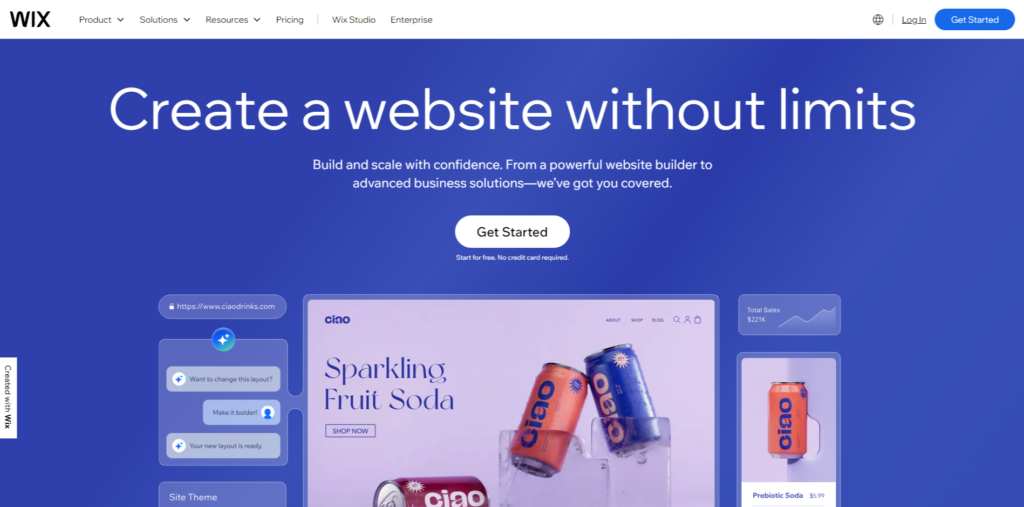
Image source
Wix is known for several key features:
- Diverse Templates: The platform offers a wide selection of templates, enhancing the professional look of websites to suit any business’s specific needs and style.
- Cloud-Based Platform: Wix operates entirely in the cloud, allowing users to access their websites from any device—be it a computer, mobile phone, or tablet—via a web browser.
- Versatile Website Creation: Wix allows users to create various websites, from corporate sites to fully functional online stores.
- User-Friendly Editor: Wix’s editor is straightforward and intuitive. It employs a drag-and-drop interface that eliminates the need for coding skills in HTML, CSS, or JavaScript.
- Freemium Model: Wix uses a freemium business model, offering basic web development services for free while providing advanced features for a fee.
- Integrated Hosting: Signing up with Wix provides users with the necessary storage space to host their websites.
What Is the Pricing of Wix?
Wix offers four pricing tiers to suit different business needs. At $159 per month, the top-tier Business Basic plan includes unlimited storage, advanced marketing tools, and a developer platform for scaling businesses. It also supports up to 15 collaborators.
The Business plan costs $36 per month and is geared towards growing brands. It offers 100 GB of storage and standard marketing features for up to 10 collaborators. For smaller needs, the Core plan, at $29 per month, provides 50 GB of storage and basic features for five collaborators, while the Light plan offers the essentials for $17 per month with 2 GB of storage for 2 collaborators. All plans include a free domain for one year and payment processing capabilities.
Why Consider Alternatives to Wix?
Business owners might look for alternatives to Wix for several reasons, with website loading times being a primary concern. Wix is suitable for smaller sites or portfolios, but larger sites, especially those with ecommerce functionality or multiple pages, can experience slow loading. This makes alternative platforms more appealing, especially for those managing websites for small to medium-sized businesses. Additionally, while varied, Wix’s template options often lead to a uniform appearance that may not meet clients’ needs, requiring more customization control over their site’s design and functionality.
Regarding performance and SEO, Wix may also not perform well against other platforms. Wix is often seen as a “heavy” platform due to its extensive use of JavaScript, unlike other platforms that primarily utilize HTML and CSS. This excess JavaScript can lead to bloated code on many Wix sites that don’t require it, resulting in slower load times. As website speed is a crucial factor for search engine rankings, this excess code can negatively impact a site’s ability to rank well.
For e-commerce-focused clients, Wix’s features may need to be revised, as more robust tools and marketing capabilities are needed to run online stores effectively.
Wix may not be the most cost-effective choice for agencies handling multiple websites, as costs can quickly accumulate with each separate site and plan upgrade. Lastly, as an agency expands and takes on larger, more complex projects, Wix’s limitations in scalability and flexibility in terms of custom coding, integrations, and plugins may prove inadequate.
What to Consider When Choosing an Alternative to Wix?
Each alternative to Wix varies in its offerings. Some provide straightforward, easy-to-use services, while others cater to users seeking more tailored features, possibly requiring a bit of coding experience or willingness to tackle a learning curve for more complex functionalities. Here are key factors to consider in a Wix alternative:
- Cost-Effectiveness: Unlike Wix, where essential features may come at an additional cost, seek out website builders that offer better overall value without extra charges.
- Integrated Features: Instead of relying on additional apps like Wix, opt for platforms with comprehensive built-in capabilities, such as the analytics tools found in Squarespace, which simplify the user experience by eliminating the need for external app installations.
- Drag-and-Drop Tools: This feature is crucial for those without extensive tech skills, such as freelancers and beginners, allowing easy manipulation of site elements to craft visually appealing pages.
- Responsive Design Templates: Choose website builders that provide adaptable templates to ensure your site looks good on both desktop and mobile devices without needing separate edits.
- E-commerce Capabilities: A builder that supports payment processing and other necessary e-commerce functions is vital for online stores or e-commerce sites.
- Design Flexibility: Your chosen platform should offer a level of design freedom comparable to or surpassing that of Wix, enabling you to create a personalized and unique website.
- Free Options: Consider alternatives that offer a way to build a website at no initial cost, such as a permanent free plan or a trial period. These allow you to explore their features without financial commitment.
Best Wix Alternatives in 2025
Wix stands out as the leading website builder in our research, yet numerous other strong options are available. Certain alternatives surpass Wix in areas where it may fall short, offering better solutions for businesses with particular requirements. Continue reading to discover more about these competitors in the industry below:
1. Squarespace
If Wix leads the DIY website market, Squarespace is a robust second-place contender. It offers functionality similar to Wix, such as a drag-and-drop editor, but Squarespace provides more complex features and requires a bit more skill to master. It is well-suited for creating visually appealing portfolios and websites that effectively represent a brand’s distinct style.
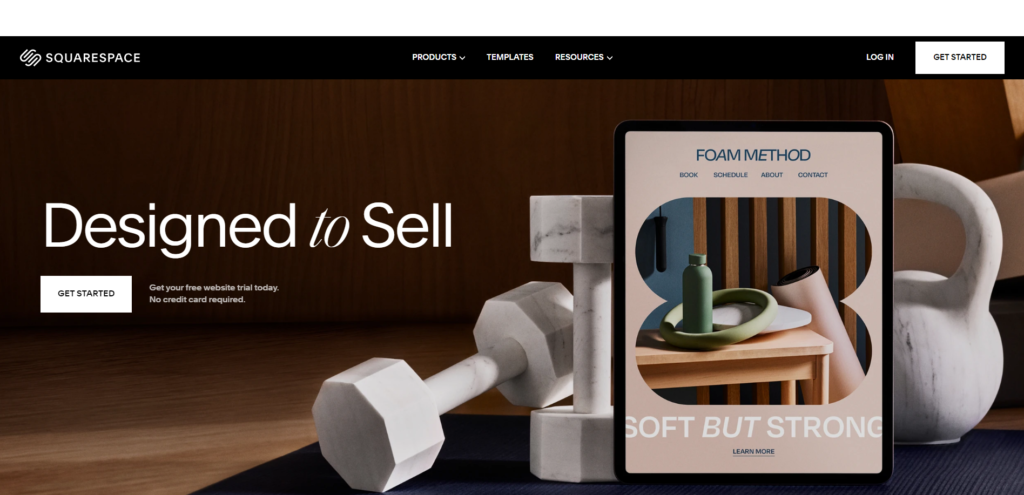
Image source
Squarespace has fewer templates than Wix, but its templates are recognized for their excellence and high level of customization, enhancing the design process. Users can develop unique content types and multi-column layouts. Unlike Wix, Squarespace allows multiple templates at once, supporting work on various designs simultaneously.
Squarespace focuses on design quality, mobile compatibility, and website speed. Although it enables the creation of custom templates and faster websites, it lacks extensions, restricting users to its built-in features. Its user-friendly editor and impressive designs have made it a top-rated alternative to Wix.
Top Features of Squarespace
- E-commerce capabilities feature payment processing, checkout pages, and tools for shipping and fulfillment to maintain efficient operations.
- Quickly select from a variety of templates based on industry, category, or style to initiate your website creation or design custom templates for a distinct look.
- Marketing and SEO resources, such as social media integrations, help enhance customer engagement and improve outreach.
- Integrated scheduling and calendar tools allow business owners to set appointments and offer services effectively.
Pricing of Squarespace
Squarespace offers a 14-day free trial to explore its features before committing to a paid plan. The plans are billed annually and range from $16 to $52 per month, catering to different needs:
- Personal ($16 per month): Ideal for simple websites, this plan includes customizable templates, mobile optimization, a free custom domain, and the ability to sell products and services with a 0% transaction fee on invoices.
- Business ($23 per month): This plan targets growing businesses. It adds advanced website analytics and allows for checkout on your domain. It maintains a 0% invoice transaction fee but includes a 3% fee on online store transactions.
- Commerce Basic ($28 per month): Designed for businesses scaling their sales, it offers enhanced selling tools like powerful merchandising, along with the perks of the Business plan but with no transaction fees on online store sales.
- Commerce Advanced ($52 per month): The most comprehensive plan, suitable for advanced sellers, includes all the features of the Commerce Basic plan plus advanced shipping, discounting options, and subscription sales, with no transaction fees.
2. WordPress
WordPress is an ideal choice if you have a precise vision for your website. It stands out as one of the top alternatives to Wix, suitable for creating both complex sites and simple blogs. While WordPress requires a greater learning investment than Wix, it rewards users with significantly more flexibility.
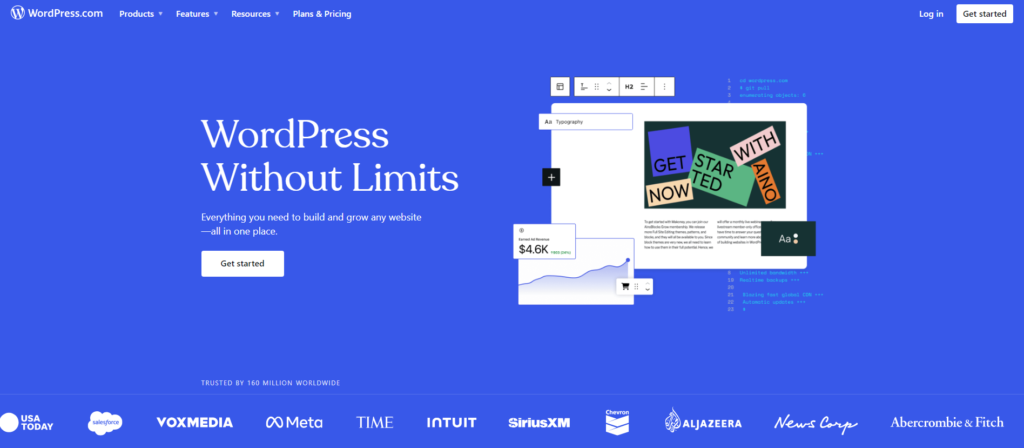
Image source
Approximately 35% of all websites run on WordPress, making it the most widely used Content Management System (CMS). Its popularity stems largely from its being free, unlike Wix, which imposes many restrictions in its free version. However, to use WordPress, you must purchase a separate hosting plan and domain name.
Buying a hosting package with a domain name and setting up WordPress is straightforward and can be completed in minutes. Leading hosting providers such as Bluehost, SiteGround, or DreamHost offer specialized WordPress hosting packages. These packages feature convenient one-click installs and additional functionalities not offered by Wix, like database access, free domain emails, manual backup options, and more. Furthermore, these plans are typically very cost-effective, starting at less than $5 per month.
Top Features of WordPress
- Backup systems safeguard all content, from blog posts to previous site versions, ensuring data protection against errors.
- Plugins and widgets provide extensive customization and scalability for inventory management, email marketing, and SEO functions.
- Numerous WordPress templates include integrated e-commerce capabilities, facilitating straightforward processing of payments and sales directly through the site.
- Complete customization options with CSS, HTML, and a drag-and-drop editor allow for custom coding and template usage to create dynamic websites.
- The company allocates 5% of its time to contribute to developing the free, open-source WordPress community.
Pricing of WordPress
WordPress is an open-source free download platform offering a free framework at no cost. However, using WordPress may involve various additional expenses. These can include an annual fee of approximately $12 for a domain name and hosting services starting at $2.95 per month. Users may also purchase pre-made themes, ranging from free to $200 as a one-time charge, and plugins, which can vary from free to $1,000, depending on whether they require ongoing payments.
Security features might start at a one-time or ongoing charge of $50. Furthermore, hiring developers can incur costs between $0 and $1,000 as a one-off expense. While comparing the total cost of WordPress with platforms like Wix isn’t straightforward, the expenses can add up, especially for those seeking advanced features.
3. Shopify

Image source
Shopify stands out as a top alternative to Wix for ecommerce store owners. It features a robust website builder with over 100 mobile-responsive templates and a user-friendly drag-and-drop editor. Additionally, Shopify enables web developers and business owners to tailor their sites to specific needs.
Explicitly designed for ecommerce, Shopify has essential features to help users create and manage effective online stores. The platform supports rapid loading times and offers a selection of over 150 themes and customizable templates, although only a few are available for free. Shopify also supports a variety of payment methods and third-party integrations and provides ongoing maintenance and 24/7 customer support.
Beyond just setting up an online store, Shopify offers a range of ecommerce tools, including content creation, email marketing, analytics, and sales and logistics support, enhancing the management of an ecommerce business. Accessing these additional tools and features may require a separate subscription fee.
Top Features of Shopify
- Integrations with business applications, marketing software, and sales tools help broaden your reach, boost engagement, and increase conversions.
- Multiple payment gateways simplify managing transaction fees and customizing checkout processes.
- With thousands of themes, over 8,000 apps, and options for custom domain names, your website can be distinctively yours.
- Manage inventory and resources to keep your website updated with real-time availability.
Pricing of Shopify
Compared to other website builders such as Wix, Shopify tends to be pricier. Shopify offers four pricing tiers, starting at $9 per month for Shopify Lite, which is ideal for adding e-commerce to blogs or existing websites. The Basic Shopify plan costs $29 monthly and is designed for new businesses. For growing businesses, the Shopify plan is available at $79 per month, and the Advanced Shopify plan, aimed at scaling businesses needing advanced features, is priced at $299 per month.
It includes a three-day free trial. Despite the higher cost, these plans include essential features for expanding your business, such as support for multiple inventory locations and local selling points worldwide. If your business involves a substantial inventory and operates globally, these features can provide significant value for the investment.
4. GoDaddy
GoDaddy could be an excellent choice if you need to launch a website quickly and without much hassle. The platform offers a selection of straightforward templates along with basic features like SEO and mobile optimization. With pricing starting at $10.99 per month, GoDaddy is both affordable and user-friendly, making it an attractive option for business owners starting their online presence.
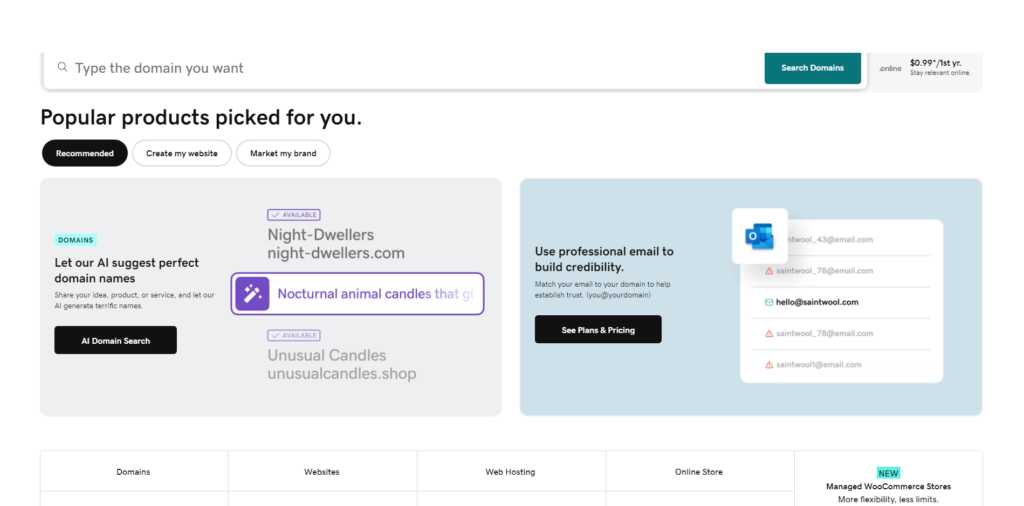
Image source
While GoDaddy’s design capabilities are not as extensive as those of Wix or Squarespace, its Artificial Design Intelligence (ADI) feature can efficiently produce an attractive website. The ADI also assists in generating content and images to complete the site setup swiftly, which is beneficial for users under time constraints.
Additionally, GoDaddy provides reliable uptime with a 99.9% service guarantee and includes continuous security monitoring to defend against DDoS attacks and other threats. The platform offers daily backups and a range of free applications that facilitate the creation of CMS-driven sites, forums, and blogs.
Top Features of GoDaddy
- The platform provides access to over 100 pre-designed templates.
- Users can enhance their website’s SEO by configuring meta descriptions and page titles.
- The GoDaddy website builder supports blogging, allowing users to create, write, and publish content.
- Additionally, from the settings editor, users can establish their site’s privacy policy and cookie banner and revert to a previous version of their website if they encounter issues with the current version.
Pricing of GoDaddy
GoDaddy Website Builder offers four distinct pricing tiers with a 30-day free trial to accommodate various user needs. The Basic plan is $9.99 per month and provides essential features. Slightly above this, the Standard plan is available at $10.49 per month. Users can opt for the Premium plan for more advanced features at $14.99 per month. Lastly, for those interested in online selling, the E-Commerce plan is offered at $16.99 per month, which includes additional tools tailored for e-commerce websites.
5. Jimdo
Jimdo is a website builder that offers robust customization features. It provides various responsive templates that automatically adjust to different screen sizes, ensuring a consistent viewing experience on all devices. Users can tailor their selected template by altering layouts, colors, fonts, and more. Jimdo particularly serves business owners and entrepreneurs with a specific option for creating online stores.

Image source
Similar to other website builders like Wix, Jimdo allows users to construct websites using a drag-and-drop editor, requiring no prior coding or design skills. While it offers some degree of customization, those seeking more extensive modifications might find it limiting for their needs and those of their clients.
Top Features of Jimdo
- The use of mobile devices is rapidly increasing, and Jimdo has responded by designing a mobile-friendly website.
- Users can access, edit, and interact with Jimdo on mobile devices as seamlessly as on desktops.
- Jimdo has also developed a logo creation tool tailored for new entrepreneurs who must establish their brand identity.
- This tool allows for customization using a variety of icons, fonts, borders, and colors.
- Additionally, Jimdo offers the flexibility to switch templates mid-project and integrate custom HTML and CSS code, enhancing user control over website design.
- For those looking to establish an online store, Jimdo provides an e-commerce plan with options including VIP, business, and basic tiers.
- Jimdo’s comprehensive e-commerce capabilities include inventory management, automatic product counting, and integrated payment processing.
Pricing of Jimdo
Jimdo offers several pricing tiers tailored to different needs.
- Play: This basic tier includes a Jimdo subdomain, which may be better for brand identity.
- Start: Priced at $9 per month, this option provides a personal domain and removes Jimdo advertisements.
- Grow: This tier offers SEO tools, analytics, and customer support with a response time of four hours for $14 per month.
- Unlimited: At $49 per month, this premium tier includes unlimited storage, a professional design review, and expedited support with a one-hour response time.
Additionally, Jimdo provides three pricing levels for its online store feature based on the number of products and pages required: Basic ($19 per month), Business ($25 per month), and VIP ($49 per month).
6. IONOS
The IONOS website builder is designed primarily to create easy-to-navigate business websites. Although it lacks general features such as blogging or highly customizable sections, it compensates with strong business-oriented features like AI-powered SEO tools and a website checker. The user-friendly platform suits those with little experience who must efficiently set up a business website.
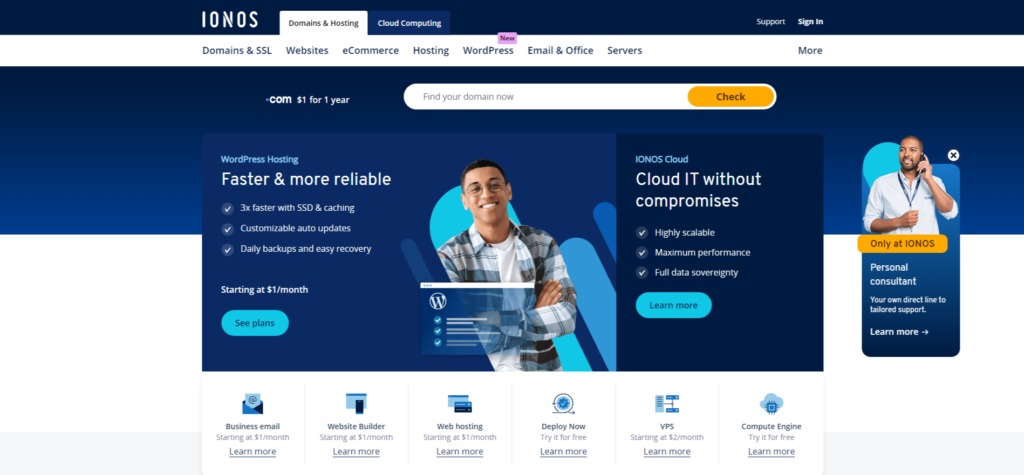
Image source
While IONOS may not offer as many options as Wix, with only 18 templates available, these templates are up-to-date, mobile-friendly, and diverse enough to meet different needs. The design options are limited but sufficient to start a website, making it ideal for beginners or those who prefer fewer choices to avoid feeling overwhelmed.
IONOS provides scalable performance management, enabling users to modify their project’s performance as necessary. It supports numerous popular apps and includes various plugins to improve a website’s functionality. These include a WordPress plugin and options for IONOS Managed WordPress Hosting. Additionally, IONOS includes a free domain for one year with any plan, which is a benefit over using a Wix subdomain.
Top Features of IONOS
- Get a free domain for one year and an email with up to 50 GB of storage, depending on your plan.
- Create engaging, SEO-friendly content using tools like the Text Improver, Generator, and SEO Text Generator.
- Design your website with a professional look using the Image and Color Palette Generator, tailored to your brand.
- Boost your site’s SEO with rankingCoach Standard in the Pro plan and SiteAnalytics for better search visibility.
- Enhance online store management with tools like discount coupons and abandoned cart recovery emails.
- Expand your reach with IONOS’s translation tools, making your website accessible in multiple languages.
Pricing of IONOS
IONOS offers various pricing tiers for its Website Builder and Online Store plans. For the Website Builder, the Starter plan costs $6 per month for the initial six months, after which the cost increases to $12. The Plus plan begins at $1 monthly for the first six months before rising to $18 monthly. The Pro plan costs $15 monthly for the first six months, escalating to $28 monthly after that.
For the Online Store options, the Starter plan starts at $6 per month for the first six months, then jumps to $24 monthly. The Plus plan offers an initial rate of $1 monthly for six months, increasing to $30 afterward. The Pro plan is $30 per month for the initial six months, with the price subsequently doubling to $60 per month. Lastly, the Expert plan is offered at $40 per month for the first six months before rising to $90 monthly.
7. Weebly
Weebly stands out as an excellent free alternative to Wix. It provides a straightforward platform for building and managing websites. Weebly streamlines website creation with its user-friendly interface and drag-and-drop features. It includes ready-to-use templates, secure payment options, and inventory management capabilities.
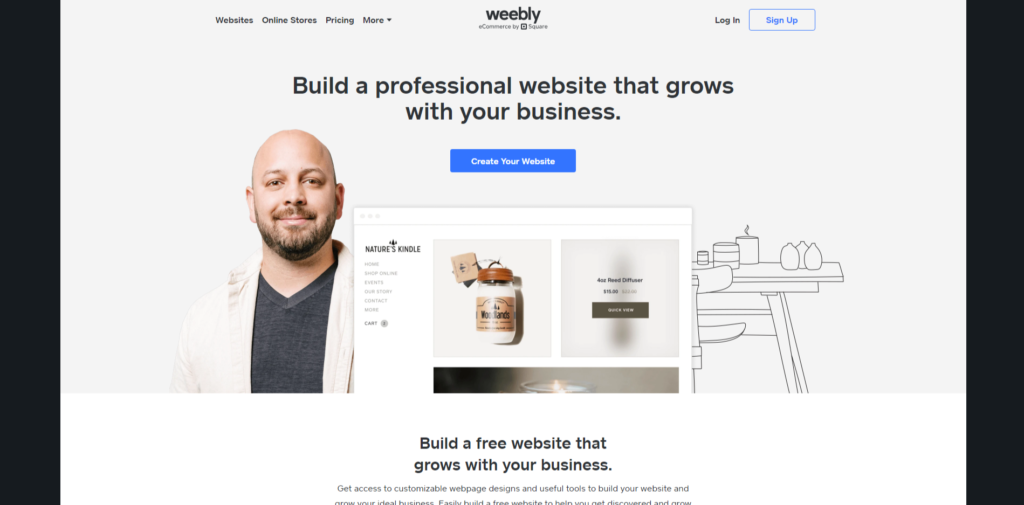
Image source
For small business websites, Weebly is ideal. It offers essential e-commerce functionalities like inventory tools, automatic order confirmation emails, and shipping tracking capabilities. While it may not offer the advanced features of e-commerce platforms like Shopify, it remains a solid choice for starting out.
Top Features of Weebly
- Provides free hosting for subdomains, making it accessible for beginners to start their website.
- Professionally designed themes give any website a polished appearance.
- A user-friendly drag-and-drop builder and tools for customizing images and videos enhance the appeal of landing pages.
- Built-in analytics tools provide data on website performance, helping users improve efficiency.
Pricing of Weebly
Weebly offers a range of pricing plans that are quite competitive compared to Wix, positioning it as a reasonable alternative. Their plans include a forever-free option, which is entirely free of charge. For those needing more features, Weebly also provides a Personal plan at $13 per month, a Professional plan at $16 per month, and a Performance plan at $29 per month. This pricing structure makes Weebly an appealing choice for users looking for cost-effective website solutions.
8. Hostinger
Hostinger’s website builder, enhanced by AI, simplifies website creation with its user-friendly drag-and-drop interface. It’s designed for users ranging from beginners to advanced, offering rapid website development at an affordable cost. Hostinger appeals to those interested in AI-driven development, requiring only three simple questions about your business to create a tailored website for you.
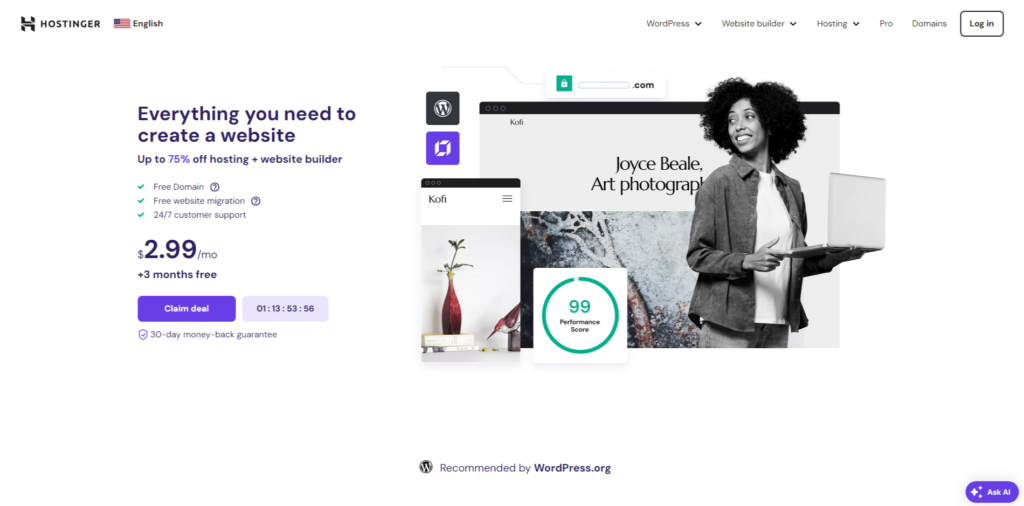
Image source
This AI-powered platform provides exceptional hosting services, a free domain, easy website transfer, an SSL certificate, and notably fast loading speeds.
Hostinger includes various tools, such as an AI-powered logo maker and content writer, eCommerce features, extensive integrations, and a practical Heatmap tool to boost conversions. The design grid ensures proper alignment, and the platform allows for significant customization, including image galleries, slideshows, and customizable contact forms.
Regarding pricing, Hostinger is highly economical, starting at just $2.49 per month, depending on the subscription term. It stands out as one of the most cost-effective AI website builders available.
Top Features of Hostinger
- It offers 150 responsive and customizable templates that allow for quick website design without compromising on style or functionality.
- Hostinger provides a free domain name for one year with any subscription that lasts 12 months or more, simplifying establishing your online presence.
- The Business plan adds AI-powered tools such as an Image Generator, AI Writer, Heatmaps, Blog Generator, and SEO tools to improve your site’s content and user experience.
- All plans include an AI Website Builder featuring an easy-to-use drag-and-drop interface suitable for users of all experience levels.
- Additionally, the Business plan includes advanced eCommerce features, enabling you to sell up to 500 products and support over 20 payment methods, expanding your online store’s reach and convenience.
Pricing of Hostinger
Hostinger provides a single subscription plan, priced at $11.99 per month for monthly users. However, the cost decreases significantly to as low as $2.99 per month if you commit to a subscription period ranging from 12 to 48 months. Overall, Hostinger’s pricing is quite reasonable and fits most businesses’ budget constraints.
9. Google Sites
Google Sites is a superb no-code website builder that fully integrates with your Google Workspace account. You can design, launch, and manage your website using the same platform from which you access your favorite Google Apps, such as Docs, Gmail, Slides, and Sheets.

Image source
Google Sites is particularly effective for information-based businesses. However, it’s also viable for online stores. By integrating with Ecwid, a free online store builder, you can list and sell up to 5 products directly on your Google Site. Google Sites is available to both free and paid Google Workspace users and is ideal for small businesses eager to expand their online footprint.
In contrast to Wix, Google Sites is more straightforward to use, has no hidden fees, and suits local businesses that utilize Google Business Profile well. For Google users seeking a basic and free website builder to enhance visibility and gather emails, Google Sites offers a compelling alternative to Wix.
Top Features of Google Sites
- Google Sites offers an intuitive platform that integrates flawlessly with other Google Workspace tools such as Drive, Docs, and Sheets.
- It supports real-time collaboration, allowing multiple users to work on a site simultaneously, which is ideal for team projects and collaborative work.
- Although Google Sites is known for its straightforward design, it does provide options for customization and integration with third-party applications, including Canva for advanced graphic design and Ecwid for incorporating e-commerce features.
- Google Sites also provides various support options, such as business-hours support, email assistance, a comprehensive knowledge base, professional services, and video tutorials.
- To enhance the site’s professionalism, users can purchase and connect a custom domain through Google Domains.
Pricing of Google Sites
Google Sites is free; users need a Google Account to access and use it.
10. Webnode
Despite being relatively new, Webnode has quickly gained popularity by consistently enhancing its platform. While not without its flaws, the latest version of Webnode represents a significant improvement over earlier versions and serves as a viable alternative to Wix.
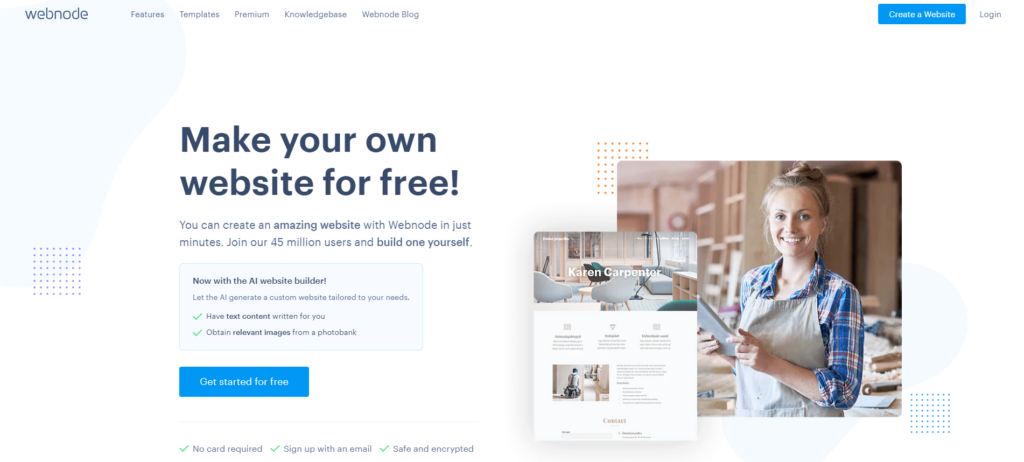
Image source
Webnode provides a straightforward drag-and-drop builder with hosting and a domain name in a single package. The template selection is limited to about 100 options, which is not the widest range but still offers enough diversity to suit most needs. All templates are available without additional cost, ensuring you don’t have to pay extra for any design. While the builder may not be ideal for blogging or e-commerce due to some missing functionalities, it is well-suited for small businesses, musicians, and artists.
Webnode’s pricing ranges from $3.95 to $19.95 per month, depending on the chosen plan. The basic package does not include a domain name but allows you to connect an existing one, similar to Wix. A free plan is also available, suitable for building basic websites but lacking many features in the premium plans.
Top Features of Webnode
- The AI-driven website builder crafts content and produces images for each page of your site.
- Its app functionality enables users to construct and modify websites directly from a mobile phone or tablet.
- The modular block design facilitates the easy addition and rearrangement of content for seamless navigation.
- Its budget-friendly pricing makes this tool attainable for nearly every financial plan.
Pricing of Webnode
Pricing for Webnode’s various plans begins with the Limited Plan, which costs $4 per month and offers 200MB of storage and 1GB of bandwidth alongside a form builder that supports up to five fields. The Mini Plan costs $7.50 per month and includes a free domain for one year, 1GB of storage, 3GB of bandwidth, email support, and a video background feature.
For those needing ecommerce capabilities, the Standard Plan at $12.90 per month supports online store functionalities. It also provides Google Analytics, AdSense integration, membership registration, and support for up to two languages. The most comprehensive option, the Profi Plan, costs $22.90 per month and offers 7GB of storage, unlimited bandwidth, no Webnode branding, unlimited language options, registration and backups, and a site search feature.
11. Drupal
Drupal is an excellent choice for developers seeking a robust open-source CMS, especially those proficient in PHP, HTML, and CSS, rather than Markdown. This CMS is tailored to construct complex websites that handle large data volumes and high traffic.
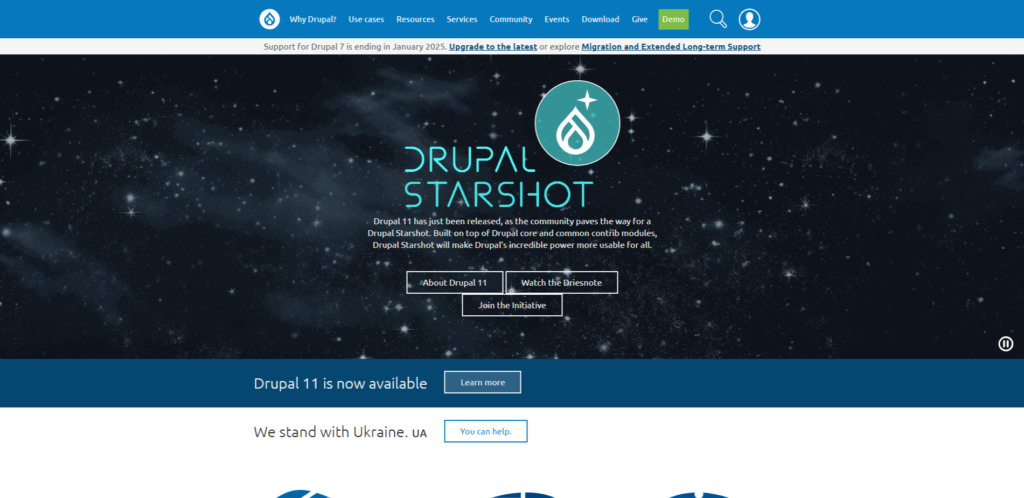
Image source
With over 44,000 modules and thousands of free themes in its directories, Drupal allows extensive customization of its core features. These elements are highly configurable, enabling developers to fine-tune both the functionality and aesthetic of their websites.
Additionally, Drupal’s architecture supports separating the front end from the back end, a strategy that can significantly enhance site loading speeds, among other benefits.
Top Features of Drupal
- Drupal prioritizes security with features like database encryption, user access controls, and protection against malicious data and DoS attacks.
- It offers advanced performance capabilities, including a modern CDN, making it ideal for high-traffic websites with large content volumes.
- Caching, optimized database queries, and performance tuning ensure efficient performance, enabling scalability and fast operation.
- Drupal supports multiple languages, allowing content translation, language preferences, and a localized user experience.
- It integrates various marketing automation tools for streamlined efforts, including real-time sales alerts, bulk data management, and targeted email reporting.
- Drupal simplifies content creation, editing, and distribution across multiple channels.
Pricing of Drupal
Drupal is a free alternative to Wix. It features a customizable, open-source content management framework ideal for simple websites to complex web applications.
12. BigCommerce
BigCommerce is a proprietary, hosted e-commerce platform that allows business owners to set up an online store and sell products. Being a hosted solution, BigCommerce operates on its servers, meaning you don’t have to buy web hosting or install software on your computer. You can access and manage your store from anywhere with internet access and a web browser.
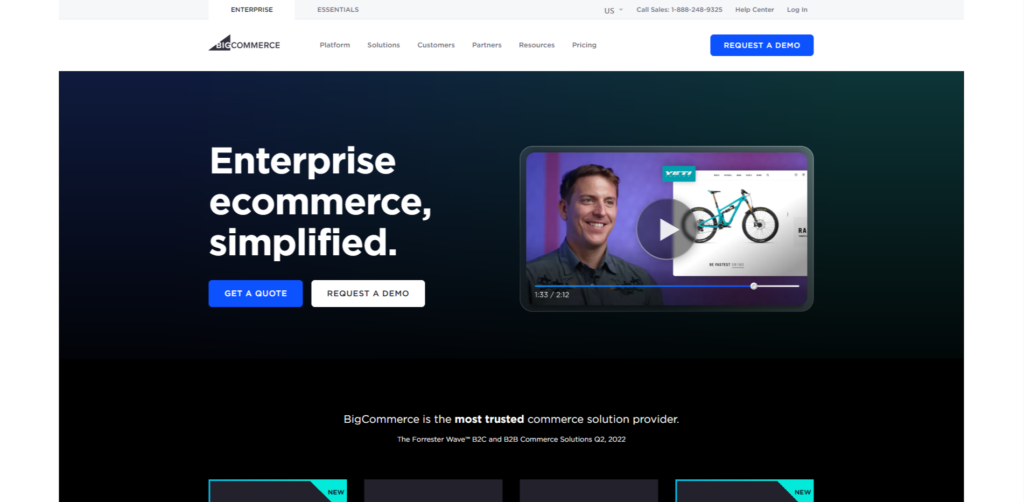
Image source
As a “software as a service” (SaaS) tool, BigCommerce requires a monthly subscription rather than a one-time purchase. The platform supports the sale of both physical and digital products and includes marketing tools to promote your store. It offers a variety of customizable templates to help you design your online presence.
BigCommerce caters to users with little web design experience but provides more advanced options for users and developers to customize their sites’ HTML and CSS. The platform features over 100 themes, including 12 free options and over 100 paid themes, with prices ranging from $145 to $235.
Finding the perfect theme on BigCommerce is straightforward. You can filter themes by industry or layout, choose designs featuring large images or grid layouts, or use the search function to narrow down options or focus on free themes.
Top Features of BigCommerce
- BigCommerce provides comprehensive e-commerce features that are ideal for developing and managing an online store.
- It is scalable to accommodate businesses of any size, from small startups to large corporations.
- The platform also offers extensive customization options, enabling users to tailor unique e-commerce experiences.
- Additionally, BigCommerce supports robust integrations with third-party tools and services, enhancing online stores with functionalities such as payment gateways and shipping services.
Pricing of BigCommerce
BigCommerce offers several pricing options: the Standard Plan at $39 per month, the Plus Plan at $105 per month, and the Pro Plan at $399 per month. The Enterprise Plan requires contacting BigCommerce directly for custom pricing for larger businesses.
BigCommerce provides a 15-day free trial, and if you choose to pay annually, you can save 25% on all paid plans, excluding the Enterprise Plan. Despite the similarities in pricing with Shopify, BigCommerce differentiates itself by not offering a “starter” plan for more minor, link-in-bio type businesses, and the overall services between the two platforms vary significantly.
Conclusion
In 2025, businesses exploring website-building alternatives to Wix will have many options tailored to various needs, from simple blogs to sophisticated e-commerce platforms. While Wix remains a strong contender due to its user-friendly design and broad template selection, its customization, scalability, and cost-efficiency limitations drive the search for alternatives. Platforms like Squarespace and WordPress appeal to those seeking greater design flexibility and robust features, whereas Shopify stands out for e-commerce functionality.
Newer entries like Jimdo and IONOS offer unique features catering to specific business requirements, emphasizing cost-effectiveness and integrated solutions. As businesses grow and their online needs evolve, choosing a website builder should align with current requirements and anticipated future needs. Therefore, exploring these alternatives allows enterprises to choose a platform that best fits their vision, operational style, and growth trajectory, ensuring their online presence is practical and scalable.