



Point of Sale Market Share 2025
Posted: July 14, 2025 | Updated:
The point-of-sale (POS) industry in 2025 is undergoing rapid transformation. Businesses are replacing clunky cash registers and legacy systems with sleek cloud-based terminals and software-driven solutions. This article provides a comprehensive overview of the POS market in 2025 and insights into global trends.
We’ll explore the market leaders, key technology trends in POS hardware and software, and how different types of businesses – from retail stores to restaurants and even e-commerce players – are adopting POS systems.
Point of Sale Market Share: An Overview
The POS market is large and growing. Globally, the POS hardware (terminals) market is estimated at just over $100 billion in 2024 and is projected to reach about $152 billion by 2029 (around 8.7% CAGR). The POS software segment is also expanding, with a valuation of around $13.7 billion in 2023 and projected to double by 2032. North America is a major driver of this growth; in fact, the region accounted for roughly 36% of the global POS market in 2023.
The U.S. in particular leads in POS technology adoption, with millions of merchants, large and small, upgrading their systems. To put it in perspective, there are over 10 million POS payment terminals in operation across the U.S. as of 2024, processing more than $8 trillion in electronic payments annually. This widespread deployment reflects the strong preference for cashless transactions and digital payments in North America.
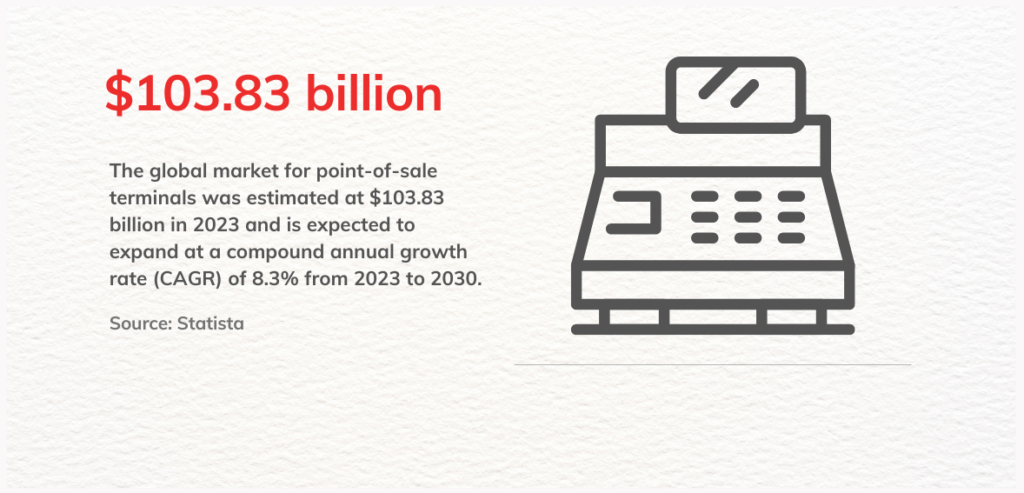
By 2025, continued economic growth and technological innovation will further boost POS investments. Analysts project the overall U.S. POS market (hardware, software, and services combined) will more than double over the decade, growing from about $5–6 billion in 2023 to well over $13 billion by 2030. North America’s leadership in POS is also significant globally because trends pioneered in the U.S. often spread worldwide. For example, the shift to cloud-based POS and mobile payment integration gained momentum in U.S. small businesses and is now being adopted in Europe and Asia.
That said, every region has its nuances. In Europe, mobile POS and affordable card readers (like SumUp or Zettle) are popular among small merchants. In developing markets, smartphone-based payments sometimes leapfrog traditional POS hardware entirely. Nonetheless, the key themes of 2025, like cloud connectivity, mobility, and seamless payment experiences, are universal in the global POS market.
Leading POS Providers and Market Share
The competitive market of POS providers is a mix of payment-tech companies and software-focused firms, all vying for merchant adoption. In the U.S., a handful of companies command a large share of the POS systems market. Square (owned by Block, Inc.) and Toast are the two frontrunners by market presence: Square accounts for roughly 27–28% of POS installations, and Toast about 24%, according to recent industry analyses. Other major players include Lightspeed, Clover (by Fiserv/First Data), and Shopify, each of which has grown their footprint in retail and hospitality segments.
The remaining portion of the market is fragmented among legacy providers and smaller vendors. POS systems market share by provider (U.S., 2024). Square and Toast lead the pack with nearly half the market combined. “First Data” refers to Fiserv’s POS solutions (including Clover). It’s important to note that market share can vary by how it’s measured (number of merchants, transaction volume, or revenue) and by industry segment.
Square’s close to 28% share shows the broad base of small businesses using Square’s easy mobile card readers and register apps. Toast’s about 24% share is concentrated in restaurants, the sector it specializes in. Lightspeed (around 7–8% share) and Shopify (a few percent) have a strong presence in retail, especially for omnichannel merchants who sell both in-store and online. Clover (Fiserv) holds roughly 5–6% of the POS systems market, primarily through banks and resellers offering Clover devices to small retailers and restaurants.
Legacy giants like NCR (maker of Aloha POS for restaurants and traditional registers for retailers) and Oracle (owner of Micros) still account for a significant installed base, especially among large chain businesses, but their share of new system sales is declining as cloud-native rivals grow. When looking specifically at POS hardware terminals (card-reading devices and touchscreens), the picture includes traditional manufacturers.
As of 2024, Verifone and Ingenico are still the top two payment terminal providers in the U.S. by installed base, with about 30% and 25% share respectively. However, integrated POS makers like Square and Clover also appear in the top five, reflecting how all-in-one POS devices have gained ground. Square’s hardware (Square Stand, Register, Terminal, etc.) makes up roughly 15% of U.S. payment terminal installations, and Clover’s devices about 10%. PAX Technology, a rising manufacturer of Android-based terminals often used by various POS software providers, holds around 8%.
The remaining market consists of smaller players and OEMs. This hardware ranking underscores that many merchants (especially larger ones) still use traditional card readers like Verifone/Ingenico alongside newer POS software, while small merchants increasingly opt for integrated solutions from companies like Square.
| Provider | Share of U.S. Installations |
| Verifone | ~30% |
| Ingenico | ~25% |
| Square | ~15% |
| Clover (Fiserv) | ~10% |
| PAX Technology | ~8% |
| Others (various) | ~12% |
Table: Top U.S. Payment Terminal Providers
Trends in POS Hardware

POS hardware has evolved far beyond the traditional cash register and card swipe machine. In 2025, the dominant hardware trend is the shift toward smart, connected devices.
Many businesses are replacing old keypad terminals and PC-based tills with tablets, all-in-one smart terminals, and even smartphones doubling as POS. The benefits are clear: these devices are typically cheaper up-front, easier to update, and offer greater mobility.
1. Mobile POS (mPOS) devices
Tablet or smartphone-based systems are ubiquitous in retail and hospitality. They untether the checkout from the counter, allowing sales associates or restaurant servers to process transactions anywhere in the store or venue. In restaurants, handheld POS usage has skyrocketed: about 61% of restaurants were using one or more handheld POS devices by 2022, up from just 30% in 2017.
Retailers use tablets for line-busting during peak times or for pop-up shop sales. Globally, the total transaction value going through mobile POS is enormous, projected at $3.78 trillion in 2024 (on track to exceed $6 trillion by 2028).
2. Fixed terminals aren’t dead
The classic checkout register has simply gotten a modern makeover. Many merchants still prefer a fixed station at the counter, but today’s stations often feature sleek touchscreens and contactless readers. In the restaurant sector, traditional fixed POS terminals accounted for about 63% of total POS solution revenues in 2023.
These remain popular for their full-size screens, peripheral support (cash drawers, printers), and durability under high-volume use. However, the fastest growth in hardware is happening in newer form factors like self-service kiosks and mobile units. Self-service kiosks (think of the ordering screens in fast-food restaurants or self-checkout in groceries) are expected to see around 9.5% annual growth through 2030, faster than any other POS hardware segment.
3. Contactless and IoT-enabled hardware is now standard
Nearly all new POS terminals come with NFC (near-field communication) for contactless card and mobile wallet payments. The pandemic accelerated demand for these “tap-to-pay” devices, and that momentum continues in 2025, as consumers have come to expect quick, hygienic transactions.
Additionally, POS hardware is increasingly IoT-connected, meaning devices can communicate in real time with other systems, updating inventory as sales happen, monitoring device status remotely, etc.
4. Specialized form factors are available for different needs
Self-service kiosks in restaurants let customers input orders directly, improving speed and freeing up staff. Smart carts and checkout-free store tech (pioneered by Amazon Go) are still emerging but exemplify how hardware and software blend for frictionless shopping.
Even wearables or voice-activated devices are being explored as future POS interfaces in some experimental retail settings.
Another notable trend is the push for hardware durability and sustainability. POS manufacturers are designing equipment that’s more energy-efficient and using recyclable materials, responding to retailers’ interest in eco-friendly operations. Rugged, waterproof tablets for restaurants or solar/battery-powered mobile readers for outdoor markets are examples addressing practical needs.
Finally, the North American market has seen a flood of Android-based POS terminals. Companies like PAX, Clover, Toast, and others offer hardware that runs on the Android OS, making it easier to develop custom POS apps and integrate third-party services. This contrasts with the inflexible, proprietary terminals of the past. The hardware is increasingly just a conduit for software – versatile, connected, and smart. As hardware gets commoditized, we can expect prices to continue to come down, often bundled “free” or at low cost in exchange for using a provider’s software and payment services.
Trends in POS Software and Services

If hardware is the body of a POS system, software is the brain – and it’s getting smarter and more connected every year. The big story in POS software is the move to the cloud. Cloud-based POS solutions have surged in popularity, replacing on-premise software that had to be installed on local servers or single machines. By 2025, most new POS deployments, especially among small and mid-sized businesses, will be cloud-based subscriptions (POS as a service). This model offers anytime/anywhere data access, easier updates, and lower upfront costs.
Globally, the cloud POS market is growing at nearly 25% CAGR, far outpacing traditional POS software growth. Hospitality businesses have taken notice – cloud capabilities are among the top features 71% of restaurants seek in new POS systems, second only to system integration needs. Key software trends and features in 2025 include:
1. Omnichannel integration
Modern POS software is expected to seamlessly connect with e-commerce, online ordering, and marketplaces. In retail, the ability to unify online and in-store sales and manage inventory across channels is crucial. A 2023 survey of retailers showed that improving omnichannel integration (e.g., buy online, pick up in store, unified order management) was the top POS priority for 54% of respondents.
Retailers want one system that can handle transactions in person and on their website, so that customers have a smooth experience and data is centralized. This has driven ecommerce platforms like Shopify to offer POS software that ties directly into their online store backend. Likewise, traditional POS providers have built APIs and integrations to connect with shopping carts, delivery apps, and more. The lines between “point of sale” and “online sale” are blurring; the trend is toward unified commerce where a POS is the central hub for all sales channels.
2. Data analytics and AI integration
With everything digitized, POS systems are now a treasure trove of data. Merchants are increasingly leveraging POS analytics to drive decisions – in fact, POS data is considered the most valuable data source for many retailers (51% of retailers said so), and 86% of restaurants report using POS data for decisions on menus, marketing, and loyalty programs.
In 2025, AI is making its way into POS platforms to supercharge this data use. For example, machine learning algorithms can analyze sales patterns to forecast inventory needs, detect fraud or abnormal transactions, and even personalize marketing offers to customers based on purchase history. AI-driven features (like predictive ordering or smart suggestions for upselling) are emerging as the next frontier – one survey found artificial intelligence ranked just behind cloud integration among sought-after POS functionalities for restaurants.
We’re also seeing early use of AI chatbots and virtual assistants integrated into POS systems for things like handling customer inquiries or guiding managers through reports.
3. Enhanced customer experiences
POS software now often doubles as a customer engagement tool. Many systems have built-in CRM (customer relationship management) features – tracking customer purchase histories, enabling loyalty programs, sending digital receipts and promotions. For instance, a small café using Square can automatically build a customer directory and track visit frequency, then launch an email campaign to bring people back.
Restaurants using Toast or Clover can run loyalty rewards and capture feedback at checkout. This trend reflects how POS is not just a transaction recorder; it’s a platform to enhance service and marketing.
4. Integration with other business systems
Beyond sales channels, POS software is increasingly expected to connect with accounting software, inventory management, employee scheduling, and more. Especially for retail, having the POS sync with backend inventory eliminates double entry and out-of-stock errors. Many retailers cite the need for better order orchestration and inventory visibility across channels.
For restaurants, POS integration with kitchen display systems, reservation platforms, and delivery apps is now common. Open APIs and app marketplaces by POS providers (e.g., Shopify’s app store, Square’s add-on apps) allow businesses to extend their POS functionality easily. The goal is a single unified system or tightly knit ecosystem that runs the whole business. This does pose challenges – ensuring all these integrations work smoothly is not trivial and small businesses often struggle with tech interoperability. Thus, providers that offer an all-in-one suite have an edge for simplicity.
5. Security and compliance
Handling payments and customer data means POS software must prioritize security. Trends here include end-to-end encryption, tokenization of card data, and compliance with PCI DSS standards by default.
With cyber threats rising, POS systems also now include more robust user permissions, two-factor authentication for back-office access, and regular security patches via cloud updates. North American providers are leading on these fronts, as security capabilities have become a global selling point.
6. Software pricing and services
The era of large upfront license fees is fading. Subscription-based pricing (SaaS) is the norm in 2025, meaning businesses pay a monthly fee per register or location for the POS software. This often includes support and updates. Additionally, POS companies have become service companies – they don’t just sell a piece of software, but also payment processing services, support, and sometimes ancillary financial services.
For example, many providers offer integrated payment processing (the merchant doesn’t need a separate merchant account or processor – the POS vendor handles it for a cut of each transaction). This is mutually beneficial: the merchant gets convenience and transparent flat-rate pricing, while the POS vendor gains a recurring revenue stream from transaction fees. As noted earlier, companies like Toast and Square derive the bulk of their revenue from payment processing fees rather than software fees alone.
Some POS vendors also offer business services like lending, payroll, and capital advances, using the data from the POS to underwrite and serve their clients. This embedded fintech model is a growing trend – the POS system becomes a gateway to financial services (loans, cash advances, card issuing, etc.) for small businesses.
Overall, POS software in 2025 is characterized by its flexibility (cloud-based, modular), rich functionality (analytics, loyalty, etc.), and the way it’s tightly intertwined with services (payments, support, and more). The rapid software innovation is allowing even small businesses to access sophisticated tools that were once only available to big companies.
At the same time, the reliance on software means businesses must be mindful of downtime (internet outages) and data security; thus, backup connectivity options and robust encryption have become standard parts of the conversation when choosing a POS.
Adoption Trends by Business Type

Different industries have unique needs from their POS systems, and adoption trends vary across retail, restaurants, and e-commerce/omnichannel businesses. Let’s examine each:
1. Retail Sector
Retailers – from boutiques to big-box stores – have been upgrading their POS systems to support a new era of shopping. A major theme is omnichannel retail, where shoppers move fluidly between online and physical stores. Retail POS systems in 2025 are judged on how well they enable a unified customer experience. For example, customers expect to buy online and pick up in-store (BOPIS) or return an online purchase to a store with no hassle.
Achieving this requires tight integration between the POS and e-commerce platform. It’s no surprise that in a 2023 Retail Consulting Partners survey, 54% of retailers said improving omnichannel integration was a top POS priority, making it the number-one concern alongside better order management. Retailers are also prioritizing robust inventory management in POS (knowing exactly what’s in stock across all stores and warehouses) and unified payment platforms that can handle multiple payment methods consistently across channels.
Adoption in retail is also driven by sub-sector needs. Notably, grocery stores and supermarkets, which historically used very proprietary, complex POS systems, are now one of the fastest-growing adopter segments for modern POS technology. Grocery retailers require high-speed scanning, scale integration, and often self-checkout kiosks; many are investing in updated systems that can handle these demands while also tying into online grocery ordering platforms.
Meanwhile, specialty retail and apparel stores focus on features like customer profiles, loyalty, and mobile checkout (so staff can assist customers on the floor). Department stores and large retail chains often stick with robust enterprise POS (some still rely on legacy vendors like Oracle or NCR for stability and scalability), but even they are experimenting with cloud-based solutions at pilot stores or pop-up concepts. Another trend in retail is the lifespan of POS technology.
Many retailers have been operating on outdated systems – studies in recent years found that around 40% of retailers’ POS hardware is more than 5 years old. This is changing as the pressure to modernize mounts. Around 46% of retailers planned software upgrades or replacements in the near term, reflecting a broad refresh cycle through 2024–2025.
Those upgrades often involve moving to cloud-based POS and adding capabilities like contactless payments and enhanced analytics. In terms of vendor adoption, retail is a bit more fragmented than restaurants. Lightspeed and Shopify POS have become popular among small to mid-size retailers, especially those seeking strong e-commerce integration (Shopify POS allows a merchant to manage online and in-store from one system).
Square is widely used by very small retailers, market vendors, and independent shop owners due to its simplicity and low entry cost. Clover has a notable share in retail as well, often provided through bank channels to merchants who want an out-of-the-box solution. For enterprise retail, Oracle Micros and NCR still power many large stores and chains – Oracle was noted to have as high as a 36% share of the North American retail POS software market back in 2016, though that has likely declined as cloud rivals emerged.
New entrants like Stripe and PayPal Zettle are also targeting retail SMBs; for instance, PayPal’s Zettle card reader and POS app launched in the U.S. to compete with Square for micro-merchants. Retailers now have a plethora of choices, and they tend to pick based on specific needs: if online integration is key, Shopify or Lightspeed might win; if robust inventory and multi-store management is paramount, Lightspeed or traditional systems might be chosen; if cost and ease are top concerns, Square or Clover could be it.
2. Restaurant and Hospitality Sector
Nowhere has POS technology changed as dramatically in recent years as in the restaurant industry. Restaurants have unique requirements – from handling complex orders (with modifiers and courses) to splitting checks, tipping, and coordinating between the front of house and kitchen. The 2020s brought additional challenges like online ordering, delivery integration, and changing service models, all of which the POS needs to accommodate.
As a result, the restaurant sector has seen a surge in the adoption of specialized, cloud-based POS solutions. Toast is a standout leader in this space. Designed specifically for food service, Toast has grown explosively among U.S. restaurants – by the end of 2024, it reached 15% of the U.S. restaurant market share in terms of locations served.
In fact, among independent full-service restaurants (single-location, table-service venues), Toast’s dominance is even greater: a 2022 industry survey found 30% of restaurateurs were using Toast, and no other single POS provider had even a 10% share among respondents. This underscores how strongly Toast has been adopted in its core market, largely displacing older systems like Aloha and Micros at those types of restaurants.
For quick-service restaurants (QSRs) and cafes, Square is also very popular due to its low cost and simplicity – many small eateries start with Square and an iPad because it’s easy to set up and has no monthly fee (only per-transaction charges). Clover also has a presence in cafes and smaller restaurants, often bundled with bank merchant services. Traditional providers like NCR (Aloha), Oracle (Micros), and PAR (Brink) still retain a lot of the enterprise restaurant chains.
Many large fast-food or casual dining chains use heavily customized legacy POS systems. However, even these chains are now exploring newer tech: for instance, some are piloting handheld devices for servers or kiosks for guests, and looking into cloud-based back-office reporting. Toast and others are moving up-market, signing on multi-unit restaurant groups and even some chain franchises that historically would use legacy POS.
We also see emerging competitors like SpotOn, Revel (recently acquired by Shift4), and Lightspeed (which acquired Upserve and Toast’s competitor ShopKeep earlier) making inroads, often by offering robust restaurant-specific features on modern cloud platforms. Key adoption trends in restaurants include:
- Mobile POS and tableside ordering:
As mentioned, over 60% of restaurants now use handheld POS devices. Waitstaff at many restaurants take orders on tablets or iPods, which send orders directly to the kitchen and allow payment to be taken at the table.
This speeds up service and table turn times. It’s become nearly essential in busy full-service environments and even some fast-casual places where staff roam the line to take orders (like Shake Shack did with tablets).
- Online ordering and delivery integration:
Restaurants in 2025 demand that their POS connect with online ordering platforms (either the restaurant’s own website/app or third-party services like DoorDash and Uber Eats). The pandemic made this a must-have, and it remains critical. Newer POS systems usually have built-in online ordering modules or at least offer integration plugins.
This prevents staff from having to re-enter online orders into the POS (which was common in the past). Ghost kitchens and virtual brands have also emerged, relying 100% on integrated tech to manage delivery-only food businesses.
- Self-service kiosks:
In fast-food and fast-casual dining, self-order kiosks are increasingly common (McDonald’s and others led the way). They are considered part of the POS ecosystem and often tie into the same system that manages other registers.
Their adoption is growing, especially as some customers prefer a DIY ordering experience. The high CAGR for kiosks (nearly 9.5%) reflects strong interest in this tech for the coming years.
- Focus on cost control features:
Restaurant operators face tight margins, so they value POS features that help track costs and reduce waste. According to surveys, independent restaurants wish their POS had better menu and recipe costing tools – 40% cited this as a feature they want.
Inventory management and staff scheduling integrations are also high on wishlists. This is driving the adoption of POS systems that offer modules for ingredient-level tracking, food cost analysis, and labor management. It’s no longer just about ringing up sales; the POS is expected to help manage the business.
- Reliability and support:
Restaurants often operate late hours and can’t afford downtime during a dinner rush. Cloud POS providers have had to prove their reliability (offline modes when the internet drops, 24/7 customer support, etc.). Many restaurants stick with older systems until a trustworthy alternative is evident.
By 2025, enough success stories from early adopters will convince even skeptics that cloud POS can be reliable and secure. Thus, we see an accelerating replacement cycle – in one survey, 43% of restaurant operators said they planned to research or test new POS systems for implementation starting in 2024. A similar number had prioritized adding a mobile POS in 2023. This indicates a high level of activity in the restaurant sector for system upgrades.
- Guest experience and omnichannel:
Restaurants are also thinking omnichannel in their way – for example, integrating reservations, dine-in, takeout, and delivery into one system for a 360-degree view of the guest. Nearly 46% of restaurants wanted to upgrade their POS to better support omnichannel customer experiences (like unified loyalty or ordering across in-person and online).
Hotels and resorts seek POS that tie into their property management systems, enabling charges to the room, etc., showing the hospitality side integration as well.
Restaurant POS adoption in 2025 is marked by a rapid shift to cloud specialists (Toast, etc.) for small and mid-sized operations, while larger chains gradually warm up to modern systems. The need for agility (like quickly adding online ordering, or changing menu pricing on the fly) has made old systems feel antiquated. Restaurants that have adopted new POS report extensive use of the data and features: almost 90% of restaurants say they use POS data for business decisions on everything from menu design to marketing. The POS has truly become the nervous system of a restaurant business, connecting the kitchen, staff, and customer experience in real time.
3. E-commerce and Omnichannel Businesses
It might sound counterintuitive to talk about “e-commerce” businesses using POS systems – after all, e-commerce is selling online without a physical point of sale. However, by 2025, the worlds of e-commerce and brick-and-mortar retail have fused in important ways. Many traditional online retailers have opened physical storefronts or pop-up shops, and virtually all large retail chains have e-commerce operations alongside their stores. Thus, the omnichannel trend means that even e-commerce-centric companies are adopting POS solutions for their offline interactions. A prime example is Shopify.
Known as a leading e-commerce platform powering online stores, Shopify recognized that its merchants often also sell in person (at craft fairs, physical boutiques, etc.). In response, Shopify developed Shopify POS, a software/hardware solution that syncs with the Shopify online store. As a result, tens of thousands of Shopify’s merchants now use Shopify POS to unify their sales channels. (Shopify reported over 100,000 merchants using Shopify POS as of mid-2019, and that number has likely grown significantly by 2025 as Shopify’s overall merchant count has exploded.)
The draw is that a merchant can manage inventory, sales, and customer profiles in one place – an item sold in the physical store immediately reflects in the online inventory and vice versa. Beyond Shopify, other e-commerce-focused companies have entered the POS space or partnered to bridge online and offline. Square launched online store capabilities and integrations with e-commerce platforms, effectively going the other direction (from POS to e-commerce).
Stripe, a major online payments provider, introduced Stripe Terminal, which is a toolkit for developers to build in-person payment solutions that connect to Stripe’s online payments infrastructure. This caters to businesses that started online and need a custom in-person solution without changing their backend.
PayPal integrated its payment services with in-person card readers via Zettle, targeting the same omnichannel convenience for small sellers who accept PayPal online and in-store. The adoption trend here is all about unifying customer data and experience across channels. An omnichannel business wants to recognize a customer whether they shopped on the website or in a shop, and they want loyalty points, gift cards, and promotions to work in both environments.
Thus, POS systems in 2025 often have modules to handle unified loyalty programs and gift cards that can be used online or offline seamlessly. Buy Online, Pick Up In Store (BOPIS) and Buy Online, Return In Store (BORIS) are supported by linking the e-commerce order system with the in-store POS – something modern cloud POS with open APIs is well-suited for.
The COVID-19 pandemic made these omnichannel capabilities essential, and businesses that invested in them have largely kept them as permanent offerings. For e-commerce pure-plays dipping into physical retail, the barrier to entry is lower than ever: they can simply adopt a POS like Shopify’s or Lightspeed that ties into their existing online platform, rather than implementing a whole separate system. This has led to more short-term and experimental physical retail (like pop-up shops or showrooms) since the tech hurdle is low. Even large online-first brands (e.g., Warby Parker, Bonobos in the past years) were able to launch brick-and-mortar stores because modern POS made it manageable to sync with their online operations.
On the flip side, traditional retailers have ramped up their e-commerce adoption, often using their POS provider’s help. Many retail POS systems now either include an integrated e-commerce storefront or easily plug into one. For instance, Lightspeed offers an e-commerce module; Clover has app integrations for online sales; and Toast introduced digital ordering and delivery integrations for restaurants as a parallel to e-commerce. The result is convergence: an ideal scenario where a business has one system for product catalog, one system for inventory, one for customer data, feeding both the online and offline sales channels.
From a technology standpoint, omnichannel demands have spurred POS providers to bolster certain features. Inventory syncing in real-time, as mentioned, is critical. Analytics that attribute sales to the right channel and track cross-channel behavior (like “customer browsed online, purchased in store”) are now being offered in advanced POS reporting suites.
Payment flexibility is another aspect – customers might want to use the same saved credit card or mobile wallet in store as on file online; solutions like Apple Pay, Google Pay, etc., have become common denominators that POS must accept (which they do – as of 2024, Apple Pay was used by 60% of consumers in the US at retail/restaurant checkouts). We also see interest in unified customer accounts: some businesses let customers log into their account in-store at the POS (via phone number or loyalty scan) to apply online coupons or earn rewards, showing how even the checkout process is merging.
Conclusion
By 2025, the point-of-sale (POS) industry will have transformed into a more agile, cloud-based, and mobile-driven ecosystem, with North America leading this evolution. Major players like Square, Toast, Lightspeed, Clover, and Shopify are not only competing within their niches but also expanding their offerings to serve a broad range of sectors, including retail, hospitality, and services.
The modern POS is now more than a transaction tool; it’s the digital backbone of business operations, integrating payment processing, inventory management, customer engagement, and data analytics. As AI, contactless payments, and omnichannel retail become standard, even small businesses can access enterprise-grade tools, creating new efficiencies and revenue opportunities.
This rapid innovation is driving both growth and consolidation in the market. Vendors are racing to offer all-in-one solutions, leading to acquisitions that fold specialized startups into larger platforms, such as Shift4 and Lightspeed’s expansion strategies. Meanwhile, global markets are following North America’s lead, adopting mobile payments and cloud POS systems at increasing rates.
Consumers benefit from faster checkouts, more payment options, and personalized experiences, while businesses gain actionable insights and scalability. However, challenges remain, including cybersecurity risks and the complexity of integrating multiple software tools. Nonetheless, with rising customer expectations and competitive pressure, businesses that fail to modernize risk falling behind, making continuous innovation in POS technology a necessity, not a luxury.
Frequently Asked Questions
-
What’s driving the POS market’s rapid growth through 2025?
Cloud-based subscriptions, mobile and contactless payments, and integrated analytics/services are fueling an 8–25% CAGR in hardware and software segments, with North America leading adoption.
-
Who are the top POS providers and their market shares?
In the U.S., Square (≈28%) and Toast (≈24%) dominate overall installations; Lightspeed, Clover, and Shopify hold mid-single-digit shares, while legacy vendors like Verifone (30%) and Ingenico (25%) still lead pure-hardware terminals.
-
What are the key hardware trends in 2025?
Smart, connected devices, tablets, smartphones, all-in-one terminals, and growth in self-service kiosks and IoT-enabled, NFC/contactless readers are replacing traditional tills.
-
How is POS software evolving?
Cloud-native platforms with omnichannel integration, AI-driven analytics, built-in CRM/loyalty, and embedded fintech (payments, lending) are making POS the central business hub.
-
How do adoption patterns differ by industry?
Retailers prioritize omnichannel inventory and e-com sync; restaurants favor mobile/tableside ordering, delivery integration, and cost-control tools; e-commerce “pure-plays” use unified POS for pop-ups and BOPIS.