


GumRoad vs. Shopify
Posted: August 29, 2024 | Updated:
Gumroad is a platform for self-publishing and selling digital products such as memberships, courses, and books. On the other hand, Shopify provides various marketing and management tools at no extra cost, aiding sellers in expanding their businesses as they see fit. This comprehensive Gumroad vs. Shopify analysis will help merchants decide which platform suits them.
In the comparison between Shopify vs. GumRoad, we found that GumRoad is an emerging company that has yet to develop fully. It is easy to use and ideal for those new to online selling. However, even the most basic Shopify plan offers more extensive features for those requiring more sophisticated customer management and invoicing tools.
Introduction to GumRoad
Gumroad is an online marketplace and e-commerce platform for selling digital products. Established in 2011 by Sahil Lavingia, it has become a favored platform for creators looking to monetize their digital content.
The platform features a user-friendly checkout system that works with various payment processors, including PayPal, Stripe, and Apple Pay. Users also have the option to receive tips or donations from their customers. In addition to sales capabilities, Gumroad provides a range of marketing tools to help track sales, create customer loyalty programs, and more. It also includes an open API, enabling users to integrate Gumroad’s checkout system into their own websites.
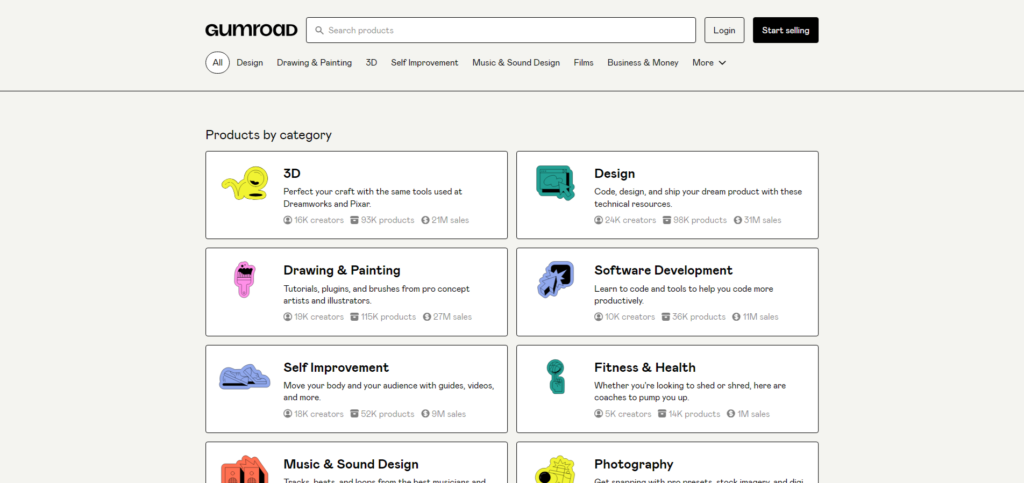
Image source
Pros and Cons of GumRoad
Pros:
- Quick setup of product pages that feature a clean design.
- Enables the sale of digital products, physical goods, and memberships.It offers various payment transfer options, including PayPal, Stripe, and bank transfers (in select countries).
- Regular weekly payouts.
- Mobile-friendly with a phone widget.
- The Gumroad Discover feature increases product visibility on the platform.
- Provides detailed analytics to track performance across different channels and regions.
- Push notifications keep sellers informed about sales.
Cons:
- Imposes a 10% flat fee on every transaction.
- Customization options for storefronts are restricted.
Introduction to Shopify
Shopify is a versatile e-commerce platform enabling small businesses to create online stores or market products on third-party sites and social media. It also offers point-of-sale (POS) software for physical store locations. Ideal for businesses seeking a comprehensive e-commerce solution, Shopify offers features including payment processing, shipping discounts, inventory management, and financial services such as banking and loans for qualified sellers.
Shopify offers a user-friendly interface that caters to novice drop shippers and rapidly expanding direct-to-consumer brands. Interested users can register for a free trial to explore the platform. This trial period allows you to set up your store, experiment with free Shopify apps, and generate online sales with effective promotion.
Most of Shopify’s features are accessible through a monthly subscription, including transaction fees. Subscription plans vary, starting at $5 per month and extending to enterprise-level pricing that requires a custom quote. Additional costs may apply for third-party apps within the Shopify ecosystem.

Image source
Pros and Cons of Shopify
Pros:
- Shopify simplifies the selling process without requiring technical hosting or site development expertise.
- It is accessible on iPhone and Android, allowing continuous customer interaction and increased sales opportunities
- .It provides 24/7 customer service through email, phone, or live chat and offers educational resources such as tutorials and webinars via Shopify Learn.
- Allows users to link their own domain to Shopify, with the option to purchase one directly through the platform.
- Shopify’s Theme Store offers more than 70 customizable themes.
- Supports dropshipping by partnering with suppliers who manage inventory and shipping.
- The Shopify App Store provides a variety of plugins to enhance store functionality.
Cons:
- Faces challenges with customization and compatibility across different browsers and operating systems.
- Imposes transaction fees ranging from 0.5% to 2.0%, though these can be avoided by using Shopify Payments.
Gumroad vs. Shopify: Features
Top Features of Gumroad
- Customization and Flexibility: Users can create and modify their own landing page on Gumroad, streamlining the process to sell digital products quickly. The platform supports various selling options such as the use of license keys, offer codes, multiple product versions (like different e-book formats), multiple currencies, a “pay what you want” feature, and options for renting films.
- Basic Plan: Gumroad offers a basic, cost-free plan tailored for new users exploring the platform. This level allows users to sell an unlimited quantity of products and is equipped with tools for real-time analytics and customer management. However, it restricts users to a limited number of posts and standard-definition video streaming.
- Payment Options: Gumroad supports payments through PayPal and all major credit cards, including MasterCard, Visa, Discover, American Express, JCB, and Diners Club.
- Upsells: Users can increase their average order value by adding upsells to the checkout process. Upsells might include related products, premium versions, or additional services that complement the initial purchase. Users can configure upsells in the settings for each product on Gumroad.
- Discount Coupons: With Gumroad’s coupon system, users can provide discounts to their audience or specific customer groups. This system allows for the creation of both percentage-based and fixed-amount coupons, the limitation of coupon use, and the monitoring of coupon performance. This feature is accessible through the product’s checkout settings.
- Email Marketing: The platform includes an email marketing tool to help users grow and maintain their email list. Features include sending broadcast emails, scheduling campaigns, and implementing automated email workflows in response to customer actions. These tools are available under the “Emails” tab in the user dashboard.
- Affiliate Program: Gumroad’s affiliate marketing program allows users to increase sales and reach. This feature allows users to set commission levels, monitor affiliate performance, and handle payouts. The affiliate program is managed via the “Affiliates” tab in the profile settings.
- Workflows: Gumroad’s workflows automate email marketing by sending targeted emails triggered by actions like product purchases, membership signups, or cart abandonment. Users can create these workflows in the “Emails” tab under the “Workflows” section.
Top Features of Shopify

- Online Storefront: Shopify’s online storefront lets users customize their digital shop. Features include a theme editor, site navigation, preference settings, blog posts, and the ability to add extra pages. Users can start with a free theme or choose from over 80 others for greater customization to match their brand.
- Automation: Shopify’s automation tools increase the efficiency of eCommerce activities. Marketing automation engages customers with customized email marketing campaigns from first contact to after purchase. eCommerce automation, using Shopify Flow, automates tasks based on specific triggers, like rewarding frequent shoppers. These tools help scale business operations, reduce manual work, and personalize customer interactions, which is essential for business growth.
- Shopify Checkout: Shopify Checkout facilitates global sales by working with over 100 payment providers, offering various payment options worldwide. It aims for a fast, secure, and convenient checkout experience with Shop Pay and other methods like Apple Pay and PayPal. This flexibility in payment processing enhances convenience and builds customer trust.
- Selling Options: Shopify provides various selling options to fit different business models and customer preferences, including subscriptions, pre-orders, and a “Try Before You Buy” option. It also offers extensive discounting opportunities like percentage discounts, “buy X, get Y” promotions, and free shipping. These options help attract and retain customers by offering customized purchasing incentives.
- Order Management & Fulfillment: Shopify’s system for order management and fulfillment handles orders from placement to delivery. It includes automated notifications, location-based routing, and detailed management tools that streamline the fulfillment process. This is especially useful for businesses with high order volumes, ensuring accurate and efficient order fulfillment and improving customer satisfaction.
- Inventory Management: Shopify’s inventory management system supports stock control across up to 250 locations. It offers bulk editing, transfer management, and detailed reporting, helping businesses avoid excess stock and shortages. This system is key for maintaining appropriate inventory levels, ensuring product availability, and managing storage costs effectively.
- Global Expansion: Shopify Markets helps businesses create localized shopping experiences for international markets. It manages currencies, shipping rates, taxes, and languages with tools like the Shopify Translate & Adapt app. It simplifies the process of expanding globally, providing tools to adapt to different markets without the usual complexities of international expansion.
- Reporting: Shopify provides analytics and reporting tools that offer insights based on various metrics such as sales, customer behavior, and marketing effectiveness. Its Live View dashboard shows real-time store activities, which is crucial for understanding current business conditions and adapting strategies as needed.
Gumroad vs. Shopify: Comparing User-Friendliness
Gumroad offers a standard design for all its stores, which means every user’s store looks similar. There are no unique themes, leading to a consistent appearance across all checkout pages. Users can modify product categories, add custom fields, create a custom domain, and change colors, but more sophisticated customization requires knowledge of CSS and HTML.
Gumroad issues payments to creators weekly, and you can access your earnings every Friday, provided your balance is over $10. You can transfer earnings directly to your bank account if you are in the US, UK, Australia, or Canada. If you are in other locations, PayPal is the only payment method. Without a PayPal account, using Gumroad might not be an option.
Shopify allows users to personalize their online stores with various themes, both free and paid. This feature provides an edge over platforms such as Gumroad. Users can access a range of themes through Shopify’s official theme store. Although some themes are expensive, beginners might find the free options more appropriate.
Shopify might not be the most accessible platform for beginners. It requires users to dedicate time to learning its functionalities, which can be complex. Despite having a Help Center complete with user guides, the complexity might drive some to seek simpler alternatives.
Gumroad vs. Shopify: Integration Options
Gumroad is limited to its built-in features and lacks support for third-party add-ons. This means users must rely on the functionality Gumroad directly provides. Key features include offering discount codes, accepting pre-orders, selling memberships, accessing analytics, and managing delivery costs for physical products. Additionally, Gumroad supports integration with several services like Zapier, the Gumroad WP Plugin, IFTTT, Convertkit, Order Desk, Sketchfab, YouTube Annotations, Drip, and BookLaunch.
On the other hand, Shopify boasts a robust and well-established ecosystem. It features an extensive app store with over 9,000 apps designed to enhance online stores. These apps cover many needs, including store design, sales and conversion strategies, shipping and order fulfillment, customer support, reporting, inventory management, marketing, product discovery, productivity, trust and safety, selling locations, and financial management.
Shopify also integrates with primary third-party e-commerce tools like Printful and Spocket, offering free and premium apps such as Matrixify, Event Ticketing, Warnify: Pro Warnings, Crowdfunder, and Bulk Discount Code Bot. Premium apps typically require ongoing subscription fees. Plus, Shopify provides access to advanced APIs and the option to develop custom apps if existing solutions do not meet a user’s specific needs.
Gumroad vs. Shopify: SEO Capabilities

When evaluating the SEO capabilities between Shopify and Gumroad, Shopify typically stands out as the superior option for most businesses, particularly in terms of scalability and its wide variety of integrations.
Shopify is equipped with comprehensive SEO tools, including customizable meta tags, sitemaps, and Google Analytics integration, which are essential for boosting search engine visibility. Its expansive app ecosystem enables further enhancements to your store’s SEO and marketing strategies. This platform is well-suited for businesses aiming to expand and need a platform with more extensive features.
Gumroad, in contrast, offers a more straightforward approach with limited SEO functionality. It provides basic analytics and Google Analytics integration but falls short in customization and depth compared to Shopify. Gumroad is better suited for individual creators or small businesses that focus on digital products and do not require advanced SEO or marketing tools.
Gumroad vs. Shopify: Customization Features
Both Gumroad and Shopify provide personalization features for online stores, but their offerings differ significantly in scope and flexibility.
Gumroad focuses on simplicity, offering only essential customization options. Users can select a color scheme and add a custom domain. Although Gumroad provides a few pre-designed themes, these are considerably fewer and less flexible than those available on Shopify.
On the other hand, Shopify boasts a collection of over 170 fully customizable mobile-responsive themes, with prices ranging from $0 to $180. For those proficient in coding, Shopify allows for further customization through custom fields and CSS, enabling a highly tailored website experience.
Moreover, Shopify extends its customization capabilities to product pages. Users can integrate custom fields such as size or color choices and craft distinct product templates for different product types.
Overall, Shopify provides greater customization flexibility and options than Gumroad, making it a preferable choice for those seeking detailed control over their online store’s appearance and functionality.
Gumroad vs. Shopify: Pricing Comparison
Gumroad utilizes a straightforward pricing model without monthly fees. Users have immediate access to all features upon registration. Transactions incur a 10% fee plus either a 2.9% credit card processing fee or a 3.49% PayPal fee. The Discover feature on Gumroad, which helps increase product visibility, requires a minimum balance of $10 and verification. Once verified, users can promote their products with a Discover boost fee starting at 30%, where a higher fee may enhance product discovery.
On the flip side, Shopify provides three main subscription options: Basic, Shopify, and Advanced. When billed annually, these range from $24 to $299 per month, offering a 25% savings compared to monthly billing. Here’s a detailed overview of the pricing:
- Starter Plan: This plan includes a mobile POS app and social media support and costs $5 per month. In-person and online transactions are charged at 5%, with an additional 30 cents for online.
- Retail Plan: This plan is primarily for in-store use and is priced at $89 per month or $79 with annual payment. Charges are 2.6% plus 10 cents for in-person and 2.9% plus 30 cents for online transactions.
- Basic Plan: Covers online and in-store channels, costs $39 monthly or $29 if paid annually. Transaction fees are 2.6% plus 10 cents in-person and 2.9% plus 30 cents online.
- Shopify Plan: This plan is also available online and in-store, with a monthly fee of $105 or $79 on an annual basis. The in-person transaction fee is 2.5% plus 10 cents, and the online fee is 2.7% plus 30 cents.
- Advanced Plan: Designed for extensive online and in-store operations, priced at $399 per month or $299 with yearly billing. Transaction fees are 2.4% plus 10 cents in-person and 2.5% plus 30 cents online.
Shopify does not offer a free plan but does provide a 3-day free trial and a promotional first month for $1.
Gumroad vs. Shopify: Dropshipping Features
Dropshipping is a popular topic of discussion on platforms like Gumroad and Shopify. Both platforms facilitate dropshipping, but Shopify is generally more suited. Gumroad offers several benefits for dropshipping digital items. It’s recognized for its simplicity and effective sales tracking statistics. Furthermore, Gumroad’s pricing is competitive.
On the other hand, Shopify provides an accessible platform that supports businesses of varying sizes, making it easier for owners to initiate online sales. It is known for its user-friendly interface and a broad range of features. These include customizable design options, PayPal integration, and real-time order tracking, which enhance the overall selling experience.
Gumroad vs. Shopify: Marketing Tools
Shopify and Gumroad each offer distinct advantages regarding marketing tools. Shopify has a robust array of marketing features that help store owners effectively promote their products. These include search engine optimization (SEO), email marketing integrations, social media advertising capabilities, and the ability to create and distribute discount codes.
In contrast, Gumroad focuses on straightforward, essential marketing tools that are exceptionally user-friendly. This includes sending email updates and offering discount codes. While these tools are less comprehensive than Shopify’s, they are more straightforward and sufficient for many users.
Shopify emerges as the stronger marketing platform. Its diverse tools provide businesses with extensive options for promoting their products and engaging with customers.
Gumroad vs. Shopify: Sales Features

Shopify and Gumroad are two prominent platforms that facilitate online product sales, each serving distinct business needs with unique features. Shopify, designed for businesses of varying sizes, supports both digital and physical products and offers extensive functionalities. Its sales features include a user-friendly checkout process with multiple payment options, an advanced inventory management system that keeps stock levels updated across online and physical stores, and detailed customer profiles that help in personalizing marketing efforts.
Furthermore, Shopify’s built-in payment processor, Shopify Payments, accepts various currencies and reduces dependency on external payment gateways. The platform also provides mobile POS hardware and customizable staff permissions, enhancing operational flexibility.
On the other hand, Gumroad is particularly suited for individual creators or small businesses focusing primarily on digital products. It supports basic sales features that cater to simpler operational needs at a lower cost. Key features include payment processing for major credit cards and PayPal, a free plan with transaction fees, subscription management, and promotional tools for offers and discounts.
Additionally, Gumroad enables content streaming, integrates basic email marketing tools, and provides options for selling directly from websites or social media platforms. While it does offer inventory management, it’s more rudimentary compared to Shopify, and it is suitable for limited product ranges.
Shopify offers a comprehensive solution with extensive features suitable for larger businesses or those needing robust sales tools. Gumroad, while less advanced, provides essential features at a more accessible price point, making it ideal for those just starting or focusing on digital sales.
Gumroad vs. Shopify: Analytics Options
Gumroad provides basic analytics, including data on product views, sales, and customer interactions. These features are generally adequate for small businesses and individual creators who need to monitor product performance and customer preferences without engaging in complex data analysis.
For instance, digital artists like Kyle Webster utilize Gumroad’s analytics to track sales and inform their future product releases based on successful items. However, Gumroad needs to offer advanced customer insights and sales funnel tracking available on Shopify, which may be necessary for businesses that require more detailed data to stimulate growth.
In contrast, Shopify provides a more extensive and detailed analytics suite. Its tools include broad sales reports, insights into customer behavior, and detailed product performance data. These capabilities enable businesses to follow critical metrics such as total sales, orders, store visits, average order value, and customer journey stages, including cart abandonment and payment completion. This detailed information helps businesses identify and address sales obstacles, thus aiding in improving conversion rates.
For example, companies like Allbirds use Shopify’s comprehensive analytics to understand customer behavior better, enhance their marketing strategies, and boost sales performance. Shopify’s analytics are presented in clear, graphical charts, simplifying data interpretation and aiding businesses in making well-informed decisions.
Overall, Shopify maintains a significant edge in analytics capabilities, especially for businesses that need precise, actionable insights to scale effectively.
Gumroad vs. Shopify: Customer Support Comparison
Gumroad offers basic support primarily through email. It also provides users with guides and articles but does not offer support through live chat or phone. This could be a significant disadvantage for some users who prefer or require immediate assistance.
In contrast, Shopify provides round-the-clock chat, email, and phone support. It also has a comprehensive knowledge base, an active community forum, and various online courses that help users utilize Shopify effectively.
Reliability is critical for entrepreneurs, mainly to avoid the financial losses associated with downtime. Being able to contact support when issues arise quickly is essential. Shopify’s commitment to 24/7 support offers a significant advantage, providing solutions and reassurance for e-commerce business owners.
Gumroad vs. Shopify: Security Features

Gumroad is primarily aimed at creators and small businesses focused on selling digital products. It ensures security through standard SSL encryption to protect user data during transactions. Payments are handled via Stripe, a reliable payment gateway. Gumroad also enhances its security with features like two-factor authentication for sellers and buyer protection policies to defend against fraud or product misrepresentation.
In contrast, Gumroad’s security, though robust, is more basic than Shopify’s, reflecting its focus on ease of use and simplicity for smaller-scale operations. For instance, Gumroad lacks advanced security measures like network monitoring and custom access controls that are available on Shopify.
Shopify, a more established platform, adheres to industry-leading security practices, including compliance with PCI DSS (Payment Card Industry Data Security Standard). This compliance ensures that all payment transactions are secure and adhere to strict security standards, minimizing the risk of fraud. Shopify also conducts continuous network monitoring and testing, maintains a strong vulnerability management program, and enforces strict access controls. These features support compliance with global privacy and data protection laws, building customer trust. Shopify’s extensive security capabilities are especially beneficial for larger businesses that manage high transaction volumes and require a scalable and secure environment.
Both Gumroad and Shopify provide secure selling platforms; however, their security features are more comprehensive, making them more suitable for larger businesses with complex regulatory needs and higher transaction volumes. Gumroad remains a reliable choice for smaller entities seeking an uncomplicated platform for selling digital products.
Gumroad vs. Shopify: Which Platform Is Right for You?
When comparing Gumroad and Shopify, it’s evident that each platform has its strengths in different areas. Gumroad is well-suited for selling digital products, especially if you already have an existing website. In contrast, Shopify is a strong choice for those focusing on dropshipping physical products.
When choosing between Gumroad and Shopify, consider your business needs and the features each platform offers. Gumroad is ideal for individual creators and small businesses selling digital products like eBooks, courses, or memberships. It’s straightforward to use, with a simple setup process that makes it perfect for beginners. However, Gumroad offers limited customization, providing only basic storefront designs.
On the other hand, Shopify suits businesses of all sizes, particularly those selling physical products and looking for growth. While it’s more complex and may require learning time, Shopify offers extensive customization with over 170 themes and deep customization potential.
Shopify also provides advanced marketing tools, such as SEO, email marketing, social media integration, and detailed analytics, offering comprehensive sales and customer data. Its 24/7 customer support via chat, email, and phone and industry-leading security features like PCI DSS compliance make it a strong choice for businesses aiming to scale.
Gumroad is the better option if you need an easy, low-cost platform for selling digital products without needing advanced features. However, Shopify is more suitable if you require a robust, scalable platform with extensive customization options, advanced marketing tools, and comprehensive support, particularly if your business sells physical products or has significant growth potential.
Conclusion
The choice between Gumroad and Shopify largely depends on your business goals and the products you plan to sell. Gumroad is ideal for individual creators or small businesses focused on selling digital products with a simple, user-friendly setup. Its straightforward approach, combined with essential features, makes it a great starting point for beginners. However, it offers limited customization and lacks the advanced tools to scale a business.
Conversely, Shopify stands out for its comprehensive features, making it suitable for businesses of all sizes, especially those selling physical products or seeking to expand. Although it has a steeper learning curve and higher costs, Shopify offers robust customization, extensive integration options, and superior scalability. It also provides a more detailed analytics suite and stronger customer support, which are crucial for businesses aiming to grow. Ultimately, your decision should be guided by your specific needs, budget, and long-term vision for your e-commerce business.