


Understanding Payment Security: Ensuring PCI Compliance in Dental Clinics
Posted: January 01, 2025 | Updated:
Processing credit card payments in dental clinics carries the responsibility of safeguarding patients’ financial data and payment security. Every step of the payment, from swiping or keying in a card at the front desk to storing transaction records or transmitting them to the bank, must be secure. The Payment Card Industry Data Security Standard (PCI DSS) provides the framework for this protection.
This means encrypting card information, using secure networks and firewalls, and strictly limiting access to payment systems. Any staff member or vendor accessing systems that handle payment cards should use a unique login and strong credentials (typically 12+ character passwords) and employ multi-factor authentication. To that end, PCI DSS is that ironclad shield that protects your patients’ credit card information at every stage – no matter how it’s captured – at the front desk, stored in your practice management system, or transmitted to your bank.
While the requirements can feel complex, with the proper knowledge and partnering with the right experts, compliance can turn from a headache into a strength. Below, you will understand how to apply PCI DSS requirements.
What Is PCI Compliance in Dental Practices?

PCI compliance means following the rules set by the PCI Security Standards Council whenever a dental practice processes, stores, or transmits credit card data. The Council (backed by Visa, MasterCard, AmEx, etc.) maintains the PCI DSS to safeguard cardholder information. A dental office that accepts cards must ensure cardholder data is protected at every stage. Compliance typically involves encrypting all stored card data, sending data only over secure, TLS-encrypted channels, and using firewalls or secure routers to isolate payment systems.
Access to any system holding payment data must be strictly limited. Each user should have a unique ID with only the privileges needed for their role, and strong authentication (ideally multi-factor authentication) should be used. Physical security is also required – for example, payment terminals or paper receipts containing card numbers must be kept under lock and key or in a restricted area.
The Importance of PCI Compliance in Dental Clinics
Data breaches have become extremely costly across all industries, and healthcare consistently ranks among the most expensive. Recent cybersecurity studies report that the global average cost of a data breach was roughly $4.88 million in 2024, and a 2025 report shows it has eased slightly to about $4.4 million.
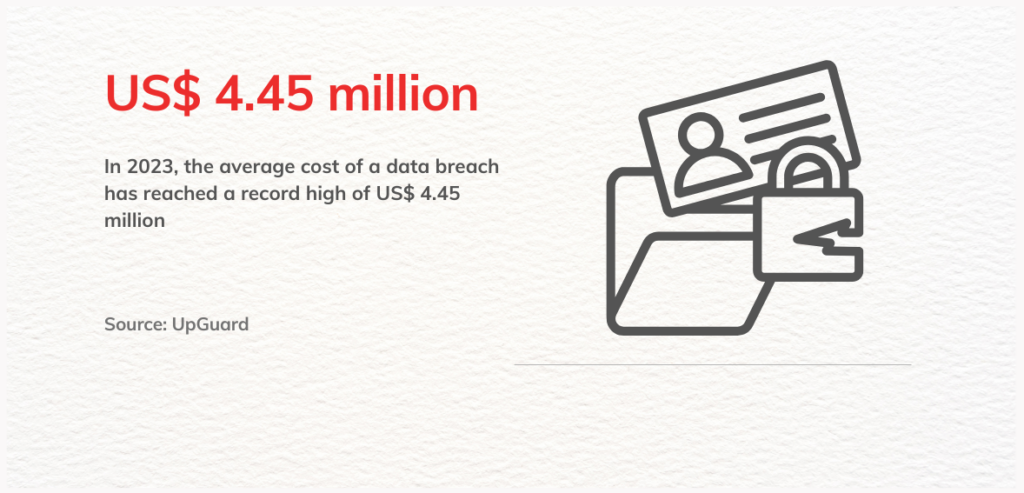
Source: UpGuard
The healthcare industry suffers even higher costs – on average, around $9.8 million per breach in 2024 – far above the global norm. At the same time, cyberattacks on healthcare are surging. In 2023, the number of attacks on U.S. healthcare organizations jumped about 128% (from 113 to 258 known victims). For a dental clinic, even one breach or compliance failure can be devastating:
- High financial stakes: A single breach in a dental practice can trigger enormous costs: notifying patients, providing credit monitoring, reissuing cards and covering fraud losses. Industry data show healthcare breaches average nearly $10 million in cost. These expenses can efficiently run into hundreds of thousands or more for a dental practice, plus legal and forensic fees.
- Regulatory fines and penalties: Even without a breach, failing PCI DSS requirements can draw penalties. Banks and card networks may levy investigation fees and fines (typically on the order of tens to thousands of dollars per month of non-compliance). Credit card processors might increase transaction fees or even suspend card acceptance until security issues are fixed.
- Reputational damage: Perhaps most importantly, a breach or PCI incident can destroy patient trust. Dental patients expect their data to be safe; any publicized breach can lead to lost appointments and a tarnished reputation that takes years to rebuild.
The cost of non-compliance (through fines, breach remediation, fraud losses, and lost business) can far exceed the cost of proactive compliance measures. Maintaining PCI compliance is an investment in preventing these costly scenarios.
What Happens If You Don’t Comply?
Ignoring PCI DSS rules has serious consequences for dental practices:
Loss of trust and business: Even apart from direct fines, the fallout of a breach (if one occurs) often includes public outcry. Patients may leave for other providers, and the practice may face legal actions. Rebuilding a reputation after a data breach is difficult and expensive.
Fines and fees: Card brands and banks can impose monthly fines for non-compliance (ranging from around $20 up to thousands per month, depending on the violation). These add up quickly, especially if issues persist.
Liability for fraud: If a breach occurs and the practice is found non-compliant, the business may be held financially liable. Banks typically require the merchant to reimburse fraudulent charges and cover the cost of reissuing cards. This can amount to tens of thousands or more in fraud liability.
Suspension of card processing: The payment processor or acquiring bank can revoke the right to accept credit cards until compliance is restored. For a dental office, losing the ability to process cards even temporarily can cripple operations, since most patients pay by card.
Updated Requirements to PCI Compliance for Your Practice

The current standard is PCI DSS v4.0 (and its minor 2024 update v4.0.1). Older standards (v3.2.1) were officially retired in 2024, and as of 2025, all “future-dated” requirements in v4.x are now in force. Key elements of PCI DSS v4.0.x include:
- Multi-Factor Authentication (MFA) Everywhere:
Any access to the Cardholder Data Environment (CDE) must use two or more authentication factors. This means not just administrators, but all staff or third parties accessing systems with payment data (even via a VPN or cloud portal) need MFA.
Every user on a workstation or terminal that can view or transmit cardholder data should authenticate with MFA.
- Stronger Passwords:
Password rules have been tightened. PCI DSS now requires at least 12-character passwords with a mix of upper/lowercase letters, numbers and symbols.
Passwords should be changed regularly – for example, PCI DSS mandates resetting passwords every 90 days unless an organization uses continuous risk-based authentication. These rules guard against brute-force or guessing attacks.
- Robust Encryption:
All cardholder data must be encrypted when stored or transmitted. Strong cryptography (current TLS protocols for network traffic, modern AES encryption, etc.) must protect payment data to prevent eavesdropping or leaks.
In many dental offices, using end-to-end encryption or tokenization on point-of-sale devices (so PAN data never appears in clear) is strongly encouraged.
- Secure Network Architecture:
Maintain strict firewall and router configurations to isolate payment systems from other networks. Keep all software (practice management systems, computers, payment terminals) fully patched and up-to-date.
Per PCI DSS, most merchants must run regular vulnerability scans (typically quarterly by a PCI-approved scanning vendor) to identify and fix any weaknesses in the network or systems.
- Strict Access Control:
Limit access to cardholder data to only those who need it. Each user with access must have a unique ID and strong authentication.
Implement the principle of least privilege so users can only reach the systems they require. Physical controls are also required: for instance, secure the area where payment terminals or paper records are kept, and log any access.
- Continuous Monitoring & Testing:
Run up-to-date anti-malware/antivirus on all systems, and enable logging of all access to payment environments. PCI DSS requires ongoing monitoring.
This includes reviewing logs, watching for unusual activity, and performing regular security tests (such as quarterly external scans and annual penetration tests). Continuous monitoring helps catch breaches or weaknesses early.
- Policies and Training:
Document a clear information security policy that addresses PCI compliance. All staff (and any vendors with access to payment data) must be trained on these policies.
Front-desk and billing staff should know how to safely handle payment cards and what steps to take if they suspect a security incident.
- Vendor Management:
Ensure any third-party service (cloud hosting, billing platforms, card terminals, etc.) is PCI compliant. Vendors should provide proof of their compliance, and contracts should explicitly require adherence to PCI DSS. If you rely on a payment processor or cloud system, verify they use PCI-compliant technology.
- Customized (Alternative) Approach:
PCI DSS 4.0 introduced flexibility with a “customized approach.” Instead of just following the specified controls word-for-word, an organization can implement equivalent security measures that meet the objectives of each requirement.
This allows dental practices to tailor solutions – for example, using new security technologies – as long as they achieve at least the same level of protection as the standard control.
Achieving PCI Compliance for Your Dental Practice: A Step-by-Step Process
The path to PCI compliance depends on your card transaction volume and environment, but generally involves the following steps:
1. Determine Your Merchant Level
Identify how many card transactions you process each year. Dental offices typically fall into Level 2 or 3 (up to 1–6 million transactions annually) for major card brands. Practices with very low volume (fewer than ~20,000 transactions per year) may qualify as Level 4.
Your merchant level determines what validation requirements apply (e.g. the type of Self-Assessment Questionnaire).
2. Select the Appropriate SAQ
Based on how you accept and handle payments, choose the correct Self-Assessment Questionnaire (SAQ). For example, if all your payments are processed through a PCI-compliant terminal or redirect service (and you never store card data), you might use SAQ A.
If you capture card data on-site (even briefly), you’ll likely use SAQ C or SAQ D. The SAQ contains versions covering different scenarios (e.g. e-commerce vs. in-person terminals).
3. Complete the SAQ Thoroughly
Go through the SAQ and answer every question. It’s a checklist of PCI DSS requirements. Be honest, this process will highlight any gaps (such as missing firewall rules, no audit logs, etc.) that you need to address. Fix any issues so that you can answer “Yes” to each applicable requirement.
4. Conduct Required Scans or Tests
Depending on your SAQ and level, you may need external vulnerability scans or an internal test. For most Level 1–4 merchants, PCI requires quarterly external network scans by an Approved Scanning Vendor (ASV).
If you are designated Level 1 (very high volume), you might also need annual penetration testing. After each scan, review the results and remediate any failures.
5. Fill Out the Attestation of Compliance (AOC)
Once you’ve completed the SAQ and resolved any issues, fill out the Attestation of Compliance form. This is a formal declaration, signed by the practice owner or officer, that you have met the PCI DSS requirements.
6. Submit Your Documentation
Provide the required documents to your acquiring bank or payment processor. Typically, you will submit the completed SAQ, any scan reports, and the signed Attestation of Compliance.
Be sure to meet your deadline (often annually or on renewal of merchant services). Keep copies of everything for your records.
Understanding the Costs of Maintaining PCI Compliance
PCI compliance costs vary widely with practice size.
If you run a small practice:
A simple PCI program can be pretty inexpensive. For a dental office that outsources most payment processing and only needs basic SAQs and quarterly scans, annual costs may be only on the order of a few hundred dollars.
For example, industry guidance notes that small merchants often spend around $300 per year on PCI-related services. In some cases banks even provide free or discounted scanning as part of the merchant account.
If you run a larger practice:
As the number of transactions and systems grows, compliance costs increase. Practices requiring a Qualified Security Assessor (QSA) audit – typically those at the highest level – can face significant fees. A full PCI audit (including on-site QSA review, extensive testing and reporting) may run tens of thousands of dollars.
One analysis suggests large organizations often spend $70,000 or more per year on PCI compliance. Ongoing costs also include staff training, IT support, and possible investment in compliant terminals or security upgrades.
Is It Worth the Investment?
Crucially, these compliance expenses are generally predictable and much lower than the cost of a breach. Healthcare data breaches have cost organizations millions of dollars. The fines, fraud losses, and recovery costs from a single incident would far exceed a few hundred or even a few thousand dollars in compliance spending.
In other words, treating PCI compliance costs as an investment in risk management can save the practice money in the long run by preventing catastrophic breaches.
Conclusion
PCI compliance in a dental practice is an ongoing commitment to protecting payment data. By fully adopting the standards of PCI DSS 4.0/4.0.1 – including strong authentication, encryption, network safeguards, and continuous monitoring – dental clinics protect their patients and their businesses. As of 2025, PCI DSS v4.0.1 is the active standard: older versions (v3.2.1 and v4.0) have been retired. All the “future” requirements introduced in v4.0 became mandatory in April 2025.
Staying ahead of these requirements means avoiding penalties, preventing expensive breaches, and maintaining patient trust. In sum, investing the effort and resources to be PCI compliant is an investment in the long-term success and integrity of the dental practice.
Frequently Asked Questions
-
What is PCI compliance, and why does it matter for dental clinics?
PCI compliance means following a set of security rules (PCI DSS) to protect credit card data. For dental clinics, it ensures that payment information is kept safe through measures like encryption, secure networks, and restricted access. Ensuring PCI compliance protects patient financial data and helps avoid breaches and penalties.
-
Why is PCI compliance essential for dental practices?
Healthcare breaches are costly and damaging, averaging over $10 million per incident, while the global average breach cost hit $4.88 million in 2024. Non-compliance can lead to large fines, payment bans, and lost patient trust if a data breach occurs.
-
What are the key PCI DSS v4.0.1 requirements for dental clinics?
Dental and healthcare breaches can be extremely costly. Recent reports show the global average breach now costs on the order of $4.4–$4.9 million, and healthcare incidents often average around $10 million. A data breach or PCI violation could impose huge financial losses (for fraud and fines) and destroy patient confidence. Non-compliance can trigger fines and even loss of the ability to process cards – so the stakes are very high.
-
What happens if a dental clinic doesn’t follow PCI rules?
Non-compliance can result in fines (ranging from tens to thousands of dollars), fraud-related costs, and even losing the ability to process cards, plus long-term damage to your reputation.
-
What are the key PCI DSS v4.0.1 requirements for dental clinics?
Under PCI DSS v4.x, clinics must use strong security controls: for example, multi-factor authentication is required for any access to systems with card data, passwords must be at least 12 characters (and regularly changed), and all cardholder data must be encrypted. Clinics must also maintain firewalls and up-to-date systems, limit access by role, monitor networks continuously, and train staff on security policies. Third-party payment vendors must be PCI compliant as well.
-
What happens if a dental clinic doesn’t follow PCI rules?
The practice can face real costs. Card brands and banks can impose fines (ranging from tens to thousands of dollars per month of non-compliance). In the event of a breach, the clinic may have to cover fraudulent charges and reissue cards. Processors might suspend card acceptance until issues are fixed. Perhaps worst, a publicized breach can drive patients away, causing long-term damage to the practice’s reputation.
-
How can a dental clinic become PCI compliant?
Determine your merchant level by transaction volume, then select the right SAQ based on how you handle payments. Complete the SAQ honestly, address any security gaps, perform scans if needed, and submit all required documents to your bank or processor annually or when systems change.