


Big Cartel Review 2025
Posted: September 03, 2024 | Updated:
Big Cartel is a website builder and eCommerce platform built specifically for artists, makers, and small brands looking to sell online without the complexity of larger systems.
In this review, we’ll cover Big Cartel’s latest features, pricing, integrations, and security capabilities, and how it compares to alternatives like Shopify, Wix, Squarespace, and Etsy.
An Overview of Big Cartel
Big Cartel is a cloud-based e-commerce platform that allows you to manage your online store from any internet-connected device. You can choose from free themes to enhance your store’s appearance or customize one using the platform’s API. Currently, it hosts nearly 200,000 live stores and ranks 11th among the most popular hosted solutions on the internet.
Designed by artists for artists, Big Cartel is tailored to sell handmade and custom products such as clothing and jewelry. When setting up your store on Big Cartel, you have various plan options, from free to paid, depending on how many items you plan to sell and the required features.
Big Cartel is often seen as a straightforward e-commerce solution. According to its website, it provides essential tools, including order management, real-time statistics, and marketing tools with SEO capabilities, making it easier to manage a small online store.
Big Cartel Review: Pros and Cons
Pros:
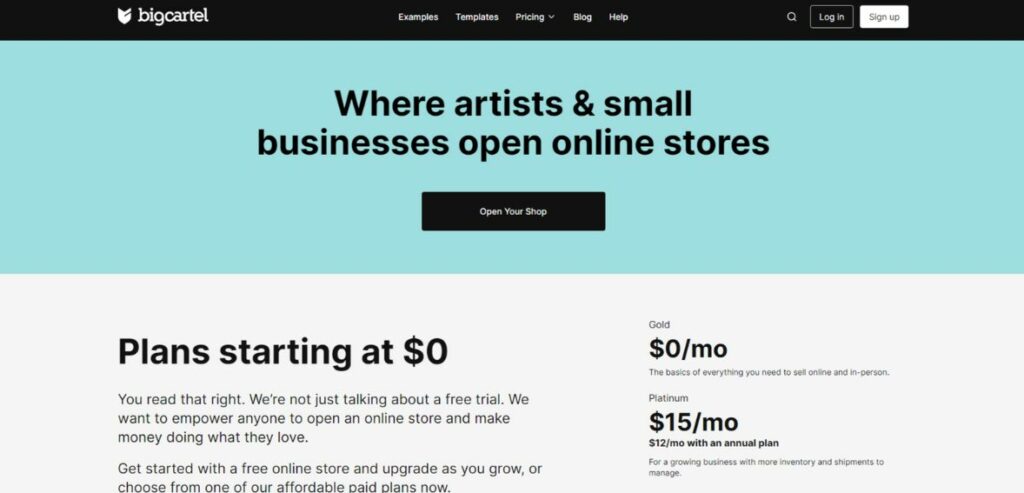
- Transparent, flat-rate pricing with no platform or transaction fees (you only pay Stripe/PayPal rates).
- Free plan for up to 5 products, making it risk-free to test and launch a small shop.
- Artist-friendly, intuitive dashboard with iOS/Android apps and mobile POS, so you can sell online or at events.
- Lightweight, mobile-responsive themes (all free) plus full code-editing on paid plans for brand-focused customization.
- Key growth tools on paid tiers – inventory tracking, bulk editing, abandoned-cart recovery (Diamond), and automatic discounts.
Cons:
- Product cap of 500 items max, so not ideal for large or rapidly scaling inventories.
- No built-in blog, email marketing, or advanced SEO controls, limiting content-driven traffic growth.
- Guest-only checkouts with no customer accounts or deep checkout customization, which can hamper repeat-buyer experience.
- Digital downloads aren’t native – you must add Pulley or another app, adding complexity and extra fees.
- Smaller integration ecosystem and no phone/live-chat support, relying instead on email and in-app messaging.
Big Cartel Pricing and Plans
A big appeal of Big Cartel’s pricing is that there are no additional listing fees or transaction fees imposed by the platform. You pay the flat monthly rate (if on Platinum or Diamond), and that’s it – Big Cartel doesn’t take a cut of your sales. The only charges per sale are the standard payment processing fees (e.g., around 2.9% + $0.30 for credit cards via Stripe, or 2.99% + $0.49 via PayPal in the U.S.), which go to the payment gateways. This transparent fee structure contrasts with marketplaces like Etsy that charge listing fees ($0.20 per item) plus a 6.5% transaction fee.
Big Cartel’s flat pricing can save money for sellers, especially those on the free plan or low-cost tiers, since you keep 100% of the sale price (minus only the unavoidable bank/PayPal fees).
Big Cartel offers three pricing tiers: one free and two paid. Each tier limits the number of products you can list, which is a key consideration for growing stores.
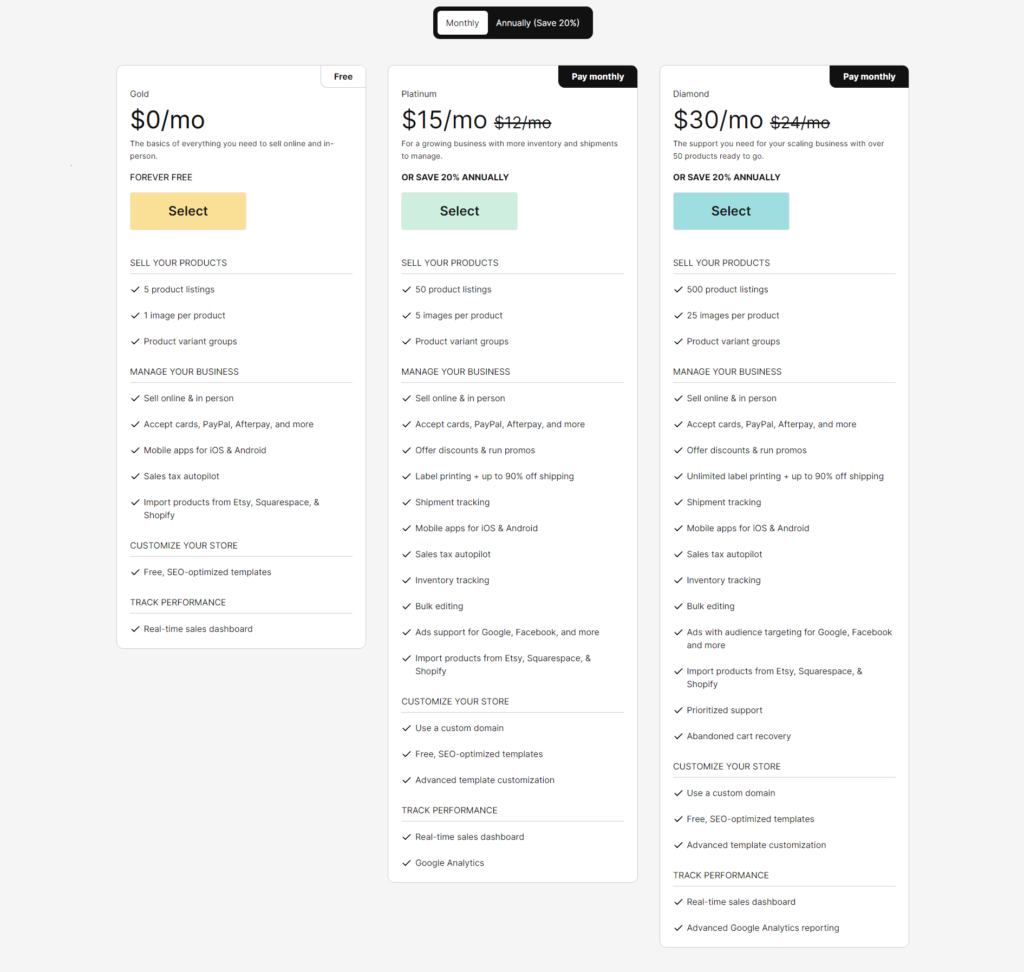
Image source
Gold (Free) – $0 per month.
This entry-level plan lets you list up to 5 products with one image each. It includes core selling features like basic stats, order management, shipment tracking, and automatic sales tax calculation.
The Gold plan is great for testing the waters on a tight budget, but note that you cannot use a custom domain on the free plan (your store URL will be yourname.bigcartel.com). You also miss out on some advanced features (like inventory tracking) unless you upgrade.
Platinum (Paid) – $15 per month (or about $12/month if billed annually)
This plan raises your cap to 50 products with up to 5 images each. Platinum includes everything in Gold, plus crucial additions: inventory tracking (so you don’t oversell products), the ability to bulk edit products, use a custom domain, and more extensive design customization. Platinum users can access Big Cartel’s theme code editor for deeper design tweaks (using HTML, CSS, and Liquid templating).
This plan also unlocks some marketing tools like the option to run ad campaigns via integrations (e.g., Facebook Ads or Google Ads support). If your business is growing beyond a handful of products, Platinum is often the sweet spot for expanding features without a steep cost.
Diamond (Paid) – $30 per month (about $24/month annually)
The top tier allows up to 500 products with 25 images each. It includes all Platinum features and adds priority support and a few advanced perks. Notably, Diamond users get Abandoned Cart Recovery – a feature that automatically emails shoppers who left items in their cart, reminding them to complete the purchase. This can help win back sales, given that about 70% of online shopping carts are abandoned on average.
Diamond also enables Automatic Discounts (rules that apply discounts automatically when conditions are met, like a buy-one-get-one or spend $X get 10% off) and advanced discount logic for more complex promos. Essentially, Diamond is geared toward more established shops that need higher product capacity and conversion tools, yet even this plan caps out at 500 items, indicating Big Cartel’s orientation towards small and mid-sized inventories.
Key Features of Big Cartel
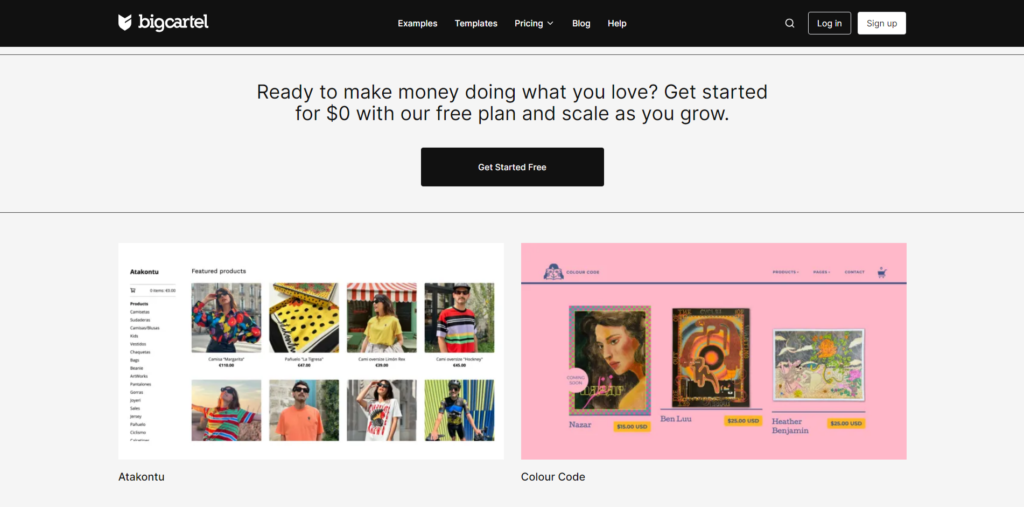
Big Cartel’s feature set has expanded with some long-awaited tools, though it remains more minimalistic compared to powerhouses like Shopify. Here we break down its major capabilities:
- Inventory Tracking:
Keeping track of stock counts is essential as you grow. On the free plan, inventory must be managed manually – Big Cartel won’t auto-track quantities (you’d have to mark items sold out yourself).
But on Platinum and Diamond, inventory tracking is included, meaning the system will decrement stock counts when orders come in and mark products as sold out when they hit zero. This is a vital feature for any store with limited quantities, and a good reason to upgrade once you have more than a few products.
- Bulk Management:
A pain point for Big Cartel in the past was that editing products one by one could get tedious. Last year, they introduced a Table View & Bulk Edit feature for paid plans. This lets you see your product catalog in a spreadsheet-like table and make quick bulk changes (like updating prices or stock levels for many items at once).
You can also use filters and search to find items easily. This improvement makes Big Cartel more viable for stores with dozens or hundreds of products by streamlining admin work.
- Abandoned Cart Recovery:
Historically, Big Cartel lacked this feature, but as mentioned, it’s now available on the Diamond plan. If you’re on Diamond, Big Cartel will automatically send a polite reminder email to any shopper who entered an email at checkout but didn’t complete their purchase.
You can toggle this on or off in settings (it’s a simple one-email automation). Lower plans do not have this, so free/Platinum users would have to rely on third-party solutions or simply miss out on recovering abandoned carts.
- Discounts and Promotions:
All Big Cartel stores can create discount codes and run basic promotions, even on the free plan. You can set up promo codes for a percentage off, a dollar amount off, or free shipping, and control the duration. Big Cartel also introduced Automatic Discounts for Diamond users. This allows you to set up promotions that apply automatically in the cart without a code (e.g., “Buy 2, get 1 free” or “10% off orders over $50”).
Diamond users also get advanced discount logic, letting you stack conditions (for example, an automatic discount that only applies to certain product categories or customer groups, if those features apply). These tools bring Big Cartel closer to parity with larger platforms’ promotion engines, albeit only at the highest tier.
- Enhanced Bulk Editing Capabilities:
The bulk editing feature dramatically improves the efficiency of managing extensive product lines in your online store. This advanced capability allows you to simultaneously modify multiple products, orders, and discounts, optimizing operational workflows and minimizing human errors.
- Social Commerce Integration:
In the modern retail landscape, limiting sales to a single channel can hinder your market reach. Big Cartel enables integration with major social platforms like Facebook and Instagram, allowing you to expand your digital footprint and customer engagement.
While available even on free plans, product tagging on Instagram requires approval from both Facebook and Instagram and might necessitate some coding for full integration.
Ease of Use
Setting up a Big Cartel store is refreshingly straightforward. The admin dashboard walks you through adding your first product, choosing a theme, setting up payments, and launching your site.
Users often praise how easy the backend is to navigate – even without prior experience, the interface is clean and not overwhelming. Large text and simple menus guide you through basic setup tasks, making the learning curve shallow.
Design and Templates of Big Cartel
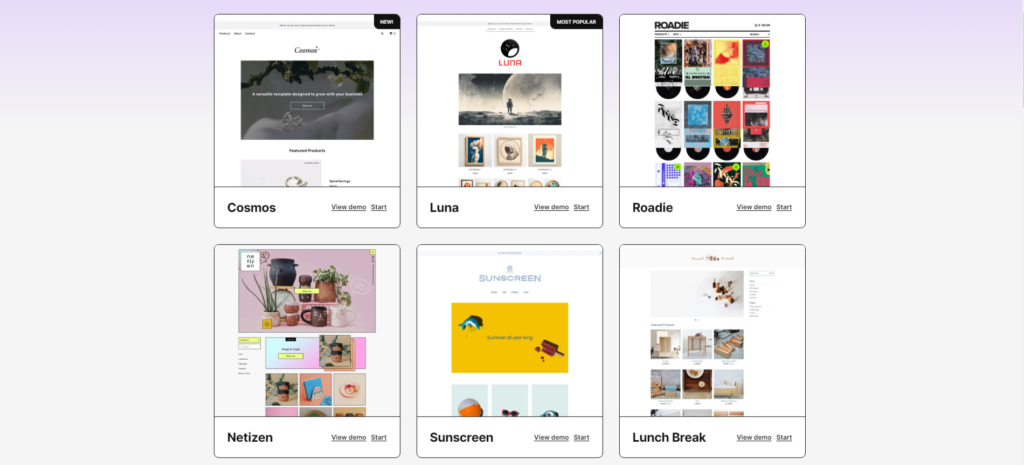
Big Cartel offers a selection of 15+ free design themes that are mobile-responsive and reasonably modern. All themes are free (no premium theme marketplace, unlike some competitors). These templates are fairly clean and geared toward creative industries (art, music, fashion, crafts, etc.), each with a slightly different style – for example, some have slide-out carts or unique menu layouts to fit different vibes.
You can preview and switch themes easily, and basic customization (like changing colors, fonts, and homepage layout options) is supported, especially on paid plans. On the free Gold plan, customization is quite limited: you can upload your logo and product images and edit text, but you won’t be able to change the layout or colors beyond the defaults.
Upgrading to Platinum or Diamond unlocks advanced theme editing, including full access to the code. If you have HTML/CSS skills (Big Cartel uses a Liquid-like templating language), you can tweak your store’s look extensively to match your brand. This is a big plus for design-oriented sellers – you’re not stuck with a cookie-cutter site if you’re willing to get your hands dirty with code. However, note that certain pages (like the checkout) cannot be modified for security reasons, which is common across ecommerce platforms.
Customization Options
Out-of-the-box, Big Cartel’s theme editor (on paid plans) lets you adjust colors, fonts, and some layout settings without code. You can also create custom pages (e.g., an “About Us” or FAQ page) and add basic content. It’s possible to embed things like an Instagram feed or videos, link to your social profiles, and add custom HTML in certain sections for extra functionality. Overall, Big Cartel’s design flexibility is good for a lightweight platform: it beats Etsy’s near-zero shop customization (every Etsy shop has the same layout), and it doesn’t drown you in too many options the way Wix might for a newbie.
That said, it’s still more limited than Shopify or Wix – there is no drag-and-drop site builder and no massive theme store. Big Cartel is best for sellers who want a quick, nice-looking storefront without investing much time or money in design. If you need a highly unique layout or lots of pages and content, you might find Big Cartel’s design capabilities a bit constrained.
Product Management and Inventory
Big Cartel is designed for selling tangible products (art prints, T-shirts, jewelry, etc.), and it handles these basic product listings well. You can add products with multiple photos (up to 5 or 25 images, depending on the plan) and organize them into simple categories. You can also create options/variants for each product (like size or color choices), each with its own price and stock count if needed. This is useful for apparel and similar items. However, digital products (like e-books, music, or printable art) are not supported natively.
If you want to sell digital downloads, you’ll need a workaround. Big Cartel offers an app called Pulley (owned by Big Cartel) that provides secure delivery of digital files for a fee. Pulley or other third-party integrations (like SendOwl) will handle delivering the file to the customer after purchase. This extra step adds complexity and cost, so if your primary business is selling digital goods, Big Cartel may not be the most convenient choice (platforms like Etsy or Shopify handle digital downloads out of the box). For most makers of physical goods, though, Big Cartel covers the basics.
When setting up an online store, the role of blogging should be considered. It is a key strategy for driving organic traffic and generating leads. It’s crucial to publish distinctive, high-quality content to draw in potential visitors, which can lead to more leads.
However, Big Cartel does not offer any built-in blogging tools, which is surprising given its audience of creative users who benefit from diverse content to enhance brand visibility.
Therefore, if you’re using Big Cartel and wish to include blog posts, add a third-party blogging platform. This integration might involve modifying the HTML code, which could be challenging for beginners.
Payment and Checkout Options
Big Cartel keeps checkout simple for both sellers and customers while adopting newer payment options that shoppers expect in 2025. Big Cartel supports two main payment processors – Stripe and PayPal. Through these, a wide range of payment methods are available:
- Credit & Debit Cards: By connecting Stripe, you can accept all major cards (Visa, MasterCard, Amex, etc.) from customers worldwide. Stripe also enables local payment methods and digital wallets.
- PayPal: Many shoppers like using PayPal balance or linked bank accounts; Big Cartel allows customers to pay via their PayPal account or even as a guest with a credit card through PayPal. Notably, if you enable PayPal, Venmo payments are automatically offered to U.S. buyers (Venmo is owned by PayPal). This was a new addition in 2024 – it means younger shoppers who prefer Venmo can pay you easily from their phone.
- “Buy Now, Pay Later” (BNPL): Big Cartel lets you offer installment payment options like Afterpay/Clearpay, Affirm, and Klarna via Stripe. Shoppers can split their purchase into payments, which can boost sales of higher-priced items. It’s important to highlight that BNPL options require a paid Big Cartel plan – the free Gold plan cannot enable Afterpay, Klarna, etc. If you upgrade, these appear as choices in checkout (depending on the customer’s location).
- Digital Wallets: Through Stripe, Big Cartel supports Apple Pay and Google Pay for fast checkout. Shoppers using Safari or Chrome on compatible devices will see an Express Checkout button (Apple Pay, Google Pay, or Stripe’s own “Link” wallet) at the top of the checkout page. These options allow returning customers to skip manual entry of their info – they can pay with a tap, using saved details, which often increases conversion rates by reducing friction. Big Cartel specifically highlighted adding Express Checkout as an improvement for higher converting carts. In practice, this means Big Cartel stores now offer a checkout experience on par with larger platforms – e.g., an iPhone user can hit “Apple Pay” and use FaceID to complete the order in seconds.
Importantly, Big Cartel does not impose any extra transaction fees on top of what Stripe or PayPal charge. You keep more of your money compared to some competitors (for example, Shopify charges an additional fee if you use an outside gateway, and Etsy takes a cut of every sale). With Big Cartel, if a customer pays $100, you just pay Stripe’s ~$3.20 (2.9%+$0.30) or PayPal’s ~$3.50 fee, and the rest is yours.
Checkout Experience
The checkout on Big Cartel stores is clean and straightforward, though fairly basic in customization. Customers add products to a cart and proceed to a standard checkout page where they enter shipping info and payment. You can enable or disable the collection of a phone number or address depending on your needs, but you cannot add custom checkout fields or fully redesign the checkout page – it’s uniform for security and simplicity.
One limitation to note is that Big Cartel does not support customer accounts for repeat buyers. All checkouts are essentially “guest checkout,” – which is fine for many small stores, but unlike Shopify, your frequent customers can’t create a saved account on your Big Cartel site to, say, view order history or save their details. This keeps things simple, but is a trade-off if customer loyalty features are important to you.
Shipping and Fulfillment
Big Cartel has made notable strides in shipping tools, an area where it used to be very bare-bones. At the basic level, you can set up shipping rules for your products (like flat rate shipping, free shipping over a certain amount, etc.) and print shipping labels. The platform supports common fulfillment scenarios:
- Multiple shipping options: e.g., you can offer standard shipping vs. expedited shipping at different rates by creating profiles. (Big Cartel has a beta feature for shipping profiles that lets you save default shipping settings and apply them to products, streamlining setup for new items.)
- Free Shipping and Pick-up: You can mark certain products or orders as free shipping, or even allow local in-person pickup for customers if that fits your business model.
A major update is the introduction of built-in discounted shipping labels. Big Cartel partnered to provide in-house label printing with up to 90% off retail shipping rates for U.S. and Canadian sellers. This is accessed via the Big Cartel Shipping Labels app (which is essentially an integrated feature now). Even on Platinum and Diamond, you get unlimited label printing right from your dashboard, meaning you can pay for and print USPS, UPS, or other carrier labels without leaving Big Cartel. The discounts are substantial – up to 90% in some cases, which likely refers to heavy discounts on certain USPS services (similar to commercial rate shipping).
This is a boon for small merchants, as it saves money and time versus buying postage at the post office. Competitors like Etsy and Shopify have long offered discounted labels; Big Cartel leveling up in this area is a big plus. In addition to Big Cartel’s label tool, there are integrations for other shipping solutions. For example, Pirate Ship (a popular free shipping software) can be used with Big Cartel, and ShipStation integration is available for more complex needs.
These can import your orders and help manage fulfillment if you sell on multiple channels. International shipping is supported in the sense that you can set country-specific rates and sell globally (Stripe and PayPal handle international payments fine). You will need to handle customs forms outside the platform (or via a shipping app) since Big Cartel doesn’t generate those itself.
Integrations and Apps
Big Cartel offers a focused selection of integrations, with around 20 to 30 core add-ons covering essential features like print-on-demand, marketing, analytics, live chat, and blogging. While it doesn’t have a large app marketplace, the available tools are aimed at helping small businesses run an online store with minimal complexity. Many additional integrations are made possible through Zapier, an automation platform that connects Big Cartel to over 7,000 third-party apps without requiring coding.
Using Zapier, store owners can automate tasks such as adding customer emails to Mailchimp, posting new listings to Facebook, or updating order records in spreadsheets. Although both Big Cartel’s advanced features and Zapier may require a paid plan, this setup removes the need to hire a developer. This approach may not appeal to every small business owner, especially those looking for all-in-one functionality, but it fits well with Big Cartel’s target audience – independent artists, makers, and former Etsy sellers looking for a simplified way to manage their own online store.
SEO and Marketing Tools
Big Cartel offers a basic set of SEO and marketing tools, leaving much of the promotional work up to the store owner. From an SEO perspective, the platform structures its pages in a generally search-friendly way, and users can edit their store’s homepage meta title and description through the settings panel. However, individual product page SEO is handled automatically – product names and descriptions are used for page metadata, with limited customization unless you’re comfortable editing the site’s theme code.
This restricts advanced SEO options like adding structured data or custom meta tags unless you have some technical skills. A major limitation is the lack of a built-in blog, which is a common tool for content-driven SEO. To fill that gap, users can integrate DropInBlog or link out to an external blog. On the marketing side, Big Cartel does support Google Shopping integration, allowing you to sync your product feed with Google Merchant Center to appear in shopping results and free listings. Social media tools are minimal but functional, with sharing buttons on product pages and the ability to embed social feeds.
Email marketing isn’t built in, but you can use tools like Mailchimp or Omnisend through form embeds or third-party integrations. Promotion tools include a discount code system and automatic discounts on the Diamond plan, which helps streamline sales without requiring customers to enter codes. However, Big Cartel lacks advanced features such as abandoned cart recovery (except on the Diamond plan), gift cards, loyalty programs, or built-in customer segmentation.
Users seeking more robust marketing functionality will need to rely on external platforms or workarounds. That said, Big Cartel’s lightweight structure makes it easy to connect outside tools, and its clean, fast-loading, SSL-secured stores give you a solid base for SEO and marketing efforts – though success will still largely depend on your strategy and execution.
Security Features of Big Cartel
Security is a key consideration for any online store, and Big Cartel covers the essentials to keep both sellers and customers protected. All stores, whether using a free .bigcartel.com subdomain or a custom domain, are secured with SSL encryption. Big Cartel provides free SSL certificates through Let’s Encrypt, ensuring that all data, including customer details and payment information, is encrypted during transmission. Checkout pages are always forced to be HTTPS, and the platform doesn’t allow insecure payment pages.
When it comes to handling payments, Big Cartel doesn’t process card data directly; instead, it relies on PCI-compliant providers like Stripe and PayPal. This setup means payment security is handled by industry leaders, and sellers don’t need to worry about managing sensitive data themselves.
On the account security side, Big Cartel allows store owners to track login activity and add a backup phone number, suggesting some level of two-factor authentication or at least active session management. Users are encouraged to use strong passwords and keep third-party scripts or image links secured with HTTPS to avoid mixed content warnings.
Since Big Cartel is cloud-hosted, the store data is managed and maintained without the need for user-side server maintenance. While exporting your product and order data occasionally is a smart practice, the platform has maintained a good record for uptime and data safety. It may not offer enterprise-level security features, but for its intended audience – independent creators and small businesses – it covers the necessary ground without unnecessary complexity.
Customer Support Options
Big Cartel’s customer support approach is personal but not as extensive in channels as some competitors. They emphasize that their support is handled by “real humans” and not chatbots, which fits their friendly, indie brand image. You can reach Big Cartel support via email or through an in-app messaging system:
- If you’re logged in, you can use the in-app message/chat feature to contact support.
- If you’re not logged in or don’t have an account yet, you can email them (support@bigcartel.com) via the contact form.
Big Cartel does not offer phone support or live chat in the traditional sense (the in-app “chat” is essentially an email form, not a live instant chat with guaranteed immediate response). They also don’t provide one-on-one onboarding or account managers (it’s a lean operation). Big Cartel advertises that support is available 24/7. This suggests they have support staff checking inquiries around the clock, which is an improvement. (Historically, Big Cartel’s support was limited to Monday–Friday business hours, 8 am–6 pm Eastern Time.
Many older reviews mention only weekday support. The company appears to have expanded coverage to be more competitive.) In practice, Big Cartel’s team is known to respond relatively quickly to emails, often within a few hours during U.S. daytime, sometimes faster. On weekends or late nights, you might wait a bit longer, but the 24/7 claim indicates you should get help even if it’s 2 am on a Sunday.
The support team at Big Cartel is often praised for being friendly and helpful. Since Big Cartel is a smaller company, their support interactions tend to feel more personal, and they have a good understanding of common artist/small biz questions. They’ll help with things like connecting domains, troubleshooting payment setup, or providing guidance on using features. They won’t, however, design your site for you or customize code (that’s beyond scope, as with most platforms). There is also a Help Center with FAQs and guides, and even some YouTube live classes walking through setup basics, which can be very handy for visual learners.
How Does It Compare With Alternatives?
Every ecommerce platform has its strengths. Here’s a quick-reference table comparing Big Cartel with Shopify, Wix, Squarespace, and Etsy on some key factors:
| Platform | Pricing (Monthly) | Free Plan | Product Limit | Abandoned Cart Recovery | SEO & Marketing Tools |
| Big Cartel | $0 (5 products), $15 (50 products), $30 (500 products) | Yes (5 products) | Capped: 500 max on highest plan | Yes – Diamond plan only | Basic SEO; no built-in blog (integration available); Google Shopping feed; discount codes (all plans); automatic discounts & promos (Diamond); no built-in email marketing |
| Shopify | $39 Basic; $105 Shopify; $399 Advanced (monthly) | No (14-day trial) | Unlimited on all plans | Yes – Included on all plans (via automated emails) | Strong SEO customization (edit meta tags, etc.); built-in blog; huge App Store for marketing; discount codes & gift cards (gift cards from Shopify plan up); built-in email + multichannel integrations |
| Wix | ~$27 Business Basic; ~$32 Business Unlimited; ~$59 VIP (monthly) | No for e-commerce (free plan exists but cannot sell) | Unlimited products | Yes – Included on all Business plans (sends cart reminder emails) | Good SEO tools (custom meta, SEO wizard); built-in blog; Wix App Market for marketing apps; email marketing (via Ascend addon); social selling integration; coupons and abandoned cart in paid plans |
| Squarespace | ~$36 Commerce Basic; ~$72 Commerce Advanced (monthly) ($23/$49 if annual) | No (14-day trial) | Unlimited products | Yes – Commerce Advanced plan only (not on basic) | Solid SEO (clean URLs, meta editing); built-in blog and newsletter tools; some Extensions for marketing (print-on-demand, etc.); discount codes (all Commerce plans); automated cart recovery (Advanced); subscriptions (Advanced) |
| Etsy | No monthly fee (listing and transaction fees apply) | N/A (Marketplace) | N/A (unlimited listings, but $0.20 fee each) | Partial – Etsy automatically sends abandoned cart coupons to some shoppers; no direct control by sellers | Etsy marketplace SEO (tags, titles for Etsy search); built-in audience & ads on platform; limited customization for branding; sellers can run sales and coupons on Etsy; no blog or external marketing tools needed on-platform |
Note: “Pricing” for Shopify, Wix, Squarespace above refers to their most common plan levels for comparison; they often have annual discounts or other tiers. Etsy’s fees: 6.5% transaction + $0.20 listing + ~3% payment processing can effectively act like a “price of admission” in lieu of a monthly plan.
Big Cartel remains the only option in this list with a completely free selling plan, making it uniquely attractive for those just starting or testing an idea with minimal risk.
Conclusion
Big Cartel continues to serve a specific type of seller well – independent artists, small-scale makers, and anyone looking for a low-cost, low-friction way to sell online. In 2025, the platform made steady improvements, including bulk editing, abandoned cart recovery (for higher-tier plans), discounted shipping labels, and more payment options like Venmo and Afterpay. These changes fill some long-standing gaps without changing the platform’s core philosophy.
Big Cartel stays intentionally simple, and that’s the appeal. It’s not designed for high-volume businesses with complex needs, but rather for sellers who want to get online quickly and keep full control over their store without dealing with marketplace rules or platform fees.
The free Gold plan is still one of the most accessible entry points in e-commerce, and the platform remains well-suited for small U.S.-based creators, bands, and anyone selling a limited number of products. You can take payments, manage orders, and even sell at events using their mobile POS app.
For those who don’t need advanced features like multi-channel selling, customer segmentation, or a full-blown marketing suite, Big Cartel offers a practical, no-frills solution. It won’t match Shopify’s scale or Wix’s design flexibility, but it also doesn’t come with the complexity or recurring add-on costs those platforms often require. If your goals are modest and you want to build your brand on your terms, Big Cartel is a straightforward, honest choice that gets the job done.
Frequently Asked Questions
-
What is Big Cartel, and who should use it?
Big Cartel is a simple e-commerce platform made for artists, makers, and small brands. It’s best for those selling handmade or creative goods who want an easy, low-cost online store.
-
What are Big Cartel’s pricing plans?
Gold (Free) allows 5 products. Platinum ($15/month) supports up to 50 products and custom domains. Diamond ($30/month) includes 500 products, discounts, and abandoned cart recovery.
-
What features does Big Cartel offer, and what are its limits?
All plans include order management, stats, and Stripe/PayPal payments. Higher tiers add inventory tools and marketing features. It’s limited to 500 products and lacks a built-in blog or digital downloads.
-
How are Big Cartel’s fees different from Etsy or Shopify?
Big Cartel has no listing or platform fees – just monthly pricing and standard Stripe/PayPal charges. Etsy adds listing and transaction fees, while Shopify adds extra charges for non-Shopify payments.
-
How does Big Cartel compare to Shopify, Wix, Squarespace, or Etsy?
Shopify and others offer more features but cost more. Etsy is fee-heavy. Big Cartel stands out for its free plan, ease of use, and no platform fees – great for simple, low-volume selling.