


Real-Time Payments for Small Businesses — 2026 Trends to Watch: FedNow, RTP, and Instant Transfers
Posted: December 23, 2025 | Updated:
In a technologically advanced environment, people are tired of waiting for invoice payments and advocate for instant money movement. Today’s small businesses are discovering that instead of sending an ACH payment on Friday and waiting until Tuesday for funds to clear, they can push or request payment and have the money arrive in seconds (even on weekends or holidays). New real-time rails are making this possible. The Federal Reserve’s FedNow service (launched in July 2023) enables banks to send instant transfers 24/7, every day of the year.
Over the last year, FedNow has quickly added participants and volume. Meanwhile, The Clearing House’s established RTP® (Real-Time Payments) network (introduced in 2017) covers most of the U.S. banking system and processes hundreds of billions of dollars per month. Together, these networks mark a sea change in how businesses pay vendors, payroll, and suppliers. Here are the top instant payments trends for small businesses to watch out for in 2026.
Understanding Real-Time Payments

At its core, a real-time payment is simply an account-to-account transfer that settles within seconds, with funds available to the payee immediately. Unlike ACH transfers (which typically take 1 to 3 business days to process) or legacy Fedwire wires (which only run during banking hours), modern instant rails operate 24/7/365.
The Clearing House RTP and FedNow both use the ISO 20022 messaging standard, enabling rich payment data and immediate settlement. Once initiated, the money moves, and the transfer is final. For small businesses, this means they can send a payment at midnight on Sunday, and the supplier’s account receives it instantly rather than waiting for Monday’s banking window.
Both real-time systems offer very similar core benefits: immediate settlement (often under 5 seconds), irrevocable transfer, and 24/7 availability. They also support payment messaging (e.g., invoice details) and are designed to be accessible to banks and credit unions of any size. The key difference is who runs them.
The Clearing House (owned by major banks such as Chase, BofA, and Wells Fargo) built the RTP network first, while FedNow is operated by the Federal Reserve. Many financial institutions use both rails to reach more counterparties. But currently they operate as two separate, non-interoperable systems. Industry data show that about 58% of banks offering instant payments are connected to both networks.
FedNow: The Fed’s Instant Payment Network
Image source
FedNow is the Federal Reserve’s instant payments rail, launched in July 2023 to give banks and credit unions of all sizes access to real-time transfers nationwide. Early adoption came from smaller institutions seeking parity with large banks already on RTP, but by late 2025, usage had broadened significantly. FedNow now connects roughly 1,500 financial institutions, covering about 40% of U.S. demand deposit accounts, with participation growing faster than RTP did in its early years. Large banks have also joined, including PNC and Capital One, signaling mainstream acceptance.
Network usage has accelerated sharply. In Q1 2025, FedNow processed about 1.3 million transactions; by Q2, that rose to roughly 2.1 million transactions and nearly $246 billion in volume, a 405% quarter-over-quarter increase. Regulators attribute the surge to increased business awareness and new use cases, including payroll, marketplace disbursements, and government payments.
The Federal Reserve has also reduced friction by raising the transaction limit from $25,000 at launch to $10 million by November 2025, enabling larger B2B and real estate payments. Core features, 24/7 availability, immediate and final settlement, push-only payments, ISO 20022 messaging, and built-in fraud controls make FedNow especially attractive for time-sensitive business payments.
Business demand is strong. Surveys show roughly two-thirds of companies would use instant payments for supplier invoices and just-in-time purchases if available, and many SMBs already rely on instant methods to manage tight cash flows. FedNow removes “float,” allowing payments sent outside bank hours to settle immediately.
Adoption has been reinforced by public-sector use, including U.S. Treasury disbursements through the Bureau of the Fiscal Service for programs like FEMA disaster relief. At roughly $0.045 per transfer, far cheaper than wires and close to ACH pricing, FedNow’s cost structure further supports adoption, particularly among smaller banks and their commercial customers.
The Clearing House RTP Network
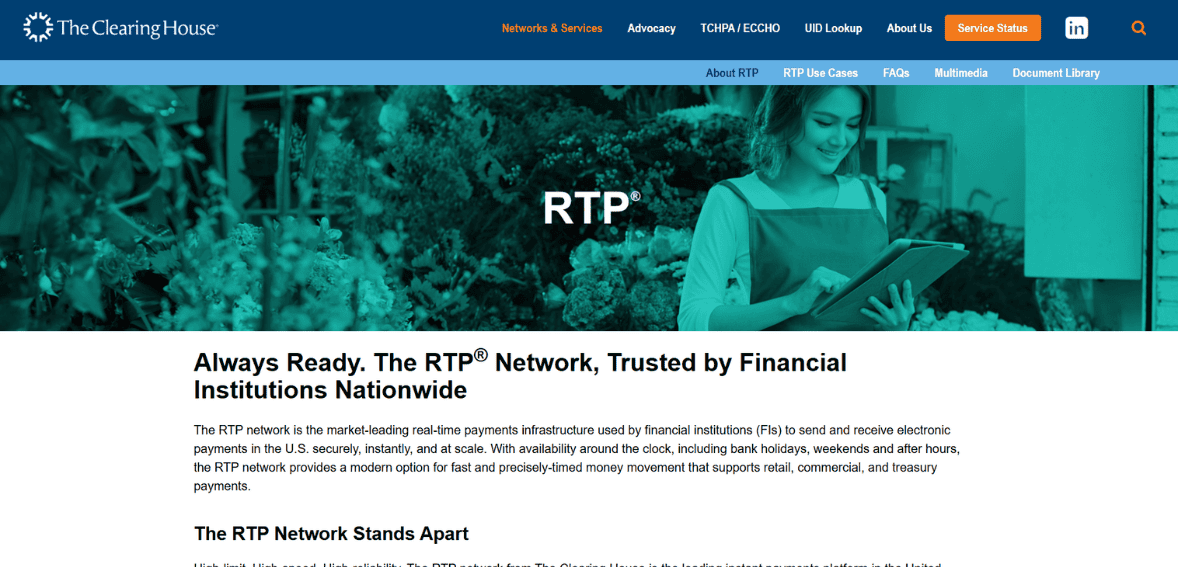
Image source
FedNow isn’t the only instant rail in the U.S. The incumbent is the RTP® network, launched in 2017 by The Clearing House. RTP already reaches about 71% of U.S. demand deposit accounts, with technical reach exceeding 90% through intermediaries, meaning most major banks and credit unions are enabled. Like FedNow, RTP operates 24/7 with seconds-level delivery and final, irrevocable settlement, but it benefits from a multi-year head start and deep penetration among large banks and corporates.
That head start is clearly evident on the scale. By late 2024, the RTP Network was processing roughly 1 million payments per day and about $500 billion per month, far exceeding FedNow’s volumes through 2025. Around 285,000 businesses send RTP payments each month, with everyday use cases including loan payments, payroll, and supply-chain disbursements. In February 2025, RTP raised its per-transaction limit from $1 million to $10 million, aligning with FedNow and enabling large corporate and real estate payments to move instantly.
As a result, most banks now pursue a multi-rail strategy. Roughly two-thirds of U.S. banks have enabled at least one instant rail, and more than half of those support both RTP and FedNow to maximize reach. While the two systems are not directly interoperable, third-party providers often bridge them, allowing businesses to pay counterparties on either network. Looking ahead, both rails support Request for Payment (RFP), enabling merchants to send a digital invoice directly to a payer’s bank app for one-click approval. Industry consensus is that RFP could meaningfully reshape B2B invoicing and consumer billing starting in 2026.
Why Instant Payments Matter for Small Businesses

For small and medium enterprises, faster payments can be transformative. The single most significant benefit is improved cash flow and liquidity. Instead of having money sit “in transit” for days, real-time transfers put funds to work immediately. This means a retailer can get paid and use those funds to restock inventory or pay the next invoice that same afternoon. It means a service provider doesn’t have to wait an extra business day to pay wages or suppliers.
Instant settlement eliminates pre-funding: businesses no longer need to hold large cash balances or worry about timing payroll in advance, because the funds arrive exactly when needed.
Another plus is transparency and record accuracy. When payments settle immediately, a business’s books are always up to date. There’s no lag between a customer paying and the accounting system reflecting the new balance. This can simplify reconciliation and planning: at any moment, you have a clear view of cash on hand and outstanding liabilities. Errors and disputes may also drop, since instant rails provide robust status messages (you know right away if a payment went through or failed).
Operationally, real-time payments cut admin work. Instead of printing checks or initiating ACH batches, a company can click to send a FedNow payment or activate a pull via RFP and be done. Funding payroll via FedNow can ensure employees get paid on time, even if last-minute adjustments are needed. Businesses can automate payables and receivables more tightly: some inventory management systems can even trigger instant payments upon shipment arrival (a “just-in-time” model). In fact, Fed surveys indicate that many companies want these options. Nearly two-thirds of firms would use instant payments for recurring bills if their bank offered them.
Several industries are already gravitating toward real-time pay. Online marketplaces are using instant disbursements to pay sellers faster after a sale. Gig-economy platforms pay workers on demand via instant rails. And service firms (contractors, healthcare providers, etc.) can request and receive immediate payment for invoices. In sectors with tight margins and cash constraints (such as hospitality and transportation), businesses increasingly require faster settlement to remain agile. Consumer-facing apps like Venmo and Zelle have shown that people expect instant transfers, and business customers are increasingly demanding the same convenience in B2B contexts.
Finally, timing can be a competitive differentiator. Offering your customers faster refunds or billing them via instant invoice requests can build goodwill. Paying a vendor in seconds can secure an early-payment discount. During emergencies (such as natural disasters), the ability to send or receive funds immediately can be critical. The recent use of FedNow for FEMA relief payments highlighted how much faster funds can reach where they’re needed.
Instant Payments Trends: What To Watch In 2026
Looking to 2026, several key trends are likely to shape how small businesses interact with real-time payments:
1. Continued Growth in Participation
The number of banks and credit unions participating in FedNow and RTP will continue to grow. By early 2026, well over half of all U.S. institutions are expected to be live on at least one instant network. In particular, the remaining mid-size banks – and some of the last big holdouts like Citigroup and Bank of America – have been moving toward connectivity.
PNC and Capital One joined FedNow in late 2025, and more are expected to follow. The result will be an even broader reach for small businesses: eventually, you can assume almost any bank account can send or receive instantly.
2. Higher Transaction Limits and Big-Business Use
With FedNow and RTP both supporting $10 million transfers, large corporate payments are becoming viable on these rails. In 2026, we expect to see more treasury departments sending big vendor bills, cross-border suppliers (via U.S. banks), and real estate or M&A transactions move in real time.
This opens up instant rails for mid-market and enterprise clients, too – meaning fintech tools that serve small businesses (like payment gateways or accounting platforms) may start supporting larger instant transfers.
3. “Request for Payment” (RFP) Goes Mainstream
Both FedNow and RTP support RFP messages (also known as “request-to-pay” or “RTPay”). Starting in 2026, this is likely to become a widely used feature: think of it as electronic invoicing on steroids. A small business can issue an RFP invoice through their bank or invoicing app; the customer receives it (often via their mobile banking app) and taps to pay immediately.
TCH executives believe RFPs will dramatically change receivables, turning old-fashioned bill collections into a seamless digital workflow. We’ll likely see RFP-enabled invoicing portals, QR-code receipts that auto-initiate payments, and more automated bill pay options for consumers and businesses.
4. Multi-Rail as the Norm
By 2026, it will be standard practice for any business-facing bank or fintech to support both FedNow and RTP (and even alternative instant rails like push-to-debit). As noted, over half of banks with instant-pay services already do this. This reduces fragmentation: if your vendor is on one network, your bank can still reach them via the other rail or a combined payments platform.
For small businesses, this means you can request an instant transfer by name, and the underlying system will select the appropriate network or service provider to execute it. In other words, instant payment “interoperability” will come through software and partnerships, if not through a single unified network.
5. Integration with Digital Wallets and Gateways
Expect more third-party payment platforms (e.g., Stripe, PayPal, Square/Block) to integrate with FedNow and RTP. Some already have pilot programs or partnerships in place. In practice, this means a small merchant on such a platform could withdraw or transfer funds on demand via instant rail.
Instead of waiting days to get a payout from an online sales platform, the business could initiate a FedNow transfer. The advantage here is flexibility: you can move funds between your bank and treasury accounts instantly, 24/7.
6. Enhanced Fraud Controls and Data
As instant payments scale, fraud and compliance capabilities will evolve. In 2025–26, the Fed introduced tools such as “account activity thresholds” and is piloting a network intelligence check (which allows senders to query recipient bank information in advance). We expect more such controls to arrive, enabling banks and businesses to vet transactions in real time.
Meanwhile, the rich ISO 20022 data fields available on FedNow/RTP will allow merchants to include detailed invoice information with each payment, aiding reconciliation and reducing errors. Better data enables small businesses to link transactions directly to invoices or purchase orders, improving accounting efficiency.
7. Government and Payroll Use
Beyond the FEMA example, governments at all levels may start using instant rails for certain disbursements (e.g., tax refunds, grants, vendor payments). In 2026, more agencies will likely give small businesses the option to receive funds instantly.
On the payroll side, instant payroll services (sometimes called earned wage access) will grow: employees can access a portion of their salary early, with funds debited from the employer’s FedNow account immediately. Many wage-payment platforms are already exploring this, and the trend will catch on with small employers who want to offer flexible pay.
8. Cross-Border and New Markets
While FedNow and RTP are domestic systems, their adoption could enable cross-border instant transfers in the future (e.g., by partnering with Canada’s new real-time system, which is slated to launch 24/7/365, as FedNow does).
For now, 2026 trends will primarily focus on U.S. domestic flows, but keep an eye on any bridging initiatives between U.S. and foreign RTP schemes – these could simplify international payments in the future.
Getting Started: Using Real-Time Payments in Your Business
If you’re a small business owner or finance professional, here’s how to take advantage of these developments:
- Check Your Bank’s Capabilities: First, see if your bank offers FedNow or RTP payment services. Many banks advertise “real-time payments” as a product. Note that early on, some banks only allowed receiving instant payments (so customers could send them money, but they couldn’t send it out). Make sure your account can send on the real-time rail as well. If you’re not sure, ask your banker or check your online bill-pay or payment services; they may offer an “instant transfer” option.
- Use Instant Payments for Invoicing and Payables: If you issue invoices, ask your customer to pay via real-time transfer. You could provide your routing and account details along with the invoice and instruct them to use FedNow/RTP. Some billing systems will soon integrate “Pay Now” buttons that generate an RFP on the fly. On the vendor side, you can pay suppliers instantly. If you need to pay a vendor outside regular ACH cycles, log into your bank’s portal and choose the “Instant” or “Real-time” payment option. Your bank will deduct the funds from your account and route them via FedNow/RTP; the vendor will receive the cleared funds seconds later (even if it’s 10 pm).
- Automate Recurring Payments: Payroll is a great use case. Instead of accumulating funds days in advance of payday, you can schedule or trigger the payroll file to send via FedNow at pay time. Employees at participating banks will receive their salaries instantly (after tax withholding), with no pushback because the funds haven’t “hit” yet. Similarly, you could automate routine vendor payments (rent, utilities, loan payments) to go out in real time, ensuring no missed deadlines.
- Mind the Transaction Limit: FedNow and RTP each have per-transaction maximums ($10 million in 2025). For most small-business needs, this is well above the typical invoice amount. If you have a substantial payment (e.g., from a large construction project), you may need to split it into multiple payments or use wire transfers. But remember that ACH often has per-batch or daily limits, whereas FedNow allows a single push of up to $10M.
- Factor in Fees: A FedNow payment costs about $0.045 (4.5 cents) per credit transfer; RTP fees are similar. Compare this to your current costs: if you’re used to wire fees or overnight ACH fees, instant rails can be cheaper. For high-volume businesses, consider how these per-payment fees affect your costs. Some banks bundle real-time payments into package fees, especially as usage grows. It’s a good time to negotiate with your banker, given the competitive landscape of real-time services.
- Stay Updated on Standards: Because real-time payments are data-rich, work with your accounting or ERP system to capture remittance info. In 2026, you’ll want to ensure your invoicing software can include invoice numbers or line items in the payment request. This way, when funds arrive, your accounts receivable automatically matches them to open invoices. Also, follow developments like the FedNow ‘Explorer’ portal (fednow.explore.gov) and industry forums for best practices.
- Educate Your Customers and Vendors: Not all of your customers or suppliers may yet be familiar with real-time payments. Consider including a note on invoices: “Want to pay instantly? Use bank quick-pay with our routing/account details or look for a ‘Request for Payment’ link.” If a client’s bank supports RTP or FedNow, they might already see an instant-pay option in their online bill pay. On the flip side, if you rely on just a few key vendors, encourage them to enable instant payment receipt (this may require no action on their part if their bank already supports it, but it’s worth confirming).
Conclusion
Real-time payments are poised to become the new normal for small businesses. Both FedNow and RTP have achieved critical mass in participation and now boast billions in quarterly volume. For U.S. SMBs, this means better cash flow, reduced financial friction, and new service models (instant invoicing, on-demand payroll, etc.).
As 2026 unfolds, watch for broader adoption by larger banks, innovative “request to pay” workflows, and the cementing of a multi-rail payments infrastructure. By exploring these tools now, businesses can get ahead of the curve – enhancing liquidity and convenience for themselves and their customers.