



Best Airline Credit Cards for May 2025
Posted: September 09, 2024 | Updated:
Airline credit cards benefit frequent travelers by helping them save on flights, hotel bookings, and other expenses. Users can enjoy free flight tickets, air miles, discounts with well-known travel brands, complimentary lounge access, travel insurance, and more. Options range from cards co-branded with major airlines or travel portals to cards that generate significant savings through air miles and rewards.
Airline credit cards provide substantial rewards and benefits for frequent flyers. Choosing a card that aligns with your spending habits ensures that the benefits received are worth more than the cost of the card.
The Top 10 Travel Credit Cards
1. Chase Sapphire Preferred®

Pros
- Earn 5X Ultimate Rewards® points on travel purchased through Chase Travel℠, 3X points on dining (including takeout and eligible delivery), and 2X points on all other travel purchases.
- New cardmembers earn 60,000 bonus points after spending $5,000 on purchases in the first three months, worth $750 when redeemed through Chase Travel℠.
- Includes premium travel protection benefits, such as trip cancellation, primary car rental, and lost luggage insurance.
- Points redeemed for travel via the Chase Ultimate Rewards® portal are worth 1.25¢ each (e.g., 60,000 points = $750).
- No foreign transaction fees make it ideal for international travel, saving up to 3% on foreign purchases.
Cons
- Does not offer an introductory APR.
- Unlike the Chase Sapphire Reserve®, this card does not include Priority Pass or other lounge memberships.
- To maximize travel earnings (5X) and the 1.25× redemption boost, you must book through Chase Travel℠, which may not always have the lowest rates.
Image source
The Chase Sapphire Preferred® is a mid-tier travel rewards card that strikes a balance between strong perks and a modest $95 annual fee. It’s widely regarded as one of the best cards for travelers looking to earn valuable points without paying premium fees. With its user-friendly rewards structure and flexible redemption options, it’s particularly well-suited for those new to travel hacking or anyone wanting solid everyday returns on dining and travel.
Beyond its compelling sign-up bonus, the card’s ability to transfer points to top airline and hotel partners at a 1:1 ratio opens avenues for outsized value, especially on premium cabin flights and high-end hotel stays. Couple that with comprehensive travel protections and no foreign transaction fees, and the Sapphire Preferred stands out as a go-to “starter” travel card for consumers who anticipate spending on trips and restaurants in the year ahead.
Rewards and Additional Card Details
| Detail | Information |
| Annual Fee | $95 |
| APR (Purchases) | Variable 19.99%–28.24% (based on creditworthiness) |
| Welcome Offer | 60,000 points after $5,000 spent in the first 3 months (worth $750 through Chase Travel℠) |
| Recommended Credit Score | Good to excellent credit (FICO 690+) |
| Earning Rates | – 5X points on travel booked via Chase Travel℠ – 3X points on dining (including takeout/delivery) – 2X points on other travel – 1X point on all other purchases |
| Point Redemption | – 1.25¢ per point value on travel through Chase Travel℠ – 1¢ per point on cash/back/gift cards – Transfer to 12+ airline & hotel partners at 1:1 |
| Travel Benefits | – $50 Annual Chase Travel Hotel Credit – Primary rental car collision damage waiver – Trip cancellation/interruption insurance – Baggage delay & trip delay coverage – Purchase & extended warranty protection – Complimentary 12-month DashPass membership (DoorDash/Caviar) – 10% anniversary points bonus – No foreign transaction fees |
| Point Transfer Partners | Aer Lingus AerClub; Air Canada Aeroplan; British Airways Executive Club; Emirates Skywards; Flying Blue (Air France/KLM); Iberia Plus; JetBlue TrueBlue; Singapore Airlines KrisFlyer; Southwest Rapid Rewards; United MileagePlus; Virgin Atlantic Flying Club; IHG® Rewards; Marriott Bonvoy; World of Hyatt. |
2. Delta SkyMiles® Gold AmEx Card
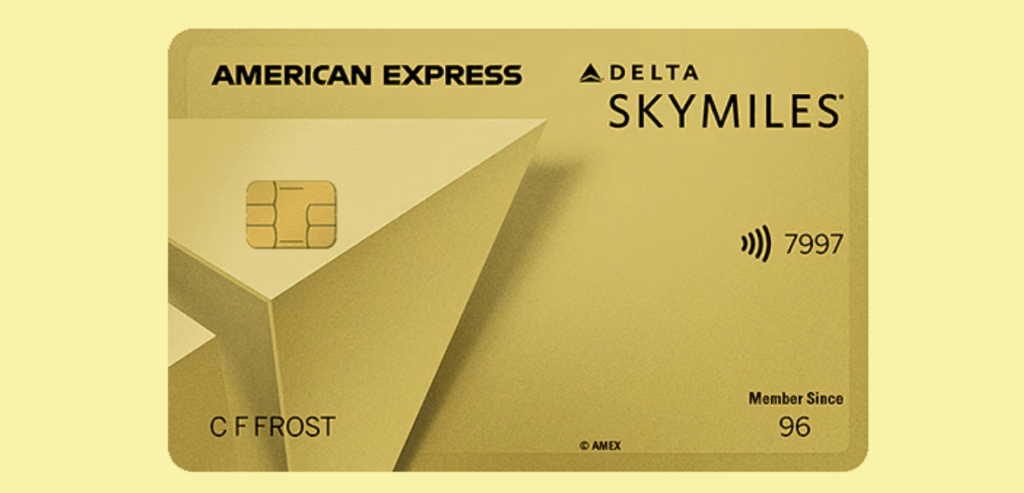
Image source
Pros
- First checked bag free for you and up to eight companions on the same reservation, potentially saving $35 per bag each way.
- Zone 1 priority boarding, granting early access to overhead bin space.
- 2X miles on Delta purchases, at U.S. supermarkets, and at restaurants worldwide (including takeout and delivery).
- 20% statement credit on eligible in-flight Delta purchases (Wi-Fi excluded).
- $200 annual Delta flight credit after spending $10,000 in a calendar year.
- Up to $100 Delta Stays credit per year on prepaid hotel or vacation rental bookings through Delta Stays.
Cons
- $150 annual fee after the first year (introductory fee waived).
- No introductory APR on purchases or balance transfers.
- No TSA PreCheck®/Global Entry credit, benefits reserved for higher-tier Delta AmEx cards.
- No Delta Sky Club® access or other lounge privileges.
- SkyMiles valuations can lag behind other major airline programs, reducing redemption value.
The Delta SkyMiles® Gold American Express Card is tailored to occasional Delta flyers who want core airline perks without a heavy fee burden. It waives the $150 annual fee in year one and delivers meaningful savings, especially if you check baggage or dine at restaurants while traveling. With its 2X-mile bonuses on Delta purchases, U.S. supermarket spending, and global dining (including delivery), this mid-tier card helps you build SkyMiles quickly even if you only fly a few times a year.
However, for Delta loyalists chasing elite status or airport lounge access, the Gold card’s benefits may feel limited. The lack of a TSA PreCheck/Global Entry credit, coupled with the absence of lounge access, pushes heavy travelers toward the Delta SkyMiles® Platinum or Reserve cards. Still, for moderate spenders—especially those who can leverage the $200 annual flight credit and $100 Delta Stays credit—the Gold card represents a compelling entry into Delta’s co-branded ecosystem.
Rewards and Additional Card Details
| Detail | Information |
| Annual Fee | $0 intro first year, then $150. |
| APR | Variable 20.24%–29.24% on purchases. |
| Welcome Bonus | Earn 50,000 bonus miles after $2,000 in purchases within the first 6 months. |
| Recommended Credit Score | Generally 690+ for approval; some approvals as low as 640. |
| Earning Rates | – 2X miles on Delta purchases, U.S. supermarkets, and restaurants worldwide (incl. takeout/delivery). – 1X mile on all other eligible purchases. |
| Travel Benefits | – Free first checked bag for you + 8 companions. – Zone 1 priority boarding. – 20% in-flight purchase credit (excl. Wi-Fi). |
| Additional Credits & Discounts | – $200 Delta flight credit after $10,000 spent annually. – Up to $100 Delta Stays credit per year. – 15% off award flights via TakeOff 15. |
| Fees & Other | – No foreign transaction fees; – Cash advance fee: $10 or 5% (whichever is greater); – Late/returned payment fees: up to $40. |
3. Chase Freedom Unlimited®

Image source
Pros
- Earn 5% cash back on travel purchased through Chase Travel℠, 3% on dining and drugstore purchases (including takeout and delivery), and 1.5% on all other purchases.
- Receive a $200 statement credit after spending $500 in the first three months from account opening.
- Enjoy 0% APR on purchases and balance transfers for 15 months (then 18.99%–28.49% variable).
- Keep all card benefits without paying any annual fee.
- Get Purchase Protection, Trip Cancellation & Interruption Insurance, Extended Warranty Protection, and 24/7 fraud monitoring.
- Redeem cash back at any time, in any amount, as statement credits, direct deposits, travel, gift cards, and more—and rewards never expire while your account is open.
Cons
- High variable APR after the intro period (18.99%–28.49%, up to 29.99% penalty APR).
- Foreign transaction fee of 3%, making it less ideal for international spending.
- Lower base rate on non-bonus spending (1.5% vs. 2% on some competitor cards).
- Fixed bonus categories only (no ability to choose or rotate), limiting flexibility.
- No premium travel perks such as airport lounge access or Global Entry/TSA PreCheck credits.
The Chase Freedom Unlimited® stands out as a best-in-class no-annual-fee cash back card, combining a straightforward rewards structure with valuable protections. It’s particularly attractive for those who want elevated returns on travel (5%), dining and drugstores (3%), and a solid 1.5% back on everything else—all without worrying about rotating categories or minimum redemptions.
While the card’s 0% intro APR for 15 months and $200 welcome bonus deliver immediate value, its long-term effectiveness hinges on paying off the balance monthly to avoid its higher post-intro APR. Additionally, the 3% foreign transaction fee and lack of premium travel benefits mean it’s best suited for domestic spenders focused on everyday rewards rather than globetrotters seeking lounge access or elite perks.
Rewards and Additional Card Details
| Detail | Information |
| Annual Fee | $0 |
| Intro Bonus | $200 statement credit after $500 spent in the first 3 months. |
| Intro APR | 0% on purchases & balance transfers for 15 months; then 18.99%–28.49% variable. |
| Regular APR | 18.99%–28.49% variable; up to 29.99% penalty APR. |
| Recommended Credit Score | Excellent–Good (670–850). |
| Earning Rates | – 5% on travel via Chase Travel℠. – 3% on dining & drugstores. – 1.5% on all other purchases. |
| Foreign Transaction Fee | 3% of each transaction in U.S. dollars. |
| Redemption Options | – No minimums; redeem as statement credit, direct deposit, travel, gift cards, and more. – Rewards never expire as long as the account is open. |
| Benefits & Protections | – Purchase Protection. – Trip Cancellation & Interruption Insurance. – Extended Warranty Protection; 24/7 fraud monitoring. |
4. Platinum Card® from AmEx
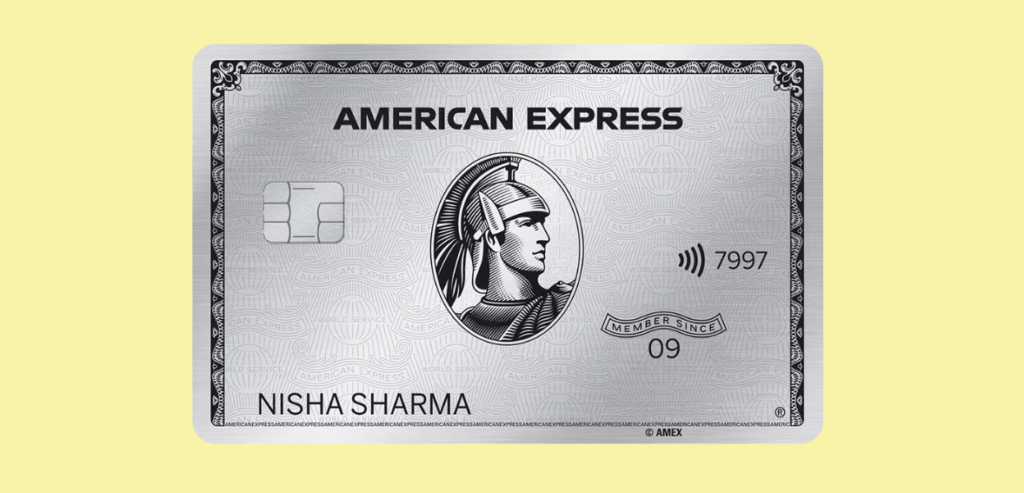
Image source
Pros
- Earn 80,000 Membership Rewards® points after spending $8,000 in the first 6 months of Card Membership.
- 5X points on flights booked directly with airlines or via American Express Travel® (up to $500,000 per calendar year) and 5X points on prepaid Fine Hotels + Resorts® or The Hotel Collection bookings.
- Complimentary access to over 1,400 airport lounges worldwide—including Centurion® Lounges, Delta Sky Clubs (10 visits/year, unlimited after $75K annual spend), Priority Pass™ Select, Plaza Premium, and more.
- Up to $1,500+ in annual credits, including $200 airline incidental fees, $200 hotel (Fine Hotels + Resorts/Hotel Collection), $240 digital entertainment, $200 Uber Cash, $199 CLEAR®, up to $120 GE/TSA PreCheck®, $100 Saks Fifth Avenue, $12.95/mo Walmart+, $300 Equinox, and $300 SoulCycle.
- Includes trip cancellation/interruption insurance, primary auto rental collision damage waiver, baggage delay coverage, trip delay reimbursement, purchase protection, extended warranty, and cell phone protection.
- Automatic Gold status with Hilton Honors and Marriott Bonvoy, Global Dining Access by Resy, 24/7 concierge service, and By Invitation Only® experiences.
Cons
- $695 — one of the steepest fees among mainstream travel cards.
- Maximizing $1,500+ in credits requires multiple enrollments and specific spending; unused credits represent lost value.
- Requires full payment each month or use of Plan It®/Pay Over Time® features, which may incur fees or interest.
- Just 1X point per dollar on all other purchases, making it less rewarding outside travel and hotels.
- Not as widely accepted internationally as Visa or Mastercard, which can be limited abroad.
The Platinum Card® from American Express is the flagship luxury travel card, offering an unmatched array of premium perks—but at a premium price. With its $695 annual fee, it’s designed for frequent travelers who can leverage its extensive lounge network, annual credits, and elite hotel status to offset costs.
Cardmembers enjoy 5X Membership Rewards® points on flights and high-end hotel bookings, up to $1,500+ in annual statement credits, and access to more than 1,400 lounges worldwide. Add in robust travel protections, concierge service, and transferable points to 20+ airline and hotel partners, and the Platinum Card delivers a best-in-class luxury travel experience—provided you use the benefits aggressively enough to justify the fee.
Rewards and Additional Card Details
| Detail | Information |
| Annual Fee | $695 |
| Welcome Offer | 80,000 Membership Rewards® points after $8,000 in purchases in the first 6 months. |
| Earning Rates | – 5X points on flights booked directly with airlines or via AmEx Travel (up to $500K/yr). – 5X points on prepaid Fine Hotels + Resorts® & The Hotel Collection. – 1X point on all other purchases. |
| Recommended Credit Score | Good to Excellent (690–850). |
| Travel Credits (Annual) | – $200 airline incidental fees – $200 hotel (Fine Hotels + Resorts/The Hotel Collection) – $240 digital entertainment – $200 Uber Cash – $199 CLEAR® – $120 Global Entry / $85 TSA PreCheck® (every 4/4.5 yrs) – $100 Saks Fifth Avenue – $12.95/mo Walmart+ – $300 Equinox – $300 SoulCycle. |
| Lounge Access | American Express Global Lounge Collection®: Centurion®, Delta Sky Club®, Priority Pass™ Select, Plaza Premium, Escape, Airspace, and more (10 Delta visits/yr, unlimited after $75K spend). |
| Travel Protections | Trip cancellation/interruption; Primary auto rental CDW; Baggage delay; Trip delay; Purchase protection; Extended warranty; Cell phone protection. |
| Foreign Transaction Fee | None. |
| Transfer Partners | 20+ airlines & hotels (e.g., Delta SkyMiles®, British Airways Executive Club, ANA, Hilton Honors, Marriott Bonvoy) at 1:1 (or better) ratios. |
5. Citi Strata Premier℠ Card
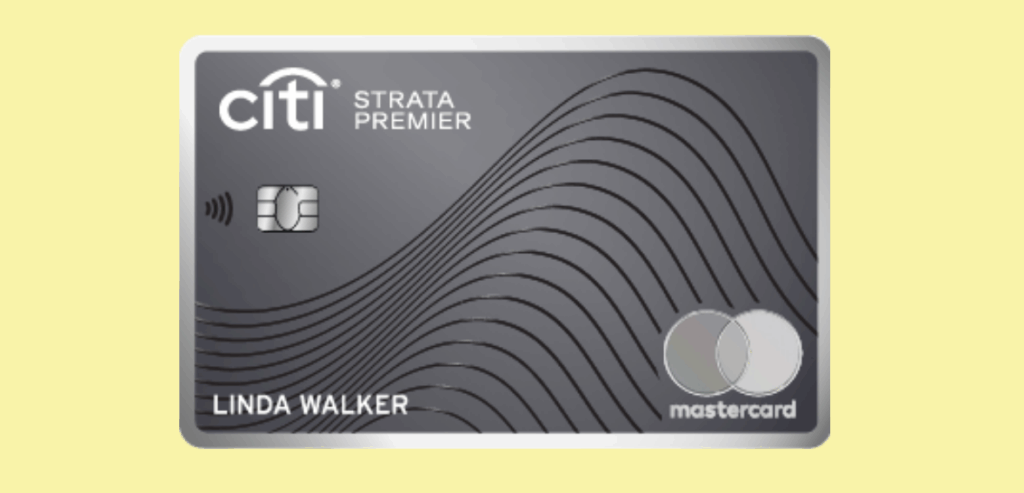
Image source
Pros
- Earn 60,000 ThankYou® Points after spending $4,000 in the first 3 months—redeemable for $600 in gift cards or travel rewards.
- 10 points/$1 on hotels, car rentals, and attractions booked via CitiTravel.com; 3 points/$1 on air travel, hotel purchases, restaurants, supermarkets, gas stations, and EV charging.
- $100 off a single hotel stay of $500+ (pre-tax/fees) once per calendar year when booked through CitiTravel.com.
- Redeem points for cash back or travel at 1¢/point, or transfer to 20+ airline and hotel partners for potential outsized value.
- Use internationally without paying the typical 3% surcharge.
- Transfer points 1:1 to partners like Air France-KLM, JetBlue TrueBlue, Singapore KrisFlyer, and more; some at enhanced ratios (e.g., Choice Privileges 1:2).
Cons
- It could outweigh benefits if credits and bonuses aren’t maximized.
- Top 10x earning applies only on CitiTravel.com, forfeiting direct loyalty perks.
- $100 savings only on stays of at least $500, limiting usefulness for shorter or cheaper stays.
- Stronger for international airlines; lacks some major U.S. carriers compared to rivals.
- Multiple earning rates and transfer ratios (1:1, 1:2, 5:1) can be confusing to optimize.
- Booking through a third-party portal may mean giving up elite status credits, free breakfast, or upgrades.
The Citi Strata Premier℠ Card strikes a balance between a robust travel card and a solid everyday rewards option. For a $95 annual fee, it delivers elevated earnings, notably 10 points per dollar on CitiTravel.com bookings and 3 points across key categories like dining, groceries, gas, and air travel, making it a versatile pick for both frequent and occasional travelers.
Beyond earning, its true strength lies in the ThankYou® Points ecosystem: points can be redeemed at a straightforward 1 cent each for cash or travel, or transferred to over 20 airline and hotel partners (including some enhanced transfer ratios), unlocking opportunities for premium redemptions. Cardholders should, however, plan to navigate the trade-offs of third-party bookings and manage the card’s multiple caps and ratios to fully realize its value.
Rewards and Additional Card Details
| Detail | Information |
| Annual Fee | $95 |
| Regular APR (Variable) | 20.24%–28.24% |
| Welcome Bonus | 60,000 bonus ThankYou® Points after $4,000 in the first 3 months (worth $600). |
| Recommended Credit Score | Good–Excellent (670–739). |
| Earning Structure | – 10× points on hotels, car rentals, and attractions via CitiTravel.com. – 3× points on air travel, hotel purchases, restaurants, supermarkets, gas stations, and EV charging. – 1× point on all other purchases. |
| Annual Hotel Credit | $100 off a $500+ hotel stay via CitiTravel.com, once per calendar year. |
| Point Redemption | – 1¢/point for travel through portal or statement credits – Transfers to 20+ partners at 1:1 (Choice 1:2, Accor 2:1, Leaders Club 5:1); 1,000-point minimum, 500,000-point cap. |
6. Wells Fargo Autograph Journey℠
Pros
- Earn 5X points on hotels, 4X points on airlines, and 3X points on restaurants and other travel, all without booking through a specific portal.
- Receive 60,000 bonus points after spending $4,000 in the first three months (worth $600 toward travel).
- Get a $50 statement credit each year on airline purchases of $50 or more.
- Covers up to $1,000 per claim (minus a $25 deductible) for damage or theft when you pay your wireless bill with the card.
- Includes up to $15,000 trip cancellation/interruption coverage, $3,000 lost baggage reimbursement, rental car collision damage waiver, and up to $1 million in common carrier accident insurance.
- Use the card abroad without incurring additional charges.
Cons
- Only six airline partners and one hotel partner, far fewer than many competitors.
- Requires a minimum $50 purchase and applies only once per calendar year.
- Lacks Priority Pass, Centurion, or other lounge memberships.
- High spend requirement for bonus: $4,000 in three months may be challenging for light spenders.
The Wells Fargo Autograph Journey℠ sits squarely in the middle of the pack for travel cards, offering top-tier earnings on accommodation and air travel without forcing you to book through a proprietary portal. Its a 60,000-point welcome offer and annual $50 airline credit help offset the $95 annual fee, while no foreign transaction fees and extensive travel protections make it a reliable companion for trips both domestic and international.
However, its limited transfer network (six airlines and one hotel) and the absence of premium perks like lounge access mean it may not satisfy the needs of hardcore points enthusiasts. For those who value straightforward earning and redemption, plus strong built-in protections, the Autograph Journey delivers solid value; just be prepared to maximize its rate tiers and statement credits to make the math work.
Rewards and Additional Card Details
| Feature | Details |
| Annual Fee | $95 |
| Welcome Bonus | 60,000 points after $4,000 in purchases within the first 3 months (worth $600). |
| Regular APR (Purchases/BT) | 20.24%, 25.24%, or 29.24% variable (based on creditworthiness). |
| Cash Advance APR | 29.99% variable |
| Foreign Transaction Fee | None. |
| Recommended Credit Score | Good to Excellent (690–850). |
| Earning Rates | – 5X points on hotels, – 4X points on airlines, – 3X points on restaurants & other travel, – 1X point on all other purchases. |
| Annual Credits | $50 airline statement credit on $50+ purchase. |
| Transfer Partners | Air France–KLM Flying Blue; Avianca LifeMiles; British Airways Executive Club; Aer Lingus AerClub; Iberia Plus; Virgin Atlantic Flying Club; Hotel: Choice Privileges (1:2 transfer ratio). |
| Travel Protections & Extras | – Trip cancellation/interruption (up to $15K), – Lost baggage reimbursement (up to $3K), – Auto rental collision damage waiver, – Common carrier accident insurance (up to $1M), – Roadside Dispatch 24/7, – Zero Liability Protection, – Visa Signature Concierge, – Contactless payments, – My Wells Fargo Deals. |
| Cell Phone Protection | Up to $1,000 per claim (max 2 claims/12 months; $25 deductible) when you pay your phone bill with the card. |
7. The New United Gateway℠ Card
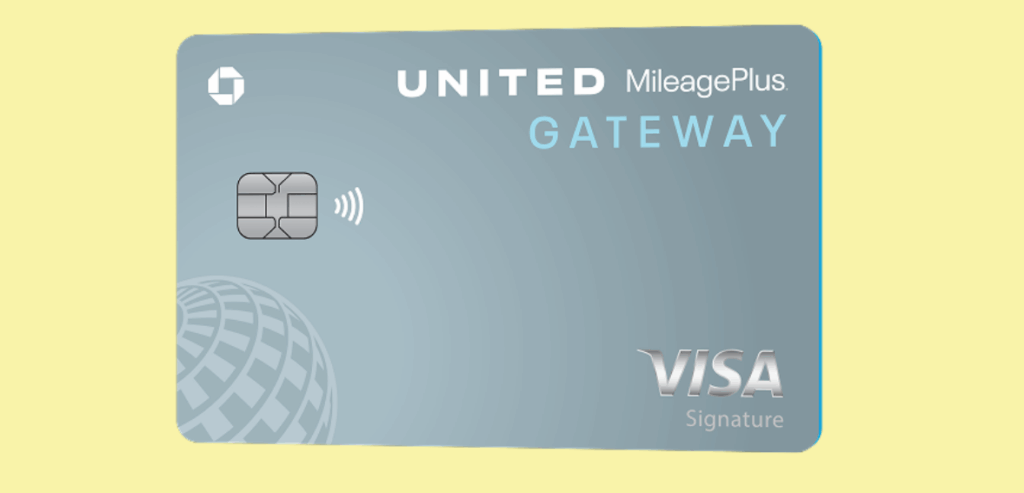
Image source
Pros
- No annual fee.
- Earn 30,000 bonus miles after spending $1,000 in the first 3 months.
- 2× miles on United® purchases, at gas stations, and on local transit & commuting (including rideshare, taxis, trains, tolls).
- 25% back as a statement credit on food, beverages, and Wi-Fi purchases on United-operated flights.
- Earn two complimentary checked bag certificates after spending $10,000 on the card in a calendar year (up to $80 value).
- Travel abroad without the usual 3% surcharge.
Cons
- 1× mile on all other purchases, limiting rewards on non-bonus spend.
- High spend threshold to unlock bag benefits ($10,000/year), which may not suit occasional spenders.
- No lounge access or priority boarding, unlike higher-tier United cards.
- Variable APR of 20.49%–28.99% after the 0% intro period.
- Requires good–excellent credit (typically 670–850) for approval.
- Limited travel perks beyond in-flight credits and baggage certificates.
The New United Gateway℠ Card is United Airlines’ no-annual-fee entry point into its co-branded credit card lineup. It appeals to both new and casual MileagePlus members by pairing a 30,000-mile welcome offer with a solid everyday earnings structure and key travel savings, most notably free checked bags (after a $10,000 annual spend) and 25% back on in-flight purchases.
While its 2× miles on United, gas, and transit spending competes well among no-fee airline cards, the 1× mile base rate on all other purchases and the high spend requirement for certain perks may leave frequent travelers seeking more premium benefits—like lounge access or automatic bag waivers—turning to higher-tier United cards. Still, for those who want to earn United miles without paying a fee, it remains one of the top no-annual-fee picks for June 2025.
Rewards and Additional Card Details
| Feature | Details |
| Annual Fee | $0 |
| Intro APR | 0% for 12 months on purchases. |
| Regular APR | 20.49%–28.99% variable; penalty APR up to 29.99%. |
| Foreign Transaction Fee | None. |
| Welcome Bonus | 30,000 bonus miles after $1,000 in purchases in the first 3 months. |
| Recommended Credit Score | Good–Excellent (670–850). |
| Earning Structure | – 2× miles on United® purchases, gas stations, local transit & commuting. – 1× mile on all other purchases. |
| In-Flight Credit | 25% back on United® inflight food, beverages, and Wi-Fi purchases. |
| Checked Bag Benefit | Two free checked bag certificates after $10,000 spend per calendar year (up to $80 value). |
| Travel Protections | Purchase protection, extended warranty, trip cancellation/interruption insurance, auto collision damage waiver. |
8. Alaska Airlines Visa Signature®
Pros
- Fly and redeem miles across 30 worldwide airline partners, including those in the oneworld® Alliance.
- Primary cardholders and up to six guests on the same reservation each get one complimentary checked bag on Alaska-operated flights.
- After spending $6,000 in a calendar year, receive Alaska’s Famous Companion Fare™—book one coach ticket and get a second for $99 + taxes.
- No foreign transaction fees.
- Unlimited 3 miles per $1 on Alaska purchases; 2 miles per $1 on eligible gas, EV charging, cable, streaming services, local transit and rideshare; 1 mile per $1 on all other purchases.
Cons
- The $6,000 annual spend threshold can be steep for some cardholders.
- Although expanding to Hawaiian Airlines soon, it currently applies only on Alaska-operated itineraries.
- Best suited for West Coast residents or those willing to connect through Alaska hubs; limited point-of-sale presence in the East Coast and Midwest.
- Lacks lounge access, TSA PreCheck®/Global Entry fee credits, and elite-qualifying miles outside of limited EQM offers.
The Alaska Airlines Visa Signature® card is a Bank of America co-branded offering tailored to Mileage Plan™ enthusiasts—especially those based on the West Coast. For an annual fee of $95, you unlock 60,000 bonus miles, a yearly Companion Fare™, free baggage for you and your party, and elevated earning rates on Alaska purchases and everyday travel-related spending.
Beyond Alaska’s domestic network, the card shines through its 30 global airline partners, enabling redemptions virtually worldwide. Its straightforward benefits—no foreign fees, priority boarding, and annual lounge credits—make it a compelling pick for those who fly Alaska often but don’t need ultra-premium perks like lounge access or statement credits for Global Entry.
Rewards and Additional Card Details
| Feature | Details |
| Annual Fee | $95 |
| Welcome Offer | 60,000 bonus miles + Famous Companion Fare™ ($99 + taxes) after $3,000 spent in the first 90 days – plus a 30% discount code for a future qualifying flight. |
| Purchase APR | 19.74%–29.24% variable*. |
| Balance Transfer Fee | 4% of each transfer amount. |
| Foreign Transaction Fee | None. |
| Recommended Credit Score | Good to Excellent (670–850). |
| Earning Rates | – 3 miles/ $1 on Alaska purchases. – 2 miles/ $1 on gas, EV charging, cable, streaming, local transit & rideshare. – 1 mile/ $1 on all other purchases. |
| Key Benefits | – Companion Fare™: $99 coach companion ticket after $6,000 spent. – Free checked bag: You + up to 6 guests. – Priority boarding; $100 off Lounge+ membership; 20% back on inflight purchases. |
9. New United℠ Explorer Card
Pros
- Free first checked bag for you and one companion on United flights (up to $160 value).
- Two United Club℠ one-time passes each anniversary year.
- 2× miles on United® purchases, dining, and hotel stays when booked directly with the hotel.
- Up to $120 statement credit for Global Entry, TSA PreCheck®, or NEXUS application fees every four years.
- $60 rideshare credit, $100 United Hotels credit, and a three-month Instacart+ membership.
- Priority group 2 boarding, primary auto rental CDW, trip cancellation/interruption insurance, and lost baggage reimbursement.
Cons
- Only 1× mile per dollar on non-bonus purchases.
- Requires $10,000 annual spend for the $100 travel credit.
- Dynamic award pricing can make redemption values unpredictable.
- Lacks complimentary Premier upgrades, full lounge membership, and ongoing TSA PreCheck access.
The New United℠ Explorer Card is United’s best-selling mid-tier card, offering fee-waived perks in year one and robust earnings on core travel and dining categories. With a 60,000-mile sign-up bonus after $3,000 in purchases within 3 months, and 2× miles on United purchases, dining, and hotel stays, it quickly offsets the $150 annual fee (post-intro) for most travelers.
Cardholders also enjoy a suite of travel enhancements—free checked bags, priority boarding, United Club passes, and an expanding array of statement credits (rideshare, hotels, Instacart+)—alongside strong travel protections. While it doesn’t deliver unlimited lounge access or automatic elite status credits, its blend of welcome value, ongoing benefits, and flexible redemptions makes it one of June 2025’s top airline cards for regular United flyers.
Rewards and Additional Card Details
| Detail | Information |
| Annual Fee | $0 intro first year; $150 thereafter. |
| Regular APR (Purchases) | 20.49%–28.99% variable; penalty APR up to 29.99%. |
| Welcome Bonus | 60,000 bonus miles after $3,000 in purchases within the first 3 months. |
| Foreign Transaction Fee | None. |
| Credit Score Needed | Good to Excellent (670–850). |
| Earning Structure | – 2× miles on United® purchases, dining, hotel stays (booked with hotel). – 1× mile on all other purchases. |
| Key Statement Credits | – $60 rideshare credit (e.g., Uber/Lyft). – $100 United Hotels credit annually. – 3-month complimentary Instacart+ membership + up to $120 Instacart credits. |
| Checked Bags & Boarding | – Free first checked bag for you + companion (up to $160). – Priority boarding (Group 2). |
| Lounge Access | Two one-time United Club℠ passes per anniversary year. |
| Travel Protections & Extras | – Up to $120 GE/TSA PreCheck®/NEXUS credit every 4–4.5 years. – Trip cancellation/interruption insurance; auto rental collision damage waiver; lost baggage reimbursement; purchase protection. |
Aeroplan® Credit Card
Pros
- Redeem points with 50+ airline partners, including Star Alliance carriers, greatly expanding travel options beyond Air Canada.
- Automatic 25K status for the remainder of the calendar year and the next, with benefits like priority airport services and complimentary upgrades.
- First checked bag is free for the primary cardholder and up to eight companions on the same reservation, saving up to $100 per bag each way.
- Includes rental car collision damage waiver, trip cancellation/interruption insurance, baggage delay coverage, trip delay reimbursement, and roadside assistance.
No foreign transaction fees.
Cons
- Best value when redeeming for Air Canada and Star Alliance flights; less versatile than general travel cards.
- Requires $15,000 in annual spend to retain 25K status beyond the initial period.
- Applicants who’ve opened five or more cards in the past 24 months may be ineligible.
Only 1× point per dollar on purchases outside bonus categories.
The Aeroplan® Credit Card from Chase is the go-to co-branded card for travelers who frequent Air Canada and the Star Alliance network. With a 60,000-point welcome bonus after $3,000 in spend within three months (plus an extra 10,000 points after your first annual fee payment), the card delivers immediate value for flying and everyday purchases alike. Cardholders also enjoy automatic 25K Elite Status, which unlocks priority airport services and complimentary upgrades—advantages typically reserved for high-tier flyers.
Beyond the sign-up offer, the card offers elevated earnings—3× points on Air Canada, dining, and groceries—and a suite of travel protections. Its free checked bag for you and up to eight companions, coupled with preferred pricing on reward flights and no foreign transaction fees, makes it a standout choice for North America–Canada itineraries. However, the card shines brightest when points are redeemed through Air Canada or its partners, so those seeking ultimate flexibility might pair it with a general travel rewards card.
Rewards and Additional Card Details
| Feature | Details |
| Annual Fee | $95 (not waived first year) |
| Welcome Bonus | 60,000 points after $3,000 spent in the first 3 months; plus 10,000 points after the first annual fee payment. |
| APR (Purchases & BT) | 20.49%–28.99% variable; balance transfer fee: $5 or 5% of transfer amount. |
| Foreign Transaction Fee | None. |
| Recommended Credit Score | Good to Excellent (700–749). |
| Earning Structure | – 3× points on Air Canada purchases, dining (incl. takeout/delivery), groceries. – 1× point on all other purchases. – 500 bonus points per $2,000 spent monthly (up to 1,500 points). |
| Elite Status | Automatic Aeroplan 25K status for the remainder of the year + next; maintain with $15,000 annual spend. |
| Travel Benefits & Protections | – Free first checked bag for you + 8 companions – Preferred pricing on reward flights – Trip cancellation/interruption insurance – Auto rental CDW – Baggage delay & trip delay coverage – Carbon offsets on Air Canada flights |
| Points Expiration | Points never expire as long as the account remains open. |
What Is a Travel Credit Card?
Travel-specific credit cards function like other rewards credit cards: you accumulate a form of currency through your spending, which can then be redeemed for various rewards. The type of currency earned—commonly referred to as “points” or “miles”—differs depending on the card. Airline-specific cards typically reward you with miles within the respective airline’s loyalty program, whereas hotel credit cards and general travel cards provide points. These points or miles can be exchanged for travel benefits and other types of rewards.
Typically, travel credit cards offer enhanced earning rates for spending on travel-related purchases. For instance, one card might award 2 points or miles for every dollar spent on airline purchases, while another might provide 3 points or miles per dollar. Depending on your spending habits, these rates can significantly impact how quickly you can accumulate rewards.
How Do Travel Credit Cards Work?
Travel credit cards allow you to earn rewards, typically points or miles, through everyday purchases like a standard credit card. Accumulating these rewards enables you to redeem them for travel-related expenses. These cards often provide various other opportunities to earn and redeem rewards.
It’s crucial to recognize that each travel credit card has a unique rewards program. While some cards might offer rewards exclusively on specific categories such as fuel, groceries, or dining, others allow you to earn miles on every purchase. The rate you earn rewards can also differ: some cards provide a uniform rate across all purchases, whereas others might offer enhanced rates for spending on travel-related items.
Redemption methods also vary; cards tied to specific airlines or hotels usually deposit rewards directly into your corresponding loyalty account, where you can use them within that specific program. Travel expenditures, including airline tickets, car rentals, and hotel stays, often yield bonus points, and some airline credit cards may offer better value when points are redeemed for flights.
Additionally, many airline credit cards feature options to use cash rewards back, book directly through travel portals, or transfer to travel partners, including those within airline alliances. Sign-up bonuses are another perk, frequently starting at $100 and potentially exceeding $500. While most airline credit cards charge an annual fee, some waive this fee for the first year.
Interest rates on these cards typically range from 15% to around 30%. Beyond earning flights, airline credit cards can enhance travel with benefits like complimentary checked baggage, priority boarding, seat upgrades, concierge services, and exclusive access to airport lounges.
Is an Airline Rewards Credit Card Right for You? Here’s What to Consider
Whether an airline rewards credit card is right for you involves examining your travel patterns, spending habits, and financial health. Here’s a checklist to help determine if an airline credit card is worth it:
- You Frequently Fly with a Specific Airline:
These cards are most beneficial if you consistently fly with the same airline. They are designed to reward loyalty to a specific carrier with perks such as free checked bags, priority boarding, and airport lounge access.
These benefits apply when you travel with the airline or its partners. If your travel tends to be with whatever airline offers the cheapest fare, you might find a general travel rewards card more useful due to its flexibility.
- You Have Good or Excellent Credit:
Airline credit cards usually demand a good to excellent credit score, typically 670 or above. If your score falls below this, consider improving your credit before applying for an airline rewards card.
- You Can Pay Off Your Balance Monthly:
The higher interest rates on these cards can negate the benefits if you carry a balance. Paying off your monthly balance is financially prudent to avoid costly interest charges. If this isn’t feasible, the interest might surpass the rewards gained.
- You Can Maximize the Card’s Perks:
Many airline cards offer additional benefits such as free checked luggage, priority boarding, and discounts on in-flight purchases. Frequent flyers who maximize these perks can often justify the annual fee.
For example, the savings from not paying for checked bags can cover the card’s cost, especially for those who travel regularly.
- You Are Comfortable Paying Annual Fees:
Airline cards come with a range of annual fees, some as high as $650 (as seen above), which can be steep if you only fly occasionally.
The fee can be worthwhile if you’re a frequent traveler who regularly uses the card’s perks, such as lounge access or companion tickets. Conversely, a lower-fee or no-fee card might be more appropriate for infrequent flyers.
How Do You Compare and Select the Right Airline Credit Card for Yourself?
When selecting an airline credit card, the primary consideration should be how well it aligns with your travel habits. If you frequently fly with the same airline, an airline-specific card could be highly advantageous, offering free checked bags and priority boarding that can outweigh the annual fee. For instance, a free checked bag can save you around $60 on a round-trip flight, a substantial saving for regular travelers.
A card affiliated with that carrier is ideal for those loyal to a particular airline. It maximizes your rewards and enhances your travel experience with benefits such as elite status credits or priority services. On the other hand, if your travel involves multiple airlines or if you’re typically searching for the best fares, a general travel credit card might be more appropriate. These cards offer the flexibility to earn and redeem points on various travel expenses, including different airlines and hotels.
When evaluating airline-specific cards, consider the value of perks like airport lounge access and assess if the higher annual fee for such benefits is justifiable for your travel needs. Premium cards offering extensive lounge access might charge fees exceeding $600 but can be worth the cost for travelers who value comfort and amenities at the airport. Conversely, if you do not need extensive perks, opting for a basic card with lower fees might be more suitable, though it may lack benefits like free luggage.
The right airline card depends on your travel frequency, the value you place on specific perks, and your willingness to pay higher fees for enhanced benefits. Carefully weigh these aspects to ensure you choose a card that offers the best value for your travel patterns.
Conclusion
Choosing the right airline credit card depends on your travel frequency, spending habits, and the specific benefits you value most. For those looking for well-rounded rewards and flexible redemptions, the Chase Sapphire Preferred® offers strong value with manageable fees. If you frequently fly with Delta, the Delta SkyMiles® Gold AmEx Card delivers useful travel perks without a steep annual cost in the first year. For everyday spenders who occasionally travel, the Chase Freedom Unlimited® provides consistent rewards and a long introductory APR period. And for seasoned travelers who can take full advantage of premium benefits, the Platinum Card® from American Express delivers top-tier travel experiences, though at a high cost.
Each of these cards serves a different kind of traveler, so it’s important to weigh the annual fees against the potential value you can get from points, miles, credits, and protections. By selecting a card that fits your lifestyle and travel goals, you can make the most of your spending while enjoying meaningful savings and convenience throughout your journeys.